Taplio for Agencies Review 2026: Is It Worth Paying For?
Affiliate disclosure: TopTrustReview may earn a commission if you buy through links in this review, at no extra cost to you. I’ve based this evaluation on Taplio’s official homepage, pricing page, and agency positioning, and I’ll separate verified product facts from practical agency interpretation.
If you manage LinkedIn content, engagement, or lead generation for clients, taplio for agencies is worth a serious look. Its strongest value is not just AI writing; it is the combination of client workspaces, account separation, scheduling, analytics, and reporting in a workflow built specifically around LinkedIn.
Official website · Latest pricing & offers
Quick verdict: Is Taplio worth it for agencies?
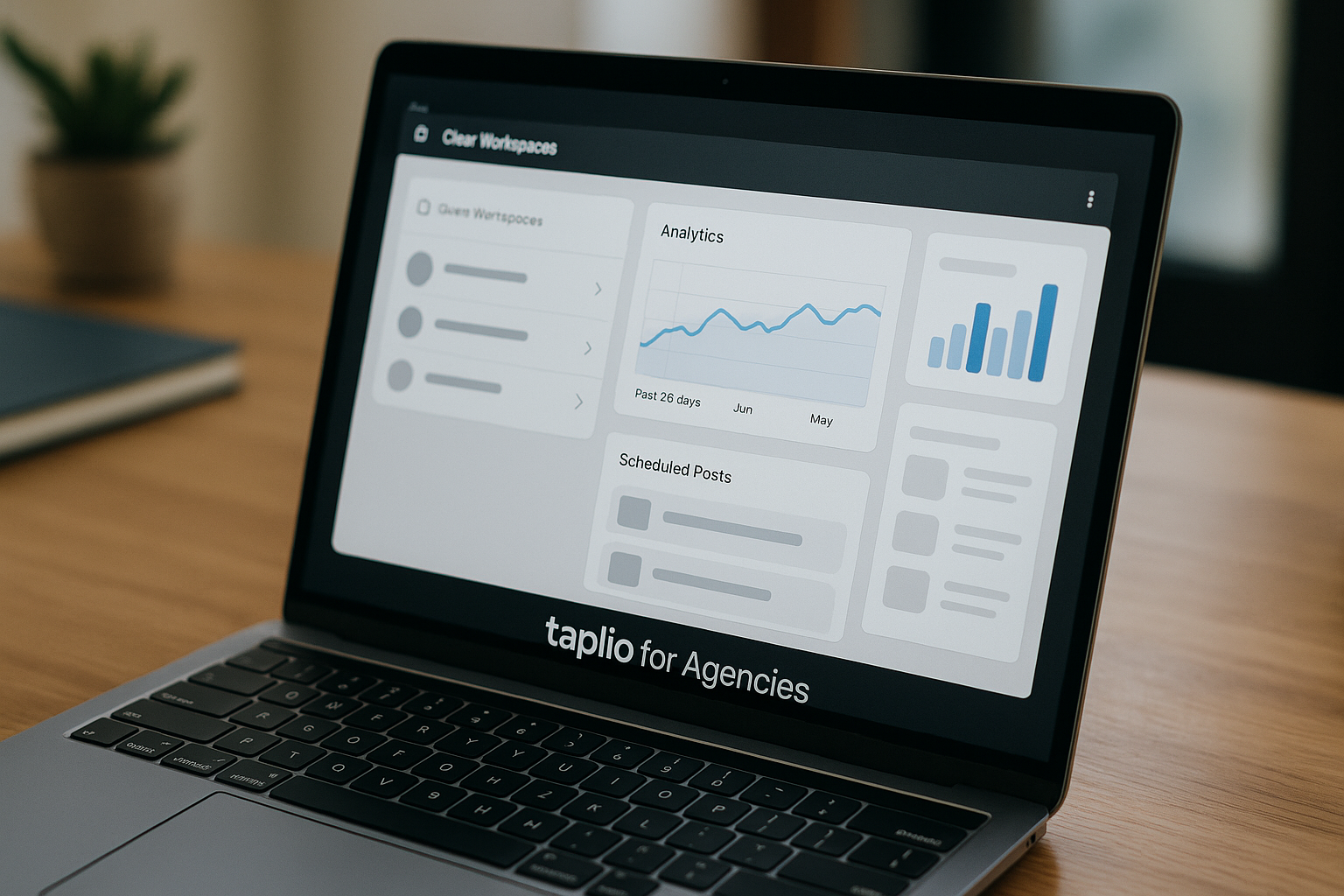
Taplio is most compelling for agencies that manage multiple LinkedIn accounts and want to reduce operational friction. Based on the official agency messaging, Taplio supports managing every client from one place, with one workspace per client, per-client permissions, and one-click switching without logging out or juggling browser profiles.
That makes taplio for agencies different from a basic post scheduler. It is positioned as a LinkedIn growth platform for teams that need to create content, schedule posts, engage with the right people, handle warm leads, and report results to clients.
Taplio for agencies: best fit scenarios
The best fit is an agency already selling LinkedIn as a meaningful channel. That could be executive personal branding, founder-led content, B2B demand generation, lead generation, or thought leadership management.
In those cases, taplio for agencies can help centralize the work that often gets scattered across Google Docs, spreadsheets, native LinkedIn scheduling, shared passwords, and manual screenshots for reporting. The value increases as the number of active clients grows.
It is also attractive for agencies that need cleaner handoffs between strategists, writers, account managers, and clients. Separate workspaces and permissions reduce the risk of posting to the wrong account or mixing up client assets.
When it may not be worth it
Taplio may be harder to justify if LinkedIn is only a small part of your client offering. If you manage one or two clients, post infrequently, or mainly need a simple multi-channel scheduler, you may not fully use what Taplio is built to do.
It is also not positioned as a universal social media management suite. If your agency’s core work is spread evenly across Instagram, TikTok, Facebook, Pinterest, X, and LinkedIn, a broader tool may still be necessary.
Bottom-line recommendation
My verdict: taplio for agencies is worth considering when LinkedIn is a revenue-driving service line and your team needs multi-client control, faster content production, clearer reporting, and fewer account-switching headaches.
If that describes your agency, you can review the current offer through this affiliate link: explore Taplio here. If you only need occasional LinkedIn scheduling, start by comparing it against simpler tools before committing.
What Taplio is and how agencies use it
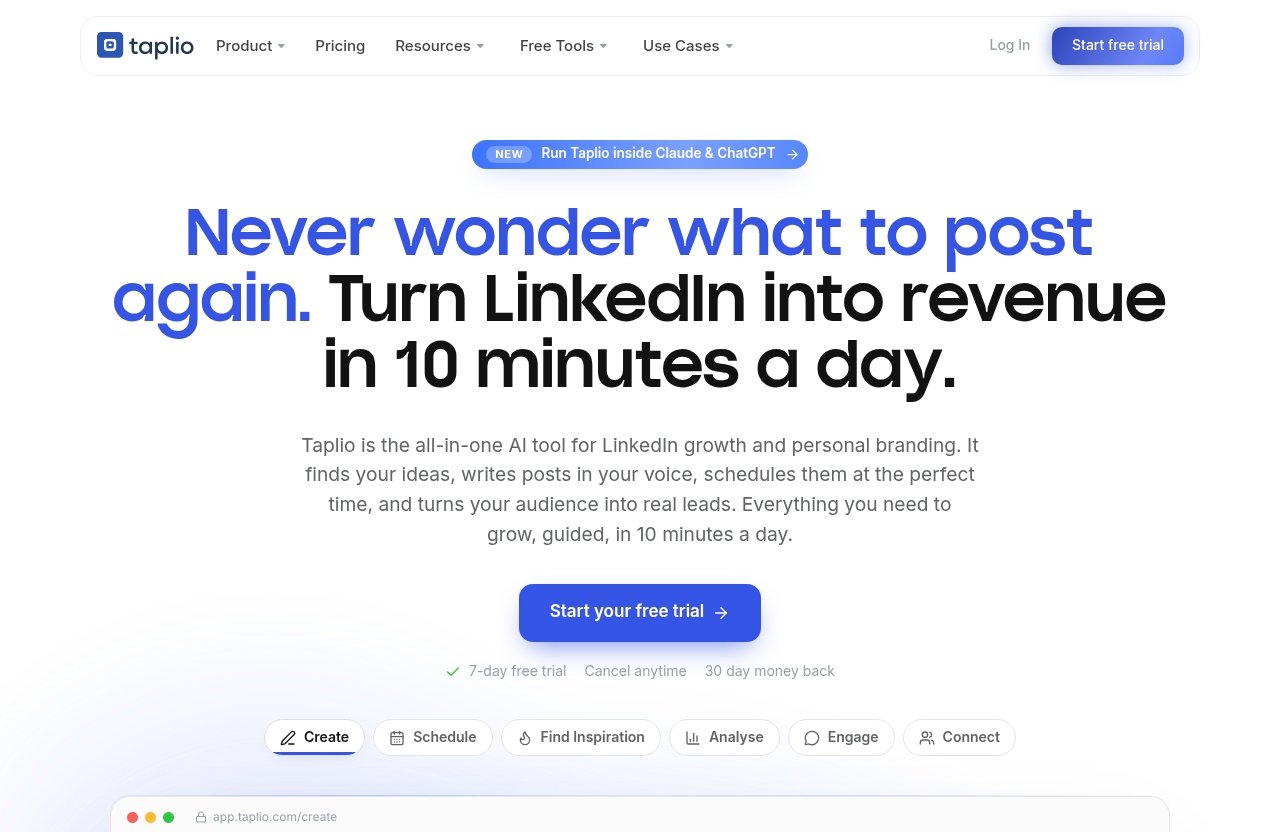
Taplio’s official homepage describes it as an AI tool to grow on LinkedIn in 10 minutes a day. For an individual creator, that means faster ideation, writing, scheduling, engagement, and analytics.
For an agency, the use case is broader. Taplio for agencies is about turning LinkedIn management into a repeatable client delivery system instead of a collection of manual tasks.
Taplio’s core LinkedIn workflow
Taplio’s verified core features include creating ideas and writing posts, finding inspiration from viral posts worth remixing, scheduling posts at the best times automatically, analyzing what works, and doubling down on it.
It also supports turning content into swipeable carousels, engaging by showing up on the right people’s posts, and auto-connecting and sending DMs to warm leads. These are important because most LinkedIn retainers involve more than publishing text posts.
In practical agency terms, the workflow looks like this:
| Agency task | Taplio capability that supports it |
|---|---|
| Content ideation | Viral post inspiration and AI-assisted idea generation |
| Writing | AI content creation and client voice support |
| Scheduling | Automatic scheduling at best times |
| Creative formats | Carousel creation |
| Engagement | Finding the right posts and people to engage with |
| Lead handling | Auto-connect and DM workflows for warm leads |
| Reporting | Analytics and client-facing performance review |
Why agencies look at it instead of generic schedulers
A generic scheduler can be useful, but LinkedIn-heavy agencies often need more than a calendar. They need content ideas, writing support, engagement workflows, LinkedIn analytics, and client reporting.
That is where taplio for agencies becomes more commercially interesting. Its agency page specifically emphasizes managing multiple LinkedIn accounts from a single dashboard, one workspace per client, and reports that help retainers get renewed.
Those are agency pain points, not just creator pain points. The value is less about “can this publish a post?” and more about “can this make LinkedIn delivery easier to sell, fulfill, and prove?”
The Taplio for agencies use case in one sentence
Taplio helps agencies manage LinkedIn growth for multiple clients from separate workspaces, with AI-assisted content creation, scheduling, engagement, lead workflows, and reporting in one LinkedIn-focused system.
Taplio features that matter most for agencies
This is the core of the taplio for agencies review: whether its features solve real operational problems for multi-client teams. From what Taplio officially highlights, its agency value centers on separation, speed, consistency, and reporting.
One workspace per client
Taplio’s agency page states that agencies can use one workspace per client. This matters because client separation is one of the biggest operational risks in social media management.
When client workspaces are separate, your team can keep content calendars, analytics, permissions, and workflows organized by account. For an agency managing several founders or executives, that structure can prevent expensive mistakes.
This is one of the clearest reasons taplio for agencies may be more useful than a lightweight personal LinkedIn tool. It is designed around multiple accounts, not just one creator’s feed.
Separate calendars, analytics, and permissions
Taplio’s agency positioning includes separate workspaces with per-client permissions. That is important when different team members need different levels of access.
For example, a strategist might need analytics access, a writer might need drafting access, and an account manager might coordinate reviews. Client-specific permissions help agencies avoid overexposing accounts or sharing access informally.
While Taplio’s public pages do not provide every implementation detail, the official message is clear: the platform is designed to separate client operations. For agencies, that is a workflow and risk-management benefit.
One-click switching without browser profiles
The official agency page says Taplio supports one-click switching with no logout or browser profiles. This is a meaningful practical benefit.
Many agencies manage LinkedIn accounts through awkward browser setups, password managers, shared devices, or manual login/logout routines. That creates friction and increases the chance of posting or engaging from the wrong profile.
With taplio for agencies, the appeal is that account switching becomes part of the platform workflow. Less context switching usually means fewer mistakes and faster delivery.
AI writing in each client’s voice
Taplio’s agency page states that its AI writes in each client’s voice. This is especially relevant for personal-branding agencies and executive content teams.
The difficult part of LinkedIn ghostwriting is not simply producing text. It is producing content that sounds like the client, reflects their point of view, and stays consistent over time.
AI voice alignment can help speed up first drafts, hooks, rewrites, and post variations. Agencies should still maintain editorial review, but taplio for agencies may reduce the blank-page time that often slows down content production.
Scheduling posts at best times
Taplio’s homepage and feature messaging include scheduling posts at the best times automatically. For agencies, scheduling is not just convenience; it is delivery reliability.
A team managing several clients cannot rely on manual posting reminders every day. A centralized scheduling workflow helps maintain cadence and reduces the account manager’s daily administrative load.
This can also make approvals easier. Once content is reviewed, it can move into the calendar instead of sitting in a document waiting for someone to remember to publish it.
Analytics and reporting clients actually understand
Taplio’s agency page mentions reports that get retainers renewed, and its core feature set includes analyzing what is working and doubling down. For agencies, reporting is directly tied to retention.
Clients usually do not want a data dump. They want to understand what content performed, what topics resonated, and what the agency will do next.
Taplio client reporting can support that conversation by giving the agency a clearer way to review LinkedIn activity and performance. I would still recommend adding strategic commentary, because reports alone rarely renew retainers; interpretation does.
Connection and DM workflows for lead generation
Taplio’s verified features include auto-connect and DM workflows for warm leads. This is especially relevant for lead-gen and demand-gen agencies that use LinkedIn beyond content publishing.
The key phrase here is “warm leads.” Agencies should be careful not to turn LinkedIn outreach into generic spam, because that can damage a client’s brand.
Used thoughtfully, taplio linkedin automation may help teams follow up with relevant prospects and keep lead-handling tasks from becoming fully manual. The commercial value depends on targeting quality, messaging quality, and how closely the agency manages the process.
Automation and AI assistant access via MCP
Taplio’s official feature list says users can run Taplio from Claude, ChatGPT, or any MCP-enabled LLM. This is a more advanced capability, but it matters for agencies building AI-assisted workflows.
In practical terms, this suggests Taplio can fit into broader AI work habits instead of forcing every task to start inside one interface. For teams already using AI assistants for research, ideation, or drafting, that may reduce friction.
I would treat this as a workflow enhancer rather than the main buying reason. The stronger agency case remains multi-client LinkedIn management, workspaces, content production, scheduling, engagement, and reporting.
Agency workflow breakdown: from onboarding to reporting
A useful way to evaluate taplio for agencies is to walk through a normal client lifecycle. The question is not whether Taplio has attractive features in isolation, but whether those features make fulfillment smoother.
Client onboarding and setup speed
During onboarding, agencies usually gather brand voice notes, positioning, target audience details, content pillars, offers, and access requirements. This process can become messy if everything lives across emails and shared documents.
With one workspace per client, Taplio gives the agency a clearer place to structure each account’s LinkedIn operation. This can reduce confusion during setup and help team members understand which client they are working on.
It may also reduce password sharing and browser-profile juggling. Since Taplio highlights one-click switching without logout or browser profiles, agencies can move closer to a more controlled account-management process.
Content ideation and approval
Content ideation is often where agency margins suffer. Writers and strategists spend time searching for angles, reviewing what has worked before, and turning client expertise into posts.
Taplio’s inspiration discovery, AI-assisted writing, and analysis features can support that process. Agencies can use viral post inspiration as a starting point for remixing ideas, then adapt the content to the client’s voice and market.
For approvals, Taplio can help keep planned LinkedIn content connected to the calendar and workspace. The official pages do not confirm every approval workflow detail, so I would not assume it replaces all client review processes, but it can reduce the gap between drafting and scheduling.
Publishing cadence
Consistent publishing is a major part of LinkedIn growth. It is also one of the hardest things to maintain across several clients.
Because Taplio supports scheduling posts at the best times automatically, agencies can prepare content in batches and avoid daily manual posting. This is useful for account managers who need to keep multiple calendars moving.
For taplio for agency clients, the operational benefit is predictability. Clients are less likely to experience missed publishing days because one person forgot to log in at the right time.
Engagement and prospecting
LinkedIn results usually depend on more than publishing. Engagement with the right people, thoughtful comments, and relevant connection activity all contribute to visibility and relationship-building.
Taplio’s official features include engaging by showing up on the right people’s posts and auto-connecting and sending DMs to warm leads. For agencies, this can create a more structured engagement workflow instead of relying on ad hoc manual activity.
That said, human judgment still matters. Agencies should avoid over-automation and make sure engagement reflects the client’s actual voice, priorities, and reputation risk.
Monthly reporting
Monthly reporting is where agencies prove value. A good report should show what happened, why it matters, and what will change next month.
Taplio’s analytics and agency reporting positioning can help agencies make LinkedIn performance easier to explain. This supports retention because clients can see activity, patterns, and progress more clearly.
For taplio for agencies, reporting is one of the most commercially important features. If it helps an account manager prepare a clearer performance conversation, it can support client confidence even without promising specific growth numbers.
ROI analysis for agencies
The ROI question is simple: does the subscription save enough time or improve enough client delivery to justify the cost? Because official pages do not provide agency-specific performance guarantees, the best approach is to evaluate operational return.
Where the time savings come from
The clearest time savings come from writing, ideation, scheduling, account switching, engagement management, and reporting. These are repeated tasks, so even modest improvements can matter across multiple clients.
For example, AI-assisted drafts may reduce the time needed to create first versions of posts. One-click switching may reduce the friction of moving between accounts. Reporting tools may reduce manual data collection.
This is why taplio for agencies becomes more attractive as client volume rises. The same workflow gains repeat across every account you manage.
What Taplio can improve operationally
Taplio can improve operational consistency. Instead of running client LinkedIn work through disconnected documents, calendars, spreadsheets, and browser sessions, agencies can centralize more of the work.
It can also reduce avoidable errors. Separate client workspaces and permissions are especially valuable when multiple team members touch multiple accounts.
The platform may also help standardize service delivery. That matters if your agency wants to scale LinkedIn management without reinventing the workflow for every client.
How to think about breakeven
Do not evaluate taplio pricing only as a software expense. Evaluate it against the cost of labor, mistakes, missed posts, delayed reports, and client churn risk.
A simple framework is:
| ROI factor | Question to ask |
|---|---|
| Client volume | How many active LinkedIn clients will use it? |
| Posting frequency | How often do you create and schedule posts? |
| Team involvement | How many people need access or handoffs? |
| Reporting workload | How much time goes into monthly reporting? |
| Lead-gen use | Do you manage engagement, connections, or DMs? |
| Retention value | Would clearer reporting help renew retainers? |
If the saved time and improved client delivery exceed the subscription cost, taplio for agencies can make financial sense. If not, a lighter tool may be enough.
Best-value agency scenarios
The best-value scenarios are agencies with several active LinkedIn clients, recurring content retainers, and a team-based delivery model. These agencies feel the pain of scattered workflows every week.
Taplio also fits agencies that sell LinkedIn outcomes as a strategic service, not just post scheduling. If content, engagement, and reporting are part of the retainer, the platform’s feature set is easier to justify.
Smaller teams can still benefit, but they should be honest about usage. If you will only schedule a few posts per month, the ROI case is weaker.
Official website · Latest pricing & offers
Pricing: what Taplio costs and how to evaluate the spend
Pricing should be assessed carefully because agencies often add tools faster than they remove them. The question is whether Taplio replaces enough manual work or disconnected software to deserve a place in your stack.
Official pricing page summary
Taplio’s official pricing page confirms that plans start from $39/month. It also confirms a 7-day free trial and a 30-day money-back guarantee.
I am intentionally not listing unverified tiers, limits, or agency-specific pricing details here. For a current view of Taplio pricing and availability, you can check the official offer through this Taplio link.
Free trial and money-back context
The 7-day free trial is useful for agencies, but only if you test it with a realistic workflow. Do not simply open the dashboard and browse features.
Use the trial to set up at least one representative client workspace, test ideation, draft posts, review scheduling, inspect analytics, and see how account switching feels. If possible, involve the person who will actually manage daily delivery.
The 30-day money-back guarantee reduces buying risk, but it should not replace proper evaluation. Agencies should decide what success looks like before subscribing.
How agencies should calculate value per client
The cleanest way to evaluate taplio for agencies is to divide the software cost by the number of clients who will actively benefit. Then compare that amount with the value of time saved and retention support.
For example, if Taplio helps your team write faster, schedule more reliably, and prepare clearer reports, the value may be spread across several retainers. If only one client uses it lightly, the cost is harder to justify.
The real question is not “Is Taplio cheap?” It is “Does Taplio improve delivery enough to protect or expand profitable LinkedIn retainers?”
Pros and cons for agencies
No tool is a perfect fit for every agency. Here is the balanced view after evaluating Taplio’s official product positioning.
Pros
- Built specifically around LinkedIn growth rather than generic social posting.
- Supports managing multiple LinkedIn accounts from a single dashboard.
- Official agency messaging includes one workspace per client.
- Separate workspaces and per-client permissions can reduce operational risk.
- One-click switching avoids constant logout cycles and browser profiles.
- AI writing in each client’s voice can speed up content production.
- Scheduling at best times supports a more consistent publishing cadence.
- Analytics and reporting can make client review conversations clearer.
- Engagement and warm lead workflows may support LinkedIn-based demand generation.
- MCP-enabled LLM access may fit advanced AI-assisted agency workflows.
For multi-client teams, taplio for agencies is strongest when these benefits combine. One feature alone may not justify the tool, but the workflow consolidation can.
Cons
- It is LinkedIn-specialized, so it may not replace a broader multi-platform social media tool.
- Smaller agencies with only one or two light LinkedIn clients may not use enough of the platform.
- Agencies still need human strategy, editing, approvals, and judgment.
- The official public pricing facts confirm plans from $39/month, but agencies should check the current page for the latest details.
- Lead and DM automation should be used carefully to protect client reputation.
The main limitation is not that Taplio lacks focus. It is that the focus may be too narrow for agencies whose clients need broad social management more than LinkedIn depth.
Who should look elsewhere
Look elsewhere if your agency mainly needs a universal content calendar for many social networks. Taplio may still be useful for LinkedIn, but it is not positioned as an all-purpose social operating system.
You may also want taplio alternatives if your workflow is mostly approval management, design production, or cross-channel campaign planning. In those cases, LinkedIn-specific AI and engagement features may be less central.
Taplio vs a generic social media tool for agencies
The comparison between taplio vs social media management tools depends on what your agency sells. If LinkedIn is one channel among many, a generic tool may be sufficient. If LinkedIn is the core service, specialization can matter.
Why LinkedIn specialization matters
LinkedIn has its own content patterns, audience behavior, personal-brand dynamics, and engagement norms. A post that works on LinkedIn is not simply a repurposed caption from another platform.
Taplio’s feature set reflects that specialization: viral post inspiration, AI-assisted LinkedIn writing, carousels, best-time scheduling, analytics, engagement, and warm lead workflows. For agencies selling LinkedIn outcomes, those features are directly relevant.
This is why taplio linkedin management for agencies can be more compelling than a general scheduler. It is designed around the work LinkedIn agencies actually repeat.
What generic tools may miss
Generic tools may handle scheduling well, but they may not provide LinkedIn-specific ideation, voice-based AI writing, lead workflows, or agency workspaces built around LinkedIn accounts.
That does not make generic tools bad. Many agencies need broad scheduling, approvals, asset management, and reporting across several platforms.
The risk is choosing a generic tool when your real pain is LinkedIn execution. If your team spends most of its time writing LinkedIn posts, switching between client profiles, engaging with prospects, and preparing LinkedIn reports, Taplio’s specialization may be more useful.
When specialization wins
Specialization wins when depth matters more than breadth. For example, an executive-branding agency managing ten LinkedIn profiles likely has different needs than a social team scheduling occasional posts across five networks.
In that case, taplio for agencies can support the full LinkedIn workflow from ideas to reporting. A generic tool may still sit elsewhere in the stack, but Taplio can become the LinkedIn operating layer.
Best agencies to use Taplio
Taplio is not equally valuable for every agency type. It fits best where LinkedIn is tied to client visibility, authority, lead generation, or founder-led growth.
LinkedIn-focused content agencies
LinkedIn content agencies are the most obvious fit. They need repeatable workflows for ideation, writing, scheduling, analytics, and reporting.
For these teams, taplio for agencies can help standardize delivery across clients. The ability to separate workspaces and switch accounts easily addresses everyday operational friction.
Lead-gen and demand-gen agencies
Lead-gen and demand-gen agencies may value Taplio’s engagement, connection, and DM-related features. The official product facts include auto-connect and DMs to warm leads, which can support LinkedIn prospecting workflows.
The key is responsible use. Agencies should pair automation with strong targeting, thoughtful messaging, and human oversight.
If LinkedIn outreach is part of your offer, taplio linkedin automation may help reduce manual effort while keeping activity more organized.
Fractional marketing teams
Fractional marketers often manage content and demand generation for multiple clients at once. They need speed, structure, and clean account separation.
A taplio multi-client workspace can be useful when one operator is balancing several client voices, calendars, and reporting cycles. This is especially relevant for solo consultants or small teams acting like an outsourced marketing department.
Personal-branding agencies managing executives
Personal-branding agencies managing founders, consultants, executives, or subject-matter experts are a strong fit. These clients need content that sounds like them, not generic AI posts.
Taplio’s agency messaging around AI writing in each client’s voice is important here. If the tool helps produce better first drafts and maintain separate client workspaces, it can improve both speed and quality control.
For this segment, taplio for agencies is less about automation for its own sake and more about producing consistent executive content at scale.
Final recommendation
Taplio is a strong fit for agencies that treat LinkedIn as a serious client service. Its agency-specific positioning around client workspaces, permissions, one-click switching, AI voice support, analytics, and reporting addresses real multi-client management problems.
Worth it for the right agency
Taplio for agencies is worth paying for if you manage several LinkedIn clients and your team spends meaningful time on ideation, writing, scheduling, engagement, lead handling, and reporting.
The strongest business case is workflow consolidation. If Taplio reduces manual switching, scattered documents, missed posts, and reporting friction, it can support both margin and retention.
Not a universal buy
Taplio is not a universal buy for every agency. If you mostly need broad social scheduling across many platforms, a generic social media management tool may be enough.
It is also not a substitute for strategy. Agencies still need to define positioning, approve sensitive content, manage client relationships, and interpret analytics.
Decision checklist
Before buying, ask:
- Do we manage multiple active LinkedIn clients?
- Is LinkedIn important enough to our retainers to justify a specialized tool?
- Do we need separate client workspaces and permissions?
- Are we wasting time switching accounts or using browser profiles?
- Would AI-assisted writing help us create better first drafts faster?
- Do we need clearer monthly LinkedIn reporting?
- Are engagement, connections, or warm DMs part of our service?
- Will enough clients use the platform to justify the subscription?
If most answers are yes, taplio for agencies deserves a place on your shortlist. If most answers are no, start with a simpler or broader tool and revisit Taplio when LinkedIn becomes a larger part of your agency delivery.
Official website · Latest pricing & offers
FAQ
Who is Taplio best for?
Taplio is best for creators, consultants, and agencies that need consistent LinkedIn posting, AI-assisted ideation, scheduling, engagement, and analytics.
For agencies, the best fit is multi-client LinkedIn management. If you need separate workspaces, faster content creation, account switching, and clearer client reporting, taplio for agencies is especially relevant.
How much does Taplio cost?
According to Taplio’s official pricing page, plans start from $39/month. The official pricing page also confirms a 7-day free trial and a 30-day money-back guarantee.
I would not assume additional pricing details without checking Taplio’s current official pricing page, because plan structures can change.
What are the best social media management tools for agencies?
The best social media management tools for agencies are usually the ones that support multi-client workspaces, scheduling, approvals, analytics, reporting, and team collaboration.
For LinkedIn-heavy agencies, a specialized tool can be stronger than a generic scheduler. Taplio focuses specifically on LinkedIn growth workflows, which may make it a better fit when LinkedIn is the agency’s main client service.
What are some good alternatives to Taplio?
Good taplio alternatives depend on what you need. If you want broad scheduling across many social platforms, look at general social media management tools. If you need deeper approval workflows, campaign planning, or asset management, consider tools built around those priorities.
If your main need is LinkedIn content creation, scheduling, engagement, and reporting for multiple clients, Taplio remains one of the more directly relevant options to evaluate.
Related Reading
- Taplio LinkedIn Lead Generation: 7 Ways to Use It in 2026
- Klap for Agencies Review: Can It Speed Up Client Content Delivery?
- Syllaby for Marketing Agencies: Practical Use Cases for Scalable Client Video Production in 2026
References
- LinkedIn management for agencies: every client, one place
- Taplio | AI tool to grow on LinkedIn in 10 min/day
- Taplio Pricing – Plans from $39/mo