
Trustindex Review 2026: Honest Verdict
If you are comparing review marketing tools, this trustindex review is designed to answer the buying question directly: is Trustindex worth using for your business website in 2026?
Trustindex is not a public review marketplace in the same category as Trustpilot. Instead, it is a review marketing platform built to help businesses collect, manage, and display customer feedback through widgets, badges, certificates, review pages, and social-feed displays. Its core appeal is turning reviews you already have—or new reviews you collect—into more visible on-site trust signals.
Affiliate disclosure: TopTrustReview may earn a commission if you purchase through our affiliate link, at no additional cost to you. This does not affect our assessment or the price you pay.
Official website · Latest pricing & offers
Trustindex Review 2026: Quick Verdict
Short answer: is Trustindex worth it?
This trustindex review finds that Trustindex can be a sensible purchase for businesses that want to make customer reviews more visible on their own website. Its verified feature set is broad: review widgets, social feed widgets, review collection tools, badges, certificates, management functions, and review summary pages are all part of the platform’s stated offering.
The biggest reason to consider it is practical. Instead of leaving reviews scattered across Google, Facebook, Tripadvisor, ecommerce marketplaces, or booking sites, you can display selected social proof where potential customers make decisions.
That said, buyers should not purchase based on feature lists alone. Current pricing was not verifiable from the official pricing-page capture available for this research, so you should confirm the live offer, billing terms, integrations, and site compatibility before subscribing.
Who should consider it first
Trustindex is most compelling for local businesses, service providers, online shops, hospitality businesses, agencies, and WordPress site owners that already receive customer feedback on third-party platforms. It is also relevant for marketers looking to add review proof to landing pages, product pages, email signatures, and conversion-focused site sections.
Businesses specifically interested in displaying trustindex google reviews alongside reviews from other supported sources may find the platform particularly useful. The official website lists widget examples for Google, Facebook, Tripadvisor, Booking.com, Airbnb, Yelp, Expedia, eBay, Etsy, AliExpress, Hotels.com, Houzz, and OpenTable.
Who should probably skip it
A trustindex review should also recognize when the product is not the right match. Skip or pause if you do not have a website where embedded reviews would matter, if your main goal is building a public review profile rather than improving your own site, or if you need pricing certainty before evaluating tools.
You may also want a simpler option if you only need one static testimonial section and do not plan to collect, manage, or repurpose reviews. Trustindex has a wider review-marketing toolkit than some small businesses need.
What Trustindex Is and How It Works
Core purpose of the platform
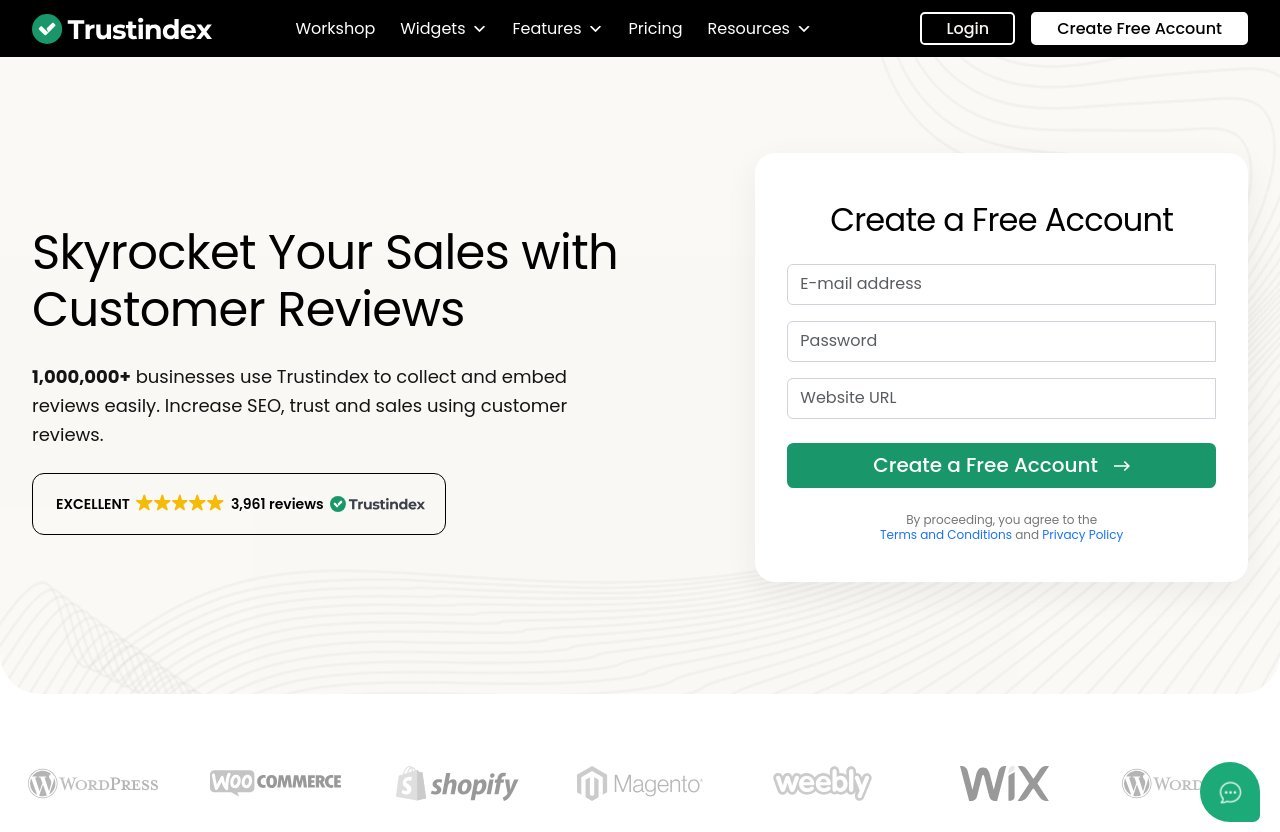
At its core, Trustindex says it helps businesses collect and embed reviews easily and use customer feedback to increase SEO, trust, and sales. This trustindex review interprets that positioning as review marketing rather than review hosting alone.
The product is designed to bring customer feedback into places that your business controls, especially your website. Rather than expecting visitors to leave your site and search for reputation signals elsewhere, the goal is to put those signals near service descriptions, booking forms, checkout pages, and calls to action.
Trustindex says that more than 1,000,000 businesses use the platform. That is a company claim, not an independent measure of customer satisfaction, but it does indicate that the product is aimed at a broad small-business and marketing audience.
How review widgets and feed widgets work
Review widgets are visual website elements that display customer feedback from supported review sources. A restaurant, for example, could use a Tripadvisor or Google Reviews widget; an ecommerce brand might display Etsy, eBay, or AliExpress reviews; and a hotel could emphasize Booking.com or Hotels.com feedback.
Feed widgets serve a related but different purpose. Trustindex lists Instagram, Google, TikTok, YouTube, Twitter, and Pinterest feed widget options, which can help businesses add fresh-looking social content alongside reviews.
In a typical trustindex review use case, widgets are not meant to replace your review source. They are a way to present existing feedback more prominently on your own pages.
Where Trustindex fits in a review marketing stack
Trustindex sits between the places where customers leave feedback and the channels where your business wants to use that feedback. It can support review collection, review display, reputation management, and trust-building assets in one ecosystem.
Search-result context suggests that Trustindex may pull in reviews from a large number of platforms, sometimes described as 130+ sources. Because that figure is not directly confirmed in the official homepage facts provided here, treat it as supporting context only and verify source availability for your specific platform before buying.
For many businesses, the relevant stack looks like this:
| Business need | Trustindex feature area |
|---|---|
| Show reviews on a website | Review widgets |
| Display social content | Feed widgets |
| Ask customers for reviews | Email campaigns, QR codes, NFC cards |
| Improve trust near conversion points | Badges, certificates, email signature widgets |
| Organize or respond to reviews | Management, tagging, ChatGPT reply feature |
| Create a shareable review destination | Review summary page |
Trustindex Features Breakdown
Review widgets and supported review sources
The central feature in this trustindex review is the review widget library. Trustindex officially lists examples for Google Reviews, Facebook Reviews, Tripadvisor Reviews, Booking.com Reviews, Airbnb Reviews, Yelp Reviews, Expedia Reviews, eBay Reviews, Etsy Reviews, AliExpress Reviews, Hotels.com Reviews, Houzz Reviews, and OpenTable Reviews.
That range is useful because review sources vary dramatically by industry. A local contractor may prioritize Google and Facebook; a travel operator may need Tripadvisor and Booking.com; while an online seller may care more about Etsy or eBay.
Before subscribing, confirm that the exact platform you rely on is supported in the format you need. A listed review source does not automatically tell us which layouts, update behavior, filtering options, or plan access apply.
Feed widgets and social content displays
Trustindex also offers feed widgets for Instagram, Google, TikTok, YouTube, Twitter, and Pinterest. These are not the same as review widgets, but they can complement them.
For example, a salon could combine customer reviews with an Instagram feed showing recent work. A retailer could pair product feedback with short-form TikTok content or a YouTube gallery. The practical benefit is a more current, visually active page without relying only on written testimonials.
This part of the platform may matter most to brands that regularly publish social content. If your social accounts are inactive, feed widgets are unlikely to be a deciding factor.
Review collection tools: email campaigns, QR codes, NFC cards, integrations
A strong trustindex review should not focus only on display. Trustindex’s verified collection features include Email Campaigns, QR Codes, NFC Cards, Integrations, and Trustindex Reviews.
These tools address a common operational problem: many satisfied customers never leave feedback unless the business asks at the right time. A QR code can work at a reception desk, in packaging, or on a printed receipt. NFC cards may be useful in face-to-face settings, while email campaigns are more appropriate after a completed service or delivery.
The important buying consideration is workflow. Choose Trustindex if you have a defined moment when customers are likely to respond. Simply having review-request tools will not solve poor timing, weak customer service, or a lack of permission to contact buyers.
Display tools: badges, certificates, email signature widget, review image generator
Trustindex lists several display-oriented features beyond standard widgets: Review widgets, an Email Signature Widget, Review Image Generator, Top Rated Badges, and a Trustindex Verified Badge.
These assets can be useful for distributing social proof beyond one web page. An email signature widget could surface reputation signals in sales or support correspondence, while review images may be useful for social posts or other marketing materials.
Trustindex also lists Review Certificate options for visitors, businesses, and trustmarks. The right use of these assets is as supporting evidence, not as a substitute for clear pricing, product information, returns policies, or responsive customer service.
Review management: tagging, summary page, ChatGPT replies
On the management side, Trustindex lists Manage Your Reviews, Reply to Reviews with ChatGPT, and Review Tagging. These features may help teams organize feedback themes and respond more efficiently.
The ChatGPT reply option deserves sensible caution. AI-assisted responses can save time, but businesses should review every reply before publishing it. A generic answer to a detailed complaint can sound automated and may create more frustration than it solves.
Trustindex’s Review Summary Page includes Offers and Rich snippets. Rich snippets are an area where buyers should avoid assumptions: eligibility and appearance in search results are ultimately determined by search engines, not guaranteed by a widget provider. This trustindex review recommends treating structured review presentation as a possible SEO-supporting feature, not a promise of rankings or stars in search.
Trustindex Pricing in 2026
Verified pricing information from official sources
The most responsible answer on trustindex price is that current pricing could not be verified from the official pricing-page capture used for this review. That capture returned a 404, so there is no reliable basis here to state subscription prices, plan names, billing intervals, trial terms, feature limits, or agency pricing.
This is important because pricing is a major part of product fit. A review tool can be useful, but its value changes significantly depending on how many websites, locations, review sources, or management features your business needs.
What is and isn’t publicly confirmed
The official homepage confirms the product areas described above, including widgets, collection tools, badges, review management, and summary pages. It does not provide verified price details in the information available for this article.
You may see searches for a trustindex free plan or a free version of the product. Do not assume a particular free tier, trial, or feature allowance applies unless the live Trustindex website explicitly shows it at the time you evaluate the service.
Similarly, avoid relying on old forum posts, cached pages, or third-party listicles for current cost information. Software pricing and plan availability can change quickly.
How to evaluate value without guessing
Before purchasing after reading this trustindex review, open the current pricing or checkout flow and answer these questions:
- Which review sources and widget types are included in the plan you are considering?
- Are review collection tools included, limited, or separately priced?
- Does the plan fit your number of websites, locations, or client accounts?
- Are the payment terms monthly, annual, or both?
- Can you test the widget on your website before committing?
- What happens to displayed widgets if you cancel or downgrade?
- Does the product offer suitable support for your technical setup?
If the live pricing information is unclear, contact Trustindex directly before payment. That is a reasonable due-diligence step, especially for agencies and multi-location businesses.
Official website · Latest pricing & offers
Trustindex Pros and Cons
Biggest strengths
This trustindex review identifies several meaningful strengths based on the official feature set:
Pros
- Broad range of listed review widget examples across local, travel, hospitality, and ecommerce platforms.
- Review collection options that include email campaigns, QR codes, NFC cards, and integrations.
- Social feed widgets for businesses that want to combine reviews with current content.
- Multiple display formats, including badges, certificates, email signatures, and review images.
- Review-management tools such as tagging and AI-assisted reply functionality.
- A clear use case for businesses that want to add social proof to websites they control.
- Features relevant to both individual businesses and marketers managing client sites.
The practical advantage is consolidation. Instead of treating reviews as something that exists only on third-party profiles, Trustindex gives businesses tools to repurpose them across customer touchpoints.
Potential drawbacks
The biggest drawback is pricing uncertainty in the available source material. This trustindex review cannot responsibly compare value against competitors without confirmed current pricing and plan limits.
Other potential drawbacks are more strategic than product-specific. A widget can enhance an existing website, but it cannot create credibility where reviews are sparse, outdated, or mixed. It also does not replace a well-maintained Google Business Profile, marketplace reputation, or public review presence.
Businesses with highly customized websites may need to validate design compatibility and page performance before rolling widgets out sitewide. That is especially relevant when adding multiple visual elements to mobile pages.
Red flags or limitations to know before buying
Searches for trustindex review complaints often revolve around practical implementation questions rather than a single universally documented issue. Potential buyers should distinguish between an individual setup problem and a platform-wide defect.
Some searchers and user discussions raise concerns about mobile appearance, WordPress performance, or widget behavior. Those comments are anecdotal feedback, not verified proof that the product is slow or unreliable for all users. Still, they are good reasons to test widgets on mobile devices and measure their effect on page speed before deploying them broadly.
Also remember the distinction between an embedded review tool and a public review platform. A Trustindex widget may show reviews on your site, but it does not automatically create the independent public visibility associated with a large review directory.
Trustindex vs Alternatives: What Makes It Different?
Trustindex vs public review platforms
A trustindex review comparison is easiest when you separate two different jobs. Public review platforms host reviews on their own domains and provide a destination where consumers can research brands. Trustindex is primarily positioned as a way to collect, manage, and display reviews and social proof on websites and related marketing channels.
Trustpilot is a separate public review platform, for example. A business may use a public review platform to establish an independently visible profile, while using Trustindex-style widgets to show feedback directly on its own pages.
Neither model is automatically better. The right choice depends on whether your immediate objective is public discovery, on-site conversion, review collection, or a combination of all three.
When Trustindex is the better fit
Trustindex is likely the better fit when you already have reviews on sources that matter to your customers and want to feature them prominently on your website. It can also suit businesses that need a collection workflow using email, QR codes, or NFC cards.
It may be particularly useful for teams that want visual review assets, social feeds, and management features without assembling separate tools for each job. Agencies may also see value if they need to add review-focused elements to client sites, subject to confirming current account and licensing details.
When a competitor-style public profile may be better
A public-profile platform may be more suitable if your central objective is being found and evaluated on an independent review destination. It can also be the better choice when third-party neutrality is more important to your audience than embedding reviews on your own website.
The right answer may be both. This trustindex review does not treat website widgets and public profiles as mutually exclusive; they solve different trust problems.
Who Trustindex Is Best For
Local businesses
Local businesses are a natural audience for Trustindex, particularly those that depend on Google and Facebook reviews. Service providers such as clinics, tradespeople, salons, restaurants, and professional firms can use review displays near booking or contact prompts.
QR codes and NFC cards may also fit in-person interactions well. The main requirement is that the business has a consistent review-request process and enough recent feedback to display credibly.
Ecommerce stores
For ecommerce sellers, Trustindex may be helpful when marketplace reviews are part of the brand’s reputation. The official list includes widgets for Etsy, eBay, and AliExpress, while display tools can potentially support trust around product collections, checkout-adjacent content, or customer-service pages.
A balanced trustindex review should note that conversion gains are never guaranteed. Test placement carefully, avoid cluttering product pages, and make sure the review source is meaningful to the shopper.
Agencies and marketers
Agencies and marketers may benefit from the range of display and collection tools, especially when working with local businesses that need social proof but lack the capacity to build custom review sections.
However, agencies should verify current pricing, client-account permissions, support terms, and implementation workflows before standardizing on the platform. Do not assume that one subscription covers a specific number of clients or domains without confirmation.
WordPress site owners
The trustindex wordpress plugin search term is common because WordPress is a major use case for review widgets. WordPress site owners should pay particular attention to theme compatibility, caching, mobile display, and page performance.
Test before placing widgets in headers, navigation areas, or every page template. A single well-positioned review section is often more useful than multiple widgets competing for attention.
Setup, Ease of Use, and Support
Getting started
Trustindex positions itself as a tool for collecting and embedding reviews easily. Based on the official feature categories, the basic setup process logically begins with choosing a review source or collection method, selecting a display asset, and adding it to a relevant business channel.
That said, this trustindex review cannot verify every onboarding step, dashboard workflow, or setup time from the source material provided. Buyers should inspect the current documentation, demo materials, and integration options before treating setup as effortless.
Searches related to trustindex login may lead users to account access pages, but login availability alone does not indicate how intuitive the product will be for a specific website stack.
Embedding on a website
Implementation requirements can vary depending on the website platform and the widget you choose. The sensible approach is to start with one high-intent page, such as a homepage, service page, product collection, or contact page.
Check desktop and mobile layouts, test loading behavior, and confirm that the widget does not interfere with forms, cookie consent tools, or other scripts. If you use WordPress, test in a staging environment when possible.
Support and onboarding experience
The available official facts confirm product feature areas, not specific support response times, onboarding guarantees, or service-level commitments. As a result, no claim about support quality would be reliable here.
Before paying, review the live support resources and determine whether the available help matches your needs. Agencies, ecommerce brands, and businesses with custom sites should ask pre-sales questions about their exact setup rather than relying on generic compatibility claims.
Real Complaints and Common Questions from Searchers
Is Trustindex trustworthy?
Trustindex appears to be a legitimate review marketing tool with a defined official product offering and a stated user base of more than 1,000,000 businesses. However, a trustworthy product for one business is not automatically the right purchase for another.
The best way to evaluate it is to verify the current pricing, read current terms, confirm source compatibility, and test how widgets appear on your own website. A trustindex honest review should always separate legitimacy from fit.
Does it work well on mobile?
Mobile performance should be tested rather than assumed. Search-related discussion sometimes mentions display or speed concerns, but those reports are anecdotal and may depend on a specific site theme, widget configuration, connection speed, or the number of scripts already running.
Before publishing a widget, inspect it on common phone sizes and measure key pages. Keep only the review elements that make the page clearer and more persuasive.
Is it slow or buggy for some users?
No software tool is immune to individual implementation issues. Some trustindex reviews reddit searches and other community-style discussions may surface complaints, but informal posts do not establish how common a problem is or whether it remains unresolved.
Use those discussions as prompts for testing, not as final evidence. Check the current product documentation, run a limited implementation, and contact support with specific technical questions before a large rollout.
Official website · Latest pricing & offers
FAQ
Can you trust Trustindex?
Trustindex appears to be a legitimate review marketing platform that helps businesses collect, manage, and display customer reviews. Its official homepage identifies tools for review widgets, feed widgets, review collection, display assets, certificates, review management, and review summary pages.
Still, trust should be earned through verification. Confirm live pricing, supported sources, website compatibility, and relevant terms before purchasing. This trustindex review recommends testing the platform on a limited set of pages before making it central to your marketing stack.
How much does Trustindex cost?
Current pricing could not be verified from the official pricing-page capture available for this article because that page returned a 404. Therefore, it would be inaccurate to publish plan names, subscription prices, or feature limits here.
Check the live Trustindex site or sales flow for the current trustindex price before buying. Make sure the plan includes the review sources, collection features, websites, and support level you need.
What is Trustindex used for?
Trustindex is used to collect, manage, and display customer reviews. Its verified feature areas include review widgets, feed widgets, email campaigns, QR codes, NFC cards, integrations, badges, certificates, review image generation, review tagging, AI-assisted replies, and review summary pages.
In practical terms, it helps businesses turn customer feedback into visible trust signals across websites and other marketing touchpoints.
Are Trustpilot reviews reliable?
Trustpilot is a separate public review platform, not the same product as Trustindex. Whether any reviews are reliable depends on context: review volume, recency, detail, response patterns, platform moderation practices, and whether the reviewer appears to be describing a real transaction.
Use public reviews as one research input rather than the only decision factor. Comparing reviews across multiple sources and checking the business’s own policies usually provides a more balanced picture.
Final Verdict: Should You Buy Trustindex?
Best-case scenario for buying
The strongest case for buying is a business that already has valuable customer feedback and wants to use it more effectively on its own website. If you need review widgets, collection tools, badges, social-feed displays, and light review-management functions in one platform, Trustindex has a verified feature set worth evaluating.
For businesses ready to confirm pricing and test compatibility, you can review the current offer through Trustindex. Check the live terms carefully before subscribing.
Best-case scenario for skipping
Skip Trustindex if you do not have enough reviews to showcase, do not need website-based social proof, or primarily want an independent public review destination. You may also want to wait if the live pricing structure does not clearly match your number of locations, sites, or client accounts.
Businesses with performance-sensitive websites should test cautiously before adding multiple widgets. Review displays should improve trust, not slow down the path to conversion.
Bottom-line recommendation
This trustindex review concludes that Trustindex is worth considering for small businesses, ecommerce sellers, agencies, marketers, and WordPress site owners who want to collect and showcase reviews on properties they control.
Its strengths are the breadth of verified review, feed, collection, display, and management features. Its key limitation for buyers researching in 2026 is the lack of verifiable pricing information in the provided official-source capture. Confirm current costs and compatibility first, then buy if the platform’s review-marketing workflow fits your business better than a simple testimonial section or a public-review-only strategy.
Related Reading
References
- Trustindex.io Official Homepage
- Trustindex vs Trustpilot (2026): Honest comparison
- Trustindex ‑ Google Reviews – Shopify App Store
- Trustindex Knowledge Base