Best Bonfire Alternatives: Practical Picks for Merch Sellers in 2026
Selling custom merchandise should not require carrying inventory, coordinating shipments, or answering every delivery question yourself. That is why many sellers compare the best bonfire alternatives in 2026: they want better storefront control, different fulfillment options, potentially stronger margins, or tools that fit a creator, nonprofit, or established brand more closely.
Affiliate disclosure: TopTrustReview may earn a commission if you sign up through certain links in this article, including our Bonfire partner link. This does not affect our recommendations. We evaluate Bonfire and competing custom merch platforms based on practical buyer needs, not hype.
Official website · Latest pricing & offers
Best Bonfire Alternatives in 2026: Quick Verdict
The right platform depends less on which service is “best” overall and more on how you sell. Bonfire remains appealing for straightforward, managed merch fundraising and simple launches. However, several Bonfire competitors give sellers more flexibility around stores, product selection, brand presentation, or fulfillment workflows.
| Platform | Best For | Main Reason to Consider It | Consider Carefully If |
|---|---|---|---|
| Printful | Branded stores and quality-focused sellers | Strong ecosystem for connecting a store and selling branded products | You want the simplest campaign-only launch |
| Printify | Sellers seeking supplier choice | Broad provider network and catalog flexibility | You prefer one centralized fulfillment experience |
| Spring | Social-first creators | Simple creator merchandising and audience-facing sales | You need a highly independent storefront |
| Fourthwall | Creators building a branded business | Creator-oriented storefront and audience monetization tools | You only need a short fundraiser campaign |
| Gooten | Growing ecommerce operations | Fulfillment infrastructure for businesses scaling product ranges | You want a beginner-first design experience |
| Teelaunch | Store owners wanting product variety | Ecommerce-oriented print-on-demand workflow | You need built-in fundraising mechanics |
| Zazzle | Designers and marketplace discovery | Marketplace exposure and customizable product options | You need complete control over customer relationships |
Who each alternative is best for
Printful is often one of the strongest best print on demand alternatives to Bonfire for sellers who already use Shopify, Etsy, WooCommerce, or another ecommerce platform. Printify is worth considering for merchants who want to compare different print providers and build a more flexible sourcing approach.
Fourthwall is especially relevant to creators who want their merch operation to feel like an extension of their brand. Spring can suit creators who want a simpler route to selling products to an existing social audience, while Gooten and Teelaunch are more naturally aligned with independent ecommerce stores.
When Bonfire is still the better choice
Bonfire is still a sensible choice when simplicity matters more than granular store management. Its official site says it handles printing, shipping, and customer support, allowing sellers to focus on their campaign, community, or cause rather than operations.
It also promotes a free starting point, no inventory requirements, and an easy-to-use setup. For a nonprofit, school group, community campaign, or first-time seller, those benefits can outweigh the extra control offered by other best bonfire alternatives.
How we evaluated fees, support, fulfillment, and branding
We looked at the questions serious buyers ask before moving their merch business: Can I protect my margin? Can I present a professional brand? Who handles customer issues? Can I sell internationally or connect to my existing store?
Because pricing, provider availability, and product catalogs change, this guide avoids unsupported fee comparisons. Before choosing among Bonfire alternatives 2026, review each provider’s official pricing, product, support, and policy pages for the current details that affect your business.
What Bonfire Does Well — and Where Buyers Look for Alternatives
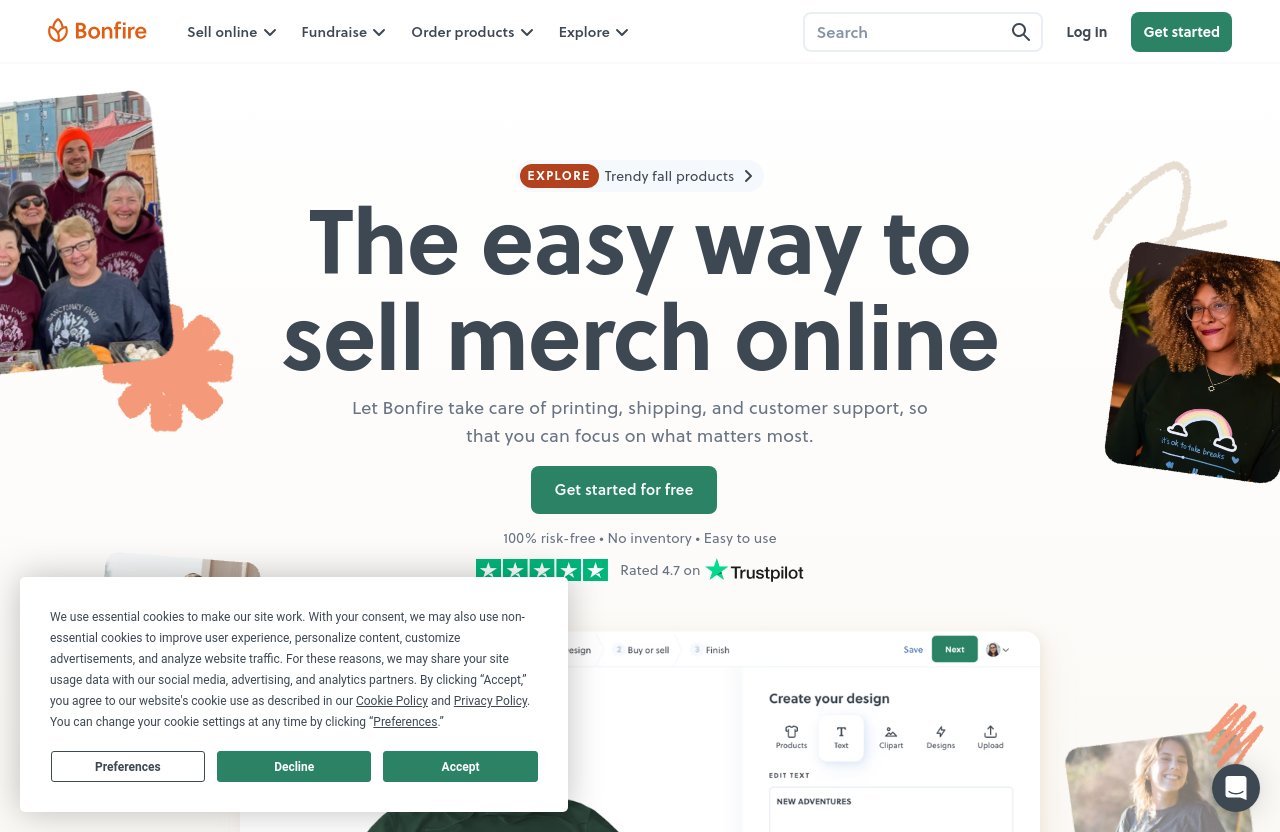
Bonfire positions itself as “The easy way to sell merch online,” and the appeal is clear. It is built to remove common operational barriers for people who have an audience, a message, or a fundraising goal but do not want to manage production and logistics.
Bonfire’s core strengths
Bonfire’s verified strengths center on convenience. The platform says it handles printing, shipping, and customer support, while sellers can launch without buying inventory upfront. Its homepage also highlights “100% risk-free,” “No inventory,” and “Easy to use.”
For buyers who value social proof, Bonfire displays a 4.7 Trustpilot rating on its homepage. It also offers “Get started for free” and “Start designing,” which lowers the barrier for testing a design or campaign before making a large operational commitment.
Bonfire has also highlighted Bonfire Pro Beta, described as a way to open a fully branded custom merch store in minutes without inventory or integrations. That makes Bonfire more flexible than the traditional campaign-only perception some shoppers may have.
Common reasons users switch
People rarely leave a platform because it is universally bad. More often, they outgrow its workflow or need a different business model. A seller may want deeper control over their storefront, an expanded product catalog, direct integration with an existing ecommerce setup, or the ability to choose among fulfillment providers.
Other sellers compare best bonfire alternatives because their priorities change. A creator may want memberships and audience tools, while a growing brand may need better control of the customer journey, email strategy, analytics, product merchandising, and fulfillment configuration.
What to compare before you choose
Do not make a decision based on a single product’s apparent profit alone. Compare the full selling experience: base product costs, shipping, transaction charges, payment processing, refunds, fulfillment regions, customer service responsibility, and how much time you will spend managing the store.
Bonfire’s official pricing URL was not available at the time of review, so it would be inappropriate to quote plan prices, commission rates, or package details. The same discipline applies to alternatives: verify current official terms before you launch or migrate.
How to Choose the Right Bonfire Alternative
A thoughtful comparison starts with your selling model. There is a major difference between a one-time awareness campaign and an always-on branded store with dozens of products.
Lowest fees vs best margins
“Lowest fees” can be misleading because the cheapest-looking option may require more work, carry higher product costs, offer fewer service protections, or create customer-service responsibilities for you. Margin is what remains after product cost, shipping, platform charges, payment fees, refunds, and promotional spending.
For sellers researching cheap Bonfire alternatives, calculate the profit on three realistic orders rather than one ideal order: a single shirt, a multi-item purchase, and an international order. Then check whether you can confidently price products at a level your audience will accept.
Campaign-based selling vs always-on store
Campaign models can work well for urgency. A limited release gives supporters a reason to buy now, helps validate demand, and can keep your catalog manageable. This approach is particularly useful for fundraising, event merchandise, or a creator’s seasonal drop.
An always-on store is better for businesses that want recurring purchases and a consistent branded destination. Many best bonfire alternatives are more useful when your priority is a persistent catalog, connected ecommerce store, and ongoing merchandising rather than occasional campaigns.
Support quality, turnaround, and fulfillment reliability
A polished storefront cannot compensate for a poor fulfillment experience. Read official shipping policies, quality guarantees, return procedures, and customer service terms before launching. If possible, order samples yourself before directing a large audience to a new shop.
In my experience reviewing print-on-demand buying journeys, a sample order reveals more than a feature list. Check print placement, fabric feel, packaging, delivery updates, and how easily a customer could get help if something arrives late or damaged.
Branding, integrations, and fundraising tools
If brand control matters, look beyond whether you can upload a logo. Consider custom domains, storefront design, product grouping, customer data access, integrations, tracking tools, email capture, and your ability to tell a coherent brand story.
For mission-driven sellers, fundraising functions deserve equal attention. A strong fundraising merch platform should make the purpose of the campaign clear, communicate how proceeds support the cause, and make it easy for supporters to share the sale confidently.
Best Bonfire Alternatives for 2026
The following platforms are not interchangeable. Each fits a different type of seller, and the best choice depends on whether you prioritize store ownership, creator tools, product breadth, provider choice, or marketplace reach.
Printful
Best for: Brands and merchants who want a polished print-on-demand workflow connected to an existing ecommerce store.
Printful is a frequent answer in the Bonfire vs Printful comparison because it is designed around on-demand fulfillment and ecommerce integration. It can be a compelling route for sellers who want to run a branded storefront through their preferred commerce platform instead of relying primarily on a campaign page.
Key strengths: Printful is commonly considered by sellers who value a broad product selection, branding-oriented options, and connections to established ecommerce ecosystems. It makes particular sense when your business already has a website and you want merchandise to live within that customer journey.
Drawbacks: More control usually means more responsibility. You may need to set up your store, configure products, manage marketing, and make more operational choices than you would with a simpler managed campaign service.
Who should skip it: Avoid it if you want the fastest possible fundraiser launch with minimal ecommerce administration. For that buyer, Bonfire or another campaign-friendly option may feel less demanding.
Printify
Best for: Merchants who want provider choice and are willing to compare fulfillment options.
Printify is often discussed in Bonfire vs Printify searches because it takes a different approach to print-on-demand fulfillment. It is known for connecting sellers with a network of print providers, which can be useful when catalog breadth, geographic coverage, or sourcing choice matters.
Key strengths: The provider-network model can give a seller more flexibility when selecting products and production partners. For an experienced store operator, this can support a more tailored merchandise strategy than a single, fixed production path.
Drawbacks: Choice adds complexity. Product quality, shipping performance, and availability can depend on the provider and item selected, so samples and careful product-level review are important.
Who should skip it: Skip Printify if you want one highly simplified fulfillment relationship and do not want to compare providers. It is better for hands-on merchants than completely passive sellers.
Spring (formerly Teespring)
Best for: Social creators who want to offer merchandise to an existing audience.
Spring is a recognizable option among creator-focused custom merch platforms. It can make sense when your main sales engine is an audience on social media or video platforms rather than search traffic to a standalone online store.
Key strengths: The appeal is accessibility for audience monetization. A creator can focus on designs, promotion, and community engagement instead of operating a warehouse or placing bulk inventory orders.
Drawbacks: It may not give every merchant the degree of independent store control they expect from a dedicated ecommerce stack. Sellers should review current store, product, payout, and support policies on the official site.
Who should skip it: Businesses building a premium direct-to-consumer brand may prefer a platform that connects more deeply to their own storefront and marketing infrastructure.
Fourthwall
Best for: Creators who want merchandise to support a larger branded business.
Fourthwall is one of the more relevant best bonfire alternatives for creators because it is positioned around helping online personalities and communities sell products through a branded presence. It is worth a close look for people who view merch as an ongoing revenue stream rather than a one-off campaign.
Key strengths: The platform’s creator focus can be valuable for sellers who need merchandising to sit alongside content, community, and audience development. It may suit a creator who wants more than a basic product page.
Drawbacks: It can be more than a casual seller needs. If you are simply raising money for one local event or offering a single commemorative shirt, a focused fundraiser platform may be easier.
Who should skip it: Skip Fourthwall if you do not have an ongoing audience or long-term brand plan. Its value is strongest when there is a community to serve over time.
Gooten
Best for: Ecommerce businesses that need fulfillment infrastructure as they expand their catalog.
Gooten is a practical contender for established online sellers looking beyond Bonfire’s managed campaign simplicity. It is generally considered by brands that want to incorporate print-on-demand products into a broader ecommerce operation.
Key strengths: Gooten’s appeal is operational: it is built for businesses that want to manage product fulfillment without stocking every item themselves. This can be useful when adding merchandise to an existing store or testing multiple product types.
Drawbacks: It may feel less intuitive for beginners than a platform designed around a guided campaign launch. Store setup and integration decisions can require more ecommerce confidence.
Who should skip it: First-time fundraisers and individual sellers who want built-in campaign simplicity should start with a less operationally demanding platform.
Teelaunch
Best for: Independent store owners seeking an ecommerce-oriented product catalog.
Teelaunch is another option to investigate if your goal is to sell branded merchandise through your own storefront. It is more relevant to merchants building around an ecommerce platform than to sellers who only need a temporary fundraiser page.
Key strengths: It can be useful for sellers who prioritize product experimentation and want to add print-on-demand merchandise to an established shop. Its ecommerce orientation makes it one of the Bonfire competitors worth reviewing for catalog-led businesses.
Drawbacks: As with other fulfillment integrations, the seller must take more ownership of storefront setup, merchandising, traffic acquisition, and customer communication. Check current product availability and integration support before committing.
Who should skip it: Choose another option if your highest priority is managed fundraising and minimal store administration.
Zazzle
Best for: Designers who want marketplace exposure and customizable product formats.
Zazzle differs from many best bonfire alternatives because marketplace discovery can play a role in its appeal. Designers may find value in reaching people who are already browsing a large catalog of personalized and customizable products.
Key strengths: Marketplace exposure can help sellers who do not yet have a large audience. Its product customization angle may also suit designers creating templates or personalized gift-oriented designs.
Drawbacks: Marketplace selling typically gives you less direct control over customer relationships, brand environment, and how your products are presented alongside other sellers. It is not always the best fit for building a standalone brand.
Who should skip it: A nonprofit or creator seeking a focused, community-branded campaign will likely get a clearer supporter experience from Bonfire or a dedicated storefront platform.
Official website · Latest pricing & offers
Best Bonfire Alternatives by Use Case
The table below turns broad platform comparisons into practical buying decisions.
| Use Case | Best Starting Point | Why It Fits | Alternative to Consider |
|---|---|---|---|
| Nonprofits and fundraising | Bonfire | Managed printing, shipping, support, and an approachable campaign setup | Fourthwall for an ongoing creator-like community brand |
| Creators and audience monetization | Fourthwall | More creator-centered branded-store potential | Spring for social-first selling |
| Higher-margin storefronts | Printful or Printify | Better suited to merchants evaluating store control and fulfillment options | Teelaunch for ecommerce catalog expansion |
| International fulfillment | Printify or Printful | Worth evaluating for provider and fulfillment-network needs | Gooten for ecommerce-oriented operations |
Best for nonprofits and fundraising
For a nonprofit, Bonfire remains a serious contender rather than merely a benchmark to replace. Its managed model, no-inventory approach, and simple launch path can reduce the administrative burden on small teams and volunteer-led campaigns.
A Bonfire alternative for nonprofits becomes more attractive when the organization needs a broader online store, deeper branding, or an ongoing merchandise program. In those cases, evaluate Fourthwall for community-oriented brand building or an ecommerce-integrated provider for a more controlled store.
Best for creators and audience monetization
Fourthwall is often the stronger choice for creators building a lasting brand around content and community. It is designed for sellers who want the store to feel more integrated with their public identity instead of treating merch as a short campaign.
Spring can also be a reasonable Bonfire alternative for creators who sell mainly through social channels. The deciding factor is whether you need a creator-friendly selling workflow or more independent control over your storefront and customer experience.
Best for higher-margin storefronts
No platform can promise higher margins without examining the exact product, shipping route, taxes, selling price, and marketing cost. Still, Printful and Printify are usually the first platforms worth comparing for merchants who want to actively manage store pricing, products, and fulfillment choices.
Order samples and build a simple margin sheet before deciding. This is the most reliable way to distinguish genuinely cheap Bonfire alternatives from options that only appear less expensive at first glance.
Best for international fulfillment
International selling adds complexity quickly. Delivery times, customs treatment, regional product availability, returns, and customer support expectations can vary substantially by destination.
Printify and Printful are reasonable starting points for sellers who need to investigate global fulfillment paths. However, verify country coverage and product-specific shipping details for every important market before promoting an international launch.
Bonfire vs Alternatives: Which Is Better for Your Situation?
Bonfire is not automatically the best or worst choice. It is a different kind of choice: one that prioritizes a straightforward, managed way to sell merchandise without inventory.
Choose Bonfire if you want simplicity and fundraising support
Choose Bonfire if you want to launch merchandise without building a complex ecommerce operation. It is particularly suitable when the goal is to support a cause, validate a design, or sell to a community without managing printing, shipping, and customer support yourself.
The official site’s emphasis on easy setup and risk-free, no-inventory selling supports this use case. For a first campaign, keeping operational demands low can be more valuable than having every possible customization setting.
Choose an alternative if you want more store control or lower costs
Consider best bonfire alternatives when your business needs more control over its store design, platform connections, product selection, supplier choices, or ongoing catalog management. Printful, Printify, Fourthwall, Gooten, and Teelaunch are especially relevant depending on your business model.
Lower costs should be validated, not assumed. Compare the same product, destination, store plan requirements, payment fees, and support responsibilities across platforms before deciding that one is cheaper.
Trade-offs to know before migrating
Moving away from Bonfire can give you greater flexibility, but it can also move more work onto your team. You may need to manage storefront design, product merchandising, customer questions, email marketing, analytics, and fulfillment partner selection.
Conversely, staying with Bonfire may mean accepting a simpler framework when your business has outgrown it. The right answer is the platform whose trade-offs match your current capacity, not the platform with the longest feature list.
Migration Tips: Switching from Bonfire Without Losing Momentum
A migration should be treated as a customer experience project, not just a technical task. Plan the change before you shut down or stop promoting an existing collection.
How to move products and designs
Create a product inventory spreadsheet before rebuilding anything. Record product names, design files, print placements, color variants, size ranges, descriptions, selling prices, campaign images, and the URLs that currently receive traffic.
Then recreate only the proven products first. A smaller, well-tested collection is easier to quality-check than trying to transfer every old design at once. Order samples from the new provider before announcing the new store.
How to keep customer trust during the switch
Tell supporters what is changing and why, especially if your store address, shipping timing, product options, or customer-service contact will be different. A short, honest announcement is better than allowing customers to discover changes during checkout.
Maintain familiar brand elements such as your logo, colors, product photography style, and cause messaging. When comparing Bonfire alternatives 2026, remember that consistency is often more important to customers than the platform name behind the scenes.
SEO and redirect considerations for store owners
If you own a custom domain, preserve it where possible. Keep high-performing product names and rewrite descriptions carefully so the new pages maintain their relevance for search visitors.
Set up redirects from old URLs to the closest relevant new product or category page when your platform allows it. Update links in social bios, email automations, creator profiles, fundraising pages, and paid advertising before the new launch goes live.
Final Recommendation
The best bonfire alternatives depend on how much control you need and how much operational responsibility you are ready to take on. Bonfire remains a strong, low-friction option for sellers who value managed printing, shipping, customer support, no inventory, and uncomplicated campaign launches.
Best overall pick
For a long-term branded store, Printful is a strong overall starting point to investigate. It is especially relevant for sellers who want merchandising to connect with an existing ecommerce presence.
Best low-cost pick
Printify is the first option to research when cost flexibility and supplier comparison are priorities. Do not assume it will be cheapest for every order; compare current official pricing and fulfillment details for your actual products and customers.
Best for beginners
Bonfire is the best fit for beginners who want an easy way to launch merch without handling inventory, printing, shipping, or front-line customer support. It is also worth considering for simple community campaigns where speed matters more than store complexity.
Best for nonprofits
For nonprofits, Bonfire remains a practical fundraising merch platform because of its simple managed model. If your organization needs a more permanent, brand-led store, compare it with creator and ecommerce-oriented alternatives before making a long-term choice.
Official website · Latest pricing & offers
FAQ
What is the best Bonfire alternative in 2026?
There is no single best choice for every seller. Printful is a strong option for branded stores, Printify suits merchants who want provider choice, Fourthwall is compelling for creators, and Bonfire itself can remain the better fit for simple fundraising campaigns.
Is Bonfire good for nonprofits?
Yes. Bonfire can be a good nonprofit option because it supports merch selling without inventory and handles printing, shipping, and customer support. Its straightforward approach can help mission-driven teams focus on their campaign rather than fulfillment operations.
Which Bonfire alternative has the lowest fees?
Fees vary by product, fulfillment location, plan, shipping destination, and payment setup. Compare official pricing pages, base product costs, transaction charges, and shipping costs using the same product scenario before deciding which platform offers the best margin.
What is better than Bonfire for creators?
Fourthwall may be better for creators who want a more brand-centered store and ongoing audience monetization. Spring can also suit social-first creators, while Printful or Printify may be stronger for creators building independent ecommerce stores.
How do I switch from Bonfire to another platform?
Start by saving your design files, product details, images, and current URLs. Rebuild your best-selling items on the new platform, order samples, update store links, communicate the transition to customers, and redirect old pages where possible to protect traffic and trust.
Related Reading
- Best Hospitable Alternatives in 2026: An Honest Comparison for STR Hosts
- Best Online Fax Services Like Alohi: Practical 2026 Comparison
- Best Review Widgets with Trustindex in 2026
References
- Bonfire homepage
- Hipcamp Journal: Try These Cozy Campfire Alternatives for Fun Without the Fire
- Outland Living: Campfire Alternatives During a Fire Ban
- Popular Mechanics: The 7 Best Smokeless Fire Pits of 2026, Tested and Reviewed