Winninghunter for Dropshipping: Honest Review, Features, Pricing, and Workflow
Official website · Latest pricing & offers
WinningHunter Review for Dropshipping: Quick Verdict
Quick verdict: WinningHunter is a capable ad spy and ecommerce intelligence platform for sellers who want a faster way to research products, study active ad angles, and investigate competitor stores. It is most valuable when research is already part of your daily workflow—not when you are looking for a shortcut that replaces product testing.
What WinningHunter is in one sentence
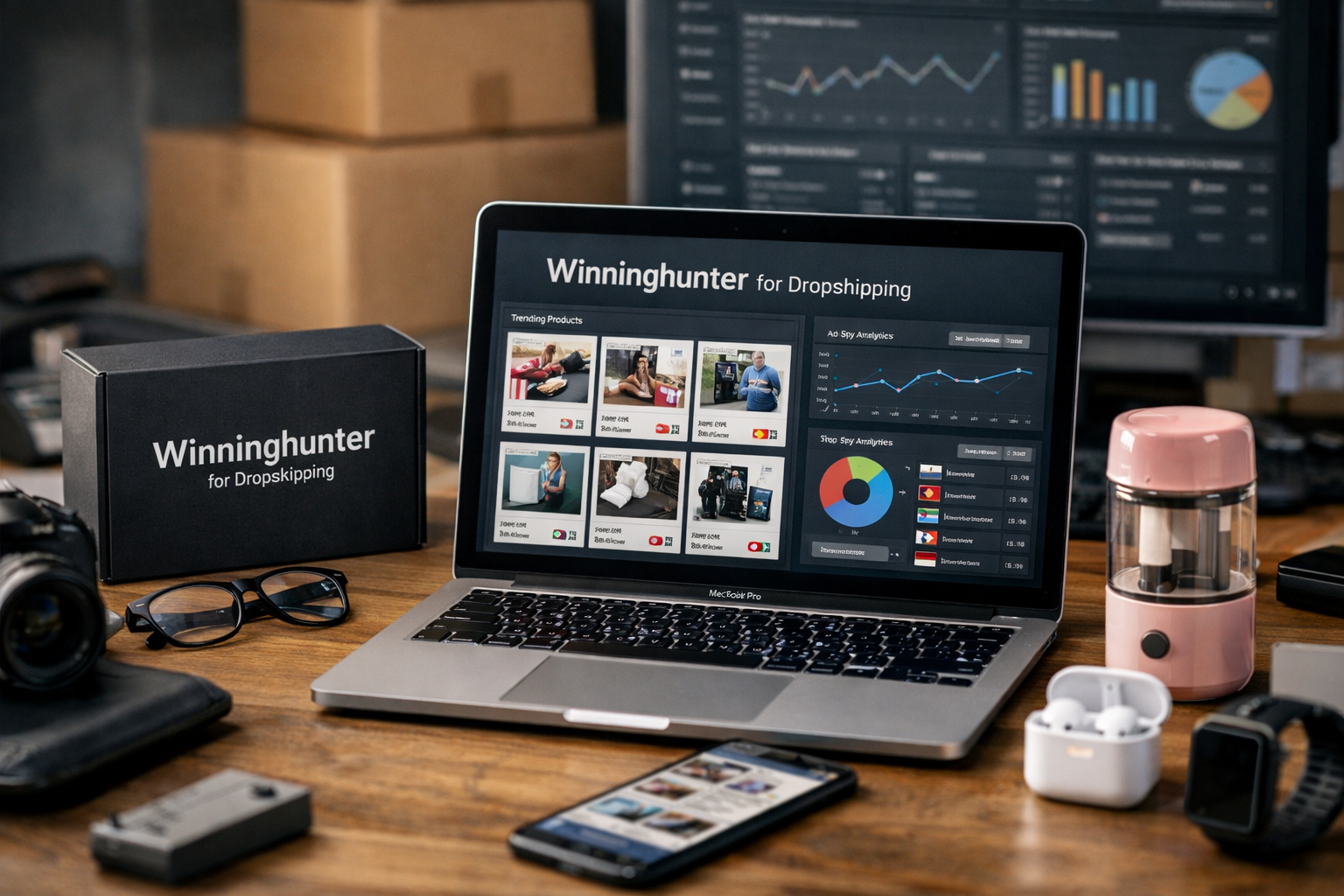
WinningHunter for dropshipping is an ad spy tool designed to help ecommerce sellers find product opportunities, analyze ads, track stores and brands, and research TikTok Shop activity from one platform.
The official site positions it as a tool for finding winning products and ads. It also says the platform is trusted by 500k+ sellers worldwide and provides data from 500,000 daily new ads and 2,250,000 Shopify shops. Those are company claims, rather than independently verified performance figures, but the breadth of the stated data sources is relevant for serious product research.
Who it is best for
This platform makes the most sense for active dropshippers, media buyers, creative teams, and ecommerce founders who regularly need new product ideas and ad concepts. It is also useful for agencies that research multiple brands or markets and need a more organized alternative to manually checking individual ad libraries.
In my view, the strongest use case is not simply copying what is already popular. It is using market signals to decide which products, problems, hooks, and offers deserve a test budget.
Bottom-line verdict for dropshippers
A practical WinningHunter review should be clear about the trade-off: you are paying for speed, consolidation, and a more repeatable research process. The tool cannot guarantee a profitable product, but it can reduce the time spent moving between social platforms, storefronts, and competitor ads.
For sellers who test products consistently, WinningHunter for dropshipping can be worth the subscription. For someone who is only occasionally browsing for ideas, free methods may be enough.
What WinningHunter Does for a Dropshipping Workflow
Finding winning products
The first job of a dropshipping product research tool is to surface products that solve visible problems or attract clear buyer attention. WinningHunter’s Ad Library, store data, trends, and TikTok Shop capabilities give researchers several ways to look for those signals.
Rather than treating “winning products dropshipping” as a list of random viral items, I prefer to start with a category and a customer problem. A good research workflow looks for repeatable demand, not just a single interesting video.
Analyzing ads and angles
Once you have a product category, the next question is why people may be buying it. WinningHunter for dropshipping gives you access to an Ad Library that the official homepage says includes 500M+ ads across Meta, TikTok, Pinterest, and Google.
That matters because the product itself is only one part of the offer. You can study the creative format, opening hook, pain point, demonstration, positioning, and landing-page direction to understand how advertisers are trying to sell it.
Tracking competitors and stores
The Store & Brand Tracker is intended to show the revenue, ads, and funnels of any store, according to the homepage. In a real workflow, this is useful for moving beyond a single ad and looking at the larger brand strategy behind it.
For a WinningHunter for dropshipping user, store research can help answer practical questions: Is a brand running multiple creatives? Does it appear to be promoting a focused product range? What kind of funnel is the store using? These observations should inform your own test rather than encourage direct copying.
Using data to validate offers before testing
Research should end with a decision, not an endless collection of screenshots. The sensible purpose of a competitor ad spy tool is to give you enough context to decide whether an offer is worth testing with your own creative and audience.
I would validate an idea using several signals at once: ad examples, store positioning, product-market fit, likely margin, shipping practicality, and the ability to create a differentiated angle. WinningHunter can support the first parts of that process, while supplier checks and test results still need to come from your own operation.
Key Features Dropshippers Will Care About Most
Ad Library across Meta, TikTok, Pinterest, and Google
The Ad Library is the core of WinningHunter for dropshipping. The official homepage says it covers Meta, TikTok, Pinterest, and Google, which is helpful when you do not want your research limited to one channel.
Cross-platform research is especially useful for spotting how a product changes by audience. A visual product may rely on a fast TikTok demonstration, while the same offer could use a more problem-focused Meta ad. Seeing those differences can help you plan several creative directions before launching your own test.
Store & Brand Tracker
WinningHunter’s Store & Brand Tracker is built around researching a store’s revenue, ads, and funnels. For dropshippers, the practical benefit is context: an ad that looks impressive may be less meaningful if it is disconnected from the rest of the brand experience.
When reviewing a store, focus on what can be responsibly learned from its public-facing approach. Look at product selection, offer framing, creative consistency, and funnel ideas. Avoid assuming that another store’s apparent activity guarantees that a product will work for you.
TikTok Shop product and creator discovery
WinningHunter TikTok Shop research is a notable part of the platform’s offering. The homepage says TikTok Shop can be used to spot products, creators, and videos that sell, while the pricing page lists TikTok Shop tracking among shared plan features.
This can be valuable when a product’s appeal depends heavily on demonstration, creator-style content, or a quick before-and-after format. It gives you another place to identify commercial signals beyond traditional paid ads.
Magic AI Search and reverse image search
The official pricing page lists Magic AI Search with reverse image search as a shared feature. This is particularly helpful when you already have a visual reference but do not know the product name, niche, or brand behind it.
For example, you may see a product in a social feed, save an image, and use that visual starting point to research related ads or stores. For WinningHunter for dropshipping users, that can be faster than guessing broad search terms and sorting through irrelevant results.
Trends and niche discovery
The pricing page also includes trends and tracked brands across plans. These tools are best used as idea generators and validation layers, not as automatic product-selection machines.
The best niches usually have enough creative variety to support fresh angles. If every ad looks identical and every store is using the same generic offer, that may signal an opportunity to differentiate—or a market that is already difficult to enter.
How to Use WinningHunter to Find Winning Products
Start with a niche or problem
Start with a customer problem instead of a vague goal to find winning products for dropshipping. Choose an area you understand or can evaluate, such as organization, comfort, cleaning, pet care, travel, or a hobby-related frustration.
This approach makes research more focused. You are not simply looking for a product that appears in ads; you are looking for a product that can be explained clearly, demonstrated visually, and sold with a believable offer.
Filter for products already scaling
Use WinningHunter for dropshipping to explore ads and stores within your selected niche. The goal is to identify products and angles that appear repeatedly enough to warrant deeper research, while remembering that visibility alone does not prove profitability.
I would build a small shortlist rather than immediately committing to one item. Save potential products that have clear demonstrations, obvious customer benefits, and room for a different creative approach.
Study ad creatives, hooks, and angles
This is the stage where an ad spy tool for dropshipping becomes more useful than simple trend browsing. Review how advertisers introduce the problem in the first few seconds, how they demonstrate the product, and what objection they address before the call to action.
Do not copy an ad word for word. Instead, document the underlying structure: problem, mechanism, proof, payoff, and offer. Then create a new version based on your own brand voice, product presentation, and target customer.
Check store signals before testing
Before spending money on ads, examine the store and brand context around the product. The Store & Brand Tracker can help you research ads and funnels, while your own review should cover product-page clarity, offer quality, shipping feasibility, and potential customer-service issues.
This is where WinningHunter for dropshipping supports validation rather than replacing it. A product may have compelling ads but still be a poor fit if you cannot source it reliably or create a credible customer experience.
Turn research into a test plan
A simple research-to-test workflow can keep you from overanalyzing:
| Step | What to Do | Output |
|---|---|---|
| 1 | Choose a niche and customer problem | Focused research direction |
| 2 | Research relevant ads and products | Shortlist of possible products |
| 3 | Review stores, funnels, and positioning | Competitor notes |
| 4 | Analyze hooks and creative formats | Original creative concepts |
| 5 | Check sourcing and economics independently | Viable test candidate |
| 6 | Launch a controlled test | Real performance data |
The important point is that WinningHunter for dropshipping helps generate better hypotheses. Your test results, fulfillment standards, and customer feedback determine whether you actually have a scalable business.
Official website · Latest pricing & offers
Pricing Breakdown: Is WinningHunter Worth It?
WinningHunter pricing is straightforward in its listed yearly-billed monthly rates. The official pricing page also states that there is no commitment and that users can cancel anytime, with quarterly and yearly billing options available.
Basic plan
The Basic plan costs $30 per month billed yearly. It includes one user, and each extra user costs $20 per month.
The official page lists shared features such as TikTok Shop tracking, Magic AI Search with reverse image search, filters, ads database, a stores database of over 2 million ecommerce stores, trends, tracked brands, MCP & API, customer service, and 1-on-1 calls. It also indicates that Basic has narrower ad and filter access than the higher plans.
Standard plan
The Standard plan costs $49 per month billed yearly for one user. Additional users are $20 per month each.
For most active product researchers, this is likely the more practical starting point because the pricing page says ads are included from the Standard plan and that Standard has broader ad and filter access than Basic. That distinction is important if ad research is your primary reason for subscribing.
Enterprise plan
The Enterprise plan costs $150 per month billed yearly for one user, with additional users priced at $20 per month each.
The pricing page states that Enterprise has broader ad and filter access than Basic, alongside the shared research capabilities. This tier is more likely to fit teams with heavier research needs than a solo store owner who is testing a limited number of offers.
Which plan makes sense for most dropshippers
For a typical seller who wants an ad spy tool for dropshipping, Standard appears to be the sensible plan to evaluate first. It costs more than Basic, but the official pricing page specifically says ads are included from Standard, which aligns with the main reason many dropshippers consider the platform.
Basic may suit someone more interested in the shared research tools and a lighter workflow. Enterprise is better considered when a larger team, agency workflow, or broader research requirement justifies the monthly cost.
Pros and Cons of WinningHunter
Main advantages
WinningHunter for dropshipping brings several research functions into one place: ad discovery, store and brand tracking, TikTok Shop research, trends, and AI-related search capabilities. That can reduce the friction of switching between separate research tools and social platforms.
The stated Ad Library coverage across Meta, TikTok, Pinterest, and Google is another meaningful advantage. Sellers can compare creative approaches across channels instead of basing a product decision on one isolated ad format.
Potential drawbacks
The main limitation is that research data is not the same as a guaranteed winning product. Even a product with strong ad activity may be unprofitable for your store due to sourcing, creative quality, audience saturation, shipping, or offer execution.
There is also a learning curve. WinningHunter for dropshipping is most useful when you know what questions to ask, how to interpret competitive activity, and how to turn observations into original tests.
Where it may be overkill
If you are still learning the basics of product pages, sourcing, customer support, and paid traffic, a paid intelligence platform may be more than you need right away. You can learn a great deal by manually reviewing ads, stores, marketplaces, and customer comments.
It may also be excessive for a seller who only researches a product once every few months. The subscription has clearer value when it supports a regular testing cadence.
WinningHunter vs Free Research Methods
What you can do for free
Free research methods remain useful. You can manually browse social feeds, review public ads, inspect competitor websites, watch marketplace trends, and read customer reviews to identify common objections and product complaints.
These methods are especially good for beginners because they force you to develop pattern recognition. You learn to notice weak offers, repetitive creative, unclear product positioning, and the difference between attention and genuine demand.
What WinningHunter saves you time on
WinningHunter for dropshipping is primarily a time-saving and organization tool. Instead of relying only on scattered searches, it centralizes ad research, store research, trends, tracked brands, TikTok Shop tracking, and reverse image search capabilities.
That convenience matters when product research is a recurring operational task. The less time you spend hunting for sources, the more time you can spend evaluating margins, developing better creatives, and improving your offer.
When free methods are enough
Free methods are enough when your budget is limited, your research volume is low, or you are still deciding whether dropshipping is a business model you want to pursue seriously. Manual research can also complement a subscription because it keeps you close to real customer language and public market behavior.
When comparing WinningHunter alternatives, do not just compare feature lists. Consider whether any option fits your actual research habits, channels, budget, and team size.
Who Should Buy WinningHunter and Who Should Skip It
Best fit profiles
WinningHunter for dropshipping is a strong fit for sellers who test products regularly and need a structured way to study ads, stores, brands, and TikTok Shop activity. It can also suit creative strategists who need fresh references for hooks, demonstrations, and offer angles.
Agencies and multi-brand operators may find the store and brand research workflow particularly useful. The platform’s stated support for extra users at $20 per month can also be relevant for collaborative teams.
Not ideal for hobbyists
It is not ideal for someone expecting a database to reveal a guaranteed winner without testing. No research platform can solve poor sourcing, weak customer experience, uncompetitive pricing, or unoriginal creative.
Casual browsers may find the cost difficult to justify. In that case, build a manual product-research routine first and move to a paid platform once research becomes a consistent bottleneck.
Best alternatives by use case
Free research is the best alternative for early-stage sellers who need to protect cash flow. Manual ad browsing, competitor store checks, marketplace reviews, and social-media trend observation can provide a solid foundation.
For teams evaluating WinningHunter alternatives, the best choice depends on the exact problem. If you need a faster all-in-one workflow across ads, store research, trends, and TikTok Shop, WinningHunter may fit well; if you only need occasional inspiration, a lighter manual process is usually sufficient.
Final Verdict and Recommendation
Best overall use case
My overall WinningHunter review conclusion is that the platform is most useful as a research operating system for active ecommerce sellers. It supports the work that happens before a product test: finding opportunities, analyzing ad angles, reviewing stores, tracking brands, and collecting evidence for a smarter decision.
WinningHunter for dropshipping is not a magic product finder, and that is actually the right expectation to have. Its value comes from helping disciplined sellers research faster and validate ideas with more context.
Best pricing tier
For most serious dropshippers, Standard is the tier I would assess first at $49 per month billed yearly. The official pricing page says ads are included from Standard and that it has broader ad and filter access than Basic, making it the more aligned option for ad-focused product discovery.
Basic at $30 per month billed yearly can still make sense for lighter research needs, while Enterprise at $150 per month billed yearly is better reserved for larger or more demanding workflows.
Affiliate CTA
If your current research process involves too much tab-switching between ads, stores, and TikTok trends, you can explore WinningHunter here and decide whether its workflow justifies the monthly cost for your business. Check the official site’s promo banner and checkout coupon field for any current offer details before subscribing.
Official website · Latest pricing & offers
FAQ
What is WinningHunter and what does it do?
WinningHunter is an ad spy and ecommerce intelligence tool. It is designed to help users find product opportunities, study ads, track stores and brands, identify trends, and research TikTok Shop products, creators, and videos that sell.
The official homepage says its Ad Library includes 500M+ ads across Meta, TikTok, Pinterest, and Google. It also offers a Store & Brand Tracker and AI integrations or MCP for asking AI about an ad or store.
Is WinningHunter good for dropshipping?
WinningHunter for dropshipping is useful for sellers who want to research products faster, analyze competitor advertising, and validate ideas before spending on tests. It is particularly relevant when you regularly need new creative references and store-level context.
However, it should be treated as a research tool, not a guarantee of revenue. You still need to independently assess sourcing, margins, fulfillment, product quality, and creative execution.
How do I find winning products for dropshipping with WinningHunter?
Start by selecting a niche or customer problem. Then use the ad and store research tools to identify products with compelling demonstrations, recurring angles, and clear buyer benefits.
Next, study the ads and related store positioning, build original creative concepts, and check whether you can source and deliver the product competitively. This is the most practical way to use WinningHunter for dropshipping: as evidence for a test plan, not as a shortcut around testing.
How much does WinningHunter cost?
According to the official pricing page, Basic costs $30 per month billed yearly, Standard costs $49 per month billed yearly, and Enterprise costs $150 per month billed yearly. Each plan includes one user, and additional users cost $20 per month each.
The site states there is no commitment and users can cancel anytime. It also offers quarterly and yearly billing options.
Does WinningHunter include TikTok Shop data?
Yes. The official homepage says WinningHunter includes TikTok Shop functionality for spotting products, creators, and videos that sell. The pricing page also lists TikTok Shop tracking as a shared feature across plans.
Related Reading
- Autods vs Zendrop: Which Dropshipping Platform Is Best in 2026?
- Best Cold Email Tools Like Smartlead in 2026
- Mydesigns Photography: A Practical Review for Better POD Mockups in 2026
References
- WinningHunter: Ad Spy Tool to Find Winning Products & Ads
- WinningHunter Pricing Plans & Subscription Costs
- Winning Hunter Review and the 16 Best Alternatives
- Winning Hunter vs Kalodata 2026: Shopify Dropshipping …