Local Falcon Pros and Cons: Local Falcon Review 2026

Official website · Latest pricing & offers
Local Falcon Review 2026: Quick Verdict
For buyers weighing the local falcon pros and cons, the short answer is simple: Local Falcon is a strong choice if you need visual proof of how a business appears across a city, service area, or group of neighborhoods. Its core advantage is geo-grid rank tracking combined with AI visibility monitoring and polished reporting.
The main trade-off is usage-based value. Local Falcon uses credits, so frequent scans, larger grids, multiple keywords, and many locations can become a meaningful operating cost. It is not automatically the cheapest option for every user, especially if basic occasional rank checks are all you need.
Who it is best for
Local Falcon is best for local SEO agencies, consultants, marketing teams, and multi-location businesses that need to explain local search performance clearly. It is particularly useful when a single average ranking is not enough to show what is happening across the map.
Businesses competing in dense markets—such as legal, home services, healthcare, hospitality, and automotive—can benefit from the neighborhood-level view. The platform’s reports make it easier to find weak areas and demonstrate progress to stakeholders.
Who should skip it
Buyers who only need a simple keyword position once in a while may not get full value from Local Falcon. The same applies to users who want one all-in-one platform for website audits, listing management, review generation, content production, and rank tracking in a single subscription.
When considering the local falcon pros and cons, budget-sensitive users should pay special attention to expected scan volume. Credit-based tools reward disciplined workflows, but they may feel less predictable for teams that run broad scans constantly without a reporting plan.
My 10-second verdict
Local Falcon is one of the more compelling options for visual local rank tracking and evidence-based client reporting. It is worth considering if map visibility, AI search visibility, and shareable reporting matter more than getting the lowest possible tracking cost.
Officially verified features include local rank tracking, AI visibility tracking, geo-grid-style scan reporting, scheduled scans, competitor reports, exports, integrations, and API access. My assessment of ease of use, report quality, and value also reflects common user sentiment, not a promise that every business will see the same outcome.
What Local Falcon Does
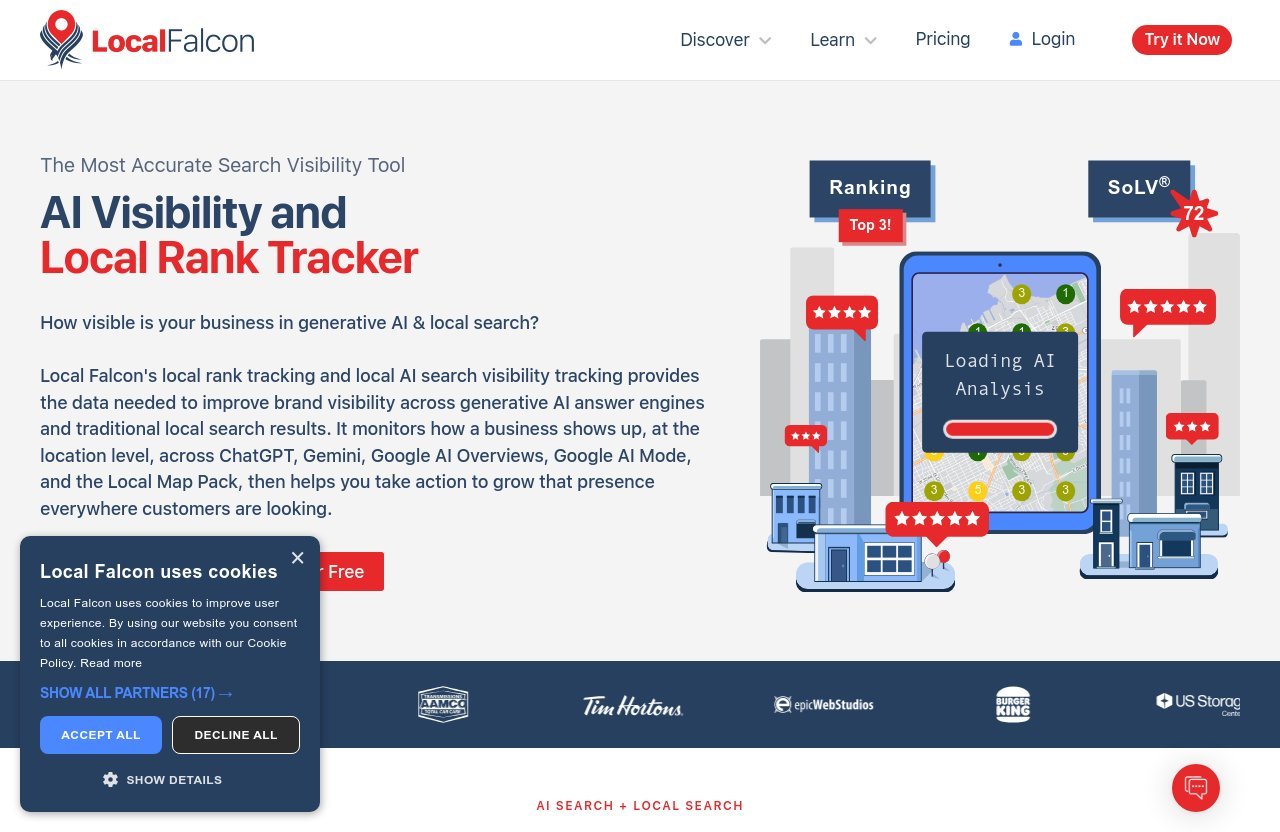
Local Falcon is positioned by its official site as an AI Search Visibility and Local SEO Rank Tracking tool. In practical terms, it helps marketers see how prominently a business appears for selected local search terms across multiple points on a map rather than relying on one generic ranking number.
That distinction matters because local search results can vary dramatically by searcher location. A business may perform well near its address but be almost invisible a few miles away, which a standard rank tracker can easily hide.
Map-based local rank tracking explained
A local rank tracker measures visibility for keywords, but Local Falcon’s approach is designed to show rankings across a configurable grid. The result is a map-based report that illustrates where a business is strong, weak, or absent for a particular search term.
The official feature set includes variable grid sizes, scan radius adjustments in .1 intervals, service area business scans, keyword reports, location reports, and scheduled scans. That gives users practical control over the scope of a scan instead of forcing every business into the same geographic view.
For anyone evaluating local falcon pros and cons, this visual model is the central reason to buy. It turns a vague claim like “we rank well in Google Maps” into a geographic performance picture that can be reviewed, prioritized, and reported on.
AI visibility tracking and local SEO workflows
Local Falcon also offers AI visibility tracking, Falcon AI, Falcon Agent, and Falcon Guard. The official pages establish these as part of its AI Search Visibility and local SEO toolset, though buyers should review the live product information before assuming a specific workflow or level of feature access.
At a high level, AI visibility tracking is relevant because customers increasingly discover local businesses through more than traditional map results. Monitoring where a business appears in AI-influenced search experiences can complement conventional Google Maps rank tracker data.
The platform also includes campaign reports, trend reports, competitor reports, and scheduled scans. Together, these features can support a repeatable workflow: establish a baseline, identify weak areas, improve local signals, scan again, and share the outcome.
Why the visual grid matters
A visual grid is more actionable than a single “position three” result. It can reveal whether that position is consistent throughout a target service area or merely reflects results near the business location.
For example, a roofing company may look highly visible in its immediate suburb but lose ground in nearby areas where it wants more leads. Geo grid rank tracking can expose that gap so the business can focus its local SEO work on the places that actually need attention.
This is where the local falcon pros and cons become practical rather than theoretical. Buyers who need location-specific evidence will likely value the grid; buyers who only need one broad keyword snapshot may not need that level of detail.
Local Falcon Pros
The strongest Local Falcon advantages come from its visual reporting model, broad reporting options, and ability to fit into professional local SEO workflows. The following benefits are based on verified official features, supplemented by recurring user sentiment around usability, reporting, accuracy, and integrations.
Highly visual geo-grid reports
Local Falcon’s scan reports are its most persuasive feature. Grid-based visualizations make local ranking differences easier to understand for clients, owners, and non-technical stakeholders who may not care about raw spreadsheets.
Instead of asking a client to interpret dozens of individual results, an agency can point to areas of strong and weak local visibility. This is especially helpful during onboarding, monthly reporting, and strategy discussions.
Among the local falcon pros and cons, the visual grid is a major advantage for teams that sell or manage local SEO. It provides a concrete way to connect technical ranking work with market coverage and business goals.
Strong accuracy and local visibility insights
Local Falcon is designed around local ranking data at multiple map points, which is inherently more useful for localized decision-making than a single national or citywide number. The official site supports scan radius controls, variable grids, and service area business scans, all of which are relevant to precision.
Users commonly praise the detailed visual reporting and perceived accuracy of the results. Still, no Google Maps rank tracker should be treated as a permanent, universal truth: rankings can vary with location, keyword phrasing, device context, personalization, competition, and changes in search results.
The practical takeaway is that the tool is most valuable for spotting patterns. A consistent weak zone or sustained improvement across repeated scans is usually more meaningful than obsessing over one isolated point.
Useful for agencies and multi-location brands
Local Falcon supports campaign reports, location reports, competitor reports, trend reports, public report URLs, and scheduled scans. Those are useful capabilities for agencies managing multiple clients or brands monitoring several physical locations.
A consultant can use initial scans to identify ranking gaps, then create recurring scans to document movement over time. A multi-location company can separate reporting by branch, service area, campaign, or market rather than treating every location as one undifferentiated entity.
The local falcon pros and cons lean favorably here for organizations that must communicate results often. The reporting structure can save time compared with manually gathering screenshots or translating raw rank data into client-ready explanations.
Helpful reporting, exports, and integrations
Officially verified reporting and workflow features include CSV and PDF exports, public report URLs, a Looker Studio connector, Zapier and n8n integrations, the Local Falcon API, and an MCP server. This is a meaningful set of options for teams that want data to move beyond the main dashboard.
CSV and PDF exports are useful for internal analysis and formal presentations. Public report URLs can simplify sharing, while Looker Studio, automation integrations, and API access can be valuable for agencies or larger teams with established reporting systems.
This breadth helps explain why some users describe Local Falcon as more than a basic local rank tracker. It can become part of a larger reporting stack, although the right setup depends on your team’s processes and technical comfort.
Easy enough for non-technical users
User sentiment frequently highlights the clean visual interface and straightforward reports. That makes sense: a color-coded or map-based result often needs less explanation than a dense ranking table.
New users will still need to understand keywords, target areas, scan size, competitors, and credits. But the core concept is accessible—choose what to monitor, review local visibility, and use the findings to guide work.
The best local rank tracker is not merely the one with the most data. It is the one your team can use consistently, explain confidently, and turn into action. Local Falcon appears well suited to that requirement.
Local Falcon Cons
A balanced Local Falcon review 2026 should not pretend that the platform fits every budget or workflow. Most concerns center on credit consumption and whether the depth of tracking is necessary for the buyer’s actual needs.
Credit-based pricing can feel expensive
The most common caution in user sentiment is affordability when usage grows. Local Falcon credits are central to the buying decision because scans are not all equally demanding: a larger grid, more keywords, more locations, and more frequent reporting naturally require greater usage.
The official pricing information confirms credit-based access and provides +100 free credits on sign-up, but buyers should check the current pricing page for plan details and expected credit requirements before subscribing. Exact plan prices and feature allowances should not be assumed without reviewing the live offer.
In the context of local falcon pros and cons, this does not make the tool overpriced by default. It means value depends heavily on whether the insights from each scan lead to smarter actions, stronger client retention, or better reporting.
Frequent or large scans can burn credits fast
Local Falcon offers variable grid sizes and scan radius settings in .1 intervals, which are valuable controls. However, the flexibility that makes the platform powerful can also encourage users to scan more broadly than necessary.
A sensible approach is to start with high-priority keywords and realistic service areas. Use scheduled scans strategically—such as a baseline, post-optimization check, and recurring client-reporting cadence—rather than running large exploratory scans without a clear question.
For a solo business with one location and limited local SEO activity, the cost-per-insight may not be as attractive as it is for an agency managing several recurring campaigns. That is the key limitation to evaluate before committing.
Advanced features may be overkill for casual users
Features such as API access, an MCP server, Looker Studio connectivity, automation integrations, campaign reporting, and AI visibility monitoring are valuable for advanced users. They may be unnecessary for an owner who simply wants to know whether they appear in the map pack.
The local falcon pros and cons are therefore partly a question of operational maturity. If you do not have a process for using scan results, reports, and trend data, you may be paying for more capability than you need.
A smaller business can still use Local Falcon effectively, but it should begin with a narrow tracking plan. Define the most commercially important keywords, the specific areas that generate customers, and the reporting frequency that supports decisions.
It is a tracking tool, not a full local SEO platform
Local Falcon is built around visibility tracking, reporting, AI visibility, and related workflows. It should not be mistaken for a complete replacement for every local SEO activity a business needs.
You will still need a strategy for improving a Google Business Profile, earning reviews, managing local listings, creating locally relevant content, improving conversion pages, and monitoring leads. The platform can reveal where visibility is weak, but it does not eliminate the work required to address it.
That specialization is a strength for data-focused users and a limitation for buyers seeking one dashboard to perform every marketing task.
Official website · Latest pricing & offers
Pricing Breakdown and Value in 2026
Local Falcon pricing should be evaluated as a usage decision, not just as a subscription decision. The official pricing page confirms credit-based plans, but buyers should verify current plan options directly because this review does not rely on unverified tier names, prices, or feature limits.
How credits work
Local Falcon credits are used within its scan-based model. The practical cost will depend on how many scans you run and how complex those scans are, including the number of keywords, locations, and grid points you choose to monitor.
This is why a realistic usage estimate matters before comparing local falcon pricing with alternatives. Agencies should forecast client reporting schedules; multi-location brands should count locations and priority markets; smaller businesses should focus only on revenue-relevant searches.
The local falcon pros and cons are most favorable when credit usage is planned. A tighter monitoring program can provide useful evidence without turning every minor ranking fluctuation into another scan.
Free trial / starter access
The official pricing page states that no credit card is needed and that new users receive +100 free credits on sign-up. It also states that users can cancel anytime.
That entry point gives prospective buyers a practical way to test the workflow. Use the initial credits to scan a few high-value keywords, compare key neighborhoods, review the report format, and determine whether the insights would genuinely change your local SEO priorities.
Avoid judging the tool solely on a single scan. Compare the map view with what you believed about your local visibility before the test—this is often where the product’s value becomes clearest.
Monthly vs annual value
The verified official facts provided for this review do not specify monthly or annual prices, discounts, or plan-by-plan credit limits. For that reason, it would be inaccurate to claim that either billing option is universally cheaper.
Instead, buyers should compare the available billing choices on the official checkout or pricing page against their anticipated scan frequency. A stable agency workload may justify a different commitment than seasonal use by a small service business.
If you are testing whether the tool fits your workflow, the no-credit-card entry and cancel-anytime policy reduce initial friction. You can review Local Falcon’s current options through this official Local Falcon offer page after calculating your likely scan volume.
Enterprise pricing note
Local Falcon also lists an enterprise pricing option. That is relevant for organizations with larger reporting needs, extensive location portfolios, custom workflows, or requirements that go beyond a standard self-serve setup.
Enterprise buyers should ask focused questions: how will teams organize locations and campaigns, what reporting needs to be automated, who needs access, and how much historical or recurring data is required? The answer matters more than a headline subscription comparison.
Best Use Cases
Local SEO agencies
Agencies are arguably the best fit for Local Falcon because they need repeatable proof of work. Initial geo-grid scans can support audits and proposals, while scheduled scans, trend reports, public URLs, and exports can strengthen ongoing client communication.
For agencies evaluating the local falcon pros and cons, the biggest upside is translating rankings into a report clients can understand. The key risk is failing to scope scan usage correctly across a growing client roster.
Small businesses
Small businesses can benefit when local visibility directly affects leads, bookings, calls, or store visits. A business owner can use the platform to see whether important neighborhoods are underperforming and decide where to focus Google Business Profile, review, landing-page, or local content efforts.
The tool is not essential for every small company. It makes most sense when the owner or marketer will act on the data rather than checking rankings out of curiosity.
Multi-location businesses
Multi-location businesses need a way to distinguish performance by branch and market. Local Falcon’s location reports, campaign reports, scheduled scans, and visual local tracking can make it easier to identify locations that need more attention.
This is especially valuable when locations compete in different local environments. One branch may dominate while another has visibility gaps caused by stronger nearby competitors or a less effective local presence.
Enterprise and reporting teams
Enterprise teams may value the API, MCP server, Looker Studio connector, Zapier and n8n integrations, exports, and enterprise pricing option. These features can help embed ranking data into broader internal reporting systems.
The best local rank tracker for a large organization is one that fits existing governance and reporting practices. Local Falcon is most compelling when its visual analysis and data connections serve a defined business process.
How Local Falcon Compares to the Alternatives
It would be misleading to invent competitor pricing, limits, or features without verified source material. The fair comparison is therefore based on buying criteria: visualization, reporting depth, integrations, tracking scope, and budget flexibility.
When Local Falcon is the better pick
Local Falcon is a strong pick when geo-grid rank tracking is the priority. Its variable grids, scan radius controls, service area business scans, competitor reporting, trend reporting, public report URLs, exports, and integrations make it particularly attractive to reporting-heavy local SEO teams.
If your question is “where do we rank across the map?” rather than simply “what is our average position?”, Local Falcon has a clear product-market fit. Its local falcon AI visibility capabilities may also appeal to buyers who want local search monitoring that extends beyond traditional rank tracking.
When another tool may be a better fit
Another tool may be a better fit if you want the lowest-cost occasional tracker, a simpler workflow, or a broader suite that combines unrelated marketing tasks under one subscription. Buyers with very limited scan needs may not need a detailed visual grid platform.
Likewise, if your priority is an all-in-one operational system rather than specialist visibility analysis, compare the broader workflow carefully. The local falcon pros and cons favor depth in local visibility reporting, not necessarily a one-tool-does-everything approach.
What buyers should compare before subscribing
Before choosing any local SEO tool, compare these practical factors:
| Buying Criterion | What to Check |
|---|---|
| Visualization | Can you see rankings across the specific neighborhoods or service area that matter? |
| Reporting | Are reports understandable for clients, executives, and non-technical teams? |
| Scan flexibility | Can you control keywords, locations, grid size, scan radius, and schedule? |
| Integrations | Does it connect with your reporting stack, automations, or internal systems? |
| Budget control | Can you forecast usage based on the tracking cadence your team actually needs? |
| Actionability | Will the data change your SEO priorities, or merely create more dashboards? |
Final Recommendation
Best if you need proof of local visibility
Local Falcon is worth buying for agencies, local SEO professionals, multi-location brands, and serious local businesses that need visual evidence of where they appear in local search. Its core strengths are map-based rank tracking, AI visibility tracking, reporting depth, scheduled scans, competitor insights, and workflow-friendly integrations.
The local falcon pros and cons point to a clear conclusion: it is strongest when rankings must be explained geographically, not just measured as one simplified number.
Not ideal if you want the cheapest tracker
Local Falcon is less suitable for buyers who need only rare ranking checks, have no use for shareable reports, or choose tools primarily by the lowest subscription cost. Credit-based usage deserves careful planning, particularly for large or frequent scan programs.
It is also not a replacement for a complete local SEO strategy. You still need to improve the business signals that influence visibility and track real commercial outcomes such as calls, leads, bookings, and revenue.
Bottom line
Is Local Falcon worth it in 2026? Yes—if your work depends on understanding local search performance across real neighborhoods and presenting that evidence clearly. The platform’s official feature set is robust, and market sentiment is especially positive about its visual grid reports, usability, reporting, and integrations.
The final decision comes down to scan volume. If you can plan local falcon credits around high-value keywords, locations, and reporting moments, Local Falcon offers meaningful value. If you only need the cheapest occasional rank check, choose a simpler alternative instead.
Official website · Latest pricing & offers
FAQ
How does Local Falcon work?
Local Falcon runs geo-grid scans for selected keywords and shows where a business ranks across multiple map points. Rather than reporting one generic position, it helps users understand local visibility by neighborhood, service area, or chosen scan radius.
Its official feature set includes variable grid sizes, .1 scan-radius intervals, service area business scans, scheduled scans, competitor reports, trend reports, and location reporting.
Is Local Falcon accurate?
Local Falcon is designed for detailed, location-based rank tracking, and users commonly praise its visual reporting and perceived accuracy. However, local search results can still vary based on the search location, keyword, competition, and changing Google results.
Treat the data as a decision-making tool for identifying patterns and tracking progress over time. Repeated scans of the same priority areas are generally more useful than relying on one isolated ranking result.
How much does Local Falcon cost?
Verified official pricing information states that no credit card is needed, users can cancel anytime, and new sign-ups receive +100 free credits. Local Falcon also offers enterprise pricing.
This review does not list exact tier prices or credit limits because those figures were not provided as verified facts. Check the current pricing page and estimate your expected scan volume before buying.
Who is Local Falcon best for?
Local Falcon is best for local SEO professionals, agencies, SMBs, and multi-location brands that need visual rank tracking and client-ready reporting. It is especially useful for teams that need to assess visibility across neighborhoods rather than at one location only.
Businesses with defined service areas and competitive local markets are likely to gain the most from its grid-based insights.
Is Local Falcon worth it in 2026?
Local Falcon is worth it for users who need map-based local ranking insights, AI visibility tracking, and professional reporting. It can be particularly valuable when the data supports client communication, campaign decisions, or multi-location monitoring.
It may be less appealing for people who need only occasional tracking or who prioritize the lowest-cost option. The deciding factor is whether the visibility insights justify the credit-based scan usage for your workflow.
Does local SEO still work?
Yes, local SEO still works because customers continue to search for nearby businesses, services, and locations with commercial intent. Strong local SEO can improve the chances of appearing when people search in or near your target market.
Results are not guaranteed, and competition can be intense. Effective local SEO requires consistent work on business information, reputation, relevant content, local landing pages, and user experience—not just rank tracking.
What are the benefits of using local SEO?
Local SEO helps businesses target people who are geographically close to a location or service area. The main benefits can include better local discovery, more relevant traffic, stronger visibility in map-based results, and clearer alignment between marketing activity and local demand.
Tools like Local Falcon help make that work measurable. They show where visibility is strong or weak so teams can prioritize improvements more intelligently.
What will local SEO look like in 2026?
Local SEO in 2026 is likely to require more location-specific measurement, better reporting, strong business information, reputation signals, and attention to AI-influenced search experiences. A single ranking number will be less useful than understanding how visibility changes across neighborhoods and platforms.
That is why local falcon AI visibility tracking and geo-grid reporting are relevant for modern local marketers. The goal is not simply to rank; it is to understand where potential customers can actually find the business.
Related Reading
References
- Local Falcon: AI Search Visibility and Local SEO Rank Tracking
- Local Falcon Pricing – Local Falcon
- Local Falcon Pros and Cons | User Likes & Dislikes
- Local Falcon Reviews | Read Customer Service Reviews of localfalcon.com