Trustworthy vs Google Drive: Which Is Better for Family Documents?

Choosing between trustworthy vs google drive is less about picking the biggest file repository and more about deciding how you want your household information to work. Google Drive is a broadly used cloud storage and file-sharing platform. Trustworthy is a purpose-built Family Operating System® designed to help families organize important records, manage access, and turn documents into answers, reminders, and next steps.
This is an affiliate article for Trustworthy, which means I may earn a commission if you choose to sign up through links in this guide. That relationship does not change the comparison: Google Drive can be enough for straightforward storage, but Trustworthy is the more focused option for families managing legal, financial, medical, property, insurance, and emergency documents.
Official website · Latest pricing & offers
Trustworthy vs Google Drive: Quick Verdict
| Decision factor | Trustworthy | Google Drive |
|---|---|---|
| Core purpose | Family Operating System® and digital vault | General cloud storage and file sharing |
| Best for | Document-heavy households needing structure and follow-through | Basic personal or work file storage |
| Organization | Family-oriented categories and automatic organization | User-created folders and manual file organization |
| Workflow | Intelligent reminders, email sync, private collaboration, Household AI | General file storage workflow |
| Access management | Access permissions, including legacy access and read-only options by plan | General sharing-oriented use cases |
| Best starting point | Free plan available | May suit people who already use it for simple storage |
Who each product is best for
In the trustworthy vs google drive decision, Trustworthy is the better match for parents, caregivers, blended families, estate planners, and anyone responsible for a growing pile of important records. It is designed around household needs rather than around folders alone.
Google Drive may suit someone who simply wants a familiar place to keep files and occasionally share them. If you do not need reminders, family-specific organization, or a digital vault for families, generic cloud storage can be perfectly practical.
Bottom-line winner for family document management
For family document management, Trustworthy wins because its stated purpose goes beyond storage. It organizes information across categories such as IDs, insurance, contacts, property, finance, passwords, and legal documents, then adds tools intended to help households take action.
That distinction is the central takeaway from this trustworthy vs google drive comparison. A folder of PDFs can be useful, but a system that helps surface answers and next steps can be more valuable when life gets busy or stressful.
When Google Drive still makes sense
Google Drive still makes sense for low-stakes, low-complexity storage. For example, a single person saving a few photos, school files, or personal documents may not need a dedicated family planning platform.
The fair version of the trustworthy vs google drive pros and cons debate is simple: Trustworthy offers more household-specific structure, while Google Drive may feel simpler if storage and occasional sharing are your only priorities.
What Trustworthy Is vs What Google Drive Is
Trustworthy as a Family Operating System
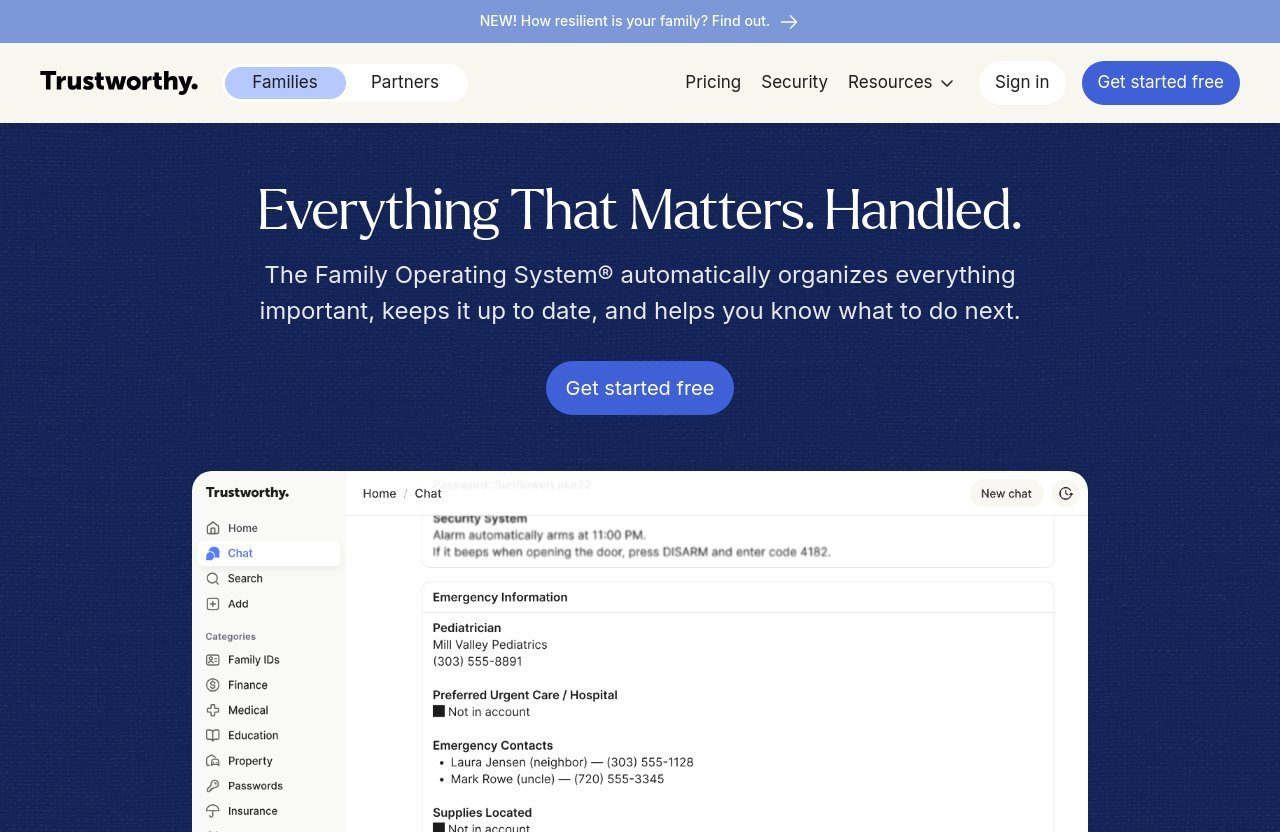
Trustworthy describes itself as the Family Operating System®. Its stated goal is to turn documents into answers, reminders, and next steps, which is a fundamentally different promise from merely storing files.
In a trustworthy vs google drive evaluation, that means Trustworthy should be considered a household-management tool first and a document vault second. It includes email sync, automatic organization, chat, intelligent reminders, private collaboration, Household AI, and an Encrypted Vault.
Google Drive as generic cloud storage
Google Drive is widely recognized as a general cloud storage and file-sharing platform. People commonly use it to keep files online, organize them into folders, and share them with others.
That flexibility is useful, but it also means the user must create the system. In the trustworthy vs google drive context, Google Drive is the blank canvas, while Trustworthy is closer to a family-specific framework with pre-defined household use cases.
Why product purpose matters
Product purpose matters most when documents have consequences. A passport renewal, insurance policy, property record, will, caregiver instruction, or financial account detail should not merely be stored somewhere; it should be organized so the right person can find it when needed.
A strong family document organizer reduces the mental burden of remembering what exists, where it is, and when it needs attention. That is why Trustworthy’s focus on document categories, reminders, and permissions is meaningful for households that need more than a shared folder.
Feature-by-Feature Comparison
Organization and document structure
Trustworthy is built around organized household document categories, including IDs, insurance, contacts, property, finance, passwords, and legal documents. Its homepage also lists automatic organization and email sync, which can help bring incoming information into a more structured system.
Google Drive generally depends on the folder structure and naming rules you create. That is not necessarily a flaw, but in the trustworthy vs google drive choice, it creates a practical difference: a generic drive can become harder to navigate as years of scans, receipts, and PDFs accumulate.
| Organization need | Trustworthy approach | Google Drive approach |
|---|---|---|
| Family records | Household-oriented categories | User-created folders |
| Incoming documents | Email sync and automatic organization | Manual filing workflow |
| Finding context | Household AI and chat features | File-based search and organization |
| Ongoing document management | Reminders and next steps | User-managed follow-up |
For document-heavy households, the appeal is not that every file must move immediately. It is that Trustworthy offers a clearer home for the records that matter most, rather than asking users to build a system from scratch.
Security and privacy controls
Trustworthy states that it uses AES-256 encryption and multi-factor authentication. It also says users stay in control of access and that information remains protected, secure, and private; according to its homepage, information is never shared, sold, or monetized.
Questions such as is google drive safe for confidential information need a careful answer. Google Drive is commonly used for private file storage, but “safe” depends on the individual’s account practices, sharing choices, device security, and the sensitivity of the records involved. This article does not treat generic storage as equivalent to a dedicated family privacy and planning system.
For the trustworthy vs google drive comparison, the stronger differentiator is not an unsupported claim that one platform is inherently unsafe. It is that Trustworthy explicitly combines an Encrypted Vault with family-oriented access controls and household workflows.
The same nuance applies to searches for is google drive safe for private photos. Storage safety is only one part of the decision; organization, access planning, and the ability to manage important family information are separate needs.
Sharing and collaboration
Trustworthy includes private collaboration and access permissions. Its Free plan includes legacy access, while paid tiers provide more granular permissions, and Gold includes all permissions, including read-only access.
This matters in real households. A spouse may need access to insurance details, an adult child may need limited visibility during an emergency, and a caregiver may need relevant instructions without receiving unrestricted access to every record.
Google Drive is commonly used to share files, but the trustworthy vs google drive advantage for Trustworthy is its family-access framing. The product is designed around who in a household should be able to access what, not only around sending file links.
Reminders and household workflow
A storage platform can hold an expiring passport scan, but it will not necessarily turn that document into a practical household task. Trustworthy’s Intelligent Reminders are available on Silver, Gold, and Platinum plans, providing a workflow layer that basic storage does not inherently provide.
This is where a secure alternative to Google Drive can be especially useful. Families often do not struggle because they lack a place to save documents; they struggle because renewals, deadlines, policy changes, and responsibilities are scattered across email, calendars, and memory.
Trustworthy also includes mobile offline mode across plans, along with iOS and Android apps. For emergency readiness, having a household system that is usable on mobile can be more relevant than having another archive of poorly labeled files.
AI assistance and automation
Trustworthy lists Household AI, chat, automatic organization, and Inbox Autopilot among its capabilities. The Free plan includes 10 AI answers per month, Silver includes 25 AI answers per month, and Gold and Platinum include unlimited AI answers.
In this trustworthy vs google drive category, AI is useful only if it reduces real household friction. The meaningful question is whether it helps you turn stored information into answers and next steps, not whether it sounds impressive on a feature list.
Trustworthy’s email sync and Inbox Autopilot allowances may be particularly helpful for households receiving ongoing records, notices, or documents by email. The appropriate plan depends on how many email addresses and family members need to be included.
Trustworthy Pricing and Plans
Trustworthy pricing is straightforward in the sense that there is a free option, followed by annual-billing paid tiers with progressively broader household capabilities. Every plan includes advanced security and privacy, the ability to download your information, iOS and Android apps, mobile offline mode, and Trustworthy Marketplace discounts.
Free plan
Trustworthy’s Free plan costs $0 and is free forever. It includes one family member, one email address for Inbox Autopilot, Household AI, 10 AI answers per month, an Encrypted Vault, SecureLinks, legacy access permissions, AI-agent priority support, and 2 GB of storage.
For a cautious first step, the Free plan is a sensible way to test whether the trustworthy vs google drive difference matters in your own household. It is best for one person who wants to begin organizing core documents without committing to a paid tier.
Silver plan
The Silver plan costs $10 per month when paid annually. It includes everything in Free, plus five family members, two email addresses for Inbox Autopilot, 25 AI answers per month, Intelligent Reminders, granular permissions, email priority support, and 10 GB of storage.
Silver is a practical entry point for a couple or smaller family that needs shared organization rather than individual storage. It is also the first tier where reminders and more detailed permissions become available.
Gold plan
The Gold plan costs $20 per month when paid annually. It includes everything in Silver, plus 10 family members, five email addresses for Inbox Autopilot, unlimited AI answers, all permissions including read-only access, chat priority support, and 100 GB of storage.
For many households, Gold is where Trustworthy becomes a more complete family document organizer. It fits families coordinating multiple people, multiple inboxes, and a broader range of records without worrying about a monthly AI-answer limit.
Platinum plan
The Platinum plan costs $40 per month when paid annually. It includes everything in Gold, with unlimited family members and unlimited email addresses for Inbox Autopilot, unlimited AI answers, and an Encrypted Vault.
Trustworthy describes Platinum as software plus service, intended for households that want both the platform and concierge help. Concierge is available separately on the other plans, while Platinum is positioned for people who want a more hands-on household support experience.
Which plan offers the best value
The best value in trustworthy pricing depends on the size and complexity of your household rather than on price alone.
| Plan | Best for | Key reason to choose it |
|---|---|---|
| Free | One person getting started | Free forever with core vault and Household AI access |
| Silver | Smaller families | Reminders, granular permissions, and up to five family members |
| Gold | Active, document-heavy households | More members, more email addresses, unlimited AI answers, and 100 GB storage |
| Platinum | Large or complex households | Unlimited family members and email addresses plus concierge-oriented support |
My practical view is that Silver is a strong starting paid tier for a typical small family. Gold becomes more compelling when multiple family members, inboxes, and ongoing questions are part of the daily reality.
Official website · Latest pricing & offers
Where Google Drive Falls Short for Family Planning
No family-specific system
Google Drive can store files, but it is not presented here as a purpose-built family planning system. It does not begin with the assumption that you are coordinating family IDs, insurance, property documents, legal records, finances, passwords, and emergency information.
That is the central limitation in trustworthy vs google drive for planning purposes. Generic storage solves “where should I put this file?” but not necessarily “who needs this, what does it mean, and what happens next?”
Manual organization burden
Most people start with good intentions: folders for taxes, medical records, home repairs, school, and insurance. Over time, those folders can become a patchwork of duplicate documents, vague names, forgotten uploads, and unclear ownership.
A family document organizer should reduce that burden rather than add to it. Trustworthy’s automatic organization and family-oriented categories are valuable because they provide structure before your household archive becomes unmanageable.
Limited workflow intelligence
An important document is often tied to a future decision. A policy needs review, an ID expires, an estate document needs to be accessible, or a caregiver needs current instructions.
The trustworthy vs google drive distinction is sharp here: Trustworthy explicitly offers Intelligent Reminders and is designed to turn documents into reminders and next steps. Google Drive may remain useful for storage, but it is not the obvious choice when the real challenge is household follow-through.
Support and customization gaps
Families vary widely. Some are managing aging parents, some are handling blended-family responsibilities, and others are organizing records after a move, illness, marriage, divorce, or new child.
Google Drive can be adapted to these situations manually. Trustworthy is the more specialized option because its features—private collaboration, access permissions, Household AI, organized categories, and reminders—are already oriented around ongoing household administration.
When Trustworthy Is the Better Choice
Managing vital family documents
Trustworthy is the better choice when your important records are spread across drawers, inboxes, phones, and multiple people. A household with passports, insurance policies, property details, financial information, legal documents, and password-related information benefits from one organized system.
This is especially true if you want a digital vault for families rather than another catch-all file folder. Trustworthy’s category-based approach makes it easier to think in terms of household responsibilities, not just filenames.
Planning for emergencies
Emergency planning is one of the clearest reasons to choose Trustworthy. In a stressful situation, family members should not have to guess where documents live or search through years of folders for critical information.
The trustworthy vs google drive decision favors Trustworthy for preparedness because it combines an Encrypted Vault, mobile offline mode, access permissions, and household-focused organization. Those features address practical readiness without requiring you to build an entire process alone.
Coordinating household access
Parents, partners, adult children, executors, and caregivers often need different levels of access. A well-designed process should allow collaboration while still respecting privacy.
Trustworthy’s private collaboration and plan-based access permissions are a better match for this use case than a generic shared-drive mindset. Legacy access on Free and granular or read-only permission options on paid plans give households a clearer starting point for access planning.
Keeping documents current with reminders
Family administration is rarely a one-time project. Renewals, policy reviews, travel documents, school-related records, and legal updates all need periodic attention.
If your biggest issue is forgetting rather than storing, Trustworthy’s Intelligent Reminders can be a deciding factor. For a household that values follow-through, the trustworthy vs google drive comparison is not close: reminders make the system more actionable.
When Google Drive May Be Enough
Simple file storage needs
Google Drive may be enough if you mainly want to upload files, create a few folders, and share occasional documents. Someone with a small number of non-sensitive files and no need for household workflows may not need a specialized platform.
This is the strongest case against overbuying. Not every person looking at google drive alternatives for families needs a family operating system immediately.
Low-complexity personal use
If you live alone, have few documents to manage, and are comfortable maintaining your own folder conventions, generic storage can be adequate. You may prefer to keep your current setup until the volume or importance of your records grows.
Still, the Free plan makes it possible to evaluate Trustworthy without immediately replacing your existing routine. That is a reasonable route for anyone who wants to compare real-world usability before moving important materials.
Teams already living in Google Workspace
People who already work in a Google-centered environment may find Google Drive convenient for everyday collaboration. That familiarity can be a legitimate reason to keep using it for work files and casual sharing.
The more balanced approach is often not all-or-nothing. Use your general storage platform for everyday files, then use a purpose-built family system for the records, reminders, access planning, and household coordination that deserve more structure.
Final Recommendation: Which Wins?
Best overall for family organization
Trustworthy is the winner for families who need more than a place to save PDFs. Its stated combination of automatic organization, email sync, Household AI, Intelligent Reminders, private collaboration, access permissions, and an Encrypted Vault addresses the real work of managing a household.
In this trustworthy vs google drive review, Google Drive is a reasonable storage utility, but Trustworthy is the more relevant tool for family administration. It is especially compelling for caregivers, parents, blended families, estate-planning households, and anyone preparing for emergencies.
Best for budget-conscious basic storage
Google Drive may be the better fit if you only need basic file storage and are happy creating your own organization system. It can be practical, familiar, and sufficient for uncomplicated personal use.
However, if you want to explore a more structured alternative without paying immediately, Trustworthy’s $0 Free plan offers a low-risk starting point. You can assess whether a family-first system improves how you manage your most important records.
My recommendation as an affiliate
My recommendation is to start with Trustworthy’s Free plan if your household documents currently live in scattered folders, email threads, paper files, or someone else’s memory. Move to Silver when reminders and shared access matter, choose Gold for larger or more active households, and consider Platinum when unlimited members, unlimited email addresses, and concierge help fit your situation.
The final trustworthy vs google drive answer is straightforward: choose Google Drive for simple storage; choose Trustworthy when your family needs an organized, private, action-oriented system for important information.
Official website · Latest pricing & offers
FAQ
Is Trustworthy better than Google Drive for family documents?
For households that need structured organization, reminders, permissions, and a digital vault, Trustworthy is the better fit. Google Drive can store and share files, but Trustworthy is designed specifically to organize family records and turn documents into answers, reminders, and next steps.
The trustworthy vs google drive choice depends on complexity. A few files may not require specialized software, while a household managing legal, insurance, financial, property, and emergency records often benefits from a purpose-built system.
Is Google Drive safe for private documents?
Google Drive is widely used for cloud storage, but safety is not the same thing as having a family-specific organization system. Anyone asking is google drive safe for confidential information should consider their own account security habits, file-sharing settings, device access, and the sensitivity of the material they store.
This comparison does not claim that Google Drive is unsafe. It simply recognizes that Trustworthy offers verified family-oriented privacy features, including AES-256 encryption, multi-factor authentication, user-controlled access, and a stated commitment not to share, sell, or monetize information.
What is the best alternative to Google Drive for secure family organization?
For the needs covered in this article, Trustworthy is the strongest alternative because it is specifically designed for family document management and planning. It combines an Encrypted Vault with organized categories, private collaboration, access permissions, Household AI, and reminders on eligible plans.
For someone looking for a secure alternative to Google Drive, the key is choosing a product that matches the job. Trustworthy is a better fit when the job includes coordinating people, deadlines, access, and important life records.
Does Trustworthy have a free plan?
Yes. Trustworthy offers a Free plan at $0, free forever. It includes one family member, one Inbox Autopilot email address, Household AI, 10 AI answers per month, an Encrypted Vault, SecureLinks, legacy access, AI-agent priority support, and 2 GB of storage.
The Free plan is a useful way to test the platform’s approach before considering paid tiers. It is particularly suitable for one person beginning to consolidate essential household documents.
Which Trustworthy plan is best value?
Silver is often the best value for a smaller family because it adds five family members, two Inbox Autopilot email addresses, 25 AI answers per month, Intelligent Reminders, granular permissions, email priority support, and 10 GB of storage for $10 per month when paid annually.
Gold may be the stronger value for larger, busier households because it provides 10 family members, five email addresses, unlimited AI answers, all permissions including read-only access, chat priority support, and 100 GB of storage for $20 per month when paid annually.
Related Reading
- How Much Does Hospitable Cost Per Month? 2026 Pricing Calculator
- Best Rezi Alternatives in 2026: 7 Tested Picks
- Answerthis vs Perplexity: Which Is Better for Serious Research?
References
- Google Drive vs. Trustworthy Digital Vault: How They Compare
- Pricing | Trustworthy: The Family Operating System®
- Is google drive 100% safe
- Google Drive Review 2026: Should You Trust It?