Seido Knife Set Guide 2026: Which Chef Knife Set to Choose

Choosing the right seido knife set comes down to evaluating whether you need a pre-packaged multi-piece collection or prefer tailoring individual blades through the official Knife Set Builder. Seido Knives provides several configurations spanning multi-piece chef sets, block sets, and artisan collections made from high-carbon stainless steel and specialized alloys. When you shop through our referral link, you get 15% off your order at checkout, making it easier to equip your kitchen with the exact profiles you need.
Affiliate disclosure: This article may contain affiliate links. If you buy through them, we may earn a commission at no extra cost to you. Details were checked on November 19, 2026 and can change.
Gift 15% off with your referral link
Quick Answer: Choosing the Right Seido Knife Set
If you want a straightforward recommendation, your choice depends primarily on your cooking style, your current kitchen storage, and whether you prefer an all-in-one bundle or a curated selection:
- Best Comprehensive Value: The Japanese Master Chef Knife Set represents the brand’s primary flagship package, frequently discounted from its $429.00 regular price to sale pricing starting around $169.00, with options extending up to an 8-knife layout or a 17-piece block setup.
- Best Premium Visual & Damascus Finish: The Awabi Damascus Chef Knife Set (regularly $899.00, catalog sale price $399.00) caters to cooks who want layered Damascus steel styling across their primary kitchen cutlery.
- Best for Targeted Cooking: The Knife Set Builder on the official store lets you pick individual profiles (such as Gyuto, Santoku, Nakiri, or Petty knives) rather than accepting pre-selected bundles with tools you might not use regularly.
- Exclusive Savings: You get 15% off your order when you shop through our link, with the promotional deduction applied directly in your cart or at checkout.
Understanding Seido Knives and Japanese Blade Craftsmanship
To evaluate any kitchen knife collection, it helps to understand the maker’s underlying design philosophy. According to the official website of Seido Knives, the Japanese word Seido translates to accuracy, precision, and lucidity. The brand positions its catalog around artisan chef knives designed to blend Japanese precision geometry with aspects of durable German knife craftsmanship. This balance targets common kitchen challenges: Japanese blades are historically revered for acute edge bevels, thin spines, and nimble handling, while Western or German-style cutlery traditionally emphasizes toughness and resistance to chipping.
In our broader Seido Knives review, we discussed how the brand emphasizes high-carbon stainless steel across its core lines. High-carbon stainless alloys aim to offer the edge retention and sharpness associated with carbon steel, while incorporating chromium to mitigate the rapid tarnishing and rust vulnerability typical of traditional unclad carbon blades. The brand advertises its knives as hand forged and built for both home cooks and culinary professionals looking for balance during repetitive prep tasks like dicing, slicing, and mincing.
Understanding these construction principles helps when deciding on a full set. A traditional Western block set typically features heavy bolsters, broad European chef knives, and thick serrated utility blades. A Japanese-inspired lineup from Seido Knives focuses heavily on specialized profiles such as the Gyuto (Japanese chef knife), Santoku (multi-purpose vegetable, meat, and fish blade), Nakiri (dedicated double-bevel vegetable cleaver), and Kiritsuke (an angular, multi-purpose slicer). Choosing the right bundle requires knowing which of these traditional cutting styles matches your daily kitchen routine.
Comparing Seido Knife Set Types: Pre-Built Sets vs. Knife Set Builder
When shopping on the official Seido Knives website, cutlery configurations fall into three main paths: standard Chef Knife Sets, comprehensive Knife Block Sets, and the interactive Knife Set Builder. Evaluating these paths side by side prevents you from buying redundant tools or lacking proper countertop storage.
Pre-Configured Chef Knife Sets
Pre-configured chef knife sets group the most commonly used kitchen blades into a single package. These collections typically range from compact three-piece essentials up to five-piece or eight-piece culinary arrangements. In most standard sets, the package is anchored by a flagship cutting tool—most often an 8-inch Gyuto chef knife—supported by secondary prep knives like a Santoku, a Nakiri, a slicing Sujihiki, and a smaller utility or Petty knife.
The primary advantage of a pre-configured chef set is streamlined pricing and visual uniformity. Buying knives bundled together provides a lower cost-per-blade compared to buying individual pieces at full retail. Furthermore, the handle materials, bolster styling, and steel finishes remain identical across the entire lineup. The trade-off is fixed selection: if a pre-built set includes a specialized bread knife or boning knife that you rarely touch, that slot remains underutilized in your kitchen.
Knife Block Sets
Knife block sets combine the cutlery with dedicated countertop storage. On the Seido Knives storefront, options like the Japanese Master Chef Knife Set catalog include tiered variations such as an 8-knife collection or expanded bundles reaching up to a 17-piece block set. A block set addresses a major practical issue: high-carbon blades should never be tossed unprotected into a crowded kitchen utensil drawer, where edges can collide with other metals, dulling or chipping the apex.
Choosing a block set makes sense if you have sufficient, unobstructed countertop space and need a total kitchen overhaul that includes primary kitchen knives, steak knives, kitchen shears, and sharpening tools in one footprint. However, if your kitchen counters are already compact, or if you prefer wall-mounted magnetic strips or dedicated knife rolls, purchasing a block set may create storage redundancy.
The Interactive Knife Set Builder
For cooks who already own select favorite knives or have specialized prep habits, the official Seido Knives Knife Set Builder offers an alternative to rigid bundles. Rather than taking whatever assortment the factory packaged, the builder interface allows shoppers to pick and choose specific blade types from available series.
For instance, a plant-focused home cook might skip traditional Western cleavers or boning knives entirely, choosing instead to build a customized trio consisting of a Nakiri for vertical vegetable chopping, a Santoku for light push-cutting, and a nimble Petty or paring knife for hand-held trimming. Conversely, someone who handles large cuts of barbecue, roasts, or whole poultry might build a set centered around a Butcher knife, a Sujihiki slicing knife, a heavy Cleaver, and a Kiritsuke. The builder bridges the gap between bulk bundle discounts and personal culinary preference.
Official Seido Knife Set Options and Catalog Highlights
While Seido Knives frequently updates seasonal promotions and package inclusions, the official catalog displays several distinct flagship sets that reflect the brand’s core design tiers. The table below outlines documented specifications, review counts, and pricing benchmarks directly published on the official storefront as of November 19, 2026.
| Set / Product Name | Documented Catalog Price | Sale / Promotional Price | Review Count on Store | Noted Package Options / Features |
|---|---|---|---|---|
| Japanese Master Chef Knife Set | $429.00 regular | From $169.00 (Save $260.00 / 61% off) | 849 Reviews | Configurable as 8 Knife set or 17 Block collection; high-carbon stainless steel craftsmanship |
| Awabi Damascus Chef Knife Set | $899.00 regular | $399.00 (Save $500.00 / 56% off) | 61 Reviews | Multi-piece Damascus steel collection |
| Kiritsuke Damascus Japanese Chef Knife (Single Reference) | $199.00 regular | From $119.00 (Save $80.00 / 40% off) | 180 Reviews | Color handle variants: Sky Blue, Green, Black, Red, White, Rainbow; individual component anchor |
| Gyuto Master 8″ Chef Knife (Single Reference) | $129.00 regular | $69.00 (Save $60.00 / 47% off) | 849 Reviews | Foundational blade for Master Series sets; multi-purpose slicing, chopping, and rocking profile |
The Japanese Master Chef Knife Set
The Master Series remains the most reviewed line on the Seido Knives website. As shown in the store’s verified product data, the Japanese Master Chef Knife Set holds over 840 customer reviews. It is offered with flexible configurations, including an 8-knife set as well as an expanded 17-piece block arrangement. Built from high-carbon stainless steel, the Master Series is designed to deliver accessible Japanese cutting ergonomics without demanding the intense, rust-prone maintenance routines required by raw, unclad carbon steel. For shoppers exploring their first full kitchen replacement, this set provides the broadest utility curve across everyday kitchen duties.
The Awabi Damascus Chef Knife Set
Positioned higher on the premium spectrum, the Awabi Damascus Chef Knife Set features layered Damascus steel and striking handle aesthetics. Damascus steel knives are constructed by forge-welding multiple layers of steel over a core alloy, resulting in organic wave patterns across the blade flats. With a documented regular price of $899.00 and promotional catalog pricing around $399.00, this set targets home chefs who prioritize artisan visual presentation alongside high cutting performance.
Core Blade Profiles Found in Seido Knife Sets
To choose the best configuration, you must understand what each blade profile is designed to accomplish. Japanese cutlery utilizes specialized shapes that differ noticeably from standard German kitchen knives. Here is an overview of the primary profiles categorized across Seido Knives collections:
1. Gyuto (Chef Knife)
The Gyuto is the Japanese equivalent of the Western chef knife. Usually measuring around 8 inches, it features a curved belly that allows for light rocking cuts, along with an acute, tapered tip for precise piercing and detail work. It functions as the primary general-purpose knife for slicing meat, chopping herbs, and processing root vegetables. Almost every comprehensive Seido knife set includes a Gyuto as its central workstation tool.
2. Santoku
The name Santoku translates loosely to “three virtues” or “three uses,” referring to its proficiency with meat, fish, and vegetables. Unlike the Gyuto, a Santoku typically features a flatter cutting edge with a blunt, sheep’s-foot tip curve. This profile encourages clean up-and-down push cutting rather than rocking. It is often shorter (around 5 to 7 inches), making it exceptionally comfortable for cooks who find full 8-inch chef knives unwieldy.
3. Nakiri
The Nakiri is a traditional Japanese vegetable knife characterized by a completely rectangular blade and a flat cutting profile. Because the edge makes flat contact with the cutting board from heel to tip, it slices through dense produce like squash, onions, and cabbage without leaving accordion cuts (vegetables remaining tethered at the bottom). A Nakiri does not have a pointed tip, focusing entirely on efficient push-cutting and board scooping.
4. Kiritsuke
Traditionally reserved in Japanese kitchens for executive master chefs, the Kiritsuke features an angled “reverse tanto” or clip-point tip and an elongated, relatively flat edge profile. It bridges the gap between a Nakiri vegetable chopper and a Sujihiki fish and meat slicer. Seido Knives features Kiritsuke models in both standard high-carbon lines and colorful Damascus series (such as the Kiritsuke Damascus available in Sky Blue, Green, Black, Red, White, and Rainbow handles). It offers exceptional visual appeal and precise push-cutting capabilities.
5. Bunka
Similar to a compact Kiritsuke or an aggressive Santoku, the Bunka features a triangular drop-point tip. This distinct geometry makes it outstanding for delicate prep work, scoring meat, dicing garlic, and working around small fish bones while retaining enough blade height for knuckle clearance over the cutting board.
6. Sujihiki (Slicing Knife)
The Sujihiki is an elongated, narrow blade designed specifically for carving cooked roasts, portioning raw proteins, and slicing boneless fish fillets in single, clean drawing strokes. Its narrow profile minimizes surface friction, preventing delicate meat fibers from tearing or sticking to the blade sides.
7. Paring and Petty Knives
While large knives manage board work, smaller tasks demand agility. A Petty knife is essentially a Japanese utility knife, handling tasks that are too small for an 8-inch Gyuto but too substantial for a tiny paring knife—such as trimming citrus, halving strawberries, or deboning small poultry. Paring knives take agility a step further, facilitating off-board peeling, coring, and fluting in the palm of your hand.
8. Cleavers, Butcher Knives, and Specialty Blades
For cooks who process whole carcasses or dense root vegetables, Seido Knives produces specialized heavy-duty tools such as the Hakai Chef Cleaver and dedicated Butcher knives. These profiles carry thicker spine geometries and heavier forward weight, enabling cooks to split joints or power through thick squashes without risking damage to the acute, delicate edges of their primary Gyuto or Santoku.
Steel Types and Knife Collections: Navigating the Seido Catalog
A key consideration when purchasing any cutlery set is the underlying blade metallurgy. On the official Seido Knives website, products are categorized both by steel metallurgy and by collection series. If you are comparing build qualities, review our guide on whether Seido Knives are good to understand general user expectations and care needs.
Documented Steel Categories
- High-Carbon Stainless Steel: Serves as the backbone for the flagship Master Series. It blends carbon for edge hardness and sharpness with stainless chromium content to prevent rust and corrosion during everyday kitchen use.
- Damascus Steel: Found in collections like the Awabi Series, featuring multiple folded layers of steel creating unique visible wave patterns across the blade surface.
- VG-10 Steel: An established Japanese stainless cutlery steel known for high carbon and vanadium content, capable of holding an acute bevel edge while retaining stainless rust resistance.
- AUS-10 Steel: Another Japanese-grade high-carbon stainless alloy comparable in hardness and edge retention to VG-10, frequently utilized in premium Japanese culinary collections.
Official Seido Knife Collections
The Seido Knives navigation highlights over a dozen themed collections. While all center around sharp kitchen cutlery, their ergonomics, finishes, and visual aesthetics differ substantially:
- Master Series: The brand’s foundational collection, balancing accessible pricing and high-carbon performance.
- Awabi Series: Characterized by layered Damascus steel construction.
- Executive Series: Sleek styling geared toward contemporary minimalist kitchen aesthetics.
- Kanpeki, Inferuno, and Epokishi Series: Featured knife collections available on the official storefront.
- Shujin, Takoizu, Kurogane, Shinko, and Titan Series: Distinct knife collections offered in the brand’s catalog.
- Caveman Knives: A dedicated knife collection featured on the official storefront.
Accessories, Storage, and Edge Maintenance Tools
Investing in a high-carbon kitchen knife set requires proper storage and maintenance. A knife is only as good as the edge on its bevel, and how you store your blades dictates how long that edge survives between sharpenings. The official Seido Knives catalog categorizes multiple accessories designed specifically for their blade geometries:
Storage Solutions: Blocks, Rolls, and Sheaths
Countertop storage blocks keep your most-used knives upright and separated, preventing contact damage. For traveling caterers, culinary students, or home cooks who prefer storing cutlery off their countertops, Seido Knives lists dedicated Knife Roll Bags. These heavy canvas or leather-style rolls securely wrap around each handle and blade, allowing safe transport. For single blades stored inside standard kitchen drawers, individual knife sheaths (or sayas) shield the edge from accidental contact and protect your fingers when reaching into storage spaces.
Sharpening Equipment: Whetstones vs. Honing Rods vs. Pull-Throughs
Japanese-style knife edges typically feature acute cutting angles (often around 15 degrees per side). To maintain this fine apex, the official site provides three distinct categories of sharpening equipment:
- Whetstones: Water stones are the traditional and most precise method for sharpening Japanese cutlery. By manually controlling the bevel angle across coarse, medium, and fine grits, you remove minimal metal while polishing a razor-sharp cutting edge.
- Sharpening & Honing Rods: Honing rods do not remove significant metal; rather, they realign a microscopic edge that has rolled slightly during cutting board impact. Regular honing prolongs the time needed between stone sharpenings.
- Pull-Through Sharpeners: A convenient mechanical option for home cooks who are uncomfortable freehanding on whetstones. While fast, pull-through units remove steel more aggressively, so users should check the manufacturer’s angle specifications on the official site before running high-end Damascus blades through them.
Step-by-Step Guide: How to Select Your Ideal Seido Knife Set
If you are feeling overwhelmed by the variety of series, steels, and bundle sizes, follow this structured four-step decision process before placing an order.
Step 1: Audit Your Daily Prep Tasks
Look at what you actually prepare over a typical seven-day cooking cycle. If your meals consist predominantly of fresh vegetables, stir-fries, and boneless chicken breasts, you do not need a 17-piece block set packed with meat cleavers and steak knives. A three-piece or five-piece set containing a Gyuto, a Nakiri, and a Petty knife will cover virtually all of your food prep. Conversely, if you frequently host family dinners, carve whole briskets, or serve bone-in steaks, an expanded block set featuring steak knives and a Sujihiki slicer becomes far more practical.
Step 2: Decide on Storage and Kitchen Footprint
Measure your counter space before committing to a knife block set. Countertop blocks require vertical clearance, especially when pulling out long 8-inch chef knives beneath low-hanging upper kitchen cabinets. If countertop space is at a premium, choose a core chef knife set paired with magnetic wall strips, individual protective sheaths, or a compact knife roll.
Step 3: Choose Between Pre-Built Value or Custom Curation
Compare the cost efficiency of the pre-packaged Master Chef Knife Set against your custom selection in the Knife Set Builder. If the pre-built bundle includes four knives you know you will use daily, its package discount often makes it cheaper than assembling three individual blades in the builder. However, if your kitchen already has a reliable bread knife and paring knife, using the builder allows you to avoid redundant cutlery entirely.
Step 4: Check Shipping and Return Terms on the Official Site
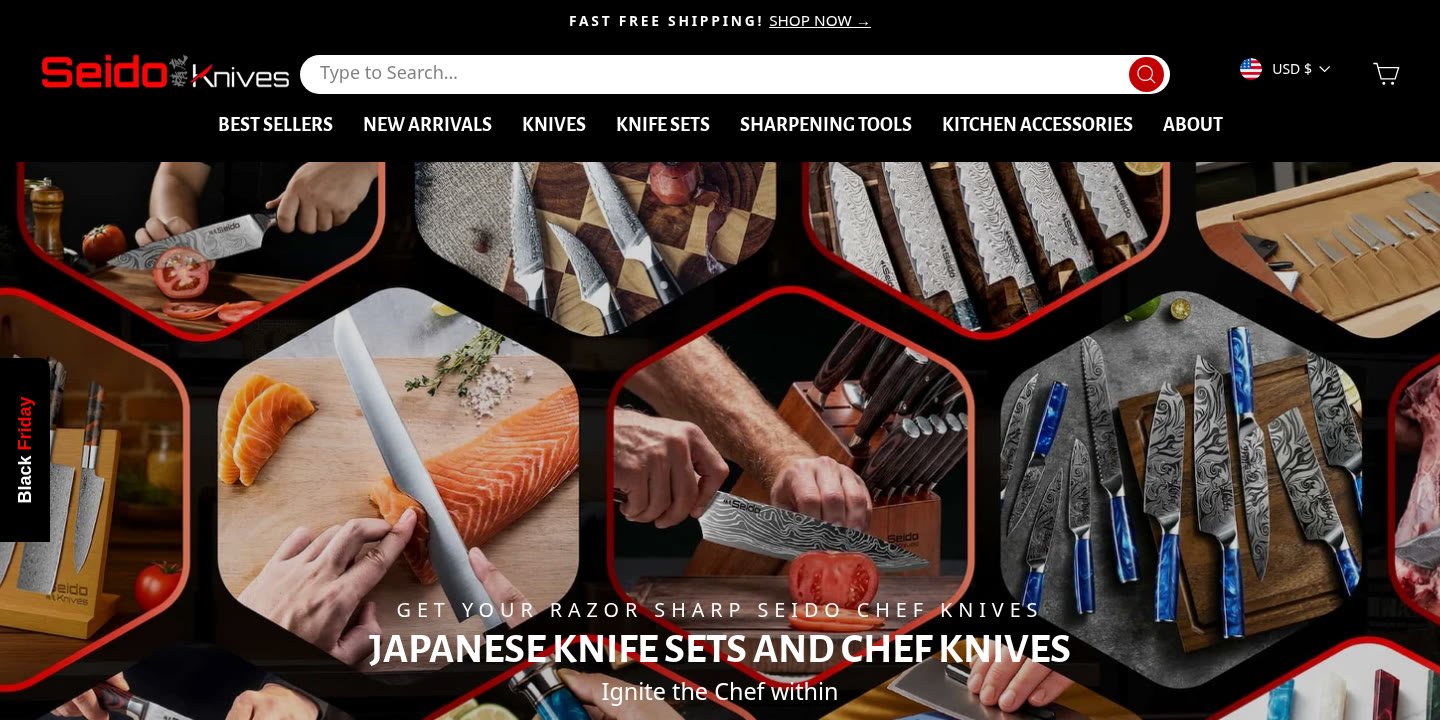
The Seido Knives homepage advertises promotional perks like fast free shipping banners and seasonal discounts. Before completing your purchase, visit the official site’s Shipping Policy, Refund Policy, and Warranty pages to confirm delivery timetables to your region and understand the return inspection criteria. Ensure your referral discount of 15% off is correctly calculated in your shopping cart before finalizing payment.
Pros and Cons of a Seido Knife Set
No single kitchen knife brand satisfies every culinary demographic. Reviewing both the advantages and the natural limitations of Seido Knives helps set realistic expectations.
Pros
- Extensive Variety of Profiles: Unlike traditional Western cookware brands that sell basic European shapes, Seido Knives provides authentic Japanese silhouettes including Gyuto, Santoku, Nakiri, Kiritsuke, Bunka, and Sujihiki.
- Competitive Catalog Promotional Pricing: With sale discounts frequently reaching 40% to 61% off standard catalog list prices (e.g., the Japanese Master Chef Knife Set discounted from $429.00 to $169.00), outfitting a kitchen is accessible.
- Flexible Knife Set Builder: The option to build a custom set prevents cooks from accumulating unused filler blades.
- High-Carbon Stainless Construction: Blends acute cutting angles with corrosion resistance, eliminating the rust anxiety associated with unclad reactive carbon steel.
- Visually Striking Handle and Steel Finishes: Collections like Awabi, Epokishi, and colored Damascus lines offer distinct aesthetic appeal on modern countertops.
Cons
- Requires Hand-Washing and Immediate Drying: High-carbon stainless steel cutlery should never be placed in an automatic dishwasher, where harsh detergents and heat degrade handles and chip fine edges.
- Thinner Edges Demand Proper Cutting Technique: Japanese blades feature acute bevels designed for slicing and push-cutting; twisting the blade into hard bones, frozen foods, or cutting on glass surfaces can cause micro-chipping.
- Variable Inventory Across Collections: Because Seido Knives maintains over a dozen individual series, certain colorways or specific blade types in niche lines may occasionally sell out during major sales events.
Who Should Buy a Seido Knife Set (and Who Should Look Elsewhere)?
Understanding the intended user profile ensures you invest in cutlery that fits your lifestyle and culinary habits.
Who It Is For
- Home Cooks Upgrading from Basic Dull Cutlery: If you are still using dull, stamped department-store knives, upgrading to a balanced set with dedicated Gyuto and Nakiri blades dramatically improves prep speed and cutting precision.
- Aesthetic-Conscious Kitchen Enthusiasts: Those who appreciate vibrant handle designs, Damascus layering, and hammered tsuchime finishes will enjoy displaying collections like Awabi or Master series on their counters.
- Shoppers Seeking Comprehensive Bundles: Cooks moving into a new home who need a matching 8-to-17-piece block setup containing prep tools, steak knives, shears, and sharpening rods in one purchase.
Who Should Look Elsewhere
- Heavy-Handed or Low-Maintenance Users: If you prefer tossing all kitchen utensils into the dishwasher or frequently use knives to pry open lids or hack through frozen blocks of meat, thick commercial German butcher knives are better suited to that kind of abuse.
- Traditional Single-Bevel Purists: Traditional Japanese sushi masters often require single-bevel Yanagiba or Deba knives forged from white or blue paper carbon steel. Seido Knives caters primarily to double-bevel Western/Japanese hybrid versatility.
Common Questions About Pricing, Promos, and Ordering
When purchasing cutlery online, verify that you are on the authentic official domain (seidoknives.com). As documented in our Seido Knives discount code guide, there is no manual coupon code needed to claim our special offer; clicking through our verified referral link automatically applies a 15% discount to your eligible order at checkout. Remember to verify the final order total and shipping information on the checkout screen before placing your order.
Remember that you get 15% off your order when you shop through our link, with savings confirmed directly at checkout.
Gift 15% off with your referral link
FAQ
What is included in a typical Seido knife set?
Inclusions vary based on the specific package. Core collections like the Japanese Master Chef Knife Set are available in configurations including an 8-knife set and a 17-piece block set. Common blades include an 8-inch Gyuto chef knife, Santoku, Nakiri, slicing knife, utility knife, and paring knife. Expanded block sets may also integrate steak knives, kitchen shears, and sharpening accessories. Always check the exact product listing on seidoknives.com before purchasing.
What is the difference between the Master Series and the Awabi Series?
The Master Series is Seido’s flagship high-carbon stainless steel collection, designed for everyday versatility and accessible pricing (documented sale price from $169.00 down from $429.00). The Awabi Series represents a higher tier featuring multi-layered Damascus steel, distinct blade patterning, and stylized ergonomic handles, reflected in its higher regular price ($899.00 regular, catalog sale price $399.00).
How does the Seido Knife Set Builder work?
The Knife Set Builder is a dedicated feature on the official Seido Knives storefront that allows shoppers to bypass pre-assembled collections. Instead of accepting fixed packages, you select your preferred blade types (such as Gyuto, Kiritsuke, Santoku, or Petty knives) and compatible accessories, building a tailored package suited to your exact culinary habits while still benefiting from bundle savings.
Are Seido knives dishwasher safe?
No. Like all fine high-carbon and Damascus kitchen cutlery, Seido knives should never be cleaned in an automatic dishwasher. The combination of intense heat, aggressive chemical detergents, and turbulent water spraying will degrade natural wood or composite handles and cause micro-chipping along acute blade edges. Wash your knives by hand using mild dish soap, rinse with warm water, and dry thoroughly with a soft towel immediately after use.
What steel is used in Seido knife sets?
The official Seido Knives store lists several blade materials across its collections. These include high-carbon stainless steel for core collections like the Master Series, folded Damascus steel for artisan lines like the Awabi Series, and premium Japanese knife steels including VG-10 and AUS-10. Exact metallurgy for each model is detailed on its respective official product page.
How do I claim the 15% discount on my Seido knife set?
There is no separate coupon code required. You receive 15% off your order simply by navigating to the store through our referral link. The promotional discount is applied to your qualifying purchase in your shopping cart or at checkout. If you do not see the discount immediately, verify your cart contents and confirm the final calculated total before completing payment.
Related Reading
- Are Seido Knives Good? What to Know Before Buying (2026)
- Seido Knives Discount Code Guide: How to Get 15% Off in 2026
- Seido Knives Review 2026: Japanese Kitchen Knives Explained