TruthScan AI Image Detector: Forensic Checks and How It Works (2026)
The truthscan ai image detector is an enterprise verification engine designed to evaluate digital images for synthetic generation, AI manipulation, and regional tampering in one to two seconds. Rather than evaluating visual submissions through superficial optical character recognition (OCR) or basic file headers, the platform applies forensic analysis at the pixel and metadata levels to return an automated classification, confidence score, and visual heatmap. Organizations embed this verification layer directly into inbound upload workflows to inspect claims evidence, identity documentation, expense receipts, and marketplace listings before automated payouts or system approvals occur.
Affiliate disclosure: This article may contain affiliate links. If you buy through them, we may earn a commission at no extra cost to you. Details were checked on November 20, 2026 and can change.
Official website · Latest pricing & offers
Quick Answer: How Does the TruthScan AI Image Detector Work?
The truthscan ai image detector screens visual files to determine whether an image was created by generative AI models, altered using AI-assisted editing tools, or manipulated using traditional digital retouching. The engine operates across web browsers, bulk upload queues, and automated REST APIs to process images in one to two seconds. When an image is received, the system examines sub-pixel artifacts, structural inconsistencies, and metadata integrity without relying on human visual inspection.
- Multi-Engine Detection: Inspects submissions for fully synthetic generation, face swaps, localized object addition or removal, and digital text tampering.
- Visual Heatmaps: Highlights the precise geographic coordinates of an image where pixel structures diverge from natural sensor capture.
- Auditable Metrics: Returns an overall authenticity classification alongside a granular probability score and plain-language explanation.
- Real-Time Performance: Delivers verdicts within 1–2 seconds, capable of handling continuous streams via REST APIs and webhooks.
- Flexible Submission Paths: Accepts single browser uploads, ZIP archives containing up to 500 files, a Chrome browser extension, or direct API integration.
Architecture of the TruthScan AI Image Detector: Pixel and Metadata Analysis
Modern generative AI platforms can produce photorealistic imagery in less than 60 seconds. Consumer-facing image generators produce files that easily deceive the human eye and pass traditional OCR checks because rendered text reads cleanly and visual textures mimic real-world lighting. To counter this, the detection pipeline built by TruthScan evaluates submissions at fundamental computational layers rather than relying on stylistic appearance.
When an image file (such as a JPG, PNG, JPEG, TIF, or WEBP up to 10 MB) enters the platform, the engine executes parallel analytical routines. The primary inspection focuses on the pixel lattice. Natural camera sensors record light through physical lenses, color filter arrays, and hardware-level analog-to-digital converters, leaving consistent hardware noise profiles, compression signatures, and sensor artifacts across the entire frame. Generative models, diffusion pipelines, and neural rendering tools synthesize pixels mathematically. These mathematical distributions exhibit statistical anomalies, unnatural frequency responses, and regional boundary seams that do not occur in authentic optical photography.
Simultaneously, the platform inspects the file’s container structure and metadata indicators. While metadata alone is insufficient for fraud prevention—since bad actors can easily strip EXIF data or re-encode files—inconsistencies between structural file markers and underlying pixel arrangements provide valuable signals. The system correlates file structure anomalies against pixel-level evidence to assemble an audit-ready forensic profile for every processed asset.
Decoding TruthScan Verdicts: Confidence Scores and Visual Heatmaps
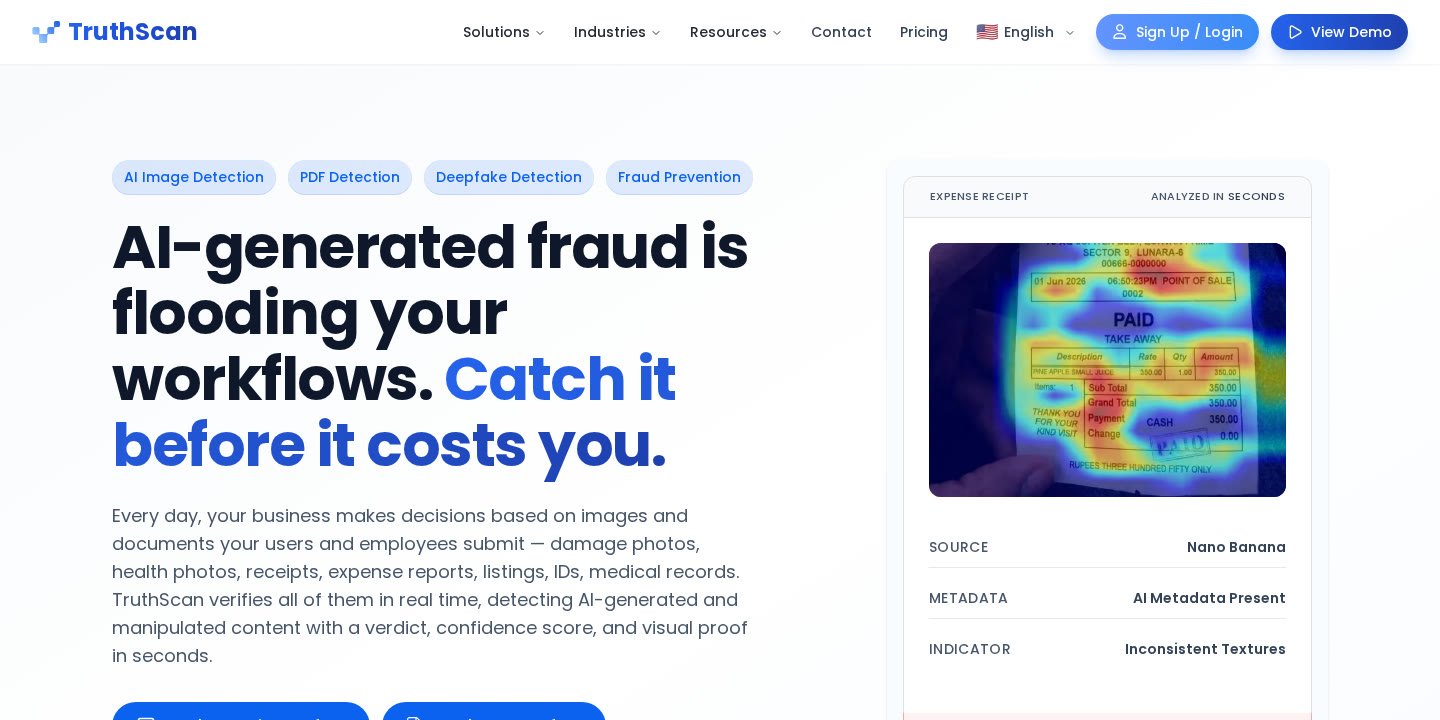
Every scan conducted by TruthScan produces a structured forensic output designed to remove guesswork from fraud reviews and automated policy enforcement. Instead of delivering an ambiguous pass-or-fail flag, the platform provides a layered verdict designed for both programmatic ingestion and manual operational review.
For a detailed breakdown of how mathematical probabilities translate into operational classifications, read our guide on TruthScan accuracy and detection scores. In standard operation, the engine returns three primary forensic assets with every completed image check:
- Overall Classification: A clear, plain-language operational determination indicating whether the media is authentic, synthetic, or manipulated.
- Confidence Score: A mathematical probability metric reflecting the statistical certainty of the classification based on benchmarked pattern recognition.
- Visual Detection Heatmap: A color-mapped spatial overlay indicating precisely which bounding regions and pixel clusters triggered the detection algorithms.
The visual heatmap serves as defensible forensic proof. In contested operations—such as an insurance claimant disputing a denied repair estimate, an e-commerce seller appealing a listing takedown, or an employee questioning a rejected expense voucher—the heatmap isolates the altered zones. If a claimant took an authentic photograph of a vehicle bumper and used an inpainting model to add body damage, the heatmap highlights the bumper damage while leaving the surrounding vehicle panels marked as unaltered.
Localized Tampering vs. Synthetic Generation: What the Engine Detects
A persistent vulnerability in first-generation AI detectors is whole-image averaging. When an algorithm assesses an image by averaging data across the entire canvas, localized edits frequently get lost in the noise. An otherwise real photograph containing a swapped face, a modified total on a receipt, or an artificially inserted dent can score as authentic because most of the file’s pixels originated from an authentic camera sensor.
TruthScan addresses this problem by performing region-level forensic analysis. The system parses the canvas into micro-regions to detect localized anomalies alongside whole-canvas generative synthesis. The engine surfaces four distinct classes of manipulation:
- Fully AI-Generated Images: Complete synthetic generation originating from text-to-image or image-to-image foundation models. TruthScan benchmarks indicate 99.3% average detection accuracy across 92 image generators and 250,000 real images, supporting over 500 distinct generator variations. Documented evaluations include models such as Nano Banana 2 (100%), Seedream 4.5 (100%), Imagen 4 (99.9%), Grok (99.9%), Flux 2 Pro (99.4%), GPT-Image 1.5 (99.2%), and Midjourney (98.6%).
- AI-Assisted Inpainting and Outpainting: Localized alterations where an authentic background is retained while specific elements are digitally placed, modified, or erased using diffusion fill tools.
- Face Swaps and Identity Modification: Synthetic replacement of facial features within authentic photographs, a common vector in synthetic identity creation and KYC onboarding fraud.
- Traditional Digital Retouching: Classical manual photo manipulation, clone-stamping, and splicing performed in image editing software without neural networks.
Detection performance varies slightly across specific media types, reflecting underlying content structures. Published operational benchmarks report the following accuracy rates by category:
| Content Category | Detection Accuracy |
|---|---|
| Chats & Messaging Screenshots | 99.9% |
| Product Photography | 99.8% |
| Close-up Imagery | 99.7% |
| Full Body Imagery | 99.6% |
| Expense Receipts | 99.3% |
| Identity Documents | 99.3% |
| Generic Visual Media | 99.2% |
| Food & Delivery Imagery | 99.0% |
| Automotive & Vehicle Panels | 99.0% |
| Faces & Portraits | 98.6% |
| Invoices & Billing Documents | 98.1% |
| Payment & ID Cards | 98.1% |
Step-by-Step Inspection Workflow: API, Dashboard, and Live Capture
Organizations deploy TruthScan across varying technical operational environments. Depending on operational scale, teams utilize automated API handshakes, browser-based review interfaces, or client-facing capture workflows.
1. The Ingestion Stage
Media enters the TruthScan pipeline through three primary entry points:
- REST API & Webhooks: Customer applications transmit images directly from upload forms at the point of submission. The API handles real-time single requests and asynchronous batch processing, returning structured JSON payloads to downstream databases.
- Web Dashboard Batch Upload: Operational teams upload files directly within their browser session. Users can process individual files or submit compressed ZIP archives containing up to 500 images per batch, with processing time averaging 1–2 seconds per image.
- Chrome Extension: Trust and safety investigators can run forensic evaluations on images directly within internal moderation portals, social media platforms, or web-based ticket queues without leaving the browser page.
2. Automated Processing and Risk Routing
Once ingested, the image passes through the detection pipeline. Organizations configure risk thresholds inside their workflow logic to execute conditional routing:
- Low-Risk Path: Clean submissions with high authenticity confidence scores trigger immediate downstream actions, such as instant warranty approvals, listing publications, or automated expense reimbursements.
- High-Risk Review Queue: Flagged submissions that meet or exceed risk thresholds route directly to human investigators, accompanied by the forensic summary and heatmap coordinates.
3. TruthScan Capture (Beta) Live Resolution
To address edge cases and maintain low false positive friction (which sits below 1% in standard operations), TruthScan includes a live capture tool. When an inbound submission produces a borderline score or triggers an unverified flag, the workflow can dispatch a TruthScan Capture link directly to the submitter’s mobile device.
The user opens the link and captures the subject matter live through their device camera, bypassing local file pickers and gallery uploads. The authenticated live image is analyzed and linked directly to the original transaction, eliminating fraud risks associated with pre-generated or edited gallery files.
TruthScan AI Image Detector Pricing and Result Quotas
TruthScan structures its commercial access around usage-based consumption tiers, where one result equals one scanned image or one processed PDF page. Organizations choose between self-serve tiers and customized enterprise contracts depending on submission volume and compliance requirements.
For an in-depth breakdown of seat structures, overage calculations, and contract variables, consult our analysis of TruthScan pricing plans and features. The published tier structure includes the following options:
| Plan Tier | Monthly Cost | Included Results | Overage Cost | Key Features Included |
|---|---|---|---|---|
| Free | $0 / month | 25 results / month | N/A | Full API access, dashboard detection history, Chrome extension, unlimited seats. |
| Starter | $24 / month ($290/yr) | 1,000 results / month | $0.03 / result | Batch uploads, CSV export of results, audit-ready detection reports, standard support. |
| Professional | $83 / month ($990/yr) | 5,000 results / month | $0.02 / result | Priority processing queue, higher API rate limits, audit-ready reports, unlimited seats. |
| Business | $333 / month ($3,990/yr) | 40,000 results / month | $0.01 / result | Zero Data Retention (ZDR), highest self-serve rate limits, priority support, custom DPA. |
| Enterprise | Custom Quote | Custom volume | $0.005 or less | Dedicated throughput, custom SLAs, regional processing (EU/UK), 24/7 account team. |
All plans include access to the Chrome extension and support unlimited team seats drawn against the unified monthly organizational result pool. Unused results do not roll over between billing cycles. On paid plans, overage charges accrue at the plan’s flat per-result rate, with real-time tracking visible once consumption reaches 80% of quota. Annual billing provides two months free across all paid tiers.
Industry Use Cases: Where Image Forensics Protect Workflows
Generative AI tools have lowered the cost of producing believable photographic fabrications to zero. Consequently, fraud schemes that previously required specialized technical skills can now be automated by casual abusers and organized fraud rings alike. To explore the broader operational footprint across document analysis and workflow defense, see our comprehensive TruthScan review and fraud prevention guide.
Delivery Platforms and Marketplaces
Delivery networks experience significant losses from automated refund abuse. Attackers generate photos of spoiled goods, foreign objects, undercooked food, or empty packaging, submitting them through customer support chats to trigger instant merchant refunds. TruthScan validates claim photos inline, flagging synthetic visual artifacts and identifying identical edited images submitted across multiple accounts.
Insurance and Claims Processing
Insurance special investigation units (SIUs) encounter synthetic vehicle damage photos, manipulated property loss imagery, and synthetic medical receipts. Adjusters face liability if legitimate claims are delayed, yet paying synthetic claims inflates loss ratios. TruthScan provides adjusters and SIU investigators with forensic documentation that details whether damage was physically present at the scene or synthesized using inpainting software.
Digital Health and Telemedicine
Telehealth platforms rely on patient-submitted clinical photographs to inform asynchronous triage and treatment decisions. Synthetic images submitted to acquire prescription pharmaceuticals or fabricate chronic medical conditions represent significant clinical and regulatory liabilities. The detection engine validates health photos for physical authenticity before medical professionals review clinical charts.
KYC, Onboarding, and Financial Services
Identity verification workflows routinely screen government-issued IDs, proof of address utility bills, and applicant portraits. Modern generative models produce synthetic identity documents that conform strictly to standard template dimensions, allowing them to pass automated format validators. TruthScan examines the underlying sub-pixel lattice of identity portraits and supporting documents to verify that the file originated from an authentic physical capture rather than a synthetic generator.
Technical Limitations and Handling Image Laundering
While forensic algorithms evaluate structural pixel distributions effectively, real-world image transmission introduces degradations that can impact signal fidelity. Understanding how the system handles file transformations is critical for setting up operational pipelines.
Survival Against Compression and Filtering
Media submitted through consumer web platforms rarely retains pristine master characteristics. Images undergo JPEG compression, platform-specific re-encoding, resizing, and downsampling across social sharing channels. Furthermore, sophisticated fraudsters attempt deliberate “image laundering”—injecting noise patterns, applying artificial grain, or passing files through multiple filters to strip digital signatures.
The TruthScan architecture is specifically calibrated against these transformations, maintaining detection capabilities through typical compression cycles and deliberate noise laundering. However, severe degradation creates physical boundaries for any forensic tool. When an image is subjected to extreme generational loss—such as a low-resolution screenshot of a compressed thumbnail—the underlying sub-pixel data is permanently discarded. In such edge cases where pixel signals are unrecoverable, workflows should route files to manual review or trigger a live verification request via TruthScan Capture.
Resolution and Format Recommendations
To maximize forensic accuracy, organizations should capture and transmit media under optimal technical parameters:
- Submit Native Resolutions: Downsampling images prior to API ingestion discards mathematical indicators. Always send original client-side captures whenever possible.
- Supported Formats: The engine natively supports JPG, PNG, JPEG, TIF, and WEBP formats up to 10 MB.
- Batching Limits: Web dashboard ZIP uploads should be maintained at or below 500 images per batch to maintain consistent 1–2 second per-image processing speeds.
- Region Cropping: For isolated micro-edits involving minuscule alterations (such as changing a single digit on a billing document), cropping into the specific region of interest and rescanning provides an amplified signal read.
Evaluating Image Forensics: Alternatives and Category Comparisons
Organizations evaluating verification infrastructure must distinguish between different technical approaches to content integrity. Depending on enterprise requirements, teams generally choose between three distinct categories of screening tools:
1. Forensic AI Detectors (e.g., TruthScan)
These platforms evaluate visual files using computer vision models trained specifically to identify the structural, statistical, and mathematical artifacts of synthetic generation and regional manipulation. They require no prior watermarking and operate asynchronously on raw user uploads. They are optimized for fraud prevention, trust and safety, and claims integrity.
2. Watermarking and Provenance Standards
Provenance frameworks (such as C2PA metadata and cryptographic watermarks) embed cryptographic signatures directly into image files at the moment of camera capture or generative synthesis. While technically robust, provenance models require universal hardware and software adoption. In real-world fraud environments, bad actors simply strip metadata or use open-source generative tools that omit provenance tags entirely, leaving forensic pixel analysis as the primary operational defense.
3. Traditional Content Moderation APIs
Standard visual moderation platforms identify explicit content, violence, copyrighted logos, or known CSAM hashes. However, these tools are built to recognize semantic subjects rather than forensic anomalies. An AI-generated photo of a dented car or a forged receipt contains no explicit material and easily passes standard content moderation filters, necessitating dedicated forensic detection layers.
Data Privacy, Retention, and Compliance Standards
Enterprise fraud prevention tools frequently process sensitive customer files, including financial statements, identity credentials, and proprietary commercial media. TruthScan operates under enterprise security frameworks that dictate how user data is stored, processed, and discarded.
The organization maintains SOC 2 Type II certification, ISO 27001 compliance, GDPR adherence, AES-256 data encryption standards, and holds partnership status with the Global Anti-Scam Alliance (GASA). By default, processed submissions are retained within the operational dashboard for historical reporting and audit verification.
For organizations operating under stringent regulatory mandates—such as healthcare networks, lending institutions, and enterprise banks—TruthScan provides Zero Data Retention (ZDR) capabilities on Business and Enterprise plans. Under ZDR, customer submissions and data are immediately discarded once detection is complete and are never utilized to train detection models. Additionally, Enterprise customers can request regional data processing deployed on dedicated EU or UK endpoints to comply with localized data residency requirements.
Official website · Latest pricing & offers
FAQ
What counts as a single result in TruthScan?
In TruthScan, one result equals either one scanned image or one processed page of a PDF document. If an operational team processes a 5-page PDF document containing visual receipts, the scan consumes 5 results from the monthly pool. Single image uploads (JPG, PNG, JPEG, TIF, WEBP) consume exactly one result each.
Does the TruthScan AI image detector require API integration to work?
No. While automated workflows frequently use the REST API and webhooks for real-time app integration, all platform capabilities are accessible directly within a web browser. Users can perform manual single-file inspections, execute bulk ZIP uploads containing up to 500 images, review visual heatmaps, and export CSV forensic reports directly from the dashboard. Investigators can also use the free Chrome extension to scan images directly on external web pages.
Can TruthScan detect localized edits, or does it only catch fully synthetic images?
TruthScan detects localized edits alongside fully synthetic generation. While many basic detectors rely on whole-image averaging—which frequently misses minor alterations—TruthScan evaluates images at the sub-pixel and regional level. This allows the engine to flag swapped faces, digitally manipulated text, clone-stamped objects, and localized inpainting on otherwise genuine photographs.
What happens if a submission consumes all quota results on a paid plan?
Paid accounts do not experience service interruptions when monthly quotas are exhausted. Additional submissions are billed automatically at the plan’s flat per-result overage rate ($0.03 on Starter, $0.02 on Professional, or $0.01 on Business). Account administrators can track cumulative usage and view a running overage total in the management dashboard once consumption reaches 80% of the plan quota.
How does TruthScan handle false positives when an authentic photo is flagged?
The system maintains a false positive rate below 1% across production environments. To resolve borderline classifications without introducing operational friction or manual review delays, organizations can deploy TruthScan Capture (beta). This feature sends a secure link directly to the submitter’s mobile device, allowing them to take an authenticated live photograph that bypasses pre-saved gallery files and attaches directly to the original transaction record.
Does TruthScan store customer images or use them to train AI models?
By default, files are retained within the customer’s dashboard to maintain detection histories and generate audit-ready reports. However, customers on Business and Enterprise plans can activate Zero Data Retention (ZDR). Under ZDR, submitted images are immediately discarded once detection is complete. TruthScan never uses customer submissions to train detection models under ZDR, and formal Data Processing Addendums (DPAs) are available for Business and Enterprise tiers.
Related Reading
- TruthScan Accuracy Explained: What Detection Scores Mean (2026)
- TruthScan Pricing Explained: Plans, Results, and Features (2026)
- TruthScan Review 2026: AI Content and Fraud Detection Explained