
TruthScan Review 2026: AI Content and Fraud Detection Explained
When assessing automated forensic defenses against synthetic media and document manipulation, this truthscan review examines how the TruthScan platform inspects user-submitted images and PDF files to prevent automated fraud across enterprise operations. By analyzing content at both the pixel and metadata levels, the platform provides automated risk decisions, forensic heatmaps, and confidence scores in one to two seconds. This comprehensive guide covers TruthScan’s technical architecture, supported detection categories, usage-based plans, and practical operational boundaries.
Affiliate disclosure: This article may contain affiliate links. If you buy through them, we may earn a commission at no extra cost to you. Details were checked on November 16, 2026 and can change.
Official website · Latest pricing & offers
Quick Answer: What Is TruthScan and How Does It Function?
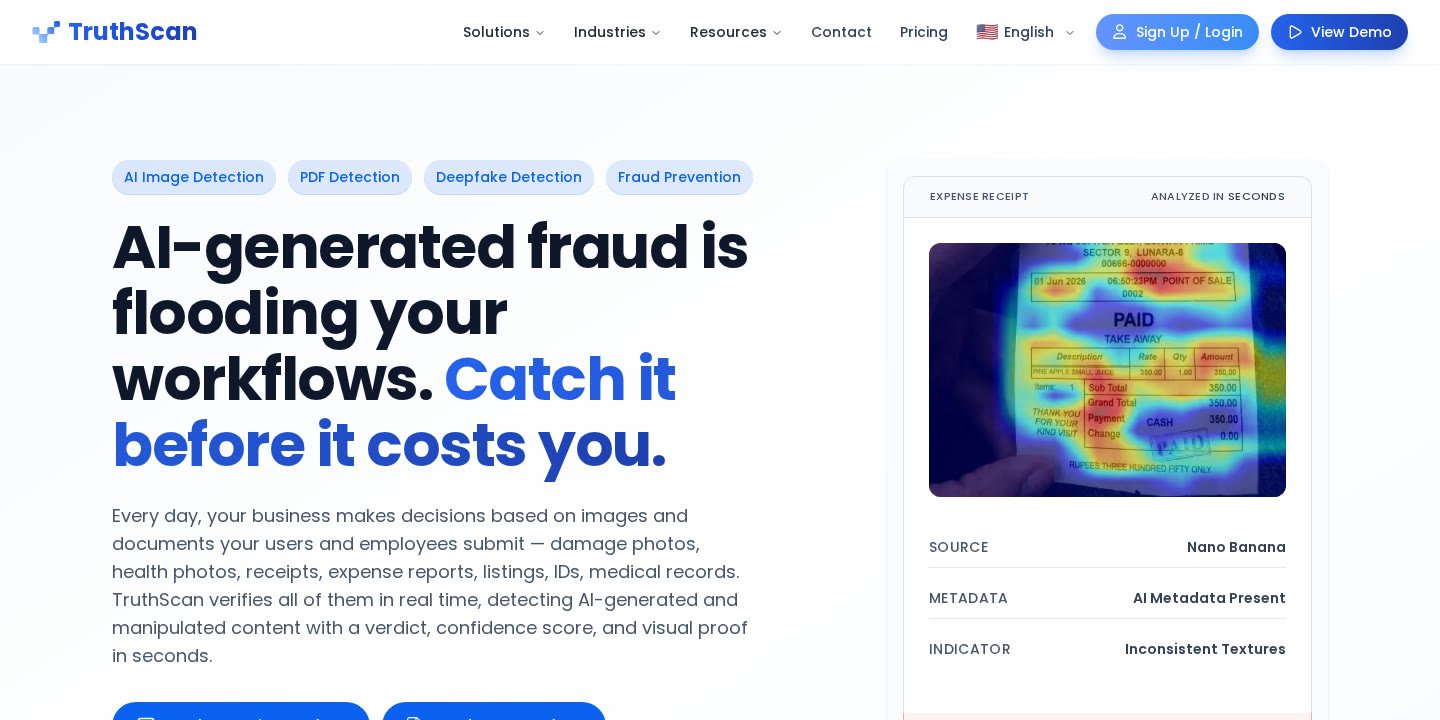
TruthScan is a cloud-based forensic verification platform engineered by Undetectable Inc. (headquartered in Sheridan, Wyoming) that protects digital workflows from generative AI fraud, edited documents, and synthetic media. The software functions as a verification layer embedded into existing customer upload pipelines via REST APIs, webhooks, a web dashboard, or a browser extension. Rather than relying on simple optical character recognition (OCR) or whole-image global averages, TruthScan pinpoints localized edits, AI-generated imagery, and document tampering.
- Primary engines: AI Image Detection and PDF/Document Detection, supported by deepfake and fraud-prevention modules.
- Processing speed: Delivers end-to-end verdicts, confidence scores, and visual heatmaps within 1 to 2 seconds per asset.
- Documented benchmark accuracy: 99.3% average detection accuracy across 92 image generators and 250,000 real images, covering over 500 generative engines with a false positive rate below 1%.
- Delivery mechanisms: Cloud REST API, webhooks, browser dashboard with batch ZIP uploads, and a free Google Chrome extension.
- Pricing structure: Usage-based tiers ranging from a permanent Free plan (25 results per month) up to Business ($333 per month billed annually for 40,000 results) and custom Enterprise deployments.
- Security credentials: SOC 2 Type II certified, ISO 27001 audited, GDPR compliant, AES-256 encrypted, and partner of the Global Anti-Scam Alliance (GASA).
The AI Fraud Landscape: Why Traditional Verification Fails
To understand the operational rationale behind TruthScan, organizations must look at the shifting economics of digital fraud. Historically, digital workflows in e-commerce, insurance, digital healthcare, and lending were designed around the fundamental assumption that a customer-provided photo or PDF was an authentic representation of a physical object. If a claimant submitted a photo of a crushed automobile fender or a buyer submitted a picture of a spoiled meal, human review teams and OCR parsers could evaluate the content at face value.
Generative artificial intelligence has eliminated the technical friction required to fabricate evidence. According to retail data published on the TruthScan platform, the annual cost of fraudulent returns and claims to retailers exceeded $103 billion even before consumer-facing AI tools became widespread. Today, modern text-to-image and inpainting tools allow bad actors to produce photorealistic damage imagery, doctored receipts, or altered medical invoices in roughly 60 seconds.
Because consumer-grade AI models synthesize clean pixels and coherent text, fabricated documents pass standard human review and automated OCR systems without triggering alerts. OCR systems simply extract characters; they do not verify whether the underlying receipt ever existed or whether an invoice total was mathematically recalculated and re-rendered by an AI PDF editor. TruthScan was developed specifically to address this vulnerability by conducting forensic evaluations at the file metadata and individual pixel level before a payout, refund, or account approval is granted.
Core Capabilities Evaluated in This TruthScan Review
TruthScan organizes its verification tools around two primary forensic engines—AI Image Detection and PDF Detection—supplemented by specialized capture tools and workflow controls. In this truthscan review, we examine each module’s technical specifications and functional scope.
1. AI Image Detection and Region-Level Heatmaps
A core differentiator in TruthScan’s image analysis engine is its focus on region-level evaluation. Conventional image classifiers frequently scan an uploaded file as a unified whole, calculating a single global average score. This architectural approach often misses localized modifications, such as an AI-inpainted dent on an undamaged car bumper, a swapped face on an identity card, or a single modified digit on a transaction record, because the untouched surrounding pixels dilute the forensic signal.
TruthScan analyzes image data down to regional structures. When an altered or fully synthetic image is submitted, the platform generates a forensic report containing:
- A numerical confidence score and classification verdict indicating the likelihood of synthetic generation or tampering.
- A visual detection heatmap that outlines the precise coordinates and regions of the file that were generated, spliced, or retouched.
- Plain-language explanations detailing the specific indicators discovered during analysis.
The image pipeline accepts JPG, PNG, JPEG, TIF, and WEBP file formats up to 10 MB per file, with native resolution recommended to preserve low-level pixel artifacts.
2. PDF and Forensic Document Analysis
Digital document fraud frequently involves vector-level alterations, typography mismatches, synthetic text generation, and metadata discrepancies. Fraudsters routinely use modern AI PDF editors to alter legitimate utility bills, bank statements, or superbills, updating amounts or names while leaving the document layout intact.
TruthScan’s PDF detection engine inspects document structure, embedded fonts, image layers, and underlying source metadata indicators. In pricing and billing terminology, TruthScan treats each page of a multi-page PDF as an individual result (for example, a 12-page document accounts for 12 results against a monthly pool). This ensures that every individual page is subjected to forensic scrutiny rather than sampling only the initial cover sheet.
3. TruthScan Capture (Beta)
One of the persistent challenges in automated fraud prevention is handling borderline scores without alienating authentic customers. Outright denials can damage user retention, while manual queue reviews introduce operational bottlenecks.
TruthScan Capture is a beta feature designed to bridge this gap. When a submission produces an ambiguous verdict or falls into a designated risk threshold, the platform allows the business to send the customer a live link to retake the photo directly on their mobile device. The newly captured media is verified in real time for camera provenance and attached directly to the original audit trail, helping resolve edge cases without manual back-and-forth communication.
4. TruthScan Free Chrome Extension
For trust and safety teams, claims adjusters, and fraud analysts who conduct investigations manually inside customer support portals or web dashboards, TruthScan offers a free Google Chrome extension. The extension allows analysts to evaluate images across their existing web applications without downloading files or switching between browser tabs. Paid and free accounts provide unlimited team seat invitations, enabling distributed review teams to utilize the extension under a shared monthly quota.
How TruthScan Works: From Submission to Automated Risk Routing
TruthScan is designed to function as an invisible forensic layer that runs behind an organization’s existing interface. Implementation does not require end customers to download special software or access a proprietary portal. The verification lifecycle follows a three-step process:
- Connect via API or Interface: Incoming customer-submitted files are routed to the TruthScan REST API or document detection endpoint at the moment of upload. Submissions can be dispatched in real time or via asynchronous batch requests. Alternatively, teams handling manual investigations can upload batches directly through the browser dashboard using ZIP files containing up to 500 images per batch.
- Forensic Inspection and Verdict Generation: Within 1 to 2 seconds, the engine processes the media against its models. It evaluates pixel structures, compression artifacts, and source metadata indicators to detect generative patterns, digital retouching, and face swaps. The API returns an automated verdict accompanied by confidence scores, forensic explanations, and visual heatmaps.
- Risk-Based Workflow Routing: Using the API’s returned data, organizations configure automated conditional logic. Media that scores as clean can be auto-approved instantly, maintaining a frictionless experience for honest users. Media flagged with high fraud probabilities can be routed automatically to an investigator’s queue with the forensic report attached, or redirected to TruthScan Capture for a live photo retake.
Resilience Against Image Laundering and Compression
A common technique among organized fraud rings is “image laundering”—intentionally degrading a fake image to erase digital watermarks and pixel anomalies. Fraudsters attempt this by repeatedly re-encoding JPEGs, resizing images, applying blur filters, injecting synthetic noise, or forwarding files across social messaging platforms that strip metadata.
According to TruthScan’s technical documentation, the detection pipeline is trained to withstand common operational handling, including platform re-compression, resizing, and moderate laundering filters. However, the company explicitly notes the physical limits of digital forensics: extreme degradation, such as submitting a low-resolution screenshot of a thumbnail that has been recompressed multiple times, discards the underlying pixel-level data needed for an unambiguous read. In such scenarios, submitting higher-resolution or uncropped source files yields the most accurate detection outcome.
Performance Benchmarks: Generator Coverage and Category Accuracy
To assess detection efficacy, TruthScan benchmarks its models against both historical generative frameworks and contemporary frontier models. Across an evaluation dataset comprising 92 distinct image generators and 250,000 authentic images, TruthScan reports an average detection accuracy of 99.3%, maintaining greater than 95% detection across more than 500 image generation engines tested, while keeping the overall false positive rate below 1%.
The platform documents specific accuracy benchmarks across both model architectures and real-world asset categories:
| Evaluated Category | Detection Accuracy Rate | Operational Fraud Context |
|---|---|---|
| Chats & Messaging | 99.9% | Fabricated customer support transcripts, fake confirmations |
| Product Listings | 99.8% | E-commerce marketplace listings, non-existent inventory |
| Close-up Photography | 99.7% | Macro defect images, localized product flaws |
| Full Body Imagery | 99.6% | Identity verification, staged injury representations |
| Documents | 99.3% | Utility bills, official notices, bank correspondence |
| Receipts | 99.3% | Expense reports, proof-of-purchase refund submissions |
| Generic Photography | 99.2% | General background imagery, staged claim contexts |
| Food & Perishables | 99.0% | Delivery claims, “raw food” or missing-item fraud |
| Automotive & Vehicles | 99.0% | Auto insurance damage claims, bumper/panel alterations |
| Faces & Portraits | 98.6% | KYC identity portraits, synthetic headshots, face swaps |
| Invoices | 98.1% | Contractor billing, healthcare superbills, repair estimates |
| Cards & Identification | 98.1% | Payment cards, driver’s licenses, national ID cards |
In addition to broad categorical coverage, TruthScan’s models are benchmarked against specific frontier image generation architectures, achieving documented accuracy ratings including Nano Banana 2 (100%), Seedream 4.5 (100%), Imagen 4 (99.9%), Grok (99.9%), Flux 2 Pro (99.4%), GPT-Image 1.5 (99.2%), and Midjourney (98.6%).
Industry Applications: Where TruthScan Operates
Because generative AI tools allow anyone to alter digital evidence easily, synthetic fraud impacts multiple commercial sectors. TruthScan structures its detection models around several key industry workflows:
Delivery and On-Demand Marketplaces
On-demand delivery platforms face significant margin pressure from coordinated refund abuse. Fraud rings submit edited delivery photos showing missing items, damaged packaging, or synthetic “raw food” to secure automatic account credits. TruthScan screens customer-submitted claim photos in-line prior to issuing credits, identifying repeated visual assets and AI-altered items across multiple user accounts.
Insurance Claims and Special Investigation Units (SIU)
In auto, property, health, and life insurance pipelines, claimants can use text-to-image tools to prompt an AI model to add a dent to an undamaged car panel, add water damage to a ceiling, or doctor an injury photo. TruthScan verifies claims imagery and supporting documents, generating audit-ready forensic reports that SIU teams can use to defend claim adjustments or denials.
Digital Health and Telemedicine
Telehealth platforms rely on patient-submitted photographs for remote clinical assessments, prescription renewals, and insurance billing. TruthScan verifies that submitted medical photos are authentic and unedited. It also performs forensic PDF analysis on medical invoices and superbills to detect altered financial totals or fabricated provider information.
KYC, Onboarding, and Financial Services
Synthetic identity fraud frequently bypasses traditional template-matching KYC systems. Fraudsters can generate synthetic profile pictures, fabricate utility bills for proof of address, or alter bank statements using AI PDF editors. TruthScan provides a forensic layer during account creation, ensuring document images and PDF statements originate from authentic sources before accounts or credit lines are opened.
E-Commerce Returns and Listing Integrity
Online retailers and third-party marketplaces encounter both buyer-side and seller-side media manipulation. Dishonest buyers submit AI-generated photos of “broken” merchandise to trigger returnless refunds, while malicious sellers deploy synthetic product photos to advertise inventory they do not own. TruthScan screens both listings and return requests to maintain marketplace trust.
TruthScan Review of Plans, Pricing, and Usage Limits
A critical component of this truthscan review is examining the platform’s commercial pricing model. TruthScan structures its services around usage-based plans without per-seat licensing fees. Organizations can invite unlimited team members under Settings → Teams & Roles, with all team members drawing from a shared monthly quota of results.
In TruthScan’s accounting, one result equals one analyzed image or one page of an analyzed PDF. For example, processing a single 10-page bank statement consumes 10 results from the plan’s balance.
| Plan Tier | Monthly Cost | Annual Prepay Cost | Included Results / Mo. | Overage Cost / Result | Key Features Included |
|---|---|---|---|---|---|
| Free | $0 | $0 | 25 | N/A (No overage) | Full API access, detailed indicators, dashboard history, Chrome extension, unlimited seats |
| Starter | $24 / mo | $290 / yr (2 mos free) | 1,000 | $0.03 | CSV exports, batch uploads, audit-ready detection reports, standard support |
| Professional | $83 / mo | $990 / yr (2 mos free) | 5,000 | $0.02 | Priority processing queue, higher API rate limits, Chrome extension, unlimited seats |
| Business | $333 / mo | $3,990 / yr (2 mos free) | 40,000 | $0.01 | Zero Data Retention (ZDR), highest self-serve rate limits, priority support, DPA available |
| Enterprise | Custom | Custom | Custom volume | $0.005 or less | Custom SLAs, dedicated throughput, 24/7 account team, on-prem/dedicated deployment, EU/UK regional endpoints |
Billing Mechanics and Overage Handling
TruthScan operates on month-to-month terms with the option to prepay annually to receive two months free. Paid subscriptions do not abruptly cut off service when an organization exceeds its quota. Instead, overages are billed automatically at the tier’s designated per-result rate ($0.03 on Starter, $0.02 on Professional, and $0.01 on Business). Dashboards display a running total of usage starting once an account reaches 80% of its monthly allowance.
Unused results do not roll over to subsequent months; the quota resets at the beginning of each billing cycle. For high-volume enterprise operations processing roughly 100,000 results per month or more, TruthScan offers customized contracts with unit pricing of $0.005 or less per result, tailored Service Level Agreements (SLAs), and dedicated throughput.
Data Retention and Regulatory Compliance
Data privacy is a vital consideration for businesses handling sensitive customer files, such as insurance records, medical documentation, and identity papers. TruthScan maintains SOC 2 Type II certification, ISO 27001 compliance, GDPR adherence, and AES-256 encryption across all data pipelines.
By default, user-submitted media is retained in dashboard histories. However, for organizations operating under strict privacy mandates, Zero Data Retention (ZDR) is available starting on the Business tier ($333/month). When ZDR is activated, submitted files and customer records are immediately discarded the moment forensic analysis concludes, ensuring media is never retained or utilized for model training. Furthermore, Data Processing Addendums (DPAs) are available for Business and Enterprise accounts, and dedicated EU/UK regional endpoints can be deployed for Enterprise clients requiring strict local data residency.
Step-by-Step Implementation: From Browser to Production API
Integrating TruthScan into an operational workflow typically follows one of three technical deployment paths depending on the organization’s technical maturity and submission volume:
Option 1: Browser-Based Manual Audits
For small investigation teams or immediate testing, no coding is required. Fraud analysts can log in to the TruthScan web interface, upload individual images or batch ZIP archives (containing up to 500 images per batch, under 10 MB per file), and view the resulting forensic heatmaps and confidence scores directly in the browser. Result histories can be exported to CSV on Starter tiers and above for internal recordkeeping.
Option 2: The Google Chrome Extension
For organizations operating within customer relationship management (CRM) platforms, help desks, or claims review web portals, the free Chrome extension offers an in-line solution. Analysts can right-click or inspect images directly on any webpage to query TruthScan’s models without manually saving files to their desktop. Seats are unlimited, allowing broad deployment across front-line support staff.
Option 3: REST API and Webhook Integration
For fully automated enterprise workflows, developers can integrate TruthScan directly into existing backend services using standard REST endpoints and webhooks. Both free and paid accounts include immediate API key generation inside the dashboard. A typical implementation involves:
- Configuring an upload trigger in the client application that passes images to the image detection endpoint and PDF pages to the document detection endpoint.
- Receiving a JSON response payload within 1 to 2 seconds containing the overall verdict, probability metrics, localized bounding box coordinates, and plain-language indicators.
- Writing conditional logic to execute automated decisions: auto-approving scores below a set threshold, sending questionable scores to a manual review queue, or triggering a TruthScan Capture session.
Strengths and Limitations: An Objective TruthScan Review Assessment
An honest evaluation requires balancing technical capabilities against platform constraints. Here is how TruthScan’s operational profile stacks up across common evaluation criteria:
Platform Strengths
- Rapid Response Latency: Delivering complete forensic verdicts and heatmaps within 1 to 2 seconds enables real-time decisions, allowing businesses to maintain instant refund or onboarding experiences for legitimate users.
- Region-Level Forensic Precision: By evaluating pixel structures across localized segments rather than relying solely on global image averaging, TruthScan successfully isolates spliced elements, swapped faces, and altered digits.
- Transparent Pricing Without Seat Penalties: Pricing is based entirely on processed results. Teams can invite unlimited investigators and support personnel to the dashboard and Chrome extension without incurring per-seat software fees.
- Enterprise Compliance Architecture: The availability of Zero Data Retention (ZDR), SOC 2 Type II certification, ISO 27001 auditing, AES-256 encryption, and optional EU/UK regional endpoints addresses strict compliance requirements for financial and healthcare institutions.
- Accessible Entry Point: The free tier offers 25 monthly results with full API access, dashboard history, and Chrome extension usage without requiring a credit card or enforcing arbitrary trial expiration dates.
Platform Limitations
- Per-Page PDF Billing: Because each page of a PDF document is treated as an individual result, organizations evaluating lengthy multi-page mortgage filings, corporate tax returns, or extended medical bundles can consume their quota rapidly.
- Vulnerability to Severe File Degradation: While resistant to moderate compression and JPEG re-encoding, heavily degraded media—such as low-resolution thumbnails or multiple successive mobile screenshots—loses the granular pixel information required for forensic certainty.
- Privacy Controls Tier-Gated: Zero Data Retention (ZDR) and formalized Data Processing Addendums (DPAs) are restricted to Business ($333/month) and Enterprise plans, leaving smaller Starter-tier teams on default retention settings.
- Regional Processing Restricted to Enterprise: Organizations requiring that media processing physically occur within specific EU or UK server boundaries must negotiate custom Enterprise deployments rather than selecting a region in self-serve tiers.
Who TruthScan Is Best For (and Who Should Look Elsewhere)
Selecting an AI detection platform requires matching organizational needs with the vendor’s core architecture. TruthScan is specifically calibrated for particular operational environments:
TruthScan Is Best Suited For:
- Marketplace and Delivery Platforms: Businesses suffering financial leakage from fraudulent refund requests, staged delivery failures, or fake damaged item claims that require real-time image validation before credits are issued.
- Insurance SIU and Claims Teams: Adjusters who need defensible, audit-ready forensic documentation and heatmaps to investigate suspected AI-altered damage photographs and forged repair estimates.
- Fintech and KYC Compliance Teams: Financial institutions seeking an automated layer to detect AI-generated identity portraits, fabricated utility bills, and altered bank statements during digital onboarding.
- Corporate Travel & Expense Departments: Finance teams looking to intercept AI-generated receipts and doctored invoices before automated reimbursement systems approve payouts.
TruthScan May Not Be the Right Fit For:
- Low-Resolution Thumbnail Workflows: Systems that only capture tiny image previews or highly compressed icons will struggle, as pixel-level forensic engines require sufficient resolution to detect artifacts.
- Casual Users Seeking Single-Asset Text Checks: While TruthScan lists text and video tools in its broader product portfolio, its core public infrastructure focuses primarily on forensic image and document fraud prevention. Users looking solely for essay-checking tools may find the platform’s fraud-prevention architecture unnecessary.
- Budget-Constrained Teams with Massive Multi-Page Documents: Organizations processing hundreds of thousands of multi-page PDF documents on minimal budgets may find per-page usage accounting cost-prohibitive without negotiating custom Enterprise volume pricing.
Evaluating Fraud and AI Detection Alternatives by Category
When assessing TruthScan against the broader risk and trust-and-safety technology landscape, buyers typically compare several distinct tool categories rather than a single direct competitor:
- Standard Document OCR Parsers: Legacy optical character recognition solutions extract data fields cleanly from documents, but they do not evaluate whether an invoice or bank statement was created using an AI editor. TruthScan complements or replaces OCR workflows by adding a forensic layer that checks pixel and metadata authenticity before the extracted text is trusted.
- Traditional Global Image Classifiers: Many standard image classifiers evaluate an image as a whole, generating a generic confidence score. However, they frequently miss localized edits—like an inpainted scratch on a car door or an edited number on a receipt. TruthScan’s region-level heatmap approach addresses this specific limitation.
- Manual Investigation Workflows: Relying purely on human fraud analysts to visually identify AI-generated media is increasingly unsustainable. Frontier generative models produce photorealistic lighting, textures, and details that deceive human reviewers. Automated forensic engines standardize detection and reduce review queues to high-risk exceptions.
Official website · Latest pricing & offers
Frequently Asked Questions About TruthScan
What counts as a result in TruthScan’s billing system?
TruthScan calculates usage based on individual media units: one result equals one analyzed image or one page of an analyzed PDF. A five-page PDF document submitted to the document detection engine consumes five results from your monthly plan allocation. There is no separate per-document cap.
Do unused results roll over to the next month?
No. Result quotas reset at the beginning of each monthly billing cycle and do not roll over. If your organization exhausts its included quota before the cycle ends, additional submissions are billed at your plan’s fixed overage rate ($0.03 per result on Starter, $0.02 on Professional, and $0.01 on Business). Upgrading your plan tier lowers your per-result overage cost.
Can I test TruthScan without providing a credit card?
Yes. TruthScan provides a permanent Free plan that includes 25 results per month. The free tier requires no credit card, has no time-limited trial expiration, and grants full access to the detection API, dashboard history, detailed forensic indicators, and the Google Chrome extension.
Does TruthScan store or train on uploaded images?
By default, submissions are retained in your account dashboard history. However, TruthScan provides Zero Data Retention (ZDR) starting on the Business tier ($333 per month). With ZDR enabled, customer files and submissions are discarded immediately after forensic analysis is complete and are never retained or used for model training. Formal Data Processing Addendums (DPAs) are also available on Business and Enterprise plans.
What happens if an authentic photo is flagged as AI?
TruthScan maintains an average false positive rate below 1% across tested categories. Because organizations can set their own automated risk thresholds, borderline or flagged submissions can be routed to a human review queue rather than being rejected outright. Additionally, TruthScan Capture (beta) allows businesses to send the user a secure link to retake the photo live on their mobile device, verifying camera provenance and attaching the live capture to the original case file.
What file formats and sizes are supported?
The image detection engine supports JPG, PNG, JPEG, TIF, and WEBP formats, with a maximum file size of 10 MB per file. Submitting media at native resolution provides the highest forensic accuracy. For bulk analysis via the web dashboard, users can upload ZIP archives containing batches of up to 500 images.
Is API access restricted to enterprise subscriptions?
No. Full REST API and webhook access is included across all account tiers, including the permanent Free plan. Users can generate their API credentials directly within the TruthScan dashboard immediately upon account registration.