Binance vs Coinbase: Which Exchange Fits You? (2026 Guide)
Exclusive reader offer
When comparing binance vs coinbase, choosing the right digital asset platform comes down to where you reside, which trading products you require, and how each platform structures its transaction fees. If you choose to trade on Binance, registering with our referral code MINTLEAF provides a 10% rebate on your spot trading fees, and eligible verified users can earn up to 100 USD in trading fee rebate vouchers by completing beginner tasks. Because crypto asset prices are volatile and trading—particularly in leveraged products like futures and margin—carries significant financial risk, this guide is educational and does not constitute financial advice.
Affiliate disclosure: This article may contain affiliate links. If you buy through them, we may earn a commission at no extra cost to you. Details were checked on November 25, 2026 and can change.
To receive a 10% spot fee rebate when creating a Binance account, enter referral code MINTLEAF during registration or use our link.
Official website · Latest pricing & offers
Quick Answer: Binance vs Coinbase Key Differences
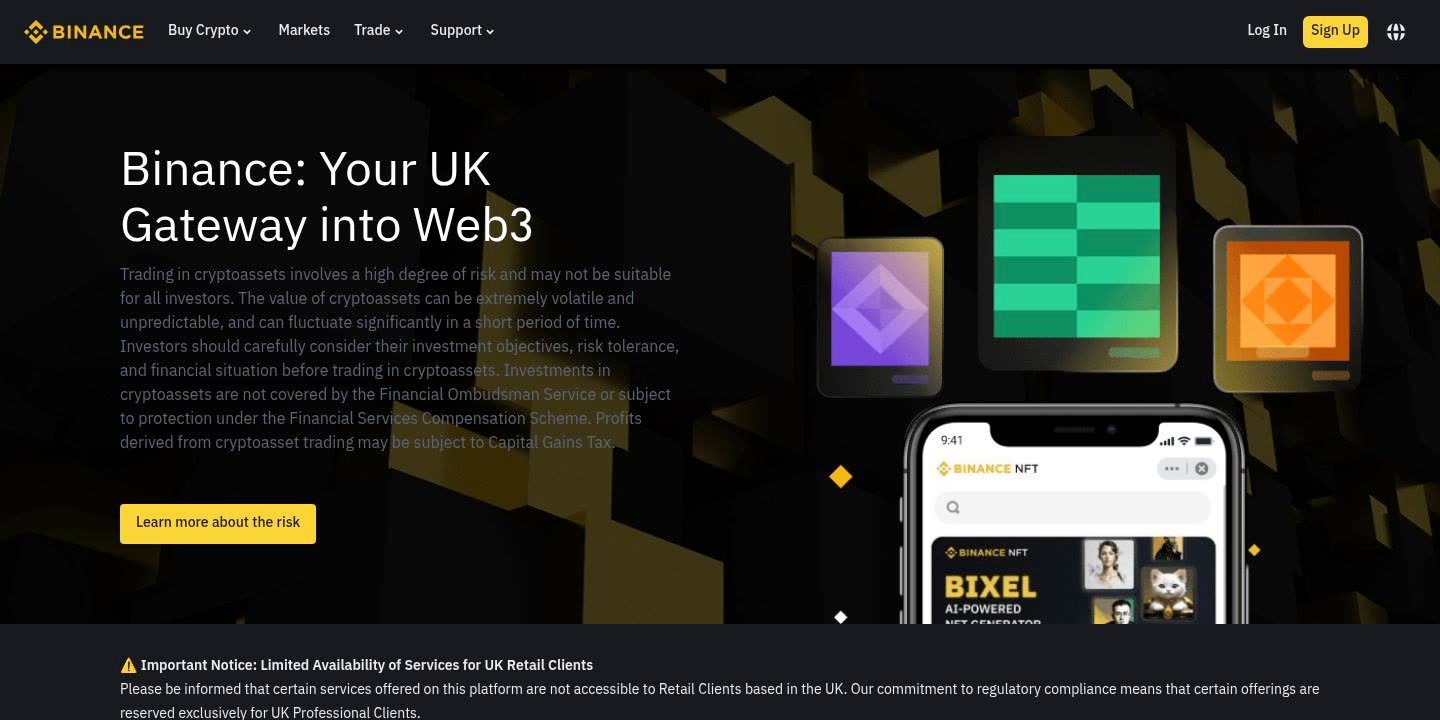
For traders weighing binance vs coinbase, the decision hinges on availability, fee transparency, and product scope. Binance provides a known spot trading fee schedule starting at 0.100% maker and 0.100% taker for standard VIP 0 accounts, with an optional 25% discount when paying fees using BNB (lowering the rate to 0.07500% / 0.07500%). By using our referral code MINTLEAF, users also secure a 10% rebate on their spot trading fees. In contrast, Coinbase fee schedules and regional product offerings vary across account tiers, order types, and geographic locations, requiring traders to review Coinbase’s official fee tables directly before executing orders.
- Jurisdiction & Access: Binance restricts services in countries subject to comprehensive U.S. sanctions, while derivatives are restricted in territories like Germany, Italy, the Netherlands, Hong Kong, and Australia. Traders considering Coinbase must check its official supported-countries list to verify whether their location is serviced.
- Fee Mechanics: Binance charges standard VIP 0 spot trading fees of 0.100% maker / 0.100% taker, reducible to 0.07500% when utilizing BNB fee deductions. Readers evaluating Coinbase should verify its direct maker/taker tiers and consumer spread fees on its official pricing page.
- Account Onboarding: Binance requires mandatory identity verification (KYC) before any trading can take place. Coinbase also enforces regulatory compliance and identity checks according to local laws.
- Available Features: Binance’s primary platform lists products including Spot, Futures, Earn, Auto-Invest, ETH Staking, Launchpool, Airdrop Portal, P2P, Pay, Copy Trading, and Academy. Derivative access remains subject to geographic restrictions.
Understanding the Binance vs Coinbase Decision Framework
Selecting a primary cryptocurrency exchange requires evaluating regulatory footing, cost structures, and product variety. The debate around binance vs coinbase is often driven by whether an investor prioritizes an extensive global ecosystem with competitive spot fees or a platform designed around specific regional compliance standards. Rather than relying on marketing claims, sensible market participants assess verifiable documentation published directly by the exchanges.
Digital asset trading involves substantial risk of capital loss. Market volatility can cause asset valuations to fluctuate rapidly, and derivative contracts amplify both gains and losses. Consequently, platform selection should align with your technical expertise, your geographic residency, and your risk tolerance. Neither Binance nor Coinbase offers guaranteed financial returns, and users must independently verify platform terms before depositing capital.
A central pillar in any exchange comparison is fee efficiency. A retail investor executing infrequent long-term purchases may tolerate standard transaction fees, whereas active spot traders need low baseline maker and taker percentages to preserve trading capital. As documented in Binance’s public fee schedules, standard baseline spot trading fees sit at 0.100% for both makers and takers, which can be further minimized by using platform utility tokens and referral rebates.
Geographic Availability and Regulatory Restrictions
Geographic availability is the primary filter in the binance vs coinbase decision. If an exchange cannot legally serve your country of residence, its trading features and fee structures become irrelevant. Under no circumstances should users attempt to circumvent regional restrictions through virtual private networks or misleading residency declarations, as doing so violates platform terms of service and risks permanent account suspension.
Binance Regulatory Status and Restricted Territories
Binance enforces strict compliance protocols and maintains a formal List of Prohibited Countries within its Terms of Use. According to official Binance documentation, this list includes territories currently subject to comprehensive sanctions by the United States. Furthermore, historical regulatory notices indicate that Binance.com does not cater to United States residents, as detailed in our guide on Binance availability in the US.
Beyond blanket territorial exclusions, Binance limits specific product categories in certain jurisdictions to comply with local financial mandates:
- European Jurisdictions: Binance announced the discontinuation of futures and derivatives products for users in Germany, Italy, and the Netherlands.
- Australia: Binance issued notices restricting options, margin trading, and leveraged tokens for newly registered Australian accounts.
- Hong Kong: The platform restricted the onboarding of new accounts for derivatives products.
On the licensing front, Binance holds regulatory authorizations in multiple global jurisdictions. In Abu Dhabi’s Financial Services Regulatory Authority (ADGM), entities including Nest Exchange Limited (operating derivatives markets), Nest Clearing and Custody Limited, and Nest Trading Limited hold regulatory permissions. Following a comprehensive resolution with U.S. regulatory authorities in 2023, Binance maintains strict identity monitoring. Prospective users should consistently consult the official Binance restricted countries documentation before attempting registration.
Checking Coinbase Regional Compliance
Because official Coinbase regional allowances vary according to local state, national, and international financial authorities, prospective traders must verify Coinbase’s standing on its official website. Coinbase publishes an updated directory of supported jurisdictions indicating whether standard retail buying, selling, staking, or advanced trading is available in a given country. Never assume cross-border parity; an asset or service available to a trader in one territory may be legally inaccessible to another.
Trading Fees and Cost Comparison
Transaction pricing directly affects net trading performance. In comparing binance vs coinbase, understanding the exact cost per transaction requires distinguishing maker orders (which add liquidity to the order book) from taker orders (which remove liquidity immediately).
Verified Binance Trading Fee Schedule
Binance publishes a transparent, tiered fee schedule accessible to all registered and prospective users. For standard accounts (designated as VIP 0, representing standard retail volume tiers), the verified spot trading fee structure is:
| User Tier | Maker Fee | Taker Fee | BNB Deduction Rate (25% Off) |
|---|---|---|---|
| VIP 0 (Standard) | 0.100% | 0.100% | 0.07500% / 0.07500% |
Traders can lower these costs using two distinct methods:
- BNB Fee Deduction: By maintaining a balance of Binance Coin (BNB) and enabling the fee deduction toggle in their account settings, users receive an automatic 25% discount, reducing maker and taker spot rates to 0.07500%.
- Referral Fee Rebates: Registering via our referral code MINTLEAF activates a 10% rebate on your personal spot trading fees. This rebate is paid back directly to your spot account based on settled trades. Note that this rebate applies to spot trading; it does not apply to futures contracts, nor should it be confused with promotional vouchers. More details are available in our guide on Binance fee mechanics.
What to Check Regarding Coinbase Fees
Coinbase employs distinct pricing models depending on whether a customer uses the standard simple buy/sell interface or an advanced order book interface. Retail order execution may incur variable percentage spreads or flat transaction charges, whereas advanced order execution follows tiered fee schedules that should be verified directly on Coinbase’s official site. Because these fee tables change periodically, readers should navigate to Coinbase’s official pricing documentation to review current maker, taker, and fiat deposit/withdrawal fees before submitting orders.
Product Ecosystems and Trading Tools
A comprehensive assessment of binance vs coinbase requires looking beyond spot trading to inspect the broader suite of financial utilities, liquidity pools, and passive management tools supported by each ecosystem.
Binance Product Suite
Binance hosts a vast directory of web and mobile applications catering to both retail and institutional capital. According to its official primary navigation, verified users have access to:
- Spot Trading: Access to extensive digital asset trading pairs with standard order types including limit, market, and stop orders.
- Futures & Derivatives: Advanced contract markets, subject to the aforementioned regional restrictions in Germany, Italy, the Netherlands, Hong Kong, and Australia.
- Binance Earn & ETH Staking: Dedicated protocols allowing users to allocate supported assets to interest-bearing programs or participate in Ethereum network validation.
- Auto-Invest: An automated dollar-cost averaging framework enabling programmatic asset accumulation over preset intervals.
- Launchpool & Airdrop Portal: Reward mechanisms where users lock eligible tokens to receive allocations of newly launched tokens.
- Binance P2P: A peer-to-peer marketplace facilitating direct fiat-to-crypto exchanges with platform escrow protection.
- Copy Trading: A tool enabling users to follow and mirror the trading strategies of public portfolio leaders, carrying inherent market risks.
- Educational Resources: Binance Academy and Learn & Earn programs providing structured guides and educational rewards.
- Merchant & Payment Utilities: Binance Pay and Binance Gift Cards for peer-to-peer and merchant digital asset transfers.
Coinbase Product Offerings to Verify
Coinbase provides services spanning consumer brokerage, advanced order execution, institutional custody, and retail educational tools. When examining Coinbase’s ecosystem, prospective users should verify which specific features—such as staking rewards, advanced charting, automated recurring purchases, and mobile wallet integrations—are officially authorized within their legal territory.
Account Verification and Onboarding Process
Regulatory scrutiny across global financial markets requires established exchanges to verify customer identity thoroughly before granting market access. In the evaluation of binance vs coinbase, both platforms mandate formal Know Your Customer (KYC) onboarding.
Binance Identity Verification (KYC)
On Binance, completing identity verification is strictly mandatory prior to executing trades. Official documentation specifies that user accounts cannot engage in trading until identity checks are finalized. The onboarding sequence follows standard compliance standards:
- Account Creation: Register using an email address or mobile number. Ensure referral code MINTLEAF is populated in the Referral ID field to bind the 10% spot fee rebate to your profile.
- Personal Information Submission: Provide full legal name, date of birth, residential address, and government-issued identification (such as a passport or driver’s license).
- Facial Verification: Complete a liveness check using a smartphone camera or webcam to confirm identity matches the submitted documentation.
- Compliance Review: Binance reviews the documentation against global sanctions databases. Once verified, account functionality is unlocked. For a comprehensive walkthrough, review our step-by-step Binance KYC guide.
Furthermore, Binance’s welcome tasks—offering up to 100 USD in trading fee rebate vouchers across three beginner milestones—become accessible only after successful account verification. These vouchers offset actual trading fees paid; they do not represent withdrawable cash balances. Note that new user welcome vouchers are not available to enterprise profiles, users registering via Binance Lite Referral, or residents of select countries including the United States, the United Kingdom, Canada, and Japan.
Coinbase Onboarding Requirements
Coinbase similarly enforces strict identity verification protocols under local anti-money laundering regulations. Users must provide valid government identification, address verification, and tax identification details depending on local legal requirements. Users should consult Coinbase’s onboarding documentation to ascertain the specific verification tiers required for their desired deposit and withdrawal limits.
Security Standards and Proof of Reserves
Custodial safety is an essential factor when comparing binance vs coinbase. Storing digital assets on any centralized exchange introduces counterparty risk. Investors should understand how each platform demonstrates reserve backing and protects client assets.
Binance Proof of Reserves and Solvency Architecture
Binance maintains a public Proof of Reserves (PoR) system designed to verify that the exchange holds user assets on a minimum 1:1 ratio. Official Binance documentation defines Proof of Reserves specifically as those assets held in custody for users, demonstrating that for every unit of cryptocurrency deposited by a client, an equivalent unit is maintained in platform custody. Users can audit cryptographic reserve proofs using Merkle tree verification tools published on Binance’s portal.
In terms of emergency capital backing, Binance maintains the Secure Asset Fund for Users (SAFU), an emergency reserve designed to provide coverage during extreme circumstances. Detailed operational breakdowns of reserve audits can be reviewed in our analysis of Binance Proof of Reserves.
Evaluating Coinbase Custodial Security
Coinbase outlines its institutional custody frameworks and security disclosures on its official platform. Traders evaluating Coinbase should review its publicly disclosed balance sheets, regulatory filings with financial authorities, and published custody disclosures to evaluate asset segregation practices.
Pros and Cons: Binance vs Coinbase
Evaluating the trade-offs of binance vs coinbase requires a side-by-side view of platform advantages and operational limitations based on verified facts.
Binance Advantages
- Clear Baseline Spot Pricing: Standard VIP 0 fees begin at 0.100% maker / 0.100% taker, with an automatic 25% discount when utilizing BNB (0.07500%).
- Spot Fee Rebate Option: Using referral code MINTLEAF grants an ongoing 10% rebate on spot trading fees.
- Broad Ecosystem: Supports a wide range of native products including Binance Earn, Auto-Invest, Launchpool, P2P, Copy Trading, and ETH Staking.
- Auditable Proof of Reserves: Maintains a public cryptographic Proof of Reserves framework confirming at least 1:1 custody for user holdings.
Binance Limitations
- Jurisdictional Exclusions: Does not service residents of the United States on Binance.com; derivatives trading is restricted across Germany, Italy, the Netherlands, Australia, and Hong Kong.
- Strict KYC Requirement: Unverified accounts cannot execute trades.
- Complex Interface for Beginners: The wide array of products and advanced order tools can present a steep learning curve.
Coinbase Considerations
- Public Reporting Standards: Check Coinbase’s official platform for its regulatory disclosures and financial reporting.
- Fee Complexity: Fee structures vary between standard retail buy/sell orders and advanced trading interfaces, requiring users to verify costs manually.
- Regional Variance: Feature sets, supported digital assets, and staking services vary significantly across individual state and national jurisdictions.
Who Is Binance For vs Who Should Consider Coinbase?
Determining which platform suits your requirements depends on your geographical residence, your trading frequency, and the tools you use daily.
Binance Is Best Suited For:
- International Active Spot Traders: Individuals located outside restricted regions who want standard spot trading fees of 0.100% or lower via BNB fee deduction.
- Rebate-Conscious Users: Traders who sign up with our referral code MINTLEAF to secure a 10% spot fee rebate on their ongoing volume.
- Ecosystem Participants: Users who utilize multiple Web3 and exchange services, such as peer-to-peer markets, automated dollar-cost averaging via Auto-Invest, and token launch participation.
Coinbase Is Best Suited For:
- Traders in Supported Regions: Users residing in territories where Coinbase holds full regulatory licenses and direct local banking rails.
- Corporate and Retail Investors Prioritizing Public Filings: Market participants who prefer working with an exchange subject to public corporate reporting requirements.
- Direct Consumer Onramps: Investors seeking simple localized fiat deposit integrations who have verified local pricing on Coinbase’s official platform.
Common Problems and How to Avoid Them
Navigating digital asset exchanges presents several common operational challenges. Understanding these hurdles helps prevent unexpected fees and account issues.
Forgetting to Enter a Referral Code
A frequent error among new Binance registrants is failing to input a referral code during account creation. According to official Binance guidelines, once a referral code is linked to an account during registration, it cannot be altered. However, if an account was registered within the past 30 days, has made no deposits, has executed zero trades, holds no existing referral link, is a primary account, and its KYC has not been used on another account in the preceding 180 days, the user may link a code retroactively via Binance’s referral binding page.
Misunderstanding Fee Rebates vs Cash Rewards
New users often confuse trading fee rebate vouchers with direct cash bonuses. Binance’s welcome tasks provide up to 100 USD worth of trading fee rebate vouchers, not withdrawable funds. These vouchers automatically refund trading fees paid on qualifying trades until the voucher balance is exhausted. Furthermore, our referral code MINTLEAF gives a 10% rebate on spot trading fees specifically; it does not eliminate fees entirely or apply to derivatives contracts.
Attempting to Circumvent Regional Restrictions
Some users attempt to access restricted products using proxy networks or secondary addresses. Both Binance and Coinbase employ strict identity verification and geo-compliance tracking. Attempting to circumvent geographic blocks violates user agreements and can result in account freezes or permanent asset locks. Always verify that your jurisdiction allows unhindered access directly on the exchange’s legal terms page.
Before funding any exchange account, check all current terms on the official site; when registering on Binance, applying referral code MINTLEAF unlocks your 10% spot fee rebate.
Official website · Latest pricing & offers
FAQ
Can I trade on both Binance and Coinbase simultaneously?
Yes. If you reside in a jurisdiction serviced by both platforms and satisfy their respective identity verification requirements, you can maintain accounts on both exchanges. Many traders use multiple platforms to access different liquidity pools or asset selections.
What does referral code MINTLEAF provide on Binance?
Entering referral code MINTLEAF when registering on Binance applies a 10% rebate on your personal spot trading fees. This rebate is paid back directly to your spot account. It does not apply to futures trading, nor does it guarantee any financial returns.
Are welcome bonuses on Binance withdrawable cash?
No. Binance offers new verified users up to 100 USD in welcome rewards distributed as trading fee rebate vouchers across three onboarding tasks. These vouchers can only be used to offset incurred trading fees and cannot be withdrawn as cash or crypto assets.
Does Binance operate for residents of the United States?
Binance.com does not serve residents of the United States. U.S. residents must consult official regulatory resources for compliant digital asset platforms.
What are the baseline spot trading fees on Binance?
For standard VIP 0 retail accounts, Binance charges a 0.100% maker fee and a 0.100% taker fee on spot markets. Users paying fees with BNB receive a 25% discount, lowering both maker and taker fees to 0.07500%.
Which countries face derivatives restrictions on Binance?
Binance has officially restricted derivatives and futures trading in several territories, including Germany, Italy, the Netherlands, Hong Kong, and Australia (where options, margin, and leveraged tokens are restricted for new accounts). Users in all countries must review the platform’s prohibited list periodically.
Related Reading
- Bybit vs Binance: Which Crypto Exchange Fits You in 2026?
- Does Binance Work in the US? Binance vs Binance.US (2026)
- Binance Restricted Countries: Where You Can’t Use Binance (2026)
- Binance Fees Explained: Spot, Futures, and Withdrawal Costs
References
- Binance Fee Schedule
- How to Register on Binance Website
- Binance Welcome Rewards FAQ
- Binance Proof of Reserves
- Binance Prohibited Countries List FAQ