TruthScan Insurance Fraud Guide 2026: Claim & Return Verification
When investigating how to mitigate modern digital deception, deploying truthscan insurance fraud screening provides automated forensic verification for user-submitted claim photos, injury documentation, and supporting PDF invoices in real time. Rather than relying on standard optical character recognition (OCR) or visual adjuster checks that miss synthetic pixel patterns, TruthScan flags AI-generated imagery and localized manipulations in one to two seconds.
Affiliate disclosure: This article may contain affiliate links. If you buy through them, we may earn a commission at no extra cost to you. Details were checked on November 24, 2026 and can change.
Official website · Latest pricing & offers
Quick Answer: What Is TruthScan for Claims and Returns Fraud?
TruthScan is an automated forensic verification platform designed to catch generative AI manipulation and synthetic media across high-volume customer upload workflows. In insurance and e-commerce operations, claimants and shoppers frequently submit digital photos of vehicle collisions, property destruction, bodily injuries, delivered packages, and digital receipts to justify financial payouts. Consumer AI tools can now fabricate photorealistic damage or alter monetary figures on a document in under 60 seconds.
TruthScan solves this vulnerability through two core detection engines—an AI image detector and a forensic PDF detector—delivering:
- Rapid Automated Decisions: End-to-end evaluation delivers verdicts within 1 to 2 seconds.
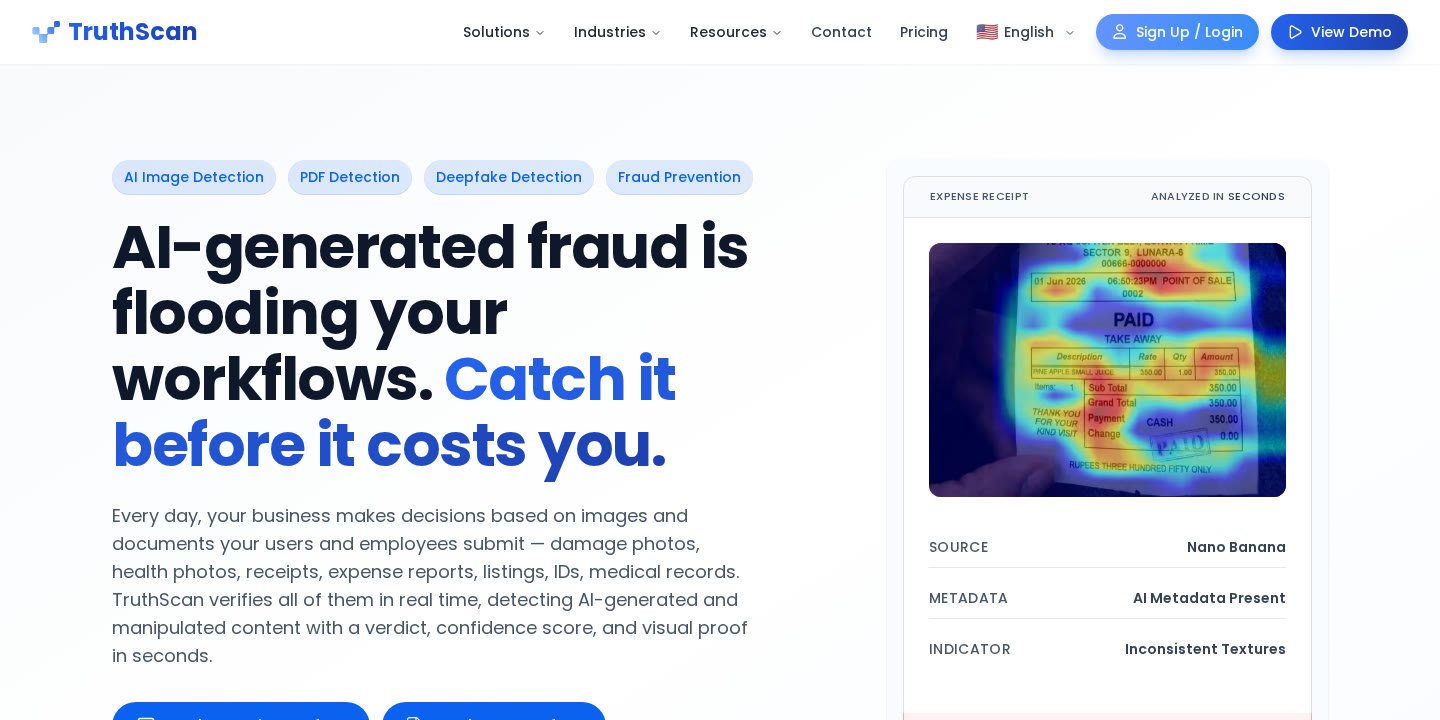
- Region-Level Heatmaps: Visual overlays pinpoint localized edits, such as an AI-generated dent on an undamaged bumper or modified digits on an invoice.
- Granular Indicators: Teams receive probability scores, classification labels, confidence metrics, and source metadata indicators for audit-ready reporting.
- Workflow Automation: Clean submissions pass immediately, high-risk items route to Special Investigation Units (SIU), and borderline files can prompt a live re-capture.
The New Threat Landscape: Generative AI in Claims and Returns
For decades, insurance claims and retail return workflows operated on a fundamental baseline assumption: if a policyholder or customer uploaded an image showing physical damage, that object genuinely existed in the condition depicted. Generative artificial intelligence fundamentally broke that assumption. According to industry returns fraud data referenced by TruthScan, fraudulent returns and claims cost retailers more than $103 billion annually even before synthetic media generation tools became accessible to the general public.
Today, consumer-grade image generators and AI-powered document editors allow bad actors to produce photorealistic “damaged item” photos, staged property losses, or doctored medical receipts in roughly 60 seconds. An individual filing an auto claim no longer needs to find a damaged vehicle in a salvage yard or inflict physical harm on a car body. Instead, they can take a smartphone photograph of an undamaged vehicle, input a simple text prompt instructing an AI model to render structural crumpling or scratched paint, and upload the synthetic result directly into a mobile claim portal.
Crucially, these synthetic artifacts are invisible to traditional automated checks. Optical character recognition systems reliably extract names, line items, and dollar totals from PDFs because the typography and formatting are mathematically crisp. Similarly, human claims adjusters inspecting dozens of thumbnail photos on a screen cannot spot micro-level pixel diffusion anomalies or synthetic generative signatures. Because human review and OCR pass these files without friction, detection must occur at the deep pixel and metadata layer.
How TruthScan Insurance Fraud Detection Protects Claims Pipelines
To stop fraudulent leakages before disbursements occur, truthscan insurance fraud screening establishes a forensic verification gate right at the ingestion layer of insurance pipelines. TruthScan processes files across several major insurance verticals:
Auto and Property Physical Damage
In auto and property lines, a common attack pattern involves localized tampering. A policyholder or organized ring captures authentic baseline imagery of a house roof, a vehicle fender, or commercial equipment, then uses an image model to add hail damage, fire scorching, or collision dents. Because the surrounding scenery, lighting, and vehicle identification numbers match real-world context, whole-image legacy detectors often average the manipulated region away against authentic pixels.
TruthScan separates itself by conducting region-level analysis. Rather than calculating a single blended probability score across the entire frame, the engine evaluates localized pixel structures. When an altered region is detected, TruthScan generates a visual detection heatmap that isolates precisely where synthetic pixels were inserted, giving desk adjusters defensible proof to question or deny the claim.
Health and Life Claims Documentation
In digital health, disability, and life claims, evidence submission often leans heavily on photos of visible bodily trauma, dermatological conditions, or mobility limitations. Fraudulent claimants leverage generative image models to render convincing injuries or doctor medical progress photos. Furthermore, claimants frequently alter health statements or superbills by regenerating legitimate billing sheets with inflated figures using generative PDF tools.
Because TruthScan inspects both imagery and multi-page PDF documents, it surfaces underlying document structure anomalies and synthetic rendering traces. Adjusters gain an objective verification score before issuing settlements, ensuring that digital clinical evaluations and supplemental health reimbursements reflect genuine patient circumstances.
Supporting Invoices and SIU Reporting
A staged loss is often accompanied by fabricated supporting paperwork, including auto body repair estimates, towing bills, and contractor invoices. TruthScan analyzes incoming PDFs page by page, evaluating source metadata indicators and structural file signatures. When a claim is flagged as high-risk, the platform compiles an audit-ready forensic report that adjusters can export directly into Special Investigation Unit (SIU) case files, establishing an evidentiary paper trail that satisfies internal compliance and legal scrutiny.
Combatting Returns Abuse and Delivery Fraud at Scale
Beyond traditional carrier insurance, e-commerce retailers, on-demand delivery apps, and online marketplaces face analogous claims fraud. In these environments, the mechanism of loss is refund abuse driven by “damaged goods,” “missing items,” or “wrong order” complaints.
In on-demand food delivery, for instance, dishonest users frequently apply AI filters or image editors to photograph legitimate meals and insert synthetic depictions of raw, spoiled, or contaminated food. With instant refund workflows designed to preserve customer satisfaction, automated systems immediately credit the account. When organized fraud rings automate this across thousands of synthetic or compromised customer profiles, delivery profit-and-loss statements suffer severe losses.
Similarly, e-commerce return processes routinely grant instant refunds or returnless chargebacks upon reviewing a customer-uploaded photograph of a “broken” electronic item, damaged luxury handbag, or shattered cosmetic jar. By deploying TruthScan behind the return portal upload module, retailers can screen these images in real time. Authentic claims flow through to preserve rapid customer service, while staged, AI-generated, or edited photos are intercepted before credits or return labels are issued.
Inside the Detection Engine: Formats, Models, and Localized Edits
To comprehend how TruthScan functions under heavy operational loads, it helps to understand its underlying forensic mechanisms and technical constraints as detailed on the official site.
Coverage Across Frontier Generators
TruthScan monitors and updates its engines against the evolving landscape of synthetic media. According to official performance metrics published by TruthScan, its systems maintain an average detection accuracy of 99.3% across 92 image generators and a benchmark dataset of 250,000 real images. In total, the system supports detection across more than 500 image generators, maintaining at least 95% accuracy on every generator tested, alongside a reported false positive rate under 1%.
Its coverage extends to major commercial and open-source frontier models, including:
- Nano Banana 2: 100% accuracy
- Seedream 4.5: 100% accuracy
- Imagen 4: 99.9% accuracy
- Grok: 99.9% accuracy
- Flux 2 Pro: 99.4% accuracy
- GPT-Image 1.5: 99.2% accuracy
- Midjourney: 98.6% accuracy
By content category, TruthScan lists specialized accuracy rates including 99.8% for product images, 99.3% for documents, 99.3% for receipts, 99.0% for automobiles, and 98.1% for invoices.
Localized Edits vs. Full Generation
Fraud schemes rarely involve fully generated, abstract scenes; rather, perpetrators execute targeted digital retouching, face swaps, object removals, or localized additions. Where traditional detectors fail by diluting a small edited patch across millions of genuine pixels, TruthScan operates at the region level. If a fraudster alters only the odometer digits on a dashboard photo, changes a line item total on a repair quote, or introduces a dent onto a door panel, TruthScan isolates the specific manipulated patch. For exceptionally minute alterations, the platform recommends cropping directly to the questionable region and rescanning to obtain the clearest reading.
File Types and Degradation Handling
In real-world claims and return flows, uploaded images rarely arrive in pristine, uncompressed states. They pass through mobile browser uploads, proprietary mobile apps, cellular messaging compression, and social media platforms. TruthScan’s pipeline is constructed to withstand standard platform re-encoding, JPEG compression artifacts, scaling, and generational loss from repeated forwarding.
The system supports uploads of JPG, PNG, JPEG, TIF, and WEBP files up to 10 MB in size. While native resolution consistently delivers the highest forensic accuracy, TruthScan is tested against deliberate evasion techniques such as noise injection and artificial filtering. However, extreme degradation—such as taking a screenshot of a compressed thumbnail—discards foundational pixel-level signal that no forensic detector can reconstruct.
Evaluating TruthScan Insurance Fraud Screening in Production Workflows
Integrating truthscan insurance fraud screening into an active carrier claims platform or e-commerce returns engine does not require overhauling existing user portals. The software is engineered as a forensic verification layer that operates silently behind existing ingestion interfaces. Claims platforms can also consult broader forensic documentation like our TruthScan AI image detector guide and our deep dive into TruthScan document fraud detection to see how visual and file-level checks interact.
| Workflow Stage | Operational Mechanism | Output / Business Outcome |
|---|---|---|
| Step 1: Ingestion & API Handshake | Customer uploads damage images or invoice PDFs via mobile app, portal, or web form. Files pass via REST API or webhooks in real time or batches. | Zero customer-facing disruption; files are submitted to the Image Detection or PDF Detection engine instantly. |
| Step 2: Automated Forensic Verdict | TruthScan inspects pixel arrays, structural metadata, and localized regions within 1 to 2 seconds. | Returns a probability score, confidence score, plain-language classification, and visual heatmap. |
| Step 3: Risk-Based Routing (Beta) | Automated routing engine applies organization-defined thresholds to sort files into approval, review, or re-capture paths. | Clean files auto-approve; high-risk files route to SIU queues with reports; borderline cases trigger a TruthScan Capture link. |
Step 1: Connecting the API
Development teams route incoming customer-submitted images to TruthScan’s image detection API and PDFs to its document detection API at the moment of initial upload. Because the architecture relies on standard REST endpoints and webhooks, organizations can configure either synchronous, real-time responses or asynchronous batch processing. TruthScan states that most development teams achieve live production readiness within days without replacing their customer-facing intake interfaces.
Step 2: Receiving the Forensic Verdict and Proof
Within 1 to 2 seconds, the API delivers a complete forensic payload. This response is not limited to a binary true/false flag. It includes:
- A numerical confidence score showing the certainty of the evaluation.
- A plain-language explanation outlining why the content was classified as synthetic or manipulated.
- A detection heatmap that visually illuminates the precise pixel clusters exhibiting synthetic artifacts.
- Source metadata indicators identifying anomalies in the file container.
For organizations dealing heavily with expense claims or purchase proofs, pairing image detection with document tools helps intercept fabricated billing statements, as covered in our guide on how to detect fake receipts generated by AI.
Step 3: Risk-Based Routing and TruthScan Capture (Beta)
Once the verdict is returned, claims engines apply custom threshold parameters to segment submissions into distinct operational pipelines:
- Auto-Approval: Clean submissions showing authentic physical signatures proceed through standard straight-through processing (STP) pipelines, ensuring rapid payouts for honest policyholders.
- SIU Escalation: High-risk media displaying unambiguous generative tampering or synthetic overlays is pushed into adjuster or SIU review queues with full forensic documentation attached, eliminating manual guesswork.
- TruthScan Capture (Beta): In borderline or ambiguous scenarios, organizations can avoid outright denials by sending a live TruthScan Capture link directly to the submitter’s smartphone. The customer retakes the photo through a verified browser-based camera session, and the newly captured, authentic image automatically binds to the original claim record.
TruthScan Pricing, Results Quotas, and Operational Economics
Understanding TruthScan’s commercial model is essential for claims leaders calculating return on investment against potential fraud losses. TruthScan operates on a monthly or annual usage-based pricing structure where cost is determined by “results.” A result is defined as one scanned image or one page of a PDF document (e.g., a 10-page medical record consumes 10 results, with no per-document caps).
| Plan Tier | Monthly Price | Included Results | Overage Rate | Key Operational Features |
|---|---|---|---|---|
| Free | $0 / month | 25 / month | N/A | Full API access, detailed indicators, dashboard history, Chrome extension, unlimited seats. |
| Starter | $24 / month ($290/yr) | 1,000 / month | $0.03 / result | Batch uploads, CSV export of history, audit-ready detection reports, standard support. |
| Professional | $83 / month ($990/yr) | 5,000 / month | $0.02 / result | Priority processing queue, higher API rate limits, audit-ready reports, unlimited seats. |
| Business | $333 / month ($3,990/yr) | 40,000 / month | $0.01 / result | Zero Data Retention (ZDR), custom DPA available, highest self-serve limits, priority support. |
| Enterprise | Custom | Custom volume | $0.005 or less | Custom SLAs, dedicated throughput, dedicated/on-prem deploy, regional EU/UK processing. |
For more details on plan structures and billing calculations, refer to our breakdown of TruthScan pricing and plan features. Key financial and licensing policies include:
- No Per-Seat Surcharges: Pricing is billed per organization. Teams can invite unlimited adjusters, investigators, and developers under Settings → Teams & Roles, with all users drawing from the shared pool of monthly results.
- Predictable Overages: Paid plans allow usage to exceed included allowances without service interruption. Additional scans bill at the tier’s fixed per-result overage rate, and running totals appear in the dashboard once 80% of quota is reached.
- Billing Flexibility: Subscriptions are month-to-month with no long-term contract lock-in. Annual billing plans include two months free. Unused results do not roll over between billing cycles.
- Enterprise Transition Point: TruthScan notes that organizations scanning approximately 100,000 results per month (roughly $1,000 on Business tier pricing) typically transition to customized Enterprise agreements to secure volume pricing of $0.005 or less per result, dedicated throughput, and bespoke Service Level Agreements (SLAs).
Enterprise Compliance, Data Retention, and Security
Insurance carriers, claims third-party administrators (TPAs), and financial platforms operate under rigorous regulatory scrutiny regarding consumer data protection, personally identifiable information (PII), and medical confidentiality.
TruthScan holds independent certifications for SOC 2 Type II and ISO 27001, alongside adherence to GDPR requirements and AES-256 data encryption standards. It is also recognized as a GASA (Global Anti-Scam Alliance) partner.
Zero Data Retention (ZDR)
By default, submissions uploaded to standard tiers are retained within the system. However, for organizations handling sensitive claims, identity credentials, or healthcare records, TruthScan provides Zero Data Retention (ZDR) on its Business and Enterprise plans. Under ZDR, customer-submitted media and document data are immediately discarded once detection is complete and are never used for model training.
Regional Data Residency
For European and UK carriers governed by strict cross-border data transfer limitations, TruthScan offers regional data processing on Enterprise plans. Running on a dedicated regional endpoint, this setup maintains local data sovereignty without compromising processing throughput or latency, taking approximately one week to provision.
Pros and Cons of TruthScan for Fraud Prevention
When assessing whether to incorporate TruthScan into an operational fraud mitigation stack, teams must weigh distinct operational strengths against practical constraints.
Pros
- Sub-Two-Second Verdicts: With an end-to-end turnaround time of 1–2 seconds, the API easily integrates into real-time upload workflows without adding latency for honest claimants.
- Granular Region Heatmaps: Visual overlays pinpointing localized manipulations give adjusters concrete visual evidence, preventing disputes over opaque “black box” scores.
- Defensible Audit Reports: Detailed reasoning, confidence metrics, and source metadata indicators produce documentation that can be directly passed to SIU investigators or regulatory auditors.
- No Per-Seat Fees: Unlimited team member seats allow cross-functional deployment across claims adjusters, customer support agents, and fraud analysts without ballooning software costs.
- Alternative Access Options: In addition to the REST API, teams can utilize bulk ZIP uploads (up to 500 images per batch), manual web dashboard checks, or a free Chrome extension to evaluate media inside existing internal tools.
Cons
- Zero Data Retention Restricted to Higher Tiers: Organizations requiring strict ZDR compliance must subscribe to the Business tier ($333/month) or higher, putting it out of reach for small firms on Starter plans.
- No Rollover of Unused Scans: Unused monthly scan quotas reset at the end of each billing cycle rather than accumulating.
- Vulnerability to Extreme Recompression: Files that have suffered generational loss (such as low-resolution re-compressed thumbnails or photos taken of computer monitors) may lack sufficient pixel signal for definitive analysis.
- Page-Based PDF Billing: Lengthy multi-page medical binders or policy records can rapidly deplete scan allowances, as every single page counts as an individual result.
Who TruthScan Is For vs. Who Should Seek Alternatives
Determining whether TruthScan matches an organization’s profile depends heavily on operational scale, file intake volume, and exposure to generative fraud.
Ideal Use Cases
- P&C and Auto Insurance Carriers: Carriers seeking to automate straight-through processing for first-notice-of-loss (FNOL) photos while flagging synthetic collision damage and forged repair estimates.
- E-Commerce Retailers and Delivery Platforms: High-volume merchants suffering from systemic refund abuse, missing-item complaints, and fake damaged-goods imagery.
- Digital Health and Telehealth Providers: Clinical platforms that need to verify member-submitted diagnostic photos and medical invoices for authenticity before rendering care or issuing reimbursements.
- Fintech and Lending Platforms: Underwriting workflows that process uploaded bank statements, pay stubs, and proof-of-address documents prone to generative PDF tampering.
When to Seek Alternative Solutions
- Exclusively In-Person Inspection Workflows: Organizations that dispatch physical adjusters or certified appraisers to inspect physical assets on-site derive limited value from digital upload verification.
- Text-Only Review Requirements: If an organization’s primary fraud exposure involves purely written claims descriptions or fabricated narrative text without accompanying photos or PDF documents, specialized linguistic analysis tools are better suited.
- Organizations Inundated with Degraded Screenshots: Operations that exclusively handle severely downscaled, low-fidelity mobile screenshots may encounter limitations, as heavy pixel degradation discards the fine artifacts TruthScan relies on.
Alternative Categories for Claims and Returns Verification
When architecting a comprehensive fraud defense, claims and security executives typically combine several verification layers rather than relying on a single tool. If you are comparing operational strategies, consider how these categories intersect:
- Forensic AI Image & Document Detectors: Platforms like TruthScan specifically target synthetic media generation, prompt-based digital tampering, and localized pixel/metadata inconsistencies in uploaded files.
- Metadata & EXIF Extractors: Standalone metadata utilities inspect container headers, camera models, GPS timestamps, and editing software tags. While useful, fraudsters frequently strip or forge EXIF data, making metadata alone insufficient without pixel-level inspection.
- Template-Matching Document Verification: Conventional identity and document engines cross-reference uploaded bank statements or IDs against known structural templates. However, as modern generative AI can render syntactically perfect documents that match templates flawlessly, template matchers increasingly need forensic pixel screening behind them.
- Device Intelligence & Telemetry: Systems that evaluate device integrity, IP reputation, browser fingerprints, and network behavior help intercept organized rings before files are even submitted.
Common Implementation Pitfalls and How to Avoid Them
Deploying automated AI fraud detection into production requires careful operational planning. Teams frequently encounter several predictable challenges:
1. Setting Aggressive Auto-Denial Thresholds
One of the most damaging mistakes an insurance carrier or marketplace can make is configuring automated claim rejections based purely on an initial borderline score. Even with low false positive rates, edge cases occur. Best practices involve establishing a multi-tiered routing model: low scores auto-approve, severe scores route to specialized adjusters with forensic heatmaps attached, and intermediate scores trigger a TruthScan Capture session to obtain a live, verified photo.
2. Disregarding Downscaling in Ingestion Portals
Many legacy claims portals aggressively compress uploaded media down to low-resolution JPEG thumbnails to save cloud storage costs before passing the file to backend services. Doing so destroys micro-level forensic markers. Development teams must ensure that TruthScan screens images at their native resolution at the point of ingestion prior to any destructive downstream compression.
3. Ignoring Document Length in Volume Budgeting
Because TruthScan counts each PDF page as an individual result, claims teams that regularly ingest 50-page hospital records or policy jackets can exhaust their monthly quotas unexpectedly. Operations teams should configure routing rules to send only relevant claim evidence pages (e.g., invoices, estimates, and diagnostic receipts) through the detection API rather than entire generic policy documentation.
Official website · Latest pricing & offers
FAQ
What counts as a single result in TruthScan?
One result corresponds to either one scanned image (such as a JPG, PNG, or WEBP file) or one individual page of a PDF document. A 12-page PDF invoice packet will consume 12 results from your plan’s monthly allocation. There are no per-document caps.
Can TruthScan detect localized edits on an otherwise real photo?
Yes. While many legacy tools evaluate images as a whole and miss subtle alterations, TruthScan conducts analysis at the region level. It surfaces localized modifications—such as an AI-generated dent added to an authentic car bumper, a swapped face on an ID, or a changed digit on a repair estimate—and renders a visual heatmap showing the exact modified area.
Does TruthScan store customer claim images or use them for AI training?
On standard plans, images are retained by default within the dashboard history. However, TruthScan provides Zero Data Retention (ZDR) on Business and Enterprise tiers. Under ZDR, customer uploads and sensitive claim records are immediately discarded once detection is complete and are never used for model training.
How fast is the detection API in an automated workflow?
TruthScan delivers end-to-end verdicts within 1 to 2 seconds per file. This latency profile allows platforms to integrate detection directly into real-time mobile app and web portal upload flows without introducing noticeable delays for claimants.
What file formats and sizes are supported?
TruthScan supports image uploads in JPG, PNG, JPEG, TIF, and WEBP formats, as well as multi-page PDF documents. The maximum file size limit is 10 MB per file, and native resolution files are recommended for optimal forensic accuracy.
What happens if a legitimate claim photo is flagged?
Organizations configure their own risk thresholds to prevent automated rejections. Borderline or disputed photos can be routed to an adjuster queue with the forensic heatmap attached, or redirected to TruthScan Capture (currently in beta), which sends the claimant a link to retake the photo live via their device camera to verify authenticity.
Related Reading
- TruthScan AI Image Detector: Forensic Checks and How It Works (2026)
- TruthScan Document Fraud Detection: Forensic Guide 2026
- Detect Fake Receipts AI: 2026 Guide to Stopping Fraud
- TruthScan Pricing Explained: Plans, Results, and Features (2026)