TruthScan Deepfake Detection Explained: Features and Limits
When automated fraud rings and deceptive submissions target modern digital pipelines, truthscan deepfake detection operates as a forensic verification layer designed to screen synthetic images, face swaps, and manipulated documents in real time. Rather than relying solely on visual reviews or standard OCR checks, the platform examines submissions at the pixel and metadata level, delivering automated confidence scores, forensic heatmaps, and audit-ready reasoning within one to two seconds.
Affiliate disclosure: This article may contain affiliate links. If you buy through them, we may earn a commission at no extra cost to you. Details were checked on November 21, 2026 and can change.
Official website · Latest pricing & offers
Quick Answer: What Is TruthScan Deepfake Detection?
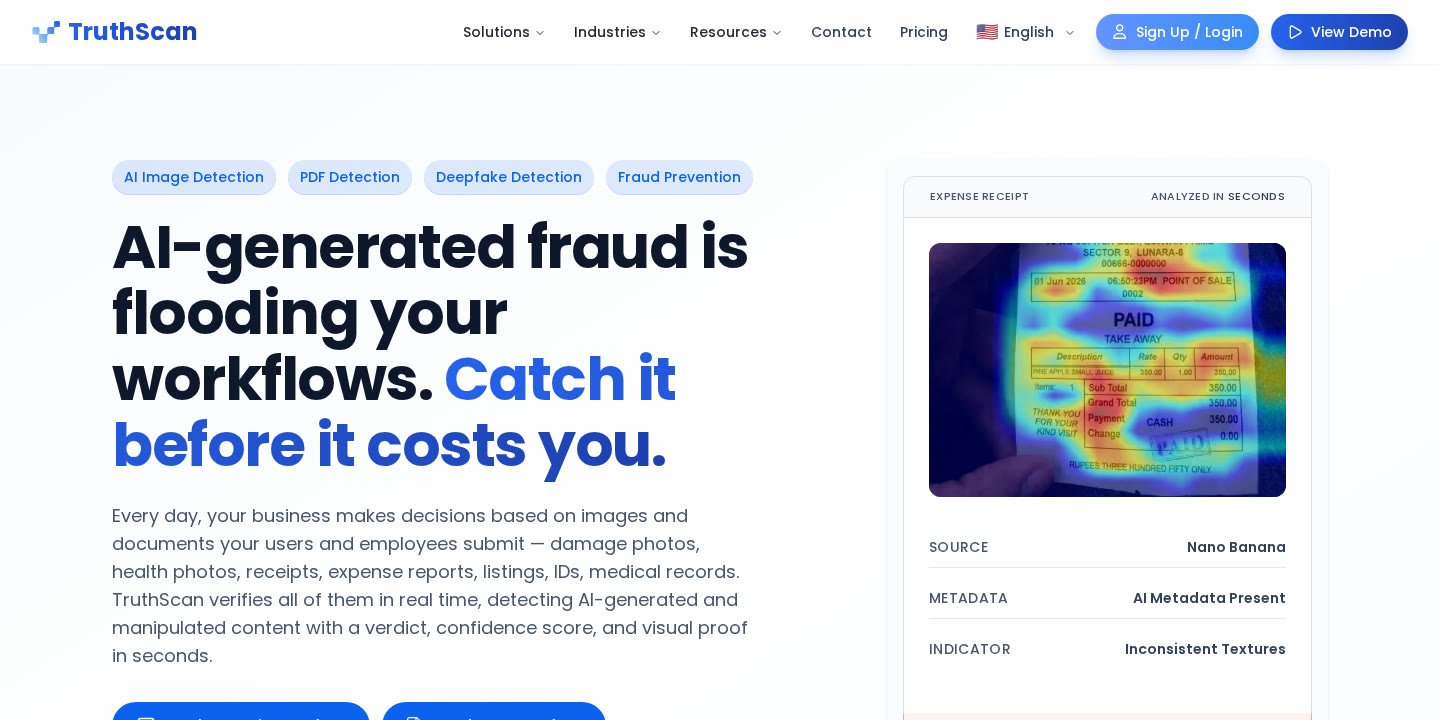
TruthScan is an enterprise-oriented AI and synthetic media detection system developed to combat generative AI fraud. It screens user-submitted files across high-risk approval workflows—including insurance claims, identity onboarding, refund requests, and digital health intakes—verifying whether an asset is genuine or synthetically manipulated.
- Detection Scope: Detects fully AI-generated images, AI-assisted modifications, localized face swaps, traditional digital retouching, and forged PDF documents.
- Turnaround Speed: Delivers end-to-end decisions, visual heatmaps, and plain-language reasoning in roughly 1 to 2 seconds.
- Benchmarked Accuracy: Achieves a 99.3% average detection accuracy across 92 evaluated image generators and 250,000 real images, maintaining a false positive rate under 1%.
- Integration Options: Available via a no-code browser interface, a free Google Chrome extension, and a REST API with webhook support.
- Data Handling: Offers SOC 2 Type II and ISO 27001 compliance, standard data retention, and optional Zero Data Retention (ZDR) on higher plans.
Core Technologies Behind TruthScan Deepfake Detection
Conventional content review tools frequently fail when analyzing modern deepfakes. Consumer generative models now produce realistic textures, lighting, and document typography in under 60 seconds, allowing altered evidence to pass superficial human inspections and automated optical character recognition (OCR) systems without raising alarms. TruthScan approaches this vulnerability through two purpose-built engines: AI Image Detection and PDF Detection.
Region-Level and Localized Manipulation Analysis
Many traditional image classifiers analyze files on a global scale. When a deepfake generator modifies only a specific fraction of a file—such as swapping a face on an identity card, altering a single digit on a receipt, or staging a dent on an auto insurance photo—global detectors can average out the anomaly across thousands of untouched pixels. TruthScan inspects files at the region level. This architecture isolates and surfaces localized edits, ensuring partial modifications to otherwise authentic photos do not get masked by legitimate background data. For very tiny edits, users can crop into the suspicious zone and rescan to isolate the forensic signal.
Pixel-Level and Source Metadata Examination
TruthScan operates at both the pixel and metadata layers. Synthetic media generation leaves mathematical artifacts and inconsistencies across pixel distributions that are invisible to the naked eye. In parallel, the engine analyzes source metadata indicators to detect discrepancies introduced during export or generation. By evaluating both layers concurrently, the system identifies synthetic markers generated by both established and frontier generative platforms.
Compression and Laundering Resilience
In real-world workflows, submitted files rarely arrive in pristine, native formats. They pass through mobile messaging apps, social networks, multi-stage uploads, and repeated re-encodings. TruthScan builds its evaluation pipeline to withstand JPEG compression, platform re-encoding, resizing, and generational degradation. Furthermore, it accounts for deliberate laundering techniques used by fraudsters, such as digital noise injection and aggressive filtering intended to evade basic classifiers.
What the Engine Catches Across Image and File Types
Generative AI tools make fake evidence fast and cheap to produce, resulting in an estimated $103B+ annual cost of fraudulent returns and claims to retailers even before modern generative tooling lowered technical barriers. To address this fraud surface, TruthScan screens across several categories of visual deception:
- Fully AI-Generated Imagery: Complete photorealistic scenes created from scratch using frontier and open-source models.
- AI-Assisted Edits: Authentic photographs modified by generative inpainting, such as adding synthetic damage to an undamaged car bumper or staging spoilt food.
- Face Swaps: Synthetic facial overlays applied to existing bodies or identification documents to bypass identity checks.
- Traditional Retouching: Conventional digital photo alterations, clone-stamping, and digital manipulation.
- Forged and Regenerated PDFs: Digitally edited invoices, bank statements, or superbills altered via AI document tools where text extracts cleanly via OCR but internal structures reveal fabrication.
For more details on how these visual checks operate technically, read our guide on TruthScan AI Image Detector: Forensic Checks and How It Works (2026).
Benchmark Accuracy and Supported Model Coverage
On its official pricing documentation, TruthScan details empirical detection performance gathered across rigorous evaluation sets. The system registers a 99.3% average detection accuracy across 92 evaluated image generators and 250,000 real images, supporting detection across more than 500 generators with an overall false positive rate below 1%.
| Content Category | Published Detection Accuracy |
|---|---|
| Chats | 99.9% |
| Product Images | 99.8% |
| Close-up Imagery | 99.7% |
| Full Body Imagery | 99.6% |
| Receipts | 99.3% |
| Documents | 99.3% |
| Generic Media | 99.2% |
| Cars | 99.0% |
| Food | 99.0% |
| Faces | 98.6% |
| Invoices | 98.1% |
| Cards | 98.1% |
Across specific frontier image generation architectures, published benchmark figures include 100% on Nano Banana 2 and Seedream 4.5; 99.9% on Imagen 4 and Grok; 99.4% on Flux 2 Pro; 99.2% on GPT-Image 1.5; and 98.6% on Midjourney. For an analysis of these evaluation scores and metrics, see our breakdown on TruthScan Accuracy Explained: What Detection Scores Mean (2026).
Real-World Industry Use Cases for TruthScan Deepfake Detection
TruthScan is designed to operate anywhere user-submitted media directly impacts an approval, a financial payout, or an active public listing.
Insurance Claims Verification
Insurance pipelines in auto, property, health, and life sectors regularly process claimant-uploaded photos. Fraudsters exploit consumer image generators to add structural damage to undamaged property or produce fabricated repair estimates. TruthScan screens submitted damage photos, injury records, and supporting billing files before adjusters issue payouts, providing audit-ready documentation for Special Investigation Units (SIU).
KYC, Onboarding, and Financial Services
Identity verification workflows face synthetic applicants who submit AI-generated portraits on fake IDs alongside forged bank statements. Because these files are generated cleanly rather than scanned poorly, they satisfy standard layout and OCR validations. TruthScan verifies the forensic integrity of identity imagery and PDF statements before customer accounts are activated.
E-Commerce, Marketplaces, and Delivery Operations
Delivery platforms contend with organized rings submitting edited photos—such as fabricated raw food or missing items—to trigger automated refunds. Similarly, online marketplaces must stop fraudulent sellers from deploying synthetic product images for non-existent inventory. TruthScan verifies refund evidence in-line before credits issue, and checks marketplace listings before they go live.
Digital Health and Healthcare Administration
Telehealth programs and healthcare insurers rely on patient-submitted clinical photographs and billing documents. TruthScan evaluates health photos to ensure clinical decisions rest on unedited physical evidence, while applying PDF forensics to medical invoices and superbills to detect altered reimbursement amounts.
Workflow Integration and Step-by-Step Operation
TruthScan integrates directly into operational infrastructure without forcing teams into an external, disconnected review portal. Organizations deploy the software via a three-step implementation loop:
- Step 01: Connect the API: Teams route incoming customer uploads to the Image Detection API or PDF Detection API via REST endpoints and webhooks. Operations can process files individually in real time or through batch routines. Non-technical teams can also run manual batch analyses directly in the web dashboard or inspect live web pages using the free Google Chrome extension.
- Step 02: Receive Verdict with Forensic Proof: Within 1 to 2 seconds, TruthScan outputs a structured response containing a numerical probability score, an overall classification, a confidence score, plain-language reasoning, and a visual heatmap highlighting the specific pixels or regions altered by AI.
- Step 03: Route by Risk: Submissions marked clean auto-approve immediately, maintaining frictionless onboarding or claim experiences. Submissions triggering high-risk forensic scores automatically route to manual review queues with attached forensic documentation. Alternatively, teams can trigger TruthScan Capture (currently in beta) to issue a secure link asking the user to retake the photograph live on their mobile device.
Understanding Detection Limits and Operational Boundaries
While TruthScan deepfake detection provides extensive protection against synthetic media, forensic classification faces absolute physical boundaries dictated by file quality and manipulation size.
Heavy File Degradation and Recompression
The forensic pipeline is built to withstand everyday compression artifacts, but it cannot resurrect destroyed data. When an image has undergone extreme degradation—such as a heavily compressed thumbnail, a low-resolution screenshot of a screenshot, or an asset downscaled to a tiny fraction of its initial resolution—crucial pixel-level signals and mathematical markers are permanently discarded. In such cases, forensic certainty degrades.
File Formats and Resolution Best Practices
TruthScan officially accepts JPG, PNG, JPEG, TIF, and WEBP formats up to 10 MB per file. The company specifies that uploading assets at their native resolution yields the most accurate forensic verdicts. Resizing or converting images prior to evaluation strips away valuable metadata and edge artifacts.
Bulk Upload Constraints
For operations conducting manual batch audits via browser rather than the REST API, TruthScan advises compressing files into a ZIP archive containing 500 images or fewer rather than uploading loose directory structures, budgeting approximately 1 to 2 seconds per image for thorough processing.
False Positives and Borderline Cases
Although the platform maintains a false positive rate under 1%, no statistical classifier eliminates errors entirely. To prevent premature auto-denials, organizations define risk thresholds that push borderline scores into secondary review. The TruthScan Capture beta serves as a mitigation mechanism here, verifying identity and physical evidence live to resolve ambiguous cases without penalizing legitimate users.
TruthScan Plans, Pricing Structure, and Data Security
TruthScan operates on a monthly or annual usage-based subscription structure where one result corresponds to one processed image or one individual page of a PDF document (e.g., a 12-page PDF expends 12 results). Paid tiers operate month-to-month with no long-term contract lock-in, and annual billing provides two months free.
| Plan Tier | Base Monthly Price | Included Monthly Results | Overage Rate | Key Features Included |
|---|---|---|---|---|
| Free | $0 /mo | 25 results/mo | N/A | Full API access, detailed indicators, detection history, Chrome extension, unlimited team seats. |
| Starter | $24 /mo ($290/yr) | 1,000 results/mo | $0.03 / result | Audit-ready reports, batch uploads, CSV export of history, standard support, Chrome extension, unlimited seats. |
| Professional | $83 /mo ($990/yr) | 5,000 results/mo | $0.02 / result | Priority processing queue, higher API rate limits, Chrome extension, unlimited seats. |
| Business | $333 /mo ($3,990/yr) | 40,000 results/mo | $0.01 / result | Zero Data Retention (ZDR), custom DPA available, highest self-serve rate limits, priority support, unlimited seats. |
| Enterprise | Custom | Custom volume | $0.005 or less | Volume discounts, custom SLAs with service credits, ZDR, dedicated throughput, dedicated/on-prem deployment, EU/UK regional processing endpoints. |
Every plan level includes probability scores, classifications, detailed reasoning, and heatmaps without extra add-on fees. Seats are shared across organizations without per-user licensing fees. Unused monthly results do not roll over to subsequent cycles. Submissions are retained by default on standard tiers, while Zero Data Retention (ZDR) is available on Business and Enterprise plans to ensure files are immediately discarded post-analysis and never utilized for model training. Compliance certifications include SOC 2 Type II, ISO 27001, GDPR, AES-256 encryption, and GASA partnership. For an exhaustive breakdown of tier features, consult our TruthScan Pricing Explained: Plans, Results, and Features (2026) guide.
TruthScan Deepfake Detection Pros and Cons
Pros
- Broad Model Coverage: Empirically tested against 500+ generators, maintaining a 99.3% average accuracy and low false positive rate (<1%).
- Granular Forensic Output: Delivers full heatmaps, probability scores, confidence ratings, and written justifications at no extra charge.
- Region-Level Sensitivity: Detects localized inpainting, text alterations, and face swaps that fool global full-frame detectors.
- Enterprise Governance: Certified with SOC 2 Type II and ISO 27001, offering ZDR and Data Processing Addendums (DPA) on Business tiers and above.
- Flexible Accessibility: Accessible via REST API, web batch interface, and a free Chrome extension with unlimited seats across all tiers.
Cons
- Degradation Sensitivity: Severe compression, multiple generations of screenshots, or tiny thumbnails reduce forensic efficacy.
- No Result Rollover: Monthly allocations reset at the start of each billing period; unused results do not roll over.
- Privacy Controls Tier-Gated: Zero Data Retention (ZDR) and custom DPAs require a Business or Enterprise tier subscription.
- Video and Voice Verification: While TruthScan references video, voice, and live capture products in its broader platform ecosystem, primary self-serve pricing metrics and documented deepfake benchmarks center heavily around image and document forensic analysis.
Who It Is For vs. Who Should Look Elsewhere
TruthScan deepfake detection matches specific fraud profiles and operational environments:
- Recommended For: Risk, Trust & Safety, underwriting, and claims management teams processing user-submitted visual evidence where fraudulent payouts, loan approvals, or fake listings create direct financial losses.
- Recommended For: Developers and platforms needing automated, low-latency (1–2 second) forensic screening embedded directly into existing upload workflows via API.
- Recommended For: Organizations requiring defensible, audit-ready visual reports and heatmaps to justify claim rejections or compliance audits.
- Not Ideal For: Casual individual consumers looking only to casually browse social media videos, as consumer video tooling operates differently from enterprise fraud pipelines.
- Not Ideal For: Teams dealing exclusively with severely degraded, tiny thumbnail images or low-resolution screenshots where pixel-level signal has been permanently eliminated.
For an overall perspective on the entire platform suite, read our comprehensive TruthScan Review 2026: AI Content and Fraud Detection Explained.
Alternatives to TruthScan by Category
When assessing the fraud detection landscape, organizations typically weigh several technical approaches rather than relying on a single tool. If you are comparing platforms, evaluate these primary architectural categories:
- Specialized Enterprise Fraud Engines: Platforms purpose-built for visual claim and document authentication, screening user uploads for synthetic manipulation, altered receipts, and metadata anomalies.
- Broad Content Moderation APIs: General-purpose safety APIs offered by large cloud service providers that scan for standard policy violations, offensive content, and basic digital anomalies.
- Identity Verification (IDV) Suites: Dedicated KYC and biometric onboarding platforms that specialize in liveness checks, facial matching, and physical identity credential parsing.
When comparing tools across these categories on platforms like Trustpilot, G2, or industry forums, focus on how providers handle false positive rates, whether they support region-level localized edits, how they maintain privacy compliance, and whether their API latency fits real-time workflows.
Official website · Latest pricing & offers
FAQ
What types of synthetic media does TruthScan deepfake detection identify?
TruthScan identifies fully AI-generated images, AI-assisted modifications (such as inpainting added damage), localized face swaps, traditional digital retouching, and forged PDF documents such as altered bank statements and medical invoices.
How fast does TruthScan return a deepfake detection verdict?
The system returns complete forensic results—including a classification, confidence score, detailed written reasoning, and a visual heatmap—in roughly 1 to 2 seconds per image.
What happens if a legitimate image is flagged as a deepfake?
Because TruthScan maintains an overall false positive rate under 1%, organizations can set custom score thresholds to route borderline submissions to review queues rather than auto-rejecting them. Teams can also utilize TruthScan Capture (beta) to send users a direct link to retake the photo live on their device.
Does TruthScan store or train AI models on submitted images?
By default, files are retained for dashboard access. However, organizations on Business and Enterprise tiers can enable Zero Data Retention (ZDR), which guarantees that files are discarded immediately upon analysis completion and are never used for model training.
Can TruthScan detect deepfakes if an image has been compressed or resized?
Yes. The detection pipeline is engineered to withstand routine compression, platform re-encoding, and noise laundering. However, extreme degradation—such as multi-generational screenshots or heavily downsampled thumbnails—permanently removes forensic pixel data, which reduces detection precision.
What file formats are supported for forensic image analysis?
TruthScan supports JPG, PNG, JPEG, TIF, and WEBP file formats up to 10 MB in size. Submitting files in their native resolution provides the highest forensic accuracy.
Related Reading
- TruthScan AI Image Detector: Forensic Checks and How It Works (2026)
- TruthScan Accuracy Explained: What Detection Scores Mean (2026)
- TruthScan Pricing Explained: Plans, Results, and Features (2026)
- TruthScan Review 2026: AI Content and Fraud Detection Explained