
Trip.com Review for Hotels: 7 Things to Know in 2026
If you are looking for a practical trip com review for hotels, the short answer is yes: Trip.com can be worth using for hotel bookings, especially when its price is clearly lower and the cancellation rules are easy to understand. It is a legitimate travel platform, but like any online travel agency, the real experience depends on the specific hotel listing, rate type, room details, and support process if something changes.
Affiliate disclosure: toptrustreview.com may earn a commission if you book through our affiliate links, at no extra cost to you. Before booking, always compare the final price and read the hotel’s current policies carefully.
You can check current Trip.com hotel prices and policies here if you want to compare live rates while reading.
Official website · Latest pricing & offers
Trip.com for hotels: quick verdict
This trip com review for hotels focuses on hotel bookings, not flights, trains, cars, or tours. Trip.com is an established travel platform that offers Hotels & Homes, Flights, Trains, Cars, Attractions & Tours, and Flight + Hotel options, according to its official site.
For hotels, the main appeal is simple: Trip.com can show competitive rates, useful filters, guest reviews, and occasional promotions. The tradeoff is that you need to read the listing carefully because cancellation terms, room inclusions, taxes, fees, and payment rules can vary from one property to another.
Quick verdict:
| Question | Short answer |
|---|---|
| Is Trip.com legit for hotels? | Yes, it is a real travel booking platform, but each listing still needs careful review. |
| Is it always cheaper? | No. It can be cheaper, but you should compare the final total against the hotel’s direct price. |
| Are cancellations simple? | Sometimes. The Trip.com cancellation policy depends on the hotel rate you choose. |
| Who should use it? | Travelers who compare prices, read policies, and save booking confirmations. |
| Who should be cautious? | Travelers booking nonrefundable, last-minute, or high-stakes stays. |
Is Trip.com legit for hotel bookings?
Trip.com is legit for hotel bookings in the sense that it is an established online travel agency with an official hotel search platform and customer support channels. The official Trip.com hotels page says travelers can search 1.7+ million hotels across 230+ countries, which gives it broad inventory for comparison shopping.
That said, “legit” does not mean every booking will be effortless. In this trip com review for hotels, the important distinction is between the platform itself and the individual hotel rate you select. Your experience depends heavily on the exact cancellation policy, room description, payment terms, and how well the hotel receives and honors the reservation.
Who Trip.com is best for
Trip.com is best for travelers who are comfortable comparing hotel prices across multiple sites. It can be useful when you are flexible, price-sensitive, or booking a straightforward stay where the room type and cancellation terms are clear.
It is also a good fit if you like using filters for location, price, star rating, amenities, and real guest reviews. Those tools make a Trip.com hotel booking easier to narrow down, especially in large cities with many similar properties.
Trip.com can make sense for:
- Budget-conscious travelers comparing final rates
- People looking for Trip.com hotel deals or new-user promos
- Travelers booking standard rooms with clear policies
- Users who prefer searching hotels, homes, flights, cars, and attractions in one ecosystem
- People who are willing to verify the reservation after booking
Who should be cautious
You should be cautious if your stay is expensive, nonrefundable, last-minute, or tied to a major event. If a mistake would seriously disrupt your trip, booking direct with the hotel may give you a simpler path for changes.
This trip com review for hotels is not saying you should avoid Trip.com. It is saying you should treat hotel bookings like contracts: read the rate rules before paying. If the cancellation window, bed type, breakfast inclusion, resort fees, or payment currency is unclear, slow down and compare alternatives.
Be extra careful with:
- Nonrefundable rates
- Same-day or next-day arrivals
- International hotels with currency conversion
- Special requests such as connecting rooms or late check-in
- Stays where elite hotel benefits matter
- Bookings where you need flexible changes
What Trip.com is and how hotel booking works
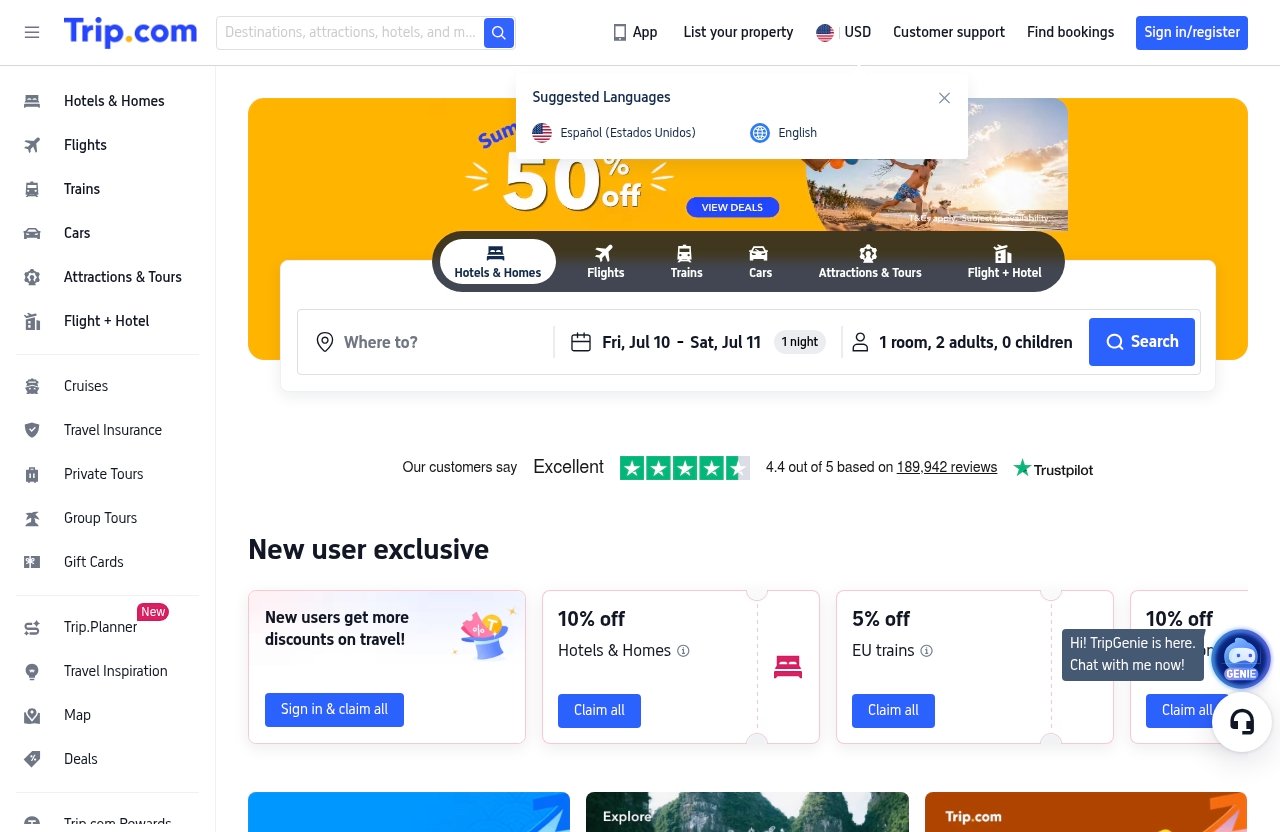
Trip.com is an online travel platform where users can search and book travel products, including Hotels & Homes, Flights, Trains, Cars, Attractions & Tours, and Flight + Hotel. For this trip com review for hotels, the focus is specifically on the hotel marketplace and what travelers should check before making a reservation.
The process is similar to other online travel agencies. You search by destination and dates, apply filters, compare properties, choose a room and rate, review the policy, then complete the booking.
Hotels & Homes marketplace
Trip.com’s Hotels & Homes section is a marketplace-style booking experience. The official hotels page states that users can search 1.7+ million hotels across 230+ countries.
That wide inventory is helpful for price discovery. It also means the booking details are not identical across every hotel. Some properties may offer flexible rates, while others may show prepaid or nonrefundable options.
A practical way to think about it:
| Booking element | Why it matters |
|---|---|
| Property | Hotel standards and policies vary by location and brand. |
| Room type | Bed type, view, occupancy, and inclusions may differ. |
| Rate type | Flexible, prepaid, or nonrefundable terms change your risk. |
| Taxes and fees | The displayed nightly rate may not be the final total. |
| Currency | International bookings may involve conversion or card fees. |
Search, filters, and guest reviews
Trip.com’s official hotel search experience includes filters for location, price, star rating, amenities, and real guest reviews. These are useful, but they work best when you use them intentionally.
For example, if you need parking, free breakfast, airport shuttle, or a pool, do not assume it is included because it appears somewhere in the hotel description. Open the room details and confirm what applies to your selected rate.
For a stronger Trip.com hotel booking process, filter first, then verify manually. Guest reviews can help you spot patterns around cleanliness, check-in, noise, and location accuracy.
Why the platform can show lower prices
A common question behind any trip com review for hotels is why Trip.com is cheap on some searches. The basic answer is that online travel agencies aggregate hotel inventory, display promotional rates, and may run discounts for certain users or channels.
Trip.com’s public hotel messaging includes new-user discounts on Hotels & Homes, and its hotel page has shown app-related promotional language. These offers can change, so treat them as current booking prompts rather than permanent guarantees.
Lower prices can come from:
- Promotional hotel rates
- New-user discounts
- App-only offers
- Regional inventory differences
- Prepaid or less-flexible rates
- Seasonal campaigns
The key is to compare the final total, not just the first price you see.
7 things to know before booking a hotel on Trip.com
This is the most important part of the trip com review for hotels because most booking problems come from missed details. Trip.com can be useful, but you need to know exactly what you are buying.
Before you book, open the full listing, review the room details, check the cancellation terms, and compare the final price against at least one other source. A few extra minutes can prevent confusion later.
1. Prices can be competitive
Trip.com hotel deals can be attractive, especially when promotions apply. The official site mentions “New users get more discounts on travel,” including 10% off Hotels & Homes, though availability and terms can vary.
Still, do not compare only the nightly rate. Compare the final checkout total, including taxes, service fees, local fees, and any payment-related differences.
A smart price check looks like this:
- Search the same hotel and same dates on Trip.com.
- Search the same room type on the hotel’s official site.
- Compare cancellation terms, not just price.
- Confirm whether breakfast, parking, or resort fees are included.
- Check whether the booking is prepaid or pay-at-property.
In this trip com review for hotels, price is a real strength only when the cheaper offer has terms you can live with.
2. Cancellation rules vary by listing
The Trip.com cancellation policy is not one universal rule for every hotel. It depends on the specific property, rate type, dates, and supplier terms shown at booking.
That means two rooms at the same hotel can have different cancellation rules. One may be flexible until a certain date, while another may be nonrefundable because it is cheaper.
Before paying, look for:
- Free cancellation deadline
- Nonrefundable wording
- Partial refund conditions
- Local time zone for cancellation cutoff
- Whether changes are allowed
- Whether no-shows are charged
Take a screenshot of the cancellation policy before booking. If you later need help, having the exact policy you accepted can make the support conversation clearer.
3. Customer support matters if plans change
Trip.com support becomes important when your flight is delayed, your hotel cannot find the reservation, or you need to change dates. Like other online travel agencies, Trip.com may act as the intermediary between you and the hotel.
That can be helpful if the platform resolves the issue quickly. It can also feel slower than dealing directly with the hotel if the property needs confirmation from Trip.com or a supplier.
For peace of mind:
- Save your Trip.com confirmation number.
- Save the hotel confirmation if one is provided.
- Contact the hotel before arrival for important stays.
- Keep screenshots of the room type and cancellation terms.
- Use the official Trip.com help page for account-specific issues.
This trip com review for hotels gives extra weight to support because low prices are less valuable if you cannot resolve a booking problem when it matters.
4. Confirm room type and inclusions
Room details matter more than many travelers realize. A “standard room” may not guarantee the bed type, view, breakfast, or occupancy you expect unless the listing clearly says so.
Look closely at the room description before booking. Pay attention to bed configuration, number of guests, smoking or nonsmoking status, bathroom type, breakfast, parking, and whether taxes or local charges are included.
Useful details to verify:
| Detail | What to check |
|---|---|
| Bed type | Queen, king, twin, or “selected at check-in” |
| Breakfast | Included, optional, or not included |
| Occupancy | Adults and children allowed in the room |
| View | City, sea, garden, or no guaranteed view |
| Fees | Resort fees, city tax, or deposits |
| Check-in | Late arrival rules and front desk hours |
If the room is for a honeymoon, business trip, family stay, or special event, consider contacting the hotel directly after booking.
5. Read recent guest reviews
Trip.com shows real guest reviews as part of the hotel search experience. Reviews are especially helpful when they are recent and mention practical details.
Look for patterns rather than one-off complaints. A single bad review may not mean much, but repeated comments about dirty rooms, weak air conditioning, noisy construction, or check-in confusion deserve attention.
You can also compare discussions from outside sources. Travelers searching “Trip com review for hotels reddit,” “Trip com hotel booking reddit,” or “Is trip com legit for hotels reddit” often want unfiltered user experiences. Reddit threads can be useful for spotting concerns, but they should not replace checking the official listing and hotel policy.
Tripadvisor forum discussions, such as searches around “Trip com review for hotels tripadvisor,” can also give context. Just remember that forum posts are individual experiences, not universal proof.
6. Check taxes, fees, and currency
The hotel price you first see may not be the amount your card is ultimately charged. Taxes, local hotel fees, deposits, resort fees, and currency conversion can affect the final cost.
This is especially important for international hotels. If your card charges foreign transaction fees or if the hotel collects local taxes at check-in, your total may differ from the headline rate.
Before booking, confirm:
- Final checkout total
- Currency used for payment
- Whether taxes are included
- Whether local fees are due at the hotel
- Whether a deposit is required
- Whether the booking is prepaid or pay later
A lower rate is only meaningful if the final total still beats your alternatives.
7. Look for app-only and new-user promos
Trip.com’s official hotel messaging includes new-user discount language for Hotels & Homes. Public promotional snippets have also shown app-related deal language, such as downloading the app for another promo code, though these promotions can change and may have caps or terms.
That means it is worth checking whether a valid promo applies before booking. But do not let a promo rush you into a bad rate.
A good promo is one that still works after you verify:
- Room type
- Cancellation policy
- Final total
- Payment currency
- Check-in requirements
- Hotel reviews
In this trip com review for hotels, promotions are a plus, not the whole reason to book.
Trip.com hotel pricing and deals explained
Trip.com does not present hotel booking as a subscription pricing model on its official homepage. Instead, hotel pricing is marketplace-driven and varies by property, date, room type, availability, user eligibility, and promotion.
That is why a trip com review for hotels should not talk about fixed hotel “plans.” The better question is whether the live rate you see is a good value compared with the hotel’s direct price and other booking sites.
New user discounts
Trip.com’s official homepage messaging says new users get more discounts on travel, including 10% off Hotels & Homes. This can make the platform appealing if you are booking for the first time.
However, promotional terms can change. Always check whether the discount applies to your selected hotel, dates, destination, and rate type before assuming the advertised savings are available.
App-only deals
Trip.com also uses app-only deal language in public hotel promotions. App deals can be useful because travel platforms sometimes push mobile-specific offers to encourage app downloads.
The practical move is simple: compare the desktop price and app price before booking. If the app-only rate is lower, still review the same cancellation and room details.
Promo codes and seasonal sales
Trip.com may display promo codes or seasonal travel campaigns depending on timing, destination, and user eligibility. These can help explain why Trip.com is cheap on a specific hotel search.
But promo codes do not override the hotel’s rules. A discounted nonrefundable rate may still be riskier than a slightly higher flexible rate.
When evaluating a promo, ask:
- Does it reduce the final total?
- Does it apply to this exact property?
- Does it change the cancellation policy?
- Is the discount capped?
- Is the room type still the one I want?
What the official site verifies
The official Trip.com hotel page verifies that travelers can search 1.7+ million hotels across 230+ countries. It also verifies filters such as location, price, star rating, amenities, and real guest reviews.
For deal messaging, the official site verifies new-user hotel discount language for Hotels & Homes. Any app-only or promo-code example should be treated as a current promotional possibility, not a permanent guarantee.
For broader context on the platform beyond hotels, you can also read our [Trip.com Review 2026: Is It Worth Booking Your Trip?](trip-com-review-2026).
Official website · Latest pricing & offers
Cancellation, changes, and booking protection
Cancellation and changes are where many online hotel bookings succeed or fail. In this trip com review for hotels, the biggest practical advice is to choose your rate based on your risk level, not just the lowest price.
If your plans are uncertain, a flexible rate may be worth paying more for. If your trip is locked in and the savings are meaningful, a stricter rate may make sense.
How to read the cancellation policy
Read the Trip.com cancellation policy on the specific listing before you book. Do not assume that because one hotel offers free cancellation, another hotel will do the same.
Look for exact wording such as:
- “Free cancellation before” a certain date
- “Nonrefundable”
- “No changes allowed”
- “Cancellation fee applies”
- “Pay at hotel”
- “Prepaid”
Also check the time zone. A cancellation deadline may be based on the hotel’s local time, not your home time zone.
Refund timing expectations
Refund timing can depend on the hotel policy, payment method, bank processing, and Trip.com’s handling process. You should avoid assuming an instant refund unless the specific booking terms say so.
If you cancel within the allowed window, keep the cancellation confirmation. If you are dealing with a nonrefundable booking, understand that approval for exceptions may depend on the hotel or supplier, not just Trip.com support.
This is one reason it is smart to save screenshots before booking. Documentation helps if there is disagreement about the policy shown at checkout.
When to contact support first
Contact Trip.com support first when the booking was made through Trip.com and the issue involves payment, cancellation, refund status, or a missing confirmation. The official customer support/help page and service guarantee page are the right verification points for current escalation options.
Contact the hotel directly when you want to confirm arrival time, bedding preference, parking, accessibility needs, or whether they have received the reservation. For important stays, doing both can reduce stress.
A simple workflow:
- Book only after reading the terms.
- Save the confirmation and policy.
- Contact the hotel to confirm the reservation.
- Use Trip.com support if there is a platform or payment issue.
- Keep written records of any changes.
Support, trust, and reputation signals
Trust is not just about whether Trip.com is a real company. It is about how confident you feel that your specific hotel booking will be honored and supported if something goes wrong.
This trip com review for hotels takes a balanced view. Trip.com has official support resources and broad brand recognition, but user experiences can vary, especially when plans change or a hotel booking involves third-party inventory.
What Trustpilot and forum discussions suggest
Public review sites and forums show mixed experiences, which is common for large online travel agencies. On Trustpilot, some users report smooth bookings and low prices, while others raise concerns about refunds, changes, or communication.
Travel forums also show a range of opinions. Tripadvisor discussions such as this Trip.com legitimacy thread include traveler questions and experiences, but individual forum posts should be read as anecdotal context.
Reddit discussions, including threads like booking hotel on Trip.com legit, can be useful for seeing real traveler concerns. Searches like “Is trip com reviews,” “Trip com Google reviews,” and “Is trip com legit for hotels reddit” often reflect the same core question: did the reservation work as expected?
What the official brand tells you
The official Trip.com hotels page shows the company’s hotel search offering, including broad hotel inventory and filtering tools. It also shows Trip.com’s positioning as a multi-category travel platform.
Trip.com is part of Trip.com Group Limited, which gives it a larger corporate footprint than an unknown booking site. That helps with legitimacy, but it does not remove the need to check individual hotel terms.
If you are comparing travel categories, you may also see searches like “Is trip com reliable for flights” or “Is trip com reliable for flights international.” Those are related reputation questions, but flight reliability and hotel booking reliability are not identical experiences.
How to verify a booking safely
Verification is the best way to reduce risk. After completing a Trip.com hotel booking, save your confirmation and contact the hotel if the stay is important.
Use this checklist:
- Save the Trip.com confirmation email.
- Screenshot the room type and cancellation policy.
- Confirm the reservation with the hotel before arrival.
- Ask the hotel whether they see your name and dates.
- Keep payment records.
- Bring ID and the booking confirmation when checking in.
For other travel-related buying decisions, the same verification mindset applies. For example, we use similar policy-first checks in our [Discover Cars Insurance Review 2026: Is Full Coverage Worth It?](discover-cars-insurance-review), and pricing transparency is also central in reviews like [Hostinger Pricing 2026: What You Really Pay](hostinger-pricing).
Trip.com vs booking direct: when each option makes sense
A good trip com review for hotels should not say one option is always better. Trip.com and direct hotel booking serve different needs.
Trip.com can be useful for comparing prices, discovering hotels, and finding promotional rates. Booking direct can be better when you want the clearest property-side control, loyalty benefits, or faster handling of special requests.
Lower price versus direct perks
Trip.com may show a lower price because of promotions, marketplace inventory, app deals, or new-user discounts. If the final total is meaningfully cheaper and the cancellation terms are clear, booking through Trip.com can be a smart move.
Direct booking may be better if the hotel offers loyalty points, elite benefits, direct upgrade handling, or easier changes. Hotels may also prioritize direct reservations when resolving room-specific requests, although this varies by property.
Compare these factors:
| Factor | Trip.com may make sense | Booking direct may make sense |
|---|---|---|
| Price | Trip.com final total is lower | Hotel direct price is similar |
| Flexibility | Policy is clearly refundable | You may need changes |
| Loyalty | Not important | Points or elite benefits matter |
| Support | You are comfortable using OTA support | You prefer hotel-only support |
| Special requests | Simple stay | Important room needs |
When direct booking may be safer
Direct booking may be safer when the stay is high-value, complicated, or time-sensitive. Examples include weddings, medical travel, major conferences, late-night arrivals, or trips with children where room type is critical.
If you need guaranteed connecting rooms, accessibility features, specific bedding, or flexible date changes, call the hotel before booking. If the hotel says they can only guarantee something on direct reservations, that may matter more than a small discount.
This does not mean Trip.com is unsafe. It means the best booking path depends on what could go wrong and how easily you need it fixed.
Best use cases for Trip.com
Trip.com is strongest when you are using it as a price discovery and comparison tool. It can also be attractive when a promotion creates a meaningful price gap.
Best use cases include:
- Flexible leisure trips
- Standard hotel stays
- Price comparisons across many properties
- Travelers who do not need hotel loyalty benefits
- Users who carefully read policies before booking
- Bookings where the Trip.com hotel deals are clearly better
If you are evaluating other online tools, the same “final cost versus real value” mindset applies. For example, our [Repurpose.io Pricing 2026: Plans and Value](repurpose-io-pricing) review also focuses on what users actually get for the price.
Final verdict: should you book hotels on Trip.com?
The final answer in this trip com review for hotels is yes, Trip.com can be worth using when the price is competitive, the room details are clear, and the cancellation policy matches your travel risk. It is not a site to use blindly, but it can be a smart option for careful travelers.
Before you book, compare the final total and read the hotel-specific rules. If the savings are meaningful and you feel confident about support and policy clarity, Trip.com is worth considering.
You can compare current Trip.com hotel rates and booking policies here before deciding.
Best-case scenario
The best-case scenario is straightforward: you find a lower hotel price, apply a valid promo, choose a clear room type, and receive a confirmation that the hotel can verify. In that case, Trip.com can deliver real value.
This is especially true for standard stays where you do not need complex changes or loyalty perks. If the rate is refundable and the final total is lower, the risk is easier to justify.
Worst-case scenario
The worst-case scenario is booking a nonrefundable or unclear rate, then needing a change or discovering that the room details were not what you expected. In that case, support, hotel cooperation, and the original policy become critical.
Be careful with last-minute bookings, major trips, and reservations where the hotel must guarantee something specific. If the policy is vague or the price gap is small, booking direct may be the calmer choice.
Bottom line
Trip.com is a legitimate hotel booking platform and can be a good way to find competitive rates. The smartest approach is to use it when the price advantage is real, the cancellation terms are clear, and you are comfortable saving confirmations and verifying the reservation.
For most travelers, the decision framework is simple: book through Trip.com when the deal is meaningfully better and the policy is easy to understand. Be cautious when the stay is nonrefundable, urgent, expensive, or dependent on special room requirements.
In short, this trip com review for hotels finds Trip.com worth checking, but not worth using without reading the fine print.
Official website · Latest pricing & offers
FAQ
Why is Trip.com so cheap?
Trip.com can be cheap because it aggregates hotel inventory, displays promotional rates, and may offer discounts such as new-user deals or app-only promotions. The official site has promoted 10% off Hotels & Homes for new users, though offers can change and may have terms.
Always compare the final total, not just the nightly rate. A cheaper Trip.com hotel booking is only a better deal if taxes, fees, cancellation rules, and room inclusions still work for your trip.
Is Trip.com a safe site?
Trip.com is a long-running travel platform with official hotel booking pages, customer support resources, and broad travel inventory. It is not an unknown site, and it offers hotel search across many countries.
Still, safe booking depends on careful verification. Read the Trip.com cancellation policy for your exact listing, confirm room details, save screenshots, and contact the hotel directly for important stays.
Is Trip.com or Expedia better?
Trip.com may be better when it shows a lower final hotel price, a useful promo, or better availability for your destination. Expedia may be preferred by some travelers because they are more familiar with it or like its broader package-booking experience.
The better choice depends on the specific hotel, dates, cancellation terms, and final price. Compare both, then choose the option with the clearest policy and best value.
Is Trip.com a reputable company?
Trip.com is part of Trip.com Group Limited and has established brand recognition in online travel. That supports its legitimacy as a travel booking platform.
However, reputation does not replace listing-level due diligence. Before booking any hotel, check the room type, cancellation policy, taxes, payment terms, and support options so you know exactly what you are buying.
Related Reading
References
- Read Customer Service Reviews of trip.com
- Is trip.com legit? – Bargain Travel Forum
- Hotel Deals & Discounts – Book Directly at Best Rates
- Booking hotel on trip.com legit? : r/travel