Taplio AI: How Good Is It in 2026?

Taplio AI is a capable LinkedIn-focused content and growth platform, but it is not a magic publishing machine. Its strongest value is the workflow: turning an idea into a draft, improving the hook and tone, scheduling the post, monitoring likely reach, and supporting engagement from one place.
This Taplio AI review is written for buyers deciding whether that broader system is worth paying for. My verdict: it is a strong fit for founders, consultants, creators, and marketers who publish on LinkedIn consistently and want to reduce the time between an idea and a well-edited post. It is less compelling for people who only need occasional AI copywriting or expect fully original, publish-ready thought leadership without human input.
Official website · Latest pricing & offers
Taplio AI in 2026: Quick Verdict
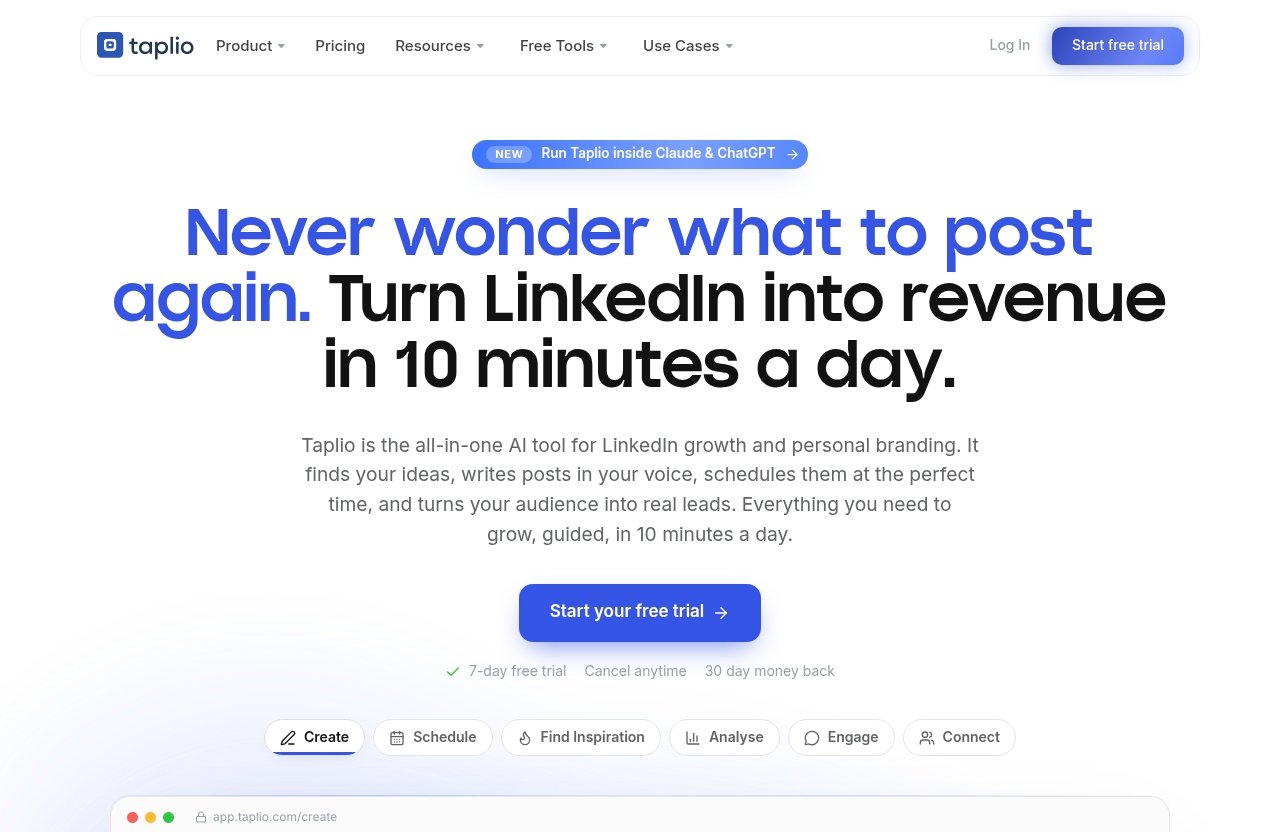
Taplio AI is good at accelerating the routine parts of LinkedIn content work: ideation, first drafts, hooks, rewrites, formatting, scheduling, and engagement prompts. It appears designed around a practical promise from the official site: helping users grow on LinkedIn in 10 minutes per day.
The key caveat is quality control. The tool can make publishing more consistent, but it cannot supply your lived experience, contrarian view, customer insight, or judgment. Use it as an intelligent drafting and workflow assistant rather than an autonomous ghostwriter.
What Taplio Is Built to Do
At its core, Taplio is an AI LinkedIn tool built around the full growth loop. You can find content ideas, generate or rewrite posts in your voice, schedule them, engage with relevant people, and use lead-focused workflows.
The official product positioning is unusually clear: its AI is trained on more than 3 million posts and is intended to turn a user’s idea into a post “in your voice,” ready to schedule. That makes it more specialized than a general-purpose text generator, although specialization does not guarantee that every draft will sound distinctively like you.
Who Should Consider It
Taplio AI makes the most sense if LinkedIn is already part of your acquisition, authority-building, or networking strategy. A consultant who needs to turn client lessons into weekly posts, a founder building trust before a sales conversation, or a creator developing a reliable publishing habit can all benefit from the system.
It is especially relevant when content is only one part of your LinkedIn process. The value grows when you use content discovery, a Taplio scheduler, engagement tools, and lead workflows together instead of treating the product as a standalone writing box.
Who Should Probably Skip It
Skip or pause on Taplio AI if you rarely publish on LinkedIn, do not have clear topics to discuss, or want only a cheap way to generate generic social captions. A focused writing assistant may be enough if your needs begin and end with producing one short post now and then.
It may also disappoint buyers who expect AI to replace editorial thinking. If your content depends on detailed research, regulated claims, sensitive personal stories, or a highly developed brand voice, you will still need careful human review before publishing.
What Taplio Actually Does
The easiest way to understand Taplio is as a LinkedIn growth workspace rather than merely a Taplio content generator. It combines content creation, planning, engagement, and prospecting-oriented tools into a connected process.
A sensible workflow starts with a rough idea or a relevant post in your niche. You use AI to shape the idea, edit the result until it reflects your perspective, schedule it, then use the engagement and connection features selectively to continue relevant conversations.
AI Post Creation and Voice Matching
Taplio AI offers AI hooks, post rewrites, and tone matching intended to write in your voice. In practical terms, that gives you several useful ways to begin: start from a blank idea, improve an existing draft, or test alternative openings before committing to a post.
This is where the product’s training on 3 million-plus posts matters most as a reasonable inference: it should help it recognize common LinkedIn post structures and attention patterns. Still, a familiar structure can become formulaic if you accept the first draft every time.
Content Inspiration and Viral Post Discovery
The platform includes a daily feed of viral posts ranked for your niche. It also has a LinkedIn Benchmark resource that analyses more than 60,000 LinkedIn posts each month.
For a busy marketer, that is useful context rather than a content shortcut. The best use is to study themes, framing, and conversation angles, then create a post based on your own opinion. Copying the surface structure of viral content is easy; adding a credible point of view is the harder and more valuable step.
Scheduling and Best-Time Publishing
Taplio provides a visual queue and best-time scheduling tuned to followers. It can also drip whole carousels and series automatically, which is useful when you have a connected sequence of posts rather than isolated ideas.
A Taplio AI workflow can therefore remove a common bottleneck: finishing a draft but failing to publish it consistently. Scheduling does not make weak content perform, but it can help a strong, edited post reach your audience at a more appropriate time.
Engagement Feed and Comment Starters
The platform offers a curated feed of prospects, peers, and creators, plus AI comment starters designed to sound like you. These Taplio engagement tools can be useful for avoiding the blank-page problem when you want to participate thoughtfully in conversations.
The important word is “starters.” A generated comment should be the beginning of your contribution, not the entire contribution. Add a specific reaction, example, question, or respectful disagreement before posting; otherwise, your engagement can read as automated even if it is technically personalized.
Lead Capture and DM Workflows
Taplio supports finding leads by title, industry, and engagement. Its official pages also describe connection requests followed by a direct message on acceptance, using safe, human-paced sequences.
That makes Taplio lead generation relevant to users who see LinkedIn content as a route to conversations, not simply impressions. The responsible approach is to connect these workflows to a clear targeting strategy and useful messaging. Automation can organize outreach, but it cannot create genuine relevance for the recipient.
How Good Is Taplio AI Writing?
The Taplio AI writer is best judged as a fast drafting partner, not as a final-authority writing system. It seems particularly suited to the format demands of LinkedIn: short openings, scannable sections, clear takeaways, and prompts that encourage discussion.
My practical assessment is that it can significantly reduce production time for people who already know what they want to say. It is less reliable when the task requires distinctive analysis, a subtle personal story, or a fact-sensitive argument.
Strengths: Speed, Hooks, and Repurposing
The most obvious strength of Taplio AI is momentum. A consultant can start with a rough note such as, “Clients do not need more dashboards; they need one weekly decision,” and quickly explore hook variations, structures, and a draft that is easier to refine.
Hooks and rewrites are particularly valuable because they address the repetitive work that slows down regular publishing. You may have a good insight but struggle to make the opening concrete enough for a busy LinkedIn reader. The AI can propose several directions, allowing you to choose the one that fits your actual message.
Repurposing is also a sensible use case. Turn a workshop takeaway, a customer question, or a founder note into a draft, then add the missing context. That is more effective than asking any AI system to invent authority from nothing.
Weaknesses: Originality, Depth, and Nuance
The primary weakness is not necessarily grammar or formatting; it is sameness. AI-generated LinkedIn copy can lean toward predictable pacing, broad claims, and familiar “lesson learned” structures. Even when the language is polished, it may lack the details that make a post memorable.
Taplio AI cannot know which uncomfortable trade-off you made, what a customer actually objected to, or why a common piece of advice failed in your market unless you provide that information. The more specific your input, the better the output is likely to become.
Nuance is another limitation. Topics involving strategy, leadership, legal or financial implications, and reputation deserve a human writer’s care. Do not let a smooth draft persuade you that the reasoning underneath it is sound.
Best Use Cases for the AI Writer
The Taplio AI writer is most useful for repeatable, experience-led content. Good examples include turning a meeting insight into a short post, rewriting a rough draft for clarity, generating hooks for a proven topic, or converting a multi-part idea into a content series.
For founders, a practical routine might look like this:
- Save three customer questions from the week.
- Choose one question that reveals a real market concern.
- Use the AI to generate a draft and several hooks.
- Add your exact experience, result, or disagreement.
- Check every claim, then schedule the final version.
That workflow uses the tool for speed while preserving the expertise that makes your content worth reading.
When You Still Need a Human Editor
Every important post deserves a human pass. Review the first line, remove generic phrases, add a real example, verify claims, and make sure the conclusion matches the point you actually want to make.
You should be especially cautious with posts that mention clients, performance figures, industry research, or sensitive professional situations. Taplio AI can organize language, but it should not be trusted to validate facts or understand reputational context on your behalf.
Taplio Features That Support the AI Content Engine
The AI writer is more useful because it sits inside a larger publishing system. Instead of generating text in one tab and managing everything else elsewhere, you can move from inspiration to scheduling and engagement in the same environment.
That integrated workflow is the main reason Taplio may justify more consideration than a generic AI writing tool. For a committed LinkedIn publisher, reduced switching can be as valuable as the generated copy itself.
Viral Post Library and Niche Ideas
The daily viral-post feed and the LinkedIn Benchmark resource can help users identify patterns in their niche. The Benchmark analyses more than 60,000 LinkedIn posts every month, according to the official site.
Treat these resources as research aids. A useful process is to identify a recurring topic, ask why it resonates with that audience, then write a response informed by your own work. The goal is not to recreate viral posts but to identify conversations worth joining.
Carousel Generation
Taplio can turn content into a swipeable carousel. This is a useful extension for creators who have a structured framework, step-by-step process, or sequence of lessons that does not fit naturally into one text post.
The quality of a carousel still depends on the underlying idea. A weak outline will not become persuasive simply because it is split across slides. Use the feature after you have clarified the core message and decided what readers should take away.
Live Reach Prediction
Taplio includes live reach prediction before publishing. This is potentially useful as a directional signal while you are choosing between different drafts, hooks, or formats.
It should not be treated as a guarantee. Audience response is influenced by topic relevance, timing, relationships, and factors outside any prediction tool. Use the estimate to inform judgment, not override it.
Best-Time Scheduling
Best-time scheduling tuned to followers is another practical feature for regular publishers. It helps turn finished content into a visible, planned habit rather than a pile of drafts waiting for the right moment.
This matters because consistency often fails at the execution stage. A Taplio scheduler can reduce that friction, especially for someone who creates multiple posts during one focused session and wants them distributed over time.
Chrome Extension and Workflow Integrations
Some buyers search for a “Taplio Chrome extension” or broader workflow integrations. Based on the verified official product facts provided for this review, the feature that is clearly supported is MCP 2.0: Taplio can be run from Claude, ChatGPT, or any MCP-enabled LLM.
That is meaningful for users who already work inside an MCP-compatible AI environment. It suggests a more flexible workflow around content planning and execution. However, buyers should confirm any specific browser-extension expectations directly on Taplio’s current official pages before purchasing, rather than assuming a feature exists because it appears in third-party keyword lists.
Official website · Latest pricing & offers
Pricing: What You Pay in 2026
Taplio pricing starts from $39 per month, according to the official pricing-page headline. The site also offers a 7-day free trial, cancellation at any time, and a 30-day money-back policy.
Because the verified information here does not specify plan names, limits, or feature-by-feature tier access, a responsible review should not guess at them. Check the current pricing page before subscribing, particularly if a specific workflow such as lead outreach or MCP access is central to your decision.
Free Trial and Cancellation Terms
The Taplio free trial lasts seven days. That is enough time to test the product’s most important question: does it actually help you publish better LinkedIn content with less effort?
Do not spend the trial only clicking through menus. Create several posts from your real ideas, test rewrites against your existing voice, build a queue, and assess whether the engagement and discovery features fit your daily workflow. The official terms also state that you can cancel anytime and offer a 30-day money-back policy.
Plan Positioning and Value Discussion
At a starting price of $39 per month, Taplio AI is easier to justify as a complete LinkedIn operating system than as a basic text generator. If all you need is one AI-written post each month, the value proposition will likely feel weak.
The calculation changes when the tool helps you maintain a publishing rhythm, find relevant discussion topics, plan content series, and manage engagement or lead-focused activity in one workflow. That is the real commercial case behind a Taplio AI app subscription.
Who Gets ROI Fastest
The fastest return is likely to come from people who already have something valuable to say but lack consistency and process. A consultant who converts weekly client insights into posts, or a founder who routinely engages with a defined market, can potentially save meaningful time.
The slowest return comes from inactive users. Paying for a content system will not help if you do not gather ideas, edit drafts, publish regularly, and follow up on relevant conversations. Before subscribing, decide how many posts and interactions you can realistically sustain each week.
Pros and Cons of Taplio AI
Taplio AI has a clear strength: it brings several LinkedIn tasks into one product. That coherence is appealing for people who want less tool switching and more disciplined publishing.
The trade-off is that the platform still asks you to provide direction. It is a system for improving a real strategy, not a substitute for having one.
Biggest Advantages
- AI-assisted post creation, hooks, rewrites, and voice matching are designed for LinkedIn-specific publishing.
- The viral-content feed and LinkedIn Benchmark give users ongoing idea inputs.
- Visual scheduling, best-time scheduling, and automated carousel or series dripping support consistency.
- Curated engagement feeds and comment starters can reduce friction when joining relevant conversations.
- Lead targeting and human-paced connection and DM workflows extend the platform beyond content alone.
- MCP 2.0 support is a notable option for people who want to run Taplio through Claude, ChatGPT, or another MCP-enabled LLM.
Main Limitations
- The AI’s output still requires editing for originality, accuracy, and personal credibility.
- Voice matching should be evaluated during the trial, not assumed from marketing language.
- Reach prediction is a guide, not proof that a post will perform.
- The platform is designed for LinkedIn, so it is not the right choice if your main content priorities sit elsewhere.
- Verified public pricing information in this review begins at $39 per month, but buyers should check the official page for current plan details and access.
Hidden Friction Points
The biggest hidden cost is editorial discipline. AI makes it easy to create more drafts, but that can lead to more generic content if you do not have a clear filter for what is worth publishing.
There is also a learning curve in building a consistent voice. To get the best from Taplio AI, you need examples, opinions, stories, customer language, and a repeatable point of view. The tool can accelerate those assets; it cannot create them from scratch.
Taplio vs. Alternatives: How to Think About the Choice
When evaluating Taplio alternatives, start with your actual bottleneck. Is it writing? Is it finding ideas? Is it posting consistently? Or is it converting LinkedIn attention into professional conversations?
A tool that solves the wrong bottleneck is poor value regardless of its feature list.
If You Want Pure AI Writing
Choose a simpler AI writing option if your only need is drafting text. Taplio AI is likely more than you need if you do not care about LinkedIn-specific discovery, scheduling, engagement, or lead workflows.
In that scenario, compare the quality of output on your own topics and the effort required to edit it. The best writer is not necessarily the one that produces the longest draft; it is the one that helps you express a specific point with less wasted effort.
If You Want LinkedIn Growth in One Tool
Taplio is more compelling if you want a connected workflow for content, scheduling, engagement, and lead activity. That is its central buying argument: fewer disconnected steps between an idea and a LinkedIn conversation.
The platform will be most useful when you actively use the surrounding features. If your process includes only generating a draft and pasting it into LinkedIn manually, much of its potential value remains unused.
If You Need Team Workflows
Teams should validate their workflow during the trial before making a commitment. The verified facts for this review do not establish specific collaboration permissions, approval flows, or team-management capabilities, so those should not be assumed.
For agencies and internal marketing teams, the key questions are practical: Can your editors maintain quality? Can you keep client or executive voices distinct? Can the team coordinate content without removing accountability? Those answers matter more than broad AI claims.
Who Taplio AI Suits Best
Taplio AI is not equally valuable for every LinkedIn user. Its best customers are people with a defined audience, a consistent reason to publish, and enough subject-matter knowledge to improve generated drafts.
The more intentional your content strategy, the more useful the system becomes.
Solo Creators and Personal Brands
Solo creators can use Taplio to establish a reliable workflow without assembling multiple tools. The daily inspiration feed, AI drafting, carousel creation, and scheduling are particularly relevant when one person handles every stage of publishing.
The warning for personal brands is simple: do not outsource your personality. Use the AI for structure and speed, but retain your own stories, opinions, and language patterns.
Founders and Consultants
Founders and consultants are arguably the strongest fit. They often have a steady supply of real-world insight but little time to convert it into content.
A founder can turn product lessons into posts, while a consultant can transform recurring client questions into useful educational content. In both cases, the AI helps organize raw expertise, but the commercial trust comes from details only the human author can provide.
Agencies and Teams
Agencies and teams may benefit when they need repeatable LinkedIn content workflows across several voices. The opportunity is to use the system for research, first drafts, scheduling, and structured engagement while preserving an editor’s final review.
However, agencies should test it with representative client work first. The most important test is not whether it can produce content quickly; it is whether the team can maintain strategic distinction between different clients and audiences.
Who Should Look Elsewhere
Look elsewhere if you need only general AI writing, publish infrequently, or are unwilling to edit generated drafts. You may also prefer another route if your main priority is a channel other than LinkedIn.
Buyers looking for a Taplio summary generator should also clarify their exact use case. The verified official facts emphasize post creation, hooks, rewrites, tone matching, scheduling, engagement, carousels, and lead workflows; they do not establish a separate summary-generator feature.
Final Recommendation
Taplio AI is a well-positioned LinkedIn growth tool for people who want more than generated text. Its strongest advantage is the way content creation, inspiration, scheduling, engagement, and lead workflows reinforce one another.
The tool is worth considering if you will actively use that ecosystem. It is less convincing when judged solely as an AI writer against simpler options.
Best-Case Scenario
The best-case user has real expertise, a defined LinkedIn audience, and a commitment to publishing consistently. They use Taplio AI to turn raw insights into drafts faster, improve hooks, build a queue, discover relevant conversations, and make engagement more deliberate.
For that buyer, the $39-per-month starting point can be commercially reasonable because it supports a repeatable process rather than a one-off writing task. If that describes your workflow, the official Taplio trial through this link is a sensible way to test fit with your own topics and voice.
Worst-Case Scenario
The worst-case user expects automated content to create authority without expertise or editing. They publish generic drafts, rely on prediction scores too heavily, and treat comment starters or outreach workflows as substitutes for genuine interaction.
In that situation, Taplio AI will not solve the real problem. It may even make content feel less personal if used without an editorial standard.
Bottom Line
So, Taplio: is it worth it? For consistent LinkedIn publishers who want an integrated content-and-growth workflow, the answer is often yes—provided they treat the AI as a collaborator, not a replacement for judgment.
Taplio AI is strongest for founders, consultants, creators, and marketers who can bring real ideas to the system and use its features regularly. Buy it for speed, organization, and LinkedIn-specific workflow support; wait if you only need occasional generic copy or want hands-off content production.
Official website · Latest pricing & offers
FAQ
Is Taplio worth the cost?
Taplio can be worth the cost if you use LinkedIn consistently and need more than an AI writer. Its starting pricing is $39 per month, and its value is strongest when you use content creation, scheduling, engagement, and lead workflows together.
If you only need occasional drafts, it may be more tool than you need. Use the 7-day trial to measure time saved and assess whether the writing matches your standards.
What is Taplio for?
Taplio is for LinkedIn content creation, scheduling, engagement, and lead-focused workflows. Its official features include AI post creation, voice matching, viral-post discovery, carousels, reach prediction, scheduling, comment starters, lead discovery, and human-paced connection and DM sequences.
Is Taplio free?
Taplio is not presented as a permanently free product in the verified pricing information. It offers a 7-day free trial, with cancellation anytime and a 30-day money-back policy according to the official site.
Which AI is 100% free?
Some AI tools may offer free access levels, but availability, limits, and features change frequently. The better question is whether a tool solves your actual workflow problem: for LinkedIn publishing, evaluate Taplio’s trial based on draft quality, scheduling needs, engagement workflow, and the amount of time it saves you.
Related Reading
- best app for planning social media posts
- how much does a post planner cost
- postplanner review complaints
References
- Taplio | AI tool to grow on LinkedIn in 10 min/day
- Taplio Pricing – Plans from $39/mo | Free Trial
- Taplio Review 2026: Features, Pricing, Safety & What Users Don't Know
- Taplio review: is this AI-powered LinkedIn tool worth it?