
DIY vs Tweet Hunter: Which X Growth Strategy Wins in 2026?
Choosing between DIY vs Tweet Hunter comes down to a simple question: do you have more time than money, or more need for consistent output than hours in the day?
Manual X growth costs no software fee and gives you complete control. However, it also means you personally handle every idea, draft, post, reply, follow-up, and performance review. Tweet Hunter is designed to reduce that workload through content support, scheduling, automation, and analytics.
For most creators, founders, freelancers, and marketers posting seriously on X, a tool can make consistency easier. But automation is not a substitute for a clear point of view, useful content, or genuine conversations.
Official website · Latest pricing & offers
DIY vs Tweet Hunter in 2026: quick verdict
The short version of DIY vs Tweet Hunter is this: manual growth is better for people who want maximum control and have enough time to execute daily. Tweet Hunter is better for people who need a repeatable system for publishing, engagement, and follow-up.
| Your situation | Better fit | Why |
|---|---|---|
| Limited budget and plenty of available time | DIY | No software cost and full hands-on control |
| Busy founder or freelancer | Tweet Hunter | Helps create, schedule, and analyze content more efficiently |
| Personal brand with sensitive messaging | DIY or hybrid | Human review remains essential |
| Managing several client or brand accounts | Tweet Hunter | Plans can include 5 or unlimited X accounts |
| New creator testing X seriously | Start manual, then consider Tweet Hunter | Learn your voice first, then build systems around it |
Who should go manual
Manual Twitter growth suits creators who are still finding their voice, have a very small budget, or simply enjoy spending time on the platform. If you post a few times per week, reply thoughtfully, and do not need to manage high volume, a DIY process can work well.
It is also a strong choice for highly personal brands. Coaches, writers, executives, and public-facing experts may prefer reviewing every word and interaction themselves before anything goes live.
Who should consider Tweet Hunter
Tweet Hunter is worth considering if X is an important channel for your business, audience growth, or lead generation. It is particularly useful when you regularly struggle to turn ideas into posts, maintain a schedule, remember follow-ups, or understand which content performs best.
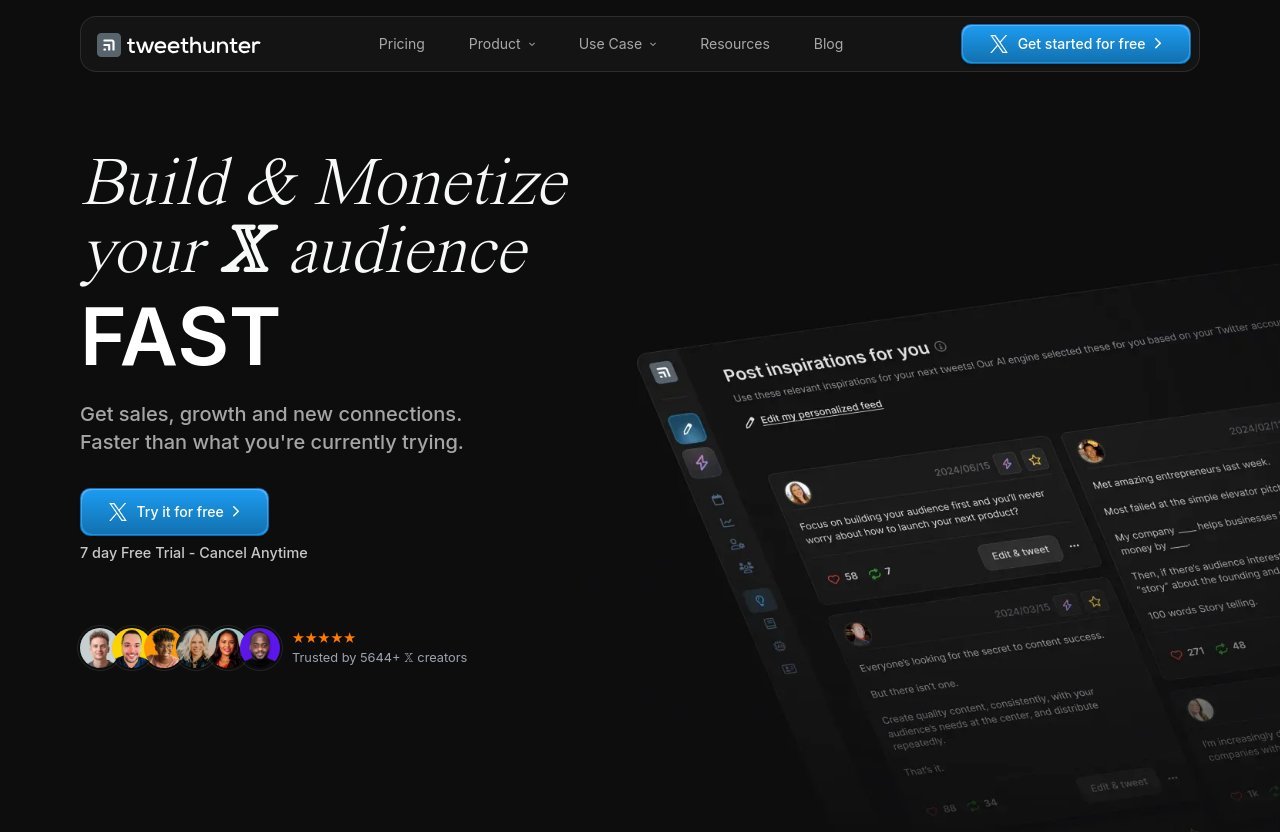
The platform positions itself around helping people build and monetize an X audience through content ideas, writing support, automation, engagement, and analysis. You can explore the platform through this Tweet Hunter recommendation if those bottlenecks sound familiar.
The biggest trade-off: time vs systems
The real DIY vs Tweet Hunter trade-off is not authenticity versus automation. It is time versus systems.
Manual work can feel more personal because you are involved in every step. Yet a system can protect consistency when client work, product launches, family responsibilities, or other priorities compete for your attention. The best approach depends on whether you can reliably execute the manual routine week after week.
What DIY X growth actually looks like day to day
DIY Twitter growth sounds simple until you map out the daily work. To grow manually, you need a repeatable process for researching topics, writing posts, publishing them, engaging with people, continuing conversations, and reviewing performance.
Each task is manageable on its own. The challenge is the accumulated context switching, especially when X is only one part of your marketing strategy.
Content idea generation by hand
Without an X growth tool, you need to collect content ideas yourself. That may involve reading industry conversations, reviewing competitor posts, taking notes from customer calls, saving screenshots, and maintaining an idea document.
This process can produce excellent content because your ideas originate from real experience. But it takes discipline. When you are busy, idea collection is often the first habit to disappear, leaving you staring at a blank compose box when it is time to post.
Writing, scheduling, and posting manually
Manual writing requires you to draft hooks, tighten language, add context, and decide whether an idea works better as a single post or a thread. You then need to remember when to publish, or prepare your own calendar and posting reminders.
For a creator publishing regularly, this can become a substantial weekly task. The difficulty is not writing one strong post; it is writing relevant, on-brand posts consistently without repeating the same ideas.
In a DIY vs Tweet Hunter comparison, this is where automation begins to have practical value. A writing and scheduling system does not create expertise for you, but it can reduce the friction between an idea and a published post.
Manual engagement and networking
X growth is not only about publishing. You also need to find relevant accounts, read their posts, leave useful replies, respond to your own comments, and continue promising direct-message conversations.
Done well, manual engagement can create genuine relationships. Done inconsistently, it becomes reactive: you engage when you have spare time, then disappear when your workload increases.
A manual approach also makes follow-up harder. You may recognize a valuable interaction but lose track of it among notifications, browser tabs, and an overflowing inbox.
Tracking performance in spreadsheets or native analytics
A DIY workflow requires you to monitor what content performs, identify patterns, and make decisions from that data. Many people use native analytics alongside a spreadsheet or notes system to record topics, formats, engagement, and next steps.
There is nothing wrong with this approach. In fact, manually reviewing performance can teach you a lot about your audience. The downside is that reporting, sorting, and comparing results takes time that could otherwise go toward creating or engaging.
What Tweet Hunter automates and why that matters
Tweet Hunter is positioned as an all-in-one X marketing tool for finding ideas, writing faster, scheduling content, engaging with people, and understanding results. Its official homepage says users can write 100 high-quality tweets in less than one hour, though your actual output and quality will still depend on your niche, standards, and editing process.
The benefit in DIY vs Tweet Hunter is not that the tool removes your responsibility. It is that it gives you a more structured operating system for the repetitive work around X growth.
Content inspiration and tweet writing
Tweet Hunter includes a library of more than 12 million viral tweets, custom tweet inspirations, and AI writing support. Verified writing features include daily AI-written tweets, rewriting tweets, finishing a tweet, and generating thread ideas and hooks.
These tools can be helpful when you have expertise but need faster ways to shape it into content. For example, a founder could turn a customer insight into several hook options, then select and edit the one that matches their voice.
The key is to treat AI suggestions as a first draft, not a final answer. The strongest posts still include your specific experience, examples, opinions, and lessons.
Scheduling and evergreen posting
X content scheduling helps remove one of the biggest weaknesses in manual Twitter growth: irregular publishing. Tweet Hunter includes tweet and thread scheduling plus evergreen tweets, allowing users to prepare posts in advance and keep useful content circulating.
This is valuable for freelancers and founders who cannot be online at the same time every day. Instead of trying to remember every publishing window, you can batch content when you have focused time.
Scheduling does not mean you should ignore your account after posts go live. You still need to review replies and remain present when conversation matters.
Auto-DMs, auto-plug, and auto-retweet
Tweet Hunter includes Auto-DMs, auto-plug, and auto-retweet features. Its listed plan capabilities include 3,000, 7,500, and 15,000 Auto-DMs per month at different plan levels.
For lead-focused users, an auto DM Twitter workflow may help organize routine follow-up. However, automated messages should be relevant, clear, and used thoughtfully. A generic message sent at scale can quickly feel impersonal, even if the underlying offer is valuable.
Auto-plug and auto-retweet features can also support a content distribution workflow. Still, users should check that any automated action aligns with their brand and current campaign priorities.
Analytics and CRM workflows
Tweet Hunter offers complete X analytics along with features to create lists of accounts, import previous tweet and DM interactions, and engage with tweets from specific lists. Those capabilities can reduce the scattered nature of managing relationships manually.
For a founder, this could mean keeping a focused list of customers, peers, prospects, or collaborators rather than relying on memory. For a marketer, it can make regular engagement with priority accounts more systematic.
Its ghostwriting mode, priority support, and custom trained AI are also listed among higher-level plan features. These additions may be more relevant to professionals managing multiple voices or more sophisticated workflows.
Feature-by-feature comparison: manual workflow vs Tweet Hunter
A useful DIY vs Tweet Hunter decision requires looking beyond one feature. The advantage of a platform is usually the way its tools connect: inspiration feeds writing, writing feeds scheduling, scheduling supports consistency, and analytics informs the next round of content.
| Task | Manual workflow | Tweet Hunter workflow | Practical difference |
|---|---|---|---|
| Finding ideas | Research feeds, bookmarks, notes, and trends by hand | Viral tweet library and custom inspirations | Faster starting point for content research |
| Drafting posts | Write from scratch and self-edit | AI-written tweets, rewrite support, finishing assistance, thread ideas and hooks | Less blank-page friction |
| Posting | Publish manually or manage your own process | Tweet and thread scheduling plus evergreen tweets | Easier publishing consistency |
| Engagement | Search for people and conversations manually | Account lists and engagement from specific lists | More structured relationship-building |
| Follow-up | Track DMs and interactions in notes or spreadsheets | Imported tweet and DM interactions plus Auto-DMs | Better workflow visibility, with careful human oversight |
| Performance review | Native data and manual records | Complete X analytics | Faster evaluation and optimization |
Idea generation
For idea generation, DIY Twitter growth depends heavily on your personal research habit. You may build a swipe file, study customer questions, or revisit old content that resonated.
Tweet Hunter’s viral tweet library and custom inspiration tools can speed up the research stage. The value is not copying what has worked for someone else; it is using proven formats and topics as prompts for original insights.
Drafting and rewriting
Manual drafting gives you total control over tone. It may also take longer, especially when you are adapting one idea into several formats or creating a thread from a rough note.
Tweet Hunter offers daily AI-written tweets, rewrite functionality, support for finishing a tweet, and thread ideas and hooks. In a practical Tweet Hunter vs manual workflow, these features are most useful for creating a workable first draft that you then personalize.
Publishing cadence
A manual publishing cadence requires calendar discipline. You can absolutely maintain one, but it means remembering to prepare content and log in to post, even on busy days.
Tweet Hunter supports scheduled tweets and threads as well as evergreen tweets. That makes it easier to batch a week of content, preserve momentum during busy periods, and keep useful material in circulation.
Engagement and lead follow-up
Manual engagement can be high quality because every reply and message is deliberately written. The trade-off is that it becomes difficult to maintain once your audience or workload grows.
Tweet Hunter provides account-list tools, engagement from specific lists, imported interaction history, and Auto-DMs. These functions can help organize outreach, but relationship quality still depends on your judgment, timing, and willingness to respond personally.
Analytics and optimization
A manual analytics process often means checking data periodically and interpreting it from memory or a spreadsheet. That can work for a small account, but it is easy to overlook patterns when you are managing several campaigns.
With complete X analytics in one platform, Tweet Hunter can make review more routine. A Twitter analytics tool is only useful when you act on the findings, so set a regular review habit: identify topics worth repeating, posts worth improving, and weak formats worth retiring.
Official website · Latest pricing & offers
Pricing and value: is Tweet Hunter worth the cost?
The financial question in DIY vs Tweet Hunter is straightforward: DIY has no direct software subscription, while Tweet Hunter charges for a system that can save time and improve workflow consistency.
Whether that cost is justified depends on how often you use X, how much your time is worth, and whether the platform supports a meaningful business goal. It is not automatically worthwhile for every casual user.
Official pricing summary
The official Tweet Hunter pricing page is titled “Tweet Hunter Pricing – Plans from $49/mo | Try Free for 7 Days.” Pricing starts at $49 per month, and the page shows both monthly and yearly billing options.
The pricing page also displays savings labels for monthly and yearly billing, including “Monthly -30%,” “Yearly -53%,” and “Save up to 25%.” Always review the live pricing page before purchasing, since plan presentation and promotional labels can change.
What the plans are designed for
Tweet Hunter pricing includes plan levels with 1 X account, 5 X accounts, and unlimited X accounts. Features expand at higher levels, with listed capabilities including different Auto-DM monthly amounts, paid partnership labels on posts, ghostwriting mode, priority support, and custom trained AI.
That structure suggests a clear progression:
- One-account access fits an individual creator, founder, or freelancer.
- Multi-account access can suit a small team, agency, or operator managing several brands.
- Unlimited-account access is more relevant when account management is central to your service or business model.
For a fuller breakdown, see our Tweet Hunter pricing 2026 guide and independent Tweet Hunter review 2026.
How to judge ROI for creators, founders, and marketers
Do not judge ROI only by follower growth. A better question is whether the tool helps you publish better content more consistently, spend less time on repetitive admin, and maintain more valuable conversations.
For example, a consultant might justify the subscription if a more reliable content workflow leads to one additional qualified client conversation. A creator may justify it if it helps them stay consistent enough to grow an audience that supports products, services, or partnerships.
On the other hand, if you only post occasionally and do not plan to use scheduling, inspiration, analytics, or engagement workflows, the value may be limited. In that case, manual systems may be the sensible option.
Best use cases for each approach
There is no universal winner in DIY vs Tweet Hunter. The right choice changes based on your budget, account volume, sales process, and ability to show up consistently.
Solo creator on a tight budget
A solo creator with more time than cash should usually start with manual Twitter growth. Build the fundamentals first: identify a niche, talk about real problems, write regularly, and learn what your audience responds to.
Once posting and engagement become a reliable habit, Tweet Hunter can become a useful upgrade. At that stage, you will know what you want to automate rather than paying for features you do not use.
Founder who needs consistent brand visibility
Founders often have valuable opinions and lessons but lack uninterrupted time to publish every day. For this user, Tweet Hunter can be helpful for transforming notes into drafts, scheduling content in batches, and reviewing analytics without building a separate stack.
The best workflow is usually not fully automated. A founder should still add personal viewpoints, product context, and replies that demonstrate genuine attention to their audience.
Agency or ghostwriter managing multiple accounts
For agencies and ghostwriters, manual workflows become harder as account count increases. Switching among client voices, maintaining schedules, tracking interactions, and reporting on results can create operational friction.
Tweet Hunter’s 5-account and unlimited-account plan options, ghostwriting mode, and custom trained AI may be relevant here. Before using any automation, establish clear client approval processes and voice guidelines.
You may also want to compare alternatives in our Tweet Hunter vs Typefully 2026 analysis, especially if your primary need is content drafting and publishing.
Sales-led creator using X to generate leads
A sales-led creator needs more than impressions. They need a way to notice interested people, follow up appropriately, and avoid letting valuable conversations disappear.
Tweet Hunter’s Auto-DMs, interaction imports, account lists, and engagement tools may provide structure for that process. Still, automated outreach should support—not replace—real conversations. The more personal the offer or relationship, the more important human follow-up becomes.
Risks, limitations, and when DIY can be better
A fair Tweet Hunter review 2026 should acknowledge that no Twitter automation tool solves strategy, messaging, or trust. Automation can help with speed and consistency, but it can also create problems when used without judgment.
Manual control remains valuable in many situations.
Automation still needs human judgment
A tool can offer ideas, drafts, schedules, and workflows. It cannot fully understand the nuance of your audience, current events, customer concerns, or brand reputation.
Review content before it publishes. Make sure suggestions are accurate, claims are supported, and your wording reflects what you actually believe. This is especially important when discussing money, health, legal matters, or sensitive personal experiences.
Over-automation can hurt brand voice
If every post follows the same pattern or every direct message feels templated, people may disengage. Automation should remove repetitive effort, not flatten your personality.
Use AI writing assistance to generate options, then edit deeply. Use evergreen posting for durable insights, not time-sensitive opinions. Use auto DM Twitter features selectively and make messages useful to the person receiving them.
DIY can be better for highly personal brands
Manual posting may be better when the account depends on spontaneity, intimate storytelling, or careful editorial judgment. A therapist, artist, executive, or public figure may choose to write and publish every message themselves, even if it takes longer.
This is not a failure to scale. It is a deliberate decision to prioritize personal presence over systemization. A hybrid model can still help by using a content calendar and analytics while keeping all publishing and replies human-led.
Compliance and platform-policy caution
Before enabling any X automation, review the current platform policies and make sure your workflow complies with them. Policies can change, and responsible users should stay informed.
You should also avoid practices that feel spammy or misleading. Relevance, consent, moderation, and genuine value matter more than volume. For a deeper comparison of interaction styles, read Manual engagement vs Tweet Hunter.
How to choose the right X growth workflow in 2026
The best DIY vs Tweet Hunter choice is the one you can sustain. A manual process is effective when you have time, focus, and a strong personal content habit. Tweet Hunter is effective when you need a system that supports regular output and organized engagement.
Decision checklist
Choose DIY if most of these statements are true:
- You have a limited budget.
- You post infrequently or are still learning your voice.
- You enjoy hands-on engagement and can maintain it.
- Your content needs careful, real-time editorial control.
- You do not need to manage several X accounts.
Choose Tweet Hunter if most of these statements are true:
- X is important for audience growth, visibility, or lead generation.
- You struggle to publish consistently due to limited time.
- You want content inspiration, writing support, and X content scheduling in one workflow.
- You need a more organized approach to engagement and interactions.
- You manage one or more active business accounts.
Questions to ask before buying
Ask yourself how many hours you currently spend on content research, drafting, posting, replies, direct messages, and analytics. Then ask which of those tasks actually require your personal attention.
Also consider your goal. If you want an audience but have no offer, service, or long-term content plan, buying software may be premature. If you already know your audience and need to execute consistently, an X growth tool can be a practical operational investment.
For another perspective, see Is Tweet Hunter worth it in 2026?.
Simple hybrid workflow suggestion
For many users, the strongest answer to DIY vs Tweet Hunter is a hybrid workflow. Use Tweet Hunter for research, idea development, drafting support, scheduling, account lists, and analytics. Keep your final edits, meaningful replies, sensitive DMs, and strategic decisions human.
A simple weekly routine could look like this:
- Collect customer questions and industry observations.
- Use content inspiration and writing support to develop draft options.
- Edit every draft to include your real perspective and examples.
- Schedule evergreen and planned content in advance.
- Spend dedicated time replying manually to meaningful conversations.
- Review analytics weekly and repeat what earns relevant engagement.
DIY is better when budget, personal control, and authenticity matter more than speed. Tweet Hunter is better when consistency, organization, and time savings are your biggest constraints. For most serious X users in 2026, the hybrid approach offers the best balance: systems handle the repeatable work, while you remain responsible for the voice and relationships that make growth valuable.
Official website · Latest pricing & offers
FAQ
Is Tweet Hunter worth it?
Tweet Hunter can be worth it when you post and engage regularly on X and value the time saved through content inspiration, writing assistance, scheduling, automation, and analytics. Its pricing starts at $49 per month, so the key question is whether a more consistent workflow supports your actual business or audience goals.
It is less compelling for occasional users who do not need structured publishing or engagement systems. Results still depend on niche, content quality, consistency, and execution.
Can I grow on X without automation tools?
Yes. Manual Twitter growth can work very well when you consistently create useful content, reply thoughtfully, and learn from your performance data.
The trade-off is time. Without automation, you are responsible for generating ideas, writing, scheduling or posting, engaging, following up, and analyzing every result yourself.
What does Tweet Hunter automate?
Tweet Hunter includes verified features such as tweet and thread scheduling, evergreen tweets, Auto-DMs, auto-plug, auto-retweet, complete X analytics, content inspiration, and AI writing support.
Its writing tools include daily AI-written tweets, tweet rewriting, help finishing a tweet, and thread ideas and hooks. It also includes account lists, imported tweet and DM interactions, and engagement with tweets from specific lists.
Who should choose manual Twitter growth instead of Tweet Hunter?
Manual growth is best for people with very limited budgets, highly personal brands, or a preference for total control over every post and interaction. It is also a good fit if you have enough time to stay active and do not need automation at scale.
Creators who are just learning their voice may benefit from starting manually before adding software to their workflow.
Is Tweet Hunter beginner-friendly?
Tweet Hunter can save beginners time by bringing writing, scheduling, automation, engagement workflows, and analytics together. However, it does have a learning curve because it combines several functions in one platform.
Beginners should start with the basics: develop original content ideas, edit drafts carefully, schedule a manageable number of posts, and use automation thoughtfully rather than turning on every feature at once.
Related Reading
References
- Tweet Hunter | Compared to other Popular Twitter Tools
- Tweet Hunter Pricing – Plans from $49/mo | Try Free for 7 Days
- Typefully vs TweetHunter: Why Typefully Is the Best Alternative
- TweetHunter's Top Alternative