Answerthis Review: Is This AI Research Assistant Worth Paying for in 2026?
This answerthis review examines whether AnswerThis is a sensible investment for researchers, students, labs, and institutions in 2026. Based on the company’s official product and pricing information, it is positioned as an AI research assistant for literature reviews, cited research workflows, and systematic evidence work.
The key appeal is clear: AnswerThis says it can search a large body of papers, trials, and PDFs, generate cited answers and summaries, and support workflows ranging from research-gap discovery to PRISMA- and Cochrane-compliant systematic literature reviews. This site may earn a commission if you purchase through links, but that does not change this assessment of the published plan details.
Official website · Latest pricing & offers
What Is AnswerThis?
AnswerThis in one sentence
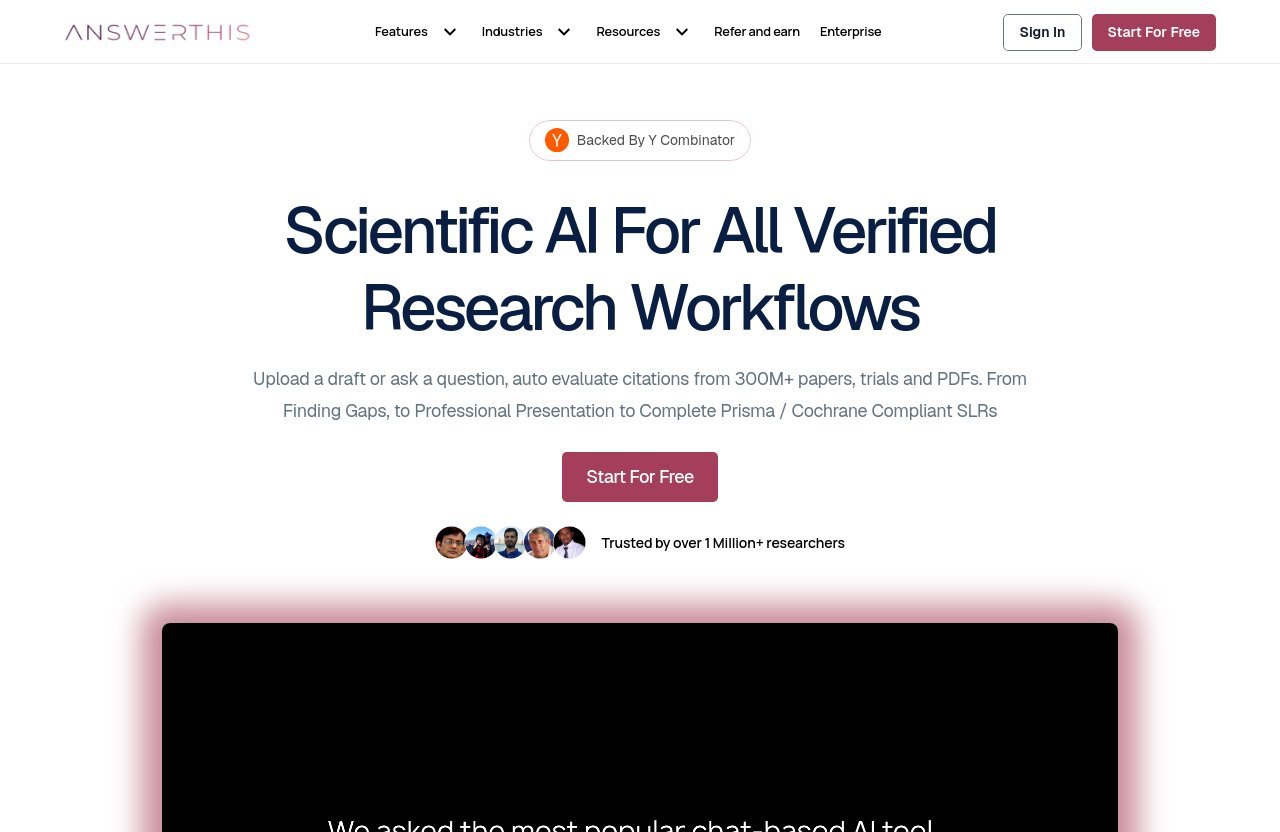
AnswerThis is an AI research assistant designed to help users search, assess, organize, and present research evidence for literature reviews and related academic or professional workflows. According to its official site, it can evaluate citations across more than 300 million papers, trials, and PDFs.
At its most basic, this answerthis review finds that the platform aims to give research-focused answers rather than general conversational responses. Users can upload a draft or ask a question, then use the resulting research workflow to investigate sources and build a more structured body of evidence.
Who it is built for
AnswerThis appears built for people who need more than quick web answers. That includes undergraduate and postgraduate students, doctoral candidates, independent researchers, academics, medical or scientific teams, and institutional research departments.
The official plan structure also suggests a widening audience. The Free and Pro tiers suit individual users, while Lab & Team and Max add collaborative, administrative, and institution-scale capabilities. This makes AnswerThis potentially relevant from an early-stage literature search through formal evidence synthesis.
For readers looking for an AnswerThis literature review tool, the strongest fit is likely someone who regularly works with academic references and needs a clearer path from question to cited output. It may be less compelling for casual users who only need occasional general-purpose AI assistance.
How it differs from a generic AI chatbot
A generic chatbot may provide a plausible explanation, but research work demands more than plausible wording. Researchers need traceable citations, source coverage, export options, and a way to review evidence rather than simply accept an answer.
AnswerThis is positioned around those research-specific needs. Its official pages emphasize cited answers, deep search, reference-manager connections, systematic review workflows, and tools for evidence synthesis. That focus is the main distinction highlighted in this answerthis review.
Still, an AI research assistant should support—not replace—researcher judgment. Users should open important sources, check the cited material, confirm study relevance, and follow the standards required by their field or organization.
AnswerThis Features Explained
Deep search across research sources
The Free plan includes deep search across more than 250 million papers, while the broader official homepage describes evaluation of citations from 300 million-plus papers, trials, and PDFs. Those figures indicate that AnswerThis is intended to work with a large research corpus rather than a narrow database.
The pricing page also states that users can search PubMed, Embase, and Cochrane in one query. For evidence-focused work, being able to begin with multiple named research sources can reduce the friction of starting a search strategy.
This part of the answerthis review should be read carefully: large source coverage does not automatically guarantee that every result is relevant or complete for a specific question. A serious researcher should still refine search terms, check eligibility criteria, and document the method used.
Cited answers and summaries
Cited answers and summaries are included on the Free plan. In practical terms, this matters because it gives users a way to connect an AI-generated explanation back to research material instead of treating the output as an unsupported statement.
The value is not just speed. A cited workflow can make it easier to trace claims, identify papers to read in full, and spot where the available evidence is limited or inconsistent.
For many users considering an AnswerThis AI review, this may be the feature worth testing first. Ask questions from your actual project, inspect the citations provided, and decide whether the source presentation is useful for your discipline and standards.
Systematic review and PRISMA workflow
AnswerThis says it supports workflows from finding research gaps to complete PRISMA- or Cochrane-compliant systematic literature reviews. The Pro plan specifically lists agent-led systematic review and PRISMA features.
PRISMA is a reporting framework widely used to make systematic review methods and study selection more transparent. The potential value of a structured workflow is that it can help research teams move from a broad question toward a documented review process.
However, a tool cannot make a review compliant merely by being used. In this answerthis review, the responsible interpretation is that AnswerThis may support systematic review work, while the researchers remain accountable for protocol decisions, screening choices, extraction, reporting, and final verification.
Meta-analysis and synthesis tools
The Lab & Team plan includes meta-analysis and evidence grading. Official pricing information also describes meta-analysis and synthesis features such as fixed- or random-effects models, network meta-analysis with SUCRA rankings, and GRADE certainty.
These are specialized capabilities intended for users working with formal evidence synthesis. A fixed- or random-effects model is a statistical approach for combining study results, while GRADE is a framework used to assess certainty in evidence.
Because synthesis decisions can materially affect conclusions, teams should confirm that the available functions match their methodological requirements before buying. Users should also ensure that an experienced reviewer or statistician oversees high-stakes analyses.
Trial Landscape and regulatory connectors
The Max plan includes Trial Landscape and regulatory connectors. The official page describes Trial Landscape as covering phase and status, sponsor views, and endpoint tracking.
The same source says regulatory-grade connectors can search regulatory filings, medical databases, and trial registries alongside the 250 million-plus papers. That could be meaningful for organizations tracking an evidence area that extends beyond journal literature.
For an individual student, these advanced tools may be more than necessary. For a large research, medical, or library environment, they could be important when evaluating the broader research and trial landscape.
Reference manager integrations
Reference management is one of the practical strengths highlighted in this answerthis review. AnswerThis says users can sync Zotero, Mendeley, and EndNote both ways, while the Free plan includes export to all three.
This flexibility matters because many researchers already have a reference workflow. A platform that supports existing tools can be easier to trial than one that requires users to rebuild their library or change how they cite sources.
The official page also says users can bring their reference manager or bring nothing at all. That suggests AnswerThis is intended to work for both established researchers with existing libraries and new users starting from scratch.
AnswerThis Pricing in 2026
AnswerThis pricing is relatively easy to understand at the headline level, although buyers should pay close attention to seat requirements and billing terms. The Free plan creates a low-risk way to test the core experience before committing to a paid subscription.
| Plan | Official Price | Billing Detail | Notable Included Features |
|---|---|---|---|
| Free | $0/month | No card required | Deep search across 250M+ papers, cited answers and summaries, 5 saved projects, Zotero/Mendeley/EndNote export |
| Pro | $35/month per seat | Billed monthly | Frontier models, no rate caps, agent-led systematic review and PRISMA, AI Writer, unlimited projects and tables, 48-hour support |
| Lab & Team | $75/month | Billed annually; 3-seat minimum | Shared workspaces, dual-reviewer screening pipelines, meta-analysis, evidence grading, centralized billing and admin |
| Max | $250/month | Volume and site pricing | Campus-wide site license, SSO and LMS integration, librarian admin console, onboarding and training |
Free plan
The AnswerThis Free plan costs $0 per month and does not require a card. It includes deep search across more than 250 million papers, cited answers and summaries, five saved projects, and exports to Zotero, Mendeley, and EndNote.
For many readers, “Is AnswerThis free?” is the most important starting question. The answer is yes: there is a genuine no-cost tier with research-focused functionality, though it has a five-project limit and does not include the paid-plan capabilities listed elsewhere.
The Free plan is the best way to validate whether AnswerThis returns useful sources for your subject area. Before upgrading, try several real questions and assess the relevance of results, the usefulness of citations, and how the exports fit your own workflow.
Pro plan
The AnswerThis Pro plan costs $35 per month per seat and is billed monthly. It includes everything in Free, plus Frontier models, no rate caps, agent-led systematic review and PRISMA, full manuscript drafting through AI Writer, unlimited projects and tables, standard AI Writer models, and 48-hour support.
This is the plan most likely to interest frequent individual users. Someone doing multiple literature reviews, managing a dissertation, or regularly drafting research content may find the unlimited projects and expanded workflow tools more relevant than a casual researcher would.
This answerthis review does not assume the Pro plan is automatically worth it for every individual. The sensible buying decision depends on how often you conduct research work and whether the cited search and structured review features save enough time to justify the monthly cost.
Lab & Team plan
The Lab & Team plan costs $75 per month and is billed annually, with a minimum of three seats. It includes everything in Pro, plus shared workspaces and projects, dual-reviewer screening pipelines, meta-analysis and evidence grading, and centralized billing and administration.
The three-seat minimum is important. At the stated per-month price, the minimum commitment works out to at least three seats, so this is aimed at an actual group rather than a solo researcher needing occasional collaboration.
The team workflow may be the central value driver here. Shared projects and dual-reviewer screening are especially relevant when a group needs clearer processes around evidence selection and review responsibilities.
Max plan
The AnswerThis Max plan is listed at $250 per month, with volume and site pricing. It includes everything in Lab & Team, then adds a campus-wide site license, SSO and LMS integration, a librarian admin console, and onboarding and training.
Max also includes the systematic review, meta-analysis, Trial Landscape, and regulatory connector capabilities described on the official pricing page. This positions it as an institutional option rather than an upgrade most independent users would need.
A university, library, or large research organization should ask for exact volume or site pricing and evaluate implementation needs before deciding. The published price is only one part of the overall procurement decision when multiple users, authentication, training, and administration are involved.
Which plan offers the best value?
The best-value plan depends heavily on the user’s workload. For exploration, coursework, and occasional research questions, the Free plan is hard to dismiss because it includes cited answers and reference-manager exports without requiring a card.
The AnswerThis Pro plan is likely the more logical paid choice for a serious individual researcher who needs unlimited projects, expanded writing tools, and systematic review support. It is billed monthly, which may suit users who prefer not to start with an annual team commitment.
Lab & Team is better evaluated as a collaboration purchase, not simply a more powerful solo plan. Max is best viewed as a procurement-level option for institutions that need site access, administrative tools, or integrations.
Is AnswerThis Legit and Trustworthy?
Backed by Y Combinator
For readers searching “Is AnswerThis legit,” the official homepage provides a few notable trust signals. It says the company is backed by Y Combinator, a recognized startup accelerator.
That is a positive credibility indicator, but it should not be confused with a guarantee about product suitability, research quality, or outcomes. In this answerthis review, legitimacy is assessed as a combination of transparent product information, usable workflows, pricing clarity, and buyer due diligence.
Social proof and trust signals
AnswerThis also says it is trusted by more than one million researchers. This is a meaningful claim from the official site and indicates that the company presents itself as serving a substantial research audience.
However, prospective buyers should treat company-reported user numbers as a trust signal rather than independently verified proof. The most useful test is whether the tool performs reliably for your own subject area, source requirements, and research process.
A practical approach is to test the Free plan with known papers or questions where you already understand the evidence landscape. That gives you a better basis for judging citation quality and search relevance than marketing language alone.
What the official site does and does not prove
The official product information supports the view that AnswerThis is a real research-focused platform with defined plans, stated source coverage, integrations, and workflows. Its Y Combinator backing and claimed researcher base add context to the legitimacy question.
What the official site cannot prove for every buyer is that every generated answer will be correct, every citation will fit a particular review protocol, or that the platform is the best choice for every discipline. AI outputs and research retrieval should always be checked.
The balanced conclusion of this answerthis review is that AnswerThis appears legitimate based on the published information, but high-stakes users should run a structured trial before purchasing. Verify source quality, exports, workflows, security requirements, and team-fit needs directly.
Official website · Latest pricing & offers
Pros and Cons
Main advantages
The main advantages are tied to its research-first design. AnswerThis offers cited answers and summaries, deep search across a stated large paper collection, and exports or two-way sync options for major reference managers.
Its workflow depth is another potential advantage. The official feature set spans literature searching, systematic review support, PRISMA workflows, manuscript drafting, team screening, meta-analysis, and institution-level administration depending on the plan.
For users who need research evidence rather than generic responses, these capabilities are more relevant than a simple question-and-answer interface. The availability of a no-card Free plan also makes evaluation easier.
Main limitations
The primary limitation is not necessarily a missing feature; it is the need for careful verification. Even when answers are cited, researchers should examine original sources and avoid treating an AI-produced summary as a final scholarly conclusion.
Pricing is another consideration. The paid tiers may be reasonable for frequent users, but the Lab & Team plan’s annual billing and three-seat minimum will not suit every small group. Max is clearly oriented toward larger organizations.
The AnswerThis pros and cons balance also depends on your workflow. If you only need to find a few papers per semester, a dedicated research platform may offer more capability than you will use.
Who may feel it is overpriced
Occasional users may feel the Pro plan is expensive if they conduct only one short assignment or literature search each year. In that scenario, the Free plan may provide enough value without a monthly payment.
Small teams that do not need shared workspaces, dual-reviewer screening, meta-analysis, or centralized administration may also find the Lab & Team entry point more than they need. Its minimum seat requirement is designed for an active group.
This answerthis review recommends paying only when the additional workflows solve a recurring problem. The more frequently you search, synthesize, export, draft, or coordinate research work, the easier it is to justify a paid plan.
Who Should Buy AnswerThis?
Students and solo researchers
Students and solo researchers should start with AnswerThis Free. The no-card plan offers deep search, cited answers, five saved projects, and reference-manager export, which is enough to test the platform on a thesis topic, seminar project, or early research question.
Frequent individual users should consider Pro if they need unlimited projects, tables, AI Writer access, or agent-led systematic review and PRISMA support. The monthly billing structure may be more manageable than a team-oriented annual plan.
Labs and research teams
Labs and research teams are the natural audience for the Lab & Team plan. Shared workspaces, shared projects, dual-reviewer screening pipelines, centralized billing, evidence grading, and meta-analysis align with activities that involve several researchers.
A team should confirm that its membership and workload justify the three-seat minimum. It is most suitable when collaboration is a consistent part of the research process rather than an occasional requirement.
Institutions and libraries
Institutions and libraries should look most closely at Max. The campus-wide site license, SSO and LMS integration, librarian admin console, onboarding, and training address needs that go beyond individual subscriptions.
The AnswerThis Max plan may make sense where an organization wants broad access and administrative control. Procurement teams should still request relevant details about volume pricing, onboarding scope, and whether the available connectors suit their research environment.
Who should skip it
People who only need general explanations, casual web research, or a one-time answer may not need a specialized tool. They may be better served by the Free plan or by their existing library resources and research process.
Researchers with strict internal requirements should also avoid assuming any AI platform is automatically approved. Check data-handling expectations, institutional policies, methodology requirements, and the quality of outputs before relying on it for sensitive or formal work.
AnswerThis vs Alternatives: How to Judge Value
When AnswerThis is strong
AnswerThis looks strongest when your priority is a research-oriented workflow. Its published offering combines deep search, cited summaries, systematic review support, reference-manager connectivity, and tiered collaboration options.
That makes it particularly relevant for buyers who value documented sources and workflow structure. It is not merely positioned as a tool for producing fast prose; its feature set is designed around finding and working with evidence.
When to compare other tools
You should compare tools when the Free plan does not meet your needs or when a paid plan represents a meaningful budget commitment. For example, an institution should compare authentication, administration, training, source needs, and integration requirements before signing a site-level agreement.
Individual researchers should compare the value of monthly cost against their actual research volume. Ask whether you need unlimited projects, formal systematic review support, team screening, or advanced evidence-synthesis capabilities.
For current access options, you can review the available plans through this AnswerThis partner link. Use the Free tier first whenever possible, then make a paid decision based on your own testing.
What matters most in a research assistant
When comparing research assistants, focus on source coverage, citation traceability, search workflow, reference-manager integration, and the ability to verify outputs. For teams, add shared workspaces, reviewer workflows, administrative controls, and pricing structure to the checklist.
The right platform is the one that fits your actual evidence process. This answerthis review favors testing how a tool handles questions in your field over relying on broad claims or feature lists alone.
Final Verdict: Is AnswerThis Worth It in 2026?
Best-case fit
AnswerThis appears best suited to researchers who want a research-specific AI workflow instead of a generic chatbot. Its official features are especially relevant for literature reviews, cited research questions, systematic review processes, and projects that require reference-manager exports.
It may also be a strong fit for collaborative teams that need shared projects and dual-reviewer screening. Institutions with library administration and campus access needs have a distinct path through the Max plan.
Best value plan
For most individuals, the Free plan is the best place to start because it costs nothing, requires no card, and includes core research functions. It gives users a practical way to test cited answers, deep search, projects, and exports before spending money.
For frequent solo researchers, Pro is likely the best paid-value option at $35 per month per seat. Lab & Team becomes more compelling when collaboration and evidence synthesis are routine, while Max is for organizations rather than typical individual buyers.
Bottom-line recommendation
The conclusion of this answerthis review is measured: AnswerThis looks worth trying for students, solo researchers, and anyone who needs cited research support, because the Free plan has meaningful included functionality. It appears worth paying for when its advanced review, writing, project, or collaboration features are used regularly enough to justify the cost.
Choose Pro if you are an active individual researcher, Lab & Team if your group needs shared and dual-review workflows, and Max if you are buying for a university, library, or large organization. In every case, test your real research questions first and verify important outputs against the original sources.
Official website · Latest pricing & offers
FAQ
Is AnswerThis legit?
Based on official information, AnswerThis appears to be a legitimate research-focused AI platform. Its homepage cites Y Combinator backing and says it is trusted by more than one million researchers, but buyers should still test the Free plan and verify outputs for their own use case.
How much does AnswerThis cost?
AnswerThis pricing includes a Free plan at $0 per month with no card required. Pro costs $35 per month per seat billed monthly, Lab & Team costs $75 per month billed annually with a three-seat minimum, and Max is listed at $250 per month with volume and site pricing.
Which AI is best for giving answers?
The best AI depends on the task. For research work, AnswerThis is positioned around grounded, cited answers and literature-review workflows rather than general conversational responses, so it may be more suitable when source traceability matters.
Is AnswerThis AI free?
Yes. AnswerThis offers a Free plan at $0 per month with no card required. It includes deep search across more than 250 million papers, cited answers and summaries, five saved projects, and exports to Zotero, Mendeley, and EndNote.