
Bonfire Pricing 2026: What You Actually Pay
Bonfire pricing is straightforward once you separate campaign selling from Bonfire Pro. Bonfire says selling through its campaigns is 100% free, meaning there is no upfront campaign-launch fee. However, that does not mean every part of the transaction is cost-free: product base cost, optional donation processing, and shipping all affect what customers pay and what sellers keep.
This guide is based on Bonfire’s official help-center and pricing-page information. It explains where money goes, how the Bonfire profit margin works, and why checking the numbers before launch matters. For most creators and fundraisers, Bonfire can be a low-risk way to sell apparel—but only if the selling price leaves enough room above the product’s base cost.
Official website · Latest pricing & offers
Bonfire Pricing in 2026: The Short Answer
The short version of Bonfire pricing is this: campaign selling has no upfront platform fee, but every physical product has a production cost. You choose the retail price, and your profit is the difference between that price and the base cost.
Additional donations can also have a processing fee. Meanwhile, Bonfire Pro is a separate paid subscription for people who want a branded online store, broader selling options, and more operational control.
What “bonfire pricing” actually means
When people search for bonfire pricing, they are usually trying to answer one practical question: “If I sell this shirt, how much money do I actually keep?”
The answer depends on the product’s base cost and the price you set. Bonfire describes the base cost as covering manufacturing, sourcing, and printing expenses. That cost is built into each item, so it is the key number to review before selecting your selling price.
Campaign selling itself is presented as free to use. In plain English, you do not need to pay a separate fee simply to create and run a Bonfire campaign.
The difference between campaign pricing and Bonfire Pro pricing
Bonfire campaign pricing applies when you launch a product campaign through Bonfire. You choose the item, create the design, set a selling price, and earn the amount left after the applicable base cost.
Bonfire Pro pricing is different. It is a paid monthly subscription for sellers who want a fully branded store and features beyond a standard campaign. Essentials costs $8.25 per month, while Super costs $24.92 per month. Both plan options can be paid yearly or monthly, according to Bonfire’s pricing page.
Quick verdict: when Bonfire looks free and when it is not
Bonfire is free to use for campaign selling in the sense that there is no upfront campaign charge. But a shirt still has a Bonfire base cost, buyers may encounter shipping charges, and optional donations carry an 8% processing fee.
The platform becomes a direct monthly expense when you choose Bonfire Pro. Before you launch, it helps to separate “free to start” from “free of all transaction-related costs.” They are not the same thing.
How Bonfire Charges Money: Every Cost Explained
The clearest way to understand Bonfire pricing is to follow the money from the buyer’s order to the seller’s potential profit. The seller sets a retail price, Bonfire’s production-related base cost is accounted for, and the remainder is the profit margin.
Shipping and optional donations are separate considerations. They may not reduce every seller’s product margin in the same way, but they can change the buyer’s total checkout cost and the final amount associated with a fundraiser.
Base cost: manufacturing, sourcing, and printing
The Bonfire base cost is the amount associated with producing an item. According to Bonfire, this includes manufacturing, sourcing, and printing expenses.
This is not a platform membership fee. It is the underlying cost of turning your design into a finished physical product. The exact Bonfire cost per shirt can vary because product choices differ, so it is important to review the specific item’s current cost rather than assume every tee, hoodie, or other product carries the same figure.
Pricing you set vs. base cost you cannot remove
Bonfire lets sellers decide how to price their products. That flexibility is useful because a fundraiser, artist, school group, or small brand may have different goals for the same type of item.
Still, the base cost is not optional. If you price too close to it, your return will be small. If you price far above it, you may increase your potential profit per sale but risk making the product less appealing to buyers. Good Bonfire campaign pricing balances both realities.
For a current product selection and store option review, you can explore Bonfire here. Check the item-level numbers before treating any projected earnings as final.
Profit margin: what’s left after costs
The basic Bonfire profit margin formula is simple:
| Calculation | Formula |
|---|---|
| Selling price | The price you choose |
| Product base cost | Manufacturing, sourcing, and printing cost |
| Profit margin | Selling price minus base cost |
For example, if a seller chooses a retail price that is higher than the listed product base cost, the difference is the campaign profit before considering any separate factors relevant to the sale. This is a generic illustration, not an official Bonfire price quote.
The most reliable habit is to check the margin product by product. A design that works well on one shirt style may not produce the same result on another item.
Bonfire Campaign Fees: Where the Money Actually Goes
Many questions around Bonfire fees come from understandable confusion. “Free campaign selling” describes the ability to launch and sell without an upfront campaign fee; it does not mean physical products have no cost or that every checkout option is fee-free.
Knowing which costs apply to products, donations, and delivery makes the model easier to evaluate.
Is Bonfire campaign selling really 100% free?
Yes, Bonfire states that selling through Bonfire campaigns is 100% free. A creator or fundraiser can launch a campaign without paying an upfront fee to use the campaign-selling model.
That said, campaign products have a base cost. Your product price needs to exceed that cost if you want to generate profit. This distinction is the most important part of understanding bonfire pricing for first-time sellers.
“Free” describes access to campaign selling, not the elimination of manufacturing costs. It also does not automatically mean that shipping or donation processing is free.
8% donation processing fee explained
If you enable additional contributions or donations, Bonfire charges an 8% processing fee on those donations. Bonfire says this fee covers credit card transaction fees and other administrative expenses.
The Bonfire donation fee applies to the additional contribution feature, not necessarily to the listed product profit calculation itself. If your campaign depends heavily on voluntary donations, account for the 8% fee when estimating the amount your cause may receive.
For a simple donation example, a contribution amount is subject to the 8% processing fee. The net amount available after that fee is lower than the donor’s original contribution. Always use the current campaign setup and official terms to confirm the final presentation before sharing fundraising estimates.
Shipping fees and why they matter to buyers
Bonfire offers domestic and international shipping for campaign orders. Shipping is important even when it does not directly change your product price, because it affects the customer’s overall checkout total.
Bonfire shipping fees can influence purchase decisions, especially for lower-priced items or international supporters. Sellers should make sure buyers understand that shipping is a separate checkout consideration rather than assuming it is included in the item’s displayed price.
If you serve supporters outside the United States, international delivery availability is useful. But customers should still check the shipping total for their location before ordering.
Bonfire Pro Pricing: Essentials vs Super
Bonfire Pro pricing is designed for sellers who need more than a single campaign page. It adds a branded-store model, with Essentials and Super plans available on a monthly or yearly payment basis.
The right plan depends less on whether you can afford the subscription and more on whether the added store tools match your selling model.
Essentials: monthly price and included features
Bonfire Pro Essentials costs $8.25 per month and is free for the first 30 days. The plan includes a fully branded store with a custom domain, full catalog and decoration control, the ability to sell your own inventory, and in-person selling through the Point of Sale app.
Essentials also includes detailed analytics, while Bonfire handles customer support. For a creator who wants a more established branded storefront without immediately moving to the higher plan, this is the entry-level paid option.
| Bonfire Pro Essentials | Officially listed details |
|---|---|
| Price | $8.25/month |
| Trial | Free for 30 days |
| Store | Fully branded store with custom domain |
| Product control | Full catalog and decoration control |
| Inventory | Sell your own inventory |
| In-person sales | Point of Sale app |
| Support and data | Detailed analytics and Bonfire customer support |
Super: monthly price and what you gain
Bonfire Pro Super costs $24.92 per month. It includes everything in Essentials, plus higher profit margins and no fees charged for donations or self-fulfilled products.
That final point is significant for organizations that collect donations or manage their own inventory. If those activities are central to your store, Super may be easier to justify than Essentials. If they are not, the higher monthly cost may not produce enough practical value.
| Bonfire Pro Super | Officially listed details |
|---|---|
| Price | $24.92/month |
| Included foundation | Everything in Essentials |
| Margin benefit | Higher profit margins |
| Donation fees | No fees charged for donations |
| Self-fulfilled products | No fees charged |
Which plan fits store owners vs fundraisers
Essentials may fit small brands, creators, and organizations that want a custom-domain store, analytics, catalog control, or in-person selling. It can make sense when your priority is store presentation rather than avoiding donation or self-fulfillment fees.
Super may be more suitable for sellers who expect to use donation features or self-fulfillment regularly. Its fee treatment and higher-margin positioning are the main reasons to consider it.
For a one-off merchandise fundraiser, a subscription may be unnecessary. Standard campaign selling is often the simpler place to start because Bonfire is free to use at the campaign level.
Official website · Latest pricing & offers
Real-World Cost Example: How Much You Actually Keep
A realistic bonfire pricing estimate starts with a formula, not a guessed dollar amount. Official product costs can vary by item, and final results depend on the product type, chosen price, quantity, shipping destination, and whether donations are enabled.
Use Bonfire’s current product tools for live figures. The examples below are intentionally generic and should not be treated as official quotes.
Example of a shirt sold through a campaign
Suppose you select a shirt with a displayed base cost and choose your own retail price. Your basic projected margin is:
Your chosen selling price − current product base cost = projected profit per shirt
If the selling price barely exceeds the base cost, your campaign may earn only a small amount per item. If you set a higher price, the margin rises, but you should consider whether your audience will still feel comfortable buying at that level.
This is why people often look for a bonfire pricing calculator before launch. They want to compare a likely retail price against the displayed product cost and see whether the campaign can meet its fundraising or earnings goal.
Example of a donation with processing fee
For an additional donation, the calculation is different:
Donation amount − 8% donation processing fee = amount remaining after the processing fee
For clarity, this formula applies to the optional additional contribution feature. It should not be confused with the product’s base cost or the seller’s shirt margin.
If you are raising money for a nonprofit or community cause, communicate carefully. Donors may appreciate knowing that credit card and administrative processing is accounted for through the stated fee.
How shipping and base cost can shrink your margin
Shipping generally matters first as a buyer-cost issue. A supporter sees the item price plus applicable shipping at checkout, which can affect whether they complete the order.
Base cost directly shapes the margin available on the product. A seller who focuses only on the public selling price can overlook the central question: what remains after production expenses? This is why a Bonfire profit margin should be reviewed before promoting a campaign widely.
Bonfire Margin Traps: Where Sellers Lose Profit
The biggest mistake in Bonfire pricing is not usually a hidden charge. It is launching without understanding the difference between revenue, base cost, optional donation fees, and customer shipping.
A little pre-launch math can prevent disappointing results.
Underpricing your product
Underpricing happens when a seller sets the product price too close to the Bonfire base cost. The campaign may still be live and functional, but each sale produces very little profit.
Before launching, decide what the campaign needs to accomplish. If the goal is awareness rather than income, a lower margin may be acceptable. If the goal is to fund an event, nonprofit project, or creative work, calculate whether the margin is enough to support that target.
Forgetting that base cost changes with quantity
Do not assume a general estimate will apply to every campaign setup. Product selection, decoration choices, and order details can affect the current figures shown in Bonfire’s tools, so use the live product information for your exact setup.
A Bonfire pricing calculator or profit estimator is useful because it encourages sellers to check the actual campaign economics before publishing. Bonfire has a pricing calculator/profit estimator tool, but you should rely on the current on-page figures rather than copying an old screenshot or another seller’s estimate.
Assuming all revenue equals payout
Total sales revenue is not the same as profit. Product-related base cost must be considered, and optional additional donations are subject to the stated 8% processing fee unless a Bonfire Pro Super arrangement applies.
Shipping can also affect the customer’s final payment, even if it is not part of your intended per-item profit. The best approach is to track each category separately:
| Money category | What to verify |
|---|---|
| Item sales | Your chosen retail price |
| Production | Current base cost for each product |
| Product earnings | Price minus base cost |
| Donations | Whether the 8% processing fee applies |
| Delivery | Shipping shown to the buyer at checkout |
| Pro subscription | Monthly plan cost, if using Pro |
Is Bonfire Worth It for Creators, Nonprofits, and Small Brands?
Bonfire can be worth using when its production-and-fulfillment approach fits your goals. The absence of an upfront campaign-selling charge lowers the barrier for a first fundraiser or merchandise test.
Still, “worth it” depends on the margin you can create and whether you need a simple campaign or a long-term branded store.
Best use cases for campaign selling
Campaign selling is a strong fit for creators testing merch demand, groups running a limited fundraiser, and nonprofits that want supporters to buy items without arranging production themselves. The model is low-risk in the sense that Bonfire campaign selling is free to launch.
It may also suit audiences that prefer a straightforward merchandise purchase tied to a cause or creator. Just set a sustainable price, verify the Bonfire cost per shirt for your product, and explain shipping expectations clearly.
Best use cases for Bonfire Pro
Bonfire Pro is more relevant for sellers building an ongoing storefront. Essentials offers branding, a custom domain, catalog and decoration control, own-inventory selling, Point of Sale access, analytics, and Bonfire-managed customer support.
Super is the more specialized option for stores where higher margins and no fees on donations or self-fulfilled products matter. The subscription cost should be weighed against the expected benefit. A small project with occasional orders may not need it, while an active store may value the expanded setup.
When a different model may be better
A different model may be better if you need specific features not listed in Bonfire’s official plan details, if your expected margins are too thin, or if your audience is especially sensitive to final delivered cost. It may also be unsuitable if you do not want to spend time setting prices and reviewing campaign economics.
Bonfire works best when you are comfortable treating margin planning as part of the launch process. It is not a “set it and forget it” revenue source.
How Bonfire Compares to What Searchers Expect
Searchers often expect one fixed answer when they type “how much does Bonfire cost?” The reality is more layered: campaign access is free, product costs vary, donation processing can apply, shipping is separate, and Pro is subscription-based.
That is why the best evaluation combines the official rules with your own campaign numbers.
Why people search for a Bonfire pricing calculator
A bonfire pricing calculator search usually signals that someone wants to estimate profit before publishing a campaign. They want to know whether a planned sale price leaves enough room after the product’s base cost.
Bonfire provides a pricing calculator/profit estimator tool for this purpose. Use it as part of your planning process, but remember that results depend on your selected product, quantity, selling price, and shipping-related checkout details. There is no universal profit number that applies to every campaign.
Why fees feel confusing at first
Bonfire fees can feel confusing because several different types of costs are discussed together. The campaign itself is free to launch, the item has a base cost, donations have an 8% processing fee when enabled, and Bonfire Pro has a monthly subscription price.
Once you separate those categories, the model becomes easier to understand. The key is not to mistake “no upfront campaign fee” for “every buyer payment becomes profit.”
What to check before launching
Before you publish, review these points:
- The current base cost for every product you plan to sell.
- Your chosen sale price and projected profit per item.
- Whether you will enable additional donations.
- The 8% donation processing fee, if applicable.
- Domestic and international shipping expectations for your audience.
- Whether campaign selling is enough or Bonfire Pro is worth the monthly cost.
- The current calculator or profit-estimator figures for your setup.
Taking these steps makes Bonfire campaign pricing more predictable and gives you a clearer answer when supporters ask where their money goes.
Final Verdict: What You Actually Pay in 2026
Bonfire pricing is transparent if you look at it in layers rather than expecting one all-inclusive fee. Campaign selling is free to launch, but each item has a base cost covering manufacturing, sourcing, and printing. Sellers control the retail price, and the difference is the potential product profit.
Campaign costs in plain English
You can create and sell through a Bonfire campaign without an upfront campaign fee. Your main financial decision is setting a price that leaves enough profit above the applicable base cost.
If you enable extra donations, the Bonfire donation fee is 8% to cover card transaction and administrative expenses. Shipping is also a separate part of the buyer’s checkout experience, with domestic and international options available.
Bonfire Pro costs in plain English
Bonfire Pro Essentials costs $8.25 per month and is free for 30 days. Bonfire Pro Super costs $24.92 per month and adds higher profit margins plus no fees charged for donations or self-fulfilled products.
Both are optional subscriptions, not a requirement for running a standard campaign. Consider Pro when you need a branded store and its listed features, not simply because you are launching your first shirt design.
Bottom-line recommendation
Bonfire is low-risk for creators, nonprofits, and beginner sellers who want to test merchandise or run a fundraiser without paying an upfront campaign fee. The main caution is margin: review the Bonfire base cost, set a realistic product price, and do not treat total order revenue as automatic profit.
For ongoing sellers, Bonfire Pro pricing may be worthwhile when the branded-store tools, higher margins, or donation and self-fulfillment fee treatment match your needs. The practical bottom line is simple: Bonfire can be an accessible option, but successful campaigns depend on careful pricing, not just free setup.
Official website · Latest pricing & offers
FAQ
How much does Bonfire charge?
Bonfire says campaign selling is 100% free, meaning there is no upfront fee to launch a campaign. However, products have a base cost, additional donations have an 8% processing fee, and shipping is separate. Bonfire Pro costs $8.25 per month for Essentials or $24.92 per month for Super.
Is Bonfire a legitimate company?
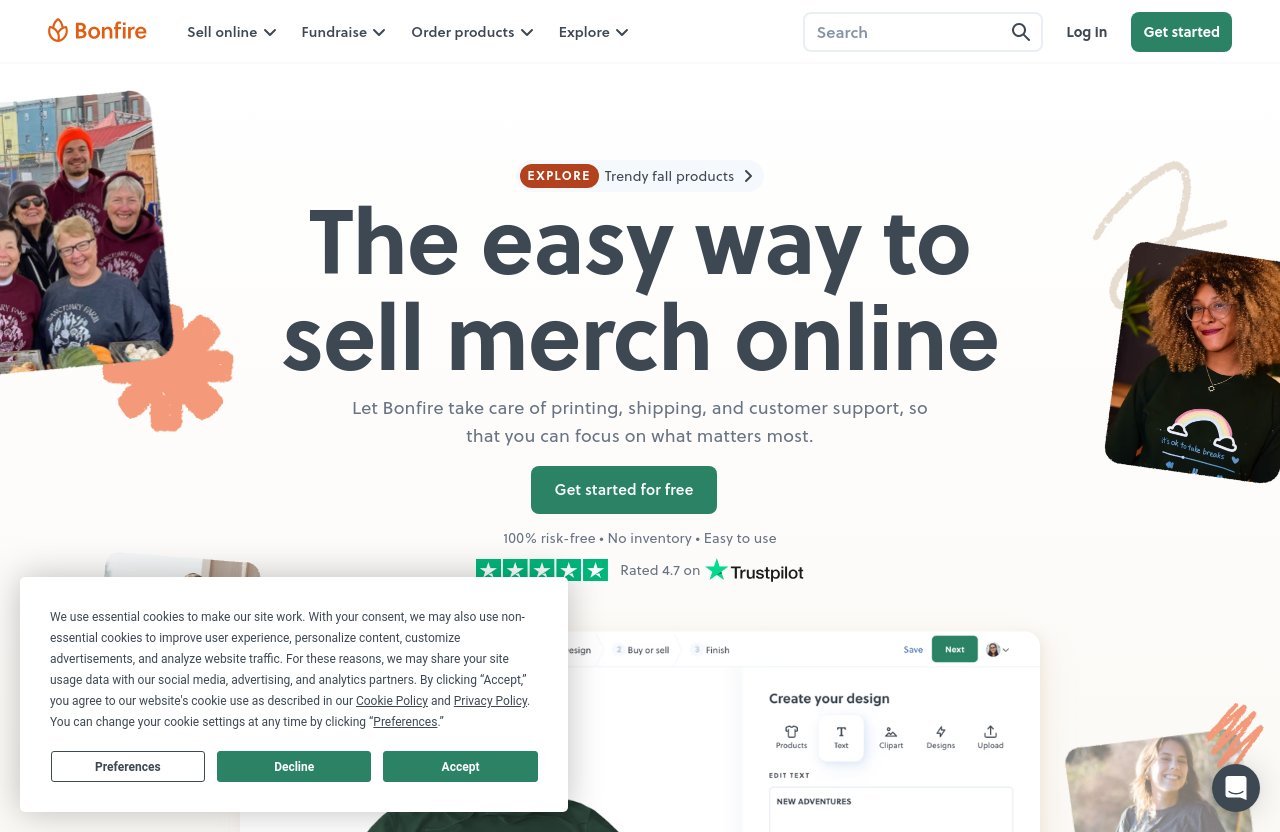
Bonfire appears to be a legitimate apparel fundraising and merchandise platform with an official website, help center, published pricing information, and public customer-review visibility on its homepage. As with any selling platform, review the current terms, product costs, and campaign settings before launching.
How does Bonfire pay out?
Bonfire’s official pricing information explains that profit is the difference between your selling price and the applicable base cost. Exact payout timing and process should be confirmed in Bonfire’s current help documentation or account settings, as this article does not assume details beyond the verified pricing information.
Do you have to pay to use Bonfire?
You do not have to pay an upfront fee to sell through Bonfire campaigns, which Bonfire describes as free. However, physical products have base costs, donations can have processing fees, shipping applies to orders, and Bonfire Pro is an optional paid subscription.
Related Reading
- Rezi Cost: Pricing, Plans & Value in 2026
- Autods Pricing 2026: Plans & Costs Explained
- Wpforms Pricing 2026: Plans Explained