Bonfire Review 2026: Is It Legit?
Official website · Latest pricing & offers
Bonfire Review 2026: Quick Verdict
Is Bonfire legit?
Yes—based on the available evidence, Bonfire appears to be a legitimate custom merchandise platform, not a suspicious pop-up website. Its official homepage explains its service clearly, links to Trustpilot, and states that it has recently served more than 5 million customers. Bonfire also says it handles printing, shipping, and customer support for sellers.
That said, a legitimate platform is not the same as a guarantee that every shirt, delivery, or support interaction will be flawless. This bonfire review finds meaningful trust signals, but buyers and campaign organizers should still check product details, expected delivery information, and applicable policies before ordering.
Who Bonfire is best for
Bonfire is most suitable for creators, nonprofits, community groups, schools, teams, and small organizations that want to sell branded merchandise without buying inventory upfront. It can also make sense for people who need custom apparel for an event, team, or personal project.
The appeal is straightforward: you create or choose merchandise, make it available online, and Bonfire says it manages the production and fulfillment side. That low-logistics model is especially useful for fundraising campaigns and first-time merch sellers.
Bottom line in one paragraph
My practical verdict is that Bonfire is a credible option for people seeking a simple merchandise and fundraising workflow. Its official site presents a clear purpose, highlights a no-inventory model, and displays a 4.7 Trustpilot rating badge. The main limitation in this bonfire review is pricing transparency: the captured official pricing page did not reveal public plan or fee details, so you should verify current costs, margins, and final order terms in the live account process before launching.
Affiliate disclosure: TopTrustReview may earn a commission if you sign up through a link in this article. This does not change the editorial assessment or the need to check Bonfire’s live terms before purchasing or selling.
What Bonfire Is and How It Works
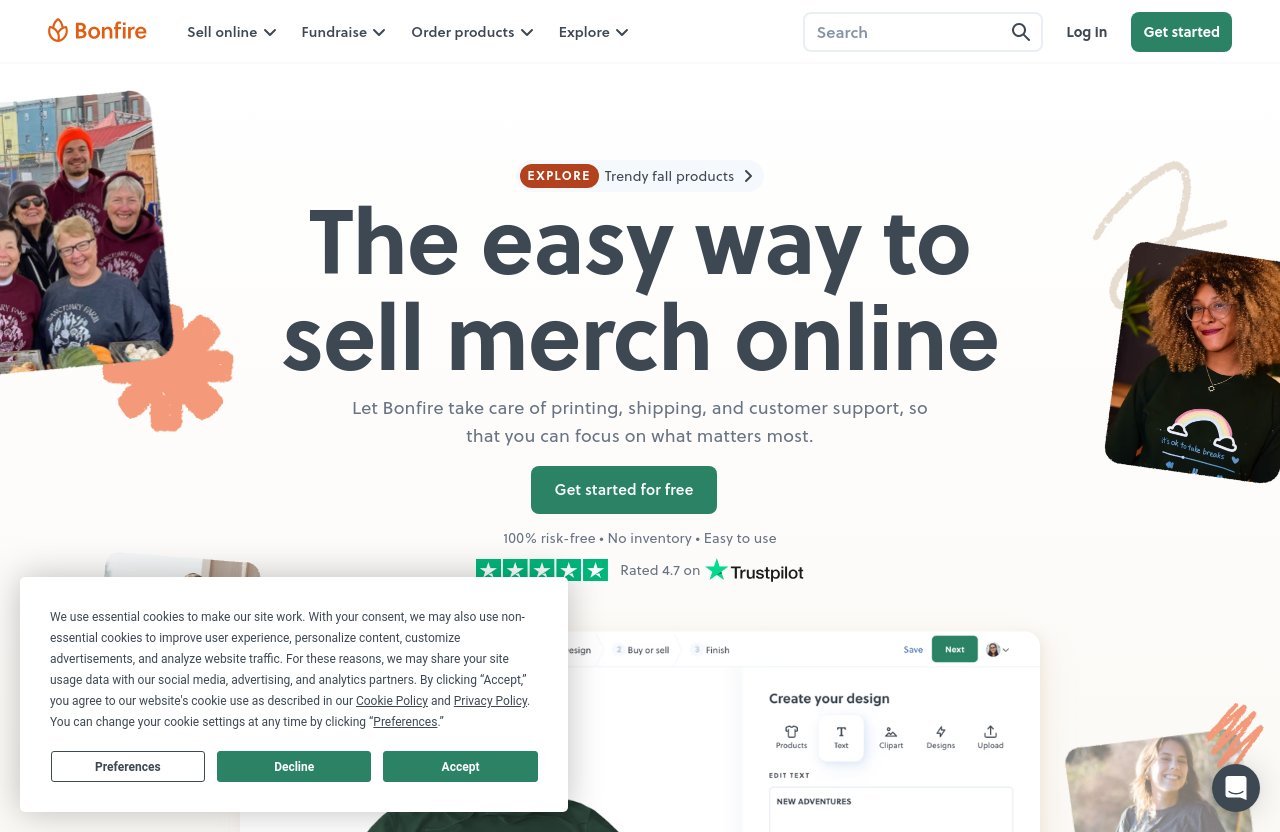
Bonfire describes itself as “the easy way to sell merch online.” Its official homepage says users can sell online, fundraise, and order products, while the platform takes care of printing, shipping, and customer support.
In simple terms, Bonfire is a custom merch service designed to reduce the operational work that normally comes with selling shirts, hoodies, and similar items. Rather than storing boxes of apparel yourself, you can use Bonfire’s fulfillment setup.
Custom merch storefronts
A Bonfire custom merch campaign or storefront gives creators a place to offer branded products online. This can be useful when you want to turn artwork, a community slogan, or an organization’s identity into apparel without managing a separate fulfillment operation.
For sellers researching bonfire print on demand options, the key benefit is convenience rather than full operational control. Bonfire’s published messaging emphasizes that it handles the physical steps after an order is placed.
Fundraising with merchandise
Bonfire also positions its service as a fundraising option. A nonprofit, school club, advocacy group, or local community initiative can create merchandise around a cause and use sales as part of its fundraising approach.
This is why many searches focus on bonfire fundraising reviews. The platform’s model is easy to understand for campaign organizers: merchandise gives supporters something tangible while helping promote the cause. Still, organizers should confirm the current financial mechanics in the live setup flow before assuming how much revenue a campaign will retain.
Order products for yourself or a team
Bonfire is not only for public sales campaigns. The official site also says users can order products, which may suit teams, events, workplaces, or groups ordering merchandise for internal use.
For a buyer looking for bonfire clothing rather than a sales platform, the experience is more like ordering custom apparel through a hosted service. Review artwork, product options, sizing information, and policy terms carefully before placing a larger group order.
Bonfire Trust Signals: What Makes It Feel Legit
Legitimacy should be assessed through several signals rather than one rating or a single customer story. In this bonfire review, the strongest indicators come from Bonfire’s active official web presence, its public Trustpilot connection, and the scale referenced on its own reviews section.
None of these points eliminates normal shopping risk. They do, however, provide a more reassuring picture than an anonymous seller with no clear operational information.
Official website and company pages
Bonfire’s official homepage clearly explains what the service is intended to do: help people sell merchandise online, fundraise, and order products. It also states that the company handles printing, shipping, and customer support.
That clarity matters. A legitimate platform should make its core service understandable before asking users to create campaigns or place orders. Bonfire’s homepage also highlights “100% risk-free,” “No inventory,” and “Easy to use,” which describe its intended seller experience.
Trustpilot rating and volume of reviews
The Bonfire homepage displays a Trustpilot badge stating “Rated 4.7 on” and links visitors to Trustpilot. That is a useful third-party trust signal because the reviews are not hosted solely by Bonfire itself.
When searching bonfire Trustpilot feedback, remember that ratings can change over time. A strong aggregate score is encouraging, but it is still wise to read recent reviews, look for recurring themes, and pay attention to how issues are described.
Customer testimonials on Bonfire's own reviews page
Bonfire’s homepage says it has recently served over 5 million customers in its reviews section. That is a substantial scale claim and suggests the service has been used broadly.
However, testimonials published on a company’s own site should be treated as marketing material, not independent proof. They are useful for seeing what the company emphasizes, but a careful buyer should balance them with third-party feedback and current policy information.
Bonfire Features and User Experience
The core value proposition in this bonfire review is simplicity. Bonfire is built for people who want custom merchandise without taking on inventory storage, printing coordination, packing, or customer service duties themselves.
That convenience may be worth more to a busy fundraiser or first-time creator than advanced control over every fulfillment detail. The right question is whether the workflow matches your needs.
Easy-to-use design flow
Bonfire says its service is easy to use, which aligns with its audience of creators, nonprofits, and casual merch sellers. The platform is designed around creating merchandise and making it available for people to order online.
Ease of use is subjective, of course. Before publicly sharing a campaign, take time to inspect your artwork, product selection, copy, sizing references, and final campaign settings. A simple setup process does not replace careful proofreading.
No inventory model
Bonfire prominently promotes a “No inventory” model. That means sellers do not need to purchase and store a batch of apparel before testing interest in a design or launching a fundraising campaign.
For people researching bonfire merch reviews, this is one of the platform’s clearest benefits. It reduces upfront logistical pressure and lets organizers focus on promotion, audience communication, and campaign goals instead of shipping labels and storage space.
Branded store option for Pro users
Bonfire’s official homepage includes a Pro callout for users who want to “Open a fully branded custom merch store in minutes.” It also says no inventory or integrations are needed.
This could be appealing to organizations that want a more dedicated branded destination rather than a one-off campaign. The provided official material does not disclose Pro pricing, eligibility, or feature limits, so treat the callout as a capability overview rather than a complete plan comparison.
Official website · Latest pricing & offers
Bonfire Pricing: What We Can Verify
What the pricing page actually shows
This is an important limitation in any responsible bonfire review. The captured official pricing page did not show a public pricing table, named plans, dollar amounts, fees, or margin examples. In the provided content, that page loaded a sign-in screen instead.
As a result, it would be inaccurate to quote Bonfire pricing, claim a specific free plan structure, or estimate campaign earnings. Anyone publishing exact numbers without current official confirmation would be guessing.
Why pricing details may depend on account access
Some platforms show different costs, options, or campaign details after a user begins the setup process. That may be the case here, but the captured material does not establish why the pricing information was unavailable.
Before using Bonfire for a fundraiser or business project, check the live website or your account flow for current product costs, available options, campaign margins, and any terms that affect your proceeds. Do this before promoting a launch date to supporters.
How to evaluate value without guessing
Instead of focusing only on an advertised starting point, assess your likely value based on the final details you can see. Review the products you want to offer, the expected selling price, your intended campaign goal, branding needs, and fulfillment expectations.
| What to verify | Why it matters |
|---|---|
| Current product costs | Helps you assess practical campaign economics |
| Seller margin or proceeds | Important for fundraising and creator budgets |
| Product and size options | Affects buyer satisfaction and conversions |
| Delivery expectations | Helps prevent avoidable customer complaints |
| Return and support policies | Important if an order has a problem |
Pros and Cons of Bonfire
Pros
Bonfire’s strongest advantage is that it says it handles printing, shipping, and customer support. That can remove significant operational work for a nonprofit organizer, independent creator, or team leader.
The no-inventory approach is another meaningful positive. This bonfire review also found credible legitimacy indicators, including an established official website, a Trustpilot link and displayed 4.7 rating, and Bonfire’s stated customer scale.
Cons
The largest drawback is incomplete public pricing visibility in the official capture provided for this review. You cannot responsibly evaluate a fundraising campaign or merch project without checking the current live pricing and margin details yourself.
Product quality, delivery timing, and support outcomes can also vary by order and circumstance. Buyers should not assume that positive bonfire shirts review posts automatically predict their own outcome, especially for time-sensitive events or large orders.
Best-fit buyer profile
Bonfire is a good fit for people who value a guided, low-inventory merch process over managing production themselves. It is particularly relevant to small creators, nonprofits, communities, and groups that want to run a merch initiative without building a separate fulfillment operation.
It may be less suitable for sellers who require complete control over every pricing variable, fulfillment process, product detail, or customer relationship. Those users should compare their requirements against the information available in Bonfire’s current account setup.
What Real Users Say About Bonfire
Positive themes in reviews
The official homepage’s Trustpilot badge and customer-review messaging suggest that many customers have had positive experiences. In review-oriented searches, favorable themes commonly center on straightforward ordering, apparel quality, delivery, and service—but these are user opinions, not guarantees.
Bonfire reviews should be read as anecdotal evidence. A customer who had an excellent experience may have ordered a different item, at a different time, and under different shipping conditions than you will.
Common concerns to watch for
When evaluating bonfire reviews complaints, focus on specifics rather than emotional headlines. Is the complaint about product sizing, print expectations, a shipping timeline, customer support, campaign setup, or a misunderstanding about order terms? The details matter.
The provided SERP evidence does not establish a verified list of recurring complaints, so it would be irresponsible to invent one. Before ordering, review the live product information and applicable policy pages, particularly if you need merchandise by a fixed date.
How to interpret review sites
Third-party review platforms such as Trustpilot can be helpful because they collect feedback outside the company’s own marketing pages. Still, no review site offers a complete picture, and individual feedback can be influenced by unusually good or bad experiences.
Discussions found through bonfire merch Reddit searches can add context, but they are also anecdotal and may lack full order details. Use Reddit snippets and forum commentary as prompts for questions—not as the final authority on whether a service is trustworthy.
Bonfire vs. Your Alternatives: When It Makes Sense
Best for creators and nonprofits
Bonfire makes the most sense when your priority is launching merchandise with less operational overhead. Its official model is built around selling online, fundraising, or ordering products while Bonfire handles printing, shipping, and customer support.
That is a practical fit for a small organization without storage space, a creator testing community interest, or a fundraising team that wants supporters to receive merchandise. For these users, a bonfire review should focus on usability and campaign clarity as much as apparel itself.
When a different solution may fit better
Look elsewhere if you need confirmed public pricing before creating an account, highly specific fulfillment control, or a workflow that requires extensive customization beyond what Bonfire’s published materials describe. This is not a criticism of Bonfire; it is a fit question.
You should also consider another approach if your project has strict delivery deadlines and you cannot verify the live production and shipping details in time. Always match the platform to the stakes of your campaign.
Questions to ask before launching
Before committing to Bonfire, answer these questions:
- Can I see the current product costs and expected margin?
- Have I reviewed all artwork, sizes, and product descriptions?
- Do I understand the current delivery expectations?
- Have I checked the official return and support policies?
- Is a campaign, branded store, or direct group order the best format for my goal?
If the answers are clear, you can explore Bonfire through this partner link and assess the live setup details for yourself.
Final Verdict: Is Bonfire Worth It in 2026?
When to use Bonfire
Bonfire is worth considering if you want a credible, low-inventory route to custom merchandise, fundraising, or team apparel. The official site’s fulfillment promise, easy-to-use positioning, Pro branded-store option, and visible Trustpilot connection make it a reasonable platform to investigate.
For nonprofits and creators, the central benefit is not just selling a shirt. It is reducing the operational burden that can make a small merchandise effort difficult to run.
When to skip it
Skip Bonfire if you need fully public, verified pricing information before entering an account flow. You should also look elsewhere if you require complete control over fulfillment or cannot take the time to verify current policies, product options, and delivery expectations.
The same caution applies to large or deadline-sensitive orders. Review the live terms and official policy pages before placing a high-stakes order.
Final recommendation
This bonfire review concludes that Bonfire appears legitimate and is best for creators, nonprofits, and groups seeking a simple way to sell custom merch without holding inventory. The available official evidence supports that conclusion: Bonfire explains its service, says it manages printing, shipping, and customer support, and displays a 4.7 Trustpilot rating badge.
Still, be practical. Verify Bonfire pricing, final margins, product details, and return terms in the current live flow before spending money or promoting a campaign. That approach gives you the convenience Bonfire offers without relying on assumptions.
Official website · Latest pricing & offers
FAQ
Is Bonfire a legitimate website?
Yes. Bonfire appears to be a legitimate website based on its official web presence, published service information, Trustpilot connection, and its own stated customer scale. However, legitimacy does not mean every individual order will be perfect, so review current product and policy information before buying.
Is Bonfire completely free?
Bonfire’s homepage says users can get started for free, but the provided official pricing-page capture does not show public fees, plan details, or margin information. Verify current costs and financial terms during the live account or checkout process.
Does Bonfire allow returns?
Return-policy details were not included in the captured official content used for this article. Check Bonfire’s current official policy pages before ordering, especially if sizing, delivery timing, or event deadlines are important.
How does the Bonfire website work?
Users can create designs, choose products, and use Bonfire to sell online, fundraise, or order merchandise. According to Bonfire’s official homepage, the company handles printing, shipping, and customer support.
Related Reading
References
- Bonfire Reviews, Hear from Our Community of Buyers & Sellers
- Read Customer Service Reviews of bonfire.com
- Do any of you use Bonfire? Is it worth it or are there better …
- Current opinions on Bonfire for print on demand?