Rss.com vs Buzzsprout: Which Podcast Host Is Better?

Choosing between rss.com vs buzzsprout comes down to what you need now and where you want your podcast to go. Both platforms are established podcast hosting options, but RSS.com is especially compelling for creators who want a permanent free plan, unlimited episodes and downloads, broader monetization options, and a straightforward upgrade path as their show grows.
Buzzsprout may still appeal to creators who prioritize a familiar, simple hosting workflow. However, the SERP information available for this comparison indicates that its free plan is limited to two hours of uploads per month and deletes episodes after 90 days, which can be a meaningful limitation for a long-term show.
Official website · Latest pricing & offers
RSS.com vs Buzzsprout: Quick Verdict
| Category | RSS.com | Buzzsprout |
|---|---|---|
| Free plan | Permanent free plan with no expiration | SERP snippets indicate 2 hours/month, with episodes deleted after 90 days |
| Episodes and downloads | Unlimited on every RSS.com plan | Specific limits beyond free-plan details were not provided in the available SERP data |
| Entry paid pricing | Plus: $15/month billed annually or $19.99 monthly | SERP snippets indicate paid plans start at $19/month |
| Distribution | Automatic distribution to Spotify, Apple Podcasts, YouTube, Amazon Music, and more | Distribution details were not fully available in provided SERP data |
| Monetization | Ads, subscriptions, donations, affiliate opportunities, and Value 4 Value/Boostagrams | Specific monetization details were not fully available in provided SERP data |
| Video support | Unlimited audio and video podcasts on Max | Video plan details were not provided in available SERP data |
| Teams and multiple shows | Up to 10 podcasts and unlimited team members on Pro | Team feature details were not provided in available SERP data |
Who RSS.com is best for
RSS.com is a strong fit for first-time podcasters, independent creators, growing shows, and small teams that do not want upload caps or download restrictions. Its free tier is practical for launching a real show rather than merely testing a platform for a limited period.
It also makes sense for creators who expect to monetize later. You can begin with donations and distribution, then move into ads, paid subscriptions, video, or multi-show management as your audience develops.
Who Buzzsprout is best for
Buzzsprout may suit creators who prefer its specific interface or already have an established workflow there. Some reviewers and comparison pages describe Buzzsprout as simple for setup and administration, although the provided SERP data does not offer a complete feature-by-feature view of its current platform.
If you only need limited monthly publishing for a temporary project, the free-plan constraints may not be a dealbreaker. For an ongoing podcast archive, though, the 90-day free-plan episode deletion noted in SERP snippets deserves close attention.
The fastest way to decide
In the rss.com vs buzzsprout decision, choose RSS.com if you want to publish without worrying about episode caps, free-plan expiration, or download limits. It is also the clearer option when you need a free podcast website, donations, advanced analytics, transcripts, team access, or video tools at higher tiers.
Choose Buzzsprout only after checking its current official pricing and feature pages yourself, particularly if you value its user experience over RSS.com’s broader verified feature set.
What to Look For in a Podcast Host Before You Choose
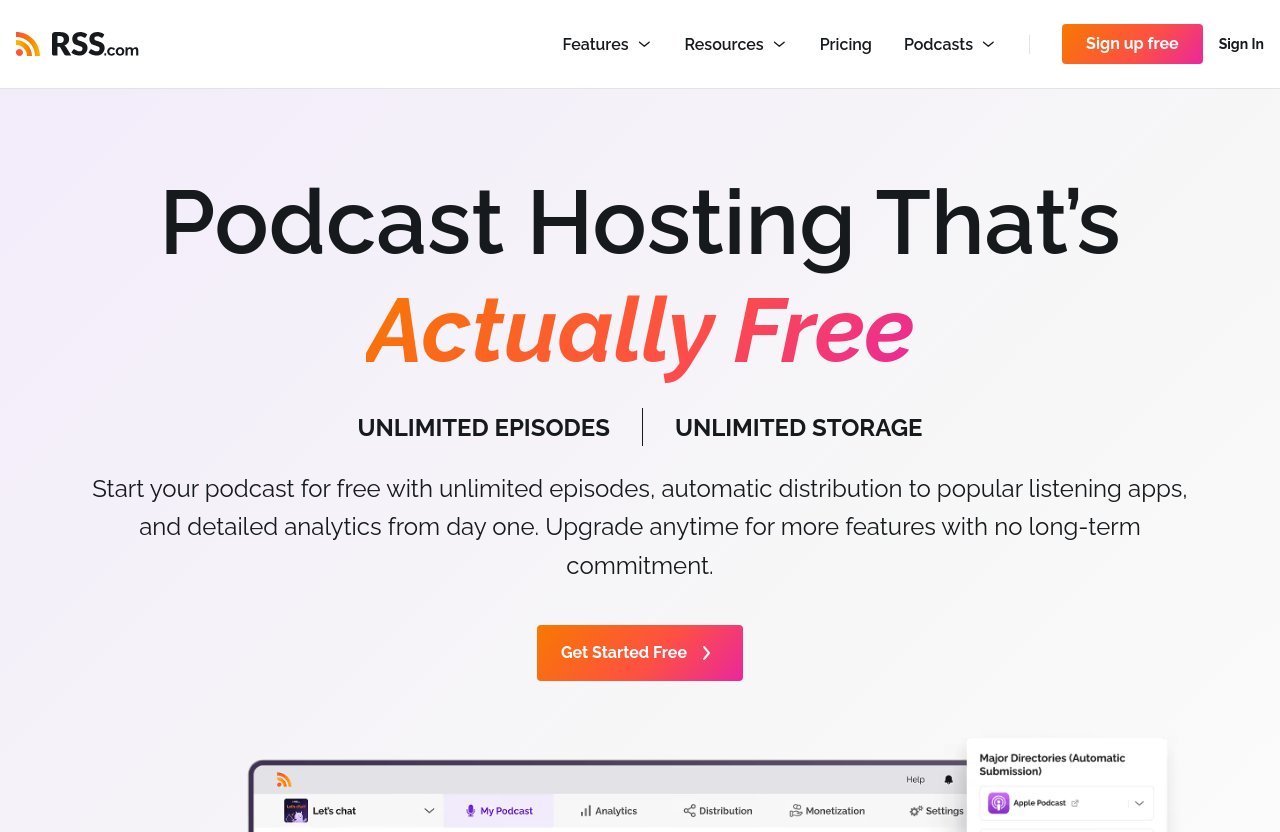
A podcast host does more than store your audio files. It creates the RSS feed that podcast apps use, helps distribute episodes, provides listener data, and can determine how easily you monetize or move your show later.
Pricing structure and hidden limits
Look beyond the advertised monthly price. Upload-hour allowances, download caps, episode expiration, storage limits, and extra charges can affect the real cost of hosting a weekly or long-running podcast.
Unlimited episodes matter because your back catalog is an asset. When your show grows, old interviews and evergreen episodes can continue attracting listeners, search traffic, and sponsorship interest without forcing you to remove content.
Distribution reach
Good podcast distribution tools should make it simple to reach major listening platforms. Spotify and Apple Podcasts are essential for most shows, while YouTube and Amazon Music can add meaningful discoverability depending on your format and audience.
The best podcast hosting platform for you should reduce repetitive work. Instead of manually rebuilding episode details for each app, look for automated or streamlined distribution.
Monetization tools
Podcast monetization is not just about traditional ads. Donations, paid subscriptions, affiliate opportunities, premium content, and video advertising can all create income at different stages of audience growth.
For a new creator, a donation feature may be more useful than a complex ad marketplace. For an established show, ad revenue splits, subscriber tools, and dynamic ad capabilities can become more important.
Analytics and support
Downloads alone do not tell the whole story. Useful podcast analytics help you understand what listeners play, where they listen, which episodes perform best, and whether growth efforts are working.
Support is equally important when launching or switching hosts. A missing RSS redirect or incorrectly configured show listing can be stressful, so creators should prioritize platforms with clear documentation and responsive help.
Ease of setup and migration
A beginner-friendly dashboard can shorten the distance between recording your first episode and publishing it. Yet ease of use should also include migration: you should be able to move hosts without losing your feed, subscribers, or established podcast listings.
That is an important practical consideration in any rss.com vs buzzsprout comparison. The platform you choose should support your current workflow without locking you into a difficult future move.
Pricing Comparison: RSS.com vs Buzzsprout
RSS.com pricing plans and what’s included
PRODUCT FACTS (verified from official RSS.com pages)
> – Free: $0/month, no trial, no expiration, and always free. Includes unlimited episodes and downloads, publishing on Apple Podcasts, Spotify, and more, a free podcast website, listener donations, and download and growth tracking.
– Plus: $15/month billed annually ($180 billed annually), or $19.99/month when billed monthly. Includes everything in Free, ads with as few as 10 downloads, Apple Podcasts paid subscriptions, YouTube videos from audio episodes, AI-generated transcripts, advanced analytics, and unlimited voicemails.
– Pro: $26/month billed annually ($312 billed annually), or $34.99/month when billed monthly. Includes everything in Plus, hosting for up to 10 podcasts, 70% of ad revenue with PAID, unlimited team members, all-time analytics for every show, and automatic transcripts for every episode.
– Max: $37/month billed annually ($444 billed annually), or $49.99/month when billed monthly. Includes everything in Pro, unlimited audio and video podcasts, publishing to Apple Podcasts and YouTube from one upload, 70% of video ad revenue, and full API access.
– Custom/Enterprise: Available by contacting RSS.com. Includes everything in Max, plus a campaign manager for dynamically inserted ads, real-time geotargeting, video at scale, and ad-free options.
– RSS.com states that annual billing is 25% off, paid plans can be cancelled anytime, and paid plans include a 30-day money-back guarantee.
The RSS.com pricing structure is easy to understand because every tier keeps unlimited episodes and downloads. That means you can select a plan based on growth tools and monetization needs rather than fearing that a growing audience will trigger a download overage.
The free tier is particularly notable. A permanent RSS.com free plan gives new podcasters room to build a catalog, validate their concept, and learn publishing basics before they commit to a paid subscription.
Buzzsprout pricing clues from the SERP
The available SERP snippets indicate that Buzzsprout offers a free plan with two upload hours per month and that free-plan episodes are deleted after 90 days. The snippets also indicate paid Buzzsprout pricing beginning at $19 per month, with higher listed levels of $39 and $79 per month.
Those figures come from provided SERP information rather than a current official Buzzsprout pricing page reviewed for this article. Before subscribing, confirm current prices, upload allowances, retention rules, and included tools directly with Buzzsprout.
Which platform gives better value at entry level
For long-term beginners, RSS.com offers stronger entry-level value based on the verified facts available. Its $0 plan has no expiration and includes unlimited episodes and downloads, a website, donations, and basic growth tracking.
By comparison, the visible Buzzsprout free-plan details create a time-sensitive decision. Two hours may be enough for short episodes, but deleting episodes after 90 days can be a serious drawback for a creator building a permanent library.
Which plan makes sense for teams and video
RSS.com Pro is the practical tier for small networks, agencies, or creators running multiple projects. It supports up to 10 podcasts and unlimited team members, while also adding all-time analytics and automatic transcripts for every episode.
For video podcast hosting, RSS.com Max is the relevant plan. It supports unlimited audio and video podcasts, lets one upload publish to Apple Podcasts and YouTube, and includes full API access for creators with connected workflows.
Features Comparison: Where RSS.com Stands Out
Unlimited episodes and downloads on every plan
One of the biggest differences in rss.com vs buzzsprout features is RSS.com’s stated approach to capacity: every plan includes unlimited episodes and downloads. This is useful for creators who publish frequently, produce longer episodes, or want to preserve every season of their show.
Unlimited publishing removes guesswork. You do not have to calculate whether a special bonus episode, back-catalog upload, or weekly release schedule will exceed a monthly allowance.
Automatic distribution to major apps
RSS.com states that it automatically distributes podcasts to Spotify, Apple Podcasts, YouTube, Amazon Music, and more. This can save substantial setup time, especially for beginners who do not yet understand the different podcast directories.
Distribution is not only about convenience. A wider presence gives listeners more chances to find your show in the app they already use, which can improve early audience growth.
Free podcast website and listener donations
Every RSS.com plan includes a free website for your podcast. For a solo host without a separate website, that can provide a simple public home for episodes, show notes, and sharing links.
RSS.com also supports listener donations on its free plan. That is a practical early monetization option because it lets supportive listeners contribute before a podcast has enough scale for meaningful ad revenue.
AI-generated transcripts and advanced analytics
On Plus and above, RSS.com includes AI-generated transcripts and advanced analytics for the show and audience. Transcripts can make episodes easier to repurpose into articles, newsletters, social posts, and accessible written content.
Advanced podcast analytics are valuable when you are testing episode topics, formats, or publishing schedules. Instead of judging performance by instinct alone, you can use data to identify which content resonates.
Video podcasting and YouTube publishing
RSS.com Plus can create YouTube videos from audio episodes. For podcasters who want a YouTube presence without recording a full studio video show, this provides a lower-effort way to add another discovery channel.
Max goes further with unlimited audio and video podcasts and a one-upload publishing workflow for Apple Podcasts and YouTube. That makes RSS.com a credible option for creators whose content strategy includes both audio and video.
Podcasting 2.0 and open RSS control
Podcasting remains built around the open RSS feed model, which gives creators more portability than a closed social platform. RSS.com also supports Value 4 Value and Boostagrams, offering another way for audiences to support creators through newer podcasting ecosystems.
In this part of the rss.com vs buzzsprout comparison, RSS.com has more clearly documented monetization and creator-growth features in the supplied materials. The available Buzzsprout SERP snippets do not provide enough verified detail to make a full technical feature comparison.
Ease of Use and Creator Experience
How simple RSS.com is for beginners
RSS.com positions its platform as requiring no prior experience, with setup designed to take only a few clicks. That matters when your priority is publishing rather than learning hosting terminology, RSS feeds, and directory submission processes.
The permanent free plan also lowers pressure for new creators. You can learn the workflow, publish consistently, and refine your concept without a trial deadline looming over your first few episodes.
Dashboard, setup, and publishing workflow
A productive hosting workflow should make it easy to upload audio, add titles and descriptions, schedule releases, review performance, and distribute episodes. RSS.com’s plan structure follows a clear progression: start free, add analytics and transcripts on Plus, then add teams, multi-show support, and video as needed.
This approach works well for creators who want to avoid switching platforms just because their show becomes more ambitious. You can upgrade capabilities while keeping the same hosting foundation.
Support, reviews, and trust signals
RSS.com states that it has a 4.95-star rating from more than 3,100 reviews. While review scores should never replace hands-on evaluation, that is a useful trust signal for creators selecting a service that will hold their full podcast catalog.
For a practical starting point, you can review the plans and publishing options through RSS.com’s podcast hosting platform. Consider beginning with the free tier before committing to a paid plan.
When Buzzsprout may feel simpler
Buzzsprout may feel simpler for creators who already know its interface or prefer its particular publishing flow. Some comparison-oriented SERP content characterizes it as easy to use for setup and administration.
That said, simplicity is subjective. In a rss.com vs buzzsprout choice, the better dashboard is the one that lets you publish consistently while meeting your needs for storage, monetization, analytics, and future growth.
Official website · Latest pricing & offers
Monetization Options Compared
Ads with as few as 10 downloads
RSS.com Plus allows creators to earn from ads with as few as 10 downloads. That lower threshold is significant because many emerging podcasts do not have the large audiences traditionally associated with sponsorships.
On Pro and Max, RSS.com states that creators keep 70% of ad revenue with PAID. The exact earnings potential will depend on audience size, advertiser demand, content category, and eligible inventory, so creators should view ads as one component of a broader revenue strategy.
Paid subscriptions on Apple Podcasts
RSS.com Plus supports paid subscriptions on Apple Podcasts. Subscription revenue can be useful for shows with loyal audiences that will pay for ad-free listening, bonus episodes, early access, or premium series.
The key advantage of subscription tools is predictability. Advertising revenue can fluctuate, while a recurring member base may offer a more stable foundation for a niche show.
Listener donations and affiliate options
RSS.com includes listener donations even on the free plan, making it easier to give fans a direct support option from day one. RSS.com also offers affiliate opportunities and supports Value 4 Value/Boostagrams.
These tools give creators flexibility. A community podcast may rely on donations, a review show may use affiliate income, and a high-growth entertainment show may emphasize ads and subscriptions.
Video monetization on Max
RSS.com Max includes 70% of eligible video ad revenue, according to its official pricing information. This can matter for creators who use video podcasts, interviews, or visual storytelling as part of their strategy.
The wider lesson in this rss.com vs buzzsprout comparison is that monetization should match your show’s stage. RSS.com provides several paths, so you are not dependent on a single revenue model.
Distribution, Analytics, and Growth Tools
One-click distribution to Spotify, Apple Podcasts, YouTube, Amazon Music
RSS.com states that it automatically sends podcasts to Spotify, Apple Podcasts, YouTube, Amazon Music, and additional platforms. This is helpful for creators who want broad availability without managing each platform as a separate publishing task.
Distribution should be treated as an audience-access decision. Listeners will not always change apps to hear your show, so being available where they already listen is a meaningful growth advantage.
Real-time and advanced analytics
The RSS.com free plan includes download and podcast growth tracking. Plus adds advanced analytics for your show and audience, while Pro provides all-time analytics for every show.
These tools help answer operational questions: Which episode should become a series? Are listeners responding to shorter formats? Is a guest topic bringing in new listeners? Good reporting turns those questions into decisions.
Team workflows and multi-show management
RSS.com Pro supports up to 10 podcasts and unlimited team members. That is useful for podcast agencies, media teams, production studios, and creators managing separate shows under one operation.
Rather than sharing one login across a team, dedicated access can make publishing more organized. It also reduces the friction of assigning editing, uploading, analysis, and show-management responsibilities.
Why growth-focused creators may prefer RSS.com
Growth-focused creators often outgrow basic hosting faster than expected. They may need transcripts for repurposing, advanced analytics for content decisions, multiple shows for a network, or video publishing for broader reach.
That is where RSS.com has a coherent upgrade path. Its pricing and features let creators start with a low-risk plan and add tools as their production and business needs become clearer.
Migration and Switching: Moving Between RSS.com and Buzzsprout
How a switch typically works
Moving hosts usually involves importing your existing show, confirming that all episodes and metadata are present, and setting up an RSS feed redirect from your old host to the new one. The redirect tells podcast apps where to find your show going forward.
Do not delete your old account immediately. Verify that the redirect is working and that key directories are updating properly before closing the previous hosting account.
RSS feed redirects and listener continuity
SERP information indicates that Buzzsprout supports moving from RSS.com while keeping episodes, listings, and listeners when migration is handled correctly. Likewise, RSS.com help content indicates that paid subscribers can redirect a feed and recommends keeping the old account active for 45 days.
The principle is the same in either direction: a correctly configured redirect should preserve listener continuity. Subscribers follow the RSS feed, not the hosting company’s dashboard, so the feed transition is the critical step.
Analytics data considerations
Analytics generally do not transfer automatically between hosting platforms. Before moving, export or save historical download reports, episode performance figures, and audience information you may need for sponsorships or planning.
After migration, allow time for new reporting to accumulate. Comparing old and new data may require care because platforms can calculate and display metrics differently.
Who should switch and why
Switching to RSS.com can make sense if you need unlimited episodes and downloads, a permanent free plan, donation tools, advanced analytics, transcripts, team access, or audio-and-video hosting. It may also be worthwhile if the free-plan expiration details visible for Buzzsprout do not fit your long-term publishing plan.
In any rss.com vs buzzsprout migration decision, do not switch casually. Make a backup, document your current statistics, confirm your feed redirect, and keep the former account active for the recommended transition period.
Best Choice by Creator Type
Best for beginners launching their first show
RSS.com is the stronger beginner option based on its no-experience-needed positioning, permanent free plan, unlimited episodes and downloads, free website, and automatic distribution to major platforms. Beginners can start publishing without immediately facing a trial deadline.
Best for budget-conscious creators
For creators protecting their budget, the RSS.com free plan is difficult to overlook. It remains free with no expiration while providing the essentials needed to launch and maintain an ongoing podcast.
This makes RSS.com one of the more practical Buzzsprout alternatives for creators who want to build a durable back catalog before paying for premium growth tools.
Best for teams and agencies
RSS.com Pro is the better-defined choice for teams in this comparison. It supports up to 10 podcasts, unlimited team members, all-time analytics for every show, and automatic transcripts for each episode.
Best for video podcasters
RSS.com Max is designed for creators who publish both audio and video. Unlimited audio and video podcasts, one-upload publishing to Apple Podcasts and YouTube, and video ad revenue sharing provide a useful foundation for a video-first strategy.
Best for creators prioritizing monetization
RSS.com is the more clearly documented option for podcast monetization. It offers listener donations on Free, ads from 10 downloads and Apple Podcasts subscriptions on Plus, PAID ad revenue sharing on Pro and Max, plus affiliate opportunities and Value 4 Value/Boostagrams.
Final Recommendation: Should You Choose RSS.com or Buzzsprout?
Choose RSS.com if…
Choose RSS.com if you want unlimited episodes and downloads on every plan, a genuinely permanent free option, automated distribution, a free website, donations, advanced analytics, AI transcripts, multiple-show support, or video podcast hosting.
It is especially well suited to creators who want to start lean but retain room to grow. You can compare the available tiers through RSS.com pricing and hosting options before deciding which level fits your publishing goals.
Choose Buzzsprout if…
Choose Buzzsprout if you have already tested its workflow and strongly prefer its interface, or if its current official plans meet your specific needs better. The SERP data suggests it is often viewed as straightforward to use, but its visible free-plan limits should be evaluated carefully.
Because this article only relies on the supplied competitor snippets, verify Buzzsprout pricing, retention rules, distribution options, and monetization features directly before committing.
Bottom-line summary
For most creators comparing rss.com vs buzzsprout, RSS.com is the more flexible recommendation. Its unlimited episodes and downloads, permanent free plan, transparent growth tiers, monetization options, distribution support, analytics, and video capabilities make it an attractive all-around host.
Buzzsprout may remain a valid choice for creators who prefer its familiar workflow. But for beginners, budget-conscious podcasters, teams, and creators building toward monetization, RSS.com offers more clearly verified value and fewer early publishing constraints.
Official website · Latest pricing & offers
FAQ
Is RSS.com better than Buzzsprout for beginners?
RSS.com is highly beginner-friendly because it is designed for no-experience-needed setup and includes unlimited episodes, unlimited downloads, a free podcast website, and automatic distribution to major platforms. Buzzsprout may also be easy to set up, but the supplied SERP data indicates that its free plan has a two-hour monthly limit and episodes expire after 90 days.
Does RSS.com have a free plan?
Yes. RSS.com offers a permanently free plan with no trial and no expiration. It includes unlimited episodes and downloads, distribution to Apple Podcasts, Spotify, and more, a free podcast website, listener donations, and download tracking.
How much does RSS.com cost?
RSS.com offers a Free plan at $0. Plus costs $15 per month billed annually or $19.99 monthly; Pro costs $26 per month billed annually or $34.99 monthly; and Max costs $37 per month billed annually or $49.99 monthly. Custom and Enterprise options are also available.
What features does RSS.com include that help with monetization?
RSS.com supports ads through PAID, Apple Podcasts paid subscriptions, listener donations, affiliate opportunities, and Value 4 Value/Boostagrams. Pro and Max offer a 70% share of ad revenue with PAID, while Max also offers 70% of eligible video ad revenue.
Can I switch from Buzzsprout to RSS.com without losing listeners?
Yes, a properly managed migration can preserve episodes, podcast listings, and listeners through an RSS feed redirect. Save your analytics before moving because historical analytics usually do not transfer automatically, and keep the old hosting account active during the redirect transition period.
Related Reading
References
- RSS.com vs. Buzzsprout | RSS.com Podcast Hosting
- Podcast Hosting Platforms Compared: Pricing, Features & Reviews 2026 | RSS.com
- Moving from RSS.com to Buzzsprout