Best Trustworthy Alternatives in 2026
Finding the right trustworthy alternatives is less about choosing the biggest cloud-storage brand and more about matching a tool to your household’s real responsibilities. Families often need a secure place for insurance policies, estate documents, IDs, financial records, and reminders—not just a folder full of files.
This guide compares the best Trustworthy alternatives in 2026 for buyers weighing security, storage, automation, family access, and budget. It also explains where Trustworthy remains a strong choice, especially for people who want a family operating system rather than basic encrypted document storage.
Official website · Latest pricing & offers
Best Trustworthy Alternatives in 2026: Quick Picks
The best trustworthy alternatives depend on whether your priority is a purpose-built family vault, estate planning, secure sharing, or simple cloud storage. There is no one-size-fits-all choice, particularly when several relatives, emergency contacts, and long-term documents are involved.
Who this guide is for
This comparison is for households reviewing Trustworthy competitors before committing to a subscription. You may be looking for a family document organizer with a lower entry cost, more storage, simpler sharing, or a different approach to estate planning software.
It is also useful for people who already use Google Drive, Dropbox, or another storage service but are unsure whether those tools provide the guidance, organization, and access controls needed for life administration.
How we chose these alternatives
I evaluated this category through a practical buying lens: security and privacy disclosures, document organization, search, reminders, automation, family permissions, mobile access, and overall pricing value. These are the features that matter when a vault contains passports, wills, healthcare directives, insurance documents, and mortgage records.
Competitor plans and product details can change frequently. Before subscribing to any of these trustworthy alternatives 2026, verify current capabilities, privacy terms, storage limits, and pricing directly on the provider’s official site.
Fast comparison by use case
| Primary need | Best type of solution to compare | What to prioritize |
|---|---|---|
| Whole-household administration | Trustworthy or a family-focused vault | Family permissions, reminders, document intelligence |
| Estate and legacy preparation | Estate-planning platform or digital vault | Emergency access, legacy planning workflow |
| Private file storage | Secure cloud-storage provider | Encryption approach, sharing controls, recovery options |
| Simple everyday files | General cloud storage | Familiar collaboration, storage value, device compatibility |
| Maximum control over data | Self-hosted platform | Technical setup, backups, access management |
For households that want documents to lead to answers and next actions, compare Trustworthy plans and pricing alongside the alternatives below. The right decision comes down to whether you need a vault alone or a broader household organization app.
What Trustworthy Does Well Before You Compare Alternatives
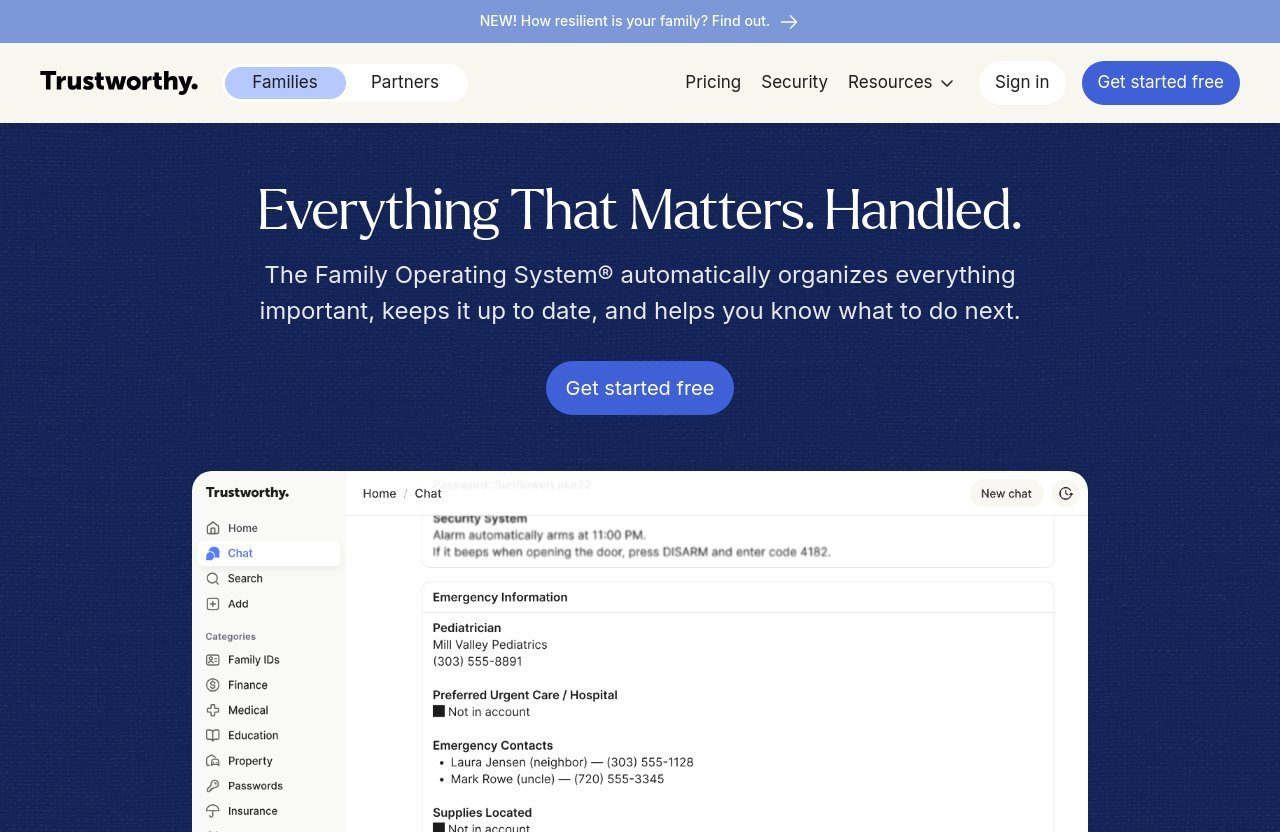
Before switching tools, it helps to understand what Trustworthy is designed to do. It is positioned as “The Family Operating System®,” with an emphasis on turning documents into answers, guidance, and action.
That makes it different from many trustworthy alternatives that primarily focus on file storage, folder sharing, or a narrow estate-planning workflow.
Family Operating System positioning
Trustworthy is built around household organization rather than merely uploading documents. Its approach combines a document vault with household-aware AI, collaboration, reminders, and information organization for major personal and family records.
The intended use case is broad: organizing birth certificates, Social Security cards, passports, driver’s licenses, marriage certificates, divorce decrees, wills, trust documents, mortgage records, powers of attorney, healthcare directives, living wills, insurance policies, and title deeds.
Core verified features from the official site
Trustworthy states that it uses AES-256 encryption and multi-factor authentication. It also says users remain in control of their information and that information is private and never shared, sold, or monetized.
Core features listed by Trustworthy include:
- Email sync and automatic organization
- An encrypted vault for important household documents
- Chat and household-aware AI
- Intelligent reminders
- Private collaboration
- SecureLinks
- iOS and Android apps
- Mobile offline mode
- Downloadable information and marketplace discounts
This feature mix matters because basic digital vault alternatives may store a document securely but not necessarily help a household organize it, set reminders around it, or make it useful in a broader family workflow.
Verified Trustworthy pricing plans
Trustworthy’s plans are structured around family size, storage, email addresses for Inbox Autopilot, AI-answer allowances, and support levels. All plans include advanced security and privacy, app access, mobile offline mode, the ability to download your information, and Trustworthy Marketplace discounts.
| Plan | Verified price | Key inclusions |
|---|---|---|
| Free | $0, free forever | 1 family member, 1 email address, 10 AI answers/month, encrypted vault, SecureLinks, 2 GB storage, legacy access permissions |
| Silver | $10/month, paid annually | 5 family members, 2 email addresses, 25 AI answers/month, intelligent reminders, granular permissions, 10 GB storage |
| Gold | $20/month, paid annually | 10 family members, 5 email addresses, unlimited AI answers, all permissions including read-only, 100 GB storage |
| Platinum | $40/month, paid annually | Unlimited family members and email addresses, unlimited AI answers, all permissions including read-only, software + service for household support |
Concierge is available separately across the plans. The Free plan is particularly relevant for shoppers testing trustworthy alternative pricing before paying for a household system.
How to Evaluate Trustworthy Alternatives
A careful comparison should go beyond headline storage capacity or a low monthly price. For security-sensitive records, a cheaper service can become expensive if it creates confusion, weakens access control, or leaves family members unable to find vital files.
Use this framework when assessing the best trustworthy alternatives for your situation.
Security and privacy
Start with the provider’s official security and privacy materials. Look for clearly stated encryption practices, multi-factor authentication, account recovery options, data-export policies, and whether the company explains how it handles customer information.
Do not assume that any service described as “secure” offers the same model of protection. A platform’s privacy policy, sharing architecture, and account-recovery process can matter as much as the encryption language on its homepage.
Document organization and search
Ask how quickly someone can locate a passport, insurance policy, will, or medical directive when it is needed. A strong family document organizer should support consistent categories, practical search, and a structure that still makes sense years later.
General cloud drives are flexible, but they typically require you to create and maintain your own naming conventions and folders. A specialized service may be more appropriate for people who want guided organization for household records.
Automation and reminders
Automation separates a passive file cabinet from an active household system. Consider whether the platform can help organize incoming information, surface documents, or remind you about deadlines and recurring responsibilities.
Among trustworthy alternatives, this is one of the most important distinctions for busy families. If your main need is preserving files, automation may be unnecessary; if you manage policies, renewals, and multiple family members, it can be worth paying for.
Family access and permissions
Check how many people can access the account, what each person can see, and whether read-only or granular permissions are available. Also consider emergency and legacy access, since the people who need records later may not be the people who upload them today.
Avoid treating family sharing as a minor feature. In real use, different visibility levels for spouses, adult children, advisors, and trusted contacts can be central to privacy and estate readiness.
Pricing and total value
Compare the full cost against the workflow you actually need. Consider annual billing requirements, storage limits, number of household members, support, automation, and whether services such as concierge help are separately priced.
Always confirm competitor pricing on official pages before choosing among secure family vault alternatives. A low starting price may cover only a single user or omit the permissions and storage required for a complete family setup.
Official website · Latest pricing & offers
Best Trustworthy Alternatives by Category
The market includes specialized vaults, estate-oriented platforms, mainstream cloud drives, privacy-centered providers, and self-hosted systems. The names below are useful comparison starting points, but buyers should verify each provider’s current plans and security details directly.
Best for digital vaulting
Prisidio is commonly considered by shoppers seeking a digital vault for important family information and documents. It is a relevant option to evaluate if your priority is keeping essential records in one organized location rather than managing day-to-day household workflows.
When comparing digital vault alternatives, examine how each service handles document categories, sharing, access after an emergency, mobile usability, and privacy controls. The closest fit is not always the platform with the most storage.
Best for family estate planning
Everplans is often researched by people focused on organizing end-of-life information and preparing information for loved ones. It can be a useful Everplans alternative comparison point when estate readiness is the central goal.
Estate planning software and family-vault tools can overlap, but they are not identical. Review whether a product supports the specific workflow you need: organizing legal documents, communicating instructions, sharing information, or maintaining an ongoing household record system.
Best for secure file sharing
Dropbox, Google Drive, Microsoft OneDrive, and Proton Drive are examples of services people may assess for file storage and sharing. These can make sense when your main objective is collaboration on files rather than a dedicated household document-management experience.
For these trustworthy alternatives, check the official documentation for sharing permissions, security controls, account administration, storage, and supported devices. The best choice depends heavily on what other tools your family already uses.
Best for self-hosted or private setups
Nextcloud is often considered by users who prefer a self-hosted or more independently managed setup. This route may appeal to technically confident households that want more control over where data is stored and how their environment is configured.
The tradeoff is responsibility. Self-hosting requires thoughtful setup, reliable backups, updates, access controls, and a recovery plan. It is rarely the simplest answer for a family that needs immediate, low-maintenance access to critical documents.
Best budget-friendly option
For lower upfront cost, start with the free tiers of reputable storage tools or Trustworthy’s Free plan. Trustworthy’s free offering includes one family member, one email address for Inbox Autopilot, 10 AI answers per month, an encrypted vault, SecureLinks, and 2 GB of storage.
A free tool can be suitable for testing your organizational habits. However, the best budget choice should still support the level of privacy, access, and long-term continuity your household requires.
Trustworthy vs. Popular Alternatives: Side-by-Side Decision Guide
The most useful comparison is not “which brand wins?” It is “which workflow reduces the risk of lost, inaccessible, or poorly organized information for my family?”
This is where trustworthy competitors differ most: some are vault-first, some are estate-first, and some are simply general-purpose storage.
Trustworthy vs. Prisidio
A trustworthy vs prisidio comparison is most relevant for buyers considering a dedicated family information vault. Evaluate both on document organization, collaboration, privacy disclosures, permissions, legacy or emergency access approach, storage, and current subscription terms.
Trustworthy’s verified differentiators include household-aware AI, email sync, automatic organization, intelligent reminders on paid plans, private collaboration, and its Family Operating System positioning. Check Prisidio’s official pages to determine whether its current workflow better matches a vault-first approach for your household.
Trustworthy vs. Everplans
Trustworthy and Everplans may both appear in estate-readiness research, but they should be compared by intended workflow rather than name recognition. An estate-focused user may value a platform designed around communicating plans and organizing legacy information.
Trustworthy may be the stronger fit when the need extends beyond estate documents into recurring household administration, family collaboration, IDs, insurance, and reminders. An estate-specific service may fit better when legacy planning is the only or primary task.
Trustworthy vs. Google Drive / general cloud storage
Google Drive and similar services are general file-storage and collaboration tools. They can work well for folders, shared documents, and everyday files, especially if your family already uses the same ecosystem.
Trustworthy is positioned differently: it is a family operating system designed to turn documents into answers, guidance, and action. For people comparing encrypted document storage with broader household organization, that distinction is more important than a simple storage-capacity comparison.
When Trustworthy is the better buy
Trustworthy is likely a better fit when you want one place for important household records plus organization, reminders, private collaboration, email sync, and household-aware AI. Its Gold and Platinum plans may be especially relevant for larger households that need more members, more email addresses, and more storage.
It is also compelling for buyers who want security features explicitly stated by the provider, including AES-256 encryption and multi-factor authentication, while retaining control over private information.
When an alternative is the better fit
An alternative may be better if you only need simple file storage, already have a trusted storage ecosystem, or prefer a technical self-hosted environment. A dedicated estate-planning service may also be more suitable if end-of-life planning is your only focus.
The best trustworthy alternatives are not necessarily replacements for every Trustworthy feature. They may simply solve a narrower problem at a price or level of complexity that suits your household.
Which Trustworthy Alternative Should You Choose?
Think of this as a practical decision tree. Start with the core job you need the software to do, then compare plans based on family size, documents, and how actively you want the system to help.
Best for families managing life admin
Choose Trustworthy if your household needs ongoing organization for documents, insurance, IDs, legal records, and shared responsibilities. Its combination of an encrypted vault, private collaboration, automatic organization, intelligent reminders, and household-aware AI is designed for this broader role.
For a full view of Free, Silver, Gold, and Platinum inclusions, see whether Trustworthy fits your family workflow before comparing individual vault products.
Best for estates and emergency access
Choose an estate-focused platform or a dedicated vault if the primary objective is preparing critical information for loved ones. Compare emergency-access options, permissions, document organization, and how clearly the service supports your estate-planning process.
Trustworthy can still be a strong option when estate documents are part of a larger family-administration system rather than a standalone project.
Best for simple encrypted storage
Choose a mainstream secure storage provider when you want to upload, sync, and share files with minimal process changes. This path works best for users who are comfortable building their own folders, assigning their own sharing rules, and handling renewal reminders manually.
These secure family vault alternatives can be cost-effective, but they may not provide the same household-oriented guidance or automation.
Best for users who want lower cost
Start with a free tier where possible, then upgrade only when storage, sharing, or automation needs justify it. Trustworthy’s Free plan provides a no-cost way to assess its encrypted vault, Household AI, SecureLinks, and organization experience.
Lower cost should not mean lower diligence. Confirm account recovery, privacy policy terms, and access controls before placing sensitive family documents in any service.
Best for users who want more automation
Trustworthy is worth close consideration for users who value email sync, automatic organization, intelligent reminders, and household-aware AI. These are practical features for turning a static document collection into an active system for family administration.
Among the best trustworthy alternatives, choose a different platform only if it offers automation that clearly aligns with your specific needs and is verified in its current official plan documentation.
Official website · Latest pricing & offers
FAQ
Are there free alternatives?
Yes. General cloud-storage providers often have free tiers, and Trustworthy has a Free plan with one family member, one email address for Inbox Autopilot, 10 AI answers per month, an encrypted vault, SecureLinks, and 2 GB of storage. Free plans are best for testing a workflow before moving sensitive records or inviting more relatives.
What is the best alternative to Trustworthy?
The best alternative depends on the job. Prisidio may be worth evaluating for digital-vault needs, Everplans for estate-focused organization, Google Drive or similar services for general storage, and Nextcloud for a self-managed setup. For households needing reminders, organization, and collaboration, Trustworthy may remain the more complete fit.
Can I use Google Drive instead?
You can, especially for general file storage and sharing. However, Google Drive is a general cloud-storage platform, while Trustworthy is positioned as a family operating system with an encrypted vault, household-aware AI, email sync, automatic organization, private collaboration, and reminders on paid plans.
Which alternative is most trustworthy?
There is no universal answer. Review each provider’s official security statements, privacy policy, authentication options, access controls, data-export process, and independent customer feedback. The most trustworthy choice is the one whose safeguards and operating model match the sensitivity of your documents.
What are the most trusted websites?
“Most trusted” depends on the task. For family document management, assess official security claims, privacy policies, independent reviews, access controls, and who retains control of the data rather than relying on brand reputation alone.
What is an alternative to Trustworthy?
Alternatives include digital vaults such as Prisidio, estate-planning platforms such as Everplans, general storage tools such as Google Drive, Dropbox, or OneDrive, and self-hosted options such as Nextcloud. Each solves a different part of the household-document problem.
What are some websites similar to Trustpilot?
That is a different category. Trustpilot is a consumer review platform, while Trustworthy is a family document-management tool. For software research, G2, Slashdot, and CB Insights are commonly used comparison sources, but official product pages should remain your source for current plan and security details.
Choosing between trustworthy alternatives should ultimately come down to the level of support your household needs. If you want basic storage, a general cloud drive may be enough; if you want a private, organized system that helps manage real family responsibilities, Trustworthy deserves serious consideration.
Related Reading
- Best Scrimba Courses for Frontend Devs in 2026
- Best Cold Email Tools Like Smartlead in 2026
- Best Bonfire Alternatives: Practical Picks for Merch Sellers in 2026
References
- Trustworthy vs. the Competition
- Top Trustworthy Alternatives, Competitors
- Top Trustworthy Alternatives in 2026
- Top Trustworthy Digital Alternatives & Competitors in 2026