
Youlearn AI vs ChatGPT for Studying: A Practical 2026 Comparison

Choosing between a dedicated study platform and a general chatbot can change how quickly you turn class material into useful revision. In this youlearn ai vs chatgpt for studying comparison, the central question is simple: do you need help working from your actual lectures and documents, or do you mainly need flexible explanations on demand?
This review focuses on study workflow speed, retention, source handling, and reliability—not on broad AI capabilities outside education. It is based on verified YouLearn product information, plus general publicly available context around how students use ChatGPT. Features and pricing can change, so always verify important details on the official product pages before deciding.
Official website · Latest pricing & offers
YouLearn AI vs ChatGPT for Studying: Quick Verdict
For most students, the decision comes down to structure versus flexibility. YouLearn is positioned as an AI tutor built around your learning materials, while ChatGPT is a wider general-purpose assistant that can support many study tasks when you provide clear prompts and verify its output.
| Study priority | Better fit | Why |
|---|---|---|
| Reviewing assigned PDFs, slides, recordings, and videos | YouLearn AI | It is designed to work with learning materials and turn them into study assets. |
| Asking a quick question or getting a different explanation | ChatGPT | It is useful for broad, conversational help and brainstorming. |
| Creating a structured revision workflow | YouLearn AI | Notes, interactive chats, quizzes, and source-based questions fit a focused study process. |
| Exploring a topic beyond course material | ChatGPT | It can help frame ideas, simplify concepts, and generate examples. |
| Last-minute review from one lecture or document | YouLearn AI | Uploading the material may reduce the need to repeatedly explain the context. |
Best for structured exam prep
In the youlearn ai vs chatgpt for studying decision, YouLearn is the stronger fit for structured exam preparation from assigned materials. Its official positioning centers on learning from your own PDFs, slides, websites, files, YouTube videos, and lectures.
That matters when your exam is based on a professor’s slides, a specific textbook chapter, or a recorded lecture. Rather than starting with a blank prompt, you can begin with the material you actually need to understand.
Best for fast, flexible explanations
ChatGPT is often more convenient when you need a fast explanation of a concept, an analogy, practice questions, or help organizing a study plan. It is especially useful when the question is not tied to a single source document.
For example, a student might ask for a plain-English explanation of opportunity cost, then request a few original practice scenarios. This is a valid use of ChatGPT for studying, provided the student checks key facts and does not treat the output as a replacement for course material.
Bottom-line recommendation for students
My practical conclusion is that YouLearn is the better choice for students who spend most of their time reviewing source materials. ChatGPT is a strong companion for general explanations, brainstorming, and quick practice—but it usually requires more manual context-setting to become a complete study workflow.
The best AI for studying is not necessarily the one that writes the longest answer. It is the one that helps you understand, retrieve, and review the content your course actually assesses.
What YouLearn AI Is Designed to Do
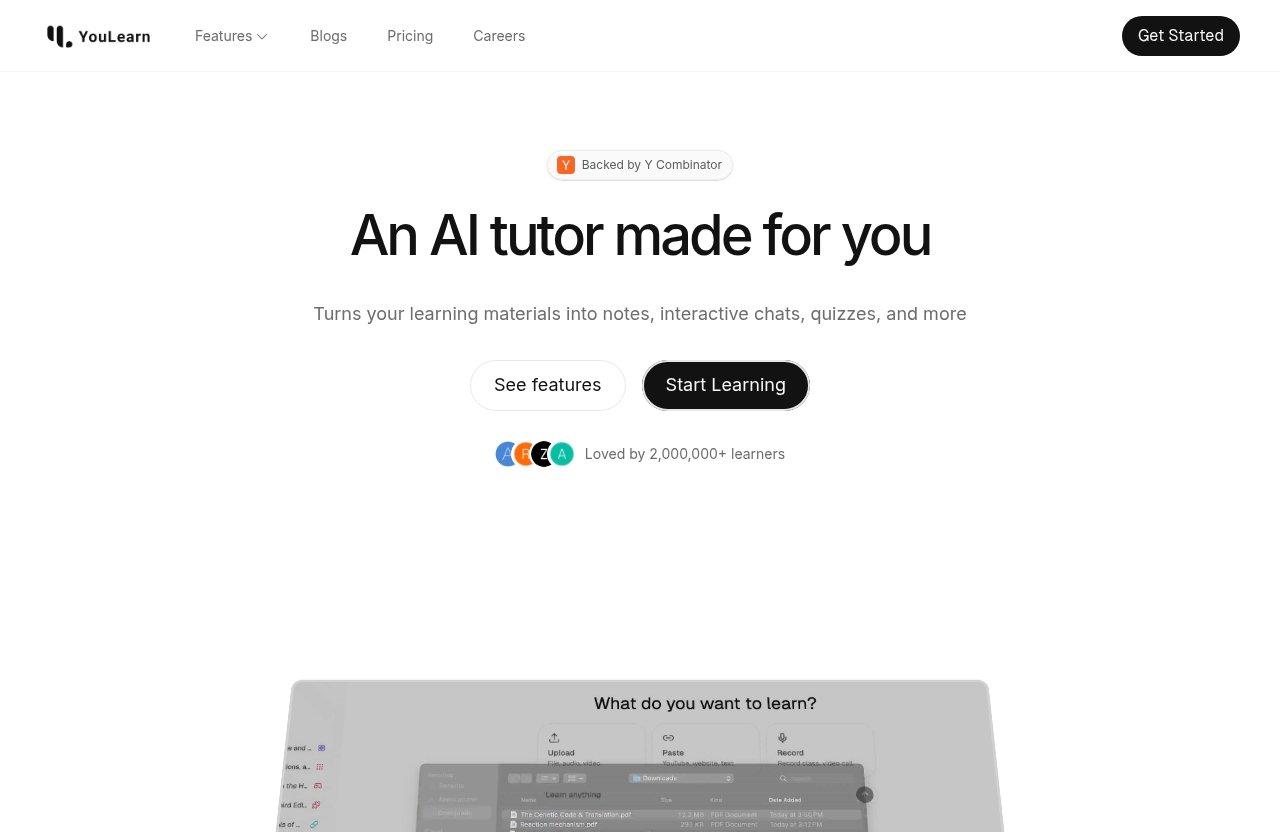
YouLearn describes itself as “an AI tutor made for you.” Its core purpose is learning from your own materials rather than offering only a general chat experience.
That focus makes YouLearn particularly relevant for students trying to study with AI in a way that stays connected to their lectures, readings, and course files.
Upload PDFs, slides, websites, files, YouTube videos, and lectures
According to the official YouLearn homepage, users can chat with YouTube videos, PDFs, slides, websites, files, and lectures. It also supports uploads from PDFs, YouTube videos, slides, and recorded lectures.
This is a meaningful distinction in a youlearn ai vs chatgpt for studying comparison. A study tool that begins with your course source can be easier to use when you need answers about a particular lecture, chapter, or presentation.
A realistic example is a biology student uploading a lecture recording and asking for the main processes discussed. Another student could use slides from a history class to identify themes likely to appear in a revision session. The value is not that AI replaces studying; it is that it can make the first pass through dense material more organized.
Turn materials into notes, interactive chats, quizzes, and more
Verified YouLearn AI features include turning learning materials into notes, interactive chats, quizzes, and more. The platform also aims to help learners understand key points, test knowledge, and get answers related to their materials.
This is where a dedicated AI tutor for students can be more practical than a blank conversation box. Instead of separately asking for a summary, then quiz questions, then clarification, students can work toward those outcomes within a learning-focused environment.
For exam prep, that sequence is useful:
- Review notes generated from a lecture or document.
- Ask questions about confusing sections.
- Test recall with quizzes.
- Return to weak topics before the exam.
Used thoughtfully, this kind of cycle can support retention better than passively rereading notes.
AI tutor experience and references
YouLearn states that it can provide answers with references and let users listen to an AI tutor. For coursework, references are especially valuable because they give students a way to return to the underlying material rather than accepting an answer without context.
In my view, this source-oriented approach is the most important part of the YouLearn AI features list. Students should still check the original slide, document, or lecture segment, but being pointed back to relevant material can make verification faster.
That does not mean every AI response should be assumed correct. It means the workflow is designed to keep the student closer to their assigned source content.
How ChatGPT Fits Into a Student Workflow
ChatGPT can be useful for studying because it is conversational, flexible, and adaptable to many subjects. Public discussion around ChatGPT for studying commonly centers on explanations, study outlines, practice questions, summaries, and idea generation.
However, it is not specifically positioned as a course-material-first study platform. Students generally get better results when they give it detailed context, specify their level, and ask it to show reasoning in an appropriate way.
General-purpose brainstorming and explanation
ChatGPT can help when a topic feels confusing after reading a textbook or attending a lecture. A student can ask for an explanation at a high-school, undergraduate, or beginner level and request examples that make the concept easier to remember.
For instance, if calculus limits are unclear, a student might ask for an intuitive explanation before returning to class examples. If an essay prompt is broad, ChatGPT can help generate potential angles or organize questions to research.
The key is to use it as a thinking partner, not an authority. A general chatbot may produce a plausible answer that does not fully match your course terminology, required method, or instructor’s expectations.
Flashcards, quizzes, and fake tests
Students also use ChatGPT to create flashcards, sample multiple-choice questions, short-answer prompts, and mock tests. It can be useful for active recall when you already know what topics need review.
Still, the quality of the output depends heavily on the instructions and source information you provide. If you want questions based on a particular chapter, you need to give it accurate chapter notes or clearly state the concepts, learning objectives, and difficulty level.
For a student deciding on youlearn ai vs chatgpt for studying, this is an important workflow difference. YouLearn is designed to transform uploaded learning materials into quizzes, while ChatGPT commonly asks the student to define the content and format through prompts.
Where prompting skill changes results
ChatGPT rewards precise prompting. “Help me study chemistry” is vague, while “Create ten practice questions on stoichiometry, include answers separately, and explain only the questions I miss” is more likely to produce a useful study session.
This flexibility is powerful, but it adds work. Students need to decide what to ask, supply context, review the result, and refine the prompt if the first answer misses the mark.
That is not necessarily a problem for confident users. But students looking for a repeatable system around lecture review may prefer a dedicated exam prep AI workflow.
Feature-by-Feature Comparison for Studying in 2026
The most useful way to assess youlearn ai vs chatgpt for studying is to compare the journey from raw class material to active revision. Both can help, but they begin from different assumptions.
| Feature area | YouLearn AI | ChatGPT |
|---|---|---|
| Primary study model | Learning from your own uploaded or linked materials | General conversation and assistance based on prompts and provided context |
| Supported learning inputs | Officially listed: PDFs, YouTube videos, slides, websites, files, and lectures | Depends on the version, settings, and what a user supplies; students should confirm current capabilities directly |
| Notes and summaries | Officially designed to turn materials into notes | Can produce summaries when given suitable content and instructions |
| Self-testing | Officially supports quizzes | Can generate practice questions and quiz formats through prompts |
| References | Officially states answers can include references | Students should request sources and independently verify important claims |
| Best workflow | Source-to-study-assets revision | Flexible explanations, planning, and one-off study tasks |
Content ingestion and source handling
YouLearn’s verified strength is its ability to work with multiple learning-material formats. Students can use PDFs, slides, websites, files, YouTube videos, and recorded lectures as the basis for interactive study.
That source-first design is useful when a course includes a mixture of materials. A student could review a lecture recording, revisit the slides, and test knowledge without having to manually restate the subject matter in every request.
ChatGPT can still be helpful when students paste notes, provide excerpts, or describe the lesson. But the student is generally responsible for establishing the context and ensuring the assistant has enough accurate information to answer appropriately.
Notes and summaries
In a youlearn ai vs chatgpt for studying review, summaries are not simply a convenience feature. A useful summary should preserve key terms, show relationships between ideas, and give the student a manageable starting point for deeper review.
YouLearn officially says it can turn learning materials into notes. This directly supports a common student task: moving from a long lecture or document to a concise revision resource.
ChatGPT can also help draft summaries, simplify wording, or reorganize notes into an outline. It may be especially useful when you want a specific format, such as a comparison chart, mnemonic, or short explanation for a difficult topic. The trade-off is that you should check whether the summary accurately reflects the source.
Quizzes, exams, and self-testing
Self-testing is one of the more effective ways to identify what you do and do not know. YouLearn officially includes quizzes among the outputs it can create from learning materials, which makes it relevant for students preparing for tests based on course content.
ChatGPT can generate practice questions, simulated oral exams, or short quizzes too. It may be a good option when you want to change the format quickly—for example, switching from multiple-choice questions to case-based questions or a short verbal test.
The difference is workflow. YouLearn begins with the material; ChatGPT often begins with the request. Students who want less setup may find YouLearn more natural for repeat revision.
Accuracy and citation support
No AI tool should be treated as a final authority for academic work. In the youlearn ai vs chatgpt for studying comparison, the most responsible question is not “Which one never makes mistakes?” Neither should be assumed flawless.
YouLearn’s official reference feature may help students trace answers back to their learning materials. This can reduce the risk of studying an answer that has drifted away from the lecture or document, especially when the student actively checks the cited context.
With ChatGPT, accuracy can vary based on the prompt, the specificity of the question, and the context available. It may offer a helpful explanation, but students should verify definitions, calculations, dates, quotations, and citations against approved course resources.
Workflow speed and ease of use
Workflow speed is often what determines whether an AI tool becomes part of a real study routine. If you have a two-hour lecture and an exam in a few days, spending twenty minutes crafting prompts may be less appealing than starting with the lecture itself.
YouLearn may save time for source-based revision because its purpose is to turn materials into notes, interactive chats, quizzes, and other learning outputs. This is particularly relevant for students who repeatedly work from lecture recordings and assignment documents.
ChatGPT can be faster for a single question: “Explain this formula,” “Give me an example,” or “Test me on this topic.” But when you need a full set of source-linked study resources, the general-chat approach can require more prompting and refinement.
Accuracy: Which One Is More Reliable for Coursework?
Reliability depends on the task and, most importantly, on how carefully the student verifies the result. It is not responsible to claim that either tool is always accurate.
For graded work, your syllabus, instructor guidance, required readings, and primary sources should remain the final standard.
When YouLearn AI’s source-grounded workflow helps
YouLearn’s focus on learning from your own materials can be helpful when the assessment is closely tied to specific lectures, slides, or assigned documents. Its ability to provide answers with references gives students a practical route back to the source.
For example, if a professor uses a unique definition or framework, working from that professor’s slides is likely more useful than relying on a broad online explanation. This is where YouLearn may be the better fit in youlearn ai vs chatgpt for studying decisions.
Where ChatGPT can still be strong
ChatGPT can be strong for clarification, examples, practice, and reframing a concept in simpler language. It can also help students spot gaps in their understanding by asking follow-up questions or challenging them with a new scenario.
The limitation is that a polished response can sound more certain than it deserves. Treat its answers as a draft for learning, then compare them with class notes, textbooks, and reliable academic sources.
How to verify answers before submitting work
Use a simple verification routine:
- Check facts, quotations, formulas, and dates against course-approved sources.
- Read the original lecture slide, textbook section, or research source.
- Solve quantitative work independently and compare your method.
- Follow your school’s AI-use policy and your instructor’s assignment rules.
- Write submitted work in your own voice and demonstrate your own understanding.
AI can support learning. It should not be used to bypass the work required to learn.
Official website · Latest pricing & offers
Speed: Which Tool Saves More Time Before an Exam?
Before an exam, the fastest tool is the one that reduces preparation without reducing understanding. That may look different for a student reviewing one chapter versus someone catching up on several recorded lectures.
Upload-and-study workflow in YouLearn AI
YouLearn’s official material support makes it well suited to an upload-and-study routine. A student can begin with a PDF, slides, video, lecture, website, or file and use the platform’s notes, chats, quizzes, and reference-supported answers to guide review.
This is valuable when the material is dense or scattered. Instead of manually building every revision asset, students can focus more of their time on active recall and less time on organizing.
For students comparing youlearn ai vs chatgpt for studying, this is the clearest time-saving advantage of a specialized study platform.
Prompting and refining in ChatGPT
ChatGPT is often quick when the task is narrow. Asking for a plain-language explanation, a memory aid, or five practice questions can take very little time.
But a more complex revision session can require multiple rounds: first providing notes, then requesting a summary, then asking for quiz questions, then correcting or refining the format. Students who already know how to prompt effectively may not mind that process.
Best use cases for last-minute review
Use YouLearn when your urgent task is reviewing a specific class source, such as a lecture recording, slide deck, or chapter PDF. Its study-material orientation can help keep the session focused on what you were assigned.
Use ChatGPT when you need immediate clarification or want rapid practice on a known topic. A sensible approach is to use both: a source-based tool for course review and ChatGPT for extra explanations when something still does not click.
Best Use Cases by Student Type
The best ai for studying varies with your material, subject, and study habits. Here is how I would match each option to common student situations.
College students with PDFs and lectures
College students often receive large volumes of reading, slides, and recorded lectures. YouLearn is likely the better fit when the goal is to work directly from those materials and convert them into notes, questions, and revision activities.
This is especially practical for courses with content-heavy assessments, such as psychology, nursing, business, law, history, or science modules. The platform’s support for lectures and documents aligns with a typical college workload.
Students preparing for exams
Students preparing for exams benefit from a loop of review, recall, correction, and repeat. YouLearn’s verified quiz capability and material-based chat make it a logical option for exam prep AI workflows.
ChatGPT can still add value by creating alternate explanations or new practice scenarios. For example, after reviewing class content in YouLearn, a student could ask ChatGPT to explain the hardest concept using a real-world analogy.
Learners who need flexible explanations
Students who learn best by asking many “why” and “what if” questions may prefer ChatGPT as their first tool. It is flexible enough for broad exploration, changing levels of difficulty, and conversational clarification.
This is where ChatGPT for studying can feel less formal and more adaptive. Just remember to bring the conversation back to course sources before relying on an answer for a test or assignment.
People studying multiple formats
If your revision material includes slides, PDFs, websites, videos, files, and recorded lectures, YouLearn’s officially listed source support is a strong advantage. Students juggling several formats may find it easier to keep revision tied to a single learning workflow.
That makes YouLearn a compelling AI tutor for students who want to spend less time transferring information between apps and more time understanding it.
Pricing and Value Considerations
Pricing matters, but it should not be separated from the value of saved study time. A cheap tool that adds friction may not help much during a demanding semester, while a paid tool can be worthwhile if it consistently makes revision more organized.
What is verified from the official YouLearn pricing page
The official YouLearn pricing-page content supplied for this review was blank, so no specific YouLearn plan, free tier, feature limit, or price is verified here. For that reason, I will not guess about YouLearn AI cost or answer “is YouLearn AI free” with an unsupported claim.
Check the official pricing page directly for current details before signing up, as pricing and access terms may change.
Why pricing should be checked live
AI products can change their plans, trials, limits, and included features. A current price shown in an old YouLearn AI review 2026 article may no longer be accurate when you are ready to choose.
Also consider whether the available plan supports your actual workflow. If you primarily need help with a few concepts per week, a general chatbot may be sufficient. If you regularly need to study multiple lectures and documents, a source-based system may offer more practical value.
How to think about value versus a general chatbot
The value of YouLearn is not just about a subscription figure; it is about whether its study-specific workflow saves you time. Its official features—material ingestion, notes, interactive chats, quizzes, references, and AI tutor listening—are directly related to revision tasks.
ChatGPT’s value is broader. It may be the more versatile option if you use AI for studying, writing preparation, coding concepts, planning, and general questions. Your choice should reflect the task you do most often.
Affiliate-Friendly Recommendation Section
This page may contain affiliate links. If you choose to sign up through a link on TopTrustReview, we may earn a commission at no extra cost to you. That does not change this comparison: the recommendation should depend on your study materials and learning habits.
Who should try YouLearn first
I would recommend exploring YouLearn through TopTrustReview first if your study routine revolves around class documents, lecture recordings, videos, slides, and other assigned sources.
YouLearn is the better fit for students who want source-based study automation. Its verified ability to turn materials into notes, chats, quizzes, and more gives it a clear advantage for structured revision and coursework review.
Who should stick with ChatGPT
ChatGPT may be enough if you mostly need flexible explanations, idea generation, quick practice questions, or help understanding concepts outside a particular document. It is also useful for students who are comfortable creating detailed prompts and checking every important answer.
In the youlearn ai vs chatgpt for studying debate, ChatGPT is not the weaker tool overall—it simply serves a broader purpose. It is a general assistant rather than a platform specifically designed around your learning files.
Recommendation summary with disclosure
For source-driven studying and exam preparation, I would choose YouLearn first. For broad, open-ended support, ChatGPT remains a helpful secondary tool or standalone option.
The practical recommendation is to choose YouLearn if you want your own materials at the center of the workflow. Choose ChatGPT if versatility matters more than a built-in study system. In either case, verify facts, follow academic-integrity rules, and make sure the final understanding is genuinely yours.
Common Questions Students Ask Before Choosing
Students often have concerns beyond features. They want to know whether AI use is ethical, whether it actually supports learning, and which tool fits education best.
Can teachers tell if you use ChatGPT?
Teachers may notice AI-assisted work through inconsistent writing style, weak understanding during follow-up questions, policy checks, or their own review of the assignment. Detection tools alone are not definitive, but relying on AI to submit work you did not understand creates real academic and ethical risks.
Use ChatGPT as a study aid, not as a shortcut for dishonest submission. Learn the material, follow your school’s policy, and write assessed work in your own words.
Is studying with ChatGPT good?
Studying with ChatGPT can be useful for explanations, practice questions, summaries, and planning. It works best when you ask specific questions, compare answers with trusted sources, and actively solve problems yourself.
It is less reliable when used passively. Reading an AI response can feel productive, but testing your memory and explaining the topic back in your own words produces a stronger learning check.
What is the best AI to use for education?
The best AI for education depends on the task. A dedicated tool such as YouLearn is a stronger option for turning learning materials into structured notes, chats, quizzes, and source-based review.
ChatGPT is useful for open-ended tutoring, brainstorming, and flexible explanations. Many students will get the best results by using a specialized tool for course materials and a general assistant for extra clarification.
Official website · Latest pricing & offers
FAQ
Which AI is better to use for studying?
For source-based study and exam preparation, YouLearn is usually the better choice because it is designed to work with your own materials and turn them into notes, quizzes, and interactive chats. For flexible explanations and general help, ChatGPT is often more convenient.
The right answer in youlearn ai vs chatgpt for studying depends on whether your priority is structured revision or broad conversational support.
Can teachers tell if you use ChatGPT?
They may be able to identify concerns through inconsistent style, factual errors, follow-up discussions, assignment policies, or their professional judgment. Students should use AI ethically for learning support rather than submitting AI-generated work as their own.
Is studying with ChatGPT good?
Yes, when you use it for practice, clarification, summaries, and active recall. Be specific with prompts, verify important claims, and return to your notes or assigned readings for final confirmation.
What is the best AI to use for education?
A dedicated AI study tool such as YouLearn is often best for students who need to review their own PDFs, slides, lectures, and videos. ChatGPT is better suited to broad explanations, brainstorming, and adaptable help across many topics.
Ultimately, choose the tool that matches how you learn. If you want a source-centered study workflow that supports notes, quizzes, and lecture review, YouLearn is likely the better fit. If you need flexible conversation and quick explanations, ChatGPT can be enough—especially when you use it carefully and verify what you learn.
Related Reading
References
- YouLearn AI
- Which Is Better for Exam Prep?
- How ChatGPT and AI Can Help You Study Smarter
- AI-Tutor.ai vs ChatGPT: Which One Is Best for Learning?