
Is Tally So Safe? 2026 Trust Check
If you are asking is tally so safe before building a lead form, survey, payment page, or file-upload workflow, the short answer is: Tally appears to be a legitimate and reasonably security-conscious form builder for typical business use. Its official site states that it is GDPR compliant, hosted in Europe, uses no cookie-tracking, and encrypts form data in transit and at rest.
Still, no form platform is automatically suitable for every data type. This review looks beyond the marketing language at Tally’s pricing transparency, privacy claims, available controls, and the practical checks you should make before publishing a form.
Official website · Latest pricing & offers
Quick Answer: Is Tally So Safe and Legit in 2026?
Short verdict: is tally so safe?
For ordinary use cases, is tally so safe is a question that receives a broadly positive answer. Tally has a public product website, published pricing, a clear feature breakdown, and documented statements about GDPR compliance, European hosting, encryption, and cookie practices.
That does not mean every form is low risk by default. If you collect health details, financial information, identity documents, confidential contracts, or sensitive employee data, you should independently confirm that Tally’s data handling, retention controls, user permissions, and integrations meet your specific obligations.
Who Tally is best for
Tally is a strong practical option for creators, freelancers, small businesses, startups, marketers, and internal teams that need to create forms without code. It is especially useful for lead capture, waitlists, surveys, feedback forms, registrations, simple intake workflows, signatures, payments, and file uploads.
The platform’s form-building approach feels closer to writing in a document than configuring a technical database. If you want to assess the interface yourself, you can review Tally’s current product experience here before committing to a workflow.
Who should be cautious
The answer to is tally so safe becomes more nuanced for organizations in heavily regulated industries or with strict procurement standards. A general security claim is not a substitute for your own legal, compliance, and security review.
Buyers should be cautious if they require a specific compliance attestation, detailed enterprise access controls, custom contractual terms, or data residency arrangements beyond the official statements published by Tally.
What Tally Is and Why People Ask About Its Safety
What Tally does
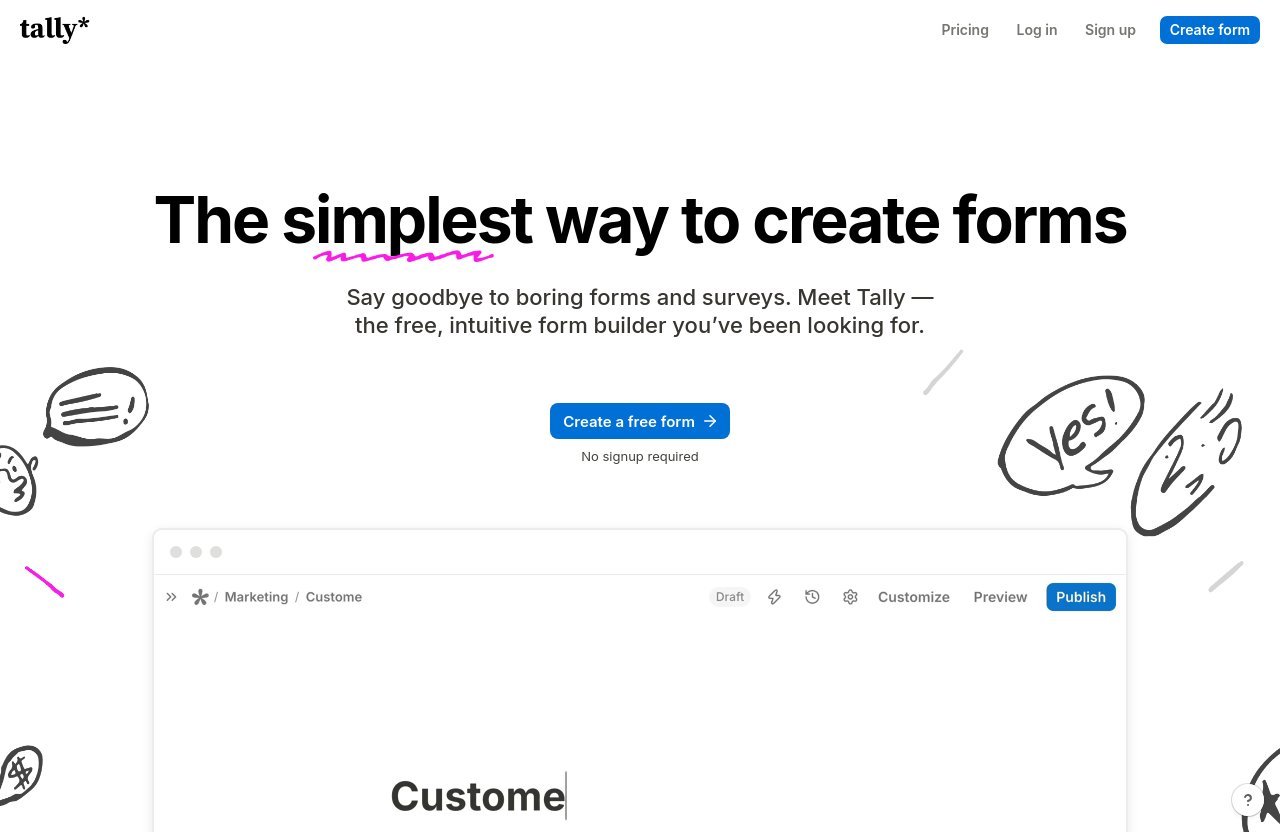
Tally is a no-code form builder. According to its official homepage, users can create forms without signing up, without coding, and with an experience designed to work like typing in a document.
Its feature set supports more than basic contact forms. Tally can be used for collecting responses, payments, signatures, uploads, and information that feeds into tools such as Google Sheets, Notion, Airtable, Zapier, Make, and webhooks.
Why trust questions come up for form builders
When people ask is tally so safe, they are usually not just evaluating a website’s appearance. They are deciding whether they can trust a third party with information submitted by prospects, customers, employees, or clients.
A form can hold names, email addresses, phone numbers, addresses, uploaded files, signed agreements, and payment-related workflow data. The more useful a form becomes, the more important privacy and security practices become.
What buyers usually worry about
Skeptical buyers tend to evaluate four areas:
- Whether the provider is a real, operating company with transparent terms and pricing
- How form data is secured during submission and storage
- Whether the platform’s privacy approach fits their audience and region
- Which form controls are available to reduce spam, duplicate entries, or unwanted access
Those are the right questions to ask in any tally review 2026, particularly when a form is part of a public-facing acquisition or client onboarding process.
Legitimacy Check: Signs Tally Is a Real Company
Official website and product footprint
A positive answer to is tally so legit starts with basic verifiability. Tally has an official product website, a public pricing page, published feature descriptions, and a recognizable form-building product that users can test without a complicated onboarding process.
The pricing page identifies Tally as an EU/Belgium-based company. That is meaningful context for buyers who prefer working with a company operating from within the European Union, although it does not eliminate the need to review the platform’s policies for your own use case.
Pricing page and transparent plan structure
Clear pricing is another trust signal. Tally publicly lists its Free, Pro, and Business plans rather than hiding all pricing behind a sales process.
Transparency alone does not prove that a product is right for you, but it helps distinguish a usable commercial service from an unclear or disposable operation. The published feature list also makes it easier to understand where plan limitations may affect your workflow.
Public reviews and discussion footprint
Searchers will find public review pages, third-party security profile pages, and community conversations such as tally.so reddit discussions. These sources can be useful for spotting recurring user experiences, but they should not be treated as verified proof of security or compliance.
For an informed decision, weigh public commentary against primary sources. Tally’s official homepage and pricing information are more reliable for current claims about its own features, while user discussions are better for understanding practical impressions and common frustrations.
Is Tally So Safe? Tally Security and Privacy Review
GDPR compliance and Europe hosting
Tally’s official homepage states that it is GDPR compliant and hosted in Europe. For privacy-conscious teams, those statements are relevant because they indicate that the company publicly positions its service around European privacy expectations.
However, is tally so safe cannot be answered solely by a GDPR claim. Your organization remains responsible for deciding what information it collects, establishing an appropriate legal basis, providing notices where needed, and honoring requests connected to personal data.
Encryption in transit and at rest
The official site states that form data is encrypted in transit and at rest. In practical terms, encryption in transit helps protect data while it moves between a respondent’s device and the service, while encryption at rest concerns stored data.
This is an important baseline for Tally security. It does not mean users should place any type of sensitive data into any form without review, but it is a meaningful published safeguard for normal lead, survey, and intake workflows.
Cookie-tracking and data handling
Tally also states that it does not use cookie-tracking. That may appeal to teams trying to minimize tracking technology on their forms and create a less intrusive experience for respondents.
Tally privacy should still be considered in the context of your full stack. If you embed a form on a website that uses analytics, advertising pixels, or other scripts, those tools may have their own data implications independent of the form builder.
Controls for forms and respondents
The free feature list includes password protection, duplicate-submission prevention, form closing by limit or date, conditional logic, calculations, answer piping, redirects, and self email notifications. These are not replacements for a complete access-control strategy, but they can help users structure safer and cleaner response processes.
When deciding whether tally forms secure enough for your needs, test the actual form settings before launch. Check who can access responses, whether a password is appropriate, when the form should close, and which integrations receive submitted information.
What Tally Can Collect and Why That Matters for Trust
Contact info and files
Tally can collect standard contact information as well as file uploads. That makes it adaptable for job applications, project briefs, client intake, support requests, registrations, and document collection.
The ability to receive uploads is valuable, but it raises the stakes. If respondents might submit IDs, contracts, medical records, financial documents, or other sensitive files, use clear instructions and consider whether collecting those materials through a form is necessary.
Signatures and payments
The official pricing page lists payment collection and signature collection on the Free plan. This makes Tally more flexible than a basic survey tool and may reduce the number of tools a small business needs for a simple workflow.
Yet, is tally so safe for payments or signatures depends partly on the surrounding process. Confirm exactly what data is collected, which connected services are involved, what your customer sees, and whether your legal or financial requirements call for additional review.
Conditional logic, hidden fields, and analytics
Conditional logic and calculations can make forms more relevant by showing respondents only the questions that apply to them. Tally also offers form visit analytics and drop-off analytics on Pro, which can help teams understand where respondents stop.
These features should be configured thoughtfully. Avoid collecting more information than you need, and do not use hidden data or analytics in ways that conflict with the expectations created by your privacy notice.
Potential risk areas
The main risk is often not the tool itself but the way a form is designed. A poorly configured form can request excessive data, route answers to the wrong people, remain open too long, or send data into unnecessary integrations.
For better Tally compliance, keep your forms focused and apply data-minimization principles:
- Ask only for information needed for the stated purpose.
- Explain why you are collecting sensitive fields.
- Avoid requesting sensitive files unless essential.
- Review connected apps and webhook destinations.
- Set practical closure dates and response limits.
- Delete or retain submissions according to your documented policy.
Official website · Latest pricing & offers
Pricing and Free Plan Reality Check
What is included for free
The Tally free plan includes unlimited forms and unlimited submissions, provided users remain within Tally’s fair usage guidelines. This is a notable offer for individuals and smaller teams that need functional forms without immediate monthly costs.
The official pricing page lists a substantial range of free capabilities, including payments, signatures, file uploads, custom Thank You pages, conditional logic, password protection, duplicate-submission prevention, integrations, webhooks, and support for 45+ languages and right-to-left layouts.
| Plan | Verified Price | Key Verified Inclusions |
|---|---|---|
| Free | Free within fair usage guidelines | Unlimited forms and submissions, payments, signatures, uploads, logic, integrations, webhooks |
| Pro | $24 per month | Branding removal, custom domains, collaboration, custom CSS, analytics, unlimited uploads |
| Business | $74 per month | Everything in Pro plus retention controls, email verification, and up to 90-day version history |
When Pro makes sense
Tally Pro pricing is listed at $24 per month. Pro adds features that matter when a form becomes part of a branded or collaborative business process, including removal of Tally branding, custom domains, collaboration, custom CSS, custom email domains, workspaces and folders, analytics, and premium integrations.
Pro also includes partial submissions, which may be useful when users complete longer forms over time. Version history is available for up to 30 days on this plan.
When Business makes sense
Tally Business pricing is listed at $74 per month. It includes everything in Pro, plus data retention controls, email verification, version history for up to 90 days, and additional future features referenced on the pricing page.
For a team managing a larger volume of forms or working with more structured internal processes, data retention controls can be especially relevant. Still, buyers should verify how those controls operate in the actual account before relying on them for compliance requirements.
What to watch before upgrading
The phrase is tally so free can be misleading if it implies every advanced business need is free forever. Tally’s free offering is generous, but fair usage guidelines apply, and several advanced branding, analytics, collaboration, and retention features are part of paid plans.
Before upgrading, map the feature to a real need. For example, a custom domain may be worth paying for if brand consistency matters, while analytics may matter more for high-traffic lead forms than for an occasional internal survey.
Pros and Cons from a Trust Perspective
Main reasons people trust Tally
Tally has several credible trust indicators for a modern form builder:
- Official claims of GDPR compliance and European hosting
- Published encryption in transit and at rest
- No cookie-tracking claim on its homepage
- Transparent Free, Pro, and Business plan pricing
- A free plan with unlimited forms and submissions within fair usage
- Useful respondent controls such as password protection and duplicate prevention
- Integrations and webhooks for practical workflows
These points support the view that tally forms legit is a reasonable conclusion for ordinary business and creator use.
Main reasons buyers hesitate
There are valid limitations to consider:
- Fair usage guidelines apply to the free plan.
- Advanced customization, analytics, collaboration, and retention features require paid plans.
- Integrations can create additional privacy and security responsibilities.
- Sensitive-data workflows require more than a general encryption claim.
- Buyers with specialized regulatory needs may need controls or documentation beyond what is publicly stated.
These are not necessarily red flags. They are reminders that is tally so safe depends on the sensitivity of your data and the way your team configures the platform.
Best-fit use cases
Tally is best suited to lower- and moderate-risk workflows where speed, flexibility, and simple no-code setup matter. Good examples include contact forms, newsletter signups, surveys, event registrations, feedback collection, service inquiries, basic client intake, and internal requests.
For these situations, Tally’s feature mix is practical without feeling unnecessarily complex.
How Tally Compares to Buyer Expectations in 2026
Ease of use vs traditional form tools
In 2026, buyers expect forms to be quick to build, mobile-friendly, customizable, and connected to the tools they already use. Tally’s document-style approach, no-code positioning, and integration options fit those expectations well.
The availability of logic, calculations, redirects, webhooks, and common productivity integrations means users can start simply and add complexity only when their workflow needs it.
Privacy-first positioning
The central is tally so safe question is helped by Tally’s public privacy-oriented positioning: GDPR compliance, Europe hosting, no cookie-tracking, and encryption claims. Those are stronger signals than a form tool that says little about data handling.
That said, privacy-first messaging should lead to practical action. Users should write clear consent language, limit unnecessary fields, and audit every destination where form data travels after submission.
Feature depth for teams and creators
Tally remains relevant because it supports both simple and more advanced workflows. Free users receive meaningful functionality, while Pro and Business users can add branding, collaboration, analytics, custom domains, data retention controls, and longer version history.
For teams comparing tools, this balance matters. You do not need to pay for advanced capabilities until your process actually requires them.
Who Should Use Tally and Who Should Look Elsewhere
Best for creators and SMBs
Creators, consultants, agencies, small businesses, and startup teams are likely to get the most value from Tally. The free plan is capable enough for many early-stage needs, while the paid tiers offer room to grow without forcing an immediate enterprise-style purchase.
If your priority is launching a polished form quickly, Tally is worth evaluating.
Best for privacy-conscious teams
Privacy-conscious teams can reasonably consider Tally because of its published European hosting, GDPR compliance, encryption, and no cookie-tracking statements. The platform also offers practical form controls that help reduce unnecessary or unwanted responses.
But is tally so safe for your team is still a governance question. Review form ownership, team access, integration permissions, response retention, and your privacy notice before collecting personal data.
Not ideal for highly regulated or enterprise-specific workflows
Tally may be less suitable for organizations that need strict procurement approvals, specialized compliance evidence, bespoke enterprise agreements, complex permission models, or very specific data-processing requirements.
This does not mean the platform is unsafe. It means a buyer with high-risk data or strict regulatory obligations should conduct a formal vendor assessment rather than relying on a general-purpose product review.
Final Verdict: Is Tally So Safe and Legit?
Bottom line
Yes, Tally appears legitimate and safe for many typical form-building use cases. The official site’s statements on GDPR compliance, European hosting, encryption in transit and at rest, and no cookie-tracking provide meaningful trust signals, while transparent pricing and a robust free plan add credibility.
The balanced answer to is tally so safe is that it is a sensible choice for everyday lead capture, surveys, registrations, signatures, payments, and uploads—but it should not replace your own compliance review for sensitive data.
Trust score-style summary
| Trust Area | Assessment |
|---|---|
| Legitimacy | Strong signs: official product presence, public pricing, and established feature set |
| Privacy posture | Positive: GDPR-compliance, Europe-hosting, and no-cookie-tracking claims |
| Data security | Positive baseline: encryption in transit and at rest stated by Tally |
| Pricing clarity | Good: Free, Pro, and Business prices publicly listed |
| Sensitive-data suitability | Requires buyer due diligence and workflow-specific review |
What to do before publishing your first form
Before you publish, review the privacy policy that applies to your workflow, test submission and notification paths, and verify which people can access responses. Check retention expectations, password settings, integrations, payment flows, and file-upload instructions.
For most normal use cases, the evidence supports the conclusion that is tally so safe can be answered positively. For sensitive or regulated data, confirm the details that matter to your organization before inviting respondents to submit information.
Official website · Latest pricing & offers
FAQ
Is Tally.so a legitimate website?
Yes. Tally has an official product site, transparent plan pricing, documented product features, and public privacy and security statements. These are meaningful signs that Tally is a legitimate form-building service, though buyers should still assess whether its controls fit their own requirements.
Is Tally safe to use?
Tally appears safe for typical form-building use. Its official site states that it is GDPR compliant, hosted in Europe, does not use cookie-tracking, and encrypts form data in transit and at rest. As with any platform, users should carefully manage sensitive data, integrations, access, and retention.
Is Tally still relevant in 2026?
Yes. Tally remains relevant in 2026 because it combines no-code form creation with a strong free plan, unlimited forms and submissions within fair usage guidelines, integrations, logic, payments, signatures, file uploads, and paid features for growing teams.
What are the disadvantages of Tally?
The main disadvantages are that fair usage guidelines apply to the free plan, several advanced features are reserved for Pro or Business, and sensitive-data users must independently evaluate privacy, permissions, retention, and compliance needs. It may also be less suitable for highly specialized enterprise workflows.
Related Reading
References
- Tally – Create Beautiful Forms for Free | Unlimited Forms & Submissions
- Tally Pricing | Free Form Builder with Unlimited Responses
- Read Customer Service Reviews of tally.so
- Is Tally Forms Safe? Learn if Tally Forms Is Legit