
Tally vs Wufoo: Best Choice for Simple Forms

Choosing between tally vs wufoo comes down to how quickly you want to build, share, and manage forms. Both are associated with online form creation, but they appeal to different preferences: Tally is a modern, document-style option built around speed and a generous free plan, while Wufoo is a classic hosted form builder that many long-time users already recognize.
For founders, freelancers, marketers, and small teams, my practical view is simple: Tally is usually the better starting point when you want clean forms without extra friction. Its free offering covers far more than basic contact forms, and its editor feels approachable even if you have never used an online form builder before.
Official website · Latest pricing & offers
Tally vs Wufoo: Quick Verdict
The short version of tally vs wufoo is that Tally is the stronger value choice for most people creating straightforward forms, surveys, registrations, or lead-capture pages. It is designed to feel lightweight, works like typing in a document, and offers unlimited forms and submissions for free within fair usage guidelines.
Wufoo remains a reasonable option for buyers who prefer a familiar, long-established form-building brand. Still, for a modern workflow and a low-cost way to get started, Tally has the clearer advantage.
Who Should Choose Tally
Choose Tally if you want to create forms quickly without code, complex setup, or an immediate subscription. It is especially well suited to solo founders, creators, consultants, and small businesses that need contact forms, waitlists, client intake forms, surveys, or simple internal workflows.
Tally is also a compelling wufoo alternative for people who prefer a document-style editing experience. You can start without signing up, then add structure and advanced behavior as your needs grow.
Who Should Choose Wufoo
Wufoo may suit buyers who are already comfortable with a classic hosted form builder or whose team has established processes around a legacy platform. Familiarity can be a valid reason to stay with a tool, particularly when changing workflows would create unnecessary disruption.
However, if you are evaluating both tools from scratch, the tally vs wufoo decision should focus on the experience you want today rather than what was popular years ago.
The Best Choice for Simple Forms
For most readers, Tally is the best simple form builder because it removes common barriers: you can begin without signup, build without code, and use unlimited forms and submissions for free within fair usage guidelines. It also supports practical needs such as payments, file uploads, signatures, conditional logic, and integrations.
If that matches your priorities, you can explore Tally’s form builder and see whether its workflow fits the way you already work.
What Tally Is and Why It Feels Simpler
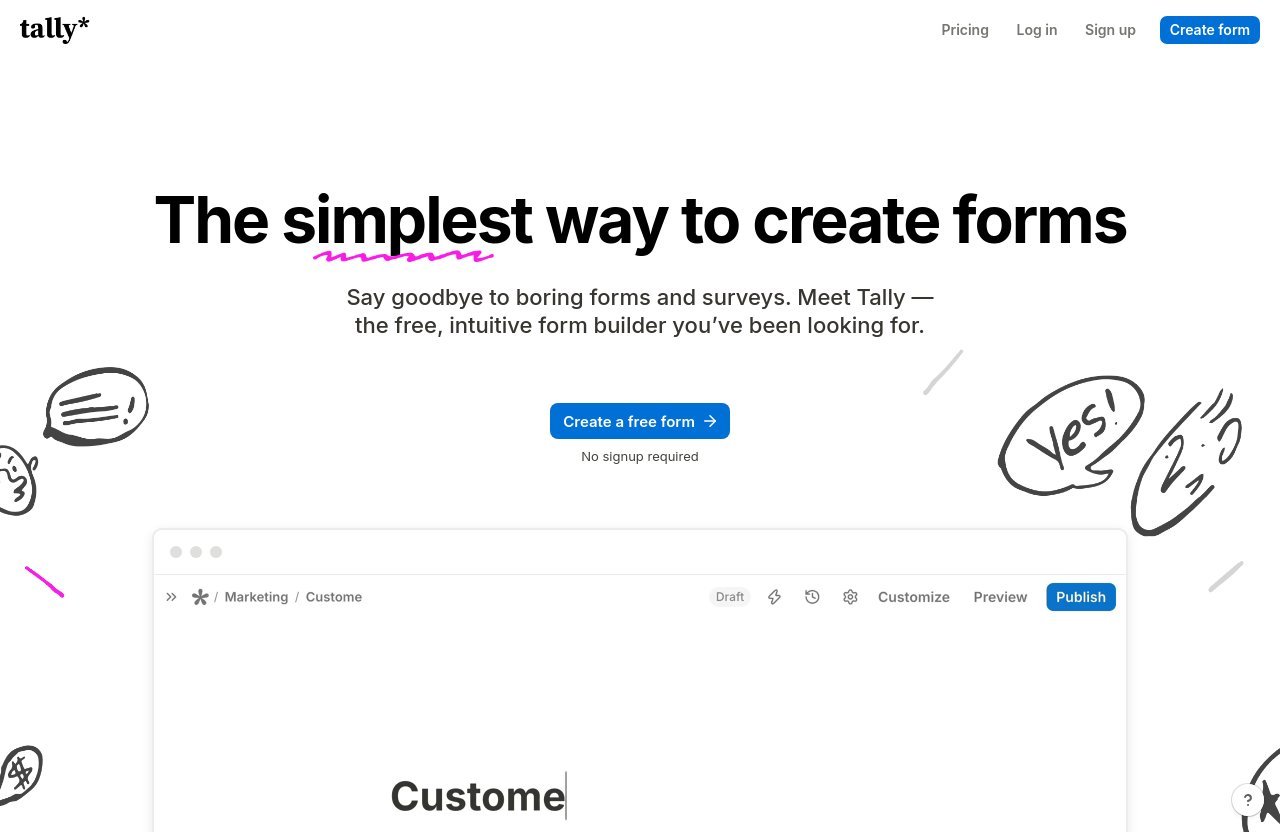
Tally is a free, intuitive form builder that works like typing in a document. Rather than presenting form building as a technical task, it emphasizes a writing-first approach that can make the process feel more natural for non-technical users.
In this tally vs wufoo comparison, that difference in workflow is important. Many people do not need a large, complicated form system; they need a form published quickly, with enough flexibility to collect useful information and send it to the tools they already use.
Notion-Like Editing Experience
Tally’s editor is often described as Notion-like because it works like typing in a document. That makes it an appealing option if you already enjoy block-based writing tools or want a simpler alternative to traditional form-builder interfaces.
You can build a form while writing the questions themselves, rather than navigating through an interface that feels more administrative. For a creator making a newsletter signup form or a freelancer building a client questionnaire, this can save time and reduce hesitation.
No Signup Required
One notable advantage is that Tally does not require signup before you begin. That is useful when you want to test an idea, sketch a form, or get a basic lead form live without committing to another account immediately.
In practical terms, this makes Tally feel more like a quick productivity tool than a platform you need to learn first. It is a meaningful benefit in an online form builder comparison where speed matters.
Unlimited Forms and Submissions for Free
The question “is tally really free?” is common because many form tools reserve meaningful usage for paid tiers. According to Tally’s official pricing page, its free plan includes unlimited forms and unlimited submissions within fair usage guidelines.
That free-first structure is one of the clearest reasons Tally stands out. You can build and test multiple forms without constantly monitoring a small submission allowance.
What Wufoo Is Best Known For
Wufoo is generally recognized as a classic hosted form builder. It has long been part of the broader form-building market, which is why it still appears in buyer research and comparisons with newer tools.
For this guide, it is important to be precise: this article does not compare unverified Wufoo pricing, limits, or feature details. Instead, it considers Wufoo as the more established legacy alternative and Tally as the modern, lightweight choice.
Classic Hosted Form Builder
Wufoo is known in the market as a traditional online form-building option. For some teams, that established position brings familiarity and confidence, particularly if they have used similar tools for years.
A familiar interface can be valuable when a team does not want to rethink its processes. But familiarity alone does not always mean the workflow is the simplest fit for new users.
Why Buyers Still Compare It With Tally
Buyers search tally vs wufoo pricing and feature comparisons because both tools sit within the same broad category: hosted tools for collecting information online. Whether you need an inquiry form, registration form, survey, or lead-capture page, both names can appear during research.
The key difference is less about naming a universal winner and more about identifying the right working style. Tally appeals to users who want to move fast with a document-style builder and an unusually capable free plan.
Where Legacy Tools Can Feel Heavier
Traditional software can sometimes feel heavier when it was designed around older interface conventions or more administrative workflows. That does not make a legacy tool bad; it simply may not be the best match for a person who values quick setup and visual simplicity.
For many new buyers, a tally alternative to wufoo is attractive precisely because it feels less like managing software and more like creating a page.
Tally vs Wufoo: Feature Comparison for Simple Forms
A useful tally vs wufoo feature review should concentrate on outcomes: Can you make a form easily? Can you collect the right information? Can responses move into your existing workflow? Tally has verified capabilities that cover a wide range of practical form use cases.
The table below stays deliberately cautious about Wufoo. Its purpose is to help you assess Tally’s verified offering without making unsupported claims about the competitor.
| Buyer consideration | Tally | Wufoo |
|---|---|---|
| General positioning | Modern, document-style form builder | Classic hosted form builder |
| Getting started | No signup required and no code needed | Evaluate the current product experience directly |
| Free usage | Unlimited forms and submissions within fair usage guidelines | Check current official terms directly |
| Form behavior | Conditional logic, calculations, answer piping, duplicate prevention, completion redirects | Confirm current capabilities with Wufoo |
| Collection options | Payments, signatures, and file uploads | Confirm current capabilities with Wufoo |
| Integrations | Google Sheets, Notion, Airtable, Zapier, Make, and webhooks | Confirm current integrations with Wufoo |
| Privacy signals | GDPR compliant, hosted in Europe, no cookie-tracking, encrypted in transit and at rest | Review Wufoo’s current privacy documentation |
Form Creation Workflow
Tally’s workflow centers on typing your form into a document-style editor. It requires no code, and the builder is designed to be intuitive for people who would rather focus on questions and responses than technical configuration.
For simple forms, that approach makes a real difference. You can create a client intake form, feedback survey, event registration, or lead form without treating it like a development project.
Branding and Customization
Tally’s free plan includes a custom Thank You page, password protection, the ability to close forms on a limit or date, and 45+ languages with RTL support. These options make it practical for public-facing forms as well as controlled or time-limited submissions.
Tally Pro adds removal of Tally branding, custom domains, advanced customization, custom CSS, custom email domains, and customizable link previews. For businesses that need more visual control, those additions are relevant when assessing tally vs wufoo cost beyond the entry-level experience.
Payments, Signatures, Uploads, and Logic
Tally’s official free-plan capabilities include collecting payments, signatures, and file uploads. It also includes conditional logic and calculations, which are valuable when a form needs to adapt to a respondent’s answers.
For example, a consultant can ask different follow-up questions depending on a prospect’s project type. A small business can collect documents, signatures, and payments in a more streamlined intake flow.
The free plan also includes answer piping, self email notifications, redirects on completion, and prevention of duplicate submissions. These are the kinds of features that allow a free form builder to support real business workflows rather than only basic questionnaires.
Integrations and Automations
Tally integrates with Google Sheets, Notion, Airtable, Zapier, Make, and webhooks on its free plan. This makes it easier to route form responses into a spreadsheet, database, workspace, or automation scenario.
For many small teams, integrations determine whether a form builder remains useful after the first week. If you collect leads but still manually copy every response into another system, the tool creates work instead of saving it.
Privacy and Security
For privacy-conscious buyers, Tally states that it is GDPR compliant, hosted in Europe, has no cookie-tracking, and encrypts data in transit and at rest. These are meaningful trust signals for anyone collecting personal or business information through forms.
No tool should be selected solely from a short comparison article. Still, in a tally vs wufoo review, Tally’s published privacy position gives buyers clear details they can evaluate before collecting responses.
Official website · Latest pricing & offers
Pricing Comparison: Which Is Cheaper?
The honest answer to tally vs wufoo pricing is that this guide can verify Tally’s pricing but does not make claims about Wufoo’s current pricing. Product prices and plan details can change, so readers should check Wufoo’s official site for its latest terms.
What is clear is Tally’s transparent path: a feature-rich free plan, followed by Pro at $24 per month and Business at $74 per month.
Tally Free Plan
Tally’s free plan includes unlimited forms and unlimited submissions within fair usage guidelines. It also includes payments, signatures, file uploads, a custom Thank You page, self email notifications, redirects on completion, conditional logic and calculations, duplicate-submission prevention, password protection, closing forms on a limit or date, answer piping, 45+ languages and RTL support.
The free plan also includes Google Sheets, Notion, Airtable, Zapier, Make, and webhooks. For many freelancers and small businesses, this means there is no immediate need to pay merely to run useful forms.
Tally Pro Plan
Tally Pro costs $24 per month according to the official pricing page. It includes everything in the free plan, plus removing Tally branding, custom domains, unlimited team-member collaboration, partial submissions, advanced customization, custom CSS, email notifications, custom email domains, customizable link previews, workspaces and folders, unlimited uploads, form visit analytics, drop-off analytics, version history up to 30 days, and premium integrations.
This plan makes sense when your forms become part of a more polished customer experience. It is also useful for teams that need shared access, organizational structure, or better insight into where visitors abandon a form.
Tally Business Plan
Tally Business costs $74 per month. It includes everything in Pro, plus control over data retention, email verification, version history up to 90 days, and more features to come.
This tier is more relevant when governance, verification, and longer historical recovery matter. It is not necessary for everyone, but it provides a defined upgrade path for growing organizations.
How to Think About Value vs Legacy Software
The best way to evaluate tally vs wufoo cost is to start with your actual form requirements. If you only need simple forms and want to avoid paying before validating your workflow, Tally’s free plan is difficult to overlook.
A legacy platform may still be worthwhile when familiarity is more valuable to your team than changing tools. But new buyers should not assume they need a paid system before they have outgrown a free plan with unlimited forms and submissions.
Best Use Cases by Buyer Type
Tally is not only for one type of user. Its combination of a simple editor, free capabilities, and practical integrations works across several common business scenarios.
Indie Makers and Solo Founders
Indie makers can use Tally for waitlists, beta applications, product feedback, feature requests, and customer research. The document-style workflow means you can go from idea to published form quickly.
For a solo founder watching costs, Tally is a strong best simple form builder candidate. You can collect submissions without immediately adding a recurring software expense.
Small Businesses That Need Clean Lead Forms
Small businesses often need simple, dependable lead forms more than complex systems. Tally can support inquiry forms, quote requests, appointment requests, service applications, and customer feedback forms.
Payments, file uploads, signatures, conditional logic, and Google Sheets integration help turn a basic contact form into a more useful lead-collection process. This is where the tally vs wufoo choice becomes practical rather than theoretical.
Teams That Want Internal Workflows
Internal forms can be just as valuable as public ones. Teams can use Tally for requests, employee feedback, content briefs, event planning, onboarding questions, or lightweight approvals.
On the Pro plan, unlimited team-member collaboration, workspaces and folders, partial submissions, and analytics can help teams manage a broader collection of forms. The free plan may still be enough for smaller internal processes.
Privacy-Conscious Creators
Creators collecting audience feedback, coaching applications, or client details should pay attention to privacy practices. Tally’s official trust signals include GDPR compliance, hosting in Europe, no cookie-tracking, and encryption in transit and at rest.
That does not remove the need to consider your own legal and privacy obligations. It does, however, give Tally a clearly stated privacy-focused foundation.
Where Tally May Not Be the Best Fit
A trustworthy tally vs wufoo guide should acknowledge that Tally will not be the best answer for every buyer. The best platform is the one that aligns with your workflow, governance needs, and team preferences.
When You Need a Deeply Traditional Admin Workflow
Some users prefer a conventional, administration-heavy approach to managing forms. If your team is most comfortable with a traditional interface and established operating habits, a newer document-style workflow may initially feel unfamiliar.
That is not a limitation of Tally’s capabilities so much as a question of working preference. A trial project is often the best way to test fit.
When Your Team Wants a Legacy Platform They Already Know
If a team already knows Wufoo well and has existing processes around it, staying with the familiar platform can be reasonable. Retraining, rebuilding forms, and updating internal documentation all have a cost.
In that situation, compare the real effort of switching against the value of Tally’s modern experience and free plan. Avoid changing tools just for novelty.
When You Need Advanced Enterprise Requirements Not Covered Here
This article focuses on simple forms, surveys, and lead capture. Organizations with specialized enterprise requirements should verify every requirement directly with each vendor before making a decision.
Examples may include specific procurement processes, contractual requirements, compliance needs, or complex internal governance. Do not assume any feature is available without reviewing current official documentation.
How to Set Up a Simple Form in Tally
The best way to understand Tally is to create a small form yourself. Its no-code, document-style experience is designed to reduce the time between an idea and a shareable link.
Start From a Blank Page
Begin with a blank page and write the title of your form. Add a short introduction that tells respondents what the form is for and how their information will be used.
Because no signup is required to start, you can test the building experience before investing time in account setup. This is helpful for quick experiments and one-off projects.
Add Fields With Slash Commands
Create your questions within the document-style editor, using slash commands to add the fields you need. Keep a simple form focused: ask only for information that helps you take the next step.
For example, a lead form might request a name, email address, business name, project type, budget range, and a short description. Add conditional logic when follow-up questions only apply to certain answers.
Publish and Share Your Form
Once the form is ready, publish it and share the link where your audience is most likely to respond. You can also use a custom Thank You page or redirect respondents on completion.
Consider password protection or a closing date if the form is limited to a private group or a specific campaign period. These small details can make a simple form feel more intentional.
Connect Responses to Your Tools
Connect your responses to Google Sheets, Notion, Airtable, Zapier, Make, or webhooks based on how you organize work. A basic connection can eliminate repetitive copying and help you respond faster.
For example, send leads to a spreadsheet, route project inquiries to Notion, or use an automation tool to notify the right person. This is often the point where a simple form becomes part of a reliable workflow.
Official website · Latest pricing & offers
FAQ
Is Tally Really Free?
Yes. Tally’s official pricing page says it offers unlimited forms and unlimited submissions for free, within fair usage guidelines. The free plan also includes a substantial set of form-building, collection, and integration capabilities.
What Features Are Included in Tally’s Free Plan?
Tally’s free plan includes payments, signatures, file uploads, custom Thank You pages, self email notifications, redirects on completion, conditional logic, calculations, duplicate-submission prevention, password protection, answer piping, and the ability to close forms on a limit or date.
It also includes 45+ languages and RTL support, plus integrations with Google Sheets, Notion, Airtable, Zapier, Make, and webhooks. For many users asking “is tally really free,” the answer is yes—with enough functionality for real-world forms.
How Much Does Tally Pro Cost?
Tally Pro costs $24 per month. It includes everything in the free plan, plus branding removal, custom domains, unlimited team-member collaboration, partial submissions, advanced customization, custom CSS, analytics, version history up to 30 days, and premium integrations.
How Much Does Tally Business Cost?
Tally Business costs $74 per month. It includes everything in Pro, plus control over data retention, email verification, and version history up to 90 days.
Is Tally Trustworthy?
Tally publishes several relevant trust signals: it is GDPR compliant, hosted in Europe, has no cookie-tracking, and encrypts data in transit and at rest. As with any tool that handles respondent data, review its current official documentation and ensure it meets your own privacy obligations.
Should I Choose Tally or Wufoo for Simple Forms?
For most people who want the simplest and most affordable starting point, Tally is the better choice. In the tally vs wufoo decision, Tally’s no-signup start, document-style editor, unlimited free forms and submissions, and practical free features make it especially appealing for straightforward forms and surveys.
Final Recommendation
For simple forms, Tally is the better default recommendation. It gives founders, freelancers, creators, and small teams a fast no-code way to collect information, automate responses, and publish professional forms without starting with a paid plan.
Bottom Line for Simple Forms
The central takeaway from this tally vs wufoo comparison is that Tally feels built for modern, low-friction form creation. You can start without signup, create forms like you write documents, and use advanced essentials such as payments, uploads, signatures, logic, and integrations on the free plan.
Wufoo can remain a sensible choice for teams committed to a familiar legacy tool. But for new buyers, Tally offers a more compelling balance of simplicity, flexibility, and accessible pricing.
Why Tally Is the Better Value for Most Readers
Tally’s free plan is strong enough for many everyday use cases, while Pro at $24 per month and Business at $74 per month provide clear upgrade paths when branding, collaboration, analytics, retention controls, or verification become important.
If you want a lightweight form builder that does not make basic lead capture feel complicated, Tally is worth considering.