Best Data Science Interview Prep Tools: Top 7 Options for 2026

Preparing for a data science interview means more than solving a few coding problems. The best data science interview prep tools help candidates practice SQL, Python, statistics, business thinking, machine learning concepts, take-home assignments, and communication under pressure.
For most serious job seekers, a combination of structured practice and realistic feedback delivers better preparation than a single generic coding site. Our premium pick is StrataScratch because it brings real interview-style questions, AI mock interviews, cloud-based projects, and learning paths into one focused platform.
Quick verdict: Choose StrataScratch if you want broad, role-specific preparation for Data Scientist, ML Engineer, or AI Engineer interviews. Add DataLemur for SQL-heavy drilling, LeetCode or HackerRank for general coding screens, and free university or community resources for interview strategy.
Official website · Latest pricing & offers
Best Data Science Interview Prep Tools: Quick Verdict
The best data science interview prep tools are not necessarily the ones with the largest collection of coding questions. A useful platform should match the interview stage you are facing: fundamentals, timed assessments, case studies, take-home projects, or live interview rehearsal.
| Tool | Best For | Primary Strength | Best Fit |
|---|---|---|---|
| StrataScratch | Complete interview preparation | Questions, mocks, projects, feedback | Serious DS, ML, and AI candidates |
| DataLemur | SQL-focused practice | SQL interview drilling | Analytics and SQL-heavy roles |
| LeetCode | General coding screens | Algorithms and coding fundamentals | Candidates facing technical screens |
| HackerRank | Timed assessments | Assessment-style practice | Candidates expecting employer tests |
| 365 Data Science Interview Simulator | Guided rehearsal | Interview simulation | Candidates needing structured practice |
| Codecademy Data Science Interview Prep | Foundations | Learning-path preparation | Beginners building SQL and Python skills |
| MIT CAPD and community resources | Free guidance | Strategy and advice | Budget-conscious candidates |
What This Roundup Covers
This comparison evaluates seven of the best data science interview prep tools across the areas that matter most during a job search: realistic question banks, SQL and Python practice, machine learning coverage, mock interview quality, take-home project preparation, and feedback.
There is no universal winner for every candidate. Someone preparing for a SQL analyst screen needs a different workflow than an experienced ML Engineer practicing system design or an early-career applicant learning Python fundamentals.
Who Should Choose a Premium Platform vs Free Tools
Free resources can be enough when you are still exploring the field, refreshing basic concepts, or working through a limited set of practice questions. They are also valuable for gathering interview advice, studying common behavioral questions, and reviewing open-source examples.
A premium option becomes more compelling when your interviews are scheduled, you need structured data science interview practice, or you want feedback beyond a correct-or-incorrect answer. The biggest advantage is usually efficiency: a focused platform reduces the time spent assembling practice materials from disconnected sources.
Why StrataScratch Is the Premium Pick
StrataScratch is our premium recommendation because it covers several interview-prep modalities in one place: an interview question bank, SQL and Python learning paths, AI-powered mock interviews, performance insights, and cloud-hosted take-home projects.
That breadth matters because real hiring processes rarely test one skill in isolation. Candidates may encounter SQL exercises, Python coding, statistics questions, ML system design discussions, and communication-focused interviews in the same application cycle. TopTrustReview may earn a commission when readers purchase through affiliate links, but the recommendation here is based on the platform’s verified scope and fit for active candidates.
How We Evaluated the Best Data Science Interview Prep Tools
We assessed the best data science interview prep tools with a buyer-first lens. The ranking favors data-science-specific resources over broad coding platforms alone, while still recognizing that general assessment practice can be useful.
Question Bank Quality
A strong question bank should help candidates practice the kinds of decisions they will make in an interview, not simply memorize syntax. We prioritized tools that support practical SQL, Python, data analysis, machine learning, and analytical reasoning.
Question volume matters, but relevance matters more. A smaller collection of targeted problems can be more useful than a massive library of unrelated algorithm exercises.
Role Coverage: DS, ML, AI Engineer
“Data science” covers several distinct roles. Data Scientists often need SQL, experimentation, statistics, metrics, and stakeholder communication. Machine Learning Engineers may face more coding, modeling, infrastructure, and system design topics, while AI Engineers can encounter AI-specific implementation and design discussions.
The best interview prep platform for data scientists should make those distinctions clear. Generic coding tools remain useful supplements, but they do not always reflect the full scope of role-specific interviews.
Mock Interview Realism
A mock data science interview should create productive pressure without becoming a gimmick. Timed sessions, role-relevant prompts, and feedback on both reasoning and communication are more valuable than passive question reading.
Mock interviews do not guarantee performance in a real process. Still, they can expose weak explanations, pacing problems, and gaps between “knowing the answer” and presenting it clearly.
Solutions, Hints, and Feedback
Quality explanations are essential when practice goes wrong. Candidates need to understand why an approach works, where their assumptions failed, and how to make their answer more robust.
Hints are particularly useful when they teach a path forward rather than reveal the solution immediately. Feedback should guide the next practice session, not merely score the previous one.
Project and Take-Home Prep
Data science take-home projects require a different skill set from whiteboard-style questions. Candidates need to frame ambiguous problems, explore data, write maintainable code, communicate findings, and explain tradeoffs.
We favor platforms that acknowledge this reality. A strong prep stack should include some project practice, especially for candidates pursuing mid-level or senior roles.
Price and Value
Price is relevant, but value depends on urgency and use case. A free tool may be the best choice for someone with months to study, while a paid platform may be worthwhile for an active applicant who needs structured repetition and feedback now.
Where official pricing details are available, we use them. We avoid unsupported competitor pricing claims, since plans and offers can change.
1. StrataScratch: Best Premium All-in-One Option
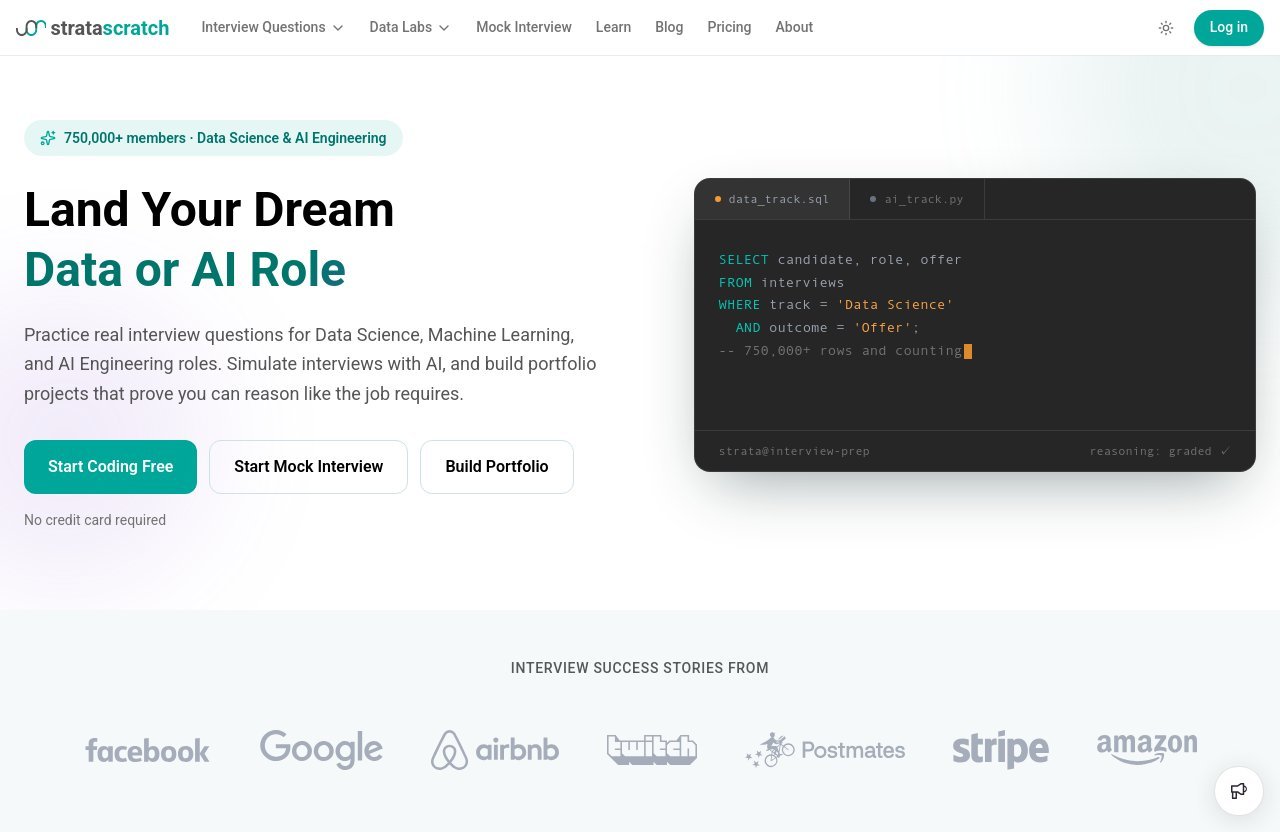
StrataScratch is the strongest all-around choice among the best data science interview prep tools for candidates who want a dedicated environment rather than a collection of separate resources. It is a Data Science and AI Engineering interview prep platform with more than 750,000 members.
Its main advantage is coverage. Instead of asking candidates to choose between coding questions, mock interview practice, and take-home preparation, it combines these formats for Data Scientist, ML Engineer, and AI Engineer roles.
1000+ Real Interview Questions
StrataScratch offers more than 1,000 real coding and concept interview questions across data science, machine learning, and AI Engineering. Topics include SQL, Python, ML system design, statistics, and related areas.
That makes the platform especially useful for candidates who need to move from isolated SQL interview prep into broader role preparation. The question bank can support targeted practice sessions while also helping users identify recurring weaknesses across topics.
AI Mock Interviews With Scoring
The platform includes AI-powered mock interviews for Data Scientist, ML Engineer, and AI Engineer roles. These sessions are timed and provide detailed feedback on code and communication.
This is a meaningful distinction from a conventional practice library. Reading solutions can improve familiarity, but a timed mock data science interview requires you to organize thoughts, explain assumptions, and make progress without unlimited time.
Cloud-Hosted Notebooks for Projects
StrataScratch also includes real take-home projects delivered in cloud-hosted Python notebooks. No local setup is required, which removes a common source of friction when candidates want to focus on analysis rather than configuring an environment.
For candidates preparing for data science take-home projects, this practical format is important. A project workflow tests how you explore, reason, document work, and communicate conclusions—not only whether you can solve a standalone problem.
Free Learning Paths for SQL and Python
The platform provides free learning paths for both SQL and Python. Each comprehensive path is shown as an 8–12 week program with six modules, 36 lessons, and more than 160 questions.
These learning paths can make StrataScratch more approachable for candidates who are not yet ready for advanced interview simulations. They offer a bridge between foundational learning and realistic interview drills, which is a useful sequence for career changers and early-career applicants.
Who It Is Best For
StrataScratch is best for candidates actively pursuing Data Scientist, ML Engineer, or AI Engineer jobs who want one system for question practice, interview simulation, projects, and feedback. It is also a good fit for applicants who know they need both technical drilling and communication practice.
The free plan has limited features and includes 50 AI credits per month, with no card required. Paid plans include access to questions, solutions, projects, hints, grading, AI mock interviews, AI grading, cloud-hosted Python notebooks, and an AI chat assistant for hints and guidance.
The monthly plan includes full access, can be canceled anytime, and includes 1,000 AI credits per month. The yearly plan is billed annually at $139 and includes 1,000 AI credits per month plus 25,000 credits with no expiry; it is presented as the best value for an active search. A lifetime plan is available as a one-time payment with no renewals and 25,000 credits that never expire. Paid plans include a five-day money-back guarantee.
Students and educators may qualify for discounted pricing on eligible plans, up to 20% off. For candidates who want to evaluate the workflow first, the StrataScratch free plan and platform overview are a sensible place to start.
2. DataLemur
DataLemur is a useful choice for candidates whose interviews are likely to be SQL-heavy. It is most relevant when the immediate goal is practical query writing rather than a full-spectrum interview-prep experience.
SQL-First Interview Practice
SQL is central to many data science, analytics, product analytics, and business intelligence interviews. Candidates often need to work with joins, aggregations, window functions, date logic, and ambiguous business questions under time pressure.
For that narrow but important need, a SQL-first resource can make daily practice more focused. It works particularly well when you are already comfortable with theory and need repetition.
Why It Complements Data Science Prep
DataLemur is best viewed as a supplement rather than a complete replacement for broader data science interview prep. SQL strength alone may not cover Python, statistics, experimental design, behavioral questions, or data science take-home projects.
Candidates can use a focused SQL tool alongside a broader platform to create a cleaner split: SQL drills in one place, mock interviews and role-specific preparation in another.
Best Use Case
Choose DataLemur if SQL is your largest weakness or if you are applying to analyst-oriented and SQL-intensive roles. It can also help experienced candidates regain speed before a technical screen.
If you are interviewing for ML or AI engineering roles, use it as a supporting resource rather than the center of your preparation.
3. LeetCode
LeetCode is one of the better-known options for general technical coding practice. It is not built exclusively for data science interviews, but it can be valuable when a hiring process includes algorithmic problem solving.
Coding Fundamentals
Some data roles, particularly technical Data Scientist, ML Engineer, and software-adjacent AI Engineer positions, include general programming screens. These can test data structures, problem decomposition, complexity awareness, and code clarity.
LeetCode can help strengthen those fundamentals. Its value rises when the target company is known to use software-engineering-style screening in addition to data-focused questions.
SQL Practice
LeetCode also offers SQL practice, making it a reasonable secondary option for candidates who want to mix query exercises with general coding challenges. However, SQL practice alone does not equal complete data science interview practice.
Use it to improve coding fluency, not as your only source of role-specific preparation. You will still need to rehearse statistics, experimentation, project explanations, and business reasoning elsewhere.
Best for General Technical Screening
LeetCode is best for candidates expecting a broad technical screen. It is especially useful when you need to sharpen coding speed before an initial assessment.
For a more targeted workflow, pair it with one of the best data science interview prep tools that covers realistic data questions and mock interviews.
4. HackerRank
HackerRank is useful for assessment-oriented preparation. Its timed challenge format can help candidates become more comfortable with the pressure and interface patterns common in online screening tests.
Practice for Assessments
Online assessments are not always identical to live interviews. They often reward time management, careful input handling, and the ability to deliver a working answer under a deadline.
Practicing in an assessment-style environment can reduce avoidable mistakes. This is especially helpful for candidates who understand concepts but freeze when the clock is running.
Employer-Style Tests
Many employers use standardized technical assessments early in the process. A broad assessment platform can help you rehearse the format, although the exact content will depend on the role and company.
HackerRank should be treated as general preparation rather than a guarantee of employer-specific familiarity. It is one part of a sensible technical interview routine.
When It Makes Sense
Choose HackerRank when you expect coding assessments and want more timed practice. It is less complete for candidates who need deep machine learning interview prep, business case discussion, or realistic project rehearsal.
A mixed stack works better: use assessment practice for speed, then use a data-focused platform for domain-specific questions and feedback.
Official website · Latest pricing & offers
5. 365 Data Science Interview Simulator
The 365 Data Science Interview Simulator is worth considering for candidates who want guided interview rehearsal. Simulator-style practice can be especially helpful for people who struggle to structure answers aloud.
AI-Powered Interview Practice
AI interview prep tools can provide a low-pressure way to practice before asking a mentor, peer, or recruiter to run a live mock interview. They are useful for identifying repeated verbal habits and gaps in explanation.
The important limitation is that automated feedback should support—not replace—human judgment. Candidates should still seek outside perspective when possible, especially on senior-level communication and domain context.
Role-Based Question Library
A role-oriented question library can help users avoid generic interview preparation. Candidates benefit when prompts reflect the types of questions they may actually see in data-focused roles.
This approach is particularly useful for practicing transitions between technical discussion and business explanation. A good answer should show both analytical competence and decision-making awareness.
Good for Structured Rehearsal
This option is best for people who want a guided routine and repeated interview reps. It may be a useful addition for candidates who have completed fundamental study but have not yet practiced explaining their thinking under realistic conditions.
For the broadest range of practice formats, compare its workflow with the other best data science interview prep tools before committing.
6. Codecademy Data Science Interview Prep
Codecademy is most useful for candidates who need to strengthen foundations before attempting high-pressure mock interviews. It suits learners who benefit from a course-like progression rather than a question-bank-first approach.
Learning Path Style Prep
A learning path can reduce overwhelm for new candidates. Instead of choosing random topics each day, you progress through a structured sequence and build confidence gradually.
This is valuable for people transitioning from another field or returning to technical work after time away. The goal is not just to memorize interview answers, but to understand the underlying concepts well enough to adapt.
Python and SQL Foundation Building
Python interview prep and SQL interview prep both become more productive once core syntax and logic feel natural. Beginners often gain more from building those foundations than from immediately tackling difficult company-style questions.
After that initial stage, interview questions become a diagnostic tool rather than a discouraging obstacle. You can identify precisely where fundamentals need reinforcement.
Best for Beginners
Codecademy is a sensible starting point for beginner candidates who want instructional support. It is less likely to be the only resource needed close to interview day, when timed practice and mock interviews become more important.
A practical progression is to start with structured lessons, then move into role-specific question banks and simulation tools.
7. MIT CAPD and Free Community Resources
MIT CAPD and community resources such as discussion forums, GitHub repositories, and peer groups can provide helpful free guidance. They are not substitutes for a dedicated prep platform, but they can add valuable perspective.
Free Guidance and Interview Tips
Career resources can help candidates understand interview flow, behavioral preparation, resume positioning, and practical job-search strategy. They are useful when you need context before selecting a practice tool.
They can also remind candidates that technical performance is only one part of hiring. Clear communication, thoughtful questions, and a convincing explanation of prior work matter too.
When Free Resources Are Enough
Free resources are often enough for candidates who are early in their learning journey, have a long timeline, or need general direction rather than high-volume practice. They can also be sufficient for reviewing behavioral interview basics.
They become less sufficient when you need structured feedback, realistic timed practice, or a comprehensive interview question bank. At that point, a focused platform can save significant preparation time.
How to Combine Them With Paid Tools
Use free resources for strategy, community insight, and supplemental explanations. Use a dedicated platform for consistent drills, projects, graded work, and mock interviews.
This combination keeps costs reasonable without forcing you to build your entire preparation plan from scattered materials.
Which Tool Is Best for Your Situation?
The best data science interview prep tools depend on your role, timeline, and current skill level. The table below can help you choose without overbuying features you will not use.
Best for Beginners
Candidates who are still learning SQL and Python should prioritize structured lessons before intensive mock interviews. Codecademy and free learning resources can help establish a baseline, while StrataScratch’s free SQL and Python learning paths offer a direct route into interview-focused study.
Do not rush into advanced problems too early. Build fluency first, then use interview practice to test application.
Best for SQL-Heavy Interviews
For analyst, analytics, and SQL-intensive Data Scientist roles, DataLemur is a focused SQL companion. StrataScratch is the more complete option if your process also includes Python, statistics, projects, or interview simulations.
| Situation | Best Starting Choice | Add This If Needed |
|---|---|---|
| Brand-new to SQL and Python | Codecademy or free learning paths | StrataScratch question practice |
| SQL-heavy screen coming soon | DataLemur | Timed mock practice |
| DS role with varied rounds | StrataScratch | LeetCode for coding screens |
| ML or AI Engineer process | StrataScratch | LeetCode or HackerRank |
| Online assessment first | HackerRank | Data-focused questions afterward |
| Very limited budget | MIT CAPD and communities | Free plans and targeted practice |
Best for Mock Interviews
Candidates who need rehearsal should prioritize simulation and feedback, not only question volume. StrataScratch is a strong choice because its AI mock interviews support Data Scientist, ML Engineer, and AI Engineer roles with timed sessions and detailed feedback on code and communication.
Mocking matters most in the final weeks before interviews. At that stage, identify whether your biggest problem is technical recall, unclear explanations, or pacing.
Best for Take-Home Projects
StrataScratch is the clearest fit for project-focused candidates because it offers real take-home projects in cloud-hosted Python notebooks. This is useful for practicing a workflow that resembles the ambiguity of real data work.
For take-homes, prioritize clean reasoning over flashy complexity. Be ready to explain data quality decisions, assumptions, methodology, limitations, and business implications.
Best Budget Option
The best budget approach is usually a combination, not a single free website. Use free community guidance and learning resources for strategy, then choose a targeted tool only where you have a clear gap.
StrataScratch’s free plan requires no card and includes limited features plus 50 AI credits per month. That makes it a reasonable way to assess whether its workflow fits your preparation style before choosing a paid plan.
How to Build a Complete Data Science Interview Prep Stack
The strongest prep plan uses different resources for different phases. Even the best data science interview prep tools cannot replace deliberate practice, reflection, and honest review of weak areas.
Foundation Phase
Start with SQL, Python, statistics, and core data manipulation. Beginners should focus on understanding joins, aggregations, functions, data structures, hypothesis testing concepts, and basic modeling ideas before optimizing for speed.
Use learning paths and introductory exercises at this stage. Keep a simple error log of concepts you miss repeatedly.
Practice Phase
Next, begin timed drills using a role-relevant interview question bank. Alternate between SQL, Python, statistics, and conceptual questions so that one subject does not become a hidden weakness.
For many candidates, this is where a dedicated data science interview prep platform earns its value. Focus on explaining your approach before looking at the solution, then compare your reasoning with the provided guidance.
Mock Interview Phase
When interviews are within a few weeks, add mock sessions. Practice speaking through your assumptions, asking clarifying questions, handling incomplete information, and recovering when you get stuck.
Use AI simulations for frequent repetition, then add peer or mentor mocks if available. Human practice is particularly helpful for behavioral stories and role-specific business judgment.
Final Review Phase
In the final days, avoid trying to learn every advanced topic. Review your error log, revisit representative questions, polish project explanations, and prepare concise stories about your previous work.
For technical rounds, rehearse a repeatable structure: clarify the prompt, state the approach, work methodically, test edge cases, and explain tradeoffs. For behavioral rounds, keep examples specific and outcome-focused.
Official website · Latest pricing & offers
FAQ
What Is the Best Data Science Interview Prep Tool Overall?
StrataScratch is the best overall option for serious candidates because it combines more than 1,000 real coding and concept questions with AI mock interviews, project practice, learning paths, and feedback. That breadth is valuable because data science interviews often include more than one type of evaluation.
The best choice still depends on your immediate need. If you only need SQL repetition, a specialized SQL resource may be enough; if you need end-to-end preparation, an all-in-one platform is usually more efficient.
Are Free Data Science Interview Prep Tools Enough?
Free tools can be enough for fundamentals, general guidance, and early practice. They are particularly helpful if you are exploring data careers or have plenty of time to study.
However, candidates in an active search often benefit from paid features such as structured feedback, realistic drills, mock interviews, and project-based preparation. Free resources work best as part of a broader plan rather than as the entire plan.
Is StrataScratch Good for SQL and Python Interviews?
Yes. StrataScratch includes comprehensive SQL and Python learning paths, each shown as 8–12 weeks with six modules, 36 lessons, and more than 160 questions. It also offers more than 1,000 real coding and concept questions across relevant data science and AI engineering topics.
That combination makes it useful for both learning and interview drilling. Candidates can start with fundamentals, then transition into more realistic question practice.
Does StrataScratch Offer Mock Interviews?
Yes. StrataScratch offers AI-powered mock interviews for Data Scientist, ML Engineer, and AI Engineer roles. The sessions are timed and provide detailed feedback on code and communication.
This makes it useful for candidates who want to rehearse their process, not just read solutions. Treat the feedback as a guide for targeted improvement rather than a final judgment of readiness.
How Much Does StrataScratch Cost?
StrataScratch offers a free plan with limited features and 50 AI credits per month, with no card required. The monthly plan includes full access, can be canceled anytime, and includes 1,000 AI credits per month.
The yearly plan is billed annually at $139 and includes 1,000 AI credits per month plus 25,000 credits that do not expire. The lifetime plan is a one-time payment with no renewals and includes 25,000 credits that never expire. All paid plans include a five-day money-back guarantee.
Which Tool Is Best for Beginners Preparing for a Data Science Interview?
Beginners should start with structured SQL and Python learning, then gradually introduce interview questions. Codecademy and free resources can be useful for foundational study, while StrataScratch’s free learning paths provide an interview-oriented way to build skills.
Once you can solve basic problems consistently, move to timed drills and mock interviews. This phased approach is usually more effective than jumping directly into advanced questions.
Final Recommendation
Best Overall
StrataScratch is our top recommendation among the best data science interview prep tools because it addresses the full interview journey: real questions, SQL and Python learning, AI mock interviews, feedback, performance insights, and cloud-hosted take-home projects.
It is particularly well suited to active candidates applying for Data Scientist, ML Engineer, or AI Engineer roles who want one environment for sustained preparation. Start with the free plan, then consider a paid option when your interview schedule and preparation needs justify the broader access.
Best Free Option
MIT CAPD resources and wider community materials are strong free starting points for strategy, interview guidance, and peer insight. Pair them with free SQL and Python practice to build core skills without immediate cost.
Their limitation is structure. You will need to create your own study plan and find separate ways to practice realistic technical interviews.
Best Budget-Friendly Combo
For most candidates, the most cost-effective stack is a focused platform plus free supplemental resources. Use StrataScratch for role-specific practice, mocks, and projects; use DataLemur, LeetCode, or HackerRank only when you have a specific SQL or assessment weakness; and rely on free communities for career perspective.
The best data science interview prep tools should make your preparation more deliberate, not more complicated. Choose the tool that matches your next interview stage, practice consistently, and prioritize clear reasoning over memorized answers.
Related Reading
References
- StrataScratch: Data Science & AI Interview Prep
- Pricing — Data Science & AI Interview Prep | StrataScratch
- Ace the data science technical interview
- 5 Best Sites to Practice for the Data Science Interview