Stratascratch vs LeetCode: Which Is Better for Data Science Interviews?
Official website · Latest pricing & offers
Quick Verdict: StrataScratch vs LeetCode for Data Scientists
The short answer
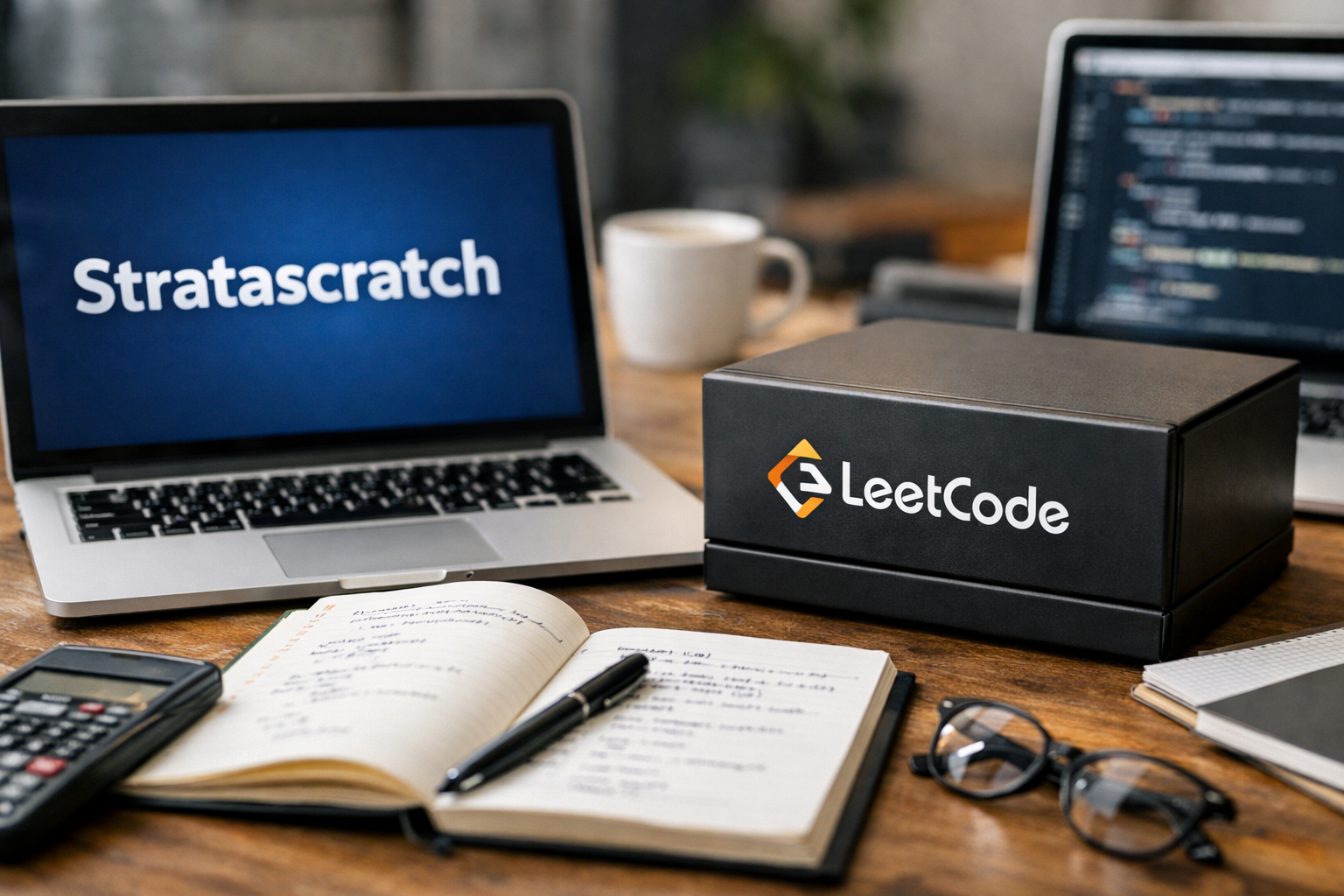
For most candidates preparing specifically for data science, machine learning, or AI engineering roles, StrataScratch is the more relevant choice. In the stratascratch vs leetcode decision, the real difference is not which platform is “harder”; it is whether your practice resembles the work you will be asked to do in an interview.
LeetCode remains useful for developing general coding and algorithm skills. But data science interview loops often lean much more heavily on SQL, data manipulation, statistics, experimentation, machine learning concepts, Python workflows, and case-style problems than on classic algorithm drills alone.
Who should choose StrataScratch
Choose StrataScratch if you are interviewing for data scientist, analytics, machine learning, or AI engineering positions and want practice tied to those roles. Its library includes more than 1,000 real coding and concept questions, including over 500 questions across machine learning, statistics, and system design.
In my view, its practical advantage is the context. Instead of treating coding as an isolated test, StrataScratch helps candidates rehearse the mix of SQL, Python, analytical judgment, and technical explanation that commonly appears in real data-role interviews.
Who should still use LeetCode
LeetCode is still a sensible option for candidates facing algorithm-focused technical screens. If a company’s process includes traditional software engineering questions, you need to be comfortable reasoning about data structures, algorithmic tradeoffs, and writing correct code under time pressure.
For many applicants, the best answer is not strictly StrataScratch or LeetCode. It is to use StrataScratch as the primary tool for role-specific data science interview prep and LeetCode as a targeted supplement where algorithm fluency is required.
What each platform is designed for
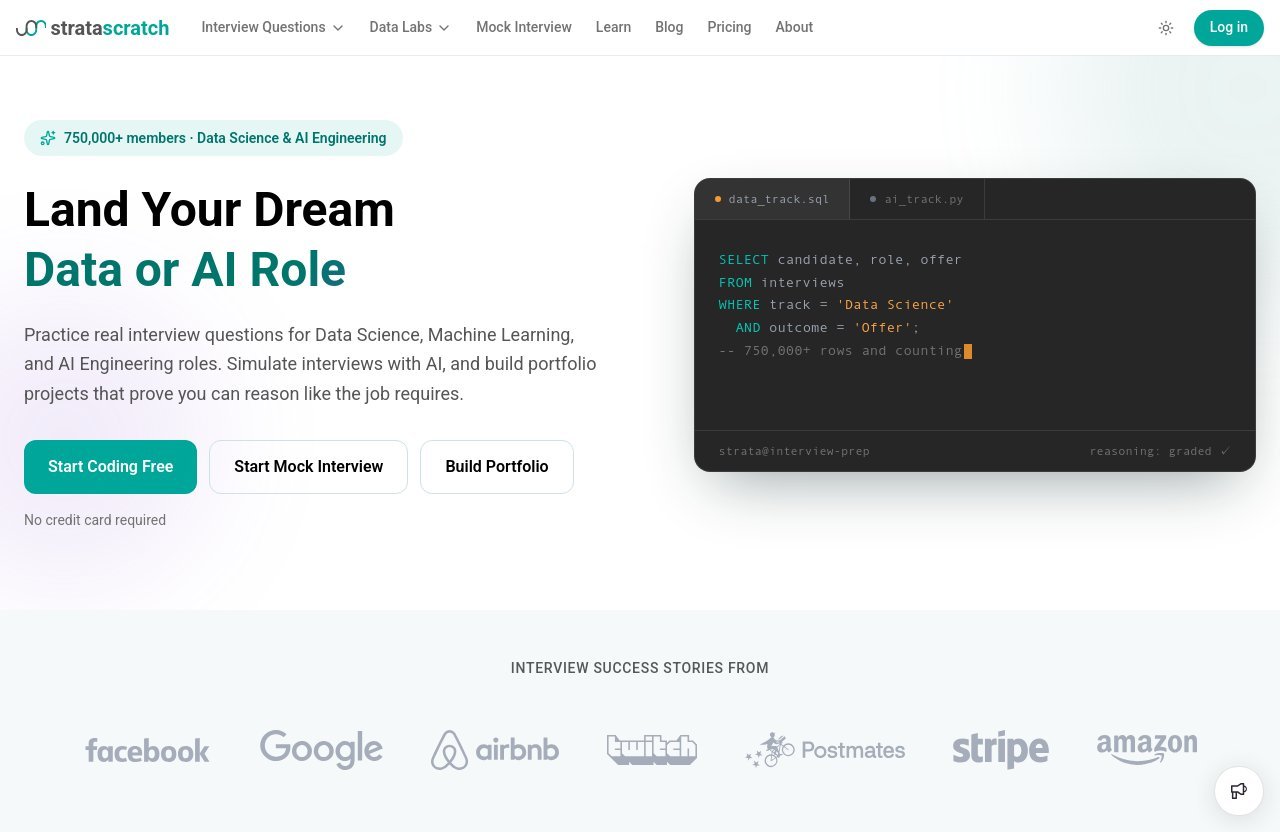
StrataScratch’s data-role focus
StrataScratch is a Data Science & AI Interview Prep platform designed around the hiring process for data-centered roles. It has more than 750,000 members and offers question types that map directly to data science, ML, and AI engineering interviews.
That includes real coding and concept questions, ML, statistics, and system design practice, plus more than 50 real data projects and take-homes. It also provides AI mock interviews, cloud-hosted Python notebooks, free SQL and Python learning paths, performance insights, and AI credits.
The important point in a stratascratch vs leetcode comparison is that StrataScratch begins with the target job. It is built for people whose interviews may require querying data, analyzing business problems, discussing models, or completing practical assignments.
LeetCode’s general coding focus
LeetCode is broadly known as a platform for general coding and algorithm practice. Its core appeal is helping candidates build a structured approach to technical programming problems that may appear in software engineering and coding-heavy interviews.
That broader focus can be valuable. It gives candidates a way to strengthen fundamental problem-solving habits, especially when an interviewer expects clean implementation, efficient reasoning, and familiarity with common algorithmic patterns.
However, general coding practice is not automatically the same as preparation for a data interview. A data scientist may need to explain an SQL query, investigate a metric change, work through a pandas-style transformation, or discuss an experiment—tasks that require a different preparation mix.
Why this difference matters in interviews
A strong platform should match the assessment, not just offer difficult problems. Data science hiring loops can include a recruiter screen, SQL round, Python exercise, statistics discussion, ML interview, stakeholder case study, and take-home project. Preparing only for one type of task can create a visible gap.
This is why candidates looking for the best platform for data science interviews should start by examining job descriptions and asking recruiters what the process includes. If the role is data-centric, the role-specific coverage in StrataScratch is usually more directly transferable.
Interview relevance: which one matches real data science interviews better?
SQL-heavy interview loops
SQL is often one of the highest-return areas for data candidates to practice. Interviewers may test joins, aggregations, window functions, retention analysis, funnel logic, deduplication, and the ability to explain assumptions behind a query.
StrataScratch is especially strong for SQL-heavy interview preparation because its question set is centered on real data science and analytics contexts. That makes it a practical option for candidates who need focused sql interview practice rather than only generic programming exercises.
LeetCode can sharpen programming logic, but a candidate can be technically capable and still underperform when asked to translate a business question into a clean, explainable SQL analysis. The role context matters.
Python and pandas-style tasks
Python interviews for data roles frequently involve manipulating tabular data, cleaning inputs, calculating metrics, or communicating an analysis. These are different from writing a standalone algorithm against an abstract input.
StrataScratch offers cloud-hosted Python notebooks, which are useful for practice that feels closer to data work. Its data science-focused question library also gives candidates a place to work through Python-oriented interview scenarios in a format that better resembles day-to-day analytical problem solving.
For python interview questions, I would prioritize clear reasoning over clever code. Explain what you are checking, validate edge cases, and make your assumptions explicit. That communication discipline matters in both live interviews and take-home assessments.
Statistics, ML, and system design questions
Data science interviews are rarely only about code. Candidates can be asked to explain statistical significance, bias and variance, model evaluation, feature choices, experimentation, monitoring, or how they would design a machine learning system.
StrataScratch includes 500+ ML, statistics, and system design questions, which is a meaningful advantage for machine learning interview prep. These subjects often determine whether an interviewer sees you as someone who can apply models responsibly rather than simply run a library function.
This is where the stratascratch vs leetcode distinction becomes clearest. Algorithm practice can help you pass a coding screen, but it does not by itself prepare you to defend a modeling choice or frame a statistical result for a business audience.
Take-home projects and portfolio work
Take-homes test a broader set of skills: defining a sensible approach, cleaning and exploring data, choosing metrics, communicating limitations, and presenting recommendations. The work may be less about finding a single correct answer and more about showing sound judgment.
StrataScratch includes more than 50 real data projects and take-homes. That gives candidates a more realistic way to practice producing an end-to-end deliverable, rather than repeatedly solving short, isolated prompts.
If you have interviews coming up, work through at least one project under timed conditions. Then revisit it and improve the explanation, charts, assumptions, and final recommendation. That second pass is often where interview-ready habits develop.
Difficulty and learning curve
Problem difficulty progression
Difficulty is subjective because different candidates have different weaknesses. A software engineer moving into data science may find SQL and statistics more challenging than coding logic, while an analyst may find algorithm patterns unfamiliar.
StrataScratch tends to feel more approachable for candidates who already work with data because the problems are job-contextual. The challenge comes from applying knowledge to realistic interview scenarios, not simply recognizing an abstract algorithmic template.
LeetCode may have a steeper learning curve for people who have not studied traditional computer science concepts. That does not make it less useful; it simply means its learning curve is aligned with a different interview format.
Real-world vs algorithmic practice
Real-world practice asks, “What would you do with this data?” Algorithmic practice asks, “What is the most effective way to solve this computational problem?” Both questions are valuable, but they assess different abilities.
For data science interview prep, candidates should not assume that completing algorithm problems alone will demonstrate strong analytical judgment. A hiring manager may care just as much about whether you can define a metric, spot a flawed assumption, or explain why a model should not be deployed yet.
The most effective stratascratch vs leetcode choice depends on the role’s technical center of gravity. For a product data scientist, analytics lead, or applied ML candidate, real data context generally deserves more preparation time.
How quickly beginners and mid-level candidates may ramp up
Beginners should start with foundations before trying to simulate a full interview loop. The free SQL and Python learning paths on StrataScratch are a useful starting point, especially for candidates who need a more structured ramp into data-role questions.
Mid-level candidates can often move faster by identifying their weakest area. If SQL is strong but ML theory is rusty, focus on statistics, machine learning, and system design questions. If concepts are solid but execution is inconsistent, add timed notebook practice and mock interview rehearsal.
StrataScratch features that matter for data scientists
AI mock interviews
Mock interviews are useful because they expose gaps that solo problem-solving can hide. You may know how to write a solution but struggle to narrate your reasoning, answer follow-up questions, or recover after a mistaken assumption.
StrataScratch offers AI mock interviews, which can help candidates practice the verbal side of technical preparation. For those seeking mock interviews for data scientists, this feature is particularly relevant because communication is often evaluated alongside technical accuracy.
Cloud-hosted notebooks
A cloud-hosted notebook environment is valuable for data candidates because it supports practice in a familiar analytical workflow. Rather than thinking only in terms of a function signature, you can focus on inspecting data, forming an approach, and iterating on code.
This is especially helpful for Python and pandas-style tasks. Candidates should still practice explaining their work aloud, since a good notebook solution can fall flat if the interviewer cannot follow the logic behind it.
Free SQL and Python learning paths
The free learning paths for SQL and Python make StrataScratch more accessible for candidates who are not ready to commit to a paid plan. They also offer a sensible way to diagnose whether your fundamentals are strong enough for interview-level questions.
A practical approach is to begin with these paths, then move into role-specific practice once you can complete basic tasks without relying heavily on references. This creates a smoother transition from learning syntax to solving interview problems.
Hints, solutions, and community discussion
Hints and solutions are most useful when used deliberately. Try the problem independently first, write down your reasoning, and only then use a hint to unblock yourself. Reading a solution without attempting the task can create a false sense of readiness.
Paid StrataScratch plans include full access to questions, solutions, projects, hints, and grading. While candidates often discuss approaches with peers in their own study groups or professional communities, the core value here is having feedback-oriented materials that help you understand not only the answer but the method.
Performance insights and public portfolio
Performance insights can help turn vague anxiety into a specific study plan. If you repeatedly struggle with joins, hypothesis testing, or model evaluation, you can direct your next practice sessions toward those weaknesses rather than randomly choosing questions.
For portfolio preparation, the most persuasive evidence remains work you can clearly explain. Use projects and take-homes to build polished examples of your process, then share them through the professional channels that fit your job search. StrataScratch’s project practice is especially helpful for rehearsing that story.
Official website · Latest pricing & offers
Pricing and value: Is StrataScratch worth it?
Free plan
The free plan has limited features and includes 50 AI credits per month. It is a reasonable low-risk way to explore the learning paths and determine whether the question style fits your needs.
For candidates comparing stratascratch pricing, I recommend trying the free option before upgrading. You will quickly learn whether role-specific practice fills a genuine gap in your current preparation.
Monthly plan
The monthly plan provides full access, is billed monthly, and can be canceled at any time. It includes 1,000 AI credits per month.
This plan makes sense for candidates with an active interview cycle who want intensive, short-term preparation. All paid plans include full access to questions, solutions, projects, hints, and grading.
Yearly plan
The yearly plan costs $139 when billed annually. It includes full access, 1,000 AI credits per month, and 25,000 credits that do not expire.
This option can offer better value for candidates planning a longer learning runway, such as career switchers, students preparing ahead of recruiting, or professionals building deeper ML and AI interview readiness over time.
Lifetime plan
The Lifetime plan is a one-time payment with no renewals. It includes 25,000 credits that never expire.
The right choice depends on how frequently you expect to interview and whether you want ongoing access for future career moves. Students and educators may be eligible for discounted pricing, and enterprise and university plans are also available.
Money-back guarantee and credits
Every paid plan includes a 5-day money-back guarantee. That is useful if you want to evaluate the workflow, question relevance, and learning experience without making a long-term decision immediately.
If StrataScratch matches your target roles, you can review the available plan options here and check the official site’s promo banner and checkout coupon field for any current offer. No specific discount code is currently verified.
Best use cases by candidate type
New grad data scientist
New grads should prioritize breadth without losing sight of relevance. Build SQL and Python fundamentals first, then practice statistics, business reasoning, and structured communication.
For a new graduate, StrataScratch can provide a clearer path into data science interview prep because the material is aligned with the work expected in data roles. Add LeetCode selectively if the companies you target include algorithm-heavy screens.
Experienced analytics or DS candidate
Experienced candidates usually benefit most from filling narrow gaps. You may already know SQL but need practice with timed questions, ML theory, take-home projects, or articulating leadership-level tradeoffs.
In the stratascratch vs leetcode decision, experienced analytics professionals should generally choose StrataScratch when moving toward data science or senior analytics roles. The practical problem contexts make it easier to translate existing work experience into interview answers.
ML engineer / AI engineer candidate
ML and AI engineering candidates need a balanced stack of preparation. They may face coding screens, model discussions, system design questions, and conversations about evaluation or deployment considerations.
StrataScratch is useful here because it combines Data Science, ML, and AI Engineering interview preparation, including ML, stats, system design, AI mock interviews, and projects. LeetCode remains a helpful companion if the target company emphasizes classic programming rounds.
Candidate with limited time before interviews
With limited time, avoid trying to master every topic equally. Review job descriptions, ask recruiters about interview stages, and focus on the highest-probability formats first.
For most data-centered roles, start with SQL, Python data tasks, statistics, and timed interview questions. A focused week on StrataScratch can be more valuable than scattering your effort across unrelated coding patterns.
Where LeetCode still wins
If your interview includes pure algorithms
LeetCode is a strong choice when you know the interview includes classic algorithms or data-structure questions. These exercises build the pattern recognition and implementation discipline needed for coding rounds that reward efficiency and correctness.
Do not avoid this preparation simply because you are applying for a data title. Some data and ML roles, particularly engineering-oriented ones, can still assess these fundamentals.
If you need broad coding practice across roles
LeetCode is also useful if you are keeping your job search broad. Candidates applying to data science, analytics engineering, software engineering, and ML engineering roles may appreciate a general coding practice resource that supports cross-role preparation.
The limitation is not that LeetCode lacks value. It is that leetcode for data scientists should usually be part of the plan, rather than the entire plan.
If you are targeting engineering-heavy screens
Engineering-heavy screens may require stronger algorithmic fluency than a typical analytics interview. In those situations, put more time into LeetCode, while retaining enough role-specific practice to handle SQL, ML, or practical data questions later in the process.
A common mistake is overcorrecting in either direction. Do not abandon data practice because an initial screen is algorithmic, and do not ignore algorithms if the recruiter explicitly says they will be tested.
How to combine both platforms for the best results
A simple prep split
For a standard data scientist role, a practical split is roughly 70% StrataScratch and 30% LeetCode. Spend the larger share on SQL, Python, statistics, projects, and mock interviews, then use LeetCode to build confidence with algorithmic fundamentals.
For ML engineering roles with coding-heavy screens, shift closer to 50/50. The right split should follow the actual interview loop, not an internet debate or a generic stratascratch vs leetcode reddit thread.
Suggested 2-week and 6-week approaches
For a two-week sprint, use the first week to identify gaps with SQL, Python, and core ML or statistics questions. In the second week, complete timed practice, one take-home-style project, and at least one mock interview, while fitting in a small number of targeted LeetCode problems.
For a six-week plan, spend the first two weeks on fundamentals and learning paths. Use weeks three and four for repeated question practice, weeks five for projects and system design, and week six for mock interviews, revision, and weak-area drills.
When to prioritize one over the other
Prioritize StrataScratch when the job description stresses SQL, experimentation, analytics, ML, AI, dashboards, modeling, or take-home work. Prioritize LeetCode when you are told that the first technical stage is a conventional algorithmic coding interview.
The decision does not need to be permanent. Adjust your study time as you move through the process. A platform is valuable when it solves the next interview problem you actually need to pass.
Final recommendation
Best overall for data scientists
StrataScratch is the best overall choice for candidates whose target roles are data science, analytics, machine learning, or AI engineering. It offers the more relevant practice mix: 1,000+ real coding and concept questions, 500+ ML, statistics, and system design questions, projects, AI mock interviews, notebooks, and learning paths.
In the final stratascratch vs leetcode verdict, LeetCode is better viewed as an algorithm supplement. StrataScratch is the stronger primary platform when you want your preparation to resemble real data-role interview work.
Best budget-conscious path
Start with StrataScratch’s free plan and its SQL and Python learning paths. Use that time to evaluate the question formats and identify the skills holding you back before paying for broader access.
If you are actively interviewing and need projects, solutions, hints, grading, and additional AI credits, a paid plan can be worthwhile. The 5-day money-back guarantee provides a short evaluation window for paid access.
Best for maximum interview transfer
For maximum interview transfer, focus on the skills that recur in your target process: SQL reasoning, Python data work, statistics, ML concepts, system design, take-homes, and clear verbal explanations. StrataScratch is purpose-built around those areas, making it the more practical recommendation for most data candidates.
If role-specific practice is your priority, consider starting with the free plan or exploring StrataScratch for your interview timeline. Use LeetCode alongside it when the role genuinely requires stronger algorithm practice.
Official website · Latest pricing & offers
FAQ
Is StrataScratch better than LeetCode for data scientists?
Yes, for data science interview relevance, StrataScratch is generally the better fit. It focuses on SQL, Python, statistics, machine learning, system design, AI mock interviews, and take-home-style work, while LeetCode is more useful for general algorithm practice.
Is StrataScratch worth it?
StrataScratch can be worth it if you are actively preparing for data science, ML, or AI engineering interviews. Its value is strongest when you need real interview-style questions, project practice, feedback-oriented resources, and mock interview preparation.
Is there anything better than LeetCode for data science?
For data science roles, a role-specific platform such as StrataScratch is often a better fit. It addresses SQL, analytics, ML, statistics, and practical interview tasks that general algorithm practice may not cover deeply.
Is LeetCode becoming obsolete?
No. LeetCode remains useful for algorithmic coding interviews and broad programming practice. For data scientists, however, it is often incomplete on its own because it does not center the full range of data-role interview formats, including SQL-heavy rounds and take-home projects.
Related Reading
- Does Rezi Actually Work? An Evidence-Led Review
- Scrimba vs Codecademy: Which Is Better?
- Best Morelogin Alternatives in 2026
References
- StrataScratch official homepage
- StrataScratch pricing
- LeetCode vs HackerRank vs StrataScratch for Data Science
- StrataScratch Review: The LeetCode for Data Scientists