Honest Stratascratch Review: Strengths and Limits
Official website · Latest pricing & offers
Quick Verdict: Is StrataScratch Worth It?
Bottom-line recommendation
This honest stratascratch review finds that StrataScratch is a credible option for candidates preparing for data science, machine learning, analytics, and AI engineering interviews. Its clearest advantage is practical specialization: the platform focuses on role-relevant questions, company and role interview loops, projects, and AI-supported practice rather than trying to be a broad programming school.
Based on the official product pages reviewed for this article, StrataScratch is strongest when you have an active interview goal and a defined preparation window. The paid plans can make sense if you will consistently use the full question library, projects, hints, grading, and AI features. It is less compelling for someone who only wants occasional SQL exercises.
Who gets the most value
The best fit is an active candidate targeting data-focused roles. If your interviews may include SQL, Python, machine learning concepts, statistics, data case studies, or practical take-homes, StrataScratch offers a more focused workflow than a generic coding-practice site.
In particular, candidates who value stratascratch company interview loops may find the platform useful for structuring preparation around role and company context. The official site highlights more than 60 interview loops by company and role, alongside real coding and concept questions.
Who should skip it
This may not be the best first purchase for casual learners, early explorers, or people who only need a handful of basic SQL drills. The free tier is the more sensible starting point in those cases, because it lets you assess the interface and question style before committing.
My cautious answer to “is stratascratch worth it?” is therefore conditional: yes for focused, repeat-use interview preparation; probably not if your needs are light, undefined, or unrelated to data and AI roles.
What StrataScratch Is and Who It’s For
Core use case
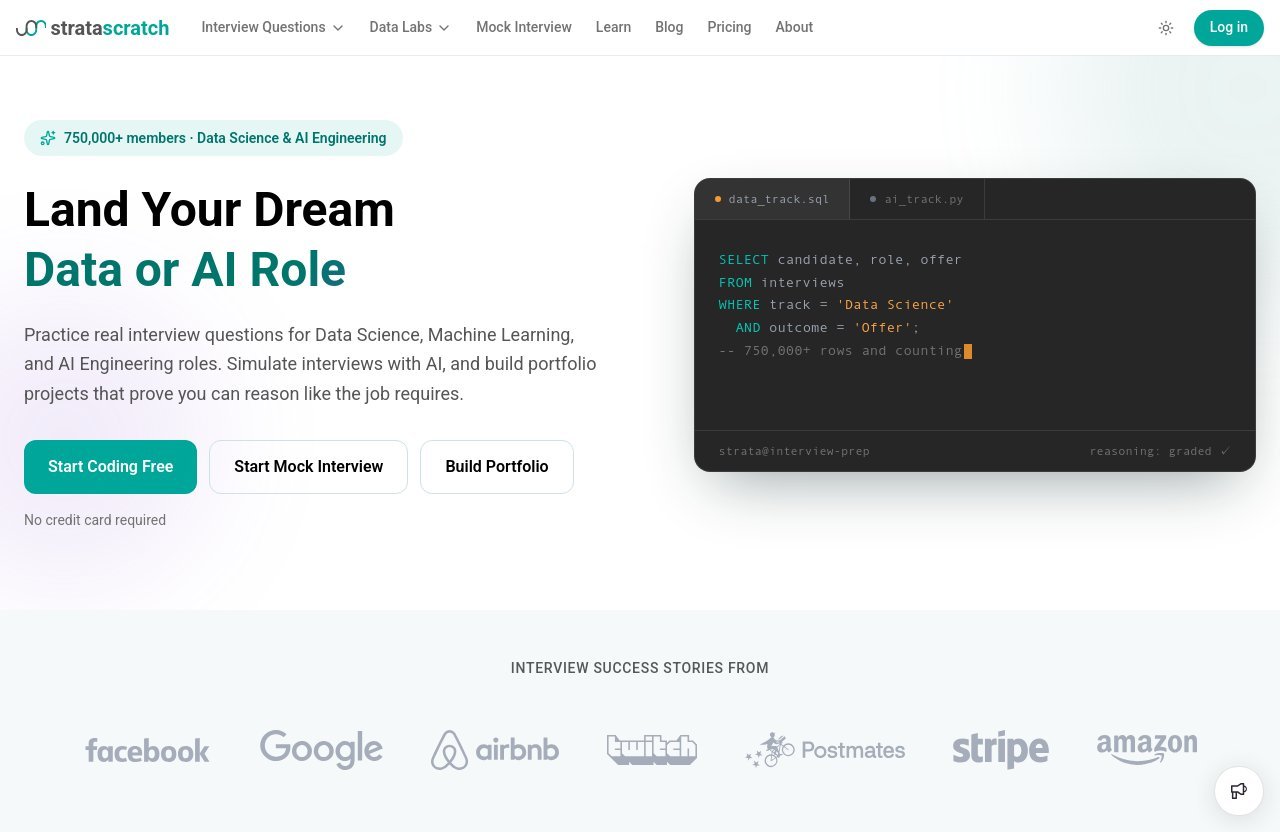
StrataScratch is an interview-preparation platform for Data Science and AI Engineering roles. It is not positioned as a general-purpose coding academy, and that distinction matters. Its official homepage emphasizes real interview questions for data science, machine learning, and AI engineering candidates.
In this honest stratascratch review, the product is best understood as a structured practice environment. You work through interview-style questions, use hosted notebooks for Python-based work, review solutions and hints, complete data projects, and use feedback to identify weak points.
Primary audience
The platform states that it has more than 750,000 members. Its likely audience includes:
- Data analysts and analytics candidates preparing for SQL-intensive interviews
- Data scientists preparing for coding, analytical, and concept-driven rounds
- Machine learning candidates who need broader technical practice
- AI engineering applicants seeking role-specific interview preparation
- Career switchers who want projects alongside question practice
For these users, stratascratch data science interview prep is more relevant than a broad coding curriculum because the practice is oriented around the kinds of tasks data candidates may encounter in hiring processes.
How it fits interview prep workflows
A typical workflow starts with identifying the role you want, practicing relevant questions, and reviewing solutions or hints when needed. From there, candidates can use interview loops, projects, learning paths, and performance insights to make their preparation more deliberate.
That workflow is a meaningful part of the value proposition. Instead of collecting random exercises from many sources, StrataScratch aims to bring practice questions, project work, and feedback into one place. Still, it should complement—not replace—resume work, networking, communication practice, and genuine domain knowledge.
How StrataScratch Works
Interview questions library
The official homepage highlights more than 1,000 real coding and concept questions. These cover the kinds of technical areas relevant to data-focused interview preparation, including coding and analytical reasoning.
For candidates researching stratascratch sql interview questions, the key appeal is the interview-oriented framing. SQL practice is most valuable when you must explain assumptions, choose an approach, and handle realistic business-style data problems rather than merely memorize syntax.
The platform also provides solutions, hints, and grading on paid plans. That combination can support a practical learn-by-doing process: attempt the problem independently, inspect guidance only when necessary, then compare your reasoning with the available solution.
Company and role interview loops
One of the more distinctive official features is the collection of 60+ interview loops by company and role. These loops are designed to make preparation more structured than simply browsing standalone questions.
In practical terms, this can help candidates avoid a common mistake: studying only the topic they enjoy. A role-oriented loop encourages broader readiness across coding, concepts, and interview formats. That is a sensible feature for candidates with interviews on the calendar.
However, users should treat company-specific material as preparation context, not a promise of exact future interview questions. Hiring processes change, and no prep platform can guarantee what any interviewer will ask.
AI interviewer and data projects
StrataScratch includes AI mock interviews, portfolio projects, and cloud-hosted Python notebooks. The official site also highlights more than 50 real data projects and take-homes, which can be especially useful when you need evidence of practical work in addition to problem-solving practice.
The appeal of stratascratch mock interviews is that they can make solo preparation more interactive. AI feedback may help you notice gaps in explanation, clarity, or technical reasoning that are easy to miss when practicing alone.
Still, AI feedback is best used as a rehearsal aid. It cannot fully replicate the unpredictability, follow-up questions, communication cues, or domain judgment of a live interviewer. Candidates should combine it with peer practice where possible.
Learning paths and performance insights
The platform offers free learning paths and performance insights. These features can help transform scattered practice into a plan, particularly for candidates who are unsure where to begin.
A useful approach is to track recurring weaknesses rather than chase completion for its own sake. If you repeatedly struggle with joins, data manipulation, model evaluation concepts, or explaining trade-offs, use that pattern to guide your next practice block.
Pricing and Plans Explained
Free plan
The stratascratch free plan includes limited features and 50 AI credits per month. It is a practical way to evaluate whether the platform’s question style, learning paths, and general workflow fit your goals.
I recommend starting here if you are uncertain. A free plan reduces the pressure to make an immediate purchase and gives you a more reliable basis for judging personal value than promotional claims or isolated stratascratch reviews.
Monthly plan
The Monthly plan provides full access and can be canceled anytime. It includes 1,000 AI credits per month.
This plan is likely the most sensible paid choice for candidates entering a concentrated interview period. If you expect to prepare intensely for a short period, a monthly commitment is easier to evaluate than paying for long-term access before you know how often you will use it.
Yearly plan
The Yearly plan is billed annually at $139. According to the official pricing page, it includes full access, 1,000 AI credits per month, and 25,000 credits that do not expire.
For regular users, the yearly option may be easier to justify than paying monthly over an extended period. But annual value depends on realistic usage. If you are unlikely to practice after one interview cycle, a shorter commitment may be more appropriate.
Lifetime plan
The Lifetime plan is a one-time payment and includes 25,000 credits that never expire. As with any lifetime offer, the right question is not whether it sounds convenient, but whether you expect to return to the product often enough over time.
It may suit repeat job seekers, long-term learners, mentors, or professionals who want continued access to a data-interview practice library. It is harder to justify for someone with a single, near-term hiring target.
Credits, refund policy, and discounts
All paid plans include full access to questions, solutions, projects, hints, and grading. The official pricing page also states that paid plans include a five-day money-back guarantee.
Student and educator discounts may be available on eligible plans, with discounts of up to 20%. Enterprise and university bulk plans are also available. For current checkout details, it is sensible to check the official site’s promotional banner and the coupon field during checkout; no specific promo code is verified for this review.
This honest stratascratch review also notes an important pricing reality: premium value rises with repeated use. If you only need a few questions, the free plan may be enough. If you will use projects, loops, grading, and AI tools regularly, paid access has a clearer practical case.
Official website · Latest pricing & offers
Strengths: What StrataScratch Does Well
Real interview-style questions
StrataScratch’s primary strength is relevance. The official feature set is built around real interview questions for data science, machine learning, and AI engineering roles, not generic programming exercises with unclear career context.
That relevance can help candidates practice the transition from “I know the topic” to “I can solve and explain a problem under interview conditions.” It is particularly useful for people who have theoretical knowledge but need more exposure to job-like prompts.
Pros:
- Focused on data, machine learning, and AI interview preparation
- More than 1,000 real coding and concept questions highlighted officially
- Solutions, hints, and grading included with paid access
- Useful for structured, repeatable technical practice
Company/role-specific prep
The company and role interview loops are another substantial benefit. In my assessment, this is one of the strongest reasons to consider StrataScratch instead of relying solely on random practice sets.
The honest stratascratch review perspective here is simple: structure saves time. Candidates preparing for specific role types can use relevant loops to organize study priorities, rather than trying to infer an entire preparation plan from scattered online advice.
Project-based practice
The official site highlights 50+ real data projects and take-homes. This is valuable because many data candidates need more than correct answers to individual questions; they also need practice working through open-ended tasks and showing their process.
Projects can support portfolio development, provided you do the work yourself and can explain your decisions. A completed project is useful only if you understand the data, assumptions, methods, limitations, and conclusions behind it.
AI feedback and grading
AI mock interviews, AI interviewer feedback, and grading can make practice more active. For independent learners, feedback mechanisms are often more useful than simply viewing an answer after getting stuck.
The limitation is also worth remembering: feedback quality should be treated as guidance, not final authority. Use it to spot patterns, then validate important technical concepts through documentation, trusted learning materials, or human review.
Strong coverage for SQL and analytics
For analytics-focused candidates, the platform’s practical question format is a strong match. SQL interviews often test logic, data interpretation, and explanation—not just query syntax—and interview-style practice supports those habits.
This is where StrataScratch appears most naturally positioned. If SQL and analytics are central to your target roles, its specialized focus may be more useful than a broad platform designed primarily around general software engineering exercises.
Limits and Drawbacks to Consider
Not ideal for casual learners
The biggest caution is fit. StrataScratch is designed around interview preparation, so it may feel more intensive than necessary if you simply want casual learning or occasional technical puzzles.
Someone doing a few SQL exercises each month may not use enough of the platform to justify stratascratch premium access. The free tier is a better low-risk option for this audience.
AI and premium features may not be necessary for everyone
AI credits, mock interviews, full question access, projects, and grading can be useful, but not every candidate needs every component. Self-directed learners with a clear study plan may prefer to start with free materials and only upgrade when a specific interview need appears.
This does not reduce the usefulness of the features; it simply means that buying decisions should be based on usage, not feature lists. More tools are not automatically better if they do not change your preparation behavior.
Coverage may be broader than some users need
Candidates with a narrow target may find parts of the library beyond their immediate needs. For example, an analyst focused solely on SQL may not need extensive work on adjacent data or AI topics.
That breadth can be a strength for exploratory learners, but it can also create distraction. The practical fix is to define a target role and use learning paths or loops deliberately instead of trying to complete everything.
Pricing sensitivity
The official stratascratch pricing structure includes a free plan, monthly access, yearly access billed at $139, and a lifetime option. That range gives buyers choices, but it also requires an honest estimate of likely usage.
Cons:
- Limited value for people needing only occasional drills
- Full benefit depends on consistent practice
- AI feedback should not replace human interview rehearsal
- Broader content can be unnecessary for narrowly focused candidates
StrataScratch vs. Common Alternatives
Versus general coding practice platforms
The most important difference is specialization. General coding platforms can be excellent for fundamental algorithms and programming repetition, while StrataScratch is oriented toward data science, machine learning, AI engineering, analytics, and interview-style data problems.
In a stratascratch vs leetcode comparison, neither is universally better. LeetCode is commonly associated with broader software-style coding preparation, while StrataScratch is more directly aligned with data-role interview practice, company and role loops, data projects, and SQL-oriented work.
Versus more lightweight interview prep tools
Lightweight tools may be sufficient when you only need flashcards, a few practice questions, or basic topic refreshers. StrataScratch becomes more compelling when you want a more connected workflow that includes questions, loops, projects, notebooks, feedback, and performance insights.
The trade-off is commitment. A focused system can reduce planning effort, but it only pays off if you actually use the available structure.
When StrataScratch is the better pick
StrataScratch is the better pick when you want practical preparation that resembles the scope of data-role interviews. It is especially appropriate if you value company-tagged preparation context, role-specific loops, portfolio-oriented data projects, and AI-supported rehearsal.
If you want to evaluate the fit directly, you can review the available plan options through StrataScratch. This article may earn an affiliate commission from that link, but the recommendation is based on the verified features and the user fit described above.
Best Use Cases and Buying Advice
Best for active job seekers
Active candidates are the clearest audience for paid access. If you have applications out, recruiter screens booked, or a realistic interview timeline, you are more likely to use the full question library and structured loops enough to benefit.
Use a schedule rather than browsing endlessly. For example, alternate between timed questions, solution review, mock interview rehearsal, and project work. That approach is more productive than trying to complete as many prompts as possible.
Best for SQL-heavy interview prep
Candidates expecting SQL-heavy assessments may find the platform particularly practical. Prioritize questions that require you to explain joins, aggregations, filtering logic, data quality assumptions, and the business interpretation of results.
The useful skill is not simply writing a query that runs. It is writing a clear query, checking edge cases, and communicating why your approach answers the question.
Best for learners who want feedback
If you learn best through feedback loops, the combination of grading, hints, solutions, performance insights, and AI interviewer tools can be valuable. These features help reduce the delay between attempting a problem and understanding where your reasoning needs improvement.
That said, use feedback actively. Write down recurring mistakes, redo selected questions later without assistance, and practice explaining your answer aloud. Passive solution-reading will not create the same interview readiness.
When to start with the free plan
Start free when you are unsure about the platform, are early in your career exploration, or have not yet defined a job target. The free plan’s limited access and 50 monthly AI credits provide a sensible opportunity to test the experience.
Upgrade only when you can name the features you will use. Monthly access fits a concentrated preparation period, yearly access is better for ongoing use, and lifetime access is most rational for long-term, repeated practice. For candidates ready to compare access options, the official StrataScratch page is the appropriate place to verify current plan details.
Official website · Latest pricing & offers
FAQ
Is StrataScratch worth it?
StrataScratch is worth it for active data science, machine learning, AI engineering, and analytics candidates who will regularly use real interview questions, company and role loops, projects, grading, and AI feedback. It is less compelling for someone who only wants occasional SQL practice.
Is StrataScratch better than LeetCode?
It is better for some goals, not all. In the stratascratch vs leetcode decision, StrataScratch is more specialized for data-role interview preparation, while LeetCode is generally associated with broader software-style coding practice.
How much does a StrataScratch subscription cost?
StrataScratch offers Free, Monthly, Yearly, and Lifetime plans. The Yearly plan is billed annually at $139; the Monthly plan provides full access and can be canceled anytime; and the Lifetime plan is a one-time payment. The official pricing page states that paid plans include full access and a five-day money-back guarantee.
Can I get StrataScratch for free?
Yes. StrataScratch has a free plan with limited features and 50 AI credits per month. It is a good starting point for evaluating the platform before paying.
Does StrataScratch include mock interviews?
Yes. The official site states that StrataScratch includes AI mock interviews and AI interviewer feedback. Paid plans include full access to the platform’s questions, solutions, projects, hints, and grading.
Final Recommendation
Summary of pros
The main strengths are focused data-role interview preparation, real interview-style questions, company and role interview loops, data projects, cloud-hosted Python notebooks, learning paths, and AI-supported feedback. For candidates who need structured practice, those features form a coherent preparation system.
Summary of cons
The main limitation is that value depends heavily on use. Casual learners and candidates seeking only a small number of SQL drills may not need premium access, while AI tools should be treated as practice support rather than a substitute for live interview experience.
Verdict for affiliate readers
This honest stratascratch review concludes that StrataScratch is a strong, practical choice for serious data science, machine learning, AI engineering, and analytics candidates who want interview-specific preparation. Its most convincing use case is structured practice around real questions, role-specific loops, and projects—not hype or guaranteed outcomes.
TopTrustReview may receive a commission if you purchase through an affiliate link, but that does not change the conclusion: start with the free plan if you are unsure, then pay only if the platform’s specialized workflow matches your active interview needs.
Related Reading
- Best Rezi alternatives for job seekers
- WinningHunter review for another affiliate-style software tool
- Is Morelogin safe? A cautious buyer’s guide
References
- StrataScratch official homepage
- StrataScratch pricing page
- StrataScratch interview loops page
- StrataScratch coding questions library