Answerthis vs Perplexity: Which Is Better for Serious Research?

Official website · Latest pricing & offers
Introduction: AnswerThis vs Perplexity for Research—What Are We Really Comparing?
Quick verdict
In the answerthis vs perplexity comparison, the better choice depends on whether you need quick orientation or a repeatable research workflow. Perplexity is useful for fast, broad exploration of a topic. AnswerThis is the stronger fit for citation-sensitive work, literature reviews, evidence synthesis, and research projects that need an organized trail from question to source.
This is not simply a comparison between two ways to ask AI questions. It is a comparison between a dedicated AI research assistant built around verified research workflows and a web-oriented AI answer engine designed for rapid discovery.
Who this comparison is for
This answerthis vs perplexity review is for students, researchers, academics, analysts, consultants, and research-heavy teams. It focuses on the practical issues that matter when an answer will influence a paper, report, presentation, market assessment, or systematic review.
I have separated verified official AnswerThis claims from general observations about Perplexity. That distinction matters: research decisions should rest on traceable product capabilities rather than vague AI marketing language.
Why source quality matters more than speed
Fast answers are valuable, but speed alone does not make research reliable. A polished summary can still be weak if its sources are incomplete, poorly matched to the claim, difficult to inspect, or unsuitable for academic use.
For serious research, the real test is whether a tool helps you find relevant evidence, understand its limits, organize it, and return to it later. That is where the answerthis vs perplexity decision becomes more meaningful than a simple “which one writes better?” question.
At a Glance: Which Tool Is Better for Research?
Best for literature reviews
AnswerThis is better suited to literature-review work because its official workflow is built around searching research materials, checking citations against papers, trials, and PDFs, and organizing papers into projects. It also supports documented search and screening trails aligned with PRISMA 2020 and Cochrane review steps.
Best for fast exploratory search
Perplexity is the stronger choice when you need an immediate overview, a quick explanation, or ideas for where to investigate next. Its cited-answer format makes it practical for early-stage discovery, especially when you are still narrowing a question.
Best for systematic workflows
For systematic and repeatable processes, AnswerThis has the clearer advantage in this answerthis vs perplexity evaluation. Officially listed capabilities include agent-led systematic review workflows, PRISMA diagrams, dual or AI reviewers, living reviews, audit trails, and advanced evidence-synthesis features on eligible plans.
Best for citation-heavy work
If citations must be inspected, saved, reused, and tied to a larger evidence base, AnswerThis is the more specialized option. Perplexity can help surface sources quickly, but AnswerThis is designed to work with research papers, trials, PDFs, libraries, and structured review processes.
| Research need | Better fit | Why |
|---|---|---|
| Quick topic overview | Perplexity | Efficient for broad, early exploration |
| Literature review | AnswerThis | Research-focused search, cited answers, projects, and gap discovery |
| Systematic review | AnswerThis | Documented screening trail and PRISMA/Cochrane-oriented workflow |
| Citation-heavy writing | AnswerThis | Citation checking across papers, trials, and PDFs |
| Everyday fact-finding | Perplexity | Lightweight AI search experience |
| Long-term research program | AnswerThis | Libraries, reference-manager support, and workflow continuity |
What AnswerThis Is Designed to Do
Scientific AI for verified research workflows
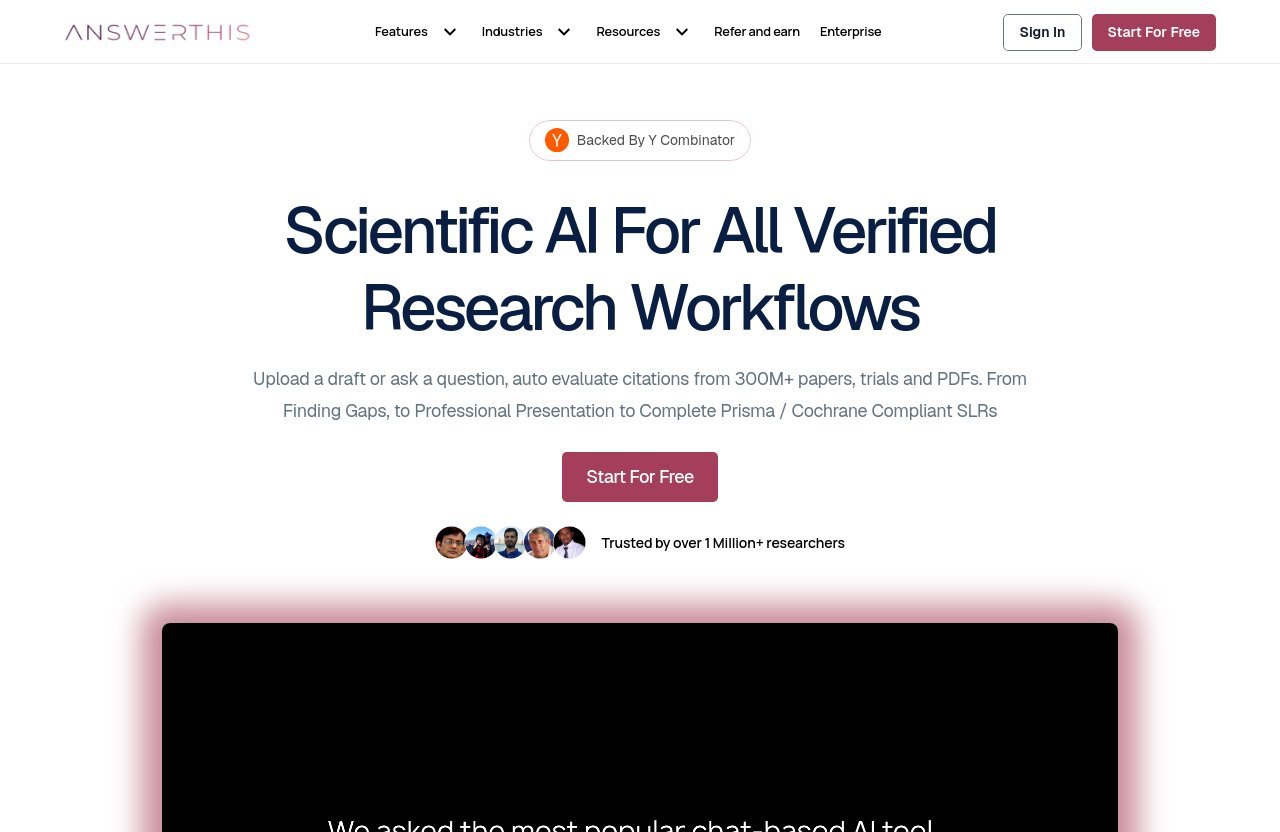
AnswerThis describes itself as “Scientific AI For All Verified Research Workflows.” That positioning is important in the answerthis vs perplexity comparison because it signals a narrower but more research-centered purpose than general web-answer tools.
According to its official product information, users can upload a draft or ask a question, then check citations against more than 300 million papers, trials, and PDFs. It can also help identify research gaps and prepare presentations, which is useful when moving from source collection to a defensible output.
Deep search across papers, trials, and PDFs
A major strength of AnswerThis is its stated deep search across 300M+ papers. For a researcher, this is more relevant than a generic answer alone because the underlying goal is often to locate and assess evidence rather than merely receive a summary.
The platform also states that it supports PRISMA 2020 and Cochrane review steps with a documented search and screening trail. For anyone conducting formal evidence work, that documentation can make research more transparent and easier to revisit.
Project organization and reference management
Research productivity often breaks down after the initial search. Papers get scattered across browser tabs, folders, spreadsheets, and separate reference tools, making it hard to reproduce a decision later.
AnswerThis supports Zotero and Mendeley connections for importing and exporting references. Users can also upload papers directly to their library and organize material into projects. In practical terms, that makes this AI research assistant more useful for work that lasts weeks or months rather than a single search session.
What Perplexity Does Well for Research
Fast answers with sources
Perplexity is commonly used as an AI answer engine that provides answers with source links or citations. That makes it useful when you need to orient yourself quickly, compare viewpoints, or get a plain-language explanation before opening deeper materials.
In the answerthis vs perplexity debate, this is Perplexity’s core advantage: it reduces the friction of early investigation. A researcher can use it to identify terms, key organizations, competing arguments, or possible follow-up questions in minutes.
Good for broad topic discovery
Perplexity is particularly practical for broad or loosely defined questions. For example, an analyst exploring a new market, a student choosing a dissertation angle, or a writer looking for a basic policy overview may benefit from its concise, web-informed summaries.
That does not mean every cited result is ready for academic use. Broad discovery is valuable, but researchers should still open sources, evaluate publication quality, and verify whether a source directly supports the answer.
Useful as an early-stage research starting point
For many users, Perplexity works well before a formal research process begins. It can help transform a vague interest into searchable concepts, keywords, and sub-questions.
This makes it one of several useful Perplexity alternatives or complements in a wider toolkit. But when the work shifts from “What should I explore?” to “What does the evidence show?”, a specialized literature review AI becomes more important.
Source Quality: Which Tool Gives More Reliable References?
Verified research sources vs web-first answers
Source quality is the most consequential difference in answerthis vs perplexity for academic and professional research. AnswerThis officially says it checks citations against 300M+ papers, trials, and PDFs. That focus makes it better aligned with research tasks where scholarly or trial evidence matters.
Perplexity’s broad cited-answer approach is helpful for web discovery, but broad web availability is not the same as source suitability. A strong web page may be excellent for context, while still being insufficient evidence for a literature review, clinical question, or evidence-based recommendation.
Citation traceability
Citation quality is not only about including links. Good citation traceability means you can inspect the original material, understand why it was selected, determine whether it supports the specific claim, and reuse it in a report or review.
AnswerThis has a practical edge because its official workflow includes research libraries, project organization, reference-manager support, and documented search and screening trails. These features are especially valuable when another person needs to audit your reasoning or reproduce your search approach.
When source quality matters most
Choose the research-first route when you are working on a thesis, systematic review, regulatory topic, clinical evidence question, policy analysis, or investment-grade report. In those situations, a fast answer is only the beginning; defensible source selection is the real work.
For casual fact-finding, the answerthis vs perplexity gap is less significant. If the stakes are low and you need a starting point rather than a formal evidence record, Perplexity’s speed may be all you need.
Answer Depth: Who Gives Better Research Answers?
Exploratory summaries
Perplexity is generally well suited to concise exploratory summaries. It can be useful for scanning a topic from multiple angles, clarifying unfamiliar concepts, and identifying questions that deserve further investigation.
Its strength is not necessarily exhaustive depth. Rather, it helps users move quickly from a broad question to a more focused research direction.
Literature review depth
AnswerThis is better positioned for literature review depth because it is designed around scientific materials and research workflows. Official capabilities include cited answers and summaries, research-gap identification, project organization, and support for systematic review methods.
This distinction matters in the answerthis vs perplexity comparison. A literature review requires more than a readable synthesis: it requires a structured way to find, compare, retain, and explain evidence.
Evidence synthesis and structured outputs
AnswerThis lists advanced research capabilities including meta-analysis and synthesis, forest and funnel plots, network meta-analysis, SUCRA rankings, GRADE certainty, Trial Landscape, live trial registries, and regulatory connectors on Max. These are specialized features for users whose work goes beyond general AI search.
The platform also offers AI Writer capabilities, with standard models on Pro and extended thinking on Research. For research drafting, this can help turn organized evidence into a clearer first draft, though human review remains essential for interpretation, methodology, and final claims.
Official website · Latest pricing & offers
Research Productivity: Which Tool Saves More Time?
From question to project
Research productivity is not just about generating an answer quickly. The biggest time savings often come from reducing repetitive work: searching, collecting, screening, organizing, revisiting, and summarizing sources.
AnswerThis supports this end-to-end process. A user can ask a question or upload a draft, search research materials, save work into projects, and return to a structured library instead of restarting from scratch each time.
Library organization and reuse
Reference organization is a major reason AnswerThis may be the better best AI for research option for frequent researchers. Its Zotero and Mendeley connectivity can reduce duplicate effort for people who already have established citation-management habits.
Unlimited library storage is included on Pro, Research, and Max plans according to official pricing information. That is meaningful for users managing an ongoing body of evidence rather than a one-off assignment.
Systematic review automation
For systematic work, AnswerThis goes beyond basic source discovery. Its official feature list includes agent-led systematic review, AI or dual reviewers, living reviews, audit trails, and full-text AI screening on the Research plan.
In the answerthis vs perplexity productivity comparison, Perplexity can accelerate the early search stage. AnswerThis can save more time across the full workflow because it is built to support repeated research tasks after the first answer has been generated.
Pricing and Plan Comparison
AnswerThis publishes clear monthly plan pricing, while exact active offers are confirmed in the app and at checkout. Existing account pricing and allowances may differ from standard offers shown on its pricing page.
AnswerThis Free plan
The Free plan costs $0 per month and does not require a card. It includes deep search across 300M+ papers, cited answers and summaries, paper organization into projects, and 10 lifetime basic questions.
This plan is a sensible way to evaluate whether the workflow fits your needs before committing. If you want to test the research experience, you can review the available options through AnswerThis and decide whether Free is enough for your workload.
AnswerThis Pro plan
The Pro plan costs $35 per month when billed monthly. It includes everything in Free, plus unlimited basic queries, two systematic reviews per month, 10 Max queries per month, unlimited library storage, AI Writer with standard models, and 48-hour support.
For individual students, analysts, and regular researchers, Pro may be the most practical middle ground. It adds reusable research capacity without requiring an enterprise-style budget.
AnswerThis Research plan
The Research plan costs $75 per month when billed monthly. It includes everything in Pro, unlimited systematic reviews, 50 Max queries per month, full-text AI screening, AI Writer with extended thinking, and 24-hour support.
This level is aimed at researchers who run frequent literature reviews or handle larger evidence workloads. The full-text screening capability is particularly relevant when source selection is a recurring bottleneck.
AnswerThis Max plan
The Max plan costs $250 per month when billed monthly. It includes everything in Research, 300 Max queries per month, frontier models, a personal research assistant, topic alerts and digests, and priority response in under one hour.
Officially listed Max-level workflow capabilities also include Trial Landscape, live trial registries, regulatory connectors, advanced synthesis, and specialized evidence-analysis outputs. This plan is more relevant to intensive research operations than occasional academic use.
How to choose a plan
| Plan | Monthly price | Best suited to |
|---|---|---|
| Free | $0 | Testing the platform or handling a small number of questions |
| Pro | $35 | Regular individual research and limited systematic review work |
| Research | $75 | Frequent literature reviews and full-text screening needs |
| Max | $250 | High-volume, advanced, or team-level research workflows |
The right answer in answerthis vs perplexity is therefore partly budget-dependent. Use Perplexity for lightweight exploration if that is all you need; consider AnswerThis Free, Pro, Research, or Max when citation traceability and research workflow depth become central.
Who Should Choose AnswerThis?
Students and early researchers
Students working on dissertations, capstones, or evidence-based assignments should consider AnswerThis when citations and source organization matter. The Free plan can be a low-risk way to assess whether deep search and project organization improve the quality of their work.
It is especially useful for students who want to build better habits around reading sources rather than relying entirely on AI-generated summaries.
PhD candidates and faculty
For PhD candidates and faculty, the answerthis vs perplexity choice usually favors AnswerThis when the work involves formal literature review, research-gap identification, ongoing source libraries, or systematic methods. The documented search and screening trail is more aligned with transparent academic practice.
Its support for Zotero and Mendeley also makes it easier to incorporate into an existing reference workflow rather than forcing researchers to start over.
Industry teams doing systematic reviews
Research teams in healthcare, policy, consulting, life sciences, or regulated industries may benefit from AnswerThis’s systematic review and evidence-synthesis capabilities. Features such as audit trails, dual or AI reviewers, living reviews, and advanced analysis tools address needs that a general AI search engine for research does not primarily target.
For these users, the platform is not just an answer generator. It can function as a structured systematic review tool that supports more repeatable research processes.
Who Should Choose Perplexity?
Casual research and ideation
Perplexity is a reasonable choice for casual research, brainstorming, and everyday learning. It is useful when you want a fast explanation without building a project, library, or documented evidence trail.
For example, it can help a student understand a topic before visiting scholarly databases or help a business user quickly identify terms to investigate.
Fast topic exploration
Perplexity is also a good starting point for rapidly exploring unfamiliar subjects. If your question is broad and your goal is to learn the landscape, its concise responses can help you identify the next questions to ask.
This is where discussions such as answerthis vs perplexity reddit often become overly simplistic. The best tool is not always the one with the fastest response; it is the one that matches the stage and standard of your research.
Users who want a lightweight answer engine
Choose Perplexity if you want an easy, lightweight way to search and synthesize information across the web. It is a strong option for preliminary work, especially when formal literature review features are unnecessary.
The limitation is workflow depth. If you need to collect and screen research evidence repeatedly, manage references, and maintain a reliable trail of decisions, a dedicated research platform is likely the better fit.
Final Verdict: Best for Research?
Best overall for serious research
For serious, citation-sensitive work, AnswerThis is the better overall choice. In this answerthis vs perplexity comparison, it wins because its officially stated features support deep research search, citation checking, organized projects, reference management, and structured systematic-review workflows.
That does not make Perplexity ineffective. It simply serves a different research purpose: quick discovery rather than end-to-end evidence work.
Best for speed and exploration
Perplexity remains a strong option for fast exploration. It is useful when you need a quick answer, broad topic orientation, or a list of directions for further investigation.
The practical approach for many researchers may be to use fast AI search for initial idea generation, then move to AnswerThis when the work requires higher citation quality, greater answer depth, and durable research productivity.
Bottom-line recommendation
| If your priority is… | Recommended tool |
|---|---|
| Rapid overviews and early ideation | Perplexity |
| Literature reviews and academic research | AnswerThis |
| Citation traceability and research libraries | AnswerThis |
| Systematic reviews and evidence synthesis | AnswerThis |
| Lightweight web-oriented discovery | Perplexity |
The bottom line on answerthis vs perplexity is clear: choose Perplexity for fast exploration, but choose AnswerThis for research that must be organized, source-aware, and defensible. Start with the Free plan if you are testing the workflow, then move to Pro, Research, or Max only when your volume and methodology justify it.
Official website · Latest pricing & offers
FAQ
Which is better than Perplexity for research?
AnswerThis is often better than Perplexity for formal research because it is designed for literature reviews, citation checking, project organization, and systematic workflows. Perplexity is still useful for quick topic discovery, but AnswerThis is more specialized for research-heavy work.
Why don’t more people use Perplexity?
Many people do use Perplexity, particularly for quick answers and exploratory search. Some researchers prefer other tools because they need deeper workflow features, stronger source control, reference management, screening support, or more structured review processes.
Which is more accurate, Perplexity AI or ChatGPT?
Accuracy depends on the task, the prompt, the sources used, and whether the user verifies the result. For research, neither should be treated as automatically correct; users should inspect original sources and ensure that citations support the precise claim being made.
Is Perplexity the best AI platform?
There is no single best platform for every use case. Perplexity can be excellent for broad, fast search and concise synthesis, while AnswerThis is a more specialized choice for researchers who need literature-review support, citation traceability, and systematic research workflows.
Related Reading
References
- AnswerThis homepage
- AnswerThis pricing page
- Top 10 AI Tools for Researchers in 2026
- AI Tools for Research and Study: Tools to use