Best Answerthis Alternatives in 2026
Official website · Latest pricing & offers
Introduction: What readers really want from an AnswerThis alternative
Researchers looking for answerthis alternatives are rarely searching for another generic chatbot. They usually want a research assistant tool that fits a particular bottleneck: finding credible papers faster, understanding difficult PDFs, checking citations, organizing a literature review, or completing a systematic review without losing the audit trail.
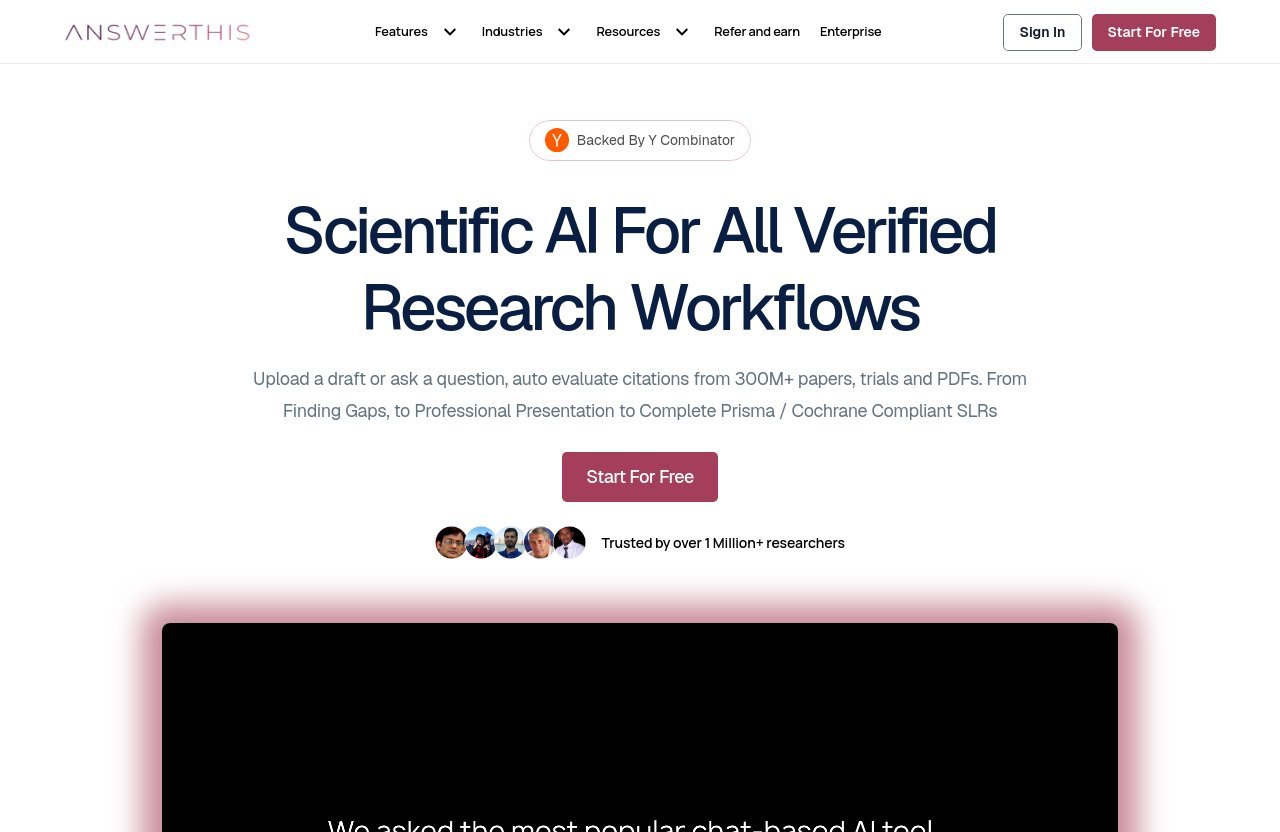
AnswerThis positions itself as “Scientific AI For All Verified Research Workflows.” Its appeal is clear for users who need cited answers, research-gap analysis, paper libraries, and structured review support in one place. But it is not automatically the right fit for every student, analyst, or medical research team.
Why people look beyond AnswerThis in 2026
In practical comparisons, the reason for switching is usually workflow fit rather than dissatisfaction. A student may only need PDF chat before a seminar. A graduate researcher may prefer a tool geared toward structured evidence discovery. An industry analyst may want source-grounded notes rather than systematic review software.
Searches for “answerthis alternatives reddit” reflect this practical mindset. Users want candid answers about whether they need a full research workflow or a simpler tool for one job. The best choice depends on the stage of research, evidence standard, and how much work happens after the first search.
The main decision factors: search depth, citation reliability, literature review workflow, PDF chat, systematic review support, and price
When assessing answerthis alternatives, I focus less on broad AI claims and more on whether each platform supports a complete, defensible research process. Important criteria include citation grounding, PDF handling, literature-review organization, reference workflows, and the ability to move from question to usable output.
AnswerThis is particularly relevant when the task involves verified searching across papers, trials, and PDFs, plus a documented review process. Narrower tools can still be better when speed, simplicity, note-taking, or document Q&A matters more than full workflow continuity.
Quick summary: the best AnswerThis alternatives at a glance
Best overall alternative
Paperguide is the strongest editorial pick for users seeking an all-in-one style research workspace rather than a single-purpose AI feature. It is best suited to researchers who want reading, organization, and writing support to feel connected.
Best for connected research workflows
Anara is worth considering for users who prioritize organized research materials and ongoing project structure. It may appeal to teams and researchers who want a more deliberate environment for keeping sources, notes, and analysis together.
Best for fast evidence finding
Elicit and Consensus are often the most relevant alternatives for question-led evidence discovery. Elicit is better aligned with structured research exploration, while Consensus is commonly preferred when users want a quick, study-oriented answer to a focused question.
Best for PDF-first work
SciSpace and ChatPDF are logical choices when the immediate problem is understanding a specific paper. SciSpace is better suited to academic paper reading, while ChatPDF is the simpler option for direct document questions.
Best free or low-cost option
For people comparing answerthis alternatives free, NotebookLM is a compelling starting point for source-based notes and synthesis, particularly when users already have the documents they need. Free access is not the same as full research capability, so always check current limits on sources, uploads, exports, and advanced functions.
| Tool | Best suited for | Main reason to consider it |
|---|---|---|
| Paperguide | Connected academic workflows | Broad research-to-writing orientation |
| Elicit | Structured evidence discovery | Question-led research exploration |
| Consensus | Fast study-based answers | Quick evidence-oriented discovery |
| SciSpace | Academic PDF reading | Paper understanding and document support |
| NotebookLM | Source-grounded synthesis | Notes and answers based on supplied sources |
| Scite | Citation context | Evaluating how publications are cited |
| Anara | Organized research projects | Structured workspace for ongoing work |
| ChatPDF | Simple PDF questions | Low-friction document Q&A |
How we chose these AnswerThis alternatives
Selection criteria
These answerthis alternatives were selected because they are relevant to the real jobs academic and professional researchers perform: evidence discovery, paper reading, citation assessment, project organization, and research writing. The list deliberately includes both broad platforms and specialized tools.
I did not treat every product as a direct replacement. A PDF chat tool, for example, can be useful without offering the same systematic-review depth as AnswerThis. That distinction matters when choosing software for a thesis, evidence review, clinical project, or market report.
What matters most for researchers
The most meaningful evaluation criteria are whether outputs remain connected to sources, whether citations can be checked, and whether the platform supports the next step after discovery. A fast answer is useful, but a fast answer with unclear provenance creates more work later.
For literature review AI tools, I would prioritize the ability to trace claims back to research, manage papers coherently, and avoid repeating searches across multiple applications. For higher-stakes work, systematic review support and documentation are more important than a polished chat interface.
Why workflow continuity matters more than raw model quality
Raw AI quality is difficult to judge from a single prompt. A better test is whether the tool reduces repeated effort from initial question through screening, synthesis, drafting, and reference management.
This is where AnswerThis has a distinct proposition: it combines deep search, cited summaries, project organization, draft uploads, and review-oriented workflows. Many AI research assistant alternatives can do part of that process well; fewer are designed around the full path from research question to documented output.
Best AnswerThis alternatives in 2026
Paperguide: best all-in-one connected research workflow
Paperguide is best suited to researchers who want one workspace for navigating the research-and-writing cycle. Its public positioning makes it a relevant option for students and academics who dislike moving constantly between paper readers, note apps, and drafting tools.
Its central strength is workflow breadth. If your work involves collecting sources, reading them, building notes, and turning those notes into an outline or draft, Paperguide may feel more cohesive than assembling separate tools.
The trade-off is that users who specifically need a verified, documented systematic-review process should compare the workflow carefully against AnswerThis. For rigorous reviews, the important question is not whether a tool can summarize papers, but whether it helps preserve a reproducible research trail.
Choose Paperguide if you want a connected academic writing assistant experience. Choose AnswerThis if citation checking, PRISMA-oriented review steps, and systematic-review continuity are central to the project.
Elicit: best for structured evidence discovery
Elicit is best for researchers starting with a question and needing to locate, compare, and make sense of relevant evidence. It is a particularly sensible option for early-stage literature mapping, when the goal is to identify important studies and refine the scope.
The strength of Elicit is its research-first orientation. Rather than treating scholarly sources as an afterthought, it is commonly used for structured exploration of evidence and research questions.
Compared with AnswerThis, Elicit may be a better fit when discovery is the primary need and the user does not require a broader review-production environment. Conversely, researchers moving toward systematic screening, formal synthesis, and auditability may find AnswerThis’s verified workflow positioning more directly aligned.
For an answerthis review from an evidence-discovery perspective, this is the key distinction: Elicit helps investigate the landscape, while AnswerThis is designed to take research further into reviewed and documented workflows.
Consensus: best for quick research answers and study-level evidence
Consensus is best suited to users who want a fast, research-oriented response to a clearly defined question. It can be especially useful for students, journalists, business researchers, and professionals who need to orient themselves before reading deeply.
Its appeal is speed and accessibility. When the task is “What does the research generally indicate?” a study-focused answer interface can be more efficient than launching a large review project.
The limitation is scope. Quick evidence answers should be treated as a starting point for decisions, not a substitute for reviewing study design, context, and applicability. For a dissertation chapter, medical evidence review, or regulated research process, the source trail and screening logic matter more.
Choose Consensus for rapid orientation. Choose AnswerThis when you need to check citations against a large research corpus, organize papers into projects, or build a more formal review process.
SciSpace: best for PDF chat and paper understanding
SciSpace is best for people whose main obstacle is understanding dense academic papers. Researchers often encounter unfamiliar terminology, methods sections, equations, and technical writing that slow down literature review work.
A PDF-oriented research interface can make close reading less intimidating. This is valuable for undergraduates, interdisciplinary researchers, and professionals reviewing papers outside their core specialty.
The trade-off versus AnswerThis is that document understanding is only one part of research. If you already have a paper and need help interpreting it, SciSpace may be the cleaner choice. If you need to find research gaps, search broadly, validate citations, and progress through a structured review, AnswerThis is the more complete fit.
Among answerthis alternatives, SciSpace is a practical specialized option rather than a full replacement for a verified literature-review workflow.
NotebookLM: best for source-grounded note taking and synthesis
NotebookLM is best for researchers who already have a curated set of documents and want to ask questions across them, develop notes, or create source-grounded synthesis. It is particularly useful for turning a folder of readings into a workable study guide or project briefing.
Its major advantage is focus. Instead of searching the whole web or a vast paper index, it can help users reason over the sources they deliberately provide. That makes it attractive for seminar preparation, qualitative projects, policy dossiers, and internal research collections.
The likely limitation is that it should not be assumed to replace specialized literature search, citation verification, or systematic-review processes. It works best after source selection, not necessarily as the system that establishes a comprehensive research base.
NotebookLM is one of the better answerthis alternatives free starting points for note-based work. It is less suitable if your challenge is evidence discovery and screening rather than synthesizing an existing source set.
Scite: best for citation context and reference checking
Scite is best suited to users who need to look beyond raw citation counts. Citation context can help researchers understand how later publications engage with a study, which is often more useful than knowing that a paper has simply been cited.
This makes Scite relevant for literature reviews, claim checking, and assessing whether a reference is being used appropriately. Researchers dealing with controversial, highly cited, or older findings may find this perspective especially valuable.
The trade-off is that citation context is a focused capability, not necessarily an end-to-end research environment. AnswerThis, by contrast, explicitly offers citation checks alongside search, project organization, writing support, and systematic-review options.
Use Scite when citation interpretation is the core concern. Use AnswerThis when you need citation checking as part of a larger research workflow.
Anara: best for organized research workflows
Anara is best for users who want research materials and project work to remain organized as the study evolves. This makes it a reasonable consideration for long-running research projects where source management and continuity become difficult.
The practical value of an organized workspace is often underestimated. Researchers lose time when insights are buried in PDFs, browser tabs, disconnected notes, and multiple versions of a draft. A tool designed around research organization can reduce that fragmentation.
Against AnswerThis, evaluate how much formal evidence-review support you need. AnswerThis is the stronger choice for users specifically seeking cited answers, broad paper search, and systematic-review functionality. Anara may be better for those whose central need is keeping their own research corpus coherent.
For graduate students handling multiple chapters or projects, Anara can be a worthwhile research assistant tool to evaluate before committing to a broader platform.
ChatPDF: best for simple PDF Q&A
ChatPDF is best for quick, low-complexity questions about a single document. If you need to extract an argument, locate a definition, summarize a report, or clarify a passage in a paper, document chat is often the fastest route.
Its strength is simplicity. There is little need to configure a research project when the immediate task is just understanding one uploaded PDF.
That simplicity is also the limitation. ChatPDF should not be treated as a substitute for comprehensive literature searching, citation verification, or systematic review software. It is a utility for a document, not a complete research workflow.
Choose ChatPDF when the paper is already in front of you. Consider AnswerThis when the real question is which papers you should be reading and how to turn them into a defensible review.
Official website · Latest pricing & offers
AnswerThis vs the alternatives: which one should you choose?
Choose AnswerThis if you need a verified literature-review workflow
AnswerThis is a strong choice when research needs to be traceable from question to output. It can check citations against 300M+ papers, trials, and PDFs, generate cited answers and summaries, identify research gaps, and organize work into projects.
It is particularly differentiated for systematic review work. Its workflow follows PRISMA 2020 and Cochrane review steps with a documented search and screening trail. At the Max tier, AnswerThis also includes agent-led systematic review capabilities, a PRISMA diagram, dual/AI reviewers, living reviews, audit trails, meta-analysis and synthesis options, GRADE certainty, and trial landscape features.
Choose an alternative if you want a narrower or cheaper tool
An alternative is better if you only need one task completed well. ChatPDF and SciSpace are more natural choices for paper-level reading. NotebookLM is attractive for source-grounded notes. Consensus and Elicit can make more sense for quick discovery and evidence orientation.
This is where many answerthis alternatives comparisons go wrong: they compare all tools as though they solve the same problem. A narrower tool may be cheaper or easier, but it may also push you back into multiple tabs when your research becomes more complex.
Best fit by persona: student, grad student, researcher, medical team, industry analyst
| Persona | Best starting point | Why |
|---|---|---|
| Undergraduate student | SciSpace, ChatPDF, or NotebookLM | Useful for reading, comprehension, and notes |
| Graduate student | AnswerThis, Elicit, or Paperguide | Better for sustained literature review work |
| Academic researcher | AnswerThis or Scite | Stronger fit for evidence and citation-focused work |
| Medical team | AnswerThis | Better aligned with structured review and documentation needs |
| Industry analyst | Consensus, NotebookLM, or AnswerThis | Depends on whether speed, internal sources, or verified research is primary |
For an answerthis io review, the practical conclusion is that AnswerThis is most compelling when the cost of an incomplete or poorly documented research process is high. It is less essential when the work is a one-off document question or lightweight study summary.
Pricing and value: what to expect from AnswerThis and competitors
AnswerThis pricing tiers
AnswerThis has a Free plan at $0 per month with no card required. It includes deep search across 300M+ papers, cited answers and summaries, project organization, and 10 lifetime basic questions.
The Pro plan is $35 per month billed monthly. It adds unlimited basic queries, two systematic reviews per month, 10 Max queries per month, unlimited library storage, AI Writer with standard models, and 48-hour support.
The Research plan costs $75 per month billed monthly. It includes unlimited systematic reviews, 50 Max queries per month, full-text AI screening, AI Writer with extended thinking, and 24-hour support.
The Max plan costs $250 per month billed monthly. It adds 300 Max queries per month, frontier models, a personal research assistant, topic alerts and digests, and priority response in under one hour. Standard offers are shown; existing account pricing and allowances can differ, so confirm the exact offer in the app and at checkout.
Free vs paid trade-offs
The free AnswerThis plan is useful for evaluating search quality and cited outputs before paying. However, 10 lifetime basic questions is an evaluation allowance, not a long-term substitute for an active research workflow.
Users exploring answerthis alternatives free should compare more than the headline price. Check whether free access supports the number of documents, searches, sources, citations, and exports your project actually requires. A free tool can be excellent for learning or a single task, while a paid platform can save time on a complex review.
How to judge value in research tools
Value is not just the monthly subscription cost. Consider the hours spent searching, manually checking sources, rebuilding notes, fixing references, and reconstructing screening decisions.
AnswerThis provides Zotero and Mendeley connections for importing and exporting references, as well as direct paper uploads to its library. That may justify the cost for users who need continuity between reference management, research discovery, and formal review work. Competitor pricing should be checked directly because plans and allowances can change.
Common problems users try to solve with an alternative
Need fewer tabs and less context switching
If the problem is a fragmented workflow, prioritize a connected platform such as Paperguide, Anara, or AnswerThis. The best tool is the one that keeps sources, notes, and decisions available when you return to the project weeks later.
Need better citation verification
For checking how research is used, Scite is a focused option worth examining. For citation checking within a broader literature-search and review workflow, AnswerThis is more directly positioned for the job.
Need stronger systematic review support
If you are conducting a formal review, do not choose based on a polished chat answer alone. You need screening transparency, documented methods, and a workflow that can support reporting requirements.
AnswerThis is the clearer fit among these options for PRISMA 2020 and Cochrane-aligned steps, a documented search and screening trail, and higher-tier systematic review functionality. This is where many general AI research assistant alternatives are not comparable.
Need simpler PDF analysis
For a quick paper-level task, SciSpace or ChatPDF can be more efficient than opening a full research workspace. They are best when the source has already been selected and the immediate goal is comprehension.
Need a free starting point
Start with free access where available, but define the test first: one research question, a small set of papers, and a specific output such as a cited summary or evidence table. This avoids switching tools based on novelty instead of real utility.
If you want to try AnswerThis directly, you can do so here.
Affiliate disclosure: TopTrustReview may earn a commission if you subscribe through this link, at no extra cost to you. This does not change our editorial assessment.
Final verdict: the best AnswerThis alternative for most users
Best overall pick
Paperguide is the best overall alternative to evaluate for users who want an integrated research and writing environment. It is a sensible fit when connected day-to-day workflow matters more than formal systematic-review capability.
Best budget pick
NotebookLM is the best budget-oriented starting point for researchers who already have a well-chosen set of sources and need help turning them into notes, questions, and syntheses. It is not a complete substitute for literature discovery or review documentation.
Best specialized pick
SciSpace is the most suitable specialized option for academic PDF understanding, while Scite is the better focused choice for citation context. Elicit and Consensus remain strong candidates for evidence discovery and fast research answers.
When to stay with AnswerThis
Stay with AnswerThis when you need verified research workflows rather than isolated AI features. Its combination of cited search across 300M+ papers, trials, and PDFs, project organization, citation checking, and PRISMA/Cochrane-aligned systematic-review support gives it a stronger case for serious research work.
The best answerthis alternatives are not necessarily “better” overall. They are better when your work is narrower: a single PDF, a quick evidence question, source-based notes, or citation context. For researchers who need a defensible, continuous path from search to synthesis, AnswerThis remains one of the more complete choices.
Official website · Latest pricing & offers
FAQ
Is AnswerThis any good?
Yes. AnswerThis is a credible option for users who need research-backed answers rather than general AI responses. Its strengths include deep search across 300M+ papers, trials, and PDFs, cited summaries, paper projects, citation checking, and structured systematic-review support.
It is especially useful for researchers who need to document how they found and screened evidence. For casual questions or one-document analysis, a simpler alternative may be better value.
What is the best site for answers?
The best site depends on the type of answer you need. AnswerThis is better suited to research-backed academic answers, while general AI tools can be sufficient for everyday questions.
For a specific PDF, ChatPDF or SciSpace may be more efficient. For citation context, Scite is a more focused choice. The best answer is the one that provides sources appropriate to the stakes of your decision.
Which AI tool is best for academic writing?
There is no single best academic writing assistant for every task. If you need research-first drafting supported by literature search, cited summaries, and organized sources, AnswerThis is a strong option to consider.
If your priority is understanding papers, choose a PDF-focused tool. If you already have your sources and need source-grounded synthesis, NotebookLM may be more suitable. Always verify citations and follow your institution’s policies on AI-assisted writing.
What is the best AI alternative?
The best AI alternative depends on the workflow. Paperguide is worth evaluating for connected research and writing, Elicit for structured evidence discovery, Consensus for quick study-oriented answers, and SciSpace or ChatPDF for PDF-based tasks.
For full literature review and systematic review needs, compare any alternative carefully against AnswerThis’s documented workflow capabilities. Brand preference should follow the task, not the other way around.
Is there a free AnswerThis alternative?
Yes. Several tools offer free entry points or limited free use, and NotebookLM can be a useful option for source-grounded notes and synthesis. AnswerThis itself also has a free plan with no card required, including deep search, cited answers and summaries, paper projects, and 10 lifetime basic questions.
Before switching, compare actual limits on searches, source uploads, citations, exports, and project storage. Those limits determine whether a free plan can support more than a short trial.
What makes an AnswerThis alternative better?
An alternative is better only when it improves the task you care about most. That could mean a simpler interface for PDF questions, lower cost for light use, more convenient note-taking, a preferred project workspace, or a specific emphasis on citation context.
For rigorous research, “better” should also mean more reliable workflow continuity. If you need verified citations, structured screening, and systematic-review support, AnswerThis may still be the better fit even when a narrower tool feels easier at first.
Related Reading
- Is Rezi AI Worth It in 2026? An Honest Buyer’s Guide
- Best Wpforms Alternatives in 2026
- Stratascratch Pricing in 2026: Plans Explained
References
- AnswerThis: AI Research Assistant for Literature Reviews
- Paperguide vs AnswerThis: Best AnswerThis Alternative in 2026
- 9 Best AnswerThis Alternatives in 2026 (Free+ Paid)
- AnswerThis vs Jenni AI | Research and Writing Compared