
How to Use Youlearn AI in 2026: A Beginner-Friendly Step-By-Step Tutorial

If you are trying to figure out how to use YouLearn AI without wasting time clicking around, this guide walks you through the whole workflow: signing in, uploading study materials, asking better questions, creating quizzes, and choosing the right plan.
YouLearn AI is positioned as an AI tutor made for you, built to help learners save hours and study smarter with uploads, chats, voice mode, recorded lectures, and more. It is also trusted by over 2 million learners, according to the official site.
Affiliate disclosure: This article contains an affiliate link. If you decide to try YouLearn through our link, TopTrustReview may earn a commission at no extra cost to you. I only recommend using it if it fits your study workflow.
Official website · Latest pricing & offers
What Is YouLearn AI and Who Is It For?
YouLearn AI is a study AI tool that helps turn learning materials into interactive study sessions. Instead of reading a long PDF alone or rewatching a lecture repeatedly, you can upload or connect your content and ask questions, generate summaries, create quizzes, prepare exams, listen with read-aloud, or use voice mode.
This how to use YouLearn AI guide is mainly for beginners who want a practical workflow, not just a feature list. It is especially useful if you study from long-form materials like PDFs, YouTube videos, recorded lectures, slides, websites, files, and pasted content.
Quick overview of the app
The YouLearn AI app experience is designed around one central idea: bring your learning content into the tool, then study it with an AI tutor. That means you are not starting from a blank chatbot; you are working from your own source material.
In practical terms, YouLearn can help with content uploads, AI chats, quizzes, exams, podcasts, lesson plans, read-aloud, voice mode, and recorded lectures. If you are learning how to use YouLearn AI for the first time, think of it as a study workspace where your materials become searchable, explainable, and easier to review.
Best use cases for students and self-learners
YouLearn AI for students makes the most sense when you have a lot of material and limited time. For example, you might upload a lecture PDF, summarize the key points, ask for simpler explanations, then generate a quiz to check what you remember.
It can also work well for exam prep learners, researchers, language learners, professionals taking courses, and anyone learning from long documents or videos. As an AI tutor for students, it is strongest when you use it to actively test yourself rather than only generate notes.
What makes it different from generic AI chat tools
Generic AI chat tools are useful, but they often require you to paste context manually. YouLearn is more focused on studying from specific learning materials, which makes it better suited for long PDFs, lectures, videos, slides, websites, and files.
That difference matters because learning is not only about getting an answer. When you understand how to use YouLearn AI, you can build a repeatable routine: upload material, summarize it, ask follow-up questions, create quizzes, review weak areas, and repeat.
How to Use YouLearn AI: Step-by-Step Setup
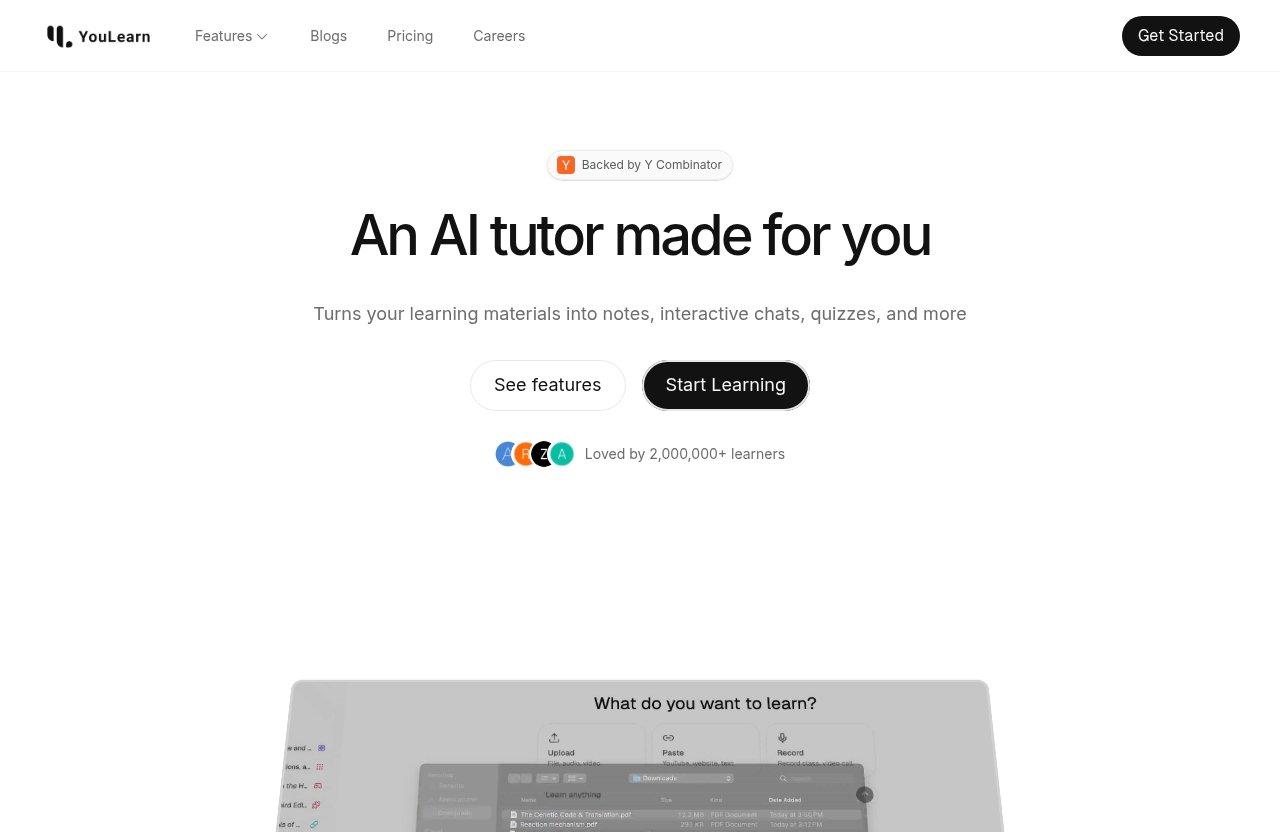
This section is the core YouLearn AI tutorial for beginners. The setup process is simple, but the choices you make at the start affect how useful the results will be.
The best way to learn how to use YouLearn AI is to begin with one source, one clear goal, and one focused study session. Do not upload everything at once on your first try.
Create an account and sign in
Start by going to the official YouLearn website or product page and creating your account. If you already have an account, use the YouLearn AI sign in option to access your workspace.
Once you are signed in, take a minute to look around before uploading anything. You want to understand where uploads, chats, quizzes, exams, voice mode, and other study features appear inside the interface.
A simple first goal could be: “I want to understand this lecture well enough to answer practice questions.” That makes the rest of the setup easier.
Choose the right learning input
Before uploading, decide what you want YouLearn to help you with. Your best input depends on the type of material and your learning goal.
| Learning goal | Best input to start with | Why it works |
|---|---|---|
| Understand a chapter | PDF or file | Good for structured reading and summaries |
| Review a lecture | Recorded lecture or slides | Helps turn spoken or visual material into study notes |
| Learn from video | YouTube video | Useful as a YouTube video summarizer and explainer |
| Compare sources | Websites and pasted content | Helpful for research and quick review |
| Prepare for a test | PDFs, slides, quizzes, exams | Supports active recall and revision |
If you are unsure how to use YouLearn AI for your first session, choose the material that is currently causing the most confusion. A difficult chapter, dense lecture, or long YouTube explanation is usually a good starting point.
Upload or paste your study material
After choosing the source, upload your file, paste your content, add a supported website, or work with a YouTube video or recorded lecture. Keep the first upload manageable so you can evaluate the quality of the responses.
Once the material is loaded, ask YouLearn for a short summary first. Then ask a more specific follow-up question, such as:
- “Explain the main argument in simple terms.”
- “What are the five most testable points?”
- “Create a beginner-friendly outline from this lecture.”
- “What parts of this source are most likely to appear on an exam?”
This is where how to use YouLearn AI becomes less about setup and more about workflow. The better your first questions are, the more useful your study session becomes.
How to Get the Most Value From YouLearn AI
The biggest mistake beginners make is treating YouLearn like a one-click summarizer. It can summarize, but the real value comes from turning passive content into active study.
If you want to master how to use YouLearn AI, use it in stages: understand, question, test, review, and reinforce.
Generate summaries and key takeaways
Start with a summary when you upload a new source. A good summary gives you the big picture before you dive into details.
For better results, ask for a specific type of summary. For example:
- “Summarize this for a first-year college student.”
- “Give me the key takeaways in bullet points.”
- “Separate definitions, examples, and exam-worthy ideas.”
- “Turn this into study notes with headings.”
This is especially helpful for long PDFs, recorded lectures, and YouTube videos. As a study AI tool, YouLearn is most useful when you tell it exactly what kind of learning output you need.
Ask follow-up questions in chat
After the summary, use AI chat to explore confusing points. Do not stop at “summarize this.” Ask why something matters, how ideas connect, and what examples clarify the concept.
Good follow-up prompts include:
- “Explain this concept using a simple analogy.”
- “What does this term mean in context?”
- “Compare these two ideas from the source.”
- “What should I memorize versus understand?”
This is one of the most important parts of how to use YouLearn AI effectively. The chat turns your material into a tutoring session instead of a static set of notes.
Create quizzes and test yourself
Quizzes are where learning becomes active. After reading the summary and asking questions, generate quiz questions to test recall.
A useful quiz prompt might be:
“Create a mixed quiz from this material with easy, medium, and hard questions. Include answers after each question.”
You can also use exams for deeper test preparation. For students, this workflow is much better than rereading notes because it forces you to retrieve information from memory.
If you get answers wrong, ask YouLearn to explain the mistake. That turns errors into a targeted review plan.
Use voice mode and read-aloud for active learning
Voice mode and read-aloud can help if you learn better by listening or speaking. This is useful when reviewing during a walk, preparing for a presentation, or studying material that feels too dense on the page.
Try using read-aloud after generating a summary. Then pause and explain the idea back in your own words.
If you are learning how to use YouLearn AI for daily studying, this habit can make sessions feel less like reading and more like tutoring. It also helps reduce screen fatigue when working through long materials.
You can also turn material into podcasts or lesson plans, depending on your plan and learning style. These outputs are useful when you want a more structured review path.
Best Ways to Use YouLearn AI for Different Content Types
Different sources require different workflows. A PDF is not the same as a recorded lecture, and a website is not the same as a slide deck.
Here is how to use YouLearn AI with the most common content types without overcomplicating the process.
Using it with PDFs
PDFs are ideal for textbooks, research papers, handouts, guides, and reports. Start by asking for a structured summary with headings, then ask for definitions, examples, and likely exam topics.
For dense PDFs, avoid asking for everything at once. Instead, work section by section:
- Summarize the section.
- Extract key terms.
- Ask for examples.
- Generate quiz questions.
- Review missed answers.
This approach is especially useful for academic reading. If you are doing a YouLearn AI review of your own study habits, PDFs are often the easiest place to see whether the tool saves time.
Using it with YouTube videos
YouLearn can also be used as a YouTube video summarizer. This is helpful when a video is long, slow-paced, or packed with details.
A good workflow is:
- Add the YouTube video.
- Ask for a short overview.
- Request timestamps or topic sections if available in the experience.
- Ask for key takeaways.
- Create a quiz from the video.
When learning how to use YouLearn AI with YouTube content, your goal should not be to skip learning. Use the summary to decide which parts deserve closer attention.
Using it with recorded lectures
Recorded lectures can be difficult because important points are often spread across a long session. YouLearn can help turn recorded lectures into summaries, questions, and study outputs.
Start by asking:
- “What are the main topics covered?”
- “What did the instructor emphasize?”
- “Create revision notes from this lecture.”
- “Generate practice questions based on the lecture.”
This is one of the strongest use cases for YouLearn AI for students. If you have multiple lectures before an exam, use the same prompt format each time so your notes stay consistent.
Using it with slides and websites
Slides are usually concise, but they may lack explanation. Websites can be broader and less structured. In both cases, YouLearn can help organize the material into a clearer study format.
For slides, ask it to explain what each major section means and turn bullet points into full study notes. For websites, ask for the main claims, definitions, examples, and anything that needs verification from the source.
If you know how to use YouLearn AI across different formats, you can build a complete study system from mixed materials. That is useful when a course includes PDFs, websites, slides, videos, and lectures at the same time.
Official website · Latest pricing & offers
YouLearn AI Pricing and Plans
YouLearn AI pricing is officially listed with Pro, Max, and Teams plans billed yearly. Since pricing and access can change, it is always smart to confirm details on the official pricing page before subscribing.
Below is a beginner-friendly summary using only verified official pricing and feature facts.
Pro plan
The Pro plan is listed at $12/month, billed yearly. It includes unlimited uploads, pastes, and records; unlimited AI chats; unlimited quiz answers; unlimited exams; 12 podcasts per day; 4 AI videos per day; 5 lesson plans per day; and 200K read-aloud characters per day.
It also supports uploading files up to 2000 pages / 300 MB.
For most individual learners, Pro is the plan to compare first. If you are learning how to use YouLearn AI for regular study, the Pro plan includes a broad set of study features.
Max plan
The Max plan is listed at $45/month, billed yearly. It includes everything in Pro plus extended premium chat limits, unlimited podcast generations, 25 AI videos per day, 50 lesson plans per day, unlimited read-aloud characters, and priority customer support.
It also supports uploading files up to 5000 pages / 500 MB.
Max is better suited for heavy users who work with larger files, need more AI video and lesson plan capacity, or want priority support.
Teams plan
The Teams plan is listed at $9/month/seat, billed yearly, with a minimum of 3 seats required. It includes everything in Pro plus discounts that scale with team size, centralized team billing, custom permissions, shared spaces, and the ability to add or remove team members.
This plan is mainly for groups, classrooms, tutoring teams, or organizations that want shared study spaces and billing.
Which plan is best for beginners
For beginners, Pro is the most logical starting point if the listed features match your needs. It gives you access to the main study workflow: uploads, chats, quizzes, exams, podcasts, lesson plans, and read-aloud.
If you are searching for how to use YouLearn AI for free, the safest answer is to check the official YouLearn pricing or product page for the latest access options. The verified official pricing details available here list the paid Pro, Max, and Teams plans, so I would avoid assuming a free tier unless YouLearn clearly shows one when you visit.
| Plan | Official yearly-billed price | Best for |
|---|---|---|
| Pro | $12/month | Individual learners and regular study |
| Max | $45/month | Heavy users and larger study workloads |
| Teams | $9/month/seat | Groups, teams, and shared learning spaces |
Tips to Use YouLearn AI Efficiently
Once you understand the basics of how to use YouLearn AI, the next step is making your sessions faster and more consistent. Small workflow changes can improve the quality of summaries, quizzes, and explanations.
Think of YouLearn as a study partner that responds better when you give it clear instructions.
Organize study materials before uploading
Before uploading, rename files clearly and group related materials together. For example, use names like “Biology Week 3 Cell Structure Slides” or “Economics Chapter 5 Demand Notes.”
This helps you stay organized and makes review easier later. If you upload random files without structure, your study workspace can become messy quickly.
For exam prep, group materials by topic instead of by file type. Put the lecture, slides, PDF, and website for the same topic together when possible.
Use focused prompts for better answers
Focused prompts usually produce better outputs than vague ones. Instead of asking “Explain this,” tell YouLearn what level, format, and goal you want.
Try prompts like:
- “Explain this topic as if I am a beginner.”
- “Create Cornell-style notes from this PDF.”
- “List the key definitions I should memorize.”
- “Give me 10 quiz questions and explain each answer.”
- “Turn this lecture into a 30-minute review plan.”
This is a key part of how to use YouLearn AI well. The tool can do more when your prompt gives it a clear job.
Combine summaries with quizzes and review
A strong study session should not end with a summary. Use the summary to understand the material, then use quizzes to check whether you actually remember it.
A simple repeatable workflow looks like this:
- Upload source material.
- Generate a summary.
- Ask follow-up questions.
- Create a quiz.
- Review wrong answers.
- Ask for a shorter final review sheet.
This workflow works for PDFs, videos, lectures, slides, and websites. It also helps prevent the common trap of feeling productive without actually retaining much.
Common Mistakes to Avoid When Using YouLearn AI
YouLearn can be very helpful, but it is still a tool. The quality of your results depends on your source materials, prompts, and review habits.
If you are still learning how to use YouLearn AI, avoiding these mistakes will make your first few sessions much more useful.
Uploading poor-quality source files
Bad inputs often lead to weak outputs. If your file is incomplete, badly formatted, or confusing, the study results may also be less helpful.
Before uploading, check that your PDF, slides, lecture, or pasted content is the correct version. If the material is very long, consider starting with the most important section first.
This is especially important for exam preparation. You do not want to study from the wrong file the night before a test.
Relying only on summaries
Summaries save time, but they are not enough by themselves. Reading a summary can make you feel like you understand the topic even when you cannot recall it later.
To avoid this, always add a testing step. Ask for quizzes, exams, or short-answer questions after each summary.
The best how to use YouLearn AI workflow includes active recall. If you can answer questions without looking, you are much more likely to remember the material.
Ignoring answer references
When studying from important material, do not blindly accept every answer without checking context. Use YouLearn to guide your learning, but keep your source material in mind.
If an answer seems surprising, ask:
- “Where does this idea appear in the source?”
- “What part of the material supports this?”
- “Explain how this answer follows from the lecture.”
This habit builds trust and reduces confusion. It also helps you learn from the material rather than just collecting AI-generated notes.
Choosing the wrong plan for your needs
Do not choose a plan only because it sounds more powerful. Match the plan to your workload.
If you are a solo learner with normal study needs, compare Pro first. If you need larger uploads, more generation capacity, unlimited podcast generations, unlimited read-aloud characters, or priority support, then Max may be more appropriate.
Teams is best when multiple people need centralized billing, shared spaces, and team permissions. For beginners, the smartest approach is to understand your study volume before upgrading.
Is YouLearn AI Worth It?
This YouLearn AI review is intentionally practical: the tool is worth considering if you regularly study from long or complex materials and want a more interactive way to learn. It is not magic, but it can make studying feel more structured.
The real question is not only how to use YouLearn AI, but whether your current study process would improve with an AI tutor built around your own content.
Who should try it
YouLearn is a good fit for students, exam prep learners, researchers, and self-learners who work with PDFs, YouTube videos, recorded lectures, slides, websites, files, and pasted content.
It is especially useful if you want to:
- Summarize long study materials faster
- Ask questions about your own sources
- Create quizzes and exams
- Review with read-aloud or voice mode
- Turn lectures and documents into structured study sessions
If that sounds like your workflow, you can explore YouLearn through this affiliate link and compare the current plans before deciding.
Who may not need it
You may not need YouLearn if you only study short notes, rarely use long-form content, or already have a study system that works well. A general AI chatbot may be enough for occasional explanations.
It may also be unnecessary if you are not willing to actively review. The tool can generate summaries and quizzes, but you still need to think, answer, check, and repeat.
Final recommendation
My balanced recommendation is this: try YouLearn if your learning process involves long PDFs, recorded lectures, YouTube videos, slides, websites, or files that take too much time to process manually.
For beginners learning how to use YouLearn AI, start with one source, generate a summary, ask follow-up questions, create a quiz, and review your weak spots. If that workflow saves you time and helps you understand more clearly, then YouLearn AI can be a worthwhile AI tutor for students and self-learners in 2026.
Official website · Latest pricing & offers
FAQ
How does YouLearn AI work?
YouLearn AI works by analyzing your uploaded, pasted, recorded, or linked study materials and turning them into interactive learning outputs. Depending on your plan and workflow, you can use it for summaries, AI chats, quizzes, exams, podcasts, lesson plans, voice mode, and read-aloud study sessions.
In simple terms, you bring the material, and YouLearn helps you study it more actively.
Is YouLearn AI free to use?
The verified official pricing information lists paid Pro, Max, and Teams plans billed yearly. If you are looking for how to use YouLearn AI for free, check the official YouLearn product or pricing page directly for the latest access details.
I would not assume a free tier unless it is clearly shown on the official site when you sign up.
How to start using AI for beginners?
Start with one source file, video, lecture, slide deck, website, or pasted text. Ask for a simple summary first, then ask one follow-up question about the part you do not understand.
After that, create a short quiz and test yourself. This beginner workflow is the easiest way to learn how to use YouLearn AI without feeling overwhelmed.
Does YouLearn AI have an app?
YouLearn offers an app experience for studying with AI, including working with learning materials, chats, and study outputs. For the latest access details, it is best to visit the official YouLearn product pages because availability and access options can change over time.
Related Reading
References
- YouLearn AI
- YouLearn – An AI tutor made for you. Chat with your YouTube video, PDF …
- YouLearn AI Review: All You Need to Know
- YouTube Video Summarizer