Best Webflow Alternatives in 2026: Simpler, Cheaper, and Better Options by Use Case
Official website · Latest pricing & offers
Best Webflow Alternatives in 2026: Quick Verdict
If you are comparing webflow alternatives, the best choice depends less on which builder is “best” overall and more on what you are trying to avoid: Webflow’s learning curve, higher-end pricing, complex client handoff, or a workflow that feels too advanced for a simple site.
For most people who want something simpler, start with Squarespace or Wix. For designers who like visual control but want faster publishing, Framer is the most natural comparison. For long-term flexibility, WordPress still deserves serious consideration. For ecommerce, Shopify is usually the cleaner choice.
Who this guide is for
This guide is for founders, marketers, freelancers, creators, and small business owners evaluating webflow alternatives before committing to a website platform in 2026.
You may already like Webflow’s design power, CMS, hosting, and modern workflows, but still feel it is more platform than you need. Or you may be building a first site and want a simpler route to launch without learning a designer-grade system.
It is also for agencies and freelancers deciding what to recommend to clients. In client work, the “best” tool is not always the most powerful one; it is the one the client can maintain without calling you for every small edit.
How we ranked the alternatives
We ranked the best webflow alternatives by practical buying criteria rather than hype:
| Rank | Alternative | Best For | Main Reason to Choose It |
|---|---|---|---|
| 1 | Framer | Marketing sites and visual editing | Strong design feel with faster page-building flow |
| 2 | Squarespace | Beginners and polished templates | Easier setup for portfolios, services, and small sites |
| 3 | Wix | All-in-one simplicity | Broad website-building experience for non-technical users |
| 4 | WordPress | Flexibility and ecosystem depth | Huge ecosystem and long-term control |
| 5 | Hostinger Website Builder | Budget-conscious users | Simple builder experience for cost-sensitive projects |
| 6 | Shopify | Ecommerce-first businesses | Built around selling products online |
| 7 | Webstudio | Open-source control | Appealing for users who want more ownership and clean workflows |
We considered ease of use, pricing posture, template quality, CMS needs, ecommerce, design control, collaboration, SEO, localization, and scaling. Pricing can change, so treat any platform cost as something to verify before buying.
Fast recommendations by use case
Choose Framer if you want a design-forward builder for landing pages, startup sites, and campaign pages. It is one of the strongest webflow alternatives when visual speed matters more than deep CMS operations.
Choose Squarespace if you want the lowest-friction path to a good-looking website. It is often the better pick for service businesses, creators, portfolios, and local brands that do not need advanced layout systems.
Choose Wix if you want an all-in-one builder with broad features and minimal technical setup. It is a practical option for users who want a website builder that feels approachable from day one.
Choose WordPress if you want ecosystem flexibility, content depth, and more ownership over your stack. The tradeoff is that setup, maintenance, hosting, plugins, and security decisions can add complexity.
Choose Shopify if your website is primarily an online store. Webflow can support advanced sites, but Shopify is more focused when products, checkout, inventory, and commerce workflows are the core business.
Choose Webstudio if you are specifically looking for webflow alternatives open source. It is best suited to technical users, agencies, and builders who care about control as much as visual workflow.
What Webflow Is Best At — and Why People Look for Alternatives
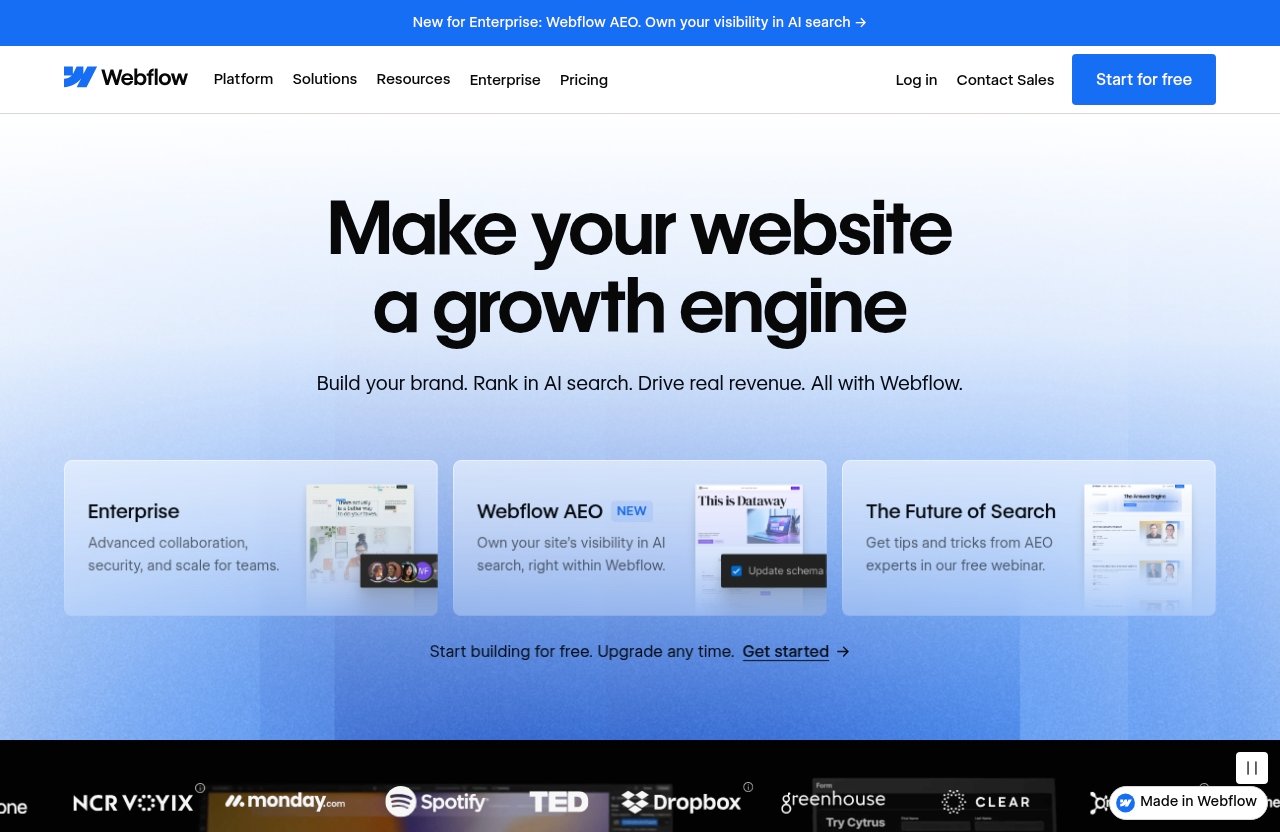
Webflow remains a premium benchmark in the no-code and visual development space. Before choosing among webflow alternatives, it helps to understand what Webflow actually does well and why many users still decide to switch.
Webflow strengths from the official platform
Webflow describes itself as an AI-native platform for modern businesses. Its official platform capabilities include Design, Edit content, Interactions, Collaboration, Page building, CMS, Hosting, Localize, Security, Shared Libraries, Analyze, Optimize, SEO, AEO, Apps, Figma to Webflow, Webflow Cloud, DevLink, and MCP.
That is a broad platform, not just a basic website builder. Webflow is designed for teams that want visual design control, structured content, publishing workflows, collaboration, hosting, optimization, and advanced website operations under one roof.
The official Webflow site plans also show its positioning. The Starter plan is free and includes a Webflow.io domain, limited Webflow CMS, 2 static pages, 1 GB bandwidth, 50 form submissions, Webflow AI, MCP server, Webflow Cloud app hosting, and a Free Starter Workspace.
The Basic plan is $15/mo billed yearly and includes a custom domain, 300 static pages, 10 GB bandwidth, unlimited form submissions, password protection, Webflow AI, MCP server, Webflow Cloud app hosting, and a Free Starter Workspace. The Premium plan is $25/mo billed yearly and includes everything in Basic plus Webflow CMS, code components, site search, form file upload, and well-known files.
Webflow Team is $2500/mo with an annual contract required and includes everything in Premium plus Site & Workspace, Webflow Localize, AEO agents, publishing workflows, single-page publishing, site activity log & API, foundational governance, enhanced security & compliance, and priority support. Webflow Enterprise is custom pricing and includes everything in Team plus enterprise-ready scale, granular permissions, custom roles, advanced governance, secure integrations, a dedicated account manager, enhanced SLAs, and custom configurations.
All Webflow prices are listed in USD per site, plus applicable taxes at checkout.
Common pain points: learning curve, cost, complexity
The main reason people search for webflow alternatives is not that Webflow lacks features. It is usually the opposite: the platform can feel too capable, too structured, or too expensive for a straightforward site.
For a designer, Webflow’s depth can be a strength. For a solo founder who just needs a five-page services site, the same depth can become friction.
Common pain points include:
- A steeper learning curve than template-first builders
- More design and layout decisions than beginners expect
- Pricing that can feel high as site needs grow
- Complexity when handing a site to a non-technical client
- More platform structure than needed for a simple brochure site
- A feeling that CMS, localization, AEO, workflows, and collaboration tools are overkill for small projects
This is why terms like easy webflow alternatives, cheaper than webflow, and even webflow alternatives reddit keep appearing in buyer research. Many users are not rejecting Webflow’s quality; they are trying to match the tool to their real workload.
When switching away makes sense
Switching away from Webflow makes sense when your website goals are simple, your team is non-technical, or your budget is tight. If you mainly need a portfolio, a restaurant site, a local service business site, or a basic landing page, you may not need Webflow’s full design and operations stack.
It also makes sense if ecommerce is your primary use case. A commerce-first platform can be easier to manage when your daily work involves products, orders, payments, and storefront operations.
On the other hand, if you need a high-control marketing site, structured CMS, advanced collaboration, localization, SEO, AEO, and scaling workflows, Webflow may still be worth comparing as the premium benchmark. If, after reviewing these webflow alternatives, you still think Webflow fits your needs, you can check it through TopTrustReview’s Webflow link while comparing your final shortlist.
Top Webflow Alternatives Ranked by Use Case
The best webflow alternatives are not interchangeable. Some are easier, some are cheaper, some are more flexible, and some are better for ecommerce or open-source control.
1. Framer — best for marketing sites and fast visual editing
Framer is the strongest option for teams that like the idea of Webflow but want a faster, more streamlined visual workflow. It is especially attractive for marketing sites, startup pages, product launches, and landing pages where visual polish matters.
In the framer vs webflow comparison, Framer often feels more immediate. Designers and marketers can move quickly, test page ideas, and publish modern-looking layouts without feeling buried in a heavier site architecture.
Key pros:
- Strong fit for marketing websites and landing pages
- Design-forward editing experience
- Good choice for fast iteration
- Easier for teams that prioritize visual speed over deep site operations
Key tradeoffs:
- May not be the best fit for complex CMS-heavy sites
- Less obvious choice for large content operations
- Teams with advanced governance needs may still prefer Webflow
Choose Framer if you want one of the most design-focused webflow alternatives and your site is primarily built around pages, campaigns, and conversion-oriented marketing.
Skip it if your main need is a large editorial CMS, highly structured content operations, or enterprise-grade website governance.
2. Squarespace — best for beginners who want polished templates
Squarespace is best for users who want a professional-looking site without thinking too much about layout systems, class structures, or design implementation. It is a strong choice for portfolios, consultants, restaurants, creators, and service businesses.
In a webflow vs squarespace decision, Squarespace usually wins on simplicity. Webflow usually wins on design control and advanced workflow depth.
Squarespace’s biggest advantage is that it reduces decision fatigue. You start with a polished foundation, customize it, add content, and publish. For many small businesses, that is exactly the right amount of control.
Key pros:
- Beginner-friendly website creation
- Polished template-led experience
- Good for portfolios, service pages, and simple business sites
- Less intimidating for non-designers
Key tradeoffs:
- Less flexible than Webflow for custom layouts
- Not ideal for teams that need advanced design systems
- May feel limiting for complex content structures
Squarespace is one of the best webflow alternatives if your top priority is launching a clean, credible site with minimal learning curve.
Skip it if you want full creative control or if your site depends on complex CMS structures and advanced interactions.
3. Wix — best for all-in-one simplicity and broad features
Wix is a strong all-in-one choice for users who want a practical website builder with broad capabilities and a softer learning curve. It works well for small businesses, creators, local services, and users who want to manage their site without a developer.
In a webflow vs wix comparison, Wix is typically easier for beginners. Webflow is more appealing when design precision, CMS structure, collaboration, and advanced website workflows matter.
Wix’s strength is approachability. If you want to build a site, add common business features, and keep everything in one environment, it deserves a spot on your shortlist.
Key pros:
- Simple all-in-one website-building experience
- Good for non-technical users
- Broad fit for small business websites
- Easier onboarding than Webflow for many beginners
Key tradeoffs:
- Less suitable for advanced custom design systems
- May not satisfy users who want designer-level layout control
- Can become less ideal as technical requirements grow
Wix is one of the most practical webflow alternatives for people who want to avoid complexity and just get a functional site online.
Skip it if your team needs granular visual control, advanced development workflows, or a highly customized design system.
4. WordPress — best for flexibility and ecosystem depth
WordPress remains one of the most important webflow alternatives because it solves a different problem. Rather than being a tightly guided visual website platform, WordPress is known for flexibility, ecosystem depth, and long-term ownership.
The webflow vs wordpress choice often comes down to workflow preference. Webflow gives you a more controlled visual design environment with hosting and platform features. WordPress gives you a huge ecosystem, but you may need to make more decisions about hosting, themes, plugins, maintenance, and security.
WordPress is especially appealing for content-heavy sites, publishers, blogs, niche sites, communities, and businesses that want maximum ecosystem choice. It can also be a good fit for teams that already have WordPress developers or editors.
Key pros:
- Deep ecosystem and flexibility
- Strong fit for content-heavy sites
- Large community and broad third-party support
- More control over hosting and technical stack
Key tradeoffs:
- More moving parts to manage
- Quality depends heavily on theme, plugin, and hosting choices
- Maintenance can become a real operational task
WordPress is a smart choice if you want flexibility and are comfortable managing the stack. It is less ideal if you want a guided, hosted, visual-first experience with fewer technical decisions.
5. Hostinger Website Builder — best for budget-conscious users
Hostinger Website Builder is worth considering if your main goal is to find something simpler and more budget-oriented. It is best for personal sites, small business pages, lean startup projects, and users who want a basic website without a premium platform feel.
Among webflow alternatives, Hostinger Website Builder stands out for cost-conscious buyers. The key reason to evaluate it is not advanced design power; it is whether it gives you enough website-building capability for a lower overall commitment.
This is the kind of platform I would shortlist for a simple brochure site, a basic service business, or a starter project where keeping costs low matters more than design precision.
Key pros:
- Good fit for budget-conscious website projects
- Simpler builder experience
- Practical for basic small business sites
- Lower-complexity option for beginners
Key tradeoffs:
- Not the best match for advanced design systems
- Less suitable for complex CMS workflows
- May feel limiting as a brand or content operation grows
Choose Hostinger Website Builder if you want something potentially cheaper than webflow and your requirements are modest.
Skip it if your site is a core growth channel requiring advanced design, CMS, localization, collaboration, or optimization workflows.
6. Shopify — best for ecommerce-first businesses
Shopify is the clearest choice when ecommerce is the center of the business. If your main website job is selling products, managing a storefront, and supporting commerce workflows, Shopify should be evaluated before general-purpose builders.
Webflow can be part of a sophisticated web presence, but Shopify’s appeal is its ecommerce-first focus. For merchants, the right question is not “Which builder has prettier layouts?” It is “Which platform makes selling and operating the store easier?”
Shopify is best for product catalogs, direct-to-consumer brands, retail businesses, and founders who want their website platform to revolve around commerce.
Key pros:
- Strong fit for ecommerce-first businesses
- Built around selling products online
- Better aligned with store operations
- Good choice when checkout and commerce workflows matter most
Key tradeoffs:
- Not always the best choice for non-commerce websites
- Design flexibility may not be the primary reason to choose it
- Content-heavy brands may still need to consider CMS needs carefully
Shopify is one of the top webflow alternatives if your site’s revenue depends directly on online sales.
Skip it if you mainly need a content-rich marketing site, portfolio, or non-commerce business website.
7. Webstudio — best open-source alternative for control and clean workflows
Webstudio is the best option in this list for users specifically seeking open-source control. If your search includes webstudio vs webflow or webflow alternatives open source, Webstudio should be on your radar.
Its appeal is not that it is the simplest beginner builder. It is more interesting for technical founders, agencies, and builders who want a cleaner sense of ownership and control while staying close to visual website-building workflows.
Webstudio can be attractive when you want to avoid being fully locked into a proprietary platform model. That said, open-source-friendly tools often require more judgment from the user, especially when compared with tightly packaged website builders.
Key pros:
- Open-source appeal
- Good fit for control-focused builders
- Interesting for agencies and technical users
- Cleaner ownership posture than many closed platforms
Key tradeoffs:
- May not be as beginner-friendly as template-first tools
- Requires more technical confidence
- Smaller ecosystem than long-established platforms
Webstudio is one of the most interesting webflow alternatives for people who care about control, portability, and open-source direction.
Skip it if you want the easiest possible onboarding or a mainstream template-first website builder.
Official website · Latest pricing & offers
Best Webflow Alternative by Scenario
This section is designed for fast decision-making. If you are shortlisting webflow alternatives, start with your main constraint, then pick the tool that best matches it.
If you need the easiest builder
Choose Squarespace if you want the easiest path to a polished site. It is the best fit for beginners who care more about looking professional than controlling every pixel.
Choose Wix if you want an all-in-one builder with broad business use cases. It can be easier to approach than Webflow, especially for users who do not think like designers or developers.
The easiest webflow alternatives are usually not the most flexible ones. That is the tradeoff: you give up some control in exchange for speed and clarity.
If you need the cheapest starting point
Start by checking Hostinger Website Builder if your budget is the main filter. It is especially relevant for simple sites where the goal is to get online without a heavy platform commitment.
Also compare Webflow’s official Starter, Basic, and Premium plans carefully. Webflow Starter is free with a Webflow.io domain and limits, while Basic is $15/mo billed yearly and Premium is $25/mo billed yearly, all in USD per site plus applicable taxes.
If your only question is “What is cheaper than webflow?” the answer can change depending on your exact plan, billing term, domain needs, CMS requirements, and add-ons. Always compare total cost of ownership, not just the first price you see.
If you need stronger design flexibility
Choose Framer if you want a faster visual design experience for marketing pages. It is the closest option for users comparing webflow vs framer because both appeal to design-minded teams.
Choose Webflow if you need more advanced platform capabilities around CMS, collaboration, localization, optimization, AEO, and workflows. That does not make it the right choice for everyone, but it does explain why Webflow remains a premium benchmark.
Among webflow alternatives, Framer is the most natural pick for designers who want speed without moving into a traditional CMS environment.
If you need ecommerce
Choose Shopify if your site is primarily a store. Ecommerce-first businesses should not force a general website builder to act like a commerce operations platform unless there is a clear reason.
Squarespace or Wix may work for simpler selling needs, depending on your requirements, but Shopify is the more obvious shortlist candidate for serious online stores.
If ecommerce is only a small part of your website, compare Shopify against your broader site needs. If ecommerce is the business, start with Shopify.
If you need open-source control
Choose Webstudio if open-source direction and control matter. It is the clearest answer for users searching for webflow alternatives open source.
Choose WordPress if you want a mature ecosystem with extensive third-party support and more control over hosting and implementation choices. It may require more maintenance, but it remains highly flexible.
Open-source control is rarely the easiest route. It is best for people who value ownership enough to accept more responsibility.
If you are an agency or freelancer
For agencies, the best platform depends on the client handoff. A beautiful Webflow project can become a support burden if the client cannot confidently edit it.
Use Squarespace or Wix for clients who need simple updates and low complexity. Use Framer for campaign-driven marketing sites. Use WordPress when the client needs long-term ecosystem flexibility. Use Shopify when the client sells products as the core business.
Agencies comparing webflow alternatives should create an internal decision matrix. The right tool for a design-led startup may be the wrong tool for a local service business.
Webflow vs Top Alternatives: How They Compare in Real-World Use
The most useful way to compare webflow alternatives is by real-world workflow: how quickly you can launch, how easily the client can edit, how much design control you get, and how painful scaling becomes.
Webflow vs Framer
The webflow vs framer decision is mostly about depth versus speed. Webflow is stronger when you need a broader platform with CMS, hosting, collaboration, localization, SEO, AEO, apps, Figma to Webflow, Webflow Cloud, DevLink, and MCP.
Framer is often better for fast-moving marketing sites, landing pages, and design-led teams that want to publish quickly. It can feel lighter and more immediate.
Choose Webflow when your site is becoming an operational platform. Choose Framer when your website is mostly a high-quality marketing surface that needs fast iteration.
Webflow vs Squarespace
In webflow vs squarespace, Squarespace is easier for beginners and template-led projects. It is usually the more comfortable option for small business owners, creators, and service providers who want a polished website without learning a complex visual design system.
Webflow offers more design and platform depth. That matters if you need structured content, advanced workflows, localization, optimization, AEO, or collaboration.
Choose Squarespace for simplicity. Choose Webflow for custom design control and more advanced site operations.
Webflow vs Wix
The webflow vs wix comparison is about all-in-one simplicity versus advanced visual control. Wix is generally a better fit for non-technical users who want a broad website builder experience and a straightforward path to launch.
Webflow is better suited to design-focused teams, agencies, and businesses that need more control over layout, CMS, collaboration, and scaling workflows.
Choose Wix if you want practical simplicity. Choose Webflow if your website is central to brand, content, and growth operations.
Webflow vs WordPress
The webflow vs wordpress decision depends heavily on how much ownership and ecosystem flexibility you want. WordPress is powerful because its ecosystem is broad, but that breadth also means more decisions.
Webflow gives you a more integrated visual platform experience. It reduces some stack decisions while offering design, CMS, hosting, collaboration, localization, SEO, AEO, and other platform capabilities.
Choose WordPress if you want flexibility and are comfortable managing more moving parts. Choose Webflow if you want a more guided visual platform for modern website operations.
Webflow vs Shopify
Webflow and Shopify are not direct substitutes for every use case. Shopify is ecommerce-first, while Webflow is a broader AI-native platform for modern business websites.
If product sales, checkout, and store operations are the center of your business, Shopify is usually the cleaner recommendation. If your site is more about brand, content, design, CMS, localization, SEO, AEO, and advanced publishing workflows, Webflow may be more relevant.
Among webflow alternatives, Shopify is the easiest recommendation when ecommerce is the primary business model.
How to Choose the Right Webflow Alternative
Choosing among webflow alternatives is easier when you stop comparing feature lists and start mapping the platform to your operating reality.
Budget and total cost of ownership
Do not compare only headline pricing. Look at the full cost of ownership: plan level, billing term, domain, hosting, CMS needs, ecommerce tools, templates, extensions, maintenance, and the time required to manage the site.
Webflow’s official site plan context is clear: Starter is free with limits, Basic is $15/mo billed yearly, Premium is $25/mo billed yearly, Team is $2500/mo with an annual contract, and Enterprise is custom pricing. These are USD per site, plus applicable taxes at checkout.
For competitors, verify current pricing directly before buying. Pricing changes often, and the cheapest platform on day one is not always the cheapest after your site grows.
CMS and content operations
If your website has only a few static pages, you probably do not need a heavyweight CMS. Squarespace, Wix, Hostinger Website Builder, or Framer may be enough.
If your site has many content types, editorial workflows, or long-term publishing plans, compare WordPress and Webflow carefully. Webflow includes CMS capabilities on relevant plans, while WordPress offers deep ecosystem flexibility.
The best webflow alternatives for content-heavy teams are usually WordPress for ecosystem depth or Framer for lighter marketing content. The right answer depends on content volume and who maintains it.
Design control vs simplicity
More design control usually means more responsibility. Webflow gives skilled users a lot of control, but that control can slow beginners down.
Squarespace and Wix reduce the number of decisions. Framer keeps the visual experience design-forward while feeling faster for marketing pages. Webstudio appeals to users who want control with an open-source direction.
If your team does not have design confidence, choose simplicity. If your brand depends on custom design, choose flexibility.
Client collaboration and handoff
For agencies and freelancers, handoff is often the hidden deal-breaker. A client who cannot update their website will keep returning for basic edits, even if the platform is excellent.
Webflow includes collaboration capabilities and higher-tier workflow features, but not every client needs that level of platform. Smaller clients may be happier with Squarespace or Wix because they can understand the editing model quickly.
Before choosing among webflow alternatives, ask who will update pages, publish content, change images, and manage forms after launch. The answer often decides the platform.
SEO, localization, and scaling
Webflow officially includes SEO and AEO capabilities, along with Localize, Analyze, Optimize, Security, Shared Libraries, Apps, Webflow Cloud, DevLink, and MCP among its platform capabilities. That makes it attractive for businesses thinking beyond a basic site.
For simpler SEO needs, many no code website builders can be sufficient if the site structure and content strategy are sound. For multilingual or scaling operations, compare platform support carefully before committing.
If localization, governance, security, workflows, and scaling are serious requirements, Webflow may remain the benchmark. If you only need a clean five-page site, simpler webflow alternatives can be the better business decision.
Final Recommendation: Which Webflow Alternative Should You Pick?
The best webflow alternatives in 2026 are scenario-specific. Do not pick a platform because it is popular; pick the one that matches your budget, team skill, content needs, ecommerce model, and maintenance reality.
Best overall
Framer is the best overall alternative for design-led marketing sites. It gives many teams the visual speed they wanted from Webflow while feeling better suited to fast page creation and campaign work.
Choose it if your site is mostly landing pages, product pages, startup marketing, or visual storytelling. Skip it if you need deep CMS operations or advanced enterprise-style workflows.
Best for beginners
Squarespace is the best beginner-friendly choice. It is ideal for users who want a polished site without spending weeks learning a visual development platform.
Wix is also a strong beginner option if you want broader all-in-one flexibility. Both are practical webflow alternatives for non-technical users.
Best for designers
Framer is the strongest pick for designers who want fast visual editing. It is especially compelling in the framer vs webflow conversation when speed and presentation matter most.
Webflow still wins when the designer also needs more advanced CMS, collaboration, localization, SEO, AEO, optimization, and scaling capabilities. That is why the right choice depends on whether you are building pages or operating a larger web platform.
Best for ecommerce
Shopify is the best ecommerce-first recommendation. If your website exists mainly to sell products, start there.
Other builders can support simpler commerce needs, but Shopify is the cleanest shortlist choice when online selling is the core business.
Best for open source
Webstudio is the best open-source-oriented option. It is most relevant for users searching for webflow alternatives open source and for teams that value control over maximum beginner simplicity.
WordPress is also a strong choice if you want ecosystem depth, content flexibility, and broad implementation options. It may require more maintenance, but it remains one of the most durable alternatives to Webflow.
Final shortlist:
| User Type | Best Pick |
|---|---|
| Fast marketing site | Framer |
| Beginner website | Squarespace |
| All-in-one small business site | Wix |
| Content-heavy or flexible site | WordPress |
| Budget-conscious simple site | Hostinger Website Builder |
| Ecommerce-first brand | Shopify |
| Open-source control | Webstudio |
If you need the simplest option, choose Squarespace or Wix. If you need the closest design-led alternative, choose Framer. If you need ecommerce, choose Shopify. If you need ecosystem flexibility, choose WordPress. If you need open-source control, choose Webstudio.
And if, after comparing these webflow alternatives, you decide you still need the premium benchmark with AI-native platform capabilities, CMS, hosting, collaboration, localization, SEO, AEO, and scaling features, you can review Webflow through TopTrustReview’s Webflow link before making your final decision.
Official website · Latest pricing & offers
FAQ
What is better than Webflow?
The best option depends on your use case. Framer can be better for fast visual editing and marketing sites, Squarespace can be better for beginners, Shopify can be better for ecommerce, and WordPress can be better for ecosystem flexibility.
Webflow is still strong for teams that need advanced design control, CMS, hosting, collaboration, localization, SEO, AEO, and scaling workflows. But many webflow alternatives are better if your priority is simplicity or lower operational complexity.
Is Wix or Webflow cheaper?
Webflow’s official site plans include Starter for free with a Webflow.io domain and limits, Basic at $15/mo billed yearly, Premium at $25/mo billed yearly, Team at $2500/mo with an annual contract, and Enterprise with custom pricing. All prices are in USD per site, plus applicable taxes at checkout.
Wix pricing should be checked directly before buying because plans and promotions can change. In general, compare total cost of ownership rather than assuming one platform is always cheaper.
Will AI replace Webflow?
AI is changing website building, but it is more accurate to say that platforms are integrating AI into workflows rather than being fully replaced by it. Webflow already describes itself as an AI-native platform for modern businesses and includes Webflow AI in its listed site plans.
AI may speed up drafting, layout creation, content editing, optimization, and support tasks. Human judgment will still matter for brand strategy, UX, conversion, content quality, and technical decisions.
Is WordPress better than Webflow in 2026?
WordPress can be better if you want ecosystem flexibility, broad third-party support, and more control over your stack. It is especially attractive for content-heavy sites and teams comfortable managing hosting, themes, plugins, and maintenance.
Webflow can be better if you want a more guided visual platform with design, CMS, hosting, collaboration, localization, SEO, AEO, and scaling capabilities in one environment. In 2026, the better choice depends on your team’s skill level, site complexity, and how much control you want over the technical stack.
Related Reading
- Webflow vs Hostinger: Which Builder Wins in 2026?
- Best Systeme.io Alternatives in 2026
- Best Cheap Cloud Hosting: 7 Top Picks
References
- Great alternatives to Webflow?
- Best Webflow Alternatives: 14 Website Builders Reviewed
- Webstudio: Best Alternative in the Webflow vs Framer Debate?
- 7 Best Webflow Alternatives for 2026