Top Skool Alternatives for 2026

Official website · Latest pricing & offers
Introduction: Why creators look for Skool alternatives in 2026
If you are comparing the top skool alternatives, you are probably not looking for “just another community tool.” You are trying to decide where your audience, courses, memberships, events, and revenue should live in 2026.
Skool has become a popular benchmark because it combines community, courses, live interaction, and monetization in a simple structure. Still, many creators eventually compare Skool competitors because their business model needs more branding, deeper course tools, stronger marketing automation, lower fees, or more control over the customer experience.
This guide is written for practical comparison shoppers. It looks at the best skool alternatives by use case, not just by popularity.
What Skool does well
Skool works well for creators who want a simple community-plus-courses setup without building a complicated tech stack. Based on Skool’s official pricing page, it offers a 14-day free trial, a Hobby plan at $9/month, and a Pro plan at $99/month labeled “Good choice!”
The Hobby plan includes unlimited members, unlimited courses, unlimited videos, unlimited live calls, a custom URL, affiliates, and a 10% transaction fee. The Pro plan includes the same unlimited usage categories, custom URL, affiliates, and a 2.9% transaction fee.
That makes Skool easy to understand compared with platforms where pricing depends on many feature gates. If you want to test Skool directly, you can review it through our Skool affiliate link here: try Skool via TopTrustReview.
Why people start comparing other platforms
Creators usually start researching the top skool alternatives for one of six reasons:
- They want more control over branding and the member experience.
- They need stronger native marketing, funnels, or email automation.
- They sell structured courses and want more learning-management depth.
- They run a creator business with multiple products, offers, and checkout flows.
- They want lower transaction fees or different payment options.
- They prefer open, free, or self-hosted community models.
None of those reasons means Skool is bad. It simply means the “best” platform depends on your business model.
For example, a paid coaching community may care most about engagement and simplicity. A course business may care more about curriculum structure, checkout pages, certificates, student progress, or marketing integrations.
How to use this list
Use this list as a decision framework, not a popularity contest. The top skool alternatives are grouped around real creator needs: community building, course delivery, monetization, branding, marketing, and ownership.
If you are still deciding whether a lightweight community model fits your audience, our guide to Skool vs Facebook Groups is also useful. If your real bottleneck is marketing automation, you may also want to compare tools like Systeme.io vs ActiveCampaign before choosing your platform.
Quick comparison table: best Skool alternatives by use case
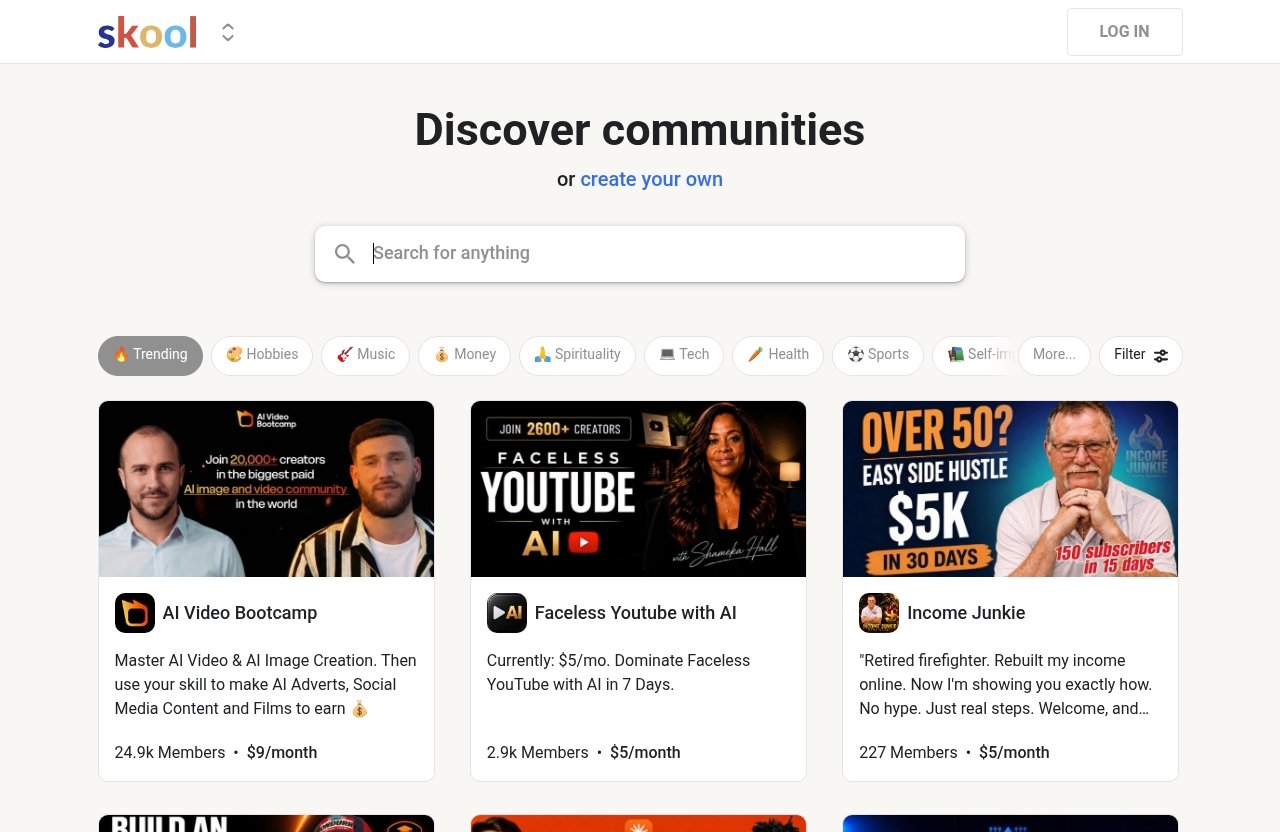
The table below summarizes the top skool alternatives for 2026. Pricing notes are intentionally high-level unless official vendor pricing is being quoted; for competitor platforms, always verify the current plan details on the official site before buying.
| Platform | Best For | Standout Strength | Pricing Note |
|---|---|---|---|
| Circle | Branded creator communities | Polished community spaces, events, courses, member experience | Check official pricing |
| Mighty Networks | Community-led brands and memberships | Branded networks, community activity, creator-led experiences | Check official pricing |
| TagMango | Creator businesses selling knowledge products | Teaching, selling, and growth workflows for creators | Check official pricing |
| Kajabi | Premium course businesses | All-in-one courses, marketing, payments, and website tools | Check official pricing |
| Thinkific | Course-first educators | Structured course delivery and student learning experience | Check official pricing |
| Teachable | Solo course sellers | Course selling, digital products, simple creator monetization | Check official pricing |
| Heartbeat | Cohort communities and live learning | Community, events, conversations, and member engagement | Check official pricing |
| Bettermode | Branded customer or member communities | Customizable community portals and brand control | Check official pricing |
| Discord | Free or informal community building | Real-time chat, open community culture, flexible servers | Free and paid options may vary; check official details |
| Discourse | Open-source-style forum communities | Searchable discussions, ownership, long-form community knowledge | Check official hosting or self-hosting costs |
Best for community-first creators
For community-first creators, Circle, Mighty Networks, Heartbeat, Discord, and Discourse are the most relevant top skool alternatives. These platforms focus heavily on conversation, member interaction, discussion spaces, and recurring engagement.
Circle and Mighty Networks feel more creator-business oriented. Discord is more informal and fast-moving. Discourse is stronger when your community needs searchable, long-term discussions.
Best for courses and memberships
For courses and memberships, Kajabi, Thinkific, Teachable, TagMango, and Circle deserve close attention. These platforms are often better fits when learning structure, product packaging, checkout, and student management matter more than a simple community feed.
The right choice depends on whether you sell high-ticket coaching, self-paced courses, memberships, digital products, or a mix.
Best for all-in-one marketing
Kajabi is the clearest all-in-one business platform in this list. Systeme.io may also be worth reviewing if your main priority is affordable funnels and automation rather than a dedicated community platform; our Systeme.io for Solopreneurs guide explains that angle in more detail.
Among the top skool alternatives, Kajabi tends to appeal to creators who want fewer separate tools for website, email, landing pages, products, and payments.
Best budget option
Discord is usually the first option creators consider when they want a low-cost or free-style community. Discourse can also be cost-effective for technical teams that are comfortable with hosting and maintenance.
However, budget should not be measured only by the monthly platform fee. Moderation time, integrations, payment setup, onboarding friction, and member confusion can all increase your real cost.
Best for ownership and branding
Bettermode, Circle, Mighty Networks, Kajabi, and Discourse are strong candidates if branding and ownership matter. These top skool alternatives give creators more room to shape the experience than a generic social group.
If your community is part of a larger brand, course school, agency, or media business, customization may matter more than speed of setup.
How we chose the best Skool alternatives
Choosing the top skool alternatives requires more than comparing feature checklists. Creator platforms can look similar on the surface but serve very different business models.
This review prioritizes commercial usefulness: which platform helps a creator attract, serve, retain, and monetize an audience with the least unnecessary friction.
Selection criteria
We evaluated each platform using practical creator-business criteria:
- Community experience and member engagement
- Course hosting and learning structure
- Live events and group interaction
- Monetization options and product flexibility
- Branding, custom domain, and ownership
- Integrations with marketing and operations tools
- Mobile experience and ease of use
- Analytics and member insights
- Affordability and pricing transparency
Because platform pricing and plan limits change often, this article avoids quoting competitor pricing unless it is verified from official vendor pages at the time of review. For Skool, only the official facts provided above are used.
Feature categories reviewed
The biggest mistake creators make is comparing platforms only by whether they “have community” or “have courses.” The real difference is how well each feature supports your workflow.
For example, a coach running weekly calls needs scheduling, reminders, member engagement, and replays. A course seller needs curriculum structure, checkout, progress tracking, and upsells. A brand community may need moderation, permissions, analytics, and integrations.
The top skool alternatives in this guide were selected because each one has a clear reason to exist for creators, educators, coaches, or community builders.
What matters most for creators
The best platform is the one your members will actually use and your business can actually maintain. A powerful platform with poor engagement is not better than a simple one that your audience loves.
Before switching from Skool or any other platform, ask three questions:
- Will this improve the member experience?
- Will this make monetization easier or more profitable?
- Will this reduce operational complexity over the next 12 months?
If the answer is not clear, test before migrating.
Top 10 Skool alternatives for 2026
Below are the top skool alternatives for creators, coaches, educators, and membership owners in 2026. Each review includes the best use case, strengths, where it may beat Skool, possible drawbacks, and who should skip it.
1. Circle
Circle is one of the strongest Skool competitors for creators who want a polished, branded community experience. It is commonly considered when buyers compare circle vs skool because both platforms appeal to community-led creators.
Best for: creators, coaches, educators, and membership businesses that want a premium community hub.
Key strengths:
- Clean community experience
- Flexible member spaces
- Strong fit for paid memberships
- Good option for branded creator communities
- Useful for events, discussions, and learning-based groups
Circle may beat Skool for creators who care deeply about the look and structure of their community. If you want more control over spaces, member segmentation, and a more brand-led experience, Circle is a serious contender among the top skool alternatives.
The tradeoff is that more flexibility can also mean more setup decisions. Skool’s appeal is its simplicity; Circle may require more thoughtful community architecture.
Who should consider it: membership owners, cohort leaders, professional communities, and creators who want a modern branded community.
Who should skip it: creators who want the fastest possible setup and do not want to think much about configuration.
2. Mighty Networks
Mighty Networks is another major option for community-led businesses. The mighty networks vs skool comparison usually comes down to whether you want a simple gamified community or a more expansive branded network.
Best for: creators building a community-driven brand, membership, or learning network.
Key strengths:
- Community-first experience
- Strong brand and network positioning
- Good fit for memberships and creator ecosystems
- Mobile-friendly member access
- Useful for creators who want a destination beyond social media
Mighty Networks may beat Skool when your goal is to build a broader branded network rather than a simple community attached to courses. It can work well for creators who want a sense of place, identity, and ongoing member activity.
The possible drawback is complexity. If your business is a single paid group with a few courses and calls, you may not need the extra structure.
Who should consider it: community brands, membership founders, coaches, and educators who want a more branded destination.
Who should skip it: creators who want a minimal setup and prefer Skool’s straightforward structure.
3. TagMango
TagMango is worth considering if you are comparing tagmango vs skool from the perspective of selling knowledge products. It is positioned more around creator business workflows than pure community simplicity.
Best for: creators who want to teach, sell, and grow from one creator-focused platform.
Key strengths:
- Creator-business orientation
- Useful for selling knowledge products
- Good fit for coaching, education, and creator monetization
- More business-workflow focused than a simple community tool
TagMango may beat Skool for creators who need more selling and growth workflows around their educational offers. If your business is not just “community plus courses” but also launches, digital products, workshops, and creator monetization, TagMango may fit your thinking better.
The possible drawback is that buyers should carefully verify current feature depth, integrations, and regional payment support on the official site. Creator platforms can vary significantly by market and use case.
Who should consider it: creator-educators, coaches, and influencers selling structured offers.
Who should skip it: community-first founders who want the cleanest possible member discussion experience.
4. Kajabi
Kajabi is one of the most important top skool alternatives for creators who want an all-in-one business platform. The kajabi vs skool decision is less about community and more about business infrastructure.
Best for: established creators selling premium courses, coaching, memberships, and digital products.
Key strengths:
- Strong all-in-one positioning
- Course and product sales workflows
- Website and marketing ecosystem
- Good fit for premium creator businesses
- Reduces the need for multiple disconnected tools
Kajabi may beat Skool if your priority is running a full digital product business with marketing, product pages, email workflows, and a more complete sales system. It is often a better fit for creators who think in funnels, offers, launches, and customer journeys.
Skool may still feel easier if your main priority is a community where members log in, engage, and consume simple course content. Kajabi can be more platform than some beginners need.
Who should consider it: advanced course creators, coaches, consultants, and digital product businesses.
Who should skip it: creators who mainly need a lightweight community and do not want an all-in-one marketing stack.
5. Thinkific
Thinkific is a course-first platform and one of the most relevant top skool alternatives for educators. The thinkific vs skool comparison usually comes down to course depth versus community simplicity.
Best for: educators and course creators who prioritize structured learning.
Key strengths:
- Course-first platform design
- Strong fit for self-paced education
- Useful for building a course catalog
- Good option for creators who care about learning delivery
- More education-oriented than pure community platforms
Thinkific may beat Skool if your business depends on delivering a polished learning experience. If you sell multiple courses, need organized curriculum flows, or want a more traditional course platform, Thinkific should be on your shortlist.
The drawback is that a course-first platform may not create the same community energy by default. If member conversation and gamified participation are central to your offer, you need to evaluate the community side carefully.
Who should consider it: teachers, trainers, subject-matter experts, and creators selling structured education.
Who should skip it: founders whose main product is an active peer community rather than courses.
6. Teachable
Teachable is another course-selling platform that often appears in teachable vs skool comparisons. It is especially relevant for solo creators who want a straightforward way to sell digital learning products.
Best for: creators selling courses, coaching, downloads, or simple educational products.
Key strengths:
- Creator-friendly course selling
- Good fit for solo educators
- Simple product packaging
- Familiar course marketplace-style experience
- Useful for creators who do not want heavy community management
Teachable may beat Skool when the core business is selling educational products rather than building a high-touch community. If you want customers to buy, learn, and move through content without requiring daily discussion, Teachable can be practical.
The possible drawback is that community may not feel as central as it does in Skool. If your paid offer depends on accountability, peer engagement, and ongoing interaction, compare carefully.
Who should consider it: solo course creators, coaches, and educators selling straightforward products.
Who should skip it: creators who need community engagement to drive retention and results.
7. Heartbeat
Heartbeat is one of the top skool alternatives for creators running cohort-based programs, learning groups, or live communities. It is often considered by people who want a community environment with strong conversation and event flow.
Best for: live learning communities, cohort programs, and engaged member groups.
Key strengths:
- Strong fit for community conversations
- Useful for events and live interaction
- Good option for cohort-based education
- Designed for member engagement
- Practical for groups that need more than a forum
Heartbeat may beat Skool if your community revolves around live sessions, cohorts, ongoing discussion, and active facilitation. It can be a good fit when the community experience itself is the product.
The drawback is that creators should verify whether its course, commerce, and integration options match their exact business model. If you need an all-in-one marketing system, it may not be the first choice.
Who should consider it: cohort leaders, coaches, community builders, and live-program operators.
Who should skip it: creators who mainly need advanced funnel, checkout, or course-business tooling.
8. Bettermode
Bettermode is a strong choice for creators and companies that need a highly branded community. Among the top skool alternatives, it stands out for communities where customization and ownership matter more than creator simplicity.
Best for: branded communities, customer communities, and businesses that need design control.
Key strengths:
- Customizable community experience
- Good fit for branded portals
- Useful for member knowledge bases and discussions
- Stronger brand control than many lightweight tools
- Practical for companies as well as creators
Bettermode may beat Skool when the community needs to feel like part of your own product or website. If you care about structured spaces, brand design, and a more tailored experience, it deserves attention.
The possible drawback is that it may be more than a solo creator needs. If you are building your first paid membership, a simpler platform may get you moving faster.
Who should consider it: established brands, agencies, product communities, and creators with serious branding needs.
Who should skip it: beginners who want the least complicated path to launch.
9. Discord
Discord is one of the most common budget-friendly Skool competitors, especially for creators with audiences already comfortable with chat-based communities. It is different from most top skool alternatives because it started as a real-time communication platform rather than a creator course platform.
Best for: free communities, informal groups, fan communities, and real-time discussion.
Key strengths:
- Familiar to many online communities
- Fast real-time chat
- Flexible channels and roles
- Useful for open or low-cost community experiments
- Strong culture for gaming, tech, Web3, and creator audiences
Discord may beat Skool if your audience prefers fast conversation and you do not need a structured course environment. It can also be a smart testing ground before investing in a paid community platform.
The drawback is organization. Chat moves quickly, content can get buried, and monetization or learning workflows may require extra tools or manual processes.
Who should consider it: creators testing community demand, fan communities, and groups that value real-time chat.
Who should skip it: educators selling structured courses, premium coaching, or searchable knowledge libraries.
10. Discourse
Discourse is a forum-style option for creators and organizations that want searchable, long-form community discussions. It belongs on a list of top skool alternatives because not every community should be built around feeds or chat.
Best for: knowledge communities, forums, technical communities, and long-term discussion archives.
Key strengths:
- Searchable long-form discussions
- Strong fit for support and knowledge sharing
- Good for communities that value depth over speed
- Ownership-friendly compared with closed social platforms
- Useful for technical, professional, and niche communities
Discourse may beat Skool when your community needs durable conversations that members can search months or years later. It is especially useful for technical topics, product communities, and expert-led forums.
The drawback is that Discourse may feel less “creator monetization” oriented out of the box. It can require more planning around payments, onboarding, and integrations.
Who should consider it: technical educators, professional communities, open-source groups, and knowledge-heavy brands.
Who should skip it: creators who want built-in course monetization and a social-learning feel with minimal setup.
Official website · Latest pricing & offers
Best Skool alternative by creator goal
The top skool alternatives only make sense when matched to a specific goal. A coach, agency owner, educator, and fan-community creator may all need different platforms.
If you want a branded community
Choose Circle, Mighty Networks, Bettermode, or Heartbeat if your community is a major part of your brand. These platforms are usually better fits when the member experience needs to feel polished and intentional.
Circle is strong for creator memberships. Mighty Networks is strong for broader community-led brands. Bettermode is better suited to custom branded portals and more structured community environments.
If your brand also has an agency or content operation behind it, you may find our Contentstudio for Agencies guide helpful for managing marketing workflows around your community.
If you want course sales plus funnels
Choose Kajabi if your priority is an all-in-one creator business platform. It is one of the best skool alternatives for creators who want courses, marketing pages, email workflows, and offer management in one ecosystem.
Thinkific and Teachable are better if you mainly care about course delivery and sales, not a full marketing suite. TagMango is worth considering if your creator business needs teaching, selling, and growth workflows in a more creator-focused package.
If you want lower platform costs
Discord and Discourse are the first options to examine if budget is your main constraint. Discord can be useful for testing an audience before turning a community into a paid membership.
However, the cheapest platform is not always the most profitable. If a low-cost setup reduces conversions, retention, or perceived value, it may cost more in the long run than a paid creator platform.
When comparing the top skool alternatives, include transaction fees, payment processing, integrations, email tools, support, migration time, and admin workload in your cost calculation.
If you want a free or open-style community
Discord is the most obvious choice for a free or open-style community. Discourse is a better fit if you want deeper, searchable discussions and more control over the forum-style experience.
Skool is more appropriate when you want a structured creator-community business rather than an open chat or forum. Based on official Skool pricing facts, it does not offer a permanent free version, but it does offer a 14-day free trial.
Skool vs alternatives: feature comparison that matters most
Comparing the top skool alternatives is easier when you focus on feature categories that directly affect revenue and retention.
Community feed and engagement
Skool is designed around a simple community experience with courses and live interaction. That simplicity can help creators launch quickly and avoid overwhelming members.
Circle, Mighty Networks, and Heartbeat may offer a more customizable or branded community feel. Discord is stronger for real-time chat, while Discourse is stronger for searchable, long-form discussions.
If your offer depends on daily accountability, member introductions, wins, and peer feedback, prioritize community UX over course features.
Course delivery
Skool includes unlimited courses and unlimited videos on both its Hobby and Pro plans, according to the official pricing facts provided. That can be attractive for creators who want straightforward course hosting inside a community.
Thinkific, Teachable, Kajabi, and TagMango may be better fits if your course business needs more traditional learning flows or product-selling infrastructure. The right choice depends on whether you need simple content access or a deeper online learning business.
For course-first creators, thinkific vs skool and teachable vs skool are especially important comparisons.
Payments and monetization
Skool’s official pricing facts show that the Hobby plan has a 10% transaction fee, while the Pro plan has a 2.9% transaction fee. Both plans include affiliates.
That matters because transaction fees can significantly affect profit as revenue grows. A beginner may care most about low monthly cost, while an established creator may care more about margin and checkout flexibility.
When comparing the top skool alternatives, check payment methods, tax handling, affiliate options, coupons, subscriptions, one-time payments, bundles, and payout availability directly on each vendor’s official site.
Email marketing and funnels
Skool is not usually chosen as a dedicated funnel or email automation platform. Creators who need deeper marketing workflows often compare kajabi vs skool or connect separate tools.
Kajabi is the strongest option in this list for creators who want a more complete business stack. Some creators may also consider funnel-focused tools outside this article if community is not the core product.
Before buying, map your actual customer journey: lead magnet, email follow-up, sales page, checkout, onboarding, community access, course delivery, and retention.
Customization and ownership
Skool keeps the experience structured and simple. That is useful if you want fewer decisions, but it can feel limiting if your brand requires more design control.
Circle, Mighty Networks, Bettermode, Kajabi, and Discourse are stronger candidates when branding, community architecture, or ownership matters. Bettermode and Discourse are especially relevant for businesses that want a more custom community feel.
The top skool alternatives for ownership are not always the easiest to launch. More control usually brings more setup responsibility.
Mobile app and UX
Mobile experience matters because community engagement often happens between scheduled calls, lessons, or events. If members do not enjoy using the platform on mobile, retention can suffer.
Skool, Circle, Mighty Networks, Heartbeat, and Discord are all commonly evaluated for member experience and mobile-friendly access. Still, creators should test the member journey directly before moving an audience.
Do not rely only on admin screenshots. Join as a test member, post, comment, watch a lesson, register for an event, and complete a purchase flow before committing.
Who should still choose Skool instead
Even in a guide to the top skool alternatives, Skool remains a strong choice for many creators. It may be the better option if you value simplicity, predictable structure, and fast setup over deep customization.
If you want to evaluate Skool directly, you can start from the official offer through our partner link: review Skool’s current trial and plans.
Creators who want simplicity
Skool is a good fit for creators who do not want to assemble a complicated stack of community software, course tools, event tools, and affiliate systems.
The official pricing facts are also easy to understand: Hobby at $9/month, Pro at $99/month, a 14-day free trial, and 2 months free on yearly billing. The key difference for many creators will be the transaction fee: 10% on Hobby and 2.9% on Pro.
Choose Skool if speed, clarity, and member simplicity matter more than advanced customization.
Users who value all-in-one community plus courses
Skool includes unlimited members, unlimited courses, unlimited videos, and unlimited live calls on both official plans listed above. That can be compelling for creators who want one place for content and community.
Some top skool alternatives may offer more advanced course, marketing, or branding tools, but Skool’s advantage is the focused combination of community and learning.
If your offer is “join the community, take the lessons, attend the calls,” Skool may still be the most direct fit.
People who like the built-in discovery effect
Some creators also like Skool because it has a platform-native feel where communities can benefit from being part of the broader Skool ecosystem. That does not replace marketing, but it may be appealing for creators who like network effects and public community visibility.
This should not be your only reason to choose Skool. Your platform still needs to support your offer, pricing model, customer journey, and member experience.
How to choose the right platform before you switch
Before moving from Skool or choosing among the top skool alternatives, slow down and define the business outcome you want. Switching platforms can be expensive if you have paying members, course content, automations, and community habits already in place.
Community size and moderation needs
A 50-person coaching group has different needs than a 20,000-member public community. Larger groups need stronger moderation workflows, permissions, search, onboarding, and reporting.
Ask yourself:
- How many members do we have now?
- How many do we expect in 12 months?
- Do we need moderators or community managers?
- Will conversations be real-time, feed-based, or forum-based?
- Do members need private spaces or role-based access?
Discord and Discourse can work well for large open communities. Circle, Mighty Networks, Heartbeat, and Bettermode may suit more structured branded communities.
Monetization model
Your monetization model should drive your platform choice. A paid membership, high-ticket coaching program, cohort course, digital product store, and free audience community all require different workflows.
Use this quick filter:
- Paid community: Circle, Mighty Networks, Skool, Heartbeat
- Course business: Kajabi, Thinkific, Teachable, TagMango
- All-in-one creator business: Kajabi, TagMango
- Open community: Discord, Discourse
- Branded portal: Bettermode, Circle
When reviewing the top skool alternatives, pay attention to subscriptions, one-time payments, bundles, affiliates, checkout experience, and transaction fees.
Need for branding and custom domain
If you are building a premium brand, your platform should feel like part of your business rather than a rented group space. This matters more for agencies, B2B communities, certification programs, and high-ticket education.
Skool’s official facts include custom URL support on both Hobby and Pro plans. For competitors, verify custom domain and branding options on the official pricing pages because these details can vary by plan.
If brand control is non-negotiable, compare Circle, Bettermode, Mighty Networks, Kajabi, and Discourse closely.
Budget and transaction fees
Do not compare only monthly subscription cost. Transaction fees, payment processing, email software, integrations, custom development, and migration support can all change the real economics.
For Skool, the verified transaction fees are 10% on Hobby and 2.9% on Pro. That makes the Pro plan more attractive as revenue grows, while Hobby can be easier to test at a low monthly subscription.
For other platforms, check current official pricing before deciding. The best skool alternatives are not necessarily the cheapest; they are the ones that improve profit, retention, and operational clarity.
Migration and onboarding
Migration is where many creators underestimate the work. Moving platforms means transferring content, rebuilding products, inviting members, updating payment flows, and training your audience.
Before switching, create this checklist:
- Export your course content and community assets.
- List every active product, subscription, and checkout.
- Identify your most important integrations.
- Test the new member onboarding flow.
- Communicate the migration timeline clearly.
- Keep your old platform active during the transition if needed.
- Ask a small group of members to beta-test the new setup.
- Track engagement before and after the move.
A clean migration can increase retention. A messy one can confuse paying members and reduce trust.
Conclusion: Which Skool alternative is best in 2026?
The best choice among the top skool alternatives depends on what you are building. Skool is still a strong option for creators who want a simple community-plus-courses setup, but it is not automatically the best fit for every creator business.
If your priority is a polished branded community, start with Circle, Mighty Networks, or Bettermode. If your priority is course sales and marketing infrastructure, compare Kajabi, Thinkific, Teachable, and TagMango. If your priority is low-cost or open community building, look at Discord or Discourse.
Best overall pick
Circle is the best overall alternative for many community-first creators because it balances community experience, branding, and creator-business flexibility. It is especially strong if you are comparing circle vs skool and want more control over how your membership feels.
That said, Kajabi may be the better overall choice if your business is more about premium courses, funnels, and digital product sales than community engagement.
Best budget pick
Discord is the best budget-style option if you want to test a free or open community before committing to paid community software. Discourse is better if you want searchable, forum-style discussions with more long-term knowledge value.
Budget-conscious creators should still calculate the full cost of moderation, integrations, payment tools, and member onboarding.
Best for advanced creators
Kajabi is the strongest choice for advanced creators who want a more complete business platform. TagMango is also worth evaluating if your creator business needs teaching, selling, and growth workflows in one place.
The practical recommendation is simple: choose Skool if you want simplicity and a focused community-learning setup. Choose one of the top skool alternatives if your business needs stronger branding, deeper courses, broader marketing tools, lower-cost experimentation, or more ownership.
Official website · Latest pricing & offers
FAQ
What is the best alternative to Skool?
The best alternative to Skool depends on your goal. Circle is one of the best overall options for branded communities, Mighty Networks is strong for community-led creator brands, and Kajabi is better for creators who want all-in-one courses, marketing, and business tools.
If you want a lower-cost or open community, Discord or Discourse may be better. If you are selling structured courses, compare Thinkific, Teachable, Kajabi, and TagMango.
What is the top 10 learning platform?
There is no single universal “top 10 learning platform” because creators need different things. For community-based learning, Skool, Circle, Mighty Networks, and Heartbeat are relevant. For course-first education, Thinkific, Teachable, Kajabi, and TagMango are common options.
For open or discussion-heavy learning communities, Discord and Discourse can also work. The best choice depends on whether you need courses, communities, memberships, live events, or marketing tools.
What are the key differences between TagMango and Skool?
The key difference in tagmango vs skool is product philosophy. Skool is centered on a simple community experience with courses, live calls, members, and affiliates.
TagMango is positioned more around creator businesses, with teaching, selling, and growth workflows. If your priority is a clean community plus learning space, Skool may feel simpler. If your priority is broader creator monetization, TagMango may be worth comparing.
Is there a free version of Skool?
Based on the official Skool pricing facts provided, Skool does not have a permanent free version. It offers a 14-day free trial.
Skool’s official plans include Hobby at $9/month and Pro at $99/month. The pricing page also confirms “2 months free” on yearly billing, and labels the Pro plan as “Good choice!”
Related Reading
- Skool vs Facebook Groups: Which Platform Is Better for Course Communities in 2026?
- Systeme.io vs ActiveCampaign 2026: Simplicity vs Advanced Automation Power
- Systeme.io Review 2026: Is Systeme.io for Solopreneurs the Best Choice?
References
- Skool Homepage
- Skool Pricing
- TagMango vs Skool: Best Skool Alternative for Creators
- Best Skool Alternatives in 2026 for Courses & Communities