Skool for Digital Products: An Honest 2026 Review for Creators

Official website · Latest pricing & offers
Quick Verdict: Is Skool Good for Digital Products?
Short answer: Skool is a strong choice for creators who sell digital products through a paid community, course, coaching offer, or recurring membership. It is less compelling for sellers who simply need a traditional storefront for individual PDF files, spreadsheets, or low-cost downloads.
Affiliate disclosure: TopTrustReview may earn a commission if you join Skool through links in this article, at no extra cost to you. This does not affect our editorial assessment; the goal is to help you decide whether Skool fits your digital product business model.
Short answer for creators
My verdict on skool for digital products is straightforward: it works best when your product is an ongoing learning experience rather than a one-time file transaction. Skool’s official offering includes unlimited members, courses, videos, and live calls on both available plans, which suits creators building an engaged member environment.
For example, a fitness coach could sell a monthly community that includes workout plans, training videos, live Q&A calls, and accountability. A business educator could combine a course with templates, peer discussion, and recurring workshops.
Best-fit use cases
Skool is strongest for membership-based offers where customers receive more value over time. It is particularly relevant for courses, paid communities, resource vaults, coaching programs, and cohort-style learning experiences.
The platform’s community-first model means buyers are not just purchasing access to content. They can join an environment that supports discussion, progress, live calls, and continued learning. That distinction matters when assessing skool for digital products as a business tool.
Where Skool is not the best choice
If your entire business is selling one-off digital downloads—such as a $5 printable, a single ebook, or a standalone spreadsheet—Skool may not be the most natural fit. This is a practical use-case judgment, not an official limitation claim.
A conventional download-focused storefront can make more sense when the buyer expects to pay once, receive a file immediately, and leave. Skool is better when the download is part of a wider offer, such as a template library, course companion, or member resource area.
What Skool Actually Is and How It Works
Community-first platform
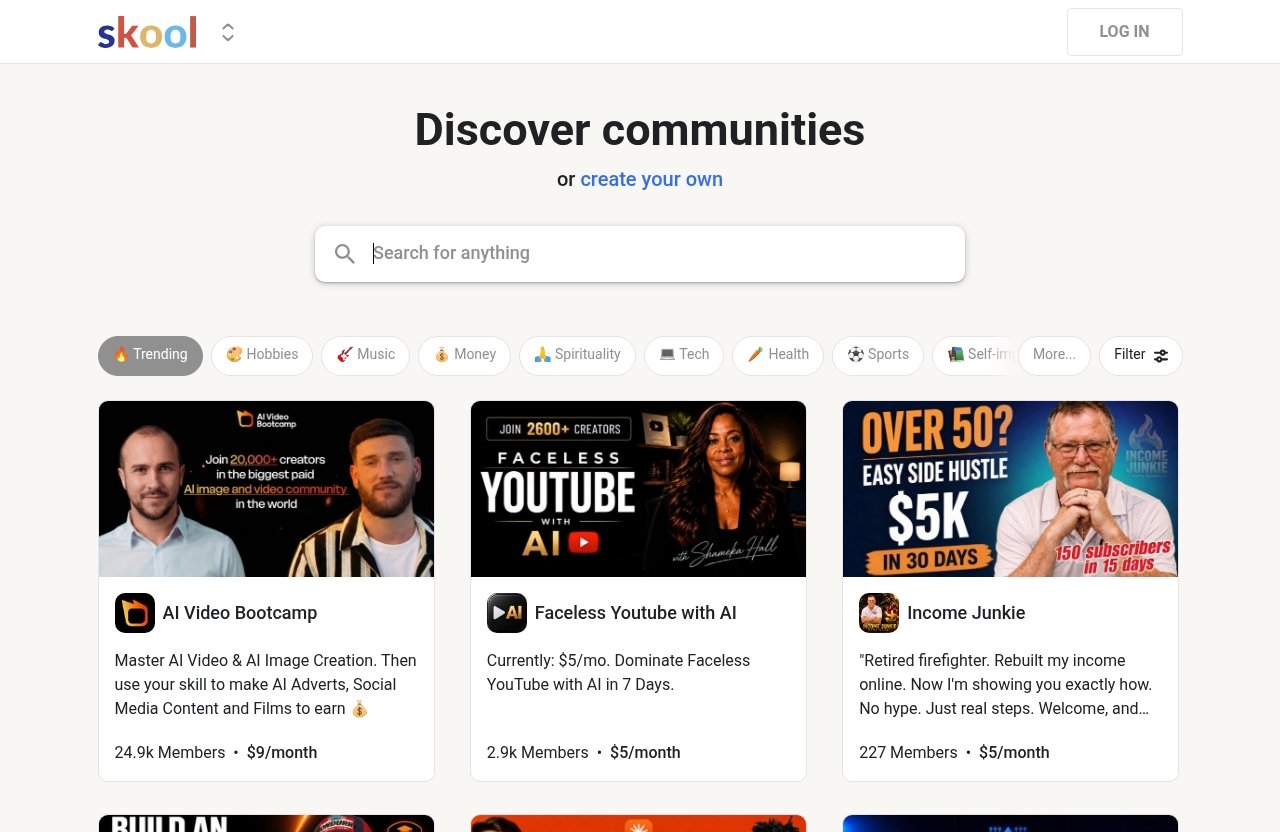
Skool’s official homepage positions it around discovering communities or creating your own. That tells you a lot about the product’s core purpose: it is a community-centered platform, not simply a marketplace for files.
A skool membership platform approach can be valuable when your audience benefits from interaction. Instead of sending customers a download and hoping they use it, you can build a place where they return, ask questions, and connect with other members.
Course hosting and member access
According to Skool’s official pricing information, both Hobby and Pro include unlimited members, unlimited courses, unlimited videos, and unlimited live calls. Both plans also include a custom URL and affiliate functionality.
This makes skool for courses a logical use case. A creator can organize educational materials, publish video lessons, run live sessions, and give members access through one central community environment.
Why the platform design matters
The delivery format affects what customers believe they are buying. A standalone digital product is usually judged by the immediate usefulness of the file, while a membership is judged by the ongoing value, guidance, access, and experience.
That is why skool for digital products makes more sense for creators selling outcomes. If your offer promises “learn a skill,” “build a system,” or “get ongoing support,” a community-led structure can reinforce that promise.
Can You Sell Digital Products on Skool?
Courses and memberships
Yes, you can sell digital products on Skool, especially when those products are delivered through course access or a paid community. Courses, videos, and live calls are explicitly included with both Skool plans, making the platform suitable for education-based offers.
A good example is a paid marketing community that includes a beginner course, monthly training calls, video walkthroughs, and updated campaign resources. The product is not merely a video course; it is continued access to learning and support.
Templates, files, and downloads inside a community
Templates, checklists, swipe files, guides, and other resources can work well when they support a membership offer. For instance, a freelance designer might create a resource vault with client proposal templates, onboarding checklists, pricing calculators, and tutorial videos.
In this setup, the files become part of an ongoing membership value proposition. That is generally a stronger use of skool for downloads than trying to treat the platform like a high-volume, one-product download shop.
Before launching, it is sensible to review Skool’s current product workflow directly and make sure it matches how you intend to organize and deliver resources. Your delivery requirements may differ depending on whether you use videos, course lessons, external files, or resource links.
Standalone product limitations
Can you sell a single downloadable product through a community-led offer? Potentially, but it may feel inefficient if the product has no ongoing component. The practical issue is not necessarily whether you can make access available; it is whether Skool’s structure matches customer expectations.
This is the main point often missed in a skool digital products review. The best platform is not always the one with the longest feature list. It is the one whose buying experience fits your product format and revenue model.
Skool Pricing for Digital Product Sellers
Hobby plan: $9/month
Skool’s Hobby plan costs $9 per month. It includes unlimited members, unlimited courses, unlimited videos, unlimited live calls, a custom URL, and affiliates. The listed transaction fee is 10%.
For a new creator testing skool for digital products, Hobby can be a lower-cost starting point. It may suit someone validating a niche community, building an early audience, or testing whether members will pay for a course-plus-community offer.
Pro plan: $99/month
Skool’s Pro plan costs $99 per month. It includes unlimited members, unlimited courses, unlimited videos, unlimited live calls, a custom URL, and affiliates. The listed transaction fee is 2.9%.
Pro may be more suitable for established sellers with consistent sales volume. The monthly price is higher, but the transaction fee is lower, so the plan may become more attractive as revenue grows. Your own break-even point depends on your sales level and pricing.
Transaction fees, yearly option, and what creators should notice
Skool offers Monthly and Yearly billing options, and its pricing page states that yearly billing includes “2 months free!” The choice between Hobby and Pro should not be based on the monthly subscription price alone.
| Plan | Monthly Price | Transaction Fee | Included Official Features |
|---|---|---|---|
| Hobby | $9/month | 10% | Unlimited members, courses, videos, live calls; custom URL; affiliates |
| Pro | $99/month | 2.9% | Unlimited members, courses, videos, live calls; custom URL; affiliates |
When comparing skool for digital products cost, consider your offer price, expected transaction volume, and whether a recurring membership gives you enough revenue per customer. A $49 monthly community has different economics than a $7 one-time template bundle.
Best Digital Product Business Models on Skool
Paid community plus course
This is arguably the most natural model for Skool. Members pay for a community and receive a structured course as part of their access.
For example, a creator teaching short-form video marketing could offer a foundational course, weekly video breakdowns, live calls, and peer feedback. The course brings people in, while the community gives them a reason to remain active.
Cohort-style program
A cohort program brings a group of people through the same learning journey over a defined period. Skool’s inclusion of courses, videos, and live calls aligns well with this style of delivery.
You might run a six-week program for aspiring consultants, releasing modules each week and holding live calls for questions. The group dynamic can create urgency and accountability that a standalone digital product often lacks.
Template library or resource vault
A template vault can be a smart version of skool for digital products when updates and context are included. Rather than selling one template, offer a growing library with demonstrations, implementation advice, and member discussion.
Think of a paid community for ecommerce operators that includes product research sheets, planning templates, ad-review checklists, and training videos. The ongoing value comes from improvements, new resources, and collective learning.
Hybrid offer with coaching
Coaches and consultants can combine content with access. A hybrid offer may include a course, resource library, live calls, and a community where members can ask questions.
This approach is especially useful when the buyer needs help applying the information. A generic template can be useful, but personalized guidance can make the overall offer more valuable and easier to position at a recurring price.
Pros of Using Skool for Digital Products
Simple all-in-one setup
Skool provides unlimited courses, videos, live calls, and members on both official plans. For a creator who wants to avoid piecing together multiple tools, that is a meaningful advantage.
The simple structure can help you focus on the offer itself: what members get, how they make progress, and why they should stay involved. For many first-time creators, reducing operational complexity is more valuable than adding endless customization options.
Community and retention advantages
A community can improve the perceived value of digital products because members are not learning alone. They can share wins, ask questions, and see how other people use the same methods or resources.
This is where skool for digital products can outperform a purely transactional model from a strategic standpoint. A product with a social and educational layer may have stronger retention potential than a one-time file with no reason for buyers to return.
Built-in affiliate support
Both Skool plans list affiliates as an included feature. This can be useful when you have satisfied members, partners, or peers who want to recommend your offer.
Affiliate support does not replace a clear product or strong marketing message. However, it can give creators an additional way to grow after they have validated that the community provides genuine value.
Good for recurring revenue
The official Skool homepage shows communities with different monthly price points, including examples such as $2, $7, $9, $19, $25, $29, $37, $39, $49, and $69 per month. This illustrates how varied community pricing can be.
Recurring revenue is not automatic, of course. Members will only stay if the offer continues to solve a problem, provide useful content, or create meaningful connection. But Skool’s structure is clearly more aligned with recurring access than a simple one-off download.
Official website · Latest pricing & offers
Cons and Risks to Know Before Choosing Skool
Not ideal for pure one-off downloads
A creator selling a single low-priced PDF, printable, preset, or file bundle may not need a community-first environment. In that situation, the extra effort of maintaining a community may outweigh the value it creates.
This is the clearest reason to look beyond skool for downloads. If there is no course, update schedule, member interaction, or ongoing benefit, a direct storefront-style solution may be more aligned with your business.
Platform dependency and branding limits
Using any hosted platform means your customer experience is shaped partly by that platform’s structure. Skool includes a custom URL, which is helpful, but creators who require highly specific store design or deeply customized buyer flows should evaluate whether the platform experience meets their needs.
This is a practical business consideration rather than an official feature claim. Before migrating an established business, map your desired customer journey—from first visit to purchase, onboarding, resource access, and renewal.
Pricing may be high for low-ticket products
The Hobby plan’s $9 monthly price may sound accessible, but its 10% transaction fee matters. Pro lowers the listed transaction fee to 2.9%, though it costs $99 per month.
For very low-ticket products, margins can become tight depending on your sales volume and delivery model. This does not make Skool expensive by default; it means the economics should be calculated before you commit to a pricing strategy.
Who Should Use Skool for Digital Products?
Beginners testing an offer
Beginners can use Skool to test whether a niche audience wants a learning-focused membership. Start with one clear promise, a small course, a useful resource set, and a regular live call schedule.
For example, instead of creating 50 generic templates, test a focused offer: “A community for new virtual assistants who need client onboarding systems.” Specificity makes it easier to attract the right people and create relevant content.
Creators selling transformation-based products
Creators who teach a result are a strong fit for skool for digital products. This includes educators, trainers, consultants, and specialists whose customers need guidance, feedback, and momentum.
Transformation-based offers can include language learning, career development, fitness education, creative skills, business systems, or industry-specific training. The key is that members benefit from more than downloading a file once.
Coaches, educators, and niche experts
Coaches and niche experts can package their knowledge in a way that scales beyond one-to-one services. A community with lessons, live calls, and resources can help members receive support while allowing the creator to serve more people.
This does not mean every expert needs a membership. But if your audience repeatedly asks similar questions, needs accountability, or wants access to peers, a Skool-style community can be a logical next step.
Who should look elsewhere
Consider another route if your primary goal is to run a pure download store, sell a large catalog of unrelated files, or create highly customized ecommerce experiences. A platform focused on a straightforward product catalog may better suit that model.
People searching for skool for digital products reddit discussions often want a universal answer. There is not one. Skool is a better fit when community and recurring value are central; it is not necessarily the best fit when speed and one-time file delivery are the entire business.
How to Set Up a Digital Product Offer on Skool
Choose a niche and promise
Start with a narrowly defined audience and a practical outcome. Avoid vague ideas such as “business resources for everyone.” Instead, focus on a clear customer, problem, and result.
For instance: “Help freelance copywriters create a repeatable client onboarding process.” A focused promise makes your course topics, templates, live calls, and marketing far easier to plan.
Structure your offer around outcomes
Build your offer in layers. Begin with a core course that teaches the essential process, add useful resources that help members apply it, and plan live calls that address common questions.
Do not fill the community with content for its own sake. A better skool for digital products offer gives members a logical path: understand the problem, follow the steps, use the resources, and get support when stuck.
Upload your course and resources
Skool officially includes unlimited courses and videos on both plans, so organize your educational content in a sequence that reflects the member journey. Keep early lessons practical and outcome-oriented.
If resources are part of your offer, make them easy to understand and connect each one to a lesson or use case. A template without instructions can feel generic; a template paired with an example and tutorial becomes much more useful.
Set pricing and launch
Choose a price that reflects the full value of the membership, not merely the number of files included. Consider your live calls, course content, community access, updates, and support expectations.
Start with a small founding group if possible. Their questions and feedback can reveal what needs clarification before you try to scale. You can then improve onboarding, course structure, and your member experience based on real behavior.
Skool vs Other Ways to Sell Digital Products
Skool as community-led selling
Skool is designed around communities, making it a relevant option for creators who want to sell access, education, accountability, and resources together. Its official plans include unlimited courses, videos, live calls, members, custom URLs, and affiliates.
In other words, Skool is not just about the transaction. It is about what happens after someone becomes a customer. That is a meaningful distinction when deciding on the best platform to sell digital products.
When a storefront platform is better
A storefront-oriented platform may be better when your main product is a one-time download and buyers do not need a community. This includes a single ebook, artwork file, printable, preset, or simple digital bundle.
Choose the selling method that reduces friction for the buyer. If your buyer wants instant access to one item, make that easy. If they want coaching, connection, and a structured learning path, a community-led platform may be more appropriate.
What to compare before deciding
Before choosing a platform, compare your needs in these areas:
| Decision Factor | Skool May Fit Best When | Another Approach May Fit Better When |
|---|---|---|
| Community | Member interaction is part of the value | Customers only need a product file |
| Courses | You sell structured education | You do not offer training content |
| Live calls | Ongoing sessions support the offer | Live interaction is unnecessary |
| Recurring revenue | You plan a membership model | You sell one-off items only |
| Digital resources | Files support a broader experience | Files are the whole product |
The right decision is based on your business model, not brand popularity. A community platform can be powerful, but only if you are willing to create an ongoing member experience.
Final Recommendation: Is Skool Worth It for Digital Products?
Verdict by creator type
Yes for educators, coaches, experts, and creators selling memberships, courses, accountability, or resource libraries. Maybe for template sellers who can add training, updates, community value, or live support. No, or probably not for sellers who only want a lightweight one-off digital download store.
The strongest reason to choose skool for digital products is not simply that it includes courses and videos. It is that the platform supports a model where customers can keep learning, participating, and receiving value after purchase.
Best next step if you want to try it
Map your offer before signing up. Define your audience, their urgent problem, the outcome you will help them achieve, and the recurring reason they will remain a member.
If that structure fits your business, you can explore Skool here and review the current plan details for yourself. Take the Hobby-versus-Pro decision seriously by calculating your likely sales volume and transaction-fee impact.
Bottom line
This skool for digital products review comes down to product positioning. Skool is a practical option for membership-led digital businesses where courses, videos, live calls, community, and resources work together.
It is not the obvious choice for every seller, especially those focused exclusively on inexpensive standalone files. But if your goal is to build a community-backed offer with recurring value, Skool is worth serious consideration.
Official website · Latest pricing & offers
FAQ
Can you sell digital products on Skool?
Yes. You can sell digital products on Skool most effectively through courses, memberships, videos, live calls, and community-based resource access. It is best viewed as a platform for delivering an ongoing member experience rather than a classic standalone download storefront.
What are the top 5 digital products to sell?
Five popular digital product categories are:
- Online courses
- Templates and swipe files
- Paid memberships
- Guides and ebooks
- Resource libraries or toolkits
For Skool, courses, memberships, resource vaults, and educational templates are especially relevant because they can be paired with community access and live calls.
What is the best platform to sell digital products?
The best platform to sell digital products depends on your business model. If you want a community-led offer with courses, videos, live calls, and recurring access, Skool is a strong option to consider.
If you only want to sell individual downloadable files without community involvement, a dedicated storefront-style solution may be more suitable. Match the platform to how customers expect to buy and use your product.
What digital products are in high demand in 2026?
In 2026, outcome-focused products are likely to remain in demand. Examples include AI prompt packs with practical use cases, niche business templates, mini-courses, implementation toolkits, specialized guides, and private communities that help people solve specific problems.
The important factor is not the format alone. High-demand products usually save time, reduce uncertainty, help customers make money, or help them develop a valuable skill.
What is the most wanted digital product?
The most wanted digital product is usually not a generic file type. It is a product that solves an urgent, specific problem for a clearly defined audience.
For example, a “social media template pack” is broad. A “30-day content template system for independent real estate agents” is much more specific and potentially more valuable. The closer the product is to a real customer outcome, the stronger the demand can be.
Related Reading
- Skool for Coaches: Best Use Cases in 2026
- Skool for Online Courses: A 2026 Review of Community, Hosting, and Retention
- How to Build a Funnel in Systeme.io: A Beginner-Friendly 2026 Tutorial
References
- Skool: Discover Communities or Create Your Own
- Skool: Pricing
- Digital Product Sales School
- Digital Products Academy