
Syllaby for Marketing Agencies: Practical Use Cases for Scalable Client Video Production in 2026

If you run client accounts, manage content retainers, or oversee production capacity, syllaby for marketing agencies is worth evaluating for one specific reason: repeatable video output is now a core agency deliverable, but traditional video workflows are still slow, expensive, and hard to scale.
This review is written for agency owners, strategists, and production leads—not hobby creators. We’ll look at where Syllaby fits inside a real agency workflow, which use cases make the most sense, and when it may not be enough.
Affiliate disclosure: TopTrustReview may earn a commission if you purchase through our Syllaby partner link. This does not affect our editorial assessment, and all product facts below are based only on Syllaby’s official homepage and pricing page.
Official website · Latest pricing & offers
What Syllaby Is and Why Agencies Care
Quick definition: syllaby for marketing agencies
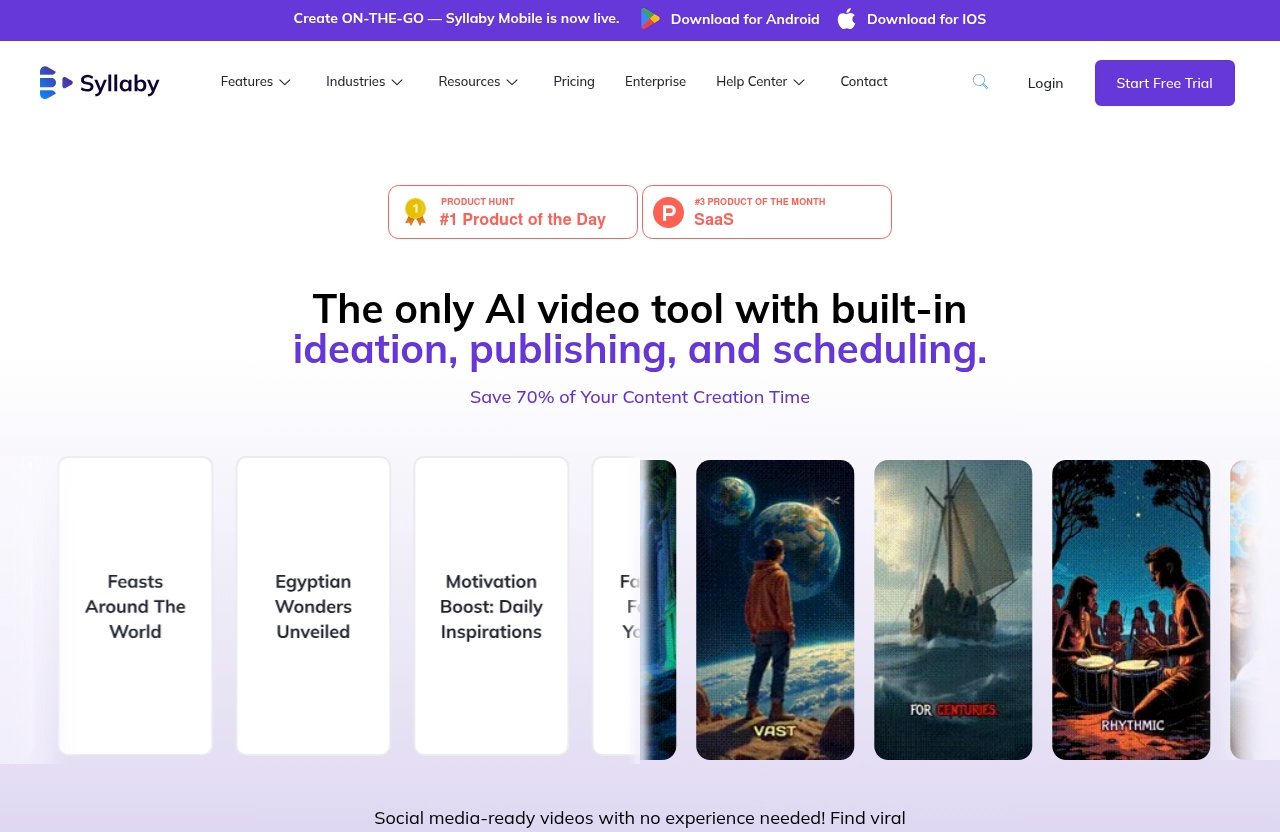
Syllaby is an AI video creation platform positioned on its official homepage around the promise to “Create Viral Videos Easily with AI Avatars.” For agencies, the important part is not the “viral” language—it is the combination of video creation, content creation, AI tools, planning, and scheduling features in one platform.
According to the official Syllaby homepage, the product includes feature areas such as faceless video, short-form video, long-form video, bulk scheduler, video editor, art style, audio-to-video, URL-to-video, character consistency, and text-to-scenes. It also lists content creation features like idea creation and AI script generation, plus AI voice cloning, an AI thumbnail generator, content calendar, social analytics, and mobile app support for Android and iOS.
In practical terms, syllaby for marketing agencies is best understood as a video workflow assistant. It can help teams move from ideas to scripts, from scripts to video formats, and from video assets to scheduled content.
Why agencies need scalable video production
Most agencies are being asked to produce more video than their existing team can comfortably handle. A client that once needed four blog posts per month may now expect short-form clips, social ads, vertical explainers, YouTube Shorts, LinkedIn thought-leadership content, and repurposed snippets from webinars.
That shift creates pressure in three places:
| Agency pressure point | Why it matters |
|---|---|
| Strategy | Clients need ideas that fit their niche, funnel, and audience. |
| Production | Editors cannot manually create every short video from scratch. |
| Delivery | Account managers need predictable calendars and publishing cadence. |
This is where an AI video generator for agencies becomes commercially interesting. The goal is not to replace strategic thinking or brand judgment, but to reduce repetitive production work.
For agencies selling monthly content retainers, syllaby for marketing agencies can support higher output consistency. It gives teams a way to standardize parts of client content production without building every asset manually.
Where Syllaby fits in an agency stack
Syllaby should not be viewed as a full replacement for your project management tool, creative strategy process, or client approval system. Instead, it sits inside the production layer of the agency stack.
A typical agency stack may include:
- CRM and sales pipeline software
- Project management tools
- File storage and asset libraries
- Design tools
- Video editing tools
- Social scheduling platforms
- Reporting dashboards
Syllaby overlaps most clearly with ideation, AI script generation for marketing, AI-assisted video production, bulk video creation, scheduling, and social analytics. For agencies that already have mature content operations, it may become one tool in the workflow rather than the entire workflow.
The strongest use of syllaby for marketing agencies is when your team has clear client strategy but needs a faster path to video drafts, faceless clips, scene-based videos, and scheduled social content.
Best Syllaby Use Cases for Marketing Agencies
Client social video production with syllaby for marketing agencies
Client social video production is the most obvious agency use case. Many businesses need regular short-form video for platforms where attention is limited and posting consistency matters.
Syllaby’s official homepage lists short-form video, faceless video, video editor, AI script generation, AI thumbnail generator, content calendar, bulk scheduler, and social analytics. Those features line up well with a social media content calendar workflow where the agency needs to produce and schedule repeatable content.
For example, an agency managing a local fitness studio could create educational clips around common questions, seasonal promotions, class benefits, and beginner tips. A B2B agency could produce weekly insight videos based on pain points, objections, and industry trends.
A useful mini-framework:
| Use case | Goal | Output type | Who benefits | Why Syllaby helps |
|---|---|---|---|---|
| Local business social content | Maintain visibility | Short-form videos | Social media managers | Supports repeatable video creation and scheduling |
| E-commerce product education | Explain benefits | Faceless or scene-based clips | Paid social teams | Helps turn product angles into video assets |
| Professional services content | Build trust | Explainer videos | Account managers and strategists | Speeds up script-to-video production |
| B2B content marketing | Share expertise | Thought-leadership clips | Content strategists | Supports ideation, scripting, and calendar planning |
For this use case, syllaby for marketing agencies is especially relevant when clients do not have in-house video talent, do not want to be on camera often, or need volume across multiple topics.
Faceless explainer videos for paid social and organic
Faceless video marketing is useful for clients that need educational or promotional content without relying on a founder, employee, or spokesperson. Syllaby’s homepage specifically lists faceless video, text-to-scenes, URL-to-video, audio-to-video, and video editor features.
This can help agencies create explainers such as:
- “How this service works”
- “Three mistakes to avoid”
- “What to know before booking”
- “Why this product solves a common problem”
- “What happens during the first consultation”
For paid social, the benefit is speed of concept testing. Agencies can create multiple creative angles, refine scripts, and test hooks without scheduling a shoot for every variation.
For organic content, faceless explainers can fill the calendar between higher-production brand videos. This is one of the clearest syllaby agency use cases because it supports consistency without requiring every client to become a video personality.
Still, agencies should apply editorial control. AI-assisted videos need brand review, compliance checks, and quality assurance before client approval or paid distribution.
Short-form repurposing from long-form content
Short-form video for clients is often created from long-form assets: webinars, interviews, podcasts, sales calls, training videos, and YouTube content. Syllaby’s official homepage lists long-form video, short-form video, audio-to-video, URL-to-video, text-to-scenes, and video editor features.
That does not mean agencies should expect one-click perfection. A realistic workflow is to use Syllaby to support the conversion from source material into shorter concepts, then have a strategist or editor refine the output.
For example, a client webinar on tax planning could become:
- A 30-second myth-busting clip
- A short explainer on one tax deadline
- A faceless video summarizing a key concept
- A thought-leadership post with a video version
- A teaser for the full webinar replay
For syllaby for marketing agencies, repurposing is commercially valuable because it helps extract more value from assets clients already have. That can increase perceived retainer value without requiring a full new shoot each week.
Lead generation videos for local businesses
Local businesses often need simple, direct videos that answer buying questions and drive inquiries. Think dentists, roofers, med spas, lawyers, gyms, consultants, home service companies, and clinics.
Syllaby can support this through idea creation, AI script generation, faceless video, short-form video, thumbnails, a content calendar, and bulk scheduler. These are official homepage feature areas, and they map well to local lead generation content.
Examples include:
- “What to expect during your first appointment”
- “How much does this service usually depend on?”
- “Signs you may need professional help”
- “Before you choose a provider, ask these questions”
- “Common myths about this service”
Agencies should be careful with regulated industries. Healthcare, legal, finance, and similar niches may require additional review before publishing. Syllaby can help produce drafts, but it does not remove the agency’s responsibility for accuracy, disclaimers, and client approval.
This is a strong application of syllaby for marketing agencies when the agency has a repeatable local SEO or paid social offer. The platform can help turn service pages, FAQs, and offers into video concepts that support lead generation campaigns.
Thought leadership videos for B2B clients
B2B clients often struggle with video because subject-matter experts are busy, camera-shy, or inconsistent. Agencies can use Syllaby to turn expert ideas into structured scripts and video formats that are easier to approve.
The most practical approach is not to fake expertise. Instead, use the client’s real viewpoints, notes, articles, webinar transcripts, or sales insights as source material, then develop structured video scripts and scene-based assets.
Good B2B video topics include:
- Industry misconceptions
- Founder perspectives
- Buyer education
- Problem-solution explainers
- Product category comparisons
- Sales objection responses
- Event and webinar promotion
For syllaby for marketing agencies, the B2B advantage is operational. The platform can help reduce the gap between “we need more thought leadership” and a ready-to-review video draft.
However, the client’s voice still matters. The strongest B2B content usually needs human review from someone who understands the buyer, the market, and the company’s positioning.
How Agencies Can Use Syllaby in a Real Workflow
Content ideation and topic discovery
A practical agency video workflow starts with the client brief. Before using any AI tool, the strategist should clarify the audience, offer, positioning, objections, approved claims, and content goals.
Syllaby’s official homepage lists idea creation as part of its content creation feature area. That makes it useful at the brainstorming stage, especially when a team needs multiple angles for a monthly calendar.
A simple workflow:
- Review the client’s offer and target audience.
- Define the campaign goal: awareness, engagement, lead generation, nurturing, or retargeting.
- Generate topic ideas around buyer questions and objections.
- Prioritize ideas by funnel stage and client approval requirements.
- Move selected ideas into scripts and production.
This is where syllaby for marketing agencies can reduce blank-page time. The strategist still chooses the strongest angles, but the tool can help expand the idea pool.
AI script generation for first drafts
Syllaby’s homepage lists AI script generation as an official feature. For agencies, this is most useful for first drafts, not final copy.
A good agency process should include:
- Hook review
- Brand voice edits
- Compliance checks
- CTA alignment
- Fact verification
- Client-specific examples
- Platform-specific formatting
For example, a script for a local law firm should be reviewed much more carefully than a script for a coffee shop. The agency needs to confirm that the language is accurate, appropriate, and aligned with the client’s risk tolerance.
Used correctly, syllaby for marketing agencies can help content teams move faster from topic to script. Used carelessly, it can create generic content that still requires heavy revision.
Video creation with avatars, faceless formats, and scene-based assets
Syllaby’s official homepage lists AI avatars, faceless video, text-to-scenes, character consistency, art style, URL-to-video, audio-to-video, long-form video, short-form video, and video editor features. It also references AI model pages such as VEO 3.1, Sora 2 Pro, Seedance 1.0 Lite, Seedance 1.0 Pro, Seedance 1.5 Pro, Kling v2.6 Pro, Kling o1 Omni, and Kling o3 Omni.
For agencies, the key production question is simple: which video format fits the client’s brand and use case?
| Format | Best for | Agency caution |
|---|---|---|
| AI avatar video | Explainers, announcements, educational clips | Make sure the avatar style fits the client’s brand |
| Faceless video | Local services, listicles, FAQs, paid social tests | Avoid generic visuals that weaken trust |
| Text-to-scenes | Structured educational content | Review scene pacing and clarity |
| Audio-to-video | Repurposing voice notes, podcasts, interviews | Check context and edit for accuracy |
| URL-to-video | Turning web content into video concepts | Verify claims from the source page |
This is one of the most important parts of syllaby for marketing agencies because it turns strategy into assets. The agency’s job is to choose the format that matches the client’s audience rather than using AI video for its own sake.
Bulk scheduling and publishing
Syllaby’s homepage lists a bulk scheduler and content calendar. For agencies, those features are useful because production efficiency only matters if the content actually gets organized, approved, and published.
A typical monthly workflow may look like this:
- Week 1: Strategy, topics, and client approval
- Week 2: Script drafting and video production
- Week 3: Revisions and compliance review
- Week 4: Scheduling, reporting, and next-month planning
Bulk scheduling can help teams avoid last-minute posting chaos. It also supports repeatability across multiple clients, especially when account managers need visibility into what is going live.
For syllaby for marketing agencies, scheduling is not just convenience. It helps agencies protect margins by reducing manual coordination.
Analytics and iteration
The official homepage lists social analytics under Analytics & Planning. Agencies should use analytics to refine content direction, not to make unsupported promises.
The practical review process should ask:
- Which hooks earned attention?
- Which topics drove comments or saves?
- Which formats clients approved fastest?
- Which videos aligned with campaign goals?
- Which content should be repeated, expanded, or retired?
Analytics should feed the next content cycle. This turns Syllaby from a one-off creation tool into part of a continuous agency video workflow.
The most mature use of syllaby for marketing agencies is not “make videos faster.” It is “create, review, publish, learn, and improve with less operational drag.”
Official website · Latest pricing & offers
Agency Team Roles That Benefit Most
Founder or agency owner
Agency owners care about margins, fulfillment capacity, client retention, and team workload. If video demand is rising but hiring more editors is not immediately realistic, Syllaby may help standardize part of the production process.
For founders, the main value is operational leverage. Syllaby for marketing agencies can support packaged video deliverables, such as monthly short-form content, faceless explainers, or repurposed clips.
The owner should still define quality standards. AI-assisted production needs clear internal rules so the agency does not trade speed for generic output.
Content strategist
Content strategists benefit from idea creation, AI script generation, content calendar planning, and format selection. Instead of starting every client calendar from scratch, they can develop repeatable frameworks.
For example, a strategist might create a monthly mix of:
- Two awareness videos
- Two objection-handling clips
- Two service explainers
- Two founder-perspective videos
- Two lead-generation videos
With syllaby for marketing agencies, the strategist can move from calendar planning into script and production briefs more efficiently. The strategic judgment remains human.
Video editor or production specialist
Editors and production specialists can use Syllaby’s video creation and video editor features to reduce repetitive work. This is especially useful for faceless videos, scene-based explainers, and short-form assets.
However, editors still play an important role. They should review pacing, visual quality, captions, transitions, brand fit, and platform standards.
The best agency setup is collaborative: Syllaby helps generate and assemble assets, while editors polish and quality-check them before client review.
Account manager
Account managers need predictable deliverables and fewer production bottlenecks. A tool that supports calendars, scheduling, and social analytics can help them communicate progress to clients more clearly.
In practice, the account manager can use the social media content calendar to show what is planned, what is in review, and what has been published. That visibility helps reduce client anxiety.
For account teams, syllaby for marketing agencies is useful when paired with a strong approval process. It should make communication easier, not bypass stakeholder review.
Paid media specialist
Paid media specialists often need multiple creative variations to test angles, hooks, and offers. Syllaby’s short-form video, faceless video, AI script generation, thumbnails, and video creation features can support faster creative development.
Useful paid media variations may include:
- Different opening hooks
- Different problem statements
- Different offer explanations
- Different visual styles
- Different audience segments
Paid specialists should still validate performance through ad platform data. Syllaby can help create assets for testing, but it does not guarantee campaign results.
When Syllaby Makes Sense vs When It Does Not
Great fit scenarios
Syllaby is a strong fit when an agency already has clients that need consistent video content but the team lacks enough production capacity. It is also useful when clients are open to AI-assisted formats such as avatars, faceless videos, or scene-based explainers.
Good-fit scenarios include:
- Social media retainers requiring recurring video output
- Local business lead generation campaigns
- B2B thought-leadership support
- Short-form repurposing from long-form assets
- Agencies building a productized video content offer
- Teams needing AI script generation for marketing workflows
- Agencies that want content planning, production, scheduling, and analytics closer together
In these cases, syllaby for marketing agencies can help create a more repeatable client content production system.
Weak fit scenarios
Syllaby may not be enough if your agency primarily produces high-end commercial video, complex motion graphics, cinematic brand films, or highly customized creative campaigns. Those workflows usually require dedicated directors, editors, designers, animators, and production crews.
It may also be a weaker fit if clients demand heavy human-on-camera authenticity in every piece of content. AI avatars and faceless formats can be useful, but they are not always the right creative choice.
Other weak-fit situations include:
- Clients with strict legal or medical compliance needs and no review process
- Brands with very specific art direction requirements
- Agencies that need only occasional video and have no volume problem
- Teams unwilling to edit or quality-check AI-generated drafts
A balanced view of syllaby for marketing agencies is that it can support production scale, but it does not replace strategy, brand judgment, or expert review.
Questions to ask before buying syllaby for marketing agencies
Before buying, agencies should ask practical operational questions:
- Which client deliverables will this support?
- Who owns ideation, scripting, editing, approval, and scheduling?
- Will clients accept AI avatars or faceless video formats?
- How will the agency maintain quality control?
- Which industries require extra fact-checking or compliance review?
- Will Syllaby replace a current tool or add a new workflow step?
- How many videos do we need to produce for the tool to be worthwhile?
- What live pricing and plan terms are currently shown on Syllaby’s official pricing page?
These questions help separate genuine use cases from software curiosity. For syllaby for marketing agencies, the buying decision should be tied to delivery capacity and client revenue, not just feature interest.
Pricing and Plan Considerations for Agencies
Verified pricing facts from the official pricing page
Based on the provided official pricing-page information, Syllaby promotes a “Lifetime Deal – Pay Once, Use Forever! Save up to 90%.” The official homepage also uses this lifetime deal language.
The pricing-page excerpt available for this review does not show numeric plan prices or plan names. For that reason, this article does not state specific pricing, tiers, limits, or plan comparisons.
Before purchasing, agencies should verify the current live pricing directly on Syllaby’s official pricing page. Pricing, plan terms, included usage, and lifetime deal availability can change, so decision-makers should review the latest terms before committing.
How to evaluate value for client output
For agencies, pricing should be evaluated against client output and margin. The key question is not only “What does Syllaby cost?” but “Which billable deliverables can this help us produce more efficiently?”
Consider these value factors:
| Evaluation question | Why it matters |
|---|---|
| How many clients need video every month? | Determines whether volume justifies adoption |
| Which deliverables can be standardized? | Helps protect margins |
| Who will use the tool daily or weekly? | Prevents unused software spend |
| How much editing is still required? | Affects true production time |
| Can it support paid, organic, and repurposing workflows? | Increases commercial utility |
For syllaby for marketing agencies, the strongest value case appears when the platform supports recurring client retainers rather than occasional one-off experiments.
What to verify before committing
Before purchase, verify current details on Syllaby’s official pricing page and homepage. Do not rely on old screenshots, social posts, or third-party summaries for final pricing decisions.
Agencies should confirm:
- Current lifetime deal availability
- Any plan limits or usage restrictions
- Supported video formats
- Publishing and scheduling capabilities
- Mobile app availability for Android and iOS
- Whether the included features match your delivery needs
- Team workflow requirements
- Client approval and export needs
If your agency is evaluating syllaby for marketing agencies, assign one internal owner to test the workflow against real client scenarios. A tool trial or small internal pilot is more useful than a feature checklist alone.
Pros, Limits, and Affiliate Verdict
Main advantages for agencies
The biggest advantage of Syllaby is that it brings several agency-relevant video workflow pieces together. According to the official homepage, it includes video creation features, content creation tools, AI tools, analytics and planning, and mobile app support.
For agencies, the strongest advantages are:
- Supports faceless video marketing workflows
- Helps with AI script generation for marketing content
- Offers short-form and long-form video feature areas
- Includes bulk scheduler and content calendar features
- Lists social analytics for iteration
- Supports AI avatars and scene-based video creation
- Can help standardize recurring client content production
- May fit productized video production for agencies
In short, syllaby for marketing agencies is most attractive when the agency needs repeatable output across multiple clients.
Potential limitations to watch
Syllaby is not a substitute for agency strategy. It can help create, script, plan, and schedule content, but agencies still need to define positioning, audience, messaging, compliance, and creative standards.
Potential limitations include:
- AI-generated drafts may need editing
- Some clients may not want avatars or faceless content
- Highly regulated industries require careful review
- Premium custom video work may need specialist production
- Pricing details must be verified live before purchase
- Feature fit depends on your actual client workflow
The fair way to assess syllaby for marketing agencies is to test it against your real deliverables. If your team cannot map it to a client package, it may become another unused SaaS tool.
Overall recommendation for agency owners
For agency owners, Syllaby is worth considering if video demand is growing faster than your production capacity. Its official feature set lines up well with client social video production, faceless explainers, short-form repurposing, local lead generation content, and B2B thought-leadership workflows.
The best buyers will be agencies with clear content strategy, repeatable client packages, and a willingness to review AI-assisted outputs before publishing. The weaker buyers will be teams expecting fully finished, brand-perfect creative without human oversight.
Affiliate verdict: If you want to evaluate syllaby for marketing agencies as part of your client video production workflow, review the current official details and pricing through our Syllaby partner link. It is not a magic replacement for strategy or editing, but it can be a practical tool for agencies trying to scale video output in 2026.
Official website · Latest pricing & offers
FAQ
What is the 3 3 3 rule in marketing?
The 3 3 3 rule is often used as a simple attention and consistency framework: communicate quickly, repeat core messages, and make the next action easy to understand. In content planning, it can mean focusing on three key audience problems, three core messages, and three repeatable content formats.
For agencies, this is useful because it prevents scattered campaigns. When using syllaby for marketing agencies, a strategist can apply the rule to build focused video topics instead of producing random clips.
What are the 7 pillars of marketing?
The 7 pillars of marketing are commonly summarized as strategy, audience, positioning, content, channels, conversion, and measurement. Some frameworks use slightly different labels, but the goal is the same: organize marketing around who you serve, what you say, where you say it, and how you measure results.
Agencies can use these pillars to structure video campaigns. For example, Syllaby may support the content, channel, and measurement parts of the workflow, while the agency still owns strategy and positioning.
How to structure a marketing agency?
To structure a marketing agency, start by defining your target audience, ideal customer profiles, niche, initial client acquisition plan, service delivery model, growth strategy, brand positioning, and data-driven improvement process.
A practical structure usually includes leadership, strategy, account management, creative production, media or SEO specialists, and reporting. If video is a core service, tools like Syllaby can support the production layer, but the agency still needs clear ownership for approvals, quality control, and client communication.
What are the 7 C's of service marketing?
The 7 C’s of service marketing are Consumer, Cost, Communication, Convenience, Caring, Co-ordinated, and Confirmation. They focus on the customer’s experience rather than only the company’s offer.
For agencies, the 7 C’s are useful when designing client content and service delivery. Video content should speak to the consumer’s needs, communicate clearly, reduce friction, and confirm that the client’s brand is trustworthy.
Related Reading
- Syllaby for YouTube Shorts: Fast Workflow Guide 2026
- Klap for Agencies Review: Can It Speed Up Client Content Delivery?
- Podsqueeze for Agencies: Podcast Client Workflow Guide for 2026
References
- How to Build a Great Marketing Agency – Online Course at CXL
- The Complete Guide to Working With a Marketing Agency: Unlock Your …
- Agency Management | School of Marketing