Local Falcon Review: Features, Accuracy, Pricing, and Verdict for 2026
If you manage local SEO for clients, stores, service-area businesses, or multiple locations, this local falcon review should help you decide whether the platform matches your workflow. Local Falcon is a specialized local visibility platform built around map-grid rankings, competitor analysis, reporting, and AI search visibility—not a general-purpose SEO suite trying to do everything.
Affiliate disclosure: TopTrustReview may earn a commission if you choose to purchase through links in this article, at no additional cost to you. Our assessment is based on the verified product information available and a practical evaluation of where the tool fits in a local SEO workflow.
Official website · Latest pricing & offers
What Local Falcon Is and Who It’s For in 2026
Local Falcon is a local rank tracking and AI visibility platform designed to show how a business listing performs across specific points within a city, service area, or target market. Rather than relying on one broad ranking position, it visualizes local search performance across a grid.
This local falcon review is most relevant for agencies, local SEO consultants, multi-location companies, and business owners who need to understand Google Maps visibility in a more detailed way. It is especially useful when a business ranks well near its address but loses prominence a few miles away.
Local SEO rank tracking explained
A traditional rank checker may tell you that a business ranks in a certain position for a keyword. A local rank tracker such as Local Falcon goes further by checking rankings from multiple geographic points around a location.
This approach is known as map grid rank tracking. It helps reveal the real-world variation in local results, where proximity, competition, relevance, and searcher location can significantly affect what appears in Google Maps.
For example, a dentist might hold a top-three Maps result near its office but fall outside the top results in nearby neighborhoods. A grid scan makes that pattern visible instead of hiding it behind a single average rank.
Why agencies and multi-location brands use it
Agencies commonly need a repeatable way to demonstrate local SEO progress to clients. The Local Falcon platform supports campaign reports, competitor reports, trend reports, location reports, scheduled scans, public report URLs, and CSV and PDF exports.
For multi-location brands, this level of reporting can help compare local performance across markets without treating every branch as if it operates under identical competitive conditions. Bulk rank checking and white-label reporting are also highlighted in official testimonials, which makes the platform more relevant to client-service teams.
Where it fits in a modern local SEO stack
The local falcon local seo tool is best viewed as a visibility intelligence layer. It does not replace content production, website optimization, review management, or listing-management work. Instead, it provides evidence for deciding where those efforts are needed most.
In a practical stack, Local Falcon can support keyword research, Google Business Profile optimization, citation work, competitor monitoring, and reporting. Its value is not just seeing a rank; it is seeing where visibility changes and using that information to prioritize action.
Local Falcon Review 2026: Quick Verdict
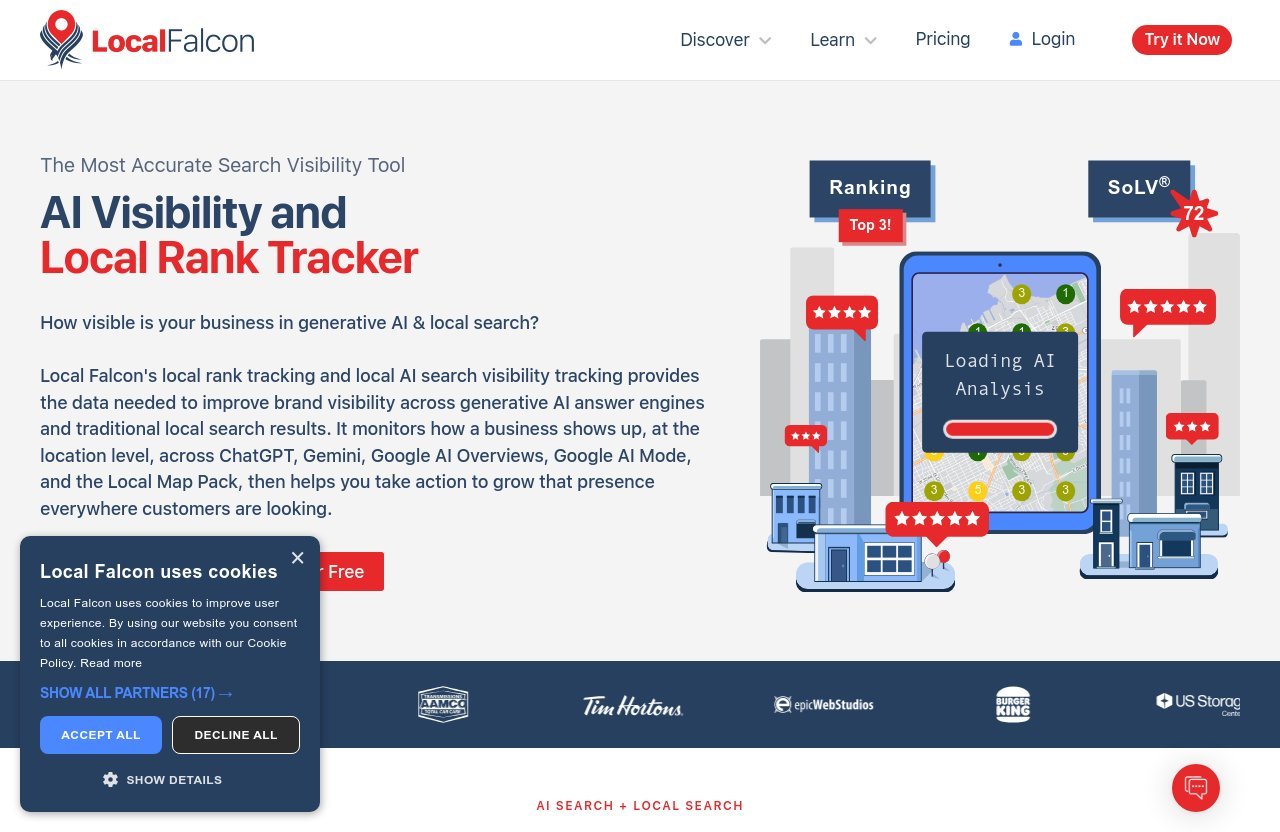
My conclusion from this local falcon review is straightforward: it is a strong choice for serious local SEO work when geographic ranking detail and client-ready visual reporting matter. Its core strength is not merely tracking positions, but translating location-specific search visibility into an understandable map.
Local Falcon positions itself as “the most cost effective and accurate way to track the rank and local AI visibility of any business listing.” That is a product claim, not an independent guarantee, but the available feature set clearly supports its focus on detailed local measurement.
Best for
Local Falcon is best for:
- Local SEO agencies managing recurring client reporting
- Consultants conducting audits and competitor analysis
- Service-area businesses that need to assess coverage beyond one address
- Multi-location brands comparing performance across markets
- In-house teams that need a capable Google Maps rank tracker
- Businesses wanting to monitor traditional local results alongside AI visibility
The platform is particularly compelling for anyone who has outgrown basic rank checks and needs location-level context.
Not ideal for
It may not be the best fit for a solo business owner who only wants an occasional broad ranking check. A basic tool may be enough if there is no need for grids, recurring scans, exports, integrations, or client presentations.
Likewise, teams looking for an all-in-one SEO platform covering technical crawls, backlink outreach, content optimization, and paid advertising management may need complementary software. Local Falcon is specialized, which is a strength for local visibility analysis but a limitation for broad SEO operations.
Bottom-line recommendation
This local falcon review recommends the platform for teams that make decisions based on local search performance rather than vanity metrics. The heatmaps, competitor visibility data, scheduled reporting, and integrations make it more useful than a simple keyword-position tool.
If your business depends on Google Maps exposure across a defined region, you can explore Local Falcon here and evaluate the free sign-up credits before committing.
Key Features That Stand Out
The strongest parts of this local falcon review come down to workflow depth. The product offers local keyword research, local rank tracking, AI visibility tracking, reporting, variable grids, scheduled scans, integrations, and export options that can support ongoing campaign management.
Map-based rank tracking and heatmaps
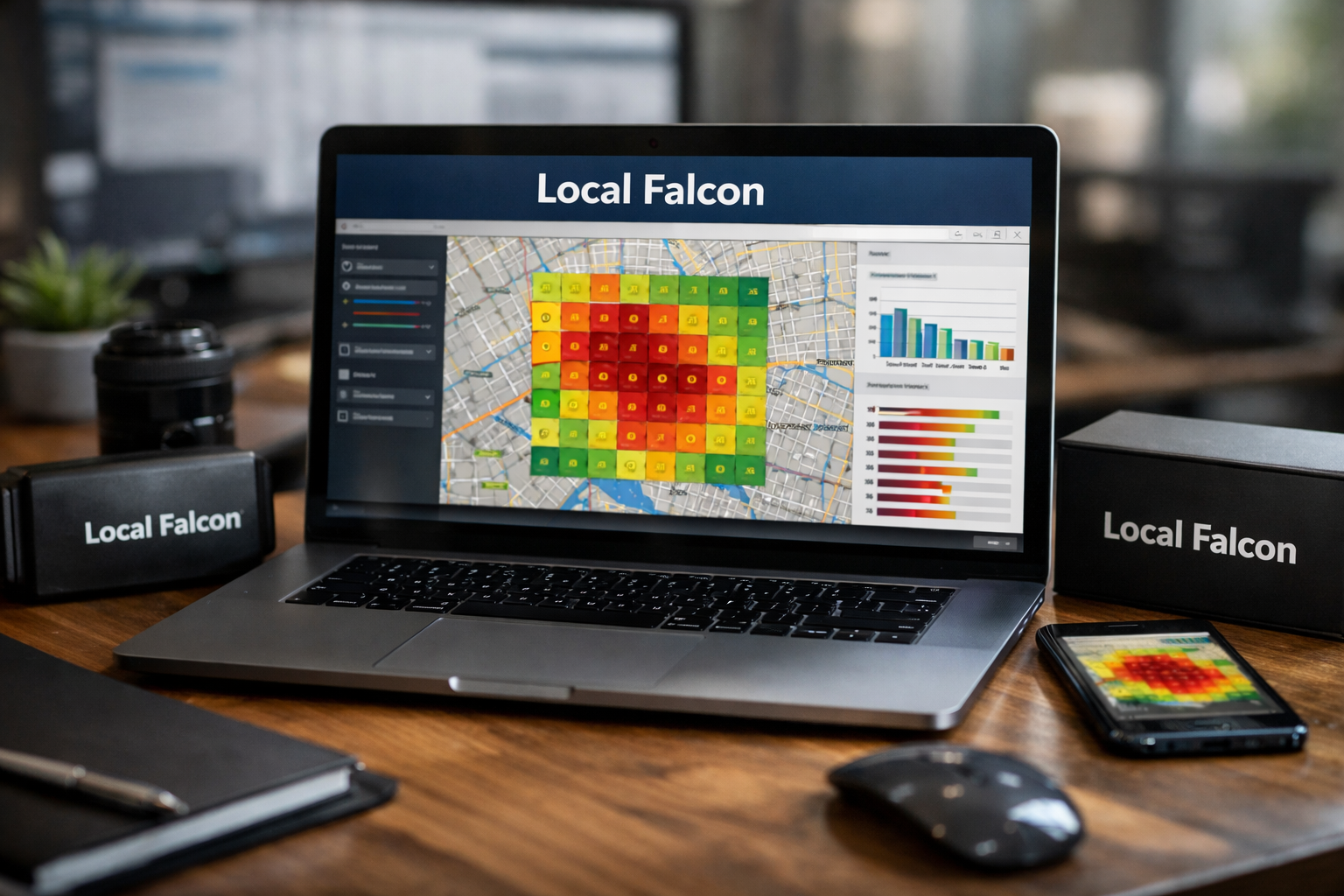
The signature Local Falcon feature is its map-based grid scan. A local falcon heatmap displays how a business ranks from multiple points surrounding a chosen location, giving a visual representation of local prominence.
Variable grid sizes and scan radius settings in 0.1 intervals offer meaningful flexibility. A consultant can use a tighter scan for a dense urban neighborhood or broaden the coverage for a service-area business that serves several surrounding communities.
This is more actionable than a single ranking number. If weak areas cluster on one side of a market, the team can investigate competitors, category relevance, review signals, location pages, citations, or the business’s practical service reach.
Competitive visibility analysis
Competitor reports help local marketers put rankings into context. A business may not have “dropped” in an absolute sense; a competing listing may simply have increased its visibility in key grid points.
This local falcon review finds competitor analysis especially useful during audits and quarterly strategy sessions. Instead of simply telling a client that rankings changed, an agency can show which competitors are gaining visibility and where those shifts appear.
That visual context makes conversations more productive. It moves the discussion from “Why aren’t we number one everywhere?” to “Which areas represent realistic opportunities, and what may be influencing the local results there?”
Trend, campaign, and competitor reports
Local Falcon includes campaign reports, trend reports, keyword reports, location reports, and competitor reports. These reports are valuable because local SEO improvements often happen gradually and unevenly.
Scheduled scans reduce manual work for agencies that report weekly or monthly. Public report URLs, CSV exports, and PDF exports also make it easier to share findings with stakeholders who do not need a platform login.
The reporting layer is where a local falcon local seo tool can earn its place in a recurring service. It helps connect tactical work—such as listing updates, review acquisition, citation cleanup, and local landing-page improvements—to changes in visible market coverage.
AI visibility tracking and Falcon AI
Local Falcon now includes AI visibility tracking and Falcon AI. The term local falcon ai visibility refers to tracking how business listings appear within local AI-oriented search visibility, alongside conventional rank monitoring.
This matters because local discovery is evolving. Searchers increasingly ask conversational questions, compare options, and expect direct recommendations. Tracking where a brand appears in these experiences can help marketers identify another layer of visibility beyond a standard map ranking.
Falcon AI and the citation-finding capability may also help teams identify relevant optimization opportunities. As with any AI-assisted feature, the output should be reviewed by someone who understands the client’s location, services, competitors, and compliance requirements.
API, Looker Studio, Zapier, n8n, and MCP integrations
The platform offers a Local Falcon API, a Looker Studio Connector, Zapier and n8n integration, and an MCP Server. These options matter most to agencies, larger brands, and operations teams that want data to flow into their existing reporting or automation systems.
For example, an agency could connect scan data to a Looker Studio dashboard, automate notifications through Zapier or n8n, or use API access in a custom reporting environment. That reduces copy-and-paste reporting and can make recurring local SEO work more consistent.
How Accurate Is Local Falcon?
Local Falcon accuracy is one of the main reasons buyers consider the platform. The company positions its tracking as accurate and its homepage testimonials emphasize precise or exact rankings. Those claims align with the platform’s point-by-point grid methodology, but they should be understood in the context of how local search works.
No Google Maps rank tracker can promise one permanent result for every user in every circumstance. Local search is inherently dynamic, influenced by geography, query wording, device context, business relevance, competition, and Google’s own result changes.
What the grid scans reveal
A grid scan reveals local ranking variation that one-location checks miss. Each point in the scan represents a different geographic perspective, helping marketers see where a business is highly visible and where it is not.
That makes this local falcon review favorable for location-specific analysis. The more localized the buying decision, the more useful it is to know whether rankings hold up across the actual places customers live, work, or search.
Service-area business scans can be particularly relevant for plumbers, roofers, law firms, and home-service companies. These businesses rarely depend on visibility only at one pin location, so geographic coverage is often more meaningful than a single rank.
Why precision matters in local SEO
Precision matters because local SEO decisions can become expensive when they rely on incomplete data. A business could invest heavily in general content or ads while overlooking a neighborhood where a competitor dominates the map results.
With map grid rank tracking, teams can isolate patterns and test whether work is improving coverage. A stronger grid may suggest progress, while stagnant areas may indicate that a business needs a more targeted local strategy.
This does not mean every grid change proves direct causation. Rankings move for many reasons, so experienced marketers should compare scans over time, evaluate competitor movement, and consider operational changes such as new locations, categories, reviews, and service offerings.
Strengths and limitations of location-based data
The central strength of Local Falcon is geographic specificity. The platform offers scan radius controls in 0.1 intervals and variable grids, enabling a more tailored assessment than a broad national or citywide keyword position.
The limitation is that location-based tracking is still a measurement of a changing environment. Search results may differ based on query phrasing, user signals, Google updates, and market conditions. Treat scan data as strong directional evidence rather than a guarantee of what every individual searcher will see.
Local Falcon Pricing and Plans in 2026
When assessing local falcon pricing, the key fact is that the company offers monthly and annual billing choices. Exact prices, plan details, and credit allocations should be checked directly on the official pricing page because they can change.
The available verified information is enough to understand the purchasing model: users choose a billing cycle, use credits for platform activity, and can access a separate enterprise pricing option when their needs exceed standard requirements.
Monthly vs annual billing
Local Falcon’s pricing page indicates a choice between monthly and annual billing. This gives buyers flexibility: monthly billing may suit testing, short engagements, or changing client counts, while annual billing may make sense for established workflows.
Before choosing, agencies should estimate expected scan volume. A campaign with several locations, many keywords, competitors, and recurring grid scans will naturally require more usage than a small business tracking a limited set of terms.
Credits and plan structure
The platform uses credits, and its pricing page states that new users receive +100 free credits on sign-up. This is helpful because it lets prospective buyers test the workflow with real locations and keywords instead of relying only on product descriptions.
Do not assume a particular credit cost for scans or reports without reviewing the current pricing information. Credit use may vary by activity, so a thoughtful buyer should model expected usage around scan frequency, grid size, number of locations, and reporting requirements.
Enterprise pricing
Separate enterprise pricing is available through Local Falcon’s enterprise pricing option. This is relevant for larger agencies, franchises, major multi-location brands, and teams requiring advanced integration, scale, or operational support.
Enterprise buyers should clarify reporting needs, API use, team access, location counts, and automation requirements during evaluation. The best enterprise decision is usually based on workflow volume rather than the headline plan label.
Free trial or sign-up credits
Local Falcon states that no credit card is needed and that users receive +100 free credits on sign-up. That is best described as a free starting offer rather than assuming a conventional time-limited free trial.
For the most current local falcon pricing details, including billing options and enterprise information, review the official Local Falcon pricing page.
Official website · Latest pricing & offers
Pros and Cons
A balanced local falcon review should recognize that the platform is powerful precisely because it is focused. It provides depth for local visibility work, but not every organization needs that depth.
Main advantages
- Detailed map-grid visibility rather than one generic position
- Heatmap visuals that are easy to explain to clients and stakeholders
- Competitor, campaign, trend, keyword, and location reporting
- Scheduled scans for repeatable monitoring
- AI visibility tracking and Falcon AI capabilities
- Service-area business scanning support
- Public report URLs plus CSV and PDF exports
- API, Looker Studio, Zapier, n8n, and MCP Server options
- No credit card required for sign-up, with +100 free credits
The biggest practical advantage is clarity. A well-presented grid can communicate local performance faster than a spreadsheet of isolated rankings.
Potential drawbacks
The platform is specialized, so it may be overkill for users who only need occasional basic rank checks. Teams with very light local SEO needs may not use advanced reporting, integrations, or detailed grids often enough to justify ongoing spend.
Credit-based usage also requires planning. Larger grids, more frequent scans, and a growing client roster can increase activity, so agencies should monitor consumption and match their operating process to the chosen billing arrangement.
Finally, ranking data requires interpretation. A heatmap is useful, but it does not automatically explain why a competitor outranks a business in a particular area.
Best-value use cases
The best-value users are agencies offering local SEO retainers, consultants running recurring audits, and businesses where Maps visibility leads directly to calls, visits, bookings, or service inquiries. In these cases, a more precise local rank tracker can inform work that affects revenue.
The tool also makes sense for a marketer who needs to prove progress. Showing a client improved coverage across a target market is often more persuasive than reporting that one keyword moved a few positions.
Local Falcon vs Alternatives
When comparing local falcon alternatives, the practical question is not whether another tool can check rankings. Many products can. The more important question is whether the alternative provides the same level of geographic context, reporting depth, and local workflow support.
Why it beats basic rank trackers
Basic rank trackers often focus on a keyword’s position in a general location. Local Falcon’s advantage is the visual, multi-point approach to Google Maps visibility.
For agencies, a local falcon heatmap can be easier to interpret than a list of positions. It shows market coverage, potential weak zones, competitor presence, and changes over time in one accessible format.
Local Falcon also differentiates itself with scheduled scans, service-area scans, campaign reports, public report URLs, exports, AI visibility features, and integration options. These are valuable when rank tracking is a recurring operational process rather than a one-off check.
When another tool may be better
A lighter tool may be better for a small business that wants a few high-level keyword checks and does not need grid tracking. A broad SEO suite may also be preferable for a team that values technical auditing, backlink research, and content tooling more than local map analysis.
The right choice depends on the job. If detailed local visibility is central to performance measurement, this local falcon review sees Local Falcon as a stronger specialist option. If local rank tracking is only a minor requirement, simpler software may offer better value.
Real User Feedback and Reputation
The available local falcon reviews 2026 discussion should be interpreted with care. User experiences vary by workflow, market, expectations, and technical familiarity. Still, official testimonials and reputable review platforms point to several consistent themes.
What users praise most
Official Local Falcon testimonials highlight ease of setup, precise rankings, weekly reporting workflows, heatmap visuals, bulk rank checking, competitor visibility, white-label reporting, and actionable data. Those are meaningful strengths because they map directly to common agency and consultant needs.
G2 reviews and community discussions can provide useful additional context, particularly around ease of use, reporting value, and suitability for client work. It is sensible to read recent feedback rather than relying on one unusually positive or negative review.
Common themes in reviews
The recurring positive themes are visual clarity and reporting efficiency. Users often value being able to turn technical rank data into an understandable client conversation.
Another common theme is that Local Falcon is more than a generic Google Maps rank tracker. Its grid methodology and competitor analysis make it more useful for diagnosing local performance differences across a target area.
Potential buyers should still assess whether the level of detail matches their needs. A feature-rich local platform delivers the most value when someone on the team will regularly interpret and act on the data.
What that means for buyers
For buyers, the message is clear: Local Falcon is likely to be appreciated by people who actively run local SEO campaigns, report to clients, or manage multiple markets. It is less likely to be essential for users seeking a minimal, set-and-forget rank checker.
To research external opinions, readers can review Local Falcon’s G2 feedback and relevant professional community discussions. Evaluate recency, use case, and reviewer role before treating any review as universally applicable.
Who Should Buy Local Falcon in 2026?
This local falcon review is most positive for buyers who can connect ranking visibility to clear commercial decisions. Different audiences will use the same data differently.
Agencies
Agencies are arguably the strongest fit. They can use scheduled scans, competitor reports, public report URLs, exports, white-label reporting, and integrations to create a repeatable client reporting process.
Weekly or monthly grid reports also make it easier to demonstrate work over time. Instead of reporting only completed tasks, an agency can show changes in visibility across the places that matter to the client.
Local businesses
A local business should consider Local Falcon if Google Maps leads are important and management wants more than an anecdotal sense of visibility. Restaurants, clinics, legal practices, home-service businesses, and local retailers can all benefit from understanding local reach.
However, a business owner should be prepared to act on findings. The tool is most useful when paired with a practical plan for improving listings, reviews, local pages, citations, and service relevance.
Multi-location brands
Multi-location brands need a consistent measurement framework without ignoring local differences. Local Falcon can help compare market performance while maintaining location-specific campaigns and reporting.
The ability to assess individual locations, competitors, and local keyword performance is valuable when branches face different search landscapes. A brand may discover that a strategy succeeding in one city needs adaptation elsewhere.
Enterprise teams
Enterprise teams should consider the separate enterprise pricing path if they need scale, custom workflows, APIs, dashboard integrations, or extensive automation. The Local Falcon API, Looker Studio Connector, Zapier, n8n, and MCP Server create more possibilities for mature marketing operations.
Large teams should still establish governance around reporting cadence, keyword selection, grid configuration, and interpretation. Better data produces better decisions only when teams agree on what success looks like.
Final Verdict: Is Local Falcon Worth It?
After this local falcon review, the answer is yes for the right buyer. Local Falcon is worth considering when your organization needs precise, location-based visibility insights, not merely a single average ranking.
Its combination of grid scans, heatmaps, competitor reporting, scheduled scans, AI visibility tracking, and integrations makes it a serious platform for local SEO operations. The platform’s specialized focus is its core advantage.
Worth it if…
Local Falcon is worth it if you manage local SEO campaigns, need to show clients or stakeholders where rankings improve, track competitors across a market, or operate multiple locations. It is also a sensible choice for businesses where Google Maps visibility materially affects leads and revenue.
The local falcon accuracy proposition is strongest when you use the tool as intended: compare point-by-point visibility, monitor changes over time, and evaluate results alongside real business outcomes.
Skip it if…
Skip it if you only need a handful of occasional rank checks and will not use map grids, reports, or recurring scans. It may also be unnecessary for teams whose main SEO priorities are national organic rankings, technical audits, or content production rather than local search.
A simpler tool can be more economical when detailed geographic visibility is not a decision-making priority.
Recommendation
Local Falcon is a strong specialist option for agencies, consultants, multi-location businesses, and serious local operators. It gives marketers a practical way to see where a business wins, where competitors dominate, and where local optimization may have the greatest impact.
If that aligns with your workflow, the no-card sign-up and +100 free credits make it reasonable to test with real campaigns. You can try Local Falcon through this partner link and decide whether its reporting and grid-based insights justify a place in your local SEO stack.
Official website · Latest pricing & offers
FAQ
Is Local Falcon worth it for local SEO in 2026?
Yes, for agencies, multi-location businesses, consultants, and serious local SEO teams that need map-grid tracking, competitor visibility, and recurring reporting. It is less compelling for casual users who only need an occasional basic ranking check.
How accurate is Local Falcon?
Local Falcon is positioned as a precise local rank tracking platform, and its point-by-point grid scans provide detailed local visibility data. However, no rank tracker can eliminate normal variation caused by location, query wording, competition, Google updates, and changing search conditions.
What does Local Falcon track?
Local Falcon supports local rank tracking, AI visibility tracking, local keyword research, competitor performance, campaign trends, keyword and location reporting, and review-related analysis depending on the report type and selected features.
Does Local Falcon offer a free trial?
The pricing page states that no credit card is needed for sign-up and that users receive +100 free credits. This is best understood as a free starting offer rather than assuming a standard time-limited trial.
Is Local Falcon good for agencies?
Yes. Agencies can benefit from scheduled scans, bulk rank checking, competitor comparisons, public report URLs, CSV and PDF exports, weekly reporting workflows, white-label reporting, and integration options.
Can Local Falcon help service-area businesses?
Yes. The platform includes service-area business scans, which can be useful for businesses that serve customers across neighborhoods or cities rather than relying solely on walk-in traffic near one physical address.
Does Local Falcon integrate with other reporting tools?
Yes. Verified integrations and connectivity options include the Local Falcon API, Looker Studio Connector, Zapier, n8n, and MCP Server.
Related Reading
References
- Local Falcon Pricing
- Google Reviews Analysis Report with AI Sentiment Analysis – Local Falcon
- Local Falcon Reviews 2026: Details, Pricing, & Features
- Local Falcon experience? : r/localseo