Gohighlevel vs HubSpot 2026: Which Platform Should You Buy?
If you’re comparing GoHighLevel vs HubSpot in 2026, the real question is not “Which platform has more features?” It is “Which platform fits the way your business sells, follows up, manages clients, and grows?”
For agencies and service businesses, GoHighLevel is usually the more practical choice because it bundles CRM, automation, funnels, calendars, messaging, payments, and white-label capabilities into one agency-friendly platform. HubSpot, on the other hand, is often a stronger fit for teams that prioritize mature CRM depth, polished reporting, and a broader enterprise-style ecosystem.
Readers can also explore the recommended GoHighLevel offer on toptrustreview.com through this GoHighLevel affiliate link if they want to test the platform after comparing both options.
Official website · Latest pricing & offers
GoHighLevel vs HubSpot at a Glance
Quick verdict for agencies vs SMBs
The short version of GoHighLevel vs HubSpot is simple: GoHighLevel is generally better for agencies, local service providers, consultants, and businesses that want affordable automation plus client management tools in one place. HubSpot is often better for organizations that need a polished CRM, advanced reporting workflows, and a mature integration ecosystem.
GoHighLevel’s official homepage positions it as “the AI-powered business operating system” and an all-in-one solution for business growth. Based on the official feature set, it is built to consolidate many tools agencies already pay for separately.
HubSpot is a common benchmark because third-party comparisons frequently describe it as a strong CRM platform with refined usability, reporting, contact management, and integrations. That makes HubSpot attractive for sales-led teams that want CRM sophistication more than agency operations.
Who should consider each platform
Choose GoHighLevel if you want:
- Client sub-account management
- White-label software positioning
- Funnels, websites, landing pages, and calendars
- Multi-channel follow-up through SMS, DMs, chat, and calls
- Automation for appointments, reminders, missed calls, and pipelines
- Built-in invoicing, payment integrations, memberships, and courses
Choose HubSpot if you want:
- A mature CRM experience
- Stronger reporting and analytics, according to many comparison sources
- A polished interface for sales and marketing teams
- Broad integration options
- A system that may suit larger or more structured sales organizations
This is why GoHighLevel vs HubSpot 2026 comparisons often come down to business model. Agencies usually care about margins, repeatable delivery, automation, and client control. Sales teams often care more about CRM depth, reporting clarity, and cross-department adoption.
What this comparison will and won’t cover
This comparison focuses on commercial buying factors: affordability, automation, agency features, CRM strength, usability, and best-fit use cases. It uses verified GoHighLevel facts from the official homepage and pricing page, including the 14-day free trial and the official feature list.
Because no official HubSpot pricing or product page was provided for this article, HubSpot references are kept high-level and based on general third-party comparison themes from sources such as Softr’s GoHighLevel vs HubSpot comparison, Simular’s comparison page, GoHighLevel’s own comparison page, and discussion-style context from GoHighLevel vs HubSpot Reddit threads.
I will not invent exact HubSpot pricing, plan limits, or feature availability. If you are price-sensitive, you may also find our related guides on GoHighLevel alternatives, Hostinger pricing, Repurpose.io pricing, and AdCreative.ai pricing useful for comparing your wider software stack.
What Is GoHighLevel?
Core positioning as an AI-powered business operating system
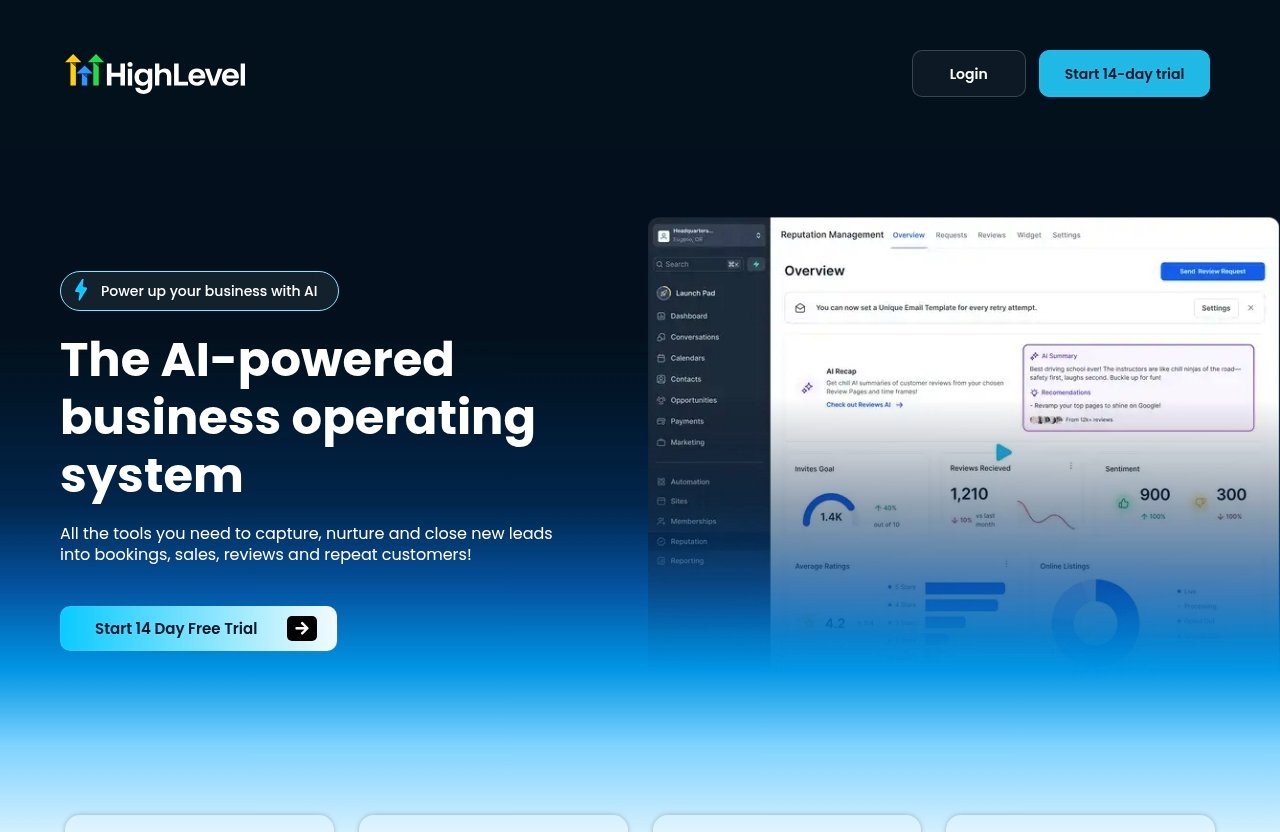
GoHighLevel is officially positioned as “the AI-powered business operating system” and an all-in-one platform for business growth. In practical terms, that means it is designed to bring lead capture, CRM, follow-up, sales pipelines, booking, payments, and client communication into a single system.
In a GoHighLevel vs HubSpot decision, this positioning matters because GoHighLevel is not just trying to be a CRM. It is trying to replace several operational tools that agencies and service businesses often stitch together.
From hands-on agency-style usage, the biggest advantage is workflow consolidation. Instead of bouncing between a funnel builder, form tool, calendar app, SMS tool, CRM, invoicing tool, and reporting dashboard, you can build a more unified client delivery process.
Agency-first model and sub-account structure
GoHighLevel is especially popular with agencies because of its agency-first model. The platform supports client sub-accounts, which allows agencies to organize separate client workspaces instead of mixing all customer data into one account.
That structure is a major reason many buyers searching for the best CRM for agencies end up comparing GoHighLevel with HubSpot. Agencies do not only need contact records. They need repeatable systems they can clone, manage, brand, and deliver across multiple clients.
The official homepage also emphasizes white-label capability. For agencies, GoHighLevel white label functionality can support a more branded client experience, where the software feels like part of the agency’s own service delivery.
Main features from the official homepage
According to the official GoHighLevel homepage, the platform includes a broad feature set covering marketing, sales, communication, and payments.
Key official features include:
- CRM
- Voice AI
- Forms, surveys, and quizzes
- Websites, funnels, and landing pages
- Webinar funnels
- Chat widget and Conversation AI
- Call tracking
- Inbound SMS and social DMs
- Social Planner
- Missed Call Text-Back
- AI Biz Card Scanner
- QR Codes
- Prospecting Tool
- Ad Manager for Google, Facebook, and Instagram ads
- Consolidated conversation stream for SMS, Messenger, Instagram DM, WhatsApp, and Livechat
- Sales pipelines
- Workflows and automations
- Calendars and appointment reminders
- Text snippets
- Ringless voicemail
- Mobile app with video messages
- Automated outbound call connect
- Lead scoring
- Estimates and proposals
- Invoicing and payment integrations
- Paid calendars
- Order forms
- Upsells and downsells
- Membership offers and courses
- One-click upsell funnels
- Text-2-Pay and Tap-2-Pay
- Gift cards and loyalty programs
That breadth is why GoHighLevel vs HubSpot often favors GoHighLevel for agencies that want fewer subscriptions and more bundled execution tools.
What Is HubSpot?
Why HubSpot is a common benchmark
HubSpot is one of the most common platforms buyers use as a benchmark when evaluating CRM and marketing software. It is widely recognized in the market and frequently appears in comparison content against all-in-one growth platforms.
In a GoHighLevel vs HubSpot buying decision, HubSpot is usually the “mature CRM” option. Third-party comparison sources often position it as strong for teams that want a polished interface, structured customer data, and more advanced reporting.
That does not automatically make it better for every buyer. It simply means HubSpot tends to appeal to companies that prioritize CRM sophistication over bundled agency delivery tools.
Typical strengths users mention in SERPs
Across SERP comparison sources, HubSpot is commonly praised for:
- Mature CRM workflows
- Polished user experience
- Strong reporting and analytics
- Deeper contact intelligence
- AI-powered data enrichment, according to some third-party summaries
- Broad integrations
- Sales and marketing team adoption
These are important strengths. If your company has a sales manager, marketing operations team, defined lifecycle stages, and multiple departments using the CRM daily, HubSpot may feel more familiar and scalable from a CRM governance perspective.
This is where hubspot crm has a clear reputation advantage. It is often viewed as a strong system of record for companies that care deeply about data quality, reporting, and pipeline visibility.
Limitations to note without inventing specs
The most common limitation mentioned in third-party comparisons is cost expansion as teams scale and need more advanced functionality. Because this article does not use official HubSpot pricing data, it would be misleading to quote exact numbers.
Instead, the fair way to phrase the gohighlevel vs hubspot cost issue is this: many comparison sources and user discussions suggest HubSpot can become more expensive as feature needs, contacts, seats, or advanced requirements grow. Buyers should verify current hubspot pricing directly before making a decision.
The other limitation is fit. HubSpot may be excellent CRM software, but it is not usually described as an agency-first white-label operating system in the same way GoHighLevel is positioned.
Pricing and Value Comparison
GoHighLevel pricing facts from the official page
The official GoHighLevel pricing page states that GoHighLevel offers a 14-day free trial. The supplied official pricing excerpt does not expose specific plan names or prices, so this article will not invent them.
That point is important. Many software comparisons casually quote outdated pricing, but gohighlevel pricing can change, and buyers should always verify the current offer directly on the official pricing page before subscribing.
For this GoHighLevel vs HubSpot comparison, the most reliable conclusion is that GoHighLevel’s value proposition is built around bundling many business-growth tools into one platform. The official homepage supports this with its broad feature list across CRM, funnels, messaging, calendars, automation, payments, and memberships.
How pricing shape affects agencies
Agencies think about pricing differently from single businesses. A solo business asks, “Can this tool help me sell more?” An agency asks, “Can this tool help me serve multiple clients profitably?”
That is where GoHighLevel’s agency-friendly structure becomes commercially attractive. Client sub-accounts, white-label capability, workflows, funnels, appointment tools, and communication features can reduce the number of separate tools an agency needs to manage.
When comparing GoHighLevel vs HubSpot, consider the hidden cost of tool sprawl. If you need separate software for funnels, calendars, SMS, forms, appointment reminders, invoicing, and memberships, your monthly stack can become harder to manage even before software fees are considered.
Why HubSpot often becomes expensive as teams scale
Third-party comparisons often suggest HubSpot can become costly as companies scale into more advanced needs. Again, this article will not quote exact hubspot pricing because no official HubSpot pricing source was provided.
The commercial point is broader: HubSpot can be a great investment when you need its CRM depth, reporting structure, and ecosystem maturity. But if your main need is agency delivery, follow-up automation, appointment booking, funnels, and client communication, you may be paying for a level of CRM sophistication that is not your highest priority.
This is why gohighlevel vs hubspot cost is not just about subscription price. It is about total operating cost, implementation complexity, and how many extra tools you need to complete your workflow.
Value summary by budget
For lean agencies, consultants, coaches, local marketers, and service providers, GoHighLevel often delivers stronger practical value because it bundles more execution tools in one place. That can make the platform feel more directly tied to revenue-generating work.
For larger sales organizations, HubSpot may justify its cost if the business needs deeper reporting, cleaner CRM governance, and a mature ecosystem. In that case, the extra investment may be reasonable.
A simple value framework:
| Buyer Priority | Better Fit |
|---|---|
| Agency delivery and client accounts | GoHighLevel |
| White-label software experience | GoHighLevel |
| Multi-channel follow-up | GoHighLevel |
| Mature CRM reporting | HubSpot |
| Broader integration ecosystem | HubSpot |
| Lower tool sprawl | GoHighLevel |
| Enterprise-style CRM process | HubSpot |
Automation and Workflow Comparison
GoHighLevel automation strengths
GoHighLevel automation is one of the strongest reasons agencies consider switching. Official features include workflows and automations, appointment reminders, missed call text-back, Conversation AI, ringless voicemail, automated outbound call connect, inbound SMS and social DMs, and a consolidated conversation stream.
In real business terms, this means GoHighLevel can help automate follow-up across channels that service businesses actually use. A lead can submit a form, book an appointment, receive reminders, trigger pipeline movement, and continue conversations through SMS, chat, or social DMs.
In a GoHighLevel vs HubSpot comparison, GoHighLevel feels especially strong for speed-to-lead and repetitive client workflows. Local businesses, for example, often care more about missed calls, appointment reminders, and text follow-up than complex lead attribution models.
HubSpot automation strengths according to SERP sources
Third-party comparison sources often describe hubspot automation as strong in structured CRM environments. HubSpot is commonly associated with organized sales processes, marketing workflows, data visibility, and reporting-connected automation.
That makes HubSpot appealing when automation needs to be tightly connected to CRM lifecycle stages, sales handoffs, and analytics. For a B2B company with a longer sales cycle, this can be a major advantage.
The tradeoff is that HubSpot may not feel as naturally agency-oriented for white-label delivery, client sub-accounts, funnels, and bundled local-business communication workflows. This is not a weakness for every buyer, but it matters for agencies.
Which platform is better for repetitive client work
For repetitive client work, GoHighLevel usually wins. Agencies often need to build similar workflows repeatedly: lead capture, booking, reminders, nurture sequences, missed-call recovery, pipeline updates, payment collection, and review-style follow-up.
GoHighLevel’s official feature list maps directly to those needs. Its combination of funnels, calendars, conversations, workflows, payments, and client accounts is designed for repeatable operational delivery.
HubSpot may be better when repetitive work is centered around CRM data quality, reporting, and structured sales operations. But for agencies delivering campaigns to multiple clients, GoHighLevel vs HubSpot usually tilts toward GoHighLevel on automation practicality.
Official website · Latest pricing & offers
Agency Features: Why GoHighLevel Often Wins Here
White-labeling and SaaS-style resale
The GoHighLevel white label capability is one of its biggest differentiators. The official homepage emphasizes white-label functionality and “all the tools you need in one AI-powered platform.”
For agencies, this changes the value equation. Instead of only selling services, an agency can create a branded software-like experience around its delivery. That can improve perceived value and make the client relationship feel more integrated.
In the GoHighLevel vs HubSpot debate, this is one of the clearest areas where GoHighLevel is more agency-aligned. HubSpot may be a stronger CRM in many contexts, but GoHighLevel is more naturally built around agency ownership, branding, and multi-client service delivery.
Client sub-accounts and multi-client management
Client sub-accounts are essential for agencies managing multiple businesses. They help separate data, workflows, calendars, pipelines, and communication streams by client.
This matters operationally. Without clean separation, agencies can end up with messy records, duplicated systems, and manual reporting work. GoHighLevel’s agency-first setup helps create a more repeatable delivery model.
If you are comparing GoHighLevel vs HubSpot as an agency owner, ask yourself this: do you need a CRM for your own business, or do you need a platform to run marketing systems for many clients? If it is the second option, GoHighLevel is usually the more natural fit.
Funnels, calendars, and built-in revenue tools
GoHighLevel includes official features such as websites, funnels, landing pages, webinar funnels, calendars, paid calendars, order forms, upsells, downsells, invoicing, payment integrations, Text-2-Pay, Tap-2-Pay, gift cards, loyalty programs, and membership offers or courses.
That mix is valuable because agencies are often judged by outcomes: leads booked, appointments confirmed, payments collected, and campaigns launched. GoHighLevel gives agencies many of the tools needed to build those systems without constantly adding separate vendors.
If your agency also manages hosting, websites, or migrations, you may want to compare software costs alongside technical operations. Our guide on how to migrate WordPress to Cloudways without downtime can help if infrastructure is part of your client delivery stack.
CRM Depth, Reporting, and Ecosystem: Where HubSpot Usually Leads
Data structure and reporting quality
HubSpot’s biggest advantage is usually CRM maturity. Third-party comparison sources often describe HubSpot as stronger for structured data, reporting, analytics, and polished CRM workflows.
If your business relies on detailed pipeline reporting, sales forecasting, customer segmentation, or executive dashboards, HubSpot may be the better option. The hubspot crm reputation is strongest when CRM quality is the central buying criterion.
In GoHighLevel vs HubSpot, this is the section where HubSpot deserves real credit. GoHighLevel has CRM and sales pipelines, according to its official homepage, but HubSpot is often described by comparison sources as the deeper CRM system.
Integration ecosystem and ecosystem maturity
HubSpot is also commonly praised for its broader ecosystem and integrations. For companies already using many established sales, marketing, support, data, and operations tools, ecosystem maturity can be a deciding factor.
This matters most when your CRM must connect cleanly with multiple departments and software layers. Larger teams may prefer a platform that fits into a wider operational architecture.
GoHighLevel’s value is different. It aims to reduce the number of tools you need by bundling core business-growth features into one platform. HubSpot may be better for connecting a sophisticated stack, while GoHighLevel may be better for replacing pieces of that stack.
Tradeoffs for agencies
For agencies, HubSpot’s strengths can sometimes be less urgent than they appear on paper. Reporting depth is valuable, but many local clients mainly want more leads, faster follow-up, easier booking, and clearer communication.
That is why GoHighLevel vs HubSpot should be judged by the client outcome you sell. If you sell advanced CRM consulting to mid-market or enterprise teams, HubSpot may make sense. If you sell lead generation, appointment booking, funnel builds, and automated follow-up to local businesses, GoHighLevel is usually more aligned.
The best platform is the one that supports your delivery model with the least friction.
Ease of Setup and Daily Usability
Learning curve and onboarding
Third-party comparisons often describe HubSpot as more beginner-friendly and intuitive. Its interface is generally viewed as polished, which can help non-technical sales and marketing teams adopt it faster.
GoHighLevel can require more setup because it covers more operational ground. You may need to configure funnels, pipelines, calendars, automations, messaging, payment settings, and client sub-accounts.
That said, the extra implementation can be worthwhile. In GoHighLevel vs HubSpot, GoHighLevel may take more planning upfront, but it can simplify daily execution once the system is properly built.
How each platform affects non-technical teams
For non-technical teams, HubSpot may feel easier at first if the main task is managing contacts, deals, and reports. This is one reason it remains a popular CRM benchmark.
GoHighLevel may feel broader because it combines CRM, funnels, messaging, automation, and payment-related tools. That breadth can be intimidating at first, but it can also reduce the number of platforms a team must learn.
If your team is small, the practical usability question is not “Which interface is prettier?” It is “Which platform lets us complete the most work with the least tool switching?”
When simplicity matters more than depth
Simplicity matters when your business needs fast implementation and your processes are not complex. For a sales team that mainly needs a clean CRM, HubSpot may be easier to adopt.
For an agency that needs templates, client accounts, funnels, conversations, automations, calendars, and billing-related tools, simplicity means consolidation. In that context, GoHighLevel may become simpler over time because more of the workflow lives in one place.
That is the key usability tradeoff in GoHighLevel vs HubSpot. HubSpot may be easier at the CRM layer, while GoHighLevel may be easier at the agency operations layer after setup.
Best Use Cases by Business Type
Marketing agencies
For marketing agencies, GoHighLevel is usually the stronger fit. It supports client sub-accounts, white-labeling, funnels, landing pages, workflows, calendars, messaging, call tracking, payments, and memberships.
These features map directly to agency services. You can build lead capture systems, automate follow-up, manage conversations, schedule appointments, and support client campaigns from one platform.
If you are evaluating the best CRM for agencies, the GoHighLevel vs HubSpot decision usually comes down to whether you need agency operations or CRM depth. Most small to mid-sized agencies will likely get more practical value from GoHighLevel.
Local service businesses
Local service businesses often care about missed calls, appointment booking, follow-up speed, and simple lead tracking. GoHighLevel’s official features include missed call text-back, appointment reminders, call tracking, calendars, inbound SMS, social DMs, and workflows.
That makes it a strong fit for dentists, med spas, home services, real estate teams, gyms, consultants, and other appointment-driven businesses. The platform is especially useful when leads arrive from multiple channels and need quick follow-up.
HubSpot may still be a fit if the business wants a more traditional CRM with stronger reporting. But for practical local lead management, GoHighLevel vs HubSpot often favors GoHighLevel.
B2B sales teams
B2B sales teams should look carefully at HubSpot. If your company has a defined sales process, multiple reps, structured reporting needs, and a heavy focus on CRM data, HubSpot may be the safer choice.
Third-party sources often frame HubSpot as stronger for mature CRM use cases, analytics, and ecosystem depth. That makes sense for teams where pipeline governance and reporting are central.
GoHighLevel can still work for B2B service businesses, especially if appointment setting, funnels, and follow-up automation are priorities. But if CRM sophistication is the primary requirement, HubSpot may lead.
Creators or course sellers
Creators, coaches, and course sellers may find GoHighLevel appealing because its official feature list includes memberships, courses, order forms, one-click upsell funnels, upsells, downsells, payment integrations, paid calendars, and webinar funnels.
That combination supports monetization workflows beyond basic contact management. You can capture leads, book calls, sell offers, run funnels, and deliver membership-style content.
HubSpot may be useful for creators building a more complex CRM and email-driven operation, but most creators comparing GoHighLevel vs HubSpot will likely care more about bundled revenue tools than advanced CRM reporting.
Final Recommendation
Choose GoHighLevel if…
Choose GoHighLevel if you are an agency, consultant, local service business, creator, or service provider that wants a practical all-in-one system for growth. It is especially compelling if you care about affordability, automation, white-labeling, client sub-accounts, funnels, calendars, conversations, and built-in revenue tools.
The official GoHighLevel homepage supports this positioning with a broad feature set that includes CRM, workflows, automations, websites, funnels, landing pages, SMS and social DMs, call tracking, appointment reminders, invoicing, payment integrations, memberships, and white-label capability.
If that sounds like your business model, you can try GoHighLevel through toptrustreview.com using this recommended GoHighLevel offer.
Choose HubSpot if…
Choose HubSpot if your main priority is a mature CRM, polished interface, deeper reporting, and a broad integration ecosystem. It is often a better fit for B2B sales teams, larger organizations, and companies with structured CRM operations.
HubSpot is also worth considering if your team values CRM data quality and analytics more than agency-specific tools like white-labeling, client sub-accounts, funnels, and bundled local-business follow-up systems.
The fairest GoHighLevel vs HubSpot conclusion is that HubSpot is not “worse.” It is simply built for a different center of gravity.
The simplest buying decision
Here is the simplest way to decide:
- If you run an agency or service business and want bundled automation, client management, white-labeling, and fewer tools, choose GoHighLevel.
- If you run a CRM-heavy sales organization and need stronger reporting, integrations, and data structure, choose HubSpot.
- If cost control and tool consolidation are major priorities, GoHighLevel is usually the better commercial fit.
- If enterprise-style CRM maturity is the priority, HubSpot deserves serious consideration.
For most agencies and service businesses comparing GoHighLevel vs HubSpot in 2026, GoHighLevel is the more practical buy because it aligns better with affordability, automation, and agency-friendly delivery.
Official website · Latest pricing & offers
FAQ
Is GoHighLevel better than HubSpot for agencies?
Yes, for many agencies GoHighLevel is the better fit. It is built around client sub-accounts, white-labeling, funnels, automation, calendars, communication tools, and bundled service-delivery features.
HubSpot may still be better for agencies that primarily deliver CRM consulting or need advanced reporting for larger clients.
Is HubSpot more expensive than GoHighLevel?
Often, third-party comparisons suggest HubSpot can become more expensive as teams scale into paid tiers and advanced needs. However, you should verify current HubSpot pricing directly because no official HubSpot pricing source was used in this article.
GoHighLevel’s official pricing page confirms a 14-day free trial, but the supplied excerpt does not expose exact plan names or prices.
Which platform is easier to use, GoHighLevel or HubSpot?
SERP comparison sources often describe HubSpot as more beginner-friendly and intuitive, especially for CRM-focused teams. GoHighLevel may require more setup because it combines more tools in one platform.
For agencies, GoHighLevel can become easier operationally once funnels, automations, calendars, and client accounts are configured.
Does GoHighLevel replace multiple tools?
Yes. Official GoHighLevel product facts show CRM, websites, funnels, landing pages, SMS and social DMs, calendars, workflows, invoicing, payment integrations, memberships, courses, and more in one platform.
That is one of the main reasons agencies compare GoHighLevel vs HubSpot when trying to reduce software sprawl.
Which is better for automation and follow-up?
GoHighLevel is especially strong for multi-channel follow-up and client communication automation, including workflows, missed call text-back, appointment reminders, SMS, DMs, Conversation AI, and call-related tools.
HubSpot is generally better known for CRM depth, structured workflows, and reporting-connected automation. For agencies and local service businesses, GoHighLevel will usually be the better automation fit.
Related Reading
References
- HubSpot vs HighLevel | CRM, Automation & Pricing Compared for 2025
- GoHighLevel vs HubSpot 2026: Which CRM Is Actually Worth Your Money?
- GoHighLevel vs HubSpot: 2026 comparison guide
- Go High Level Vs HubSpot – Reddit