5 Best Remote Job Sites Like Remote Rocketship
If you are comparing sites like Remote Rocketship, you probably want one simple thing: more reliable places to find legitimate remote roles without wasting hours on generic job boards. Remote Rocketship can be useful as part of that search, but it should not be the only source you use.
This guide compares five strong Remote Rocketship alternatives: Remote OK, We Work Remotely, Remotive, Dynamite Jobs, and Working Nomads. I’ll also cover a few extra remote job sites worth bookmarking, how to choose the right board for your situation, and practical ways to get better results from your search.
If you want to compare Remote Rocketship directly while reading, you can also explore Remote Rocketship here. Because its official homepage and pricing page were inaccessible behind security verification at the time of review, I won’t make claims about unverified pricing, plans, or private features.
Official website · Latest pricing & offers
Quick Answer: The 5 Best Sites Like Remote Rocketship
Here is the short version if you want a fast comparison of the best sites like Remote Rocketship before reading the full guide.
| Remote Job Site | Best For | Short Verdict |
|---|---|---|
| Remote OK | High listing volume and broad remote coverage | A practical first stop if you want lots of remote roles across tech, marketing, support, design, and more. |
| We Work Remotely | Established remote-first employers | Strong for candidates who want a familiar remote job board with recognizable companies and professional listings. |
| Remotive | Curated remote roles | Good for people who prefer a cleaner, less noisy remote-only job search experience. |
| Dynamite Jobs | Startups, small teams, and flexible companies | Useful if you want more context around team stage, company type, or startup-style roles. |
| Working Nomads | Daily browsing and fresh remote listings | Easy to scan regularly if you want a simple way to monitor new remote opportunities. |
These sites like Remote Rocketship are not identical. Some focus on volume, some on curation, and others are better for startup or niche roles.
Why this list is different
Many lists of remote job boards simply name the biggest platforms. This guide looks at how each site fits a real job-search workflow: what kind of candidate it helps, where it saves time, and where you may need a backup board.
I also avoid unsupported claims. For Remote Rocketship specifically, no verified pricing or detailed product information could be extracted from the official pages because they were blocked by security verification. If pricing matters to you, check the official site directly for the latest details.
Who each site is best for
If you want the most listings, start with Remote OK. If you want established remote-first companies, add We Work Remotely. If you prefer curation over volume, Remotive may feel more manageable.
Dynamite Jobs is a good fit for startup-minded candidates, while Working Nomads works well as a quick daily browsing habit. In practice, most job seekers get better coverage by using two or three sites like Remote Rocketship together instead of relying on one board.
What Remote Rocketship Is Best For—and Where Alternatives Help
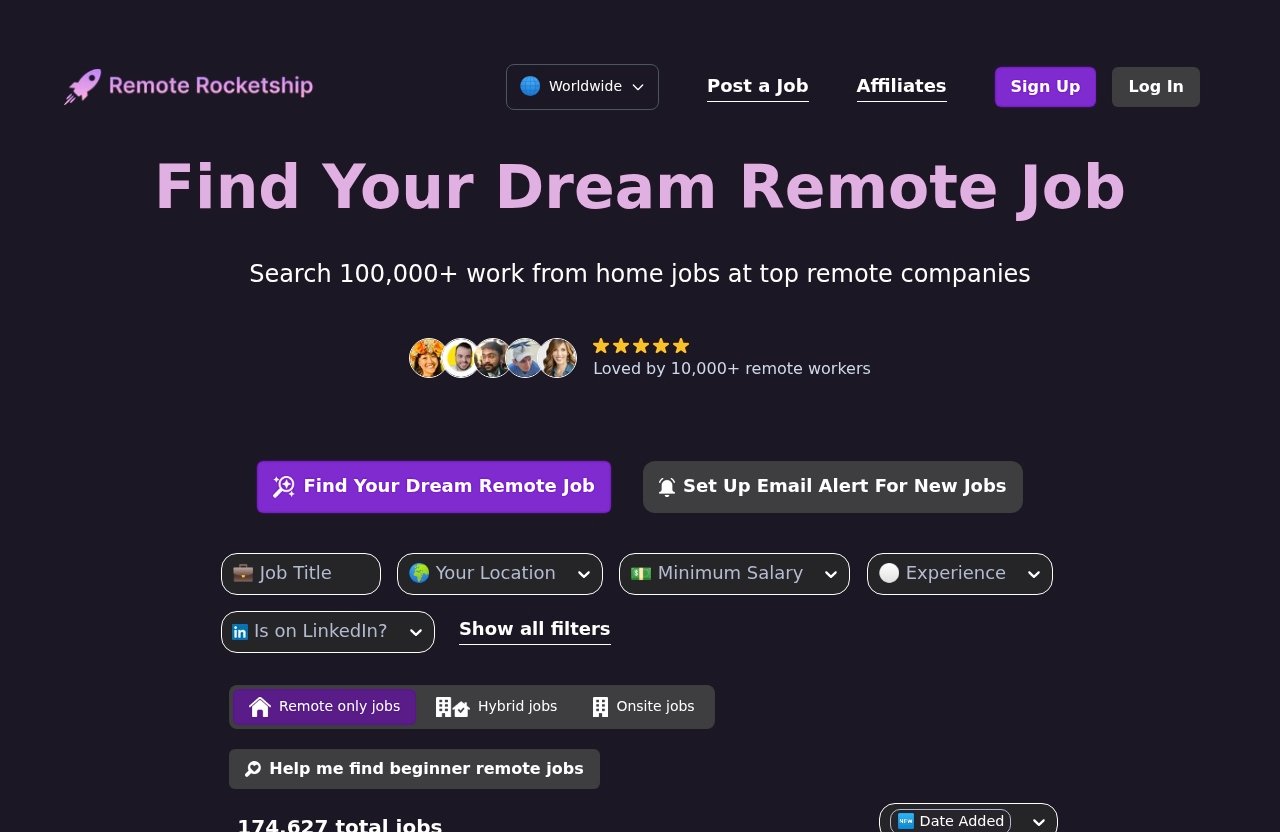
Remote Rocketship appears in searches for remote job discovery and remote job board comparisons. Based on public search results and comparison context, it is positioned for people who want to find remote opportunities in one place.
That can be helpful, but job seekers often benefit from comparing multiple sites like Remote Rocketship because remote hiring is fragmented. Some companies post on one board, some post on several, and some only list openings on their own careers page.
Curated remote listings
The main appeal of curated remote job platforms is simple: they reduce the time you spend filtering out irrelevant on-site or hybrid listings. For remote candidates, this matters because generic job boards often label roles as remote even when there are location, timezone, or office requirements.
A curated board can make the search feel more focused. Still, every listing should be checked carefully for location eligibility, employment type, salary transparency, and application instructions.
Need for broader coverage
No single remote job board covers every good opening. That is why remote rocketship alternatives are worth considering if you want broader coverage across industries, role types, and company sizes.
For example, one site may be stronger for software engineering roles, while another may surface more customer support, operations, product, or marketing jobs. If you are early in your search, broader coverage helps you understand what employers are actually asking for.
When job seekers should use more than one board
You should use more than one board when your role is competitive, your timezone matters, or you are applying across different industries. This is especially true for candidates searching internationally or looking for entry-level remote jobs.
A smart workflow is to choose one primary board and two supporting sites like Remote Rocketship. That gives you enough variety without turning your job search into a full-time research project.
How We Chose These Remote Job Sites
This shortlist was selected based on practical job-search usefulness, not hype. The focus is on remote-only or remote-friendly platforms that help candidates find relevant roles faster than broad, general-purpose job boards.
The best remote job sites are not always the ones with the most listings. They are the ones that make it easier to identify suitable jobs, avoid duplicates, and apply before a role becomes overcrowded.
Curation and quality control
Curation matters because remote job searches can get noisy fast. A board that screens, categorizes, or organizes listings well can save you time, even if it has fewer total openings.
When evaluating sites like Remote Rocketship, I looked for boards that make it easier to separate real remote opportunities from vague or low-quality posts. Job seekers should still do their own checks, but better curation improves the starting point.
Search filters and role specificity
Good filters help you narrow results by category, seniority, location, company type, or technology. This matters because “remote” can mean fully remote worldwide, remote within one country, remote within certain timezones, or hybrid with occasional office visits.
The strongest remote work boards make these distinctions easier to spot. Even when filters are limited, clear job titles and company descriptions can make browsing more efficient.
Free vs paid access
Many candidates look for free sites like Remote Rocketship, especially when they are applying to multiple roles per week. Free access is valuable, but it is not the only factor to consider.
Some boards may offer paid options, employer-paid listings, premium alerts, or other monetization models. Since Remote Rocketship’s verified pricing details could not be accessed during review, readers should check the official site directly if they need current pricing information.
Freshness and update frequency
Fresh listings matter because remote jobs often attract many applicants quickly. A job posted weeks ago may still be open, but your odds can be better when you apply early with a tailored application.
That is why the best remote jobs websites are worth checking on a schedule. Daily or several-times-a-week browsing can help you catch new roles before they are widely shared.
1. Remote OK
Remote OK is one of the more recognizable remote job boards and a strong choice for candidates who want volume. It covers a wide range of remote roles, with many listings in tech and digital work.
Among sites like Remote Rocketship, Remote OK is useful when you want to quickly understand what kinds of remote jobs are currently being advertised across different categories.
Best for large volume and broad remote coverage
Remote OK is best for job seekers who would rather start with a large pool of opportunities and narrow down from there. If you are open to several role types or industries, that volume can be helpful.
It is especially practical for candidates in software development, product, design, marketing, and customer support. As with any high-volume board, you should expect to filter carefully.
Best features to look for
When using Remote OK, pay attention to filters, tags, role categories, and location requirements. These details can help you avoid wasting time on roles that are not actually available in your region.
For example, “worldwide” and “remote in the U.S.” are very different from a candidate’s perspective. Always read the full posting before applying.
Pros and trade-offs
| Pros | Trade-Offs |
|---|---|
| Large range of remote listings | Can feel noisy if you do not filter well |
| Useful for tech and digital roles | Some categories may be more competitive |
| Good for discovering market demand | Duplicate or expired listings may still require checking |
Remote OK works best when you use it as a discovery engine. Pair it with a more curated board if you want both volume and quality control.
2. We Work Remotely
We Work Remotely is another well-known remote job board and is often considered by candidates comparing the best remote job boards. It has a long-standing presence in the remote work space and is familiar to many remote-first employers.
For people researching sites like Remote Rocketship, We Work Remotely is worth checking because it tends to attract serious remote job postings across professional categories.
Best for established remote-first companies
We Work Remotely is a good fit if you want to find roles from companies that are comfortable hiring remotely. That does not mean every role is right for every candidate, but the board is clearly built around remote work.
It can be especially useful for experienced candidates who already understand remote hiring expectations. If you have remote collaboration experience, this board can help you find companies that value it.
Role types commonly found
You can commonly find categories such as programming, design, marketing, customer support, product, sales, and operations. Availability changes over time, so the best approach is to check the categories that match your target role.
Candidates should pay attention to seniority level. Many remote roles require prior experience, strong written communication, or overlap with specific timezones.
Pros and trade-offs
| Pros | Trade-Offs |
|---|---|
| Strong remote-work reputation | Popular roles may attract many applicants |
| Good for professional remote roles | Not every category has equal volume |
| Simple category-based browsing | You still need to verify location rules |
We Work Remotely is a strong primary or secondary board if you want employer familiarity and a straightforward remote job search experience.
3. Remotive
Remotive is a remote-only job board that appeals to people who want curation and simplicity. It is often a better fit for candidates who dislike scrolling through large, noisy job feeds.
If your goal is to compare sites like Remote Rocketship with a cleaner browsing experience, Remotive belongs on your shortlist.
Best for curated remote roles
Remotive is best for job seekers who value relevance over raw volume. A curated remote board can make the process feel less overwhelming, especially if you are applying around a full-time schedule.
It is useful for candidates in tech, marketing, customer support, product, and other remote-friendly roles. As always, review each posting for region limits and employer expectations.
How it differs from mass aggregators
Mass aggregators can surface a huge number of jobs, but they often require more cleanup. Remotive’s appeal is that it keeps the experience focused on remote roles.
This makes it a practical choice for people who want fewer distractions. It may not show every opportunity, but it can help you browse more intentionally.
Pros and trade-offs
| Pros | Trade-Offs |
|---|---|
| Remote-only focus | May have fewer listings than high-volume boards |
| Cleaner experience than many aggregators | Niche roles may require additional boards |
| Useful for curated browsing | Some roles may still have location restrictions |
Remotive is a good supporting board if you already use Remote OK or We Work Remotely. Together, they give you a mix of volume and curation.
Official website · Latest pricing & offers
4. Dynamite Jobs
Dynamite Jobs focuses on remote and flexible roles, often appealing to candidates who like startups, small teams, and online businesses. It can be useful when you want more context than a basic job title and company name.
Among sites like Remote Rocketship, Dynamite Jobs stands out for candidates who care about company fit, team structure, and startup-style work environments.
Best for small teams and startup roles
Dynamite Jobs is best for people who want to work with growing companies, lean teams, or entrepreneurial organizations. These roles may offer broader responsibilities than traditional corporate jobs.
That can be exciting, but it also requires careful reading. Startup roles may involve ambiguity, fast-changing priorities, or a need to work independently.
Why team-stage filters matter
Company stage matters because the day-to-day experience at a 10-person team can be very different from a 500-person remote company. Some candidates thrive in small teams, while others prefer mature processes and defined responsibilities.
Filters or contextual information around company type can help you decide where you are likely to perform well. This is especially important for remote work, where communication norms and management style matter.
Pros and trade-offs
| Pros | Trade-Offs |
|---|---|
| Good for startup-minded candidates | May not suit people seeking large-company structure |
| Helpful company context | Some roles may require broad skill sets |
| Useful for flexible and remote work searches | Volume may vary by category |
Dynamite Jobs is worth adding if you want remote opportunities beyond the usual large-company postings. It is especially useful as a companion to broader remote job board alternatives.
5. Working Nomads
Working Nomads is a simple, easy-to-scan remote job board. It is useful for candidates who want to check fresh remote listings regularly without getting buried in too many features.
For people comparing sites like Remote Rocketship, Working Nomads is a practical option because it fits well into a daily or weekly job-search routine.
Best for daily-updated remote listings
Working Nomads is best for browsing new remote jobs consistently. If you are actively applying, checking a board like this several times per week can help you spot roles early.
The site is particularly useful when you want a quick overview of what is available across common remote categories. It may not replace deeper boards, but it can be a reliable part of your search stack.
Best for flexible browsing
Some job seekers do not need complex tools; they need a clean list of new roles. Working Nomads fits that style of search well.
It is also helpful for candidates who want to browse by category and then investigate companies directly. This keeps the process simple and efficient.
Pros and trade-offs
| Pros | Trade-Offs |
|---|---|
| Easy to scan quickly | Less detailed than some specialized boards |
| Useful for routine browsing | May require cross-checking company sites |
| Covers common remote categories | Not always ideal for highly niche searches |
Working Nomads is a good low-friction board. Use it alongside more specialized remote jobs websites if you want both speed and depth.
Other Sites Worth Bookmarking
The five boards above are the main recommendations, but they are not the only sites like Remote Rocketship worth knowing. Depending on your role, the following platforms can add useful coverage.
These bonus sites are especially helpful if you want curated feeds, startup opportunities, or additional remote job sources beyond the most familiar names.
Remote Circle
Remote Circle is worth bookmarking if you like curated remote job discovery. It may appeal to candidates who want a more focused feed rather than a massive database.
Use it as a secondary source to catch roles that may not appear on larger boards. As with any platform, verify the employer, role requirements, and location rules before applying.
Remote Friendly
Remote Friendly can be useful if you care about distributed-first or remote-friendly companies. For some candidates, the company’s remote culture matters as much as the job title.
This type of board can help you think beyond the listing itself. Look for signs that the company has clear remote processes, async communication habits, and realistic expectations.
NoDesk
NoDesk is another remote work resource worth checking, especially if you like curated remote job listings and remote-work content. It can be useful for candidates who want a broader remote career resource, not just a job feed.
It is best used as part of a wider search routine. Pair it with higher-volume boards if you want more opportunities to compare.
Wellfound
Wellfound is especially relevant for startup roles. It is not only a remote job board, but it can be useful if you are interested in startup jobs, early-stage companies, or tech-focused opportunities.
When using Wellfound, pay close attention to whether a role is truly remote, hybrid, or location-specific. Startup listings can be promising, but details matter.
Remote Rocketship vs. Other Remote Job Sites: Which Should You Use?
The best answer is not “use only one.” Most candidates should combine Remote Rocketship with other sites like Remote Rocketship to increase coverage and reduce blind spots.
If you want to compare Remote Rocketship directly, check the official site for current details, especially pricing or account features. Public access limitations during review mean those details should not be assumed.
If you want curated and simple
If you want a curated and simple search experience, start with Remote Rocketship and Remotive. Both fit the type of user who wants less noise and more remote-focused browsing.
You can also add Remote Circle or NoDesk if you like curated feeds. This setup works well for candidates who would rather apply to fewer, better-matched roles.
If you want volume
If volume matters most, Remote OK and We Work Remotely should be near the top of your list. These are among the best sites for remote jobs when you want to see a wider range of openings.
Volume is useful, but it requires discipline. Use filters, save searches, and avoid applying to roles that clearly do not match your experience or location.
If you want niche or startup roles
For startup roles, Dynamite Jobs and Wellfound are strong additions. They are useful for candidates who want smaller teams, early-stage companies, or more flexible responsibilities.
This route is especially good for generalists, operators, marketers, developers, and product-minded candidates. Just make sure you are comfortable with the pace and ambiguity that can come with startup work.
If you want the best overall workflow
A balanced workflow might look like this: use one curated board, one high-volume board, and one niche board. For example, combine Remotive, Remote OK, and Dynamite Jobs.
That gives you quality, volume, and startup coverage. For many candidates, this mix is more effective than relying on a single list of sites like Remote Rocketship.
Tips for Getting Better Results on Remote Job Boards
Finding remote work is not just about choosing the right board. It is also about how you search, how fast you respond, and how clearly your application shows that you can work remotely.
These tips apply whether you use Remote Rocketship, Remote OK, Remotive, or other remote job sites.
Use multiple boards
Use two or three boards at the same time. One board may have better volume, another may have stronger curation, and another may be better for startups or niche roles.
A good setup is one primary board plus two backups. This prevents you from missing good roles without overwhelming your schedule.
Set alerts
Job alerts can help you apply earlier. Set alerts for your target role titles, tools, industries, and seniority levels.
Avoid alerts that are too broad, such as only “remote marketing” or “remote developer.” More specific alerts usually produce better matches.
Search by role and seniority
Search for job titles in several ways. For example, a customer support candidate might search “customer success,” “support specialist,” “technical support,” and “customer experience.”
Also include seniority terms like junior, associate, mid-level, senior, lead, or manager. This helps you find roles that match your experience more accurately.
Watch for duplicate listings
Remote job listings often appear on multiple boards. Duplicates are not always a problem, but they can waste time if you repeatedly review the same role.
Keep a simple spreadsheet with company name, job title, date found, source, and application status. This makes your search more organized and less stressful.
Tailor your resume for remote work
Remote employers often look for evidence that you can communicate clearly, manage time, and work independently. Your resume should show those strengths directly.
Mention remote collaboration tools if relevant, but do not overdo it. Strong examples of ownership, written communication, cross-functional work, and async collaboration are usually more persuasive.
Final Verdict: The Best Sites Like Remote Rocketship for Different Job Seekers
The best sites like Remote Rocketship depend on your goals. If you want the widest search, use Remote OK and We Work Remotely. If you want a cleaner curated experience, add Remotive. If you want startup or small-team roles, use Dynamite Jobs and Wellfound.
Remote Rocketship can still be part of your comparison process, but because verified pricing and detailed feature information were not accessible during review, check the official site directly before making decisions based on cost or specific tools.
Best overall alternative
Remote OK is the best overall alternative for candidates who want broad coverage and a large pool of remote listings. It is especially useful if you are still exploring which remote roles match your background.
Pair it with a curated board to reduce noise. That combination gives you a better balance than using only one platform.
Best free option
For candidates looking for free sites like Remote Rocketship, Remote OK, We Work Remotely, Remotive, Working Nomads, and other public boards are worth checking first. Access models can change, so always confirm directly on each site.
Free browsing does not mean every listing is equally good. You still need to verify employers and apply carefully.
Best for curated quality
Remotive is a strong pick for curated quality. It is a good fit if you want remote-only listings without the clutter of broader job platforms.
Remote Circle and NoDesk are also worth bookmarking if you like curated remote feeds. These can supplement your main search without adding too much noise.
Best for startup roles
Dynamite Jobs is the strongest pick in this list for startup-minded candidates. Wellfound is also valuable if you are targeting startups, tech companies, or early-stage teams.
If you want a practical strategy, use Dynamite Jobs for fit, Remote OK for volume, and Remotive for curation. That is a strong mix of sites like Remote Rocketship for most remote job seekers in 2026.
Official website · Latest pricing & offers
FAQ
What is similar to Remote Rocketship?
Sites similar to Remote Rocketship include Remote OK for volume and filters, Remotive for curated remote roles, We Work Remotely for established remote-first postings, and Dynamite Jobs for startup-style opportunities.
Other options worth checking include Remote Circle for a curated feed, Remote Friendly for distributed-first companies, NoDesk for remote-work resources, and Remotelist-style nomad-focused boards. The right choice depends on whether you want volume, curation, startup roles, or simple daily browsing.
Does Remote Rocketship really work?
Remote Rocketship can be useful for remote job discovery, but results depend on your role, experience level, location, and how consistently you apply. No job board can guarantee interviews or offers.
If you are wondering “is Remote Rocketship legit,” the safest approach is to compare it with other established remote job boards, verify listings directly with employers, and avoid relying on one source.
What is the most legit site for remote jobs?
There is no single most legitimate site for every remote job seeker. Legitimacy usually comes from the employer, the clarity of the job posting, and the board’s moderation or listing standards.
Look for established remote-only boards with clear postings, active updates, transparent employer information, and realistic job descriptions. Always research the company before applying or sharing sensitive information.
How to make $1000 a week remotely?
Making $1000 a week remotely is possible in some roles, but it is not guaranteed. It usually requires in-demand skills, consistent applications, relevant experience, or freelance clients willing to pay for specialized work.
Focus on roles such as software development, design, marketing, sales, customer success, consulting, operations, or skilled freelance services. Build a clear portfolio, apply consistently across multiple remote job boards, and tailor each application to the role.
Related Reading
References
- Remote Rocketship Competitors & Alternatives (2026)
- Remote Jobs You Won't Find on LinkedIn
- 15 Best Job Boards for Finding Remote Work in 2026
- NoDesk – Where Everyone Works Remote