Taplio for Founders: Best Use Cases in 2026

Building a founder brand on LinkedIn sounds simple until you try to do it alongside sales calls, product decisions, hiring, and customer support. Most founders do not lack opinions or useful lessons—they lack a repeatable way to turn those insights into visible content without spending hours every week.
That is where taplio for founders can fit. It is designed to support a LinkedIn workflow that includes idea generation, writing, scheduling, engagement, lead follow-up, and performance analysis. This page may contain affiliate links; if you choose to purchase through one, TopTrustReview may earn a commission at no additional cost to you.
In reviewing the platform’s published feature set, the practical value is not simply “AI writes posts.” The real appeal is creating a lightweight system for sharing founder expertise consistently, engaging with the people who matter, and converting attention into relevant conversations.
Official website · Latest pricing & offers
Why Taplio Fits Founders in 2026
What founders need from a LinkedIn tool
Founders need more than an AI LinkedIn post generator. They need a process that reduces the blank-page problem while keeping their point of view intact. A generic post about leadership or startups will not build credibility in the same way as a specific lesson from a failed product launch, an unexpected customer objection, or a hard-won GTM insight.
For busy operators, taplio for founders is most useful when it becomes a structured execution layer. You bring the real experiences, customer knowledge, and market perspective; the tool helps organize, draft, publish, and follow up on that material.
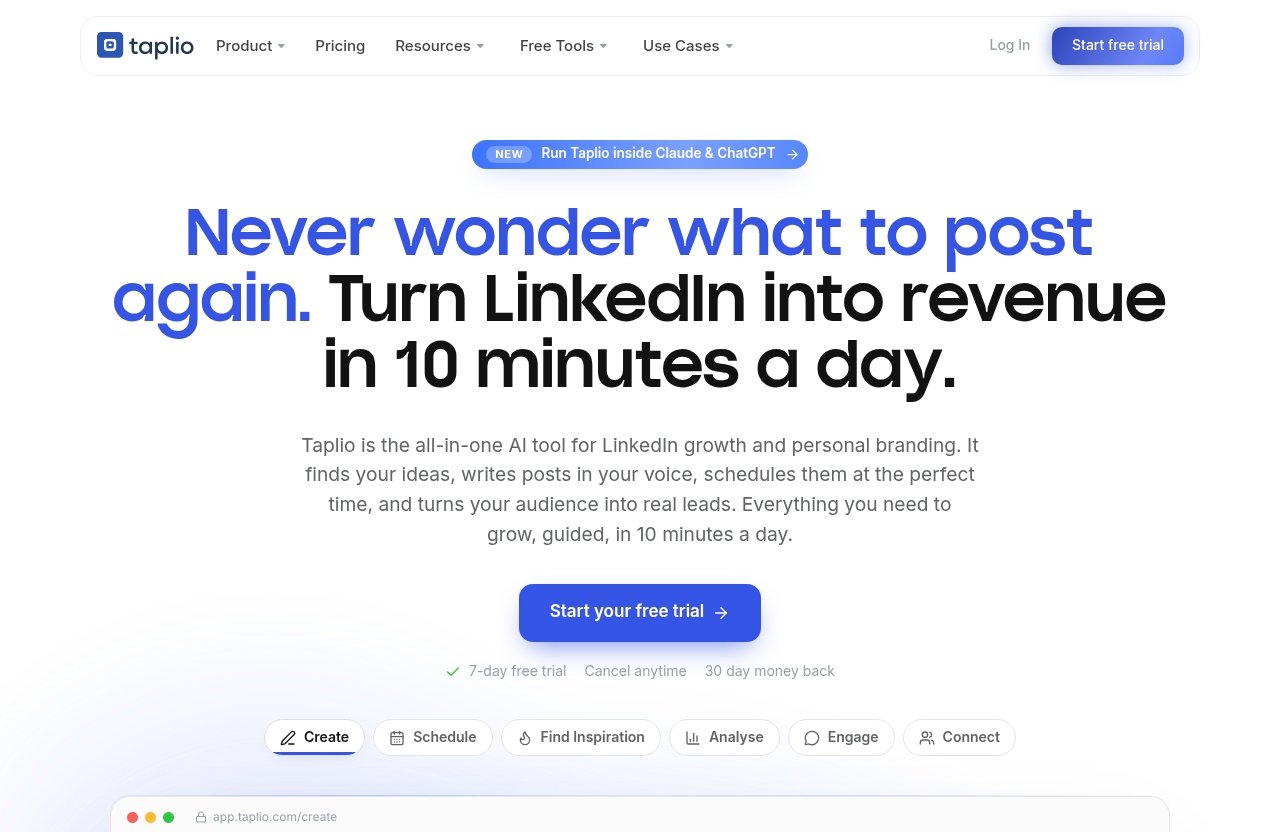
Verified product facts: Taplio’s official homepage describes it as an AI tool to grow on LinkedIn in 10 minutes a day. Its listed capabilities include creating posts, finding inspiration, scheduling, creating carousels, engaging with relevant people, connecting with warm leads, analytics, and automation. Taplio also says its AI is trained on more than 3 million posts.
Why consistency beats sporadic viral posts
A viral post can create a short-term spike, but founders generally benefit more from repeated relevance. When the same audience sees useful posts over several weeks, they begin to associate the founder with a specific problem, category, or perspective.
For example, a B2B SaaS founder could post weekly about onboarding lessons, product positioning, customer research, and implementation mistakes. That consistency makes later product announcements feel more credible because the audience already understands what the founder knows.
The goal is not to publish every thought. It is to develop a reliable cadence that makes your founder personal brand on LinkedIn recognizable.
Where taplio for founders sits in the founder growth stack
Think of Taplio as an operational tool between your raw knowledge and your LinkedIn activity. It does not replace strategy, customer interviews, strong positioning, or a useful product. It can reduce the friction between having an insight and getting that insight in front of the right audience.
For founders who already use a CRM, email platform, and product analytics stack, LinkedIn is often the neglected channel. Taplio for founders provides a more focused environment for the content and relationship-building side of that channel.
If you want a deeper view of how this can fit into a content process, see our guide to [Taplio workflows for LinkedIn growth](/taplio-workflows/).
Taplio Use Case #1: Turn Founder Insights Into Posts Fast
Repurpose product lessons, customer calls, and founder stories
The best LinkedIn content often already exists inside a founder’s week. A customer asks a revealing question. A feature launch exposes a positioning problem. A lost deal shows that your messaging is unclear. These are not just operational moments—they are potential posts.
A useful starting workflow for taplio for founders is to capture short notes after meetings. Instead of writing a polished post immediately, record three points: what happened, what surprised you, and what another founder could learn from it.
For instance:
| Raw founder insight | Possible post angle |
|---|---|
| Customers keep asking for a feature you will not build | “Why we said no to our most requested feature” |
| A launch underperformed | “The distribution lesson we learned after a quiet launch” |
| A customer call changed your positioning | “The phrase customers use that changed our homepage copy” |
This approach produces specific content with evidence behind it. It is stronger than asking AI to invent an opinion on a topic you have not experienced.
Use AI to draft in your voice
Taplio’s official homepage lists “Create” as a feature for finding ideas and writing posts that grow. That can be helpful for turning rough founder notes into a first draft, especially when you know the point but cannot find the structure.
The important distinction is that AI should accelerate drafting, not create a fake founder voice. Give it your raw notes, desired audience, and clear point of view. Then edit the result for specificity: include the actual decision, a credible detail, and the nuance that makes the post yours.
With taplio for founders, a practical prompt might start with: “Turn this customer call note into a concise LinkedIn post. Keep it direct, avoid motivational language, and end with a question for B2B operators.” That gives the draft a purpose without sacrificing authenticity.
Build a weekly idea bank
Founder content becomes easier when ideas are stored before you need them. Keep a simple bank organized around recurring themes: product, customer learning, company building, industry opinions, and personal founder stories.
Each week, save several potential hooks rather than relying on one “perfect” idea. Taplio’s inspiration feature is intended to help users discover viral posts worth remixing. Use this as research, not a copying mechanism.
A smart remixing method is to borrow the format—not the claim. If a post uses a compelling “three mistakes” framework, apply that structure to your own experience. This is one reason taplio for founders can be useful for founders who have ideas but struggle with packaging.
Taplio Use Case #2: Schedule Consistent LinkedIn Content
Plan a full week in one sitting
Scheduling is where many founders recover meaningful time. Rather than deciding what to publish every morning, block 60 to 90 minutes once a week to choose topics, refine drafts, and prepare a simple content queue.
A sensible weekly mix could include one lesson from building the company, one practical framework for your buyers, one opinion about the market, and one story that shows the human side of building. You do not need to publish all of these every week; the right cadence is one you can maintain.
For founders who value predictable execution, taplio for founders can serve as a LinkedIn content scheduler rather than another daily task list.
Queue posts at the best times
According to Taplio’s official homepage, its Schedule feature lets users queue posts at their best times automatically. This is valuable because the founder no longer needs to manually publish every post during a busy workday.
That said, a scheduled post still benefits from founder involvement after it goes live. Be available to respond to early comments, clarify questions, and continue conversations with relevant people. Scheduling handles distribution timing; it does not replace participation.
Keep momentum during launch weeks and travel
Launch weeks are exactly when founders want visibility but have the least spare time. Travel, fundraising periods, conferences, and customer escalations can also interrupt a posting habit quickly.
With a planned queue, your point of view can remain visible while your calendar is demanding. Taplio for founders is particularly helpful here because it turns content consistency into a pre-planned process rather than a daily act of willpower.
Use scheduling carefully. Avoid publishing a pre-written celebratory post if your launch runs into a problem or broader news makes the tone inappropriate. Founder-led content should remain responsive to reality.
Taplio Use Case #3: Create Carousels and High-Engagement Formats
Turn long-form ideas into swipeable carousels
Carousels work well for founders who explain complex ideas: product strategy, onboarding frameworks, implementation lessons, pricing principles, or market education. Taplio’s official feature list says its Carousels tool can turn content into a swipeable carousel.
A carousel should not be a slide-by-slide copy of a long post. It should simplify one useful idea into a sequence that readers can scan and save. A strong structure is: problem, common mistake, framework, example, takeaway.
For education-led B2B brands, taplio for founders can help make a useful argument easier to consume without requiring design-heavy production every time.
When founders should use carousels vs text posts
Use text posts when the power comes from a sharp opinion, personal story, or concise observation. Use a carousel when the audience needs steps, examples, visuals, or a framework they may reference later.
A founder writing about “what we learned from losing 20 enterprise deals” may be better served by a text story. A founder teaching “our five-step enterprise onboarding process” could turn that into a clearer carousel.
The format should follow the message. High engagement is useful, but relevance to the right customer or partner is more valuable than broad reach from a loosely connected audience.
Simple carousel workflow for product, lessons, and frameworks
Start with one core idea. Then write a title that promises a clear outcome, create five to eight supporting slides, and end with a grounded conclusion. Keep each slide focused on one point.
Good founder carousel topics include:
- A launch retrospective and the lessons behind it
- A teardown of a common workflow in your category
- A customer research framework your team uses
- A “before and after” explanation of your product process
- A contrarian view on a familiar industry belief
The Taplio carousel generator may speed up production, but review every slide before posting. Ensure the examples are true, claims are supportable, and the language sounds like the person behind the company.
Taplio Use Case #4: Grow Reach Through Smarter Engagement
Engage on the right people's posts
Posting alone is only half of a founder’s LinkedIn strategy. Meaningful comments on the posts of customers, peers, operators, creators, and investors can put your thinking in front of aligned audiences.
Taplio lists Engage as a feature that helps users show up on the right people’s posts. For a founder, “right people” should be defined before you start: ideal buyers, potential partners, category experts, and founders serving adjacent markets.
This is one of the more practical Taplio use cases because it encourages targeted distribution rather than waiting for your own posts to do all the work.
Build visibility with targeted commenting
A useful comment adds an idea, a relevant example, a respectful counterpoint, or a thoughtful question. “Great post!” is rarely memorable. A short response that shows you understand the topic can start real conversations.
For example, if an ideal customer posts about a difficult onboarding process, do not pitch your product in the comments. Share one relevant observation from building in that space, then let the relationship develop naturally.
With taplio for founders, create a small, focused engagement list instead of trying to comment everywhere. Ten useful comments on relevant posts can be more valuable than dozens of generic interactions.
Use engagement as a warm-up to inbound interest
Engagement often creates familiarity before a prospect ever reads your profile or sends a message. When they later see your post, your name is not entirely new to them.
This does not guarantee leads, and it should not be treated as a shortcut to sales. It is a visibility habit that compounds when your comments and posts consistently demonstrate useful expertise.
For a closer look at browser-based LinkedIn workflows, you can also read our [Taplio Chrome extension review](/taplio-chrome-extension/).
Taplio Use Case #5: Capture Warm Leads From Visibility
Auto-connect and send DMs to warm leads
Taplio’s official homepage lists Connect as a feature that can auto-connect and send DMs to warm leads. For founders, the phrase “warm leads” matters. A relevant interaction, profile visit, comment, or clear interest signal should come before outreach whenever possible.
The best message is usually simple and contextual. Refer to the conversation or content that brought you together, ask a genuine question, and avoid a long pitch.
Used thoughtfully, taplio for founders can help keep promising conversations from slipping through the cracks after a post gets attention.
Move from attention to conversations
Visibility becomes commercially useful when you have a process for identifying intent. After a post, look for commenters who describe the problem you solve, ask detailed questions, or share a relevant role and company context.
Do not message every person who likes a post. Focus on people who appear genuinely relevant, and start with a conversation rather than a demo request.
A founder could write: “Thanks for your comment about reducing manual reporting. Is that a priority for your team this quarter, or was it more of a general observation?” This makes room for a real answer.
Avoid spammy founder outreach
Automation is not permission to remove judgment. LinkedIn relationships are fragile, especially for an early-stage company whose founder is the public face of the brand.
Do not use copied messages, false familiarity, or pressure-heavy follow-ups. Set clear qualification criteria and make sure any message adds context or value. A smaller number of relevant conversations is healthier than a large number of low-quality outreach attempts.
Official website · Latest pricing & offers
What Founders Actually Get from Taplio
Core workflow: create, schedule, engage, connect
At its best, taplio for founders connects several LinkedIn tasks that are often scattered across notes, calendars, and manual outreach. The workflow begins with capturing insights, then moves through drafting, scheduling, engaging, and following up with warm people.
| Workflow stage | Relevant Taplio capability | Founder responsibility |
|---|---|---|
| Find topics | Inspiration and Create | Supply real experiences and useful opinions |
| Produce content | AI-assisted writing and Carousels | Edit for accuracy, voice, and evidence |
| Publish consistently | Schedule | Maintain a sustainable cadence |
| Expand reach | Engage | Choose the right people and add useful comments |
| Start conversations | Connect | Use ethical, personalized outreach |
| Improve over time | Analyse | Interpret performance in business context |
What the AI assistant can and cannot do
Taplio AI can support content ideation and drafting, and the official site says the AI is trained on more than 3 million posts. That may help users recognize common LinkedIn structures and turn rough ideas into workable drafts.
However, AI cannot know your customer truth, product trade-offs, or hard-earned conviction unless you provide it. It also cannot decide whether a post supports your positioning or attracts the audience you actually want.
Analytics and automation should be treated the same way. Taplio’s official homepage includes Analyse and Automate among its features, but founders still need to decide what “working” means. A post with many reactions may be less valuable than one that starts two conversations with ideal buyers.
Best outcomes for solo founders vs growing teams
Solo founders often benefit most from reduced content friction. One person can capture ideas, prepare content in batches, and maintain a visible presence without adding a complex marketing process.
Growing teams can use taplio for founders to make the founder’s voice more repeatable while keeping final editorial control close to the founder. The strongest approach is usually collaborative: a marketer or operator can organize raw material, while the founder approves the actual perspective and facts.
Taplio Pricing and Free Trial: What to Know Before You Buy
Verified pricing information from the official pricing page
Taplio’s official pricing page is titled “Taplio Pricing – Plans from $39/mo | Free Trial.” Based on that verified information, Taplio pricing starts from $39 per month.
Avoid making a decision based only on the starting number. Consider whether you will actually use the connected workflow: ideas, posting, scheduling, carousels, engagement, lead conversations, and analysis.
Free trial and cancellation policy
The official site states that Taplio offers a 7-day free trial and a 30-day money-back guarantee. These terms give founders an opportunity to test whether the platform fits their actual weekly routine.
During the trial, do not only test the writing tool. Create several posts, schedule content, try a carousel, engage with a focused group of people, and assess whether the workflow saves time.
How to judge value for a founder budget
A LinkedIn personal branding tool is worth paying for when it helps you maintain high-quality visibility that would otherwise disappear under operational workload. It is less valuable if you only use it once for a few AI-generated drafts.
If the workflow matches how you build relationships on LinkedIn, you can review Taplio’s current offer here. Confirm current terms directly on the official checkout and pricing pages before buying.
When Taplio Is the Right Choice vs When It Is Not
Best for founders who post personally and want growth
Taplio for founders is a strong fit for solo founders, B2B operators, consultants, and startup leaders who want a more organized LinkedIn system. It is particularly useful when your brand depends on explaining a market, building trust, and starting conversations with knowledgeable buyers.
It also fits founders who already have useful raw material but do not publish consistently. Customer calls, product decisions, and operating lessons become more valuable when they are turned into content reliably.
Not ideal if you need only a simple scheduler
If you simply want to publish occasional updates and have no interest in idea development, carousels, engagement, or lead follow-up, a broader workflow may be more than you need. In that case, a basic manual process could be enough.
Likewise, it is not the right choice for someone looking for fully hands-off personal branding. Your audience will respond best when the founder’s judgment, personality, and specific experience remain visible.
Considerations before switching from manual posting
Before adopting taplio for founders, define your content pillars and your ideal audience. Otherwise, an efficient workflow can simply produce more unfocused content.
Also decide who owns final approval. For most founder-led brands, every post should receive a quick review for accuracy, tone, and strategic fit. Explore our other [content and automation tool reviews](/content-automation-tools/) if you are comparing different types of workflow support.
Practical Founder Workflow: A 7-Day Taplio Plan
Day 1: gather ideas and proof points
Spend 20 to 30 minutes reviewing the past week. Capture customer questions, objections, product lessons, wins, mistakes, and industry conversations that made you think.
Choose three content ideas with different purposes: one educational, one personal or operational, and one opinion-led. The goal is not volume—it is building a small backlog of credible material.
Day 2: draft posts and carousels
Use your notes to draft two text posts and one carousel. With taplio for founders, provide enough context for the draft to sound informed: audience, problem, point of view, and a concrete example.
Edit each draft manually. Remove generic phrases, add specifics, and check that the hook accurately represents what follows. If a post could be written by any founder, it probably needs more of your experience.
Day 3: schedule and engage
Queue the content using Taplio’s scheduling capability, which the official homepage says can automatically schedule posts at your best times. Then identify a short list of people whose posts are worth engaging with.
Leave several thoughtful comments that day. Focus on the people your ideal customers already trust, not just accounts with large audiences.
Day 4-7: monitor analytics and refine
Watch for meaningful signals: thoughtful comments, profile views, relevant connection requests, direct messages, and recurring questions. Taplio includes an Analyse feature intended to show what is working so you can double down.
At the end of the week, note what resonated and why. Perhaps a customer story produced better conversations than a broad market take. Perhaps a carousel earned saves because it addressed a practical process. Use that evidence to improve the following week.
This routine makes taplio for founders a working habit rather than an unused subscription. The system remains simple: capture, create, schedule, engage, learn, and repeat.
Taplio for Founders: Final Verdict
Who should try it
Founders who want to build visibility on LinkedIn without treating content as a full-time job should consider Taplio. Its official feature set covers the areas that typically break down in a founder’s process: ideas, drafting, scheduling, carousels, engagement, connections, analytics, and automation.
The strongest fit is a founder with real experience to share and a desire to turn that expertise into a consistent presence. Taplio for founders is most compelling as a complete workflow, not merely as a writing assistant.
Who should skip it
Skip it if you do not plan to post personally, do not have a clear audience, or only need a very occasional scheduling tool. It is also a poor fit if your expectation is automated growth without participation, judgment, or relationship-building.
LinkedIn is still a trust channel. The tool can make execution easier, but it cannot replace a useful perspective.
Best next step
Start by identifying five insights from your last two weeks of operating your business. If you can see those becoming useful posts, carousels, or conversations, taplio for founders may be a practical investment in consistent founder-led distribution.
Use the 7-day free trial to test the full workflow, then decide whether the time saved and increased consistency justify the monthly cost.
Official website · Latest pricing & offers
FAQ
Who is Taplio best for?
Taplio is best for founders, creators, consultants, and teams who want to build a personal brand and grow on LinkedIn with a repeatable content, scheduling, engagement, and relationship-building workflow. It is especially relevant for people who have valuable expertise but struggle to publish consistently.
How much does Taplio cost?
According to the official Taplio pricing page, pricing starts from $39 per month. The official site also states that a 7-day free trial and a 30-day money-back guarantee are available. Check the official pricing page for current terms before purchasing.
What are some good alternatives to Taplio?
Alternatives exist for different content, scheduling, and automation workflows. The right option depends on whether you primarily need ideation, publishing support, analytics, engagement, or lead follow-up. Compare tools based on your content style, available time, budget, and how much LinkedIn contributes to your pipeline.
Which AI tool is best for generating LinkedIn posts?
The best AI tool depends on what you need beyond writing. If you only need rough drafts, many AI writing tools can help. If you want an integrated process for ideas, LinkedIn posts, scheduling, carousels, engagement, analytics, and warm lead follow-up, Taplio is a strong option to evaluate.
Related Reading
- Taplio Use Cases: Best Workflows for LinkedIn Growth in 2026
- Taplio Chrome Extension Review: A Practical LinkedIn Workflow Tool
- Contentstudio Pricing Plans Explained 2026: Which Fits You?
References
- Taplio | AI tool to grow on LinkedIn in 10 min/day
- Taplio Pricing – Plans from $39/mo | Free Trial
- Taplio – Crunchbase Company Profile & Funding
- What is Taplio and how can it help me grow my personal brand