Webflow Pricing 2026: Is It Worth It?
Official website · Latest pricing & offers
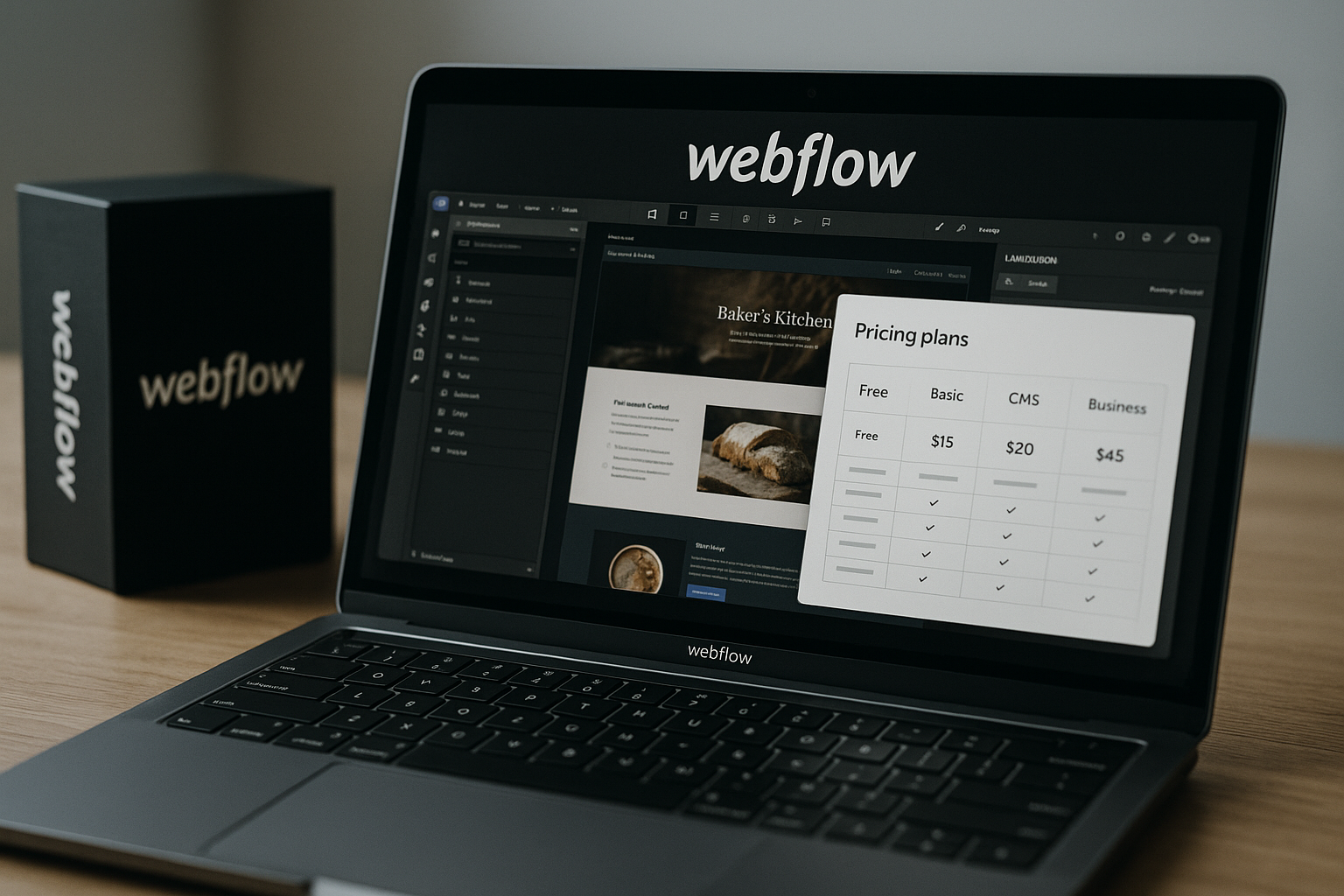
Webflow pricing 2026 at a glance
Quick answer: is Webflow worth it?
Webflow pricing is worth it in 2026 if you need more than a basic drag-and-drop website builder: visual design control, managed hosting, CMS capabilities, collaboration, localization, publishing workflows, and governance as your site grows.
It is less compelling if you only need a very simple brochure site, have no CMS needs, and are choosing mainly on the lowest possible monthly cost. In that case, the value depends on whether Webflow’s design flexibility and hosting stack save you enough time or agency cost to justify the subscription.
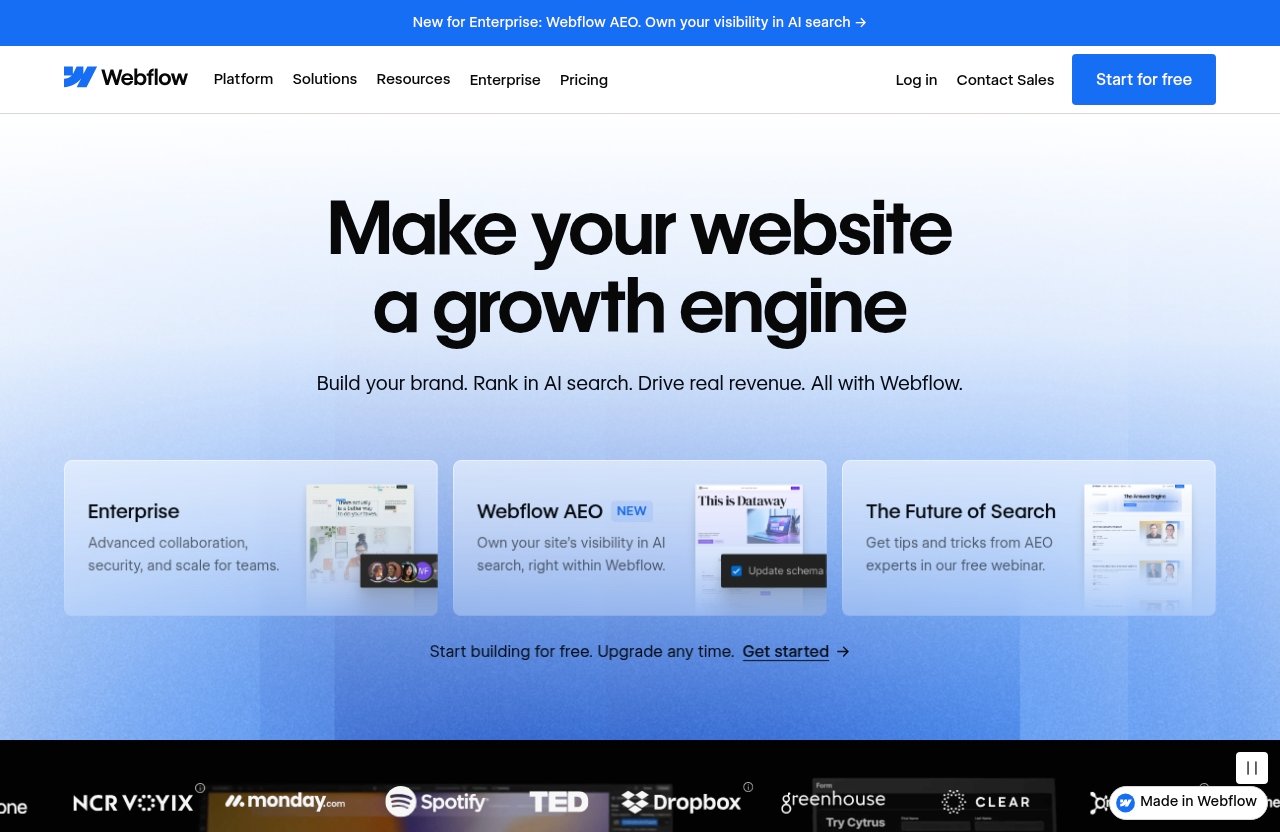
According to Webflow’s official pricing page, all listed prices are in USD, per site, and applicable taxes are added at checkout. Webflow’s homepage also positions the platform as an AI-native website experience platform with capabilities across design, content editing, CMS, hosting, localization, SEO, AEO, apps, Webflow Cloud, DevLink, MCP, and more.
| Plan | Official Price | Best For | Main Upgrade Reason |
|---|---|---|---|
| Starter | Free | Learning, testing, experimenting | Try Webflow before paying |
| Basic | $15/mo billed yearly | Simple sites without CMS | Custom domain, more pages, more bandwidth |
| Premium | $25/mo billed yearly | Content-rich sites | CMS, search, file uploads, stronger content tools |
| Team | $2500/mo, annual contract required | Growing teams | Governance, workflows, localization, priority support |
| Enterprise | Custom | Large organizations | Advanced scale, custom roles, SLAs, secure integrations |
If you already know Webflow is on your shortlist, you can review the latest official plan details through this Webflow pricing page before choosing a tier.
The 3 cost layers buyers need to understand
The most important thing about Webflow pricing is that it is layered. Many buyers look at one monthly number and miss the full budgeting picture.
There are three cost layers to think about:
- Site plan cost
This is the per-site plan that controls hosting, domain support, CMS access, bandwidth, pages, forms, and related site features.
- Platform or workspace needs
Webflow includes a Free Starter Workspace in the verified plan facts, but teams may need broader workspace or platform capabilities depending on collaboration, governance, and publishing requirements.
- Implementation and operating costs
Your real budget may also include design work, content migration, custom development, third-party tools, integrations, maintenance, and internal labor.
This is why two businesses can look at the same Webflow pricing table and end up with very different total costs.
Who should choose Starter, Basic, Premium, Team, or Enterprise
Here is the practical view:
| Buyer Type | Most Likely Fit | Why |
|---|---|---|
| Learner or solo tester | Starter | Free way to explore Webflow |
| Small business with a simple site | Basic | Custom domain and simple site publishing |
| Blog, resource hub, or content site | Premium | CMS and content operations features |
| Growing marketing team or agency | Team | Workflows, governance, collaboration, localization |
| Large organization | Enterprise | Custom scale, roles, SLAs, secure integrations |
For most small businesses, Webflow pricing becomes attractive at Basic or Premium. Basic is the sensible choice for a polished custom-domain site without CMS needs. Premium is the more realistic fit when content publishing, search, and CMS-driven pages matter.
How Webflow pricing works
Site plans vs platform/workspace plans
Webflow pricing has two broad concepts buyers should separate: Webflow Site plans and broader Platform or Workspace-related plans.
Site plans are tied to a specific site. Based on the verified facts, Starter, Basic, and Premium are site-level options that determine limits and features such as domain support, static pages, bandwidth, form submissions, CMS availability, search, and file uploads.
Platform-level options, such as Team and Enterprise, are aimed at organizations that need more control. These plans add capabilities around Site & Workspace, Webflow Localize, publishing workflows, governance, enhanced security and compliance, priority support, granular permissions, custom roles, secure integrations, and account management.
A common mistake is assuming the free Starter experience reflects the full operating model. Starter is useful, but it uses a Webflow.io domain and includes limited CMS access, 2 static pages, 1 GB bandwidth, and 50 form submissions.
Why the same project can cost very differently
Two companies can use the same platform but pay very different amounts because their requirements differ.
A freelancer building a one-page portfolio may only need to experiment on Starter. A local service business may need the Webflow Basic plan to connect a custom domain. A marketing team running a content hub may need the Webflow Premium plan because CMS and content operations are central to the site.
A larger organization may find the Webflow Team plan or Enterprise more relevant because the real value is not only hosting. It is workflow control, governance, security, collaboration, and publishing confidence.
This is also why a simple Webflow pricing calculator should not only ask, “What is the monthly plan?” It should ask:
- Do you need a custom domain?
- Do you need CMS?
- How many static pages do you need?
- Do you need site search?
- Do you need file uploads in forms?
- Will multiple people publish content?
- Do you need governance, roles, or compliance support?
- Will localization matter?
- Who will design, build, and maintain the site?
What ‘per site’ and annual billing mean
The verified plan facts state that all prices are in USD, per site, with applicable taxes added at checkout. That matters if you manage more than one website.
Basic is listed at $15/mo billed yearly. Premium is listed at $25/mo billed yearly. Team is listed at $2500/mo, with an annual contract required. Enterprise is custom.
When buyers search for Webflow pricing per year, they are usually trying to understand annual commitment and budgeting. Based on the verified facts, Basic and Premium prices are monthly figures billed yearly, while Team requires an annual contract. Enterprise pricing is not publicly specified in the provided official facts and requires a custom discussion.
Webflow Site plans explained
Starter: free testing and learning plan
The Webflow Starter plan is free and is designed for exploring and experimenting with Webflow.
According to the official pricing facts, Starter includes:
| Starter Feature | Included |
|---|---|
| Price | Free |
| Domain | Webflow.io domain |
| CMS | Limited Webflow CMS |
| Static pages | 2 |
| Bandwidth | 1 GB |
| Form submissions | 50 |
| Webflow AI | Included |
| MCP server | Included |
| Webflow Cloud app hosting | Included |
| Workspace | Free Starter Workspace |
Starter is the right place to learn the designer, test the CMS concept, explore Webflow AI, and understand whether the platform feels right before paying.
The tradeoff is clear: Starter is not built for a serious public business website. The Webflow.io domain, 2 static pages, 1 GB bandwidth, and 50 form submissions make it best for testing rather than scaling.
From a Webflow pricing perspective, Starter is valuable because it lowers the risk of trying the platform. You can experiment before deciding whether Basic, Premium, Team, or Enterprise makes sense.
Basic: simple sites without CMS
The Webflow Basic plan is listed at $15/mo billed yearly and is designed for simple sites that do not need a CMS.
Officially, Basic includes:
| Basic Feature | Included |
|---|---|
| Price | $15/mo billed yearly |
| Best for | Simple sites that do not need CMS |
| Custom domain | Included |
| Static pages | 300 |
| Bandwidth | 10 GB |
| Form submissions | Unlimited |
| Password protection | Included |
| Webflow AI | Included |
| MCP server | Included |
| Webflow Cloud app hosting | Included |
| Workspace | Free Starter Workspace |
Basic is the first plan that makes sense for a typical small business brochure site because it includes a custom domain. That is often the real upgrade trigger.
If your site is mostly fixed pages—home, about, services, contact, landing pages—the Basic plan can be a clean fit. You get 300 static pages, 10 GB bandwidth, unlimited form submissions, password protection, and the core Webflow stack without paying for CMS features you may not use.
The main reason not to choose Basic is simple: if you need CMS-driven content, Basic is not the right tier. In that case, Webflow pricing moves you toward Premium.
Premium: content-rich sites with CMS and traffic needs
The Webflow Premium plan is listed at $25/mo billed yearly. It is designed for content-rich sites with robust CMS and traffic needs.
Officially, Premium includes everything in Basic, plus:
| Premium Feature | Included |
|---|---|
| Price | $25/mo billed yearly |
| Best for | Content-rich sites with robust CMS and traffic needs |
| Webflow CMS | Included |
| Bandwidth | Included, per official plan listing |
| Code components | Included |
| Site search | Included |
| Form file upload | Included |
| Well-known files | Included |
Premium is the plan I would look at first for a content marketing site, blog, resource center, editorial site, or CMS-powered company website.
The practical difference is that Premium unlocks the Webflow CMS. That changes what you can build. Instead of manually creating static pages for every article, case study, author page, or resource, you can manage structured content through CMS collections.
Premium also adds site search and form file upload, which can matter for content-heavy and lead-generation websites. If a visitor needs to search your resources or submit documents through a form, Premium has a clearer value case than Basic.
For buyers comparing Webflow pricing with cheaper website builders, Premium is often the point where the decision becomes strategic. You are no longer paying only for a website. You are paying for a content system.
Webflow Platform plans explained
Team: for growing organizations
The Webflow Team plan is listed at $2500/mo, with an annual contract required. It is designed for growing teams that need more control without complexity.
According to the verified official facts, Team includes everything in Premium, plus:
- Site & Workspace
- Webflow Localize
- AEO agents
- Publishing workflows
- Single-page publishing
- Site activity log & API
- Foundational governance
- Enhanced security & compliance
- Priority support
This is not a plan I would recommend for a solo creator or small brochure site. The value is in organizational control.
Team makes more sense when multiple stakeholders are involved in building, reviewing, publishing, localizing, and maintaining a site. Marketing teams, agencies, and growth-stage companies may value workflow structure and governance more than the raw hosting features.
In practical terms, Webflow pricing jumps significantly at Team because the buyer profile changes. You are paying for more than a site plan. You are paying for collaboration, governance, and operational maturity.
Enterprise: for custom scale and governance
Webflow Enterprise pricing is custom. That means the official pricing facts do not provide a public monthly price.
Enterprise includes everything in Team, plus:
- Enterprise-ready scale
- Granular permissions
- Custom roles
- Advanced governance
- Secure integrations
- Dedicated account manager
- Enhanced SLAs
- Custom configurations
Enterprise is for organizations with complex requirements around scale, permissions, security, integrations, compliance, service levels, and account support.
If you are evaluating Enterprise, the right next step is not to estimate from public tables. It is to contact Webflow sales and confirm the exact configuration, contract terms, and support model.
For most readers comparing Webflow pricing 2026, Enterprise will be outside the normal small-business decision path. But for larger organizations, the value may come from reducing operational risk and giving teams controlled flexibility.
Official website · Latest pricing & offers
What you actually get for the money
Design and build features
Webflow’s homepage positions the platform around capabilities such as design, page building, interactions and animations, content editing, collaboration, hosting, apps, Figma to Webflow, Webflow Cloud, DevLink, and MCP.
The design value is the main reason many buyers consider Webflow in the first place. You can build visually while still working with a more structured design system than many basic site builders.
From a buyer’s perspective, this matters if your website needs to look custom, support marketing campaigns, or evolve without sending every small update through engineering. That is where Webflow pricing can become easier to justify.
The plan choice affects how far you can take that site. Starter is for learning. Basic supports simple published sites with a custom domain. Premium adds CMS-driven building blocks. Team and Enterprise add the operational layer for larger groups.
CMS, search, and content operations
The biggest functional dividing line in the lower tiers is CMS.
Basic is for simple sites that do not need CMS. Premium is for content-rich sites with robust CMS and traffic needs. That distinction should drive your decision more than the monthly price difference alone.
If you publish articles, case studies, resources, landing pages, author profiles, or structured content, Premium is usually the more practical fit. It includes Webflow CMS, site search, code components, form file upload, and well-known files.
Search is especially important for content libraries. A site with many resources becomes harder to navigate without search, and Premium includes site search based on the verified facts.
When people ask “is Webflow worth it,” the honest answer often depends on content operations. If your site is static and rarely changes, Basic may be enough. If content is part of your growth engine, Premium is usually the more serious plan.
AEO, localization, publishing workflows, and governance
Webflow’s homepage highlights AEO, SEO, Analyze, Optimize, Localize, security, collaboration, apps, and AI-native capabilities. The verified pricing facts also show AEO agents, Webflow Localize, publishing workflows, governance, enhanced security and compliance, and priority support in the Team plan.
These features matter most when the website becomes a shared business system rather than a single-person project.
For example:
| Capability | Why It Matters | Most Relevant Tier |
|---|---|---|
| Custom domain | Professional publishing | Basic and above |
| CMS | Structured content | Premium and above |
| Site search | Resource discovery | Premium and above |
| Form file upload | Richer lead capture | Premium and above |
| Webflow Localize | Multilingual or regional content | Team and above |
| Publishing workflows | Review and approval control | Team and above |
| Governance | Safer team operations | Team and Enterprise |
| Granular permissions/custom roles | Enterprise control | Enterprise |
This is where Webflow pricing should be judged against risk, speed, and control—not only against the cheapest possible site hosting cost.
A solo creator may not need governance. A company with multiple teams publishing pages may need it badly. The same feature can be unnecessary for one buyer and essential for another.
Hidden costs and budgeting reality
Taxes at checkout
The official pricing facts are clear that all listed prices are in USD, per site, and applicable taxes are added at checkout.
That means the displayed monthly plan price is not always the final checkout total. The final amount can vary depending on your location and tax rules.
When planning Webflow pricing per year, include taxes in your budget. Do not calculate annual spend by multiplying the displayed monthly number and assuming that is the final charge.
This is not unique to Webflow, but it is important for buyers preparing client proposals, annual budgets, or internal approvals.
Workspace requirements and collaboration costs
The verified facts state that Starter, Basic, and Premium include a Free Starter Workspace. The facts also note that buyers may need a paid Workspace plan for some features on Starter sites.
The important point is not to assume that one free workspace setup will cover every collaboration need. If you are working with clients, teammates, or multiple stakeholders, your operating model may require more than the entry-level setup.
Searches like webflow workspace plans, webflow freelancer plan, and even webflow pricing reddit often come from people trying to understand this exact issue: “What do I actually need to pay for to work the way I want?”
The safest answer is to use Webflow’s official pricing page as the source of truth and confirm current workspace or platform requirements before committing. If a cost is not listed in the official pricing facts, it should not be guessed.
Third-party tools, maintenance, and implementation labor
The subscription is only part of the total cost.
Your real Webflow budget may also include:
- Strategy and planning
- Visual design
- Webflow development
- CMS setup
- Content migration
- Copywriting
- SEO setup
- Analytics and tracking
- Third-party apps or integrations
- Ongoing maintenance
- Team training
- Quality assurance before launch
No official price can be attached to those items without knowing the project scope. A freelancer, agency, or internal team can change the total cost dramatically.
This is why Webflow pricing should be treated as the platform cost, not the full project cost. A $15/mo or $25/mo plan does not mean the whole website costs only that amount to launch and maintain.
Also, buyers searching for webflow ecommerce pricing should be careful. Ecommerce pricing details are not included in the verified facts provided for this article, so I will not invent ecommerce plan numbers or limits here. Check Webflow’s official pricing page for the latest ecommerce-specific details if online selling is part of your project.
Which Webflow plan is best for your use case?
Solo creator or learner
Best fit: Starter
If you are learning Webflow, testing a concept, or deciding whether the platform fits your workflow, Starter is the right first step. It is free and lets you experiment with Webflow before paying.
You get a Webflow.io domain, limited Webflow CMS, 2 static pages, 1 GB bandwidth, 50 form submissions, Webflow AI, MCP server, Webflow Cloud app hosting, and a Free Starter Workspace.
Starter is not the plan I would use for a serious business launch. But as an evaluation tool, it makes Webflow pricing easier to approach because you can learn before committing.
Choose Starter if:
- You are still exploring
- You do not need a custom domain yet
- You are learning the designer
- You are testing content structure
- You are not ready to publish a full business site
Small business brochure site
Best fit: Basic
For a small business site without CMS needs, Basic is usually the cleanest match. It is listed at $15/mo billed yearly and includes a custom domain, 300 static pages, 10 GB bandwidth, unlimited form submissions, and password protection.
This is a practical fit for service businesses, consultants, local companies, and professional portfolios that mainly need polished static pages.
The value case is simple: you pay for a professional custom-domain site with Webflow’s design and hosting capabilities, without paying for CMS tools you do not need.
Choose Basic if:
- You need a custom domain
- Your pages are mostly static
- You do not need blog or CMS functionality
- You want unlimited form submissions
- You want a professional site without Team-level complexity
If budget is the only priority and design flexibility does not matter much, a cheaper builder may be enough. But if presentation and control matter, Webflow pricing at Basic can be reasonable.
Content marketing site or blog
Best fit: Premium
For content marketing, blogging, resource libraries, case studies, or CMS-powered pages, Premium is the stronger choice.
The plan is listed at $25/mo billed yearly and includes everything in Basic plus Webflow CMS, bandwidth, code components, site search, form file upload, and well-known files.
This is the plan where Webflow starts to feel less like a page builder and more like a content platform. If your marketing strategy depends on publishing and organizing content, Premium is usually easier to justify than Basic.
Choose Premium if:
- You need Webflow CMS
- You publish articles or resources
- You need site search
- You need form file upload
- You are building a content-rich site
- You expect the site to grow beyond static pages
For many marketers, Webflow pricing becomes worth it at Premium because CMS and search reduce content friction.
Growing team or agency
Best fit: Team
The Team plan is for growing organizations that need more control without complexity. It is listed at $2500/mo with an annual contract required.
This plan is not about getting a simple website online. It is about giving a team the tools to manage publishing, localization, activity visibility, governance, compliance, and support.
Choose Team if:
- Multiple people manage the site
- Publishing workflows matter
- You need Webflow Localize
- You need AEO agents
- Governance is becoming important
- You value enhanced security and compliance
- Priority support matters
For agencies and growing marketing teams, Team can be worth considering when the cost of slow publishing, inconsistent processes, or weak governance is higher than the platform investment.
Enterprise organization
Best fit: Enterprise
Enterprise is custom and is designed for organizations that need enterprise-ready scale.
It includes everything in Team plus granular permissions, custom roles, advanced governance, secure integrations, a dedicated account manager, enhanced SLAs, and custom configurations.
Choose Enterprise if:
- You need custom roles and granular permissions
- Security and integrations are major buying criteria
- You require enhanced SLAs
- You need custom configurations
- You want a dedicated account manager
- Your organization has complex governance requirements
For large organizations, Webflow pricing should be evaluated against operational control, speed to publish, security, and support—not just subscription cost.
Webflow pricing vs alternatives: what matters most
Why buyers compare Webflow pricing with other builders
Buyers compare Webflow pricing with other builders because Webflow is rarely the cheapest option in the market for a simple website.
That comparison is fair. If your main goal is to publish a basic page at the lowest cost, you should compare platforms carefully and choose the simplest tool that meets your needs.
But price alone is not the full decision. You should compare based on:
- Design control
- CMS needs
- Hosting expectations
- Team collaboration
- Publishing workflow
- Localization needs
- Security and governance
- Long-term site complexity
- Who will maintain the site
- How often the site will change
A cheaper tool can be the right buy if your needs are simple. A more capable platform can be the better value if it reduces design, publishing, and operational friction.
When Webflow wins on control and scalability
Webflow is strongest when the website is an important marketing asset, not just an online business card.
Based on Webflow’s homepage positioning and official plan features, the platform covers design, content editing, CMS, hosting, localization, security, Analyze, Optimize, SEO, AEO, apps, Figma to Webflow, Webflow Cloud, DevLink, and MCP.
That range matters when your site needs to evolve. You may start with static pages, then add CMS content, search, workflows, localization, and governance as the organization grows.
In my view, Webflow pricing is most defensible when:
- Design quality matters
- Marketing teams need more control
- CMS content is central
- The site changes often
- Stakeholders need publishing workflows
- Governance and security matter
- You want managed hosting included in the platform decision
This does not mean Webflow is automatically better for everyone. It means the value case improves as your site becomes more strategic.
When a cheaper platform may be the smarter buy
A cheaper platform may be smarter if your website is simple, rarely updated, and not central to marketing or operations.
For example, if you need only a few pages, do not care much about custom design control, do not need CMS, and are highly budget-constrained, paying for a more powerful system may be unnecessary.
You may also want to delay upgrading if you are still validating the business, still writing your content, or unsure who will maintain the site.
The most expensive mistake is not choosing a cheaper platform. It is choosing any platform without matching it to your real needs.
If you are still unsure, use Starter to explore. Then upgrade only when a specific requirement—custom domain, CMS, search, workflows, localization, governance—makes the next plan worth it.
Final verdict: is Webflow pricing worth it in 2026?
Best reasons to pay for Webflow
Webflow pricing is worth it in 2026 for buyers who need a serious visual website platform with room to grow.
The strongest reasons to pay are:
- You need a professional custom-domain site
- You want strong visual design control
- You need CMS-driven content
- You want managed hosting as part of the platform
- You publish content regularly
- You need site search or form file upload
- Your team needs workflows and governance
- Localization or AEO capabilities matter
- Security, compliance, and support are part of the buying decision
For most small sites, Basic is the first realistic paid plan. For content marketing, Premium is the stronger value. For organizations, Team or Enterprise should be evaluated around governance, collaboration, and operational control.
Before making a final decision, I recommend checking the latest official details on Webflow’s pricing page, since that is the source of truth and taxes are added at checkout.
Best reasons to skip or delay upgrading
You should skip or delay upgrading if you are still experimenting, do not need a custom domain, or are not ready to publish a full site.
Starter is free and gives you a safe way to test the platform. Use it before paying if you are unsure.
You may also want to avoid a paid plan if:
- Your site is only a temporary test
- You do not need CMS
- You do not need a custom domain yet
- Budget is the top priority
- You do not have content ready
- You do not have someone to maintain the site
- You need ecommerce pricing details and have not verified them on the official page
In those cases, Webflow pricing may feel expensive because you are not yet using the features that justify the cost.
Buyer checklist before choosing a plan
Use this quick checklist before choosing among the Webflow plans:
| Question | If Yes | Likely Plan |
|---|---|---|
| Are you only learning or testing? | Stay free | Starter |
| Do you need a custom domain? | Upgrade from Starter | Basic or higher |
| Is your site mostly static? | Avoid paying for CMS | Basic |
| Do you need CMS content? | Choose CMS tier | Premium or higher |
| Do you need site search? | Use Premium features | Premium or higher |
| Do you need localization and workflows? | Consider organization tier | Team |
| Do you need custom roles and SLAs? | Contact sales | Enterprise |
| Are taxes included in your budget? | Add at checkout | All paid plans |
Final recommendation: pay for Webflow if your website needs custom design, CMS-driven growth, managed hosting, and future-ready team capabilities. Choose Basic for simple business sites, Premium for content operations, Team for growing organizations, and Enterprise for custom scale.
Skip or delay paying if you only need a basic low-cost website, are still experimenting, or do not yet have the content, traffic, team, or workflow needs that make Webflow valuable.
Official website · Latest pricing & offers
FAQ
How much does Webflow cost?
According to the verified official pricing facts, Starter is free, Basic is $15/mo billed yearly, Premium is $25/mo billed yearly, Team is $2500/mo with an annual contract required, and Enterprise is custom.
All prices are in USD, per site, and applicable taxes are added at checkout.
Is Webflow completely free?
Webflow has a free Starter plan for exploring and experimenting. It includes a Webflow.io domain, limited Webflow CMS, 2 static pages, 1 GB bandwidth, and 50 form submissions.
However, Webflow is not completely free if you need more advanced publishing features. A paid plan is needed for features such as a custom domain, and CMS capabilities become more practical on Premium and higher.
What is the difference between Webflow Site plans and Platform plans?
Webflow Site plans are per-site hosting and feature tiers. They control site-level features such as domain support, static pages, bandwidth, form submissions, CMS access, and search.
Platform plans such as Team and Enterprise are geared toward organizations that need collaboration, governance, workflows, localization, enhanced security, support, and custom scale.
Do I need a paid plan to use a custom domain on Webflow?
Yes. Based on the official pricing facts, the Basic plan includes a custom domain, while Starter uses a Webflow.io domain.
If you want a professional site on your own domain, Basic is the first listed plan in the verified facts that includes custom domain support.
Is Webflow worth it for a small business?
Webflow can be worth it for a small business if the company values design control, a custom domain, managed hosting, and room to grow into CMS or content marketing features.
For a simple brochure site without CMS, Basic is likely the most relevant option. If the business only needs the cheapest possible website and does not care much about design flexibility or growth features, a simpler platform may be enough.
Related Reading
References
- Plans & pricing | Webflow
- Webflow Pricing 2026: All Plans, Real Costs & Hidden Fees Explained
- Webflow Pricing Explained: Which Plan Is Right for You?