Answerthis vs ChatGPT for Research: Which Is Better for Academic Work?

For students and research teams comparing answerthis vs chatgpt, the central question is not which AI writes the smoothest paragraph. It is which tool gives you a more dependable path from a research question to sources you can inspect, organize, and cite.
This article contains an affiliate link to AnswerThis. TopTrustReview may earn a commission if you use it, at no extra cost to you. Our recommendation is based on the verified product facts provided by AnswerThis, not on unsupported performance claims or promotional hype.
Official website · Latest pricing & offers
AnswerThis vs ChatGPT: Quick Verdict for Research Users
The practical answerthis vs chatgpt verdict is straightforward: AnswerThis is the stronger fit for evidence-first academic research, while ChatGPT is the more flexible general-purpose assistant for brainstorming, outlining, explanation, and prose revision.
AnswerThis is designed around research tasks such as finding papers, producing cited answers and summaries, organizing sources into projects, identifying research gaps, and supporting systematic review workflows. ChatGPT can be useful throughout an academic research workflow, but it is not positioned as a purpose-built literature search, screening, and evidence-trail workspace.
| If your priority is… | Better starting point |
|---|---|
| Source-grounded answers and paper discovery | AnswerThis |
| Citation-heavy literature reviews | AnswerThis |
| Systematic review support and documented steps | AnswerThis |
| Brainstorming research angles | ChatGPT |
| Rewriting, simplifying, and polishing drafts | ChatGPT |
| Combining evidence work with general writing help | Use both |
Who Should Choose AnswerThis in the AnswerThis vs ChatGPT Decision
Choose AnswerThis if your work depends on traceable evidence. That includes dissertation chapters, grant background sections, evidence syntheses, clinical or policy research, lab reviews, and any assignment where the quality of references matters as much as the quality of the writing.
It is especially relevant when you need to search scholarly material, collect cited answers, manage papers by project, or establish a repeatable review process. For researchers who regularly lose time moving between search tools, PDFs, reference managers, notes, and drafts, a specialized AI research assistant can reduce friction.
Who Should Choose ChatGPT
ChatGPT is a sensible choice when your main need is general intellectual support rather than source-specific research workflow management. It can help turn rough notes into an outline, generate alternative explanations, suggest headings, clarify technical language, or improve the flow of a draft.
For example, a student may use ChatGPT to explore how to frame a thesis question or to make a complex methods section easier to read. The important boundary is that polished language should not be mistaken for verified evidence.
The Short Answer on Citations and Accuracy
In the answerthis vs chatgpt comparison, AnswerThis has the clearer advantage when citation traceability is the deciding factor. Its verified workflow includes cited answers and citation checking against more than 300 million papers, trials, and PDFs.
That does not mean researchers should accept any AI-generated result without review. Academic work still requires reading relevant primary sources, checking methods and publication details, and deciding whether a paper genuinely supports the claim being made.
What AnswerThis Is Built to Do
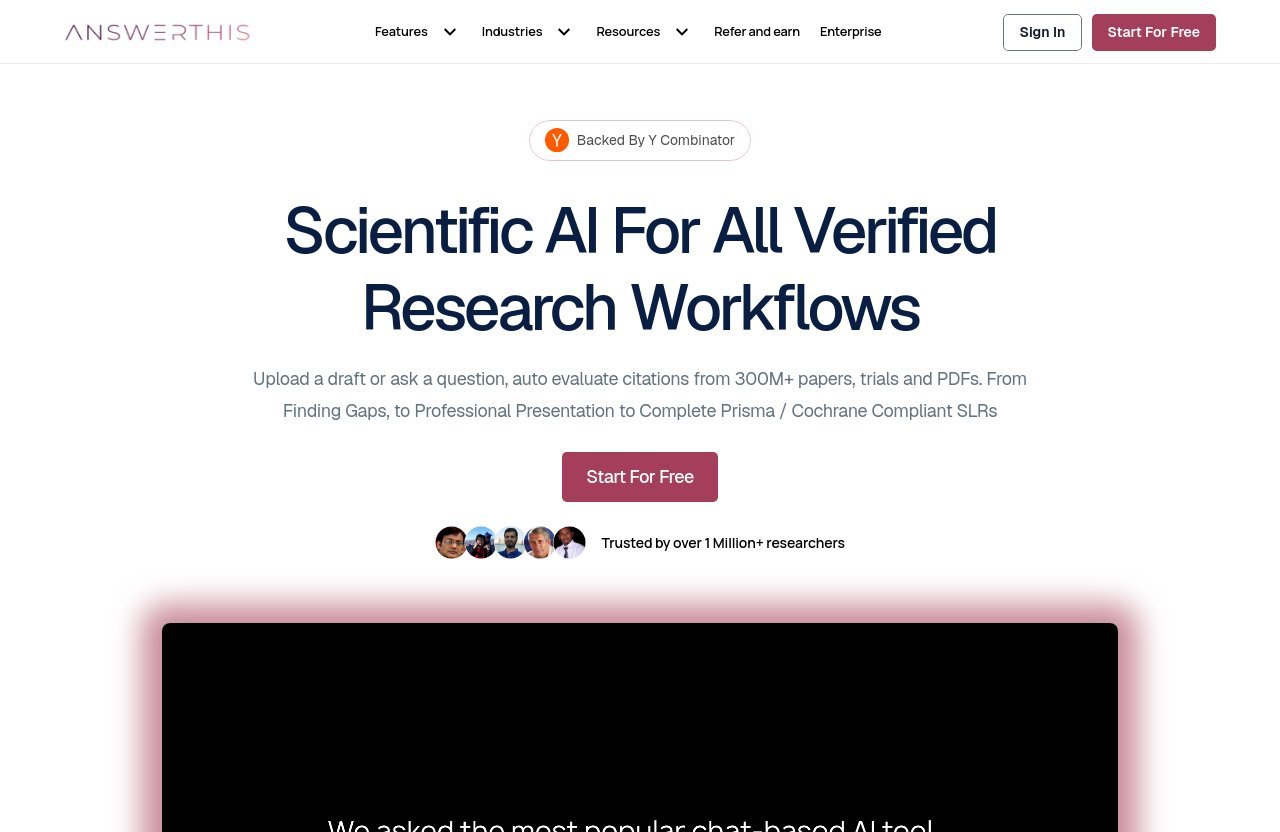
AnswerThis AI is positioned as an evidence-first research workspace rather than a broad conversational tool. Its verified capabilities focus on helping users search research, work with cited responses, organize material, identify knowledge gaps, and move from search to structured synthesis.
For academic users, that distinction matters. A general chat assistant can be useful in many moments, but a literature review tool needs to preserve a relationship between a claim and the evidence behind it.
Official Product Positioning
According to the verified product information, AnswerThis supports deep search across 300M+ papers and provides cited answers and summaries. Users can organize papers into projects, upload papers directly to their library, and connect Zotero or Mendeley.
The platform also describes support for research gap discovery, presentation preparation, agent-led systematic reviews, meta-analysis and synthesis, and trial landscape work. Max-plan users can additionally access Trial Landscape and regulatory connectors.
Verified Research Workflow Support
AnswerThis supports systematic review workflows following PRISMA 2020 and Cochrane review steps, with a documented search and screening trail. That is materially different from simply asking an AI to summarize a topic in a chat window.
PRISMA provides widely used reporting guidance for systematic reviews, while Cochrane methods emphasize transparent and structured evidence assessment. Researchers should still apply these standards themselves, but the presence of a documented workflow can make the research process more organized and auditable.
For a closer look at the product’s research-focused workflow, readers can review AnswerThis through TopTrustReview. Before subscribing, confirm the current in-app offer and checkout details because allowances and account pricing may vary.
Key Use Cases for Academics
The answerthis vs chatgpt choice becomes easier when the task is specific. AnswerThis is best aligned with literature review preparation, source exploration, research gap discovery, paper organization, cited synthesis, and systematic review support.
It can suit undergraduate students building a source base, doctoral candidates mapping a field, faculty preparing evidence-backed materials, and industry teams reviewing scientific or clinical information. The common thread is a need to work from research evidence rather than only generate ideas about it.
How ChatGPT Compares for Research Workflows
ChatGPT for research is most useful when researchers treat it as a general reasoning and writing assistant. It can help users articulate a question, generate a preliminary outline, produce a list of counterarguments, translate jargon into plain language, or revise a paragraph for clarity.
In other words, it often works well around the research process. It is less naturally suited to being the central location for source discovery, screening documentation, and evidence traceability.
Strengths for Brainstorming and Drafting
ChatGPT can be valuable at the beginning and end of an academic task. At the beginning, it can help a researcher narrow broad interests into possible questions, identify terms to investigate, or create a preliminary review structure.
At the end, it can support editing tasks such as shortening repetitive passages, improving transitions, or adjusting a paper for a non-specialist audience. These are real time-saving benefits, particularly when the researcher already has verified notes and references.
Where ChatGPT Is Less Specialized
The key limitation in the answerthis vs chatgpt decision is specialization. ChatGPT is not presented here as an end-to-end academic search and screening environment with the same verified research-specific features as AnswerThis.
A researcher working on a citation-heavy review often needs more than a coherent summary. They need a reproducible source trail, a way to organize selected papers, a method for checking citations, and confidence that important claims can be traced back to original material.
Why General AI Can Be Risky Without Verification
Generative AI can produce statements that sound plausible but are incomplete, overgeneralized, or inaccurate. It can also present references or details in ways that require careful checking before they are used in academic work.
That risk does not make ChatGPT useless. It simply means users should reserve final judgment for the researcher and verify every important claim against the paper, dataset, guideline, or primary source that supports it.
Research Accuracy: Which Tool Is Better for Verified Answers?
When evaluating answerthis vs chatgpt for accuracy, it helps to separate two concepts: answer quality and answer verifiability. A well-written answer may be useful, but an answer is more useful in academic work when you can inspect the evidence trail behind it.
AnswerThis is better aligned with verified-answer workflows because its stated functionality includes cited answers and citation checking across 300M+ papers, trials, and PDFs. ChatGPT may help synthesize or explain material, but researchers should independently verify source support before relying on generated content.
Source-Grounded Research vs Generative Synthesis
Source-grounded research begins with evidence: papers, trials, PDFs, and documented sources. The researcher can then assess study design, sample limitations, dates, conflicts of interest, results, and relevance to the actual question.
Generative synthesis begins with a prompt and produces a response based on patterns in information. This can be helpful for understanding and drafting, but it does not remove the need to inspect evidence. In an answerthis vs chatgpt evaluation, that difference is often more important than writing style.
Why Citations Matter in Academic Work
Citations allow readers, supervisors, peer reviewers, and collaborators to evaluate how a conclusion was reached. They are not decoration at the end of a paragraph; they are part of the argument’s evidence structure.
For this reason, research citations AI tools should be judged by more than speed. Researchers need to know whether a cited source is real, relevant, current enough for the question, and supportive of the exact statement made.
How to Reduce Hallucination Risk
Use AI output as a research aid, not as a final authority. Open the original paper, read the abstract and relevant sections, check publication metadata, and confirm that the source supports the claim in context.
A practical rule is to apply extra scrutiny to numerical findings, causal claims, medical recommendations, policy implications, and statements that could materially affect a conclusion. The more consequential the claim, the less appropriate it is to rely on unverified AI wording.
Citations and Reference Workflows
The best academic research workflow keeps evidence, notes, citations, and draft writing connected without treating them as the same thing. This is where AnswerThis has a clearer research-focused proposition than a general conversational assistant.
For the answerthis vs chatgpt comparison, citation workflow is one of the most meaningful distinctions. AnswerThis is built to return cited answers and to help users check citations against a large research corpus; ChatGPT citation use typically requires user direction and manual review.
Cited Answers in AnswerThis
AnswerThis provides cited answers and summaries, allowing users to begin from source-linked research output rather than unsupported text alone. It also states that it can check citations against more than 300M+ papers, trials, and PDFs.
That can be useful for building a reading list or exploring a topic quickly. Still, cited answers should be treated as a starting point: researchers should examine the original documents, especially before including a citation in a thesis, manuscript, systematic review, or presentation.
Reference Manager Connections
AnswerThis can connect with Zotero or Mendeley, according to the verified product facts. It also allows users to upload papers directly to their library and organize papers into projects.
These connections matter because reference management is often where research projects become fragmented. A tool that helps keep papers and project context together may reduce duplicate work, but it does not replace good citation hygiene or a consistent team process.
What to Do When Citations Need Manual Checking
Always verify author names, publication year, title, journal or publisher details, and the connection between source and claim. If a paper is behind a paywall, read the available abstract cautiously and avoid overinterpreting it.
For systematic reviews and high-stakes academic work, document why sources were included or excluded. Manual checking remains necessary even when an AI research assistant improves the speed of searching and organizing.
Official website · Latest pricing & offers
Literature Review Workflow Comparison
A literature review is rarely one task. It includes question formulation, search, selection, screening, note-taking, comparison, synthesis, drafting, citation management, and repeated revision.
The practical answerthis vs chatgpt difference is that AnswerThis is designed to participate in more of the evidence-handling sequence, while ChatGPT is generally more useful for thinking and writing tasks around that sequence.
Searching Papers
AnswerThis supports deep search across 300M+ papers and can help users find cited answers, summaries, and research gaps. This makes it a natural starting point for researchers who need to identify relevant academic material efficiently.
ChatGPT can help develop search terms, identify concepts to investigate, or refine a question before searching. However, researchers should not treat a general AI response as a substitute for a documented academic search process.
Screening and Organizing Sources
AnswerThis supports project-based organization, direct paper uploads, library storage on applicable plans, and systematic review functions. Its stated workflow follows PRISMA 2020 and Cochrane review steps with a documented search and screening trail.
That structure is particularly valuable for systematic review AI use cases, where transparency matters. ChatGPT can help create screening questions or summarize researcher-provided notes, but it is not the specialized evidence-management layer in this comparison.
Drafting the Review
Once a verified source set is available, ChatGPT can be helpful for converting notes into a logical chapter outline, improving readability, or generating alternative transitions between sections. AnswerThis can support source-grounded drafting through cited answers, summaries, and its AI Writer on paid plans.
The strongest approach is often sequential: use AnswerThis to locate and organize evidence, then use a writing assistant carefully to improve presentation. In either case, the final review should reflect the researcher’s interpretation rather than an unexamined AI synthesis.
Pricing and Value for Academic Users
AnswerThis pricing should be assessed against the volume and complexity of your research. A student handling one small project has different needs from a doctoral researcher conducting recurring evidence reviews or a team managing multiple projects.
The following plans and allowances are the verified standard offers. Existing account prices and allowances may differ, and the exact offer is confirmed in the app and at checkout.
AnswerThis Pricing Plans
| Plan | Price | Verified Included Features |
|---|---|---|
| Free | $0/month | No card required; deep search across 300M+ papers; cited answers and summaries; projects; 10 lifetime basic questions |
| Pro | $35/month, billed monthly | Everything in Free; unlimited basic queries; 2 systematic reviews/month; 10 Max queries/month; unlimited library storage; AI Writer with standard models; 48-hour support |
| Research | $75/month, billed monthly | Everything in Pro; unlimited systematic reviews; 50 Max queries/month; full-text AI screening; AI Writer with extended thinking; 24-hour support |
| Max | $250/month, billed monthly | Everything in Research; 300 Max queries/month; frontier models; personal research assistant; topic alerts and digests; priority response under 1 hour |
No specific promotional code is verified for this offer. If you are considering a paid plan, check the promotional banner on the official site and the coupon field at checkout rather than relying on third-party coupon claims.
Which Plan Fits Each Type of User
The Free plan is a reasonable way to test whether AnswerThis fits your research habits. It includes 10 lifetime basic questions, cited answers and summaries, paper search, and project organization without requiring a card.
Pro may fit users who need regular basic queries and occasional systematic reviews. Research is more aligned with frequent review work because it includes unlimited systematic reviews and full-text AI screening. Max is aimed at high-volume users who need more Max queries, alerts, digests, frontier models, and a personal research assistant.
Best Value Decision Framework
In the answerthis vs chatgpt purchase decision, do not judge value only by monthly cost. Consider how many hours you spend locating papers, checking source relationships, organizing a library, screening material, and reformatting research notes.
A specialized tool may be worth more to someone producing recurring evidence-based work than to someone who only needs help editing an essay. Conversely, a general AI assistant may be sufficient for users whose core need is writing support rather than research evidence management.
Best Use Cases by User Type
Different researchers will reach different conclusions from the same comparison. The best AI for academic research depends on the importance of citations, the scale of the literature, the need for repeatable review methods, and the role AI plays in the final output.
Undergraduate and Master’s Students
Students working on essays, dissertations, capstones, or proposals can use AnswerThis to build a source base and find cited answers before drafting. This is helpful when a supervisor expects reliable references and a visible research process.
ChatGPT can then help clarify concepts, improve an outline, or make the student’s own writing more concise. The student should retain authorship, understand every cited source, and follow institutional rules on AI use.
PhD Candidates and Labs
For PhD candidates, the answerthis vs chatgpt comparison usually favors AnswerThis when the project requires ongoing literature mapping, research gap discovery, project organization, or systematic review support. A dissertation often becomes difficult not because of one paper, but because of hundreds of papers and evolving research questions.
Labs may benefit from a structured workspace when team members need to locate and discuss evidence consistently. ChatGPT remains useful for internal explanations, meeting summaries based on researcher-provided notes, and draft refinement.
Faculty and Industry Researchers
Faculty, clinical teams, and industry research groups often need an auditable connection between research questions and evidence. AnswerThis’s documented search and screening trail, systematic review support, and source-oriented workflow are most relevant in these settings.
ChatGPT can still support communication work, such as adapting technical material for a presentation or preparing a first-pass outline for a nontechnical audience. For regulated, clinical, or decision-critical work, teams should maintain their own validation and governance procedures.
Pros, Cons, and Trade-Offs
No research tool removes the need for scholarly judgment. The right choice depends on whether you are primarily trying to accelerate evidence work or accelerate general thinking and writing.
AnswerThis Strengths
AnswerThis has verified features that directly support academic evidence workflows: deep search across 300M+ papers, cited answers and summaries, project organization, Zotero and Mendeley connections, paper uploads, research gap discovery, and systematic review support.
Its systematic review workflow follows PRISMA 2020 and Cochrane review steps with a documented search and screening trail. For users who need research traceability, these are meaningful advantages over a general chat-based workflow.
AnswerThis Limitations
AnswerThis is more specialized than a broad general-purpose AI assistant. Users looking mainly for casual conversation, creative generation, coding help, or broad everyday assistance may find that a research-first workspace is not the only tool they need.
It also cannot replace researcher judgment. Even with cited answers and source checking, users must evaluate evidence quality, relevance, bias, methodology, and the appropriate interpretation of findings.
ChatGPT Strengths and Limitations
ChatGPT’s strength is flexibility. It can be useful for brainstorming, outlining, explaining difficult concepts, reframing arguments, and improving prose across many subjects.
Its limitation in a citation-driven context is that users need to verify output carefully and maintain their own source trail. In the answerthis vs chatgpt trade-off, ChatGPT is generally stronger as a versatile assistant, while AnswerThis is more directly aligned with evidence-based research operations.
Final Recommendation: Should You Use AnswerThis or ChatGPT for Research?
The final answerthis vs chatgpt recommendation is not that one tool must replace the other. Instead, match the tool to the stage of work and the standard of evidence required.
Choose AnswerThis when your priority is finding and organizing research, working from cited answers, checking references, identifying research gaps, or conducting structured literature and systematic review tasks. Choose ChatGPT when your priority is brainstorming, planning, simplifying, revising, or polishing researcher-verified content.
Best Choice by Task in the AnswerThis vs ChatGPT Comparison
For citation-heavy literature reviews, systematic review preparation, source organization, and evidence discovery, AnswerThis is the better fit. Its verified research-focused features make it more appropriate for users who need a documented and source-aware workflow.
For idea generation, draft structure, language refinement, and general explanation, ChatGPT remains useful. It is best treated as a writing and thinking companion, not as the final authority on academic evidence.
Recommended Workflow Combining Both
Start with AnswerThis to search for relevant papers, organize sources into projects, develop cited answers, and build an evidence base. Use its reference manager connections and review-oriented workflow to keep the research trail manageable.
Then use ChatGPT to brainstorm alternative framing, turn verified notes into a clearer outline, simplify dense passages, and polish your own draft. Before submission or publication, validate all important claims and citations against the original sources.
Affiliate Disclosure and Next Step
TopTrustReview includes an affiliate link to AnswerThis, meaning we may receive a commission if you choose to subscribe through our link. This does not change the central conclusion: AnswerThis is most compelling for researchers who need evidence-first workflows, while ChatGPT is most useful as a flexible general assistant.
If the research-focused capabilities match your needs, you can explore AnswerThis here. Review the current plan details in the app and at checkout, and check the site’s promotional banner and coupon field for any available offer.
Official website · Latest pricing & offers
FAQ
Is AnswerThis a good tool?
AnswerThis is a strong tool for academic workflows that require cited answers, literature review support, research gap discovery, project organization, and structured review steps. Its value is highest for people who need to work from evidence rather than simply generate text.
It is not a replacement for reading studies or applying subject expertise. Researchers should still verify final claims against original sources and make their own decisions about evidence quality.
Who Is Better for Research, AnswerThis or ChatGPT?
In the answerthis vs chatgpt comparison, AnswerThis is generally the better fit for citation-heavy academic research. Its verified feature set is focused on research search, cited answers, source organization, and systematic review-oriented workflows.
ChatGPT is better suited to general-purpose support such as brainstorming, outlining, simplifying explanations, and polishing prose. Many researchers will get the best result by using both tools at different stages.
Does AnswerThis Provide Citations?
Yes. AnswerThis provides cited answers and summaries, and its verified workflow includes citation checking against more than 300M+ papers, trials, and PDFs.
Researchers should still check every source they plan to cite formally. Confirm the original publication details, read the relevant sections, and make sure the source supports the specific claim being made.
Can AnswerThis Replace Manual Literature Reviews?
No. AnswerThis can accelerate searching, screening, organizing, summarizing, and drafting, but it does not replace researcher judgment or methodological responsibility.
A rigorous literature review still requires careful question design, inclusion and exclusion decisions, assessment of evidence quality, interpretation, and transparent reporting. Think of it as a workflow accelerator rather than an automatic substitute for scholarly review.
What Is the Best Workflow for Using AnswerThis and ChatGPT Together?
Use AnswerThis for evidence work: finding papers, organizing sources, reviewing cited answers, identifying research gaps, and maintaining a more structured research trail. This is the foundation for reliable academic output.
Use ChatGPT afterward for brainstorming angles, creating a draft structure, improving readability, and revising researcher-verified writing. This combination preserves the benefits of AI speed without treating generated prose as a replacement for evidence.
Related Reading
References
- AnswerThis: AI Research Assistant for Literature Reviews
- AnswerThis Pricing: Free, Pro, Research and Max Plans
- AnswerThis vs. ChatGPT: What Sets These AI Tools Apart for Researchers
- Top 10 AI Tools for Researchers in 2026