
skool vs kajabi: Which Platform Is Better for Creators, Courses, and Communities?
If you are comparing skool vs kajabi, the real question is not “Which platform has more features?” It is “Which platform fits the way your creator business actually grows?”
Skool is stronger for community-first growth, recurring memberships, live interaction, and simple course delivery inside an engaged member space. Kajabi is better suited to creators who want a broader all-in-one business platform with marketing, funnels, email, and a more traditional digital product ecosystem.
This comparison is written for creators, coaches, educators, and membership-site owners who want a practical buying decision—not hype. This article may contain affiliate links, meaning TopTrustReview may earn a commission at no extra cost to you if you choose to buy through our links.
Official website · Latest pricing & offers
Skool vs Kajabi: Quick Verdict for Creators
The simplest skool vs kajabi verdict is this: choose Skool if community is the center of your offer, and choose Kajabi if your business depends more on marketing infrastructure and a broader all-in-one setup.
Skool is built around discovering communities or creating your own, which makes it naturally appealing for creators who want discussion, accountability, courses, live calls, and memberships in one focused environment. Kajabi, by contrast, is commonly positioned as a more complete business platform for selling, marketing, and managing digital products.
Neither platform is “best” for everyone. The better choice depends on your offer, your audience, and how much complexity you want to manage.
Who should choose Skool
Choose Skool if your business model depends on member activity, peer discussion, accountability, and ongoing participation. In practical terms, this includes paid communities, coaching memberships, challenge-based programs, mastermind groups, and course communities where people learn better by interacting with others.
Skool is especially attractive because its plans include unlimited members, unlimited courses, unlimited videos, and unlimited live calls. That makes it easier to build around engagement without constantly worrying about whether your next course, video, or call will push you into a more complicated plan.
For creators evaluating skool vs kajabi, Skool is the cleaner choice when community is not just a bonus feature—it is the product.
Who should choose Kajabi
Choose Kajabi if your biggest need is a broader all-in-one business stack. Kajabi is often discussed as a strong option for creators who want marketing funnels, email capabilities, landing pages, analytics, and a more complete digital product ecosystem in one platform.
That can be valuable if your business is already built around launches, sales pages, automated nurture sequences, and multiple digital products. Kajabi may also appeal to teams that prefer having more marketing tools under one roof rather than stitching together separate systems.
In a skool vs kajabi decision, Kajabi usually makes more sense when the sales and marketing system matters more than day-to-day member interaction.
Best use-case summary
| Creator need | Better fit | Why |
|---|---|---|
| Paid community or membership | Skool | Community-first structure with courses, videos, and live calls |
| Simple course delivery inside a group | Skool | Unlimited courses and videos on both Skool plans |
| Funnel-heavy digital product business | Kajabi | Broader marketing and sales ecosystem |
| Email-first business | Kajabi | Commonly chosen for integrated marketing workflows |
| Beginner-friendly community business | Skool | Simpler setup and clearer focus |
| Advanced all-in-one creator business | Kajabi | Better suited to broader business infrastructure |
For most TopTrustReview readers who are building around community, coaching, and recurring membership revenue, Skool is the recommendation. If you want to explore it directly, you can review Skool through our affiliate link here: https://toptrustreview.com/60g1.
What Skool Is Best At
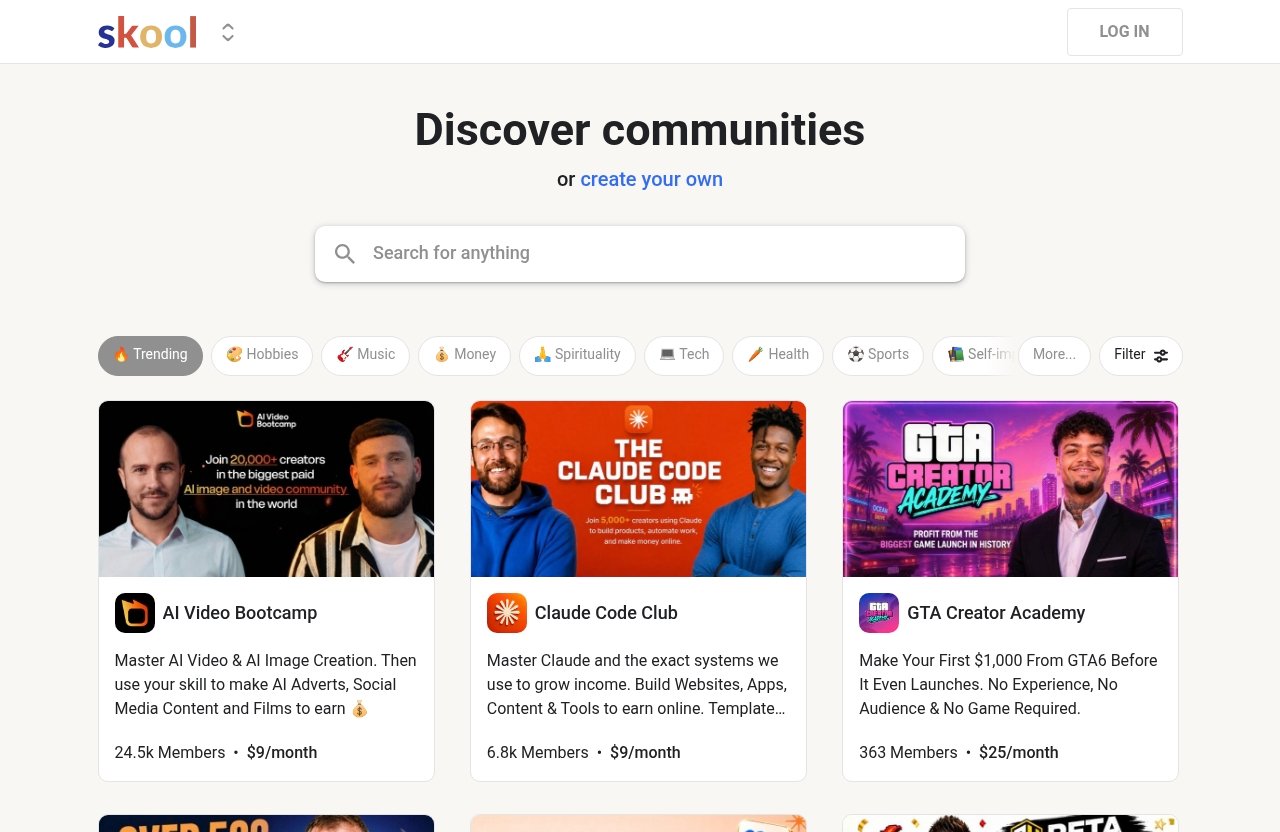
Skool is best understood as a community-first platform for creators who want to bring members, courses, videos, live calls, and affiliate support into a focused environment. Its homepage positions the product as a place to discover communities or create your own, which explains its appeal among coaches, educators, and online experts.
In the skool vs kajabi comparison, Skool’s advantage is not that it tries to do everything. Its advantage is that it simplifies the core experience many creators actually need: get people into a community, give them learning material, host live calls, and keep them engaged.
Community engagement and member activity
Skool is strongest when members are meant to interact with each other, not just consume content privately. This matters because many online courses fail not from poor content, but from low follow-through and weak accountability.
In real-world creator businesses, engagement often comes from discussions, group prompts, shared wins, weekly calls, and visible member participation. Skool’s community-first structure fits that pattern well.
For coaches and membership-site owners comparing skool vs kajabi, this is the key difference. Skool feels designed around the community as the main environment, while Kajabi is more often considered a broader business platform where community may be one part of a larger system.
Simple course delivery inside a community
Skool includes unlimited courses and unlimited videos on both its Hobby and Pro plans. That is a major practical advantage for creators who do not want to build a separate course site before they have validated their offer.
A simple example: a fitness coach could create a paid community, add beginner, intermediate, and advanced course modules, host recurring live calls, and keep everything connected to the same member base. A business coach could do the same with onboarding lessons, templates, replays, and weekly accountability threads.
This is where many skool vs kajabi buyers need to be honest with themselves. If your course is meant to live inside an active group, Skool may be more intuitive than a heavier all-in-one marketing platform.
Live calls and recurring memberships
Skool’s verified plan details include unlimited live calls, unlimited members, unlimited courses, and unlimited videos. For recurring memberships, that combination is important because the value of the offer usually comes from ongoing access rather than a one-time download.
Live calls also give creators a natural retention lever. Members may join for the course content, but they often stay for coaching, feedback, Q&A, and community accountability.
In this part of skool vs kajabi, Skool’s strength is its focused simplicity. Creators can build a recurring experience without overengineering the business before they have consistent revenue.
What Kajabi Is Best At
Kajabi is best known as a broader all-in-one platform for creators selling digital products. In most market comparisons, Kajabi is associated with sales pages, email marketing, funnels, analytics, websites, and product delivery.
That makes the skool vs kajabi choice clearer: Kajabi is often the better fit when the creator wants a full business system, while Skool is better when the community experience is the business system.
All-in-one business tools
Kajabi’s main appeal is consolidation. Instead of thinking about separate tools for pages, email, offers, and digital products, many creators look at Kajabi because it can support more of the business stack in one place.
This can be helpful for established creators with multiple products, launch campaigns, and a need for more advanced marketing structure. If you are running evergreen funnels or selling across several offers, that broader ecosystem may matter.
In a skool vs kajabi comparison, Kajabi is not weak because it has more moving parts. It is simply aimed at a different type of creator business.
Marketing funnels and email
Kajabi is commonly discussed as a strong option for creators who care about funnels and email-driven sales. If your revenue depends on lead magnets, nurture sequences, launch emails, landing pages, and conversion tracking, Kajabi may be a better strategic fit.
This is especially true if community is secondary to the sales process. For example, a creator selling several self-paced products may prefer a platform that emphasizes marketing workflows more than live group interaction.
That is why skool vs kajabi pricing should not be evaluated only by monthly subscription cost. The better question is whether the platform supports your primary revenue engine.
Website and product ecosystem
Kajabi is often chosen by creators who want a more complete website and product ecosystem. This can be useful for course creators, consultants, and digital entrepreneurs who want their platform to support multiple offers under one brand.
The tradeoff is that broader platforms can feel more complex, especially for beginners who mainly need to launch a community and start serving members. More capability can be valuable, but only if you actually use it.
When comparing skool vs kajabi, Kajabi wins for creators who need a more expansive digital business hub. Skool wins when speed, focus, and engagement are more important than having every marketing feature in one dashboard.
Skool vs Kajabi: Feature-by-Feature Comparison
A fair skool vs kajabi comparison should look at how each platform supports the creator’s actual workflow. Community, courses, calls, monetization, customization, and ease of use all matter—but they do not matter equally for every business.
Here is a practical side-by-side view.
| Feature area | Skool | Kajabi |
|---|---|---|
| Community | Community-first platform for creating or discovering communities | Broader platform where community is typically part of a larger business system |
| Courses | Unlimited courses and videos on both Skool plans | Commonly used for course and digital product delivery |
| Live calls | Unlimited live calls included on both Skool plans | Often used by creators alongside coaching and digital products |
| Monetization | Paid communities, courses, memberships, custom URL, affiliates, transaction fees by plan | Known for selling digital products through a broader marketing stack |
| Customization | Custom URL included on both Skool plans | Generally positioned as more website and brand ecosystem oriented |
| Ease of use | Focused and simple for community-led offers | More comprehensive, which can mean more setup and learning |
Community
Community is the biggest reason many creators choose Skool. Its positioning is centered on discovering communities or creating your own, so the user experience naturally supports group participation.
For paid memberships, this matters. Members need a reason to return, and that reason is often discussion, accountability, live events, and visible progress.
In the skool vs kajabi debate, Skool is usually the stronger fit when community engagement is the core product. Kajabi may still work for creators who need community alongside other tools, but it is not usually chosen primarily for a community-first experience.
Courses
Skool includes unlimited courses and unlimited videos on both the Hobby and Pro plans. This gives creators room to build a course library without worrying about course count or video count within Skool’s stated plan features.
That is useful for memberships where content grows over time. A language coach, for example, might add pronunciation drills, live call replays, grammar lessons, and weekly practice materials inside the same community.
If your skool vs kajabi decision is mostly about course delivery, think about context. If the course is meant to be consumed inside an active group, Skool is compelling. If the course is part of a larger funnel and product suite, Kajabi may be worth considering.
Live events and calls
Skool’s plans include unlimited live calls. For coaches, consultants, educators, and membership operators, this can be central to the offer.
Live calls create momentum. They give members direct access, help surface common questions, and provide recurring value beyond static lessons.
In practical skool vs kajabi terms, Skool is particularly strong for cohort-style coaching, accountability programs, and recurring group sessions. Kajabi may still support businesses that run live elements, but its broader appeal is usually tied to all-in-one business infrastructure.
Monetization
Skool supports monetization through paid communities, courses, affiliates, and custom URLs, with transaction fees that vary by plan. The Hobby plan has a 10% transaction fee, while the Pro plan has a 2.9% transaction fee.
This creates a clear path for creators at different stages. A beginner can start with a lower monthly plan and accept a higher transaction fee, while a more established creator can move to the Pro plan for a lower transaction fee.
For skool vs kajabi cost, this is one of the most important factors. Do not compare only monthly subscription prices; consider transaction fees, how many members you expect, how much you charge, and whether you will actually use a broader marketing stack.
Customization and branding
Skool includes a custom URL on both plans, which is useful for creators who want a cleaner branded experience. It also includes affiliates on both plans, which can support referral-based growth.
Kajabi is generally positioned as stronger for creators who want a broader website and product ecosystem. That may matter if your brand needs multiple landing pages, sales pages, digital products, and more complete marketing infrastructure.
In the skool vs kajabi choice, customization depends on what you mean by “brand.” If your brand is the community experience, Skool may be enough. If your brand requires a more elaborate site and funnel system, Kajabi may fit better.
Ease of use
Skool’s appeal is its simplicity. The platform’s core promise is easy to understand: create or discover communities, add courses and videos, host live calls, and monetize with memberships.
Kajabi can be powerful, but broader platforms naturally require more decisions. That is not a flaw if you need the functionality, but it can slow down beginners who mainly need to validate an offer.
Creators browsing skool vs kajabi reddit discussions often care about this point: “Which one will I actually use consistently?” For community-first creators, the answer often leans toward the simpler platform.
Pricing and Value: Which Platform Costs Less in Practice?
Pricing is one of the most searched parts of skool vs kajabi, but the cheapest monthly plan is not always the best value. The right comparison is based on your business model, expected revenue, feature usage, and how quickly you can launch.
For Skool, the official pricing facts are straightforward. Skool’s pricing page says there are 2 months free on yearly billing.
Skool Hobby plan
Skool’s Hobby plan is $9/month. It includes:
| Skool Hobby plan | Included |
|---|---|
| Monthly price | $9/month |
| Members | Unlimited members |
| Courses | Unlimited courses |
| Videos | Unlimited videos |
| Live calls | Unlimited live calls |
| Transaction fee | 10% |
| Custom URL | Included |
| Affiliates | Included |
This plan is attractive for beginners because the monthly cost is low while still allowing unlimited members, courses, videos, and live calls. The tradeoff is the 10% transaction fee, which matters more as sales increase.
For creators researching skool vs kajabi pricing, the Hobby plan can make Skool easier to test before committing to a larger monthly platform cost.
Skool Pro plan
Skool’s Pro plan is $99/month. It includes:
| Skool Pro plan | Included |
|---|---|
| Monthly price | $99/month |
| Members | Unlimited members |
| Courses | Unlimited courses |
| Videos | Unlimited videos |
| Live calls | Unlimited live calls |
| Transaction fee | 2.9% |
| Custom URL | Included |
| Affiliates | Included |
The Pro plan is better suited to creators who already have paying members or expect meaningful revenue. The lower transaction fee can become important as sales volume grows.
In a skool vs kajabi cost analysis, Skool’s simplicity makes the math easier. You can compare the plan cost, transaction fee, and included community/course features without dealing with too many moving parts.
How pricing affects creator profitability
Creator profitability depends on more than software cost. It depends on how quickly you launch, how well members stay engaged, and whether the platform supports the behavior that drives renewals.
For a community-first membership, Skool can be strong value because unlimited members, courses, videos, and live calls are available on both plans. If you are charging a monthly membership fee, the ability to keep adding value without complicating the tech stack can help you stay focused on retention.
Kajabi may be worth the premium positioning if its broader marketing tools replace several other systems in your business. But if you do not need that full stack, paying for complexity you will not use can reduce practical value.
That is the key skool vs kajabi pricing lesson: buy the platform that matches your revenue engine, not the one with the longest feature list.
Official website · Latest pricing & offers
Best Use Cases: When Skool Wins
Skool wins when the member experience is the product. If your customers are paying for access, interaction, accountability, education, and momentum, Skool’s community-first structure is a natural fit.
This is also where a balanced skool review tends to be most positive. Skool is not trying to replace every creator tool; it is trying to make community-based learning and monetization simpler.
Paid communities
Paid communities are one of Skool’s clearest use cases. A creator can bring members into a shared environment, provide courses and videos, host live calls, and build recurring value around interaction.
This works well for fitness groups, business coaching, creator masterminds, language learning, investing education, career development, and many other expert-led communities. The platform is topic-agnostic, which gives creators flexibility.
In the skool vs kajabi comparison, Skool wins if your paid offer depends on members showing up regularly and engaging with each other.
Challenge-based programs
Challenge-based programs often need daily prompts, lessons, accountability, and live check-ins. Skool’s mix of community, unlimited courses, videos, and live calls can support this format without requiring a complicated setup.
For example, a 30-day writing challenge could include daily lesson videos, weekly live calls, member feedback threads, and a final showcase. The value comes from structure and participation, not just content access.
If you are comparing skool vs circle vs kajabi, Skool deserves attention when your challenge includes both learning materials and active community behavior in one simple setup.
Creator memberships
Creator memberships work best when fans, students, or clients have a reason to remain subscribed. Skool supports that through recurring interaction, course content, live calls, and a centralized member experience.
A YouTuber, newsletter writer, coach, or consultant could use Skool to turn an audience into a paid learning community. Instead of selling only one-off products, the creator can build ongoing access around expertise and participation.
For readers deciding skool vs kajabi, this is where Skool often feels more aligned with modern creator-led communities.
Cohort-style coaching with interaction
Cohort-style coaching is another strong Skool use case. The format usually includes lessons, group discussion, assignments, feedback, and live calls over a defined period.
Skool’s unlimited live calls and courses make it suitable for this kind of delivery. Members can access structured content while also participating in the group experience.
If you want to try this model, you can evaluate Skool through TopTrustReview’s affiliate link: https://toptrustreview.com/60g1. We recommend comparing it against your actual workflow before choosing any platform.
Best Use Cases: When Kajabi Wins
Kajabi wins when the creator needs a broader business platform more than a community-first environment. It is commonly discussed as a strong option for creators who want more sales and marketing infrastructure under one roof.
This part of skool vs kajabi is important because Skool is not automatically better for every creator. If your business is built around funnels, email sequences, and multiple digital products, Kajabi may be the more practical choice.
Broader funnel-based businesses
Kajabi is often a better fit for creators who run funnel-based businesses. These businesses may rely on landing pages, lead capture, automated sequences, sales pages, and product upsells.
If your customer journey starts with a free resource, moves through email education, and ends in a paid digital product, Kajabi’s broader positioning may be useful. The community may matter, but it may not be the central engine.
In skool vs kajabi, Kajabi wins when the funnel is more important than the forum.
Email-first businesses
Some creators build revenue primarily through email. They nurture subscribers, segment audiences, launch offers, and use email as the main relationship channel.
For these creators, Kajabi’s commonly discussed email and marketing strengths may be more valuable than Skool’s simplicity. If the community is optional or only a small part of the product, Skool may feel too focused.
This is also where comparisons like skool vs thinkific or kajabi vs thinkific become relevant. Course creators with different marketing needs may prefer different ecosystems depending on how they sell.
Creators selling multiple digital products
Kajabi may be better for creators selling several digital products across different customer journeys. This could include courses, downloads, coaching packages, memberships, and other offers tied together through marketing campaigns.
If you need a platform that feels more like a digital business operating system, Kajabi may justify its premium positioning. The tradeoff is that setup and management can require more time and attention.
In the broader world of kajabi alternatives, Skool stands out for community-first growth. Kajabi stands out for creators who want a wider all-in-one product and marketing environment.
Pros and Cons of Skool vs Kajabi
No platform is perfect. A trustworthy skool vs kajabi review should make the tradeoffs obvious so you can choose based on fit rather than hype.
Skool pros
- Community-first platform for creators who want engagement and member interaction.
- Skool’s homepage positions it around discovering communities or creating your own.
- Unlimited members on both Hobby and Pro plans.
- Unlimited courses and unlimited videos on both plans.
- Unlimited live calls on both plans.
- Custom URL included on both plans.
- Affiliate support included on both plans.
- Simple pricing structure with a low-cost Hobby plan and a Pro plan.
- 2 months free on yearly billing according to Skool’s pricing page.
Skool’s biggest strength is focus. It is easier to understand what you are building: a community with learning, calls, and monetization attached.
Skool cons
- It may not replace a full marketing automation stack for creators who need advanced funnels and email workflows.
- The Hobby plan has a 10% transaction fee, which can become significant as revenue grows.
- Creators wanting a more expansive website and product ecosystem may prefer a broader platform.
- Teams with complex launch operations may need additional tools alongside Skool.
These are not dealbreakers for every creator. They simply mean Skool is best when community-led growth is the priority.
Kajabi pros
- Commonly positioned as a broader all-in-one creator business platform.
- Often discussed as strong for marketing funnels, email, sales pages, and analytics.
- Useful for creators with multiple digital products and more complex sales systems.
- May reduce the need for several separate marketing tools.
- Better fit for businesses where the website and funnel ecosystem matter heavily.
Kajabi’s main advantage is breadth. If you need more than a community and course environment, it may offer a more complete setup.
Kajabi cons
- Commonly criticized for premium pricing compared with simpler creator platforms.
- Broader functionality can mean more complexity and setup time.
- May be more platform than a beginner community builder needs.
- Limited phone support is a common criticism in search discussions, though many users still value the broader toolset.
- Community-first creators may find it less focused than Skool.
For many skool vs kajabi buyers, the real Kajabi downside is not quality—it is fit. Paying for a larger business platform only makes sense if you will use the larger business platform.
Decision Framework: How to Choose the Right Platform
The best way to decide skool vs kajabi is to map each platform to your business model, audience behavior, and operating capacity. Do not start with features. Start with how your offer creates value.
Choose based on business model
Ask yourself: what are people paying for?
Choose Skool if they are paying for access, accountability, community, coaching, live calls, and ongoing learning. That includes paid memberships, masterminds, group coaching, and community-based courses.
Choose Kajabi if they are paying through a funnel-led digital product business where landing pages, email, launches, and multiple offers are central. In that case, the broader all-in-one structure may matter more.
A simple skool vs kajabi rule: if community engagement is central, choose Skool. If marketing automation and an all-in-one setup matter most, choose Kajabi.
Choose based on audience behavior
Your audience’s behavior should shape your platform choice. If your members want to ask questions, post wins, attend calls, and interact with peers, Skool is likely a better match.
If your audience mostly wants to buy a course, receive emails, watch lessons privately, and move through a sales journey, Kajabi may be more appropriate. The strongest platform is the one that supports how your customers naturally participate.
This is why the best platform for creators is not universal. A coach, a course seller, and a newsletter entrepreneur may all need different systems.
Choose based on budget and team size
Budget matters, but so does operational complexity. A solo beginner may benefit from Skool’s lower-cost Hobby plan and simpler setup, while a larger creator business may value Kajabi’s broader ecosystem.
If you have a small team or no team, avoid buying complexity before you need it. If you already have established funnels, email workflows, and multiple products, a more comprehensive platform may be easier to justify.
For skool pricing, the decision is straightforward: Hobby is $9/month with a 10% transaction fee, and Pro is $99/month with a 2.9% transaction fee. Both include unlimited members, courses, videos, live calls, custom URL, and affiliates.
Final Recommendation for TopTrustReview Readers
For most creators who come to TopTrustReview comparing skool vs kajabi, Skool is the better starting point if the goal is to build a paid community, deliver courses simply, host live calls, and grow through member engagement.
Kajabi remains a strong option for creators who need a broader all-in-one marketing and digital product platform. But if your business depends on people showing up, participating, and staying engaged, Skool’s focused community-first approach is hard to ignore.
Best overall for creators who want community
Skool is our recommended option for creators who want community at the center of their business. It is particularly well suited to coaches, educators, experts, and membership owners who want courses, videos, live calls, and members in one focused space.
The official Skool plans also make the value proposition clear. Both plans include unlimited members, unlimited courses, unlimited videos, unlimited live calls, custom URL, and affiliates, with different monthly prices and transaction fees.
In the skool vs kajabi decision, this makes Skool the more practical fit for many community-first creators.
Best for advanced all-in-one needs
Kajabi is the better choice if your business needs a more complete marketing and product ecosystem. If funnels, email, landing pages, analytics, and multiple digital product journeys are central to your revenue, Kajabi may be worth considering.
This is especially true for established creators who already know they need a broader platform. For those users, Skool may feel too narrow unless community is the core of the offer.
The fair conclusion is not that Kajabi is bad. It is that Kajabi is better for a different kind of creator business.
Bottom line
The bottom line on skool vs kajabi is simple: choose Skool for community-first growth, paid memberships, live interaction, and simple course delivery; choose Kajabi for broader funnel-based digital product businesses.
For TopTrustReview readers building coaching programs, paid communities, cohort courses, or membership businesses, Skool is the platform we would evaluate first. Just make sure the platform matches your offer, audience, and budget before committing.
Official website · Latest pricing & offers
FAQ
Where is Skool most commonly used?
Skool is commonly used by creators, coaches, educators, and experts who want to build online communities and sell learning experiences around many different topics. It works especially well for paid communities, group coaching, memberships, and course communities where interaction matters.
In the skool vs kajabi context, Skool is most commonly used when the community itself is a major part of the value.
What are the cons of Kajabi?
The most common criticisms of Kajabi are premium pricing and higher complexity compared with simpler creator platforms. Limited phone support is also commonly mentioned in search discussions.
That said, many creators still value Kajabi because it offers a broader toolset for digital products, marketing funnels, email, and business infrastructure. It is best viewed as a more comprehensive platform, not necessarily the simplest one.
Is Skool better than Kajabi for communities?
Yes, Skool is generally the stronger choice when community engagement and member interaction are the priority. Its positioning is centered on discovering communities or creating your own, which makes it naturally aligned with paid groups, memberships, and coaching communities.
For skool vs kajabi, Kajabi may be better for broader marketing needs, but Skool is usually the better fit for community-first creators.
Can you sell courses on Skool?
Yes. Skool includes unlimited courses and unlimited videos on both the Hobby and Pro plans, making it suitable for course delivery inside a community.
This is one of the reasons creators compare skool vs kajabi in the first place. Skool can support both the learning content and the member interaction around that content.
Is Skool worth it for beginners?
Yes, Skool can be worth it for beginners, especially if they want a simple, community-first platform without a complicated setup. The Hobby plan is $9/month and includes unlimited members, courses, videos, live calls, a custom URL, and affiliates, with a 10% transaction fee.
Beginners should still think carefully about their offer. If your first product is a paid community, coaching group, or course with interaction, Skool is a strong place to start.
Related Reading
- Skool Review 2026: Best Community Platform?
- Skool Pricing 2026: Is It Worth It?
- GoHighLevel Review 2026: Best CRM for Agencies?
References
- Kajabi vs. Skool For Delivering Your Course & Program
- Skool Vs Circle Vs Kajabi In 2026: Are They Even Worth Anymore?
- Skool vs Kajabi: A Personal Review (April 2026) – Miha
- Skool vs. Kajabi – My Experience and Analysis in 2026 – BloggingX