
Skool vs Kajabi: Which Platform Is Better in 2026?
When comparing skool vs kajabi, the fundamental decision comes down to whether your creator business centers on community engagement or complex sales funnels. Skool prioritizes active peer discussions, integrated course classrooms, event calendars, and built-in gamification in a unified environment. Kajabi represents the traditional all-in-one business architecture focused on extensive landing page builders, complex marketing funnels, and advanced email marketing sequences.
Affiliate disclosure: This article may contain affiliate links. If you buy through them, we may earn a commission at no extra cost to you. Details were checked on November 17, 2026 and can change.
Official website · Latest pricing & offers
Quick Answer: Choosing Between Skool and Kajabi in 2026
For creators deciding between these two platforms, the operational focus of your business dictates the right choice:
- Choose Skool if: Your model relies on community interaction, recurring subscriptions, group accountability, live coaching sessions, and a clean, clutter-free member experience that takes under 30 minutes to configure.
- Choose Kajabi if: Your business model centers on multi-step sales funnels, standalone digital downloads, detailed email list segmentation, and landing pages built natively under a single roof.
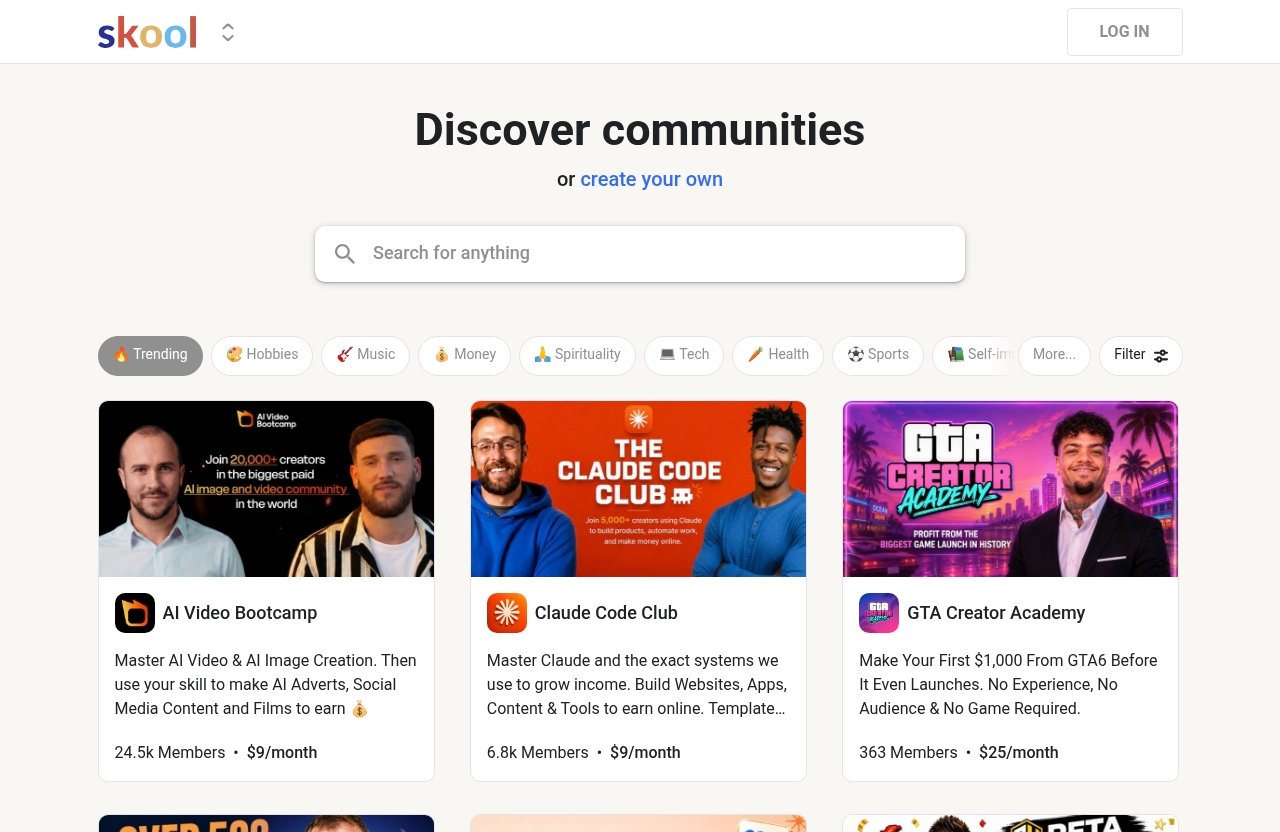
Skool is built around discovering communities or creating your own, keeping your members interacting through posts, comments, direct chats, and course modules without requiring third-party tool integrations. If you want to dive deeper into launching a recurring group, explore our guide on how to use Skool for membership site setup.
Skool vs Kajabi: Understanding the Core Architecture
The architectural differences between Skool and Kajabi reflect two entirely different philosophies regarding how online knowledge businesses operate. Understanding these underlying structures is essential before committing your audience and content to either ecosystem.
The Community-First Model (Skool)
Skool was founded in 2019 by CEO Sam Ovens and CTO Daniel Kang, operating out of Los Angeles, California, with a focused team of 30 employees. The entire premise of Skool is to eliminate administrative fragmentation by consolidating community, courses, and events into a single operational interface. In 2024, Alex Hormozi partnered with Skool to introduce The Skool Games, further reinforcing the platform’s focus on community-driven growth and creator competition.
On Skool, every member uses 1-login, 1-profile, and 1-search bar across every group they join. When a user logs in, they are immediately placed into the community discussion feed. Learning content and event schedules are treated as integrated tabs alongside the conversation rather than separate portals. This layout maximizes member retention and daily active participation by reducing login friction and navigation hurdles.
The Funnel-First Model (Kajabi)
Kajabi historically approached the creator economy from a marketing and infrastructure perspective. Its core objective has been serving as a comprehensive business suite where an entrepreneur can construct public websites, build multi-stage lead generation funnels, host standalone video courses, and run automated email nurturing campaigns.
In a funnel-first architecture, the digital product often sits behind a sales sequence. While Kajabi provides community capabilities, the system is fundamentally engineered around the transaction and marketing pipeline. Creators who rely on elaborate opt-in pages, upsells, order bumps, and complex behavioral email tags often look to Kajabi to handle the entire customer acquisition journey internally.
Community and Engagement Features Compared
A primary friction point for online educators is student completion and participation. When students consume pre-recorded videos in isolation, completion rates frequently drop. How each platform handles discussion and peer collaboration is central to any skool vs kajabi evaluation.
Group Discussions, Categories, and Real-Time Interaction
Skool organizes member interaction through a dedicated Community tab. Creators can organize discussions into custom categories, allowing members to publish posts, share thoughts, upload photos and videos, include animated GIFs, and run interactive polls. The interface supports real-time interactions, mentions, likes, and comment threads that mirror modern social networks.
Because members use a single profile across the entire platform, community members can easily direct chat with one another, follow specific discussion threads, and receive immediate in-app and email notifications. In addition, Skool sends automated email digests featuring popular community posts, which pulls inactive members back into the conversation without requiring manual intervention from the community owner.
Unified Search Across Content and Discussions
One of the most practical administrative features on Skool is its universal search function. Using a single search input, members can search across posts, comments, course classroom content, and member profiles simultaneously. For example, if a member searches for a specific topic like “email marketing,” Skool surfaces every group discussion, video module mention, and peer profile referencing that term. This removes repetitive questions and makes historical discussions a searchable knowledge base for the entire group.
Traditional course platforms often separate community discussion boards from the learning management system (LMS). On platforms structured like Kajabi, community spaces are historically separate modules or add-ons. While Kajabi offers community tools, creators should check Kajabi’s official site to see how community discussions integrate with their specific product tiers and whether members experience a seamless transition between course lessons and group chats.
Course Delivery and Classroom Experience: Skool vs Kajabi
Delivering educational material effectively requires an intuitive curriculum layout that students can navigate without getting lost. For a detailed review of curriculum delivery, read our guide on Skool for online courses and retention.
Skool’s Classroom Structure
Skool houses all instructional material inside its “Classroom” tab. The platform allows creators to build courses composed of structured modules, individual pages, hosted videos, downloadable resources, and searchable video transcripts. The student interface emphasizes clarity:
- Searchable Transcripts: Students can search within video transcripts to locate exact timestamps where an instructor explains a specific concept.
- Progress Tracking: Visual indicators show completed lessons, helping students track their advancement through the curriculum.
- Frictionless Navigation: Students can toggle between the Community discussion and Classroom lessons with a single click, allowing them to ask questions immediately after watching a video.
Furthermore, Skool allows creators to sell courses either through recurring subscription memberships or as one-time course purchases. This provides flexibility whether you run a monthly membership or a standalone training program.
Kajabi’s Digital Product Architecture
Kajabi has long been recognized for offering flexible structural options for digital products. On Kajabi, creators can configure diverse product formats, ranging from mini-courses and flagship programs to coaching programs and digital downloads. Kajabi provides customizable course player themes, allowing brands to control typography, color palettes, and visual branding in granular detail.
However, that visual customizability comes with added administrative decisions. On Kajabi, creators must configure course layouts, customize player templates, and establish automation rules manually. On Skool, the layout is intentionally standardized, ensuring that every course looks clean, loads fast, and functions identically on mobile devices and desktop browsers without custom coding.
Gamification and Retention Mechanisms
Student retention is the lifeline of any membership business. Skool tackles retention through built-in gamification natively tied to community activity.
Points, Levels, and Custom Rewards on Skool
Skool includes an integrated gamification system where members earn points whenever other members “like” their posts or comments. As members accumulate points, they automatically progress through numerical levels. Community administrators can customize these levels with unique names that reflect their brand or community culture.
The most powerful component of Skool’s gamification is the ability to unlock Classroom courses based on member levels. An educator can provide introductory training at Level 1, but reserve advanced workshops, templates, or bonus resources for members who reach Level 2, Level 3, or higher. This creates a positive feedback loop: members contribute meaningful insights, help peers, and post valuable content in order to unlock higher-tier training, naturally driving organic engagement across the group.
Gamification in Traditional Platforms
In conventional course platforms like Kajabi, gamification is rarely a core native mechanic. Achieving similar functionality typically requires third-party plugins, webhook automations, or external gamification tools connected via API. Creators evaluating skool vs kajabi who prioritize active peer-to-peer engagement find Skool’s native level system significantly easier to execute because it requires no configuration or external software.
Events and Live Interaction: The Calendar System
Live interaction—such as weekly coaching calls, Q&A sessions, guest lectures, and virtual coworking—is often the core value proposition of premium communities.
| Feature Dimension | Skool Event Calendar | Traditional Course Platform (e.g., Kajabi) |
|---|---|---|
| Event Display | Dedicated Calendar tab showing all upcoming livestreams and sessions | Events are typically managed via email announcements or separate landing pages |
| Timezone Handling | Automatically converts event times to the member’s local timezone | Often requires manual calendar invites or external timezone scheduling widgets |
| Automated Reminders | Native reminder emails sent directly to members prior to the call | Requires setting up custom broadcast sequences or email automation rules |
| Community Visibility | Visible to all community members directly within the group navigation | Often isolated inside specific coaching pipelines or separate portal pages |
Skool’s built-in Calendar tab simplifies scheduling livestreams and group meetings. Members can view scheduled events converted directly into their own local timezone, eliminating confusion around global scheduling. Skool also sends automated reminder emails to members, boosting live attendance without requiring the creator to schedule broadcast reminders manually.
Email and Communication Workflows
Communication workflows highlight another stark divergence in the skool vs kajabi comparison. Your choice here depends entirely on whether you prefer streamlined direct communication or complex marketing automation.
Skool’s 1-Click Broadcast System
Skool deliberately rejects traditional marketing automation complexities like tag management, conditional branches, and audience segmentation. Instead, Skool provides an “Email broadcasts” feature designed for speed and clarity:
- The creator writes a regular post inside the Community feed.
- The creator clicks a single button to broadcast that post via email.
- The post is delivered immediately to all community members’ email inboxes.
There are no segmenting lists, no complex formatting builders, and no tag setups required. In addition, members can adjust their personal notification preferences, receive daily or weekly digests of popular posts, and chat directly with instructors and peers via private messaging. If your communication style is conversational and community-wide, this setup eliminates substantial administrative overhead.
Kajabi’s Advanced Marketing Email Engine
For businesses whose revenue depends on segmenting cold prospects from existing customers, running automated 14-day abandoned cart funnels, or executing automated webinar pitch sequences, Kajabi’s marketing tools are distinctly capable. Kajabi provides a visual email builder, behavioral automations, lead tagging, and multi-stage pipeline sequences.
However, managing that infrastructure requires ongoing oversight. If you run a membership community where your main goal is simply notifying your existing students about new lessons or upcoming live calls, an advanced email marketing stack can introduce unnecessary friction. Creators considering Kajabi should evaluate whether they truly need complex sales funnels or if a direct broadcast system satisfies their audience communication requirements.
Monetization, Pricing Structure, and Affiliate Dynamics
Understanding how revenue and platform costs operate is crucial for long-term sustainability.
Skool Subscription and Auto-Affiliate Mechanics
Skool offers a straightforward entry point with a 14-day free trial, allowing creators to explore the platform, set up their classroom, and invite initial members before committing financially. Creators on Skool can monetize their groups in two distinct ways:
- Subscription Memberships: Charge members a recurring monthly or annual fee to maintain access to the community, courses, and calendar.
- 1-Time Course Purchases: Charge a single upfront price for lifetime access to specific materials.
In addition, Skool includes an automated affiliate feature known as “Auto affiliate.” If an active member inside your community decides to launch their own Skool group, Skool automatically tracks that referral and pays you a 40% monthly recurring commission for the lifetime of their subscription. This mechanism turns platform overhead into an ongoing income stream simply by running your group visibly on the platform. To learn more about this referral model, read our breakdown of the Skool affiliate program.
Kajabi Pricing and Packaging Considerations
Kajabi operates on a tiered subscription pricing model (check Kajabi’s official pricing page for exact current tiers, rates, active product limits, and pipeline quotas). Because Kajabi includes website hosting, landing pages, email marketing, and checkout funnels, its plans are priced to reflect an all-in-one marketing suite.
Creators comparing both tools should calculate the total operational cost. If you select Skool, you may choose to pair it with an external email service provider or simple landing page tool if you require extensive lead generation funnels. Conversely, if you select Kajabi, you pay a higher base software subscription to keep marketing, checkout, and course hosting inside one company ecosystem.
Setup Complexity and Management Overhead
A critical metric often ignored during software selection is implementation time—how long it takes from signing up to actually welcoming paying customers into your program.
Setting Up on Skool: Under 30 Minutes
Skool is engineered so that non-technical creators can set up and launch an entire online business in less than 30 minutes. Because it is an all-in-one community platform, there are no external plugins to connect, no API keys to configure, and no complex theme customizers to navigate. A creator simply needs to:
- Name the community and upload an icon or cover image.
- Create discussion categories (e.g., General, Wins, Q&A).
- Upload video lessons and resource links into the Classroom tab.
- Add recurring calls to the Calendar tab.
- Connect payouts and set subscription or one-time pricing.
Because the layout is responsive out of the box, the community and classroom are fully accessible on desktop and mobile devices immediately. For a step-by-step walkthrough of this process, consult our Skool beginner tutorial.
Setting Up on Kajabi
Launching a complete business on Kajabi is a significantly larger project. Creators must design custom website themes, build individual product pages, create checkout offers, draft automated email sequences, and link marketing pipelines together. While this provides maximum brand styling flexibility, it frequently results in weeks of setup time or requires hiring a dedicated Kajabi developer to complete the launch.
Pros and Cons: Evaluating Each Model
Every software platform forces deliberate trade-offs. Examining these pros and cons helps clarify which platform aligns with your operational priorities.
Skool Advantages
- Rapid Deployment: Complete community, classroom, and calendar configuration in under 30 minutes.
- Unified User Experience: Members navigate discussions, courses, events, and direct messaging using 1-login, 1-profile, and 1-search.
- High Engagement Architecture: Social features (likes, mentions, polls, GIFs) paired with native gamification keep members active.
- Course-Gated Levels: Automatically incentivize peer interaction by unlocking courses when members reach higher levels.
- Built-In Affiliate Growth: 40% recurring auto-affiliate payouts when your community members create their own groups.
- Mobile Flexibility: Full access for administrators and students across desktop and mobile devices without custom app configuration.
Skool Considerations
- Simplified Marketing Tools: Lacks advanced behavioral email funnels, complex marketing automations, and custom landing page page-builders.
- Fixed Design Layout: Customization is intentionally focused on branding assets and content rather than arbitrary layout coding.
Kajabi Advantages
- Comprehensive Funnel Infrastructure: Native pipeline builders integrate landing pages, checkouts, and email sequences under one roof.
- Extensive Theme Customization: Deep control over course player aesthetics, branding palettes, and typography.
- Advanced Email Marketing: Tagging, segmentation, and conditional logic built directly into the core platform.
Kajabi Considerations
- Steeper Learning Curve: Requires configuring multiple interconnected systems (pages, pipelines, offers, products, email templates) before launch.
- Secondary Community Focus: The platform is historically optimized around individual course consumption and sales funnels rather than spontaneous peer-to-peer discussion.
- Higher Base Investment: Premium software pricing reflecting its broader marketing toolset.
Who Should Choose Which Platform?
To finalize your decision in the skool vs kajabi evaluation, identify which creator persona best matches your current business strategy:
When Skool Is the Clear Choice:
- Coaches and Consultants: Group coaches who need weekly scheduled calls, peer accountability threads, and clean course repositories for session replays.
- Paid Community Operators: Creators whose primary business asset is a recurring monthly or annual membership community.
- Educators Battling Course Completion: Instructors who want to use points, levels, and public discussions to keep students motivated to finish courses.
- Creators Seeking Simplicity: Solopreneurs who want to eliminate tech stack fatigue and launch an offer without integrating third-party software.
When Kajabi Is the Clear Choice:
- Funnel-Driven Marketers: Businesses that generate revenue primarily through paid traffic, automated webinars, and multi-tier launch sequences.
- Design-Centric Brands: Companies that demand pixel-perfect website customization, tailored CSS, and unique corporate branding across every page.
- Complex Product Catalogs: Creators offering a wide assortment of standalone ebooks, self-paced mini-courses, and diverse digital products that do not require any ongoing community element.
What to Research Before Making Your Decision
Before moving your entire audience to either platform, conduct thorough due diligence. Relying on marketing claims alone can lead to migration headaches later.
When reviewing user feedback, Reddit discussions, or Trustpilot reviews for both platforms, focus on specific operational details rather than emotional reviews. Look for discussions concerning customer support responsiveness, video playback reliability across international regions, billing stability, and how easily students adapt to the interface. Avoid taking anonymous complaints at face value; instead, verify whether specific complaints stem from user setup errors or actual system constraints. Taking advantage of the 14-day free trial on Skool allows you to test the classroom uploading workflow, set up test calendar events, and evaluate the community layout firsthand before paying.
Official website · Latest pricing & offers
FAQ
What is the primary difference between Skool and Kajabi?
The primary difference lies in core focus: Skool is a community-first platform designed to combine group discussions, course classrooms, event calendars, and gamification in a simple, integrated environment. Kajabi is an all-in-one marketing platform built around websites, landing pages, complex sales funnels, and email automation.
Can I sell courses on Skool without building a separate website?
Yes. Skool allows creators to set up paid communities or sell courses directly through recurring subscriptions or 1-time course purchases. The platform handles community access, course content hosting, and member profiles without requiring external integrations.
Does Skool offer a free trial?
Yes, Skool offers a 14-day free trial. This gives creators the opportunity to configure their group, upload course modules, schedule calendar events, and test features before any billing begins.
How does gamification work on Skool?
Skool includes native gamification where members earn points when other community members like their posts and comments. Earning points unlocks customizable levels. Group owners can configure courses in the Classroom tab to automatically unlock when a member reaches a designated level, incentivizing quality engagement.
Can I send emails to my community members through Skool?
Yes. Skool provides a 1-click email broadcast feature. Community leaders can write a post in the community and send it directly to all members via email with a single click, eliminating the need for list segmentation, tagging, or complex formatting templates. Members also receive automatic notification digests and event reminders.
How does the Skool auto-affiliate feature work?
Skool automatically turns creators into affiliates. If an active member of your Skool group decides to start their own Skool community, the platform automatically credits you with the referral and pays you a 40% recurring monthly commission for the duration of their active subscription.
Related Reading
- How to Use Skool for Membership Site Setup and Launch
- Skool for Online Courses: A 2026 Review of Community, Hosting, and Retention
- Skool Affiliate Program Review 2026: Commission, Payouts, and Promotion Strategy
- Skool Tutorial: A Beginner’s Guide to Setting Up and Launching in 2026