
Skool Platform Review: Pros, Cons, and Real Value

If you are comparing community tools, course platforms, and membership software, this skool platform review is designed to give you a practical buyer’s view rather than a hype-filled sales pitch. Skool is attractive because it keeps the core offer simple: communities, courses, videos, live calls, custom URLs, and affiliates under straightforward pricing.
My quick take: Skool can be a strong fit for community-first creators, coaches, and membership businesses that want a cleaner, easier way to host people and content. It is less compelling if your business depends on deep branding control, advanced funnels, or sophisticated email marketing automation.
Official website · Latest pricing & offers
Quick Verdict: Is Skool Worth It? — Skool Platform Review
Short answer for creators, coaches, and community builders
Yes, Skool can be worth it if your business model is built around a community, recurring membership, coaching group, or course-led audience. The biggest appeal is that it reduces friction: you are not trying to stitch together a separate community app, course host, video area, live-call system, and affiliate setup.
In this skool platform review, the main verdict is simple: Skool is best for people who want an easy-to-understand community hub, not people who want a heavily customized marketing machine. If your offer depends on ongoing discussion, accountability, learning, and group momentum, Skool’s structure makes sense.
The tradeoff is that simplicity usually comes with limits. A highly customized brand experience, advanced marketing automation, or complex funnel architecture may require a different setup or additional tools.
If you already understand the pros and cons and want to inspect the platform yourself, you can explore Skool through this affiliate link. I recommend doing that only after you compare the fit against your actual business model.
Who will get the most value from Skool
The people most likely to benefit are creators, coaches, educators, consultants, and membership operators who want to build around audience interaction. Skool’s official homepage positions it as a place to discover communities or create your own, which matches that community-first use case.
It is especially relevant if your customers need more than passive content. For example, a coaching group, accountability community, education membership, wellness group, or AI-focused learning community may all benefit from a central place where members can learn and interact.
This is where many positive Skool reviews tend to focus: not on having every advanced feature, but on making the member experience easier to follow. A clean environment can help reduce distraction and encourage participation.
Who should probably look elsewhere
Skool may not be the best first choice if your main priority is full design control, complex website building, advanced segmentation, or deep email automation. It is also not ideal if you want a platform that behaves like a complete CRM, funnel builder, and marketing automation suite.
If you are researching “is Skool worth it,” your answer depends heavily on what you are replacing. If you are replacing a messy stack of basic tools, Skool could be valuable. If you are replacing a mature marketing operation with advanced workflows, you may feel constrained.
Buyers comparing a Skool alternative should focus less on feature count and more on business fit. A more complex platform may be better for marketing depth, while Skool may be better for simplicity and member engagement.
What Skool Is and How It Works
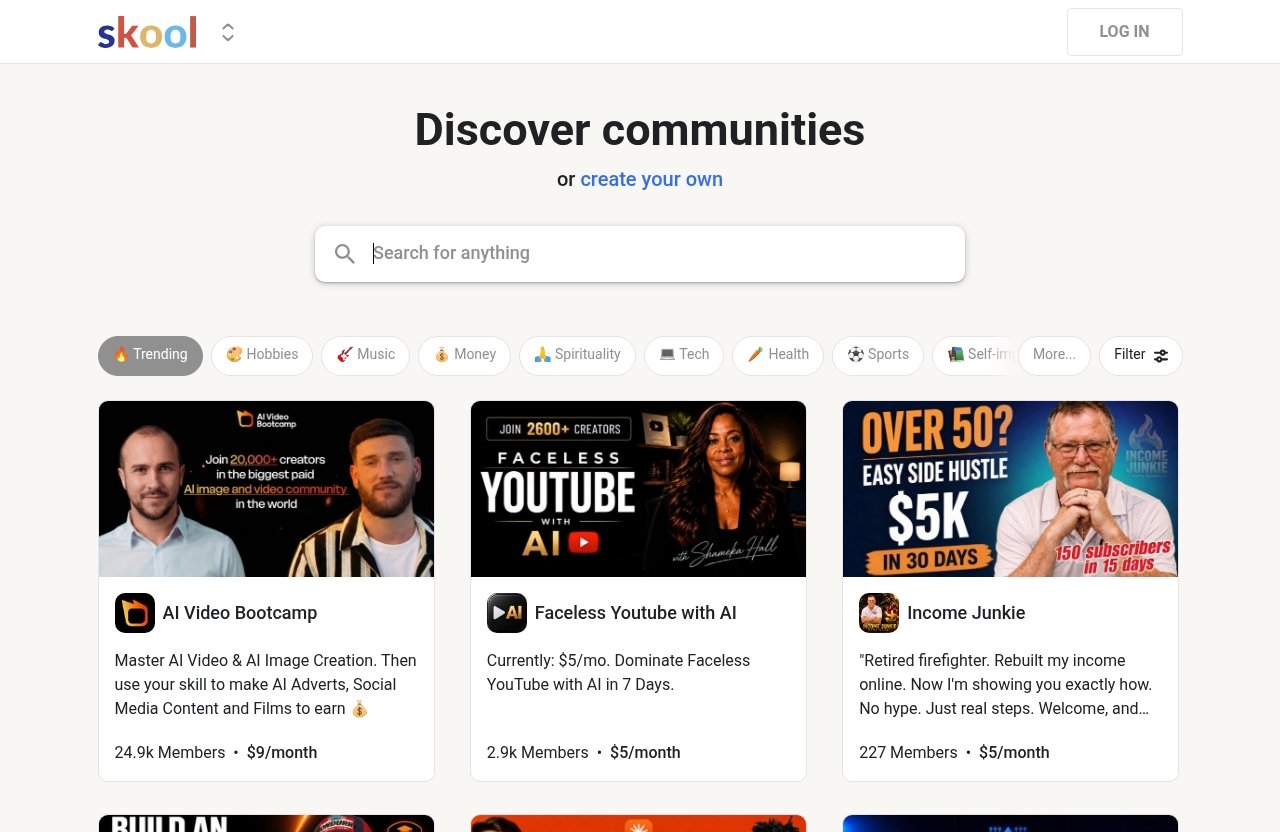
Skool’s core promise: community + courses + live calls
Skool is a community-centered platform that brings together communities, courses, videos, and live calls. Based on the official pricing page, both plans include unlimited members, unlimited courses, unlimited videos, and unlimited live calls.
That combination is the main reason the skool community platform gets attention from creators and coaches. Instead of treating the community as an add-on to a course, Skool appears designed around the idea that discussion and learning belong together.
From a buyer’s standpoint, that matters because many membership businesses fail when members feel disconnected. A platform that keeps learning and interaction close together can make the offer easier to consume.
How the platform is positioned on the official homepage
The official homepage positions Skool as a place where people can discover communities or create their own. The examples shown on the official homepage include communities around AI, education, coaching, wellness, and memberships.
That positioning is important for this skool platform review because it shows the platform is not only about hosting static courses. It is aimed at people building groups, audiences, and ongoing member experiences.
This also explains why Skool often comes up in commercial searches like “skool membership platform” or “skool course platform.” It sits in the overlap between community software, online learning, and paid membership infrastructure.
What users typically use Skool for
In practical terms, users typically evaluate Skool for paid communities, coaching groups, course delivery, mastermind-style memberships, and education-based businesses. It may also appeal to people who want to create a simpler home for their audience instead of relying entirely on social media groups.
A coach might use it to keep lessons, member discussion, and live-call access in one place. A creator might use it to build a paid learning community around a niche topic.
The real question is not whether Skool has every possible tool. The better question is whether its structure matches the way your members learn, interact, and stay engaged.
PRODUCT FACTS: Verified Skool Pricing and Features For This Skool Platform Review
Hobby plan: $9/month
According to the official Skool pricing page, the Hobby plan is $9/month. The verified official facts state that the Hobby plan includes:
| Hobby Plan | Verified Official Details |
|---|---|
| Price | $9/month |
| Members | Unlimited members |
| Courses | Unlimited courses |
| Videos | Unlimited videos |
| Live calls | Unlimited live calls |
| Transaction fee | 10% transaction fee |
| Custom URL | Included |
| Affiliates | Included |
For buyers comparing skool pricing, the key detail is the transaction fee. A lower monthly price can be appealing, but the 10% transaction fee on the Hobby plan is an important commercial consideration if you expect meaningful revenue.
Pro plan: $99/month
According to the official Skool pricing page, the Pro plan is $99/month. The verified official facts state that the Pro plan includes:
| Pro Plan | Verified Official Details |
|---|---|
| Price | $99/month |
| Members | Unlimited members |
| Courses | Unlimited courses |
| Videos | Unlimited videos |
| Live calls | Unlimited live calls |
| Transaction fee | 2.9% transaction fee |
| Custom URL | Included |
| Affiliates | Included |
The Pro plan has a higher monthly price but a lower transaction fee than Hobby. For a paid community or course business, that difference may matter once sales volume increases.
I would not judge skool pricing only by the monthly subscription. You should also estimate how transaction fees affect your margins.
What is included in both plans
Based on the verified official pricing facts, both Skool plans include unlimited members, unlimited courses, unlimited videos, unlimited live calls, custom URL, and affiliates. The official pricing page also says “Simple pricing” and “2 months free!”
The pricing page shows Monthly and Yearly billing options, but no verified yearly price is provided in the source details available here. For that reason, this skool platform review will not invent or assume annual pricing.
Here is the clean comparison:
| Feature / Pricing Detail | Hobby | Pro |
|---|---|---|
| Monthly price | $9/month | $99/month |
| Unlimited members | Yes | Yes |
| Unlimited courses | Yes | Yes |
| Unlimited videos | Yes | Yes |
| Unlimited live calls | Yes | Yes |
| Custom URL | Yes | Yes |
| Affiliates | Yes | Yes |
| Transaction fee | 10% | 2.9% |
The practical takeaway: Hobby lowers the entry cost, while Pro reduces the transaction-fee burden.
Main Pros of Skool
Simple, distraction-free community experience
The biggest strength of Skool is simplicity. For many creators, the problem is not that they lack tools; it is that their tools are scattered and hard for members to follow.
A clean community environment can make it easier for members to know where to go, what to do, and how to participate. That matters because a community business depends on retention, not just signups.
In my view, this is where the skool community platform has its clearest value. It is designed around a direct member experience rather than a complicated admin experience.
Courses, videos, and live calls in one place
Another clear advantage is consolidation. The verified official pricing facts show that both plans include unlimited courses, unlimited videos, and unlimited live calls.
For creators selling education or coaching, this can reduce operational friction. You can organize the learning side and the group side in the same environment, which may be easier than sending members across several different tools.
This is one reason a skool course platform can make sense for creators who teach through both content and conversation. If your course is supported by discussion, Q&A, and live sessions, that combined structure is useful.
Built-in affiliates and monetization-friendly structure
Both verified plans include affiliates, which is a meaningful point for commercial users. Affiliate functionality can be useful when members, partners, or collaborators help promote your community or course.
That does not mean money is automatic. A platform can support monetization, but your results still depend on your niche, positioning, audience trust, offer quality, and consistency.
Still, for a skool membership platform, having affiliates included in both plans makes the business model feel more creator-friendly. In this skool platform review, I see that as a practical advantage for people who already have an offer worth promoting.
Official website · Latest pricing & offers
Main Cons and Limitations
Limited customization and branding control
The main limitation to understand is customization. Skool’s appeal is simplicity, but that also means it may not satisfy buyers who want highly flexible page design, advanced brand styling, or a fully custom digital experience.
This is not necessarily a flaw. It is a tradeoff. Some creators are better served by a standardized community structure because it reduces setup time and confusion.
However, if your brand experience is central to your premium positioning, you should evaluate Skool carefully. A skool alternative may be better if visual control and custom layouts are non-negotiable.
Not ideal for advanced funnels or email marketing
Skool should not be viewed as a complete replacement for every marketing tool. If your business relies on complex funnels, detailed email automation, lead scoring, advanced segmentation, or multi-step campaign logic, you may need additional systems.
This is a common point in many skool pros and cons discussions. Skool appears strongest as a community and learning hub, not as a deep marketing automation platform.
That distinction matters before you buy. If your primary pain is member engagement, Skool may help. If your primary pain is sophisticated lead nurturing, another toolset may be a better match.
Potential transaction-fee tradeoff at the Hobby plan
The Hobby plan’s $9/month price is attractive, but the verified 10% transaction fee is the major tradeoff. For a small test or early-stage community, that may be acceptable.
For a revenue-generating membership, you should model the fee against expected sales. At some point, the Pro plan’s $99/month price and 2.9% transaction fee may become more financially sensible.
This is one of the most important buyer-focused points in any honest skool platform review. Do not evaluate the monthly price alone; evaluate the total cost relative to your revenue.
Real Value: Who Skool Is Best For
Creators selling memberships or paid communities
Skool is best suited for creators whose value is delivered through a mix of content, community, and ongoing access. If your members benefit from discussion, peer support, and structured learning, Skool’s format is aligned with that model.
A creator selling a paid community often needs three things: a clear home for members, a simple way to deliver educational material, and a repeatable engagement rhythm. Skool’s verified feature set supports that kind of business.
This is why the question “is Skool worth it” usually depends on whether your audience actually wants community. If your customers only want downloadable files or one-time content access, Skool may be more platform than you need.
Coaches teaching via discussion and accountability
Coaches may get strong value from Skool because coaching is rarely just about content. It often depends on accountability, questions, discussion, and regular touchpoints.
The official homepage examples include coaching, which fits this use case. A coaching community can benefit from having members, courses, videos, and live calls under one roof.
In this context, the skool platform review verdict is positive. If your coaching offer improves when members interact with you and each other, Skool’s simplicity can become a business advantage.
Business owners who value simplicity over complexity
Skool is also a good fit for business owners who are tired of complicated software stacks. If you want fewer moving pieces, the platform’s direct structure may be appealing.
The value is not only in the listed features. It is also in the potential operational clarity: fewer places for members to get lost, fewer systems to manage, and a more focused environment.
That said, simplicity is valuable only if it matches your strategy. If your business model requires advanced marketing depth, the same simplicity may feel restrictive.
Skool vs the Alternatives People Ask About
When Skool makes sense vs more complex platforms
Skool makes sense when community engagement is the center of the offer. If you want members to learn, discuss, attend live calls, and stay inside one focused environment, it is easy to see the appeal.
More complex platforms may make sense when your needs go beyond community and course delivery. For example, if you need deeper website customization, advanced marketing workflows, or broader business operations, a different platform may fit better.
This is the most useful way to think about a skool alternative. Do not ask which tool has the longest feature list. Ask which tool best supports the way you sell, deliver, and retain customers.
What to compare before switching
Before switching from another platform to Skool, compare the following decision factors:
| Decision Factor | Why It Matters |
|---|---|
| Community focus | Skool is strongest when member interaction matters |
| Course delivery needs | Both plans include unlimited courses and videos |
| Live-call workflow | Both plans include unlimited live calls |
| Branding expectations | Skool may not suit deep customization needs |
| Marketing complexity | Advanced funnels or email automation may require other tools |
| Revenue model | Transaction fees affect total cost |
| Affiliate strategy | Affiliates are included in both verified plans |
If you are reading skool.com reviews, skool reviews reddit threads, or general review sites, use them as context rather than final proof. Reddit and Trustpilot-style perspectives can surface useful concerns, but individual experiences vary widely by niche, expectations, and business maturity.
A practical buyer should combine external feedback with the official homepage and pricing page. That keeps your decision grounded in verified facts rather than rumors or isolated complaints.
Why some buyers may prefer other tools
Some buyers may prefer other tools because they need more control, more automation, or more specialized workflows. That does not make Skool bad; it simply means Skool is not trying to be everything.
For example, a brand-heavy company may want a platform that supports a more custom visual experience. A funnel-driven business may want deeper campaign tools.
This is why balanced skool pros and cons matter. Skool’s strength is focus, and its biggest weakness is also focus. It gives community-first businesses a simpler path, but it may not satisfy buyers who want maximum flexibility.
How to Evaluate Skool Before You Buy
Best trial/use-case test to run
The best way to evaluate Skool is to map one real offer into the platform before fully committing your business operations. Pick a specific use case, such as a paid coaching group, a course community, or a small membership.
Then ask whether the core member journey feels clear. Can members understand where to learn, where to participate, and how live calls fit into the experience?
For this skool platform review, my recommended test is simple: judge Skool by how easily it helps your members take action. A beautiful or feature-rich platform is not useful if members do not engage.
Questions to ask about your audience and offer
Before buying, answer these questions:
- Does my audience want a community, or do they only want content?
- Will discussion and accountability improve the result I sell?
- Do I need unlimited members, courses, videos, and live calls?
- How important is a custom URL for my brand?
- Will affiliates play a role in my growth?
- Can I accept the transaction fee on the plan I choose?
- Do I need advanced funnels or email marketing outside the platform?
- Is simplicity more valuable to me than deep customization?
These questions are more important than reading one glowing skool review or one negative complaint. Your business model determines whether the platform is a smart fit.
If you want to examine Skool after working through those questions, you can visit it through this affiliate link. The point is not to buy blindly, but to compare the actual platform against your offer and audience.
Red flags that Skool may not fit
Skool may not fit if you need highly customized branding, complex marketing automation, or an all-in-one system for every part of your sales operation. It may also be a poor fit if your audience is not interested in community interaction.
Another red flag is choosing the Hobby plan only because the monthly price is low while ignoring the 10% transaction fee. If you plan to sell actively, model the real cost first.
Finally, be careful if you are expecting software to solve an offer problem. Skool can host and support a community, but it cannot replace clear positioning, trust, content quality, and consistent leadership.
Final Verdict: The Best Fit and the Biggest Caveat In This Skool Platform Review
Summary of strengths
Skool’s biggest strengths are simplicity, community focus, and a practical combination of courses, videos, live calls, custom URL, and affiliates. Based on the verified official pricing facts, both plans include unlimited members, unlimited courses, unlimited videos, and unlimited live calls.
That makes it appealing for creators, coaches, and membership businesses that want a focused place to bring people together. If your value increases when members interact, learn, and stay accountable, Skool is worth serious consideration.
The best-fit buyer is someone who wants a community-first platform without spending weeks building a complicated tech stack.
Summary of tradeoffs
The main tradeoffs are limited customization, less suitability for advanced funnels or email marketing, and transaction-fee considerations. The Hobby plan is $9/month with a 10% transaction fee, while the Pro plan is $99/month with a 2.9% transaction fee.
Those numbers matter. A low monthly price can look appealing, but the right plan depends on your revenue expectations and margin structure.
This skool platform review would not be complete without emphasizing that Skool is not the best platform for every creator. It is strongest when your offer is community-led and weakest when your business needs deep marketing and branding flexibility.
Bottom-line recommendation
Skool is best for community-first creators, coaches, educators, and membership businesses that want a simple home for members, courses, videos, live calls, and affiliate-supported growth. It is not ideal for businesses that require heavy customization, advanced marketing automation, or complex funnel infrastructure.
My recommendation is to consider Skool if your business succeeds through engagement, accountability, and ongoing member value. Look elsewhere if your main needs are design control, marketing depth, or highly complex operations.
Bottom line: Skool can be a smart, practical choice, but only when the platform matches your offer. The biggest caveat is that simplicity is a strength for the right buyer and a limitation for the wrong one.
Official website · Latest pricing & offers
FAQ
Is the Skool platform worth it?
Yes, the Skool platform can be worth it for community-first creators, coaches, and membership businesses that want simplicity. It may not be ideal if you need heavy branding control, advanced funnels, or deep email marketing automation.
Can you actually make money on Skool?
Yes, monetization is possible through paid communities, courses, and membership-style offers. However, results depend on your niche, audience trust, offer quality, pricing, and ability to keep members engaged.
How much is Skool per month?
According to the verified official pricing facts, Skool’s Hobby plan is $9/month and the Pro plan is $99/month. The Hobby plan has a 10% transaction fee, while the Pro plan has a 2.9% transaction fee.
What is better than Skool?
It depends on your priorities. A Skool alternative may be better if you need deeper custom branding, advanced marketing automation, complex funnels, or broader operational features. Skool is usually stronger for simplicity and community-first delivery.
Related Reading
References
- Skool Home Page
- Skool Pricing
- Reddit: Can someone explain me what Skool is?
- Trustpilot: Skool reviews