Systeme.io vs HubSpot: Which Platform Is Better for Lean Small Businesses in 2026?
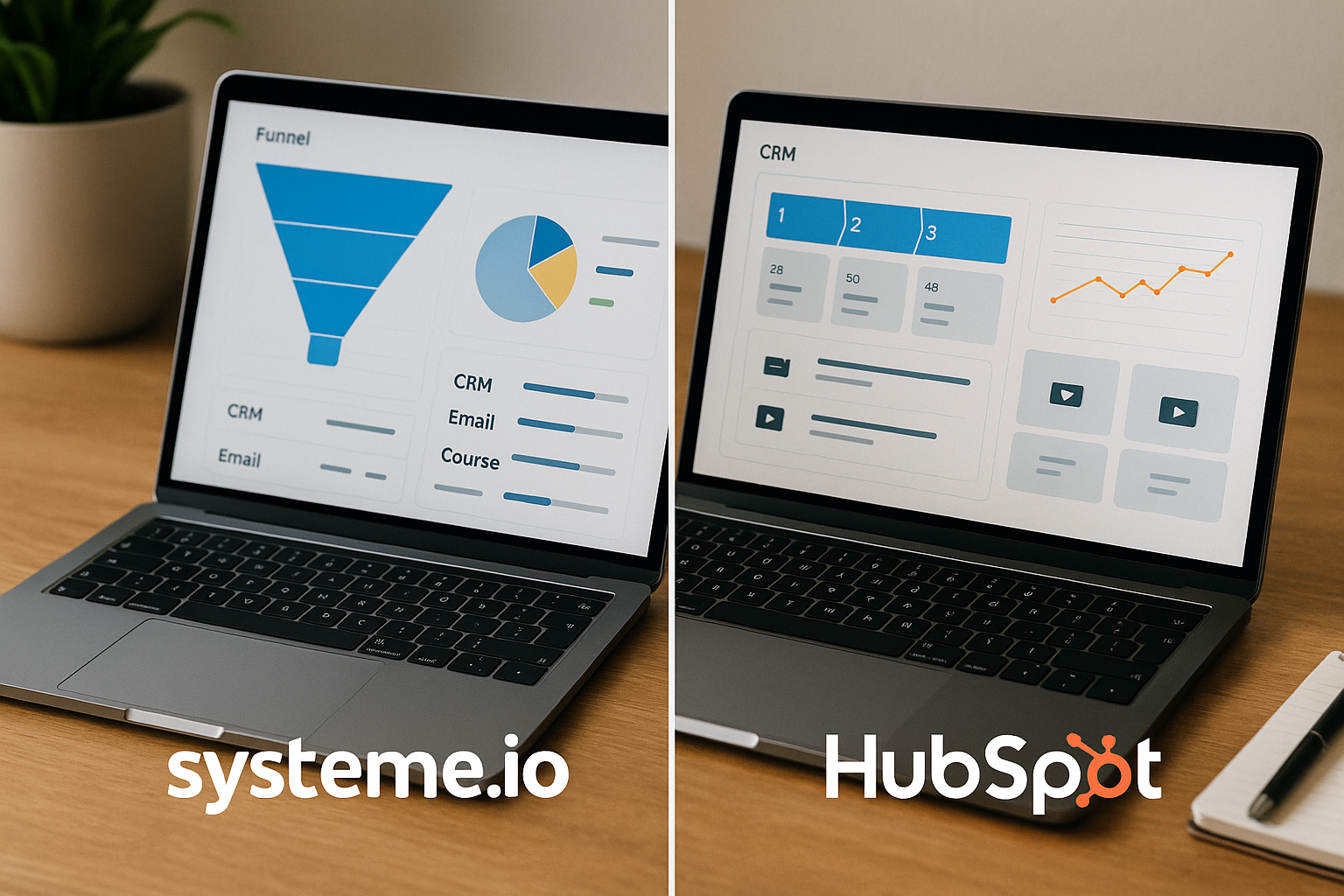
If you are comparing systeme.io vs hubspot, the direct answer is simple: for most small businesses, solopreneurs, creators, coaches, and lean teams, systeme.io is usually the better value because it combines sales funnels, email marketing, course hosting, checkout tools, blogging, and affiliate features in one lower-cost platform.
HubSpot can still make sense for companies that need a deeper CRM ecosystem and more complex sales or service operations. But if your priority is launching offers, collecting leads, sending emails, selling courses, and keeping costs under control, systeme.io is the more practical starting point.
I’d frame this less as “which platform has more total enterprise power?” and more as “which one helps a small business get to revenue faster without tool overload?” On that question, systeme.io has the edge for most lean operators.
Official website · Latest pricing & offers
Systeme.io vs HubSpot: Quick verdict for small businesses
This is not a generic CRM bake-off. The real question is whether you need a heavyweight CRM suite or a lean all-in-one marketing platform that lets you build, promote, and sell digital offers from one dashboard.
For the average solo founder or small team, the simpler stack often wins. Fewer tools means fewer subscriptions, fewer integrations, and fewer broken handoffs between landing pages, email lists, checkout pages, and course delivery.
Who should pick systeme.io
Pick systeme.io if you want one platform for the core online business workflow: build a funnel, capture leads, send emails, sell a product, host a course, and manage basic pipelines.
It is especially strong for:
- Solopreneurs launching a first offer
- Coaches selling programs or packages
- Course creators who need native course hosting
- Digital product sellers using funnels and checkout pages
- Small businesses that want email marketing without adding another tool
- Lean teams that value speed over complex CRM customization
The official systeme.io positioning is clear: it is “The only tool you need to launch your online business,” with tools for sales funnels, email marketing, online courses, selling online, and blogging. That matches the day-to-day needs I see most often in small online businesses.
If you want to test it with minimal risk, you can try systeme.io with the free account option here. The official pricing page states the Free plan is $0, free forever, and requires no credit card.
Who should pick HubSpot
HubSpot makes more sense when your business needs a broader CRM and marketing suite rather than a simple launch-and-sell platform.
Based on the search-result context supplied for this review, HubSpot is positioned more as a larger CRM ecosystem. That may be valuable if you have a dedicated sales team, complex deal stages, heavier reporting needs, or multiple departments working across marketing, sales, and service.
In practical terms, choose HubSpot if your main problem is managing a more mature customer database and sales operation. Choose systeme.io if your main problem is getting offers live and selling them with less software friction.
The short answer in one comparison table
| Category | systeme.io | HubSpot |
|---|---|---|
| Best fit | Solopreneurs, creators, coaches, lean small businesses | Larger teams needing broader CRM operations |
| Core strength | Funnels, email, courses, selling online, blogging | CRM ecosystem and broader sales/marketing suite |
| Course hosting | Included in systeme.io’s platform focus | SERP snippets indicate HubSpot does not include course hosting |
| Affiliate management | Search results suggest systeme.io includes affiliate tools | SERP snippets indicate HubSpot does not include affiliate management at any tier |
| Free plan | $0, no credit card required, free forever | Avoiding unsupported pricing claims here |
| Startup risk | Low, because the Free plan and $17 Startup plan cover many early needs | Can be higher depending on required hubs and tiers |
| Best buying decision | Choose if you want a lean all-in-one business platform | Choose if CRM depth matters more than simplicity |
What each platform is built to do
Before getting lost in feature lists, look at the product philosophy. This matters because software is not just a checklist; it shapes how your business operates every week.
A lean founder usually needs fewer moving pieces. A larger company may need advanced processes, permissions, handoffs, reporting, and CRM depth.
Systeme.io as an all-in-one online business platform
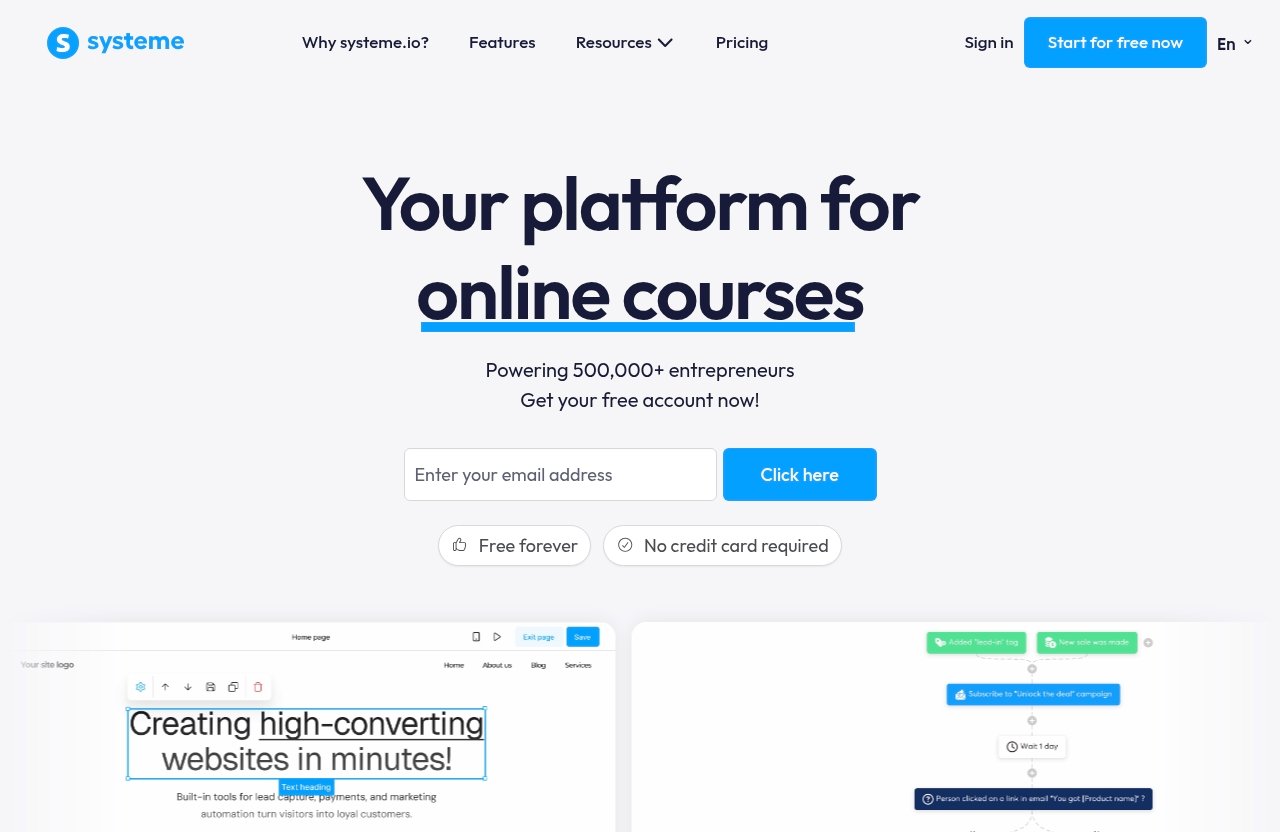
Systeme.io is built around launching and running an online business from one place. The official homepage describes it as a platform for sales funnels, email marketing, online courses, selling online, and blogging.
That matters because these are not separate “nice-to-have” features for a creator or digital seller. They are the operating system of the business.
A typical workflow might look like this:
- Publish a landing page for a lead magnet.
- Send automated emails to new subscribers.
- Offer a paid course or coaching package.
- Add an order bump or upsell.
- Deliver the content inside the same platform.
- Track buyers and leads through a basic CRM pipeline.
For a small team, that simplicity is valuable. You are not stitching together a funnel builder, email tool, checkout system, course platform, blog, and basic CRM.
HubSpot as a broader CRM and marketing suite
HubSpot is better understood as a broader CRM and marketing suite. The supplied search-result context positions it as a more expansive CRM ecosystem, which can be useful for companies with more developed sales and customer operations.
That kind of platform can be a strong fit when you have more people, more process, and more data moving across departments. It may be overkill if you are still validating an offer or trying to keep monthly software costs predictable.
To keep this review fair, I am not making unsupported claims about HubSpot’s full feature set or official pricing. The point is simply that HubSpot appears to serve a broader CRM use case, while systeme.io is focused more tightly on launching, marketing, and selling online.
Why the product philosophy matters for small teams
Small teams do not just pay with money. They pay with setup time, learning curves, maintenance, and decision fatigue.
When I evaluate software for a lean business, I ask:
- Can the founder launch without hiring a technical specialist?
- Are the core selling tools in one place?
- Does the pricing make sense before the business has predictable revenue?
- Will the tool still work after the first offer starts selling?
- Is the platform simple enough to use weekly, not just impressive in a demo?
That is where systeme.io often feels more aligned with small-business reality. It prioritizes the path from idea to offer to sale.
Feature-by-feature comparison that matters most for lean teams
A useful systeme.io vs hubspot review should focus on the features that actually affect revenue and operations for small teams. For most readers, that means funnels, email, courses, checkout, affiliate selling, CRM basics, and websites.
More features are not always better. The better tool is the one that covers your real workflow without forcing you into a larger system than you need.
Funnels and landing pages
Funnels are one of systeme.io’s clearest strengths. The official pricing facts show funnel access across all plans, including the Free plan.
Here are the verified funnel limits:
| Plan | Funnel allowance | Funnel steps |
|---|---|---|
| Free | 3 funnels | 1 sales funnel has 15 steps |
| Startup | Up to 10 funnels | 50 funnel steps |
| Webinar | Up to 50 funnels | 300 funnel steps |
| Unlimited | Unlimited funnels | Unlimited funnel steps |
For a small business, three funnels on the Free plan can be enough to test a lead magnet, a paid offer, and a simple sales sequence. The Startup plan expands that to 10 funnels, which gives more room for different offers or audience segments.
HubSpot may support landing pages and marketing workflows depending on the setup, but I am not using unsupported plan-level claims here. From a lean-business perspective, the key point is that systeme.io puts funnels at the center of the product.
Email marketing and automation
Email marketing is another area where systeme.io is practical for small teams. The verified pricing facts state that all systeme.io plans include unlimited emails sent.
That is important because many early-stage businesses are not only watching their subscriber count; they are also worried about being charged more as they communicate more frequently.
Systeme.io plan limits include:
| Plan | Contacts | Automation rules | Email campaigns | Workflows |
|---|---|---|---|---|
| Free | Up to 2,000 contacts | 1 | 1 | Not listed for Free in the provided facts |
| Startup | 5,000 contacts | 10 | 10 | 10 |
| Webinar | 10,000 contacts | 100 | 100 | 20 |
| Unlimited | Unlimited contacts | Unlimited | Unlimited | Unlimited |
For a creator or service provider, this is enough to build a simple nurture sequence, promote launches, and follow up with buyers. On higher plans, the automation limits become more flexible.
The tradeoff is that systeme.io is not trying to be the deepest enterprise automation environment. If you need highly complex CRM-triggered lifecycle systems across multiple departments, HubSpot may be the more appropriate conversation.
Courses, memberships, and digital products
For course creators, this is where the comparison becomes much clearer. Systeme.io’s official homepage lists online courses as a core part of the platform.
That means you can build your marketing funnel, collect leads, sell the offer, and deliver the course inside the same ecosystem. For many creators, that removes the need for a separate course platform.
The supplied SERP snippets indicate that HubSpot does not include course hosting at any tier. Because that is search-result context rather than an official HubSpot pricing page, I would treat it cautiously, but it still supports an important buying question: if your business depends on course delivery, verify whether your CRM platform can actually host the product.
For coaches and educators, systeme.io has a more direct fit. You are not just managing contacts; you are packaging and delivering paid knowledge.
Affiliate program and checkout tools
Affiliate selling can be a major growth lever for creators, course owners, and digital product businesses. Search results suggest systeme.io includes affiliate tools, while the SERP snippets supplied for this review indicate HubSpot does not include affiliate management at any tier.
On the checkout side, the verified systeme.io pricing facts list practical selling features across plans:
| Feature | Free | Startup | Webinar | Unlimited |
|---|---|---|---|---|
| 1-click upsells | 1 | 10 | 100 | Unlimited |
| Order bumps | 1 | 10 | 100 | Unlimited |
| Transaction fees | 0% | 0% | 0% | 0% |
| Payment integrations | Multiple payment integrations listed | Multiple payment integrations listed | Multiple payment integrations listed | Multiple payment integrations listed |
This is one of the reasons I see systeme.io as a strong hubspot alternative for small business owners who sell online. Funnels and email are helpful, but checkout optimization features like order bumps and upsells can directly affect average order value.
The Free plan gives you a basic version of these tools. The paid plans expand the limits as your offer catalog grows.
CRM and pipelines
Systeme.io includes CRM pipelines, but it should be viewed as a practical small-business CRM layer rather than a full enterprise CRM suite.
The verified CRM pipeline limits are:
| Plan | CRM pipelines |
|---|---|
| Free | 1 |
| Startup | 5 |
| Webinar | 20 |
| Unlimited | Unlimited |
For a coach, consultant, creator, or local service business, one pipeline may be enough to track leads, booked calls, and customers. The Startup and Webinar plans give more room for multiple products, services, or sales processes.
HubSpot’s likely advantage is CRM depth. If your team needs sophisticated sales operations, advanced customer records, and broader department-level workflows, HubSpot may be the better fit.
But for many small businesses, the CRM problem is simpler: “Can I see who my leads are, follow up, and move opportunities through a pipeline?” Systeme.io covers that leaner use case while also handling funnels and sales tools.
Blogs and websites
Systeme.io includes websites and blogs across its plans, according to the verified pricing facts.
| Plan | Websites | Blogs |
|---|---|---|
| Free | 1 website | 1 blog |
| Startup | 10 websites | Blogs included |
| Webinar | 20 websites | Blogs included |
| Unlimited | Unlimited websites | Blogs included |
The official facts also state that all plans include unlimited sub-accounts, unlimited bookings, blogs, 0% transaction fees, and unlimited file storage.
For a small online business, having a simple site, blog, funnel, and email list in one platform can be enough to start publishing and selling. It may not replace every specialized website stack for every company, but it reduces the number of tools needed at the beginning.
This is where the “lean all-in-one” angle matters. If your website is mainly there to explain your offer, capture leads, publish content, and send people into funnels, systeme.io is a practical fit.
Official website · Latest pricing & offers
Pricing breakdown: what you really pay to get started
The systeme.io vs hubspot pricing question is one of the biggest reasons small-business buyers compare these platforms.
For systeme.io, the verified pricing is straightforward: Free at $0, Startup at $17, Webinar at $47, and Unlimited at $97. The Free plan is stated as free forever with no credit card required.
For HubSpot, I am deliberately not presenting official pricing because the prompt only provides SERP snippet context. Those snippets suggest HubSpot Marketing Hub starts at $800/month and that higher tiers can become much more expensive, but that should be treated as search-result context rather than official product validation.
Systeme.io pricing plans
Here is the verified systeme.io pricing breakdown using only the provided product facts:
| Plan | Price | Best for | Key verified limits |
|---|---|---|---|
| Free | $0 | Testing an idea or launching lean | 3 funnels, 1 automation rule, 1 custom domain, up to 2,000 contacts, unlimited emails sent, 1 CRM pipeline, 1 campaign, 1 website, 1 blog |
| Startup | $17 | Early businesses needing more room | 10 funnels, 10 automation rules, 3 custom domains, 5,000 contacts, 5 CRM pipelines, 10 campaigns, 10 workflows, 10 websites |
| Webinar | $47 | Businesses using webinars and larger funnels | 50 funnels, 100 automation rules, 10 custom domains, 10,000 contacts, 20 CRM pipelines, 100 campaigns, 20 workflows, 10 evergreen webinars |
| Unlimited | $97 | Scaling teams wanting fewer limits | Unlimited funnels, contacts, automation rules, domains, CRM pipelines, campaigns, workflows, websites, webinars, A/B tests, upsells, order bumps, and file storage |
All plans include 0% transaction fees, unlimited sub-accounts, unlimited bookings, blogs, unlimited file storage, and multiple payment integrations listed on the pricing page.
From a buying perspective, the standout point is not just the price. It is that the lower tiers still include the core tools needed to build and sell online.
How the free plan stacks up
The systeme.io free plan is unusually useful for testing. It includes up to 2,000 contacts, unlimited emails sent, 3 funnels, 1 automation rule, 1 custom domain, 1 CRM pipeline, 1 email campaign, 1 website, 1 blog, 1 tag, 1 A/B test, 1 one-click upsell, and 1 order bump.
That is enough to validate a simple business idea:
- One landing page for a free resource
- One email campaign to nurture leads
- One funnel for a paid offer
- One checkout path with an order bump or upsell
- One blog or website to support content marketing
- One CRM pipeline to track prospects
For a new founder, this reduces startup risk. You can build before committing to a monthly bill.
Why small businesses often outgrow free CRM-only tools
Free CRM tools can be useful, but they often solve only one part of the business. A CRM helps you manage contacts and deals; it does not automatically give you a complete selling system.
Small businesses usually need the whole chain:
- Traffic source
- Landing page
- Lead capture
- Email follow-up
- Offer page
- Checkout
- Upsell or order bump
- Product delivery
- Customer tracking
This is why a systeme.io hubspot alternative comparison is not only about CRM records. It is about whether the platform helps you get from audience to revenue without adding five other subscriptions.
For many lean teams, systeme.io pricing is easier to justify because it covers several jobs in one place.
Best use cases: when systeme.io wins vs when HubSpot wins
The best choice depends on your business model. A course creator and a B2B sales organization do not need the same stack.
If you are deciding on systeme.io vs hubspot for small business, start with your revenue motion. Are you selling digital offers and building an audience, or are you managing a larger sales organization?
Best for solopreneurs, coaches, and course creators
Systeme.io is a strong fit for solopreneurs because it keeps the operating system simple. You can build a funnel, run email marketing, host a course, and sell from one platform.
For a coach, that might mean:
- A landing page for a free consultation or lead magnet
- An email sequence to warm up prospects
- A checkout page for a paid program
- A course area for training materials
- A pipeline to track leads and clients
For a course creator, the native online course focus is especially important. You do not have to send buyers to a separate learning platform unless you choose to.
Best for small businesses selling digital offers
Digital product sellers usually care about speed, margins, and simplicity. They need to test offers quickly and improve conversion without building a complicated tech stack.
Systeme.io supports that workflow with funnels, unlimited emails sent on all plans, order bumps, one-click upsells, blogs, websites, and 0% transaction fees.
A small business could use it to sell:
- Templates
- Mini-courses
- Coaching packages
- Paid workshops
- Membership-style educational content
- Downloadable resources
The more your business depends on direct online selling, the more sense systeme.io makes.
Best for larger teams needing a heavyweight CRM
HubSpot becomes more compelling when CRM complexity is the central requirement. If you have a larger sales team, detailed customer records, multi-stage sales processes, or cross-functional departments, a broader CRM suite may be worth the extra complexity.
That does not make HubSpot “better” for everyone. It means it is built for a different kind of operational problem.
If your team’s biggest challenge is sales management depth, choose the tool designed around that. If your biggest challenge is launching and selling offers quickly, systeme.io is likely the cleaner fit.
When to skip systeme.io
Skip systeme.io if you know you need a full enterprise-style CRM suite from day one.
It may not be the right fit if:
- Your sales process has many complex pipeline rules
- You need deeper CRM customization across departments
- Your organization already runs on a larger CRM ecosystem
- You have a dedicated operations team that wants advanced CRM architecture
- Your business does not need funnels, courses, digital checkout, or email marketing in one place
That honesty matters. Systeme.io is excellent for lean online business operations, but it is not trying to be every enterprise platform at once.
Pros and cons of systeme.io for small-business buyers
No tool is perfect. The real question is whether the strengths match your business stage and whether the tradeoffs are acceptable.
For most small-business readers, the pros are more relevant than the cons. But the cons are worth understanding before you switch.
Pros
- Strong value for lean businesses: The Free plan and low-cost paid plans reduce financial risk.
- No credit card required for the Free plan: You can test the platform before paying.
- Free forever plan: The official pricing page lists the Free plan at $0.
- Funnels included: Even the Free plan includes 3 funnels.
- Unlimited emails sent on all plans: Useful for list-building and regular campaigns.
- Course hosting focus: Online courses are part of the official platform positioning.
- Checkout growth tools: Order bumps and one-click upsells are included with plan-based limits.
- 0% transaction fees: All plans list 0% transaction fees.
- Blogs and websites included: Helpful for simple content marketing and offer pages.
- Evergreen webinars on higher plans: The Webinar plan includes 10 evergreen webinars, while Unlimited removes that limit.
- Unlimited file storage: Included across plans according to the verified pricing facts.
- 500,000+ entrepreneurs: The official homepage notes that systeme.io has 500,000+ entrepreneurs.
Cons
- Not a full enterprise CRM suite: If CRM depth is your top priority, HubSpot may fit better.
- Plan limits matter: Free and lower paid plans have limits on funnels, automation rules, domains, campaigns, tags, and workflows.
- CRM is practical, not heavyweight: Good for lean pipelines, but not necessarily for complex sales organizations.
- Advanced teams may want more specialization: Larger companies may prefer separate best-in-class tools for each department.
- Migration still takes planning: Moving funnels, emails, courses, and contacts always requires careful setup.
Decision checklist before you switch
Before choosing, ask yourself:
- Do I need course hosting inside the same platform?
- Am I selling digital products, coaching, or online programs?
- Do I want funnels and email marketing in one place?
- Is keeping monthly cost low important right now?
- Can my CRM needs be handled with simple pipelines?
- Would a larger CRM suite slow me down more than help me?
If you answered “yes” to most of those, systeme.io is probably the better fit.
How to choose in 5 minutes
If you are stuck, do not compare every possible feature. Compare the next 90 days of your business.
What do you actually need to launch, sell, and follow up? That answer usually makes the decision obvious.
Choose systeme.io if you want speed and simplicity
Choose systeme.io if you want to get an offer live quickly without managing multiple tools.
It is the stronger choice if you need:
- Funnels
- Email marketing
- Course hosting
- Blog or website pages
- Checkout tools
- Upsells and order bumps
- Basic CRM pipelines
- Lower startup cost
This is why systeme.io is often the best hubspot alternative for lean founders. It covers the online selling workflow without forcing you into a larger CRM stack too early.
Choose HubSpot if you want enterprise-style CRM depth
Choose HubSpot if your business is already CRM-heavy. If your main work happens across sales teams, service teams, detailed contact records, and complex pipelines, HubSpot may be a better operational match.
That is especially true if you have the budget and team capacity to manage a broader suite. More power is useful when you have the structure to take advantage of it.
For a solo creator, though, that same depth can become drag.
A simple decision matrix
| Your situation | Better fit | Why |
|---|---|---|
| You are launching your first digital offer | systeme.io | Lower startup risk and built-in selling tools |
| You need a free plan with funnels and email | systeme.io | Free plan includes 3 funnels and unlimited emails sent |
| You sell online courses | systeme.io | Online courses are part of the platform’s official focus |
| You want affiliate tools for digital products | systeme.io | SERP context suggests systeme.io supports affiliates |
| You need a simple crm for small business | systeme.io | CRM pipelines are included with plan-based limits |
| You manage a large sales team | HubSpot | Broader CRM suite may fit better |
| You need enterprise-style CRM operations | HubSpot | More appropriate for complex sales and service stacks |
| You want the leanest all-in-one marketing platform | systeme.io | Funnels, email, websites, blogs, and selling tools are combined |
Official website · Latest pricing & offers
FAQ
Is systeme.io a good HubSpot alternative for small businesses?
Yes, systeme.io is a good HubSpot alternative for small businesses that need funnels, email marketing, course hosting, checkout tools, affiliate-related selling features, and basic CRM pipelines in one platform.
It is especially strong for solopreneurs and small teams that do not need enterprise CRM complexity. HubSpot may still be better for larger teams with deeper CRM and sales operations.
Does systeme.io have a free plan?
Yes. The official systeme.io pricing page lists a permanent Free plan at $0.
It is also described as free forever and does not require a credit card. That makes it a low-risk option for testing an online business idea before upgrading.
What is included in the systeme.io Free plan?
The verified systeme.io Free plan includes 3 funnels, 1 automation rule, 1 custom domain, and up to 2,000 contacts.
It also includes unlimited emails sent, 1 CRM pipeline, 1 email campaign, 1 website, 1 blog, 1 tag, 1 A/B test, 1 one-click upsell, 1 order bump, and unlimited file storage. For many new businesses, that is enough to build a basic funnel and start selling.
Which is better for course creators: systeme.io or HubSpot?
Systeme.io is the stronger fit for most course creators because online courses are part of its official platform focus.
The supplied SERP materials indicate that HubSpot does not include course hosting. If your business depends on selling and delivering courses, systeme.io gives you a more direct all-in-one path.
When should a business choose HubSpot instead?
A business should choose HubSpot when it needs a broader, deeper CRM suite for complex sales pipelines, larger teams, and more enterprise-style marketing or service operations.
If your business is already built around advanced CRM processes, HubSpot may be worth evaluating. If you mainly need to launch, market, and sell online with fewer moving parts, systeme.io is usually the more practical choice.
Final recommendation for most small businesses
For most readers comparing systeme.io vs hubspot, I would choose systeme.io if the business is lean, offer-driven, and cost-conscious.
HubSpot deserves consideration when CRM depth is the priority. But for creators, coaches, solopreneurs, and small businesses selling digital products or services, systeme.io better matches the real workflow: build an audience, capture leads, send emails, sell offers, deliver content, and track customers.
The best pick for lean operations
Systeme.io is the best fit when you want one login and one integrated workflow.
You get funnels, email marketing, online course functionality, selling tools, blogs, websites, CRM pipelines, and plan-based automation without starting with a large software stack. That combination is exactly what many small businesses need before they are ready for a heavier CRM suite.
Why the value gap matters
The value gap matters because early-stage businesses need momentum more than complexity.
A permanent $0 Free plan with no credit card required lowers the barrier to action. The $17 Startup plan gives more room for funnels, contacts, automation rules, campaigns, workflows, websites, and CRM pipelines. The $47 Webinar and $97 Unlimited plans add more capacity for businesses that are growing.
That pricing structure lets you start small and upgrade when the business justifies it.
Call to action
If your priority is a lean all-in-one marketing platform for launching and selling online, systeme.io is the platform I would test first.
You can start with systeme.io here and see whether the free plan fits your workflow before committing to a paid plan. For most small-business buyers, that is the smartest way to make the systeme.io vs hubspot decision with real experience instead of guesswork.
Related Reading
- Systeme.io vs ActiveCampaign 2026: Simplicity vs Advanced Automation Power
- Systeme.io Review 2026: Is Systeme.io for Solopreneurs the Best Choice?
- How Does Systeme.io Pay You? 2026 Guide
References
- Free HubSpot alternative
- How systeme.io compares to the alternatives
- Systeme.io Pricing — Free, Startup, Webinar, Unlimited Plans