How Accurate Is Lalal.AI? A 2026 Review of Sound Quality, Artifacts, and Real-World Results
Official website · Latest pricing & offers
Quick answer: how accurate is LALAL.AI?
Short verdict for musicians, creators, and DJs
So, how accurate is LALAL.AI in practical use? It can be very useful for extracting usable vocals, instrumentals, drums, bass, and other elements from reasonably clean, well-produced audio. Its results are often good enough for remix preparation, DJ edits, content production, karaoke versions, reference listening, podcast cleanup, and creative sampling.
However, LALAL.AI is not a replacement for original multitrack session files. Dense arrangements, distorted guitars, heavy limiting, reverb-heavy vocals, and live recordings can expose artifacts or leave audible bleed between stems. The right question is not whether an AI splitter is “perfect,” but whether the output is clean enough for your intended project.
This trust-first lalal ai review focuses on that distinction. For many everyday creative workflows, the platform can save significant time. For a commercial release requiring isolated, studio-grade stems, you should expect to inspect and potentially repair the result.
What ‘accuracy’ means in stem separation
In an AI stem splitter, accuracy means more than whether vocals disappear from an instrumental. It includes four practical measures:
| Accuracy Measure | What It Means in Practice |
|---|---|
| Separation | How well the requested element is extracted from the mix |
| Bleed | How much of the unwanted material remains in the output |
| Tonal integrity | Whether the isolated sound keeps its natural tone and detail |
| Artifact level | Whether processing creates swishing, phasing, chirping, or damaged transients |
A strong vocal extraction should retain lead vocal intelligibility, consonants, breaths, and natural high frequencies without pulling too much snare, guitar, synth, or reverb into the vocal stem. Likewise, a usable instrumental should remove the vocal without leaving a ghost-like vocal residue in the center of the mix.
When evaluating how accurate is LALAL.AI, it is worth listening on headphones as well as speakers. Small artifacts may be nearly invisible in a social video but obvious when the output is played alone, processed further, or used in a club mix.
The difference between clean separation and artifact-free audio
Clean separation and artifact-free audio are related, but they are not identical. A tool may remove a vocal successfully while leaving behind a thin, watery texture in cymbals or high-frequency synths. Another result may preserve the instrumental naturally but leave faint vocal phrases behind.
That trade-off matters because different users have different thresholds. A DJ making a quick transition edit may prefer a mostly clean acapella with minor instrumental bleed. A producer sampling one phrase may accept some phasey background texture. A mastering engineer, by contrast, may reject the same file because it does not behave like a true studio stem.
What LALAL.AI is designed to do
Core products and supported use cases
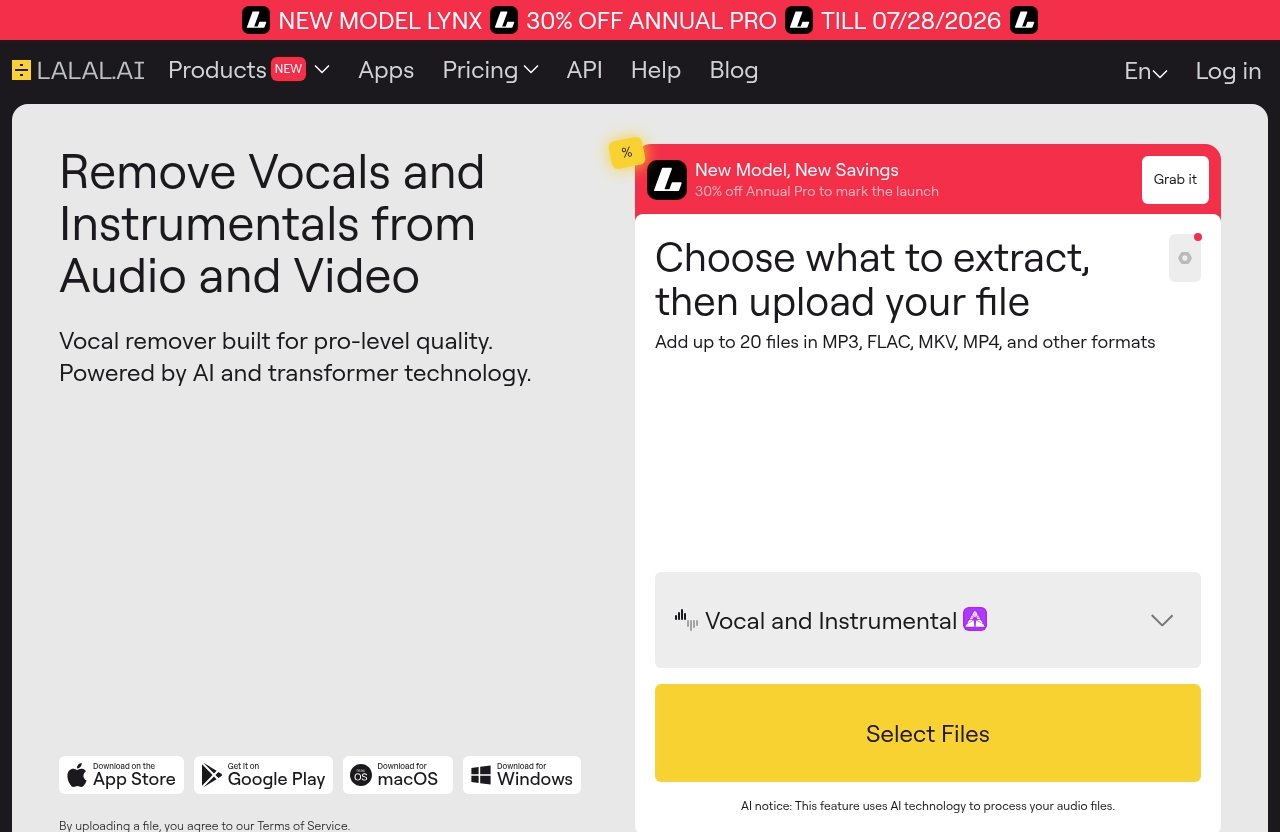
LALAL.AI offers a broader audio-processing toolkit than a basic vocal remover. According to the official product homepage, its products include Vocal Remover, Stem Splitter, Voice Cleaner, Voice Changer, Voice Cloner, Echo & Reverb Remover, and Lead/Back Splitter.
The LALAL.AI vocal remover is intended to remove vocals and instrumentals from music tracks, audio clips, and video files. The Stem Splitter is built for extracting individual musical components, while the Voice Cleaner addresses unwanted background music, plosives, microphone rumble, and other noise issues.
For voice-focused workflows, the platform also offers tools to transform a voice, create a personalized AI voice model from recordings, reduce echo and reverb, and separate lead vocals from backing vocals. That range makes it relevant to musicians, DJs, podcasters, video editors, and developers rather than only remix creators.
Stem types it can isolate
The official description of the LALAL.AI stem splitter says it can extract:
- Vocals
- Instrumental
- Drums
- Bass
- Guitar
- Synth
- String instruments
- Wind instruments
It also offers Lead/Back Splitter functionality for separating lead vocals and backing vocals. In real production terms, this is useful when you need to study an arrangement, create an edit, prepare a performance backing track, isolate a vocal idea, or make a rough remix arrangement without access to the original session.
The more elements overlap in the same frequency range, the harder the job becomes. A singer, distorted guitar, synth pad, and snare can all occupy important midrange space. AI can identify patterns, but it cannot retrieve information that was never independently available in the final stereo mix.
Where it fits in a workflow
LALAL.AI is best treated as a fast preparation and problem-solving tool. A creator might use it to isolate dialogue before cleaning it, a DJ might make an acapella for a transition, and a producer might extract drums to analyze groove and arrangement.
The official homepage also lists desktop applications for Windows, macOS, and Linux, plus iOS apps for iPhone and iPad and Android support for phones and tablets. For production environments, LALAL.AI offers a VST Plugin that runs locally inside a DAW, as well as an API for developers.
How we should judge accuracy in audio separation
Vocals vs instrumental separation
The most common test of how accurate is LALAL.AI is a vocal-versus-instrumental split. This is also the easiest comparison for most buyers because they immediately recognize whether a singer sounds natural and whether the backing track is sufficiently free of vocal remnants.
A clean pop recording with a centered lead vocal and wide instrumental production gives an AI model useful clues. The vocal may be easier to isolate because it occupies a recognizable position and tonal range. Problems increase when vocals are doubled heavily, panned creatively, saturated, buried in a mix, or blended with similar-sounding instruments.
For an instrumental result, listen specifically for the words that remain behind. Faint vocal tails, sibilance, or reverb can be less noticeable in a full mix but distracting when used for karaoke, sync work, or a public performance.
Bleed, phasing, and musical artifacts
Bleed occurs when part of an unwanted source leaks into the separated stem. A vocal stem may include hi-hats, snare hits, guitar harmonics, or synth textures. An instrumental may retain breaths, vocal reverb, or fragments of words.
Phasing is another common issue. It can make a sound feel hollow, unstable, or as if it is moving in and out of focus. Swishy highs, smeared cymbals, metallic texture around consonants, and softened drum hits are all recognizable examples of LALAL.AI artifacts that can appear in challenging material.
These are not unique to one platform; they are normal limitations of source separation from a completed mix. What matters is whether the artifact level is acceptable for the job. A short social-media clip has a very different standard from a commercial remix release.
Why source quality matters so much
The quality of the source is one of the largest variables in LALAL.AI accuracy. A clean, high-quality export contains more information for the model to analyze than a compressed stream, low-bitrate MP3, noisy recording, or audio captured from a speaker.
Mastering also changes the difficulty. Heavy limiting can flatten transients, aggressive stereo processing can blur placement clues, and broad-band compression can make instruments and vocals overlap more consistently. LALAL.AI’s own guidance in its FAQ and blog resources emphasizes the importance of input quality when seeking better splitting results.
Real-world sound quality: where LALAL.AI performs well
Clean vocals and pop-friendly arrangements
The most favorable situation is a clean, modern recording with a prominent lead singer, controlled low end, and clearly arranged instrumentation. Pop tracks often fit this profile because the vocal is intentionally mixed to remain intelligible above the backing production.
In these scenarios, how accurate is LALAL.AI can be answered positively for practical work. Vocal intelligibility may remain strong, while the instrumental output can be useful for rehearsal, karaoke, mashup drafting, or remix arrangement. You may still hear occasional high-frequency processing on cymbals or reverb tails, but the core musical information is often preserved well enough to work with.
Simple mixes with wide separation
Electronic tracks can also separate well when their elements are clearly layered. A centered vocal, wide pads, distinct kick, bass, and percussion can offer more predictable separation cues than a crowded live band recording.
This is particularly helpful for DJs and producers who need an acapella, drum-focused section, or rough instrumental reference. The LALAL.AI stem separation quality tends to be more convincing when sounds are distinct in both frequency and stereo placement.
Simple acoustic recordings may also produce useful results, especially where a lead voice and a single instrument are clearly captured. That does not guarantee perfection, but it reduces the number of competing signals the model has to untangle.
When the preview sounds impressive
A preview can sound genuinely impressive when the original arrangement is orderly and the extracted element is clearly defined. Still, do not judge only by the first few seconds. Listen to quiet verses, chorus peaks, sibilant words, cymbal-heavy moments, and sections with backing vocals.
The practical test is whether the output survives your next step. If you will only place an extracted vocal over a new beat, minor bleed may disappear in context. If you plan to solo it, pitch-shift it, compress it heavily, or release it publicly, inspect more critically.
Where artifacts show up
Metal, dense rock, and heavily compressed tracks
Dense rock and metal are among the harder categories for AI separation. Distorted guitars occupy a broad frequency range, cymbals create constant high-frequency information, drums can be transient-heavy, and vocals may be aggressive, layered, or heavily processed.
In these conditions, how accurate is LALAL.AI depends heavily on the specific mix. It may still provide a useful sketch stem, but isolated vocals can include guitar residue or cymbal wash, while instrumentals may retain vocal fragments. The result can be helpful for practice, analysis, or rough edits, but it should not be assumed ready for a polished release.
Heavily compressed modern productions create similar challenges even outside metal. When every part is loud and consistently present, the boundaries between sources are less obvious.
Reverb-heavy vocals and crowded midrange
Reverb is especially difficult because it spreads vocal information across time and frequency. An AI model may isolate the direct vocal reasonably well but struggle to decide whether the reverberant tail belongs to the vocal, the instrumental, or both.
Crowded midrange is another frequent issue. Vocal frequencies overlap with guitars, pianos, brass, strings, synth leads, and snare presence. When those elements share the same tonal territory, separation can create a thinner vocal tone or leave faint musical traces behind.
This is why an ai vocal remover review should never rely on a single clean pop song. A trustworthy assessment includes the difficult material where source separation limits become audible.
Common signs of over-processing
Before relying on a split, listen for these warning signs:
- “Swirling” or watery cymbals
- Phasey vocal consonants
- Thin or brittle high frequencies
- Chopped-off reverbs and breaths
- Missing drum attack or softened transients
- Ghost vocals in the instrumental
- Background instruments leaking into an acapella
None of these automatically makes the result unusable. But they are reasons to test the stem in the actual context where you plan to use it. A file that sounds imperfect in solo may still be completely workable beneath a new arrangement.
Genre-by-genre accuracy breakdown
Pop and electronic music
Pop is generally one of the more favorable genres for LALAL.AI accuracy, particularly when vocals are forward, clear, and centered. Modern pop mixes often use deliberate vocal placement and controlled production, which can give separation tools a cleaner target.
Electronic music can also perform well where the arrangement uses distinct layers. A kick, bass, programmed percussion, pad, and vocal are often more separable than multiple acoustic instruments competing in the same range. Dense festival-style productions with large stacked synths and aggressive mastering can still be challenging.
Hip-hop and spoken-word material
Hip-hop can deliver useful vocal extraction when a rapper or speaker is clearly placed over a beat. Spoken-word recordings, podcasts, interviews, and voiceovers can be even more favorable when the recording is relatively dry and the background is controlled.
The challenge comes from ad-libs, doubled vocals, sample-heavy instrumentals, vinyl texture, and heavy vocal effects. When assessing how accurate is LALAL.AI for rap, pay attention to plosive sounds, fast consonants, and the clarity of words during busy sections.
For podcasters, Voice Cleaner and Echo & Reverb Remover may be as relevant as stem splitting. A better workflow may involve reducing unwanted noise first, then making a separate vocal or dialogue-focused edit.
Rock, metal, and live recordings
Rock, metal, and live recordings should be approached with more conservative expectations. The combination of distorted instruments, cymbal wash, room reflections, audience noise, and changing microphone bleed is difficult for any automated separation process.
A LALAL.AI vocal remover result may still be useful for rehearsal tracks, arrangement study, rough remix ideas, or content edits. But musicians expecting pristine vocal isolation from a full band recording should test carefully before paying for more processing time.
Live recordings are particularly variable. A professionally mixed concert recording may perform better than a phone recording from the audience, yet both can contain room reflections and overlapping sound that reduce separation clarity.
Classical, acoustic, and jazz recordings
Classical, acoustic, and jazz recordings vary widely. A simple singer-and-guitar track can be relatively manageable, especially when the vocal and instrument have distinct space. A full orchestra, large choir, or busy jazz ensemble can be difficult because many instruments overlap naturally.
These genres also reveal artifacts more easily. Acoustic instruments have detailed transients and natural harmonics, while classical recordings often rely on room ambience. If the split changes those subtleties, listeners may notice quickly.
For these genres, use the output as a creative or educational resource unless you have verified that a particular track separates cleanly enough for your final purpose.
Official website · Latest pricing & offers
Factors that improve or reduce split quality
File quality and mastering
Use the best available source file. A clean original export is preferable to a file that has been re-encoded multiple times, downloaded from an unknown source, or captured through speakers and a microphone.
Avoid low-bitrate audio when possible. Lossy compression can remove subtle details and introduce its own artifacts, leaving the AI with less reliable information. If you have access to an official download, uncompressed source, or high-quality original file, start there.
Mastering matters too. Very loud, heavily limited tracks can reduce the space between elements. A dynamic mix with clearer instrument placement often gives a better starting point.
Mono vs stereo and mix density
Stereo recordings commonly provide more spatial information than mono sources. When vocals are centered and instruments are spread across the stereo field, separation may have more clues to work with. Mono files can still be processed, but there is less spatial distinction between sources.
Mix density is equally important. A sparse arrangement with a lead vocal and light accompaniment is usually easier than a full chorus with stacked harmonies, guitars, percussion, pads, and effects all competing in the same frequencies.
This is a major reason why LALAL.AI vs real songs is not a simple pass-or-fail comparison. Real songs differ drastically in arrangement, production methods, and source quality.
Fast vs relaxed workflow expectations
Fast results are valuable, but fast should not mean uncritical. If the output will be used publicly, take time to audition it at normal volume, low volume, and in solo. Compare the stem against the original track at the moments where the arrangement becomes busiest.
When possible, process a short representative section before committing to an entire project. Choose a verse, chorus, vocal reverb tail, and instrumental break. That gives you a more realistic idea of whether LALAL.AI is accurate enough for your needs.
How LALAL.AI compares on value, not just accuracy
Accuracy versus convenience
The best stem splitter is not necessarily the one that produces the cleanest result on one specific song. Value also includes workflow speed, supported stem types, device access, editing needs, and whether you can use the output in your preferred creative environment.
LALAL.AI’s value proposition is its breadth of audio tools and use cases. Rather than only offering vocal removal, it also provides stem extraction, vocal cleanup, echo and reverb reduction, lead/back vocal splitting, voice transformation, voice cloning, a DAW-focused VST Plugin, and an API for developers.
For users who regularly need fast audio isolation, those workflow options can matter as much as small differences in artifact levels.
When pay-as-you-go is enough
If you only need occasional stems for a remix concept, a one-off content edit, rehearsal material, or a podcast rescue job, it makes sense to evaluate the output before committing to more usage. Check the official product pages, review the current options, and test a representative file where possible.
If you decide the tool matches your workflow, you can review the official offering through this disclosure-friendly LALAL.AI product link. As with any affiliate recommendation, the goal should be to assess fit rather than assume it will solve every difficult separation problem.
Who should consider enterprise or API use
The official pricing page includes Plans & Extras and an Enterprise Solution, while the homepage lists an API built for developers. These options are most relevant to teams or products that need audio processing as part of a repeatable system.
Potential enterprise or API users include media platforms, production teams, audio software developers, agencies handling recurring content workflows, and services that need automated audio processing at scale. In that setting, consistency, integration requirements, volume, and quality-control processes matter as much as individual stem quality.
Pricing and what you get
Verified plans and extras
LALAL.AI provides an official pricing page at lalal.ai/pricing. Based on the verified information available for this review, the page includes Plans & Extras and an Enterprise Solution.
Because plan prices and detailed allowances can change, it is better to confirm the current official page before purchase than rely on outdated third-party pricing tables. This is especially important if you expect to process many files, use specialized features, or need business-level access.
How to choose the right plan
Choose based on workload, not just curiosity. An occasional creator should first determine whether their typical files separate cleanly enough. A DJ or producer with recurring remix and edit work may value repeat access to the Stem Splitter and Vocal Remover more highly.
Podcasters and video creators should also consider whether Voice Cleaner or Echo & Reverb Remover addresses a recurring problem. The best value comes from using the specific tools that reduce time in your existing workflow.
What to confirm before checkout
Before purchasing, confirm these details directly on the official product and pricing pages:
- The current Plan or Extra that fits your expected volume
- Whether the specific product feature you need is included
- Current supported file requirements and usage conditions
- Whether desktop, mobile, VST Plugin, or API access matters for your workflow
- The quality of results on your own representative source audio
This final test matters more than a generic rating. A clean pop vocal and a dense metal track can produce very different outcomes from the same tool.
Who should buy LALAL.AI
Best for content creators and remixers
LALAL.AI is a sensible option for content creators, DJs, remixers, and producers who need quick access to usable stems without manual editing from scratch. It is particularly practical for vocal extraction, instrumental preparation, mashup drafts, short-form content, arrangement analysis, and sampling ideas.
For these users, how accurate is LALAL.AI is usually best answered in terms of speed and usability. If the stem works in the context of a new mix or video, minor artifacts may not be a deal-breaker.
Best for podcasters and cleanup workflows
Podcasters, interview editors, educators, and video creators may benefit from the wider toolset, not only stem separation. Voice Cleaner can target background music, plosives, microphone rumble, and other unwanted noise, while Echo & Reverb Remover is relevant for recordings made in less-than-ideal rooms.
This is useful when an otherwise valuable recording needs practical cleanup rather than forensic restoration. The key is to set realistic expectations: aggressive cleanup can sometimes alter the natural tone of a voice.
Not ideal for users expecting studio-grade stems every time
LALAL.AI may not be the right choice if your project requires flawless, original-session-quality multitracks from every source. It cannot fully overcome a crowded mix, poor source file, intense distortion, severe compression, or overlapping effects.
If you are producing a commercial release, sampling a stem prominently, or preparing material for detailed engineering work, treat AI-separated audio as a starting point. You may need manual cleanup, additional processing, replacement sounds, or permissioned original stems.
Final verdict
Is LALAL.AI accurate enough for paid use?
For many users, how accurate is LALAL.AI has a practical answer: yes, it is accurate enough for paid use when the source is clean and the intended outcome allows for occasional imperfections. It can be especially worthwhile for fast vocal removal, usable instrumental creation, creative stem extraction, and voice-focused cleanup tasks.
The important limitation is consistency across difficult recordings. Dense mixes, rock and metal productions, live material, heavy reverb, and aggressive mastering are more likely to reveal bleed and artifacts. This is normal for AI source separation and should be part of the purchase decision.
Best use cases by user type
Musicians and producers can use it for arrangement analysis, remix foundations, demos, and creative sampling. DJs can use it for edits, transitions, acapella ideas, and performance preparation. Podcasters and creators can use the voice-focused tools for practical recording cleanup.
Developers and teams may find the API and Enterprise Solution relevant if audio processing is part of a larger service. In every case, the strongest results begin with the best possible source file and realistic quality expectations.
Bottom-line recommendation
This lalal ai review finds that LALAL.AI is best for creators who value fast, flexible stem and voice processing and understand that AI separation is not identical to receiving original studio stems. It performs most convincingly on clean, well-separated arrangements and becomes less reliable as mixes get denser and more heavily processed.
If you need quick, useful results and can tolerate minor cleanup in difficult tracks, it is worth evaluating. If you need perfect isolation every time, original multitracks remain the only dependable standard. Review the official product information and test it on your own real-world files before purchasing.
Official website · Latest pricing & offers
FAQ
How accurate is LALAL.AI for vocals and instrumentals?
LALAL.AI can be strong on clean, well-mixed tracks with clearly placed vocals and relatively separated instrumentation. The output is often usable for remixes, karaoke, DJ edits, content creation, and production references.
Accuracy can decline when a track is dense, heavily compressed, noisy, or full of overlapping guitars, synths, backing vocals, and effects. Always judge results using the type of songs you actually plan to process.
Does LALAL.AI leave artifacts?
Yes, it can leave artifacts, particularly on more complex source material. Common examples include swishy high frequencies, phasey textures, softened drum transients, instrumental bleed in a vocal stem, or faint vocal remnants in an instrumental.
These issues may be minor in a full arrangement but more obvious when a stem is soloed or heavily processed. The usefulness of the result depends on your final application.
What music genres does LALAL.AI handle best?
Pop, electronic music, simpler acoustic material, spoken word, and some hip-hop tracks are often more favorable because their elements may be more clearly separated. A centered vocal over a controlled backing track is generally easier to isolate.
Dense rock, metal, orchestral recordings, live performances, and heavily reverbed productions are more challenging. In those genres, expect more variation and inspect the output carefully.
Can I improve LALAL.AI results?
Use the highest-quality source file available and avoid noisy, low-bitrate, repeatedly compressed, or speaker-recorded audio. Stereo files and mixes with more space between instruments can also provide better separation clues than dense mono sources.
It also helps to audition the most demanding parts of a song, not only the intro. Check choruses, cymbal-heavy sections, layered vocals, and reverb tails before deciding whether the output is ready to use.
Is LALAL.AI worth paying for?
LALAL.AI can be worth paying for if you regularly need quick stem isolation or practical voice cleanup and understand that occasional imperfections are part of AI processing. It is especially relevant for creators who can use the results in a larger mix, edit, video, or performance context.
It is less suitable for users who require flawless studio-grade stems from every song. Before paying, check the official product pages and test the tool with a representative file from your own workflow.
Related Reading
References
- LALAL.AI FAQ
- How LALAL.AI Works and How to Improve Its Splitting Results
- Is LALAL.AI The Best Stem Isolator On The Market? – Attack Magazine
- Read Customer Service Reviews of lalal.ai – Trustpilot