Webflow for Agencies: Is It Worth It in 2026?

For many design-led studios, webflow for agencies is a practical way to deliver polished marketing websites faster without making every layout change dependent on a developer. It can improve client handoff, streamline content management, and create more room for profitable retainers—provided the project is a website, not a deeply custom software product disguised as one.
The short version: Webflow is often worth it for agencies building B2B, SaaS, professional services, campaign, and brand websites. It is less compelling when a brief requires complex application logic, extensive custom infrastructure, or a highly specialized commerce setup.
Official website · Latest pricing & offers
Webflow for agencies: the short answer
My operational view is that webflow for agencies works best when an agency sells strategy, design, messaging, and conversion outcomes—not simply development hours. The platform can remove friction between approved designs and a publishable site, which is valuable when deadlines are tight and clients expect frequent iteration.
The value is not that Webflow makes every project easy. The value is that it gives the right projects a more repeatable delivery model, with fewer moving parts to explain, manage, and maintain after launch.
What agencies usually mean by “worth it”
When agency owners ask whether Webflow is worth adopting, they usually mean four things:
- Can we launch client sites faster?
- Can designers and strategists participate more directly in production?
- Will clients find the site easier to manage after handoff?
- Can we protect or increase margins without sacrificing quality?
A strong webflow for agencies review should not treat speed as the only benefit. A faster build is useful only if it also reduces revision friction, creates a cleaner approval process, and supports a site that the client can confidently operate.
In my experience with agency-style website delivery, the biggest operational gain is often fewer bottlenecks. Instead of waiting for a development queue to turn a small page update into a release, the team can focus more energy on content, hierarchy, conversion paths, and launch readiness.
Who gets the biggest ROI from Webflow
The highest-return use case for webflow for agencies is a studio serving marketing-led clients with regularly changing websites. Think SaaS companies launching product pages, B2B firms publishing resources, consultancies refreshing their positioning, or growth teams running campaign landing pages.
Agencies that already have strong design systems and clear project management typically see the most benefit. They can turn reusable components, page patterns, and editorial standards into a dependable internal delivery process rather than starting every site from zero.
Smaller freelance studios can also benefit, particularly when they want to deliver a premium visual result without expanding into a larger development operation. Larger organizations may need more governance, permissions, and formal publishing controls, which is where plan selection becomes more important.
What Webflow gives agencies that WordPress and hand-coded stacks often don't
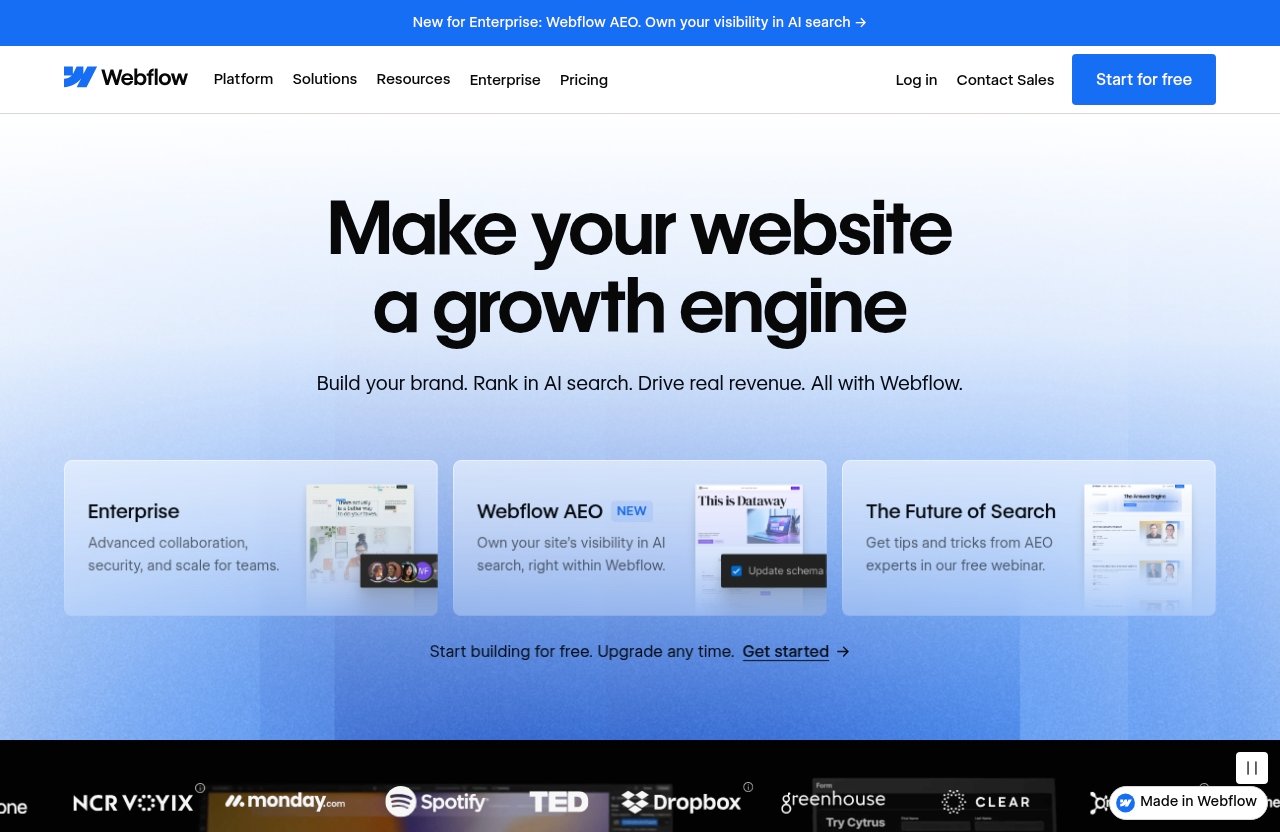
The case for webflow for agencies is primarily a workflow case. WordPress and custom-coded stacks can be excellent choices, but they often require a different division of labor, more technical coordination, or a larger maintenance surface depending on the project.
Webflow describes itself as “the agentic web platform for modern businesses,” with platform areas for Build, Manage, Optimize, and Extend. For an agency, that framing matters because client work rarely ends the day a site launches.
Visual build workflow
A visual production workflow can reduce the gap between design intent and the final implementation. Designers can work closer to the live website experience, while developers can reserve their time for work that truly needs engineering judgment.
With webflow for agencies, that can mean fewer rounds of translating static designs into pages, then checking whether the result still matches the approved direction. It also makes it easier to assess responsive behavior, spacing, content length, and interactions during the build rather than treating them as late-stage fixes.
This does not eliminate the need for technical discipline. Agencies still need structured styles, naming conventions, component standards, QA checklists, and accessibility review. The platform accelerates a good process; it does not replace one.
Built-in CMS and hosting
For content-led sites, Webflow CMS for agencies can offer a cleaner conversation with clients than a disconnected collection of tools. The agency can design the content structure around real publishing needs rather than handing over a visual site with an unclear editorial workflow.
Webflow site plans include hosting-related capabilities, and Premium includes Webflow CMS, bandwidth, code components, site search, form file upload, and well-known files. This can simplify the client handoff because the agency is not asking a marketing team to coordinate separate hosting and content systems for a standard marketing site.
The practical benefit is consistency. When the site, content model, and publishing process are considered together, agencies can spend less time troubleshooting ownership gaps after launch.
Collaboration and handoff
Client handoff is where many otherwise successful web projects lose margin. A client may approve a site but then need repeated help with a new team member, a campaign update, a resource page, or an unplanned executive request.
A well-scoped webflow for agencies delivery can reduce that risk because the client can be trained around the pages and content structures they will actually use. The handoff should still include recorded training, documentation, admin responsibilities, and a defined support window.
For larger teams, Webflow’s Team platform plan includes Site & Workspace, Webflow Localize, AEO agents, publishing workflows, single-page publishing, a site activity log and API, foundational governance, enhanced security and compliance, and priority support. Those features can be relevant when client publishing requires clearer controls.
No-code for repeatable delivery
“No-code” should not be interpreted as “no expertise required.” For agencies, the more useful idea is repeatable delivery: creating page structures, CMS patterns, and operating procedures that make high-quality work less dependent on one individual.
A mature webflow for agencies process may include a discovery template, messaging framework, component library, content model, launch checklist, and post-launch optimization plan. That is where the platform becomes commercially meaningful: it helps the agency sell a system, not just a one-off website.
Compared with a hand-coded approach, this can be especially useful for clients that need speed and ongoing marketing flexibility more than bespoke engineering architecture.
How Webflow can improve agency margins
Better margins do not come from charging more simply because a site was built in a popular platform. They come from aligning the scope, process, staffing, and commercial model around the type of outcome the client values.
For the right work, webflow for agencies can help reduce production hours while making the final offer feel more strategic and complete.
Shorter build times
The clearest margin lever is avoiding unnecessary production delay. If a designer, strategist, or Webflow specialist can move an approved page into a production-ready state without a long developer handoff, projects can move with fewer queues.
That does not mean an agency should discount the work. Clients are paying for a better launch process, stronger creative execution, and a website that supports marketing activity—not for the number of hours spent moving pixels.
A useful pricing model is fixed-fee project pricing based on business value and scope. Internally, track estimated versus actual time so the agency can see whether its Webflow workflow is genuinely improving profitability.
Fewer maintenance tickets
Maintenance can quietly erode the profit of a fixed-fee build. Small requests—text updates, new pages, form changes, image replacements, and campaign adjustments—become expensive when every edit requires technical intervention.
With webflow for agencies, the goal should be to give clients appropriate editing autonomy while retaining governance around structural changes. Agencies can define which content types clients own and which requests stay within a paid support arrangement.
This is also why training matters. A clear client handoff can reduce reactive support while improving the client’s confidence in the platform.
Higher perceived value
A website engagement becomes easier to position at a premium when the agency connects it to business outcomes. That may include clearer messaging, stronger conversion paths, faster campaign deployment, a maintainable content structure, and a more confident internal handoff.
The best Webflow agency is not necessarily the one that builds the most visually elaborate site. It is the one that makes the client’s team more effective after launch and can explain why the chosen build approach supports that result.
Agencies should avoid selling “Webflow websites” as a commodity. Sell a strategic website system, then explain why Webflow is an appropriate delivery platform for that system.
Retainers and ongoing optimization
The post-launch period is where an agency can create recurring revenue without inventing unnecessary work. Common retainer areas include conversion-rate optimization, content publishing support, landing-page creation, analytics-informed page improvements, SEO implementation, and design system stewardship.
For clients with wider market needs, localization and publishing workflow support can become valuable add-ons where the selected plan and project scope support them. The key is to sell an ongoing improvement program, not vague “maintenance.”
In practice, webflow for agencies is most profitable when it supports a recurring relationship. A site launch should be the beginning of measurement and iteration, not the end of agency involvement.
Where Webflow is a strong fit for agency client work
Not every client website needs the same stack. The strongest candidates are usually organizations whose website is a core marketing asset and whose teams need a balance of design quality, speed, and content control.
B2B and SaaS marketing sites
B2B and SaaS teams often need to update product messaging, solution pages, customer stories, resources, and campaign content as their positioning evolves. This makes them a natural fit for webflow for agencies, particularly when the site is primarily a marketing and demand-generation property.
The agency can build a content model around repeatable sections such as case studies, blog posts, integrations, team pages, or resource libraries. The client then has a clearer path for publishing without rebuilding every page from scratch.
Brand refreshes and redesigns
A rebrand or visual refresh is a strong Webflow scenario because agencies can connect brand strategy directly to a modern site experience. The project often requires careful messaging, typography, layout, imagery, and responsive behavior more than complex back-end architecture.
For redesign work, Webflow migration for agencies should begin with content inventory and redirect planning, not just visual design. A polished launch can still underperform if important content is missing or old URLs are handled poorly.
Landing pages and campaign sites
Campaign work rewards speed, testing discipline, and visual consistency. When a client needs a focused launch page, event microsite, product announcement, or lead-generation sequence, Webflow can give an agency a more efficient way to ship branded assets.
This is a good entry point for agencies evaluating webflow for agencies before making it their default platform. A contained campaign project reveals how well the team handles build standards, client edits, approvals, and launch QA.
Migrations from legacy CMSs
Legacy CMS migrations can be commercially valuable because they combine strategy, content cleanup, design, technical planning, and training. They also create an opportunity to replace cluttered navigation and outdated templates with a more intentional content system.
A Webflow migration should never be sold as a simple copy-and-paste exercise. Agencies need to assess the current site’s pages, content types, search expectations, integrations, redirect requirements, and internal publishing habits before committing to a scope.
Official website · Latest pricing & offers
Where Webflow may not be the best choice
A balanced recommendation matters. Webflow is a strong platform for many agency websites, but forcing it into every brief can create delivery risk and damage client trust.
Complex app functionality
If the project is fundamentally a software product with extensive custom user logic, sophisticated account behavior, or highly specialized workflows, a different technical stack may be the better fit. An agency should clarify whether the client needs a marketing website, an application, or both.
Using webflow for agencies is most sensible when Webflow is the right layer for the public-facing marketing experience. It should not be treated as a universal replacement for specialized application development.
Heavy eCommerce needs
Commerce requirements deserve early discovery. A simple product-focused marketing presence and a demanding commerce operation are very different projects, especially when the latter depends on unusual fulfillment, catalog, checkout, or operational requirements.
Before recommending Webflow, document the entire buyer journey and every system that needs to connect to it. If the client’s commercial operation is unusually complex, choose the stack based on those requirements rather than the agency’s preferred design workflow.
Very low-budget clients
A low budget can make any platform a poor fit when expectations are unrealistic. Clients who expect custom strategy, original design, migration, content support, and ongoing revisions for a minimal fee will create margin pressure regardless of technology.
For these clients, a narrower offer may be smarter: a defined landing page, a limited template-based launch, or a strategic roadmap. The advantage of webflow for agencies is not that it makes professional work free; it is that it can make a well-defined service more repeatable.
Teams requiring deep custom infrastructure
Some clients require a highly controlled technical environment, extensive bespoke integrations, or governance policies that need deeper evaluation. These needs should be identified before a proposal is finalized, not discovered in the final week of build.
Webflow offers Enterprise with enterprise-ready scale, granular permissions, custom roles, advanced governance, secure integrations, a dedicated account manager, enhanced SLAs, and custom configurations. Still, enterprise suitability should be assessed against the client’s specific procurement, security, and technical requirements.
Pricing and plans agencies need to understand
Webflow agency pricing should be discussed transparently with clients. According to the official Webflow pricing page, prices are in USD, per site, and applicable taxes are added at checkout.
An agency should separate its professional fees from the client’s platform costs. That avoids confusion about whether hosting, CMS capability, and ongoing platform access are included in a project quote.
Starter vs Basic vs Premium site plans
The Starter plan is free and includes a Webflow.io domain, limited Webflow CMS, two static pages, 1 GB bandwidth, 50 form submissions, Webflow AI, MCP server, Webflow Cloud app hosting, and a Free Starter Workspace. It is useful for experimentation and early evaluation rather than a typical finished client site.
Basic costs $15 per month when billed yearly. It includes a custom domain, 300 static pages, 10 GB bandwidth, unlimited form submissions, password protection, Webflow AI, MCP server, Webflow Cloud app hosting, and a Free Starter Workspace.
Premium costs $25 per month when billed yearly. It includes everything in Basic, plus Webflow CMS, bandwidth, code components, site search, form file upload, and well-known files. For many content-driven marketing sites, this is the Webflow agency plan to evaluate first.
| Client scenario | Practical plan starting point | Why |
|---|---|---|
| Testing or learning Webflow | Starter | Free environment with limited CMS and a Webflow.io domain |
| Simple brochure-style client site | Basic | Custom domain and static-page capacity |
| Content-led marketing site | Premium | Includes Webflow CMS and additional site capabilities |
Team platform plan
The Webflow team plan is priced at $2,500 per month with an annual contract required. It includes everything in Premium, plus Site & Workspace, Webflow Localize, AEO agents, publishing workflows, single-page publishing, a site activity log and API, foundational governance, enhanced security and compliance, and priority support.
This plan is not automatically necessary for every agency client. It is better viewed as an option for organizations that need more mature publishing operations, governance, and collaboration structure than a standard site plan provides.
Enterprise plan
Enterprise has custom pricing and includes everything in Team, along with enterprise-ready scale, granular permissions, custom roles, advanced governance, secure integrations, a dedicated account manager, enhanced SLAs, and custom configurations.
For agencies, Enterprise discussions should be led by client requirements rather than enthusiasm for premium features. Involve stakeholders responsible for security, procurement, governance, and publishing operations early in the sales process.
What pricing means for client billing
The cleanest commercial model is typically to have the client own and pay for the site plan while the agency bills separately for strategy, design, implementation, training, and ongoing services. This protects the client’s ownership and keeps the agency’s fee structure clear.
When presenting webflow for agencies as a solution, show platform costs as a transparent operating expense rather than hiding them inside a broad project number. Clients are usually more comfortable when they understand what they are paying the platform for and what they are paying the agency to deliver.
How agencies can package Webflow services
Productized offers make Webflow easier to sell and easier to deliver. Instead of quoting every project as an open-ended custom build, define outcomes, deliverables, boundaries, and post-launch options.
Website builds
A core offer can include discovery, messaging, sitemap, design direction, Webflow implementation, content migration support, QA, launch, and training. The scope should clearly state page counts, revision rounds, client responsibilities, and approval milestones.
For webflow for agencies, a “marketing site sprint” can be particularly effective for clients that need a focused launch rather than a months-long digital transformation. The agency retains flexibility while the client sees a defined path to a live site.
Migrations
Migration packages should include content inventory, priority-page mapping, redirect planning, content model design, implementation, QA, and editor training. They should also identify whether the client will rewrite content, supply it, or ask the agency to handle it.
A migration offer is stronger when it includes cleanup and prioritization. Clients do not always need every legacy page reproduced; often, they need a clearer and more useful website.
Retainers
A monthly retainer can cover a set number of strategic improvements, content support, campaign pages, conversion reviews, and advisory time. Define turnaround times and what counts as a request to avoid an unlimited-work expectation.
For agencies using Webflow Partners or working alongside Webflow certified partners, specialized implementation or advisory support can also help expand capacity without hiring for every skill in-house. Webflow’s agency resources include Agencies, Certified Partners, and Partner with Webflow.
Performance and SEO optimization
Optimization services should be framed around continuous improvement: reviewing page priorities, content structure, search intent, conversion paths, and publishing cadence. Avoid promising rankings or revenue outcomes that no platform can guarantee.
The agency can sell recurring reviews and implementation support after launch. This turns a static web build into an evolving marketing asset and helps clients get more value from their Webflow hosting investment.
What to ask before choosing Webflow for a client
A disciplined qualification process prevents bad-fit projects. Before recommending a platform, the agency should understand what the website must do, who will operate it, and what constraints exist around timeline, budget, and governance.
Content needs
Ask how frequently the client publishes, which teams will edit content, and what content types they need. A resource-heavy site may benefit from a structured CMS approach, while a small brochure site may not need the same level of complexity.
Also ask who owns content quality after launch. A platform can make editing easier, but it cannot solve unclear editorial ownership.
Approval workflow
Clarify who approves design, copy, legal language, and publishing. If multiple stakeholders need visibility and control, workflow requirements should influence the selected plan and implementation process.
This is an essential discovery point for webflow for agencies because many late-stage delays are approval problems, not build problems. Put publishing responsibilities and escalation paths in writing before launch.
SEO requirements
Ask which existing pages drive traffic, what content must be retained, whether redirects are required, and who will own future optimization. SEO planning should begin during sitemap and migration work, not after the site is already built.
An agency should also set realistic expectations. Webflow can support a structured marketing site, but search performance depends on content quality, technical implementation, competition, and ongoing effort.
Scalability and governance
Ask whether the site will expand into multiple regions, brands, teams, or publishing groups. Determine whether the client needs more formal governance, security, permissions, or integration review before recommending a plan.
This conversation separates a standard marketing-site project from a larger platform evaluation. It also helps prevent an agency from under-scoping enterprise-level requirements.
Budget and timeline
Finally, establish the client’s actual budget, desired launch date, internal availability, and willingness to make decisions quickly. A compressed timeline only works when content, stakeholders, and approvals are equally ready.
A strong webflow for agencies proposal should state assumptions clearly. If the client misses content deadlines or introduces new functionality, the timeline and price should be revisited through a defined change-control process.
Final verdict: is Webflow worth it for agencies?
Best-case scenario
Webflow is worth serious consideration for agencies delivering design-forward, content-led marketing websites where speed, clean handoff, and ongoing iteration matter. It is especially compelling for B2B, SaaS, brand refresh, campaign, and CMS-driven work.
The most successful agencies build a repeatable system around it: documented standards, clear client training, transparent pricing, and defined retainer offers.
When to choose something else
Choose another approach when the project is primarily a complex custom application, requires unusually deep infrastructure, has demanding specialized commerce needs, or cannot be responsibly delivered within the client’s budget and operating constraints.
Platform choice should follow client needs. No agency should force a familiar tool into a project that requires a different technical answer.
Bottom-line recommendation
For the right client profile, webflow for agencies can improve delivery speed, reduce developer bottlenecks, support cleaner collaboration, and create better conditions for agency margins. It is not an automatic fit for every brief, but it is one of the stronger options for agencies that want to turn high-quality marketing websites into a scalable service line.
TopTrustReview may earn a commission if you choose to explore Webflow through this Webflow link, at no extra cost to you. That relationship does not change the recommendation: evaluate Webflow when your agency values speed, design control, client usability, and a repeatable website delivery process.
Official website · Latest pricing & offers
FAQ
Is Webflow good for agencies?
Yes, Webflow is good for agencies that build marketing websites and want a design-first workflow, faster delivery, and clearer client handoff. It can be particularly useful for B2B, SaaS, professional services, and campaign work.
Its main limitation is fit: agencies should not treat it as the default solution for complex application functionality, heavily specialized commerce operations, or projects requiring deep custom infrastructure.
Does Webflow save agencies time?
It can save time by reducing handoffs between design and development, enabling more direct production workflows, and giving clients a clearer way to manage approved content after launch. The actual time saved depends on the agency’s internal standards, project scope, and training process.
Agencies still need proper QA, content planning, and governance. The platform helps most when it is supported by a disciplined delivery system.
Is Webflow better than WordPress for agencies?
Neither platform is universally better. Webflow may be simpler for agencies that prioritize visual implementation, streamlined site delivery, and a more contained marketing-site workflow.
WordPress may still suit projects that depend on a plugin-heavy ecosystem or highly customized requirements. The right choice depends on the client’s operational needs, not platform loyalty.
Can agencies make more money with Webflow?
Agencies can potentially improve margins through shorter build cycles, fewer post-launch support requests, premium positioning, and recurring optimization services. Those outcomes are not guaranteed; they depend on pricing discipline, scope control, and the agency’s ability to standardize delivery.
The strongest model is often a fixed-fee strategic build followed by a clearly defined monthly optimization or support retainer.
Which Webflow plan should an agency use?
Use Starter for experimentation and learning. Basic can suit simple static client sites, while Premium is the practical choice to evaluate for CMS-driven marketing sites because it includes Webflow CMS and additional site capabilities.
The Team plan may suit organizations that need publishing workflows, governance, Webflow Localize, AEO agents, and other expanded platform capabilities. Enterprise is designed for clients with advanced governance, permissions, scale, and configuration needs.
Related Reading
- Webflow for SaaS Landing Pages
- Top 7 Webflow Templates for Small Businesses in 2026
- How to Use Gohighlevel in 7 Easy Steps
References
- The best website builder for agencies | Webflow
- Plans & pricing – Webflow
- Hire certified Webflow designers and agencies | Certified Partners
- 15 Best Webflow Agencies in 2026 (By Specialty & Budget) – Enzuzo