Is Webflow Free? 2026 Plan Breakdown
If you are asking is Webflow free, the answer is yes—but with important limits. Webflow offers a free Starter plan and a Free Starter Workspace for learning the platform, experimenting with designs, and publishing a very small site on a Webflow.io subdomain.
This 2026 plan breakdown is designed to help you decide whether the free option is enough or whether a paid plan makes more sense for your website goals. The goal is not to push an upgrade; it is to help you choose a plan that fits how you actually intend to publish, manage, and grow your site.
Official website · Latest pricing & offers
Quick Answer: Is Webflow Free In 2026?
The Short Answer
Yes, is Webflow free in 2026 has a straightforward answer: Webflow has a free Starter plan. You can begin building with its AI-native platform at no cost and upgrade when your project requires more publishing capacity or professional site features.
The free plan is useful for beginners, designers practicing in the Designer, marketers testing layouts, and creators validating a simple idea. However, it is not the right long-term fit for most branded business websites, content-heavy projects, or client launches.
What “Free” Means In Webflow’s Pricing Model
Webflow describes the Starter option as its entry-level subscription for exploring and experimenting. Its official glossary also states that the Free plan provides full access to Designer features, allowing users to start building a site immediately without paying.
In practical terms, the webflow free plan is a working environment rather than a full production-site package. You can design, build, test, and publish within defined limits, but a custom domain and broader site capacity require a paid site plan.
What You Get On Webflow’s Free Starter Plan
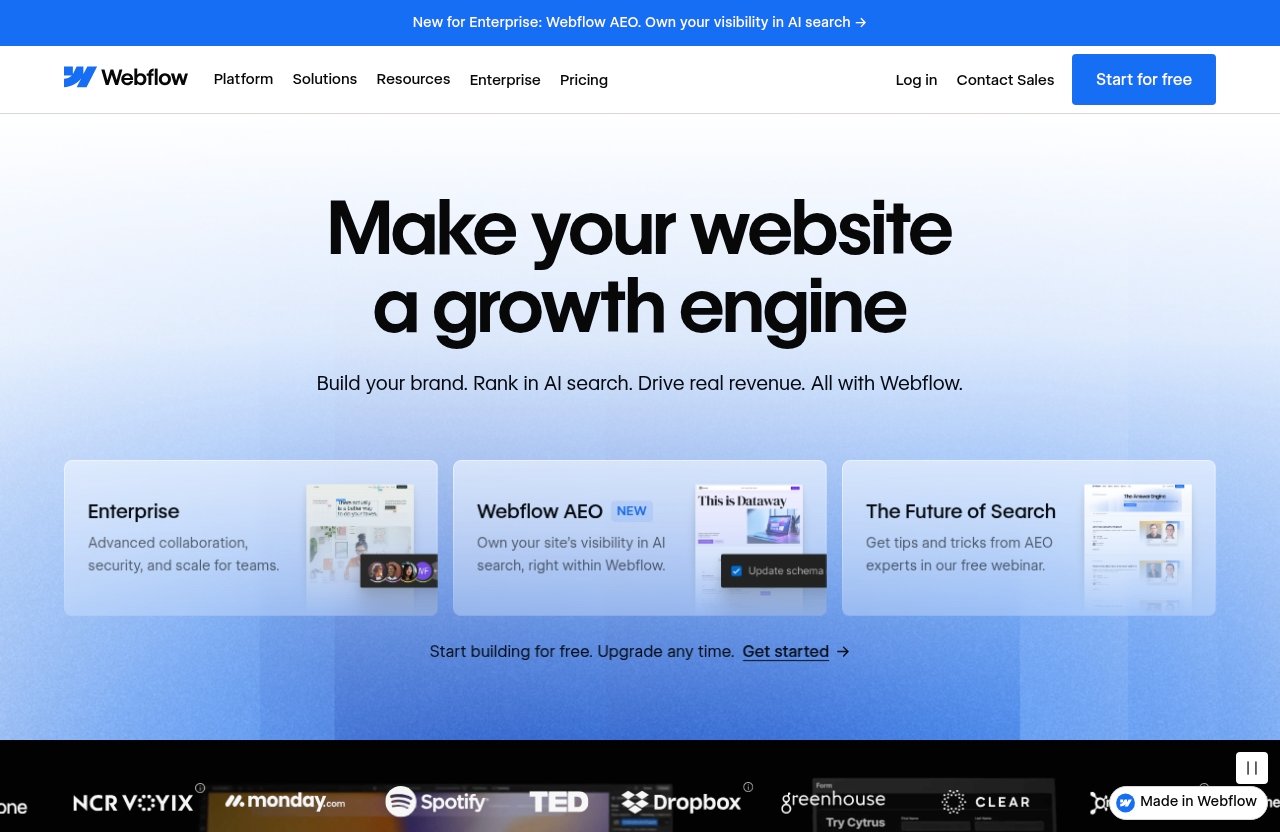
Free Webflow.io Subdomain
The Webflow Starter plan includes a Webflow.io domain. This lets you publish a project online without purchasing a paid site plan just to see how the live site looks and behaves.
For a prototype, design exercise, or small personal experiment, a webflow.io domain can be perfectly adequate. For a business that wants its own branded web address, it is usually a temporary starting point rather than the final destination.
2 Static Pages And Limited CMS Access
A major point to understand when evaluating is Webflow free is the page limit. The Starter plan includes 2 static pages and limited Webflow CMS access.
Two pages can work for a compact proof of concept, such as a home page and a contact page. It becomes restrictive quickly if you need separate service pages, an about page, a blog structure, landing pages, or a larger content library.
The official Webflow Starter plan also includes these capabilities:
| Starter Plan Feature | Included on the Free Plan |
|---|---|
| Publishing address | Webflow.io domain |
| Static pages | 2 |
| CMS | Limited Webflow CMS |
| Bandwidth | 1 GB |
| Form submissions | 50 |
| AI tools | Webflow AI |
| Development tools | MCP server and Webflow Cloud app hosting |
| Workspace | Free Starter Workspace |
These inclusions make the plan more capable than a simple design demo. Still, the webflow free pages allowance is one of the first limits most serious projects outgrow.
Bandwidth, Forms, And AI Access Limits
The free Starter plan includes 1 GB of bandwidth and 50 form submissions. Those limits may be sufficient for a small test site with low traffic, but they should be assessed carefully before using the plan for an active lead-generation project.
Webflow also lists Webflow AI, the MCP server, and Webflow Cloud app hosting as Starter plan features. That makes the free tier a practical place to explore the platform’s newer workflows before committing to a paid plan.
The key consideration is that access does not remove site-plan restrictions. If your project needs greater scale, unlimited form submissions, or a custom domain, the question is no longer simply is Webflow free—it becomes which paid level supports your publishing needs.
What You Cannot Do For Free
Custom Domain Publishing
You cannot use a custom domain on the Starter plan. The free option publishes on a Webflow.io domain, while the Basic plan includes a custom domain.
That distinction matters for a professional brand. A freelancer promoting services, a local business collecting leads, or a creator selling their expertise will generally want a domain that matches their name or business identity.
Scaling Beyond 2 Pages
The Starter plan’s 2 static-page allowance is intentionally small. It gives you room to build and test, but it is not designed for a full website with multiple navigation paths and a growing library of pages.
The Webflow Basic plan expands capacity to 300 static pages. If your site needs a homepage, service pages, campaign landing pages, policy pages, team information, and more, upgrading becomes a practical necessity rather than a luxury.
Unlimited Forms, Stronger CMS, And Advanced Site Features
The Starter plan has a 50-submission webflow forms limit, limited CMS access, and 1 GB of bandwidth. Basic adds unlimited form submissions, password protection, and custom-domain support, while Premium adds Webflow CMS, site search, form file upload, code components, well-known files, and additional bandwidth.
This is why the free plan is best treated as a sandbox or a lightweight published project. It can show you how Webflow works, but it does not include the full set of tools many content-led or business websites require.
Webflow 2026 Pricing Breakdown: When You Must Pay
Webflow’s official prices below are in USD, per site, with applicable taxes added at checkout. Reviewing the current options through Webflow’s plan page can be worthwhile before you build around a feature that belongs to a higher tier.
Basic Plan: $15/Mo Billed Yearly
The Webflow Basic plan costs $15 per month when billed yearly. It is a logical first paid step for brochure-style sites that need a webflow custom domain, more pages, and reliable form capacity.
Basic includes a custom domain, 300 static pages, 10 GB bandwidth, unlimited form submissions, password protection, Webflow AI, the MCP server, Webflow Cloud app hosting, and a Free Starter Workspace.
Choose Basic when your site is primarily static: think a freelance portfolio, a small business website, a service company site, or a focused marketing landing page collection. It is the sensible upgrade when the Starter plan’s two-page structure no longer matches the project.
Premium Plan: $25/Mo Billed Yearly
The Webflow Premium plan costs $25 per month when billed yearly. It includes everything in Basic, plus Webflow CMS, bandwidth, code components, site search, form file upload, and well-known files.
For marketers and publishers, this is often the tier where Webflow becomes more practical for ongoing content operations. If you need more than limited CMS functionality, searchable content, file uploads through forms, or code components, Premium is the relevant step up.
The webflow premium plan is best evaluated based on the type of content you manage. A mostly static portfolio may not need it, while a regularly updated resource site may find it essential.
Team Plan: $2,500/Mo Annual Contract
The Webflow Team plan is listed at $2,500 per month and requires an annual contract. It includes everything in Premium, plus Site & Workspace, Webflow Localize, AEO agents, publishing workflows, single-page publishing, a site activity log and API, foundational governance, enhanced security and compliance, and priority support.
This is not a typical upgrade for a solo freelancer launching one site. The webflow team plan is built for organizations that need structured publishing processes, security, governance, visibility into site activity, and more advanced operational support.
Enterprise: Custom Pricing
Webflow Enterprise pricing is custom. Enterprise includes everything in Team, plus enterprise-ready scale, granular permissions, custom roles, advanced governance, secure integrations, a dedicated account manager, enhanced SLAs, and custom configurations.
This level is aimed at larger organizations with formal security, compliance, integration, and administrative requirements. For most small businesses, the question is Webflow free will be settled long before Enterprise becomes relevant.
Official website · Latest pricing & offers
Free Vs Paid: Which Plan Fits Your Use Case?
Learning And Prototyping
The Starter plan is an excellent fit for learning Webflow’s Designer, testing layouts, practicing responsive design decisions, and publishing a small proof of concept. You can use the free tier to decide whether the platform’s workflow suits you before making a financial commitment.
For this use case, staying free is reasonable. The Webflow Starter plan gives you a real environment to build in, not merely a limited preview of the interface.
Portfolio And Personal Sites
A minimal personal project may work on Starter if two static pages and a Webflow.io address are acceptable. For example, a simple introduction page plus a contact page can be enough for someone sharing work with a small circle.
However, a polished public-facing portfolio usually benefits from a custom domain and more pages. The Basic plan is generally the better fit for a freelancer who needs case studies, services, contact details, and a branded online presence.
| Use Case | Best Starting Point | Likely Upgrade Trigger |
|---|---|---|
| Learning Webflow | Starter | You want a branded published site |
| Small prototype | Starter | You exceed 2 static pages |
| Personal portfolio | Starter or Basic | You need a custom domain or more pages |
| Freelancer website | Basic | You need CMS-driven content or advanced features |
| Content-focused site | Premium | You need stronger CMS and site search |
| Large team operation | Team or Enterprise | You need governance, workflows, and advanced permissions |
Client Projects, Content Sites, And Scaling Teams
For client projects, it is wise to separate building and production requirements. You can use the free environment for initial exploration, but a live client site often needs its own domain, more than two pages, and a plan that supports the required site functionality.
Content sites are more likely to require Premium because the plan includes Webflow CMS and site search. Organizations with multiple stakeholders, formal publishing reviews, and governance requirements should assess Team or Enterprise instead of trying to stretch the free tier beyond its intended role.
Webflow Free Tier Limitations To Watch In 2026
Branding And Domain Limitations
The biggest visible limitation is the Webflow.io address. A custom domain is included with Basic and above, not with Starter.
That is a critical decision point for businesses. If your website is a core customer touchpoint, brand credibility and domain control are usually reasons to move past the free plan early.
CMS And Content Volume Restrictions
Webflow lists limited CMS access on Starter, while Premium explicitly includes Webflow CMS. This difference matters if your publishing strategy depends on regular articles, resource collections, case studies, or other repeatable content formats.
The limited structure of the free tier also pairs with only 2 static pages. If you already know your site will grow, building the project with a paid plan in mind can prevent a frustrating mismatch between your content plan and your publishing capacity.
Workflow And Governance Limits
Starter is designed for exploration, not complex organization-wide web operations. Publishing workflows, single-page publishing, the site activity log and API, foundational governance, enhanced security and compliance, and priority support are listed under Team.
Webflow’s pricing page also notes that certain SEO/AEO capabilities on Starter sites may require a paid Workspace plan. Since those requirements can depend on the specific capability, check the current official pricing details before basing an SEO or AEO workflow on the free tier.
How Webflow Compares To The Idea Of A Free Trial
Free Forever Vs Time-Limited Trial
People often search is Webflow free forever because they assume free access must expire after a few days. Webflow presents Starter as a free plan, not as a short, time-limited trial.
There is no stated expiration period in the verified plan information. You can start building for free and upgrade when you need more than the Starter plan offers.
Why Webflow’s Free Plan Is Different
A typical webflow free trial question focuses on whether you can test paid capabilities temporarily. Webflow’s Starter approach is different: it gives you a permanent no-cost entry point with specific site limits.
That is helpful because you can take time to learn the platform without rushing. The tradeoff is straightforward: production-ready needs such as a custom domain, broader page capacity, unlimited form submissions, and higher-level site capabilities require payment.
Common Mistakes Users Make
The most common mistake is assuming a free published project will support a full business website indefinitely. It may be fine for a demo, but the 2-page limit, Webflow.io address, 1 GB bandwidth, and 50 form submissions should be considered before launch.
Another mistake is choosing a plan based only on today’s design needs. Consider how often you will publish content, whether you need a branded domain, and whether team workflows or governance will matter later.
Verdict: Is Webflow Free Enough For You?
Best For Beginners
For beginners, is Webflow free should not be a barrier to getting started. The Starter plan provides a genuine no-cost way to learn the Designer, experiment with Webflow AI, use limited CMS access, and publish a small project on a Webflow.io domain.
Stay on the free plan if you are practicing, prototyping, or validating a very small concept. It is a sensible low-risk way to see whether Webflow matches your workflow.
Best For Freelancers And Agencies
Freelancers can use Starter for learning and early design exploration, but most professional portfolios and client sites will outgrow it. The Basic plan is the practical choice when a custom domain, 300 static pages, unlimited form submissions, and password protection matter.
Agencies and larger teams should assess Premium, Team, or Enterprise based on content requirements and operational complexity. The right choice depends less on company size alone and more on how the site is published, maintained, governed, and scaled.
When To Upgrade Immediately
Upgrade immediately if you need a custom domain, more than 2 static pages, unlimited form submissions, password protection, stronger CMS capabilities, site search, file uploads, or team-level publishing and governance tools.
The final answer to is Webflow free is yes—but free is best for exploration and compact projects. If you are launching a serious branded site, choose the plan that supports your real publishing needs rather than trying to work around Starter limits.
Official website · Latest pricing & offers
FAQ
Is Webflow Free Forever?
Yes, Webflow offers a free Starter plan with no stated time limit in its official pricing information. However, the plan has defined limits, including a Webflow.io domain, 2 static pages, 1 GB bandwidth, 50 form submissions, and limited CMS access.
Do I Need A Credit Card To Use Webflow Free?
Webflow presents Starter as a no-cost way to begin building. The verified plan details do not specify the current credit-card requirement for signup, so confirm the latest signup flow on Webflow’s official pricing page before creating an account.
Can I Use A Custom Domain On Webflow Free?
No. Starter uses a Webflow.io domain. A custom domain is included with the paid Basic plan and higher plans.
How Many Pages Do I Get On Webflow Free?
The Starter plan includes 2 static pages. If your project needs a larger structure, the Basic plan includes up to 300 static pages.
Can I Build An ECommerce Or Client Site On Webflow Free?
You can use the free plan to prototype a client or business site, but it is limited for most live production projects. A paid plan is generally the better choice when you need a custom domain, more pages, stronger content capabilities, or greater publishing flexibility.
Related Reading
- How Much Does Skool Cost in 2026? A Clear Pricing Guide
- How to Replace ClickFunnels with Systeme.io in 2026
- Webflow Ecommerce Review 2026: Features, Pricing, Limitations, and Verdict
References
- Plans & pricing – Webflow
- Free plan – Definition | Webflow Glossary
- Webflow Workspace and Site plans overview
- Webflow: The agentic web platform for modern businesses