FX Replay Review: Best Trading Simulator in 2026
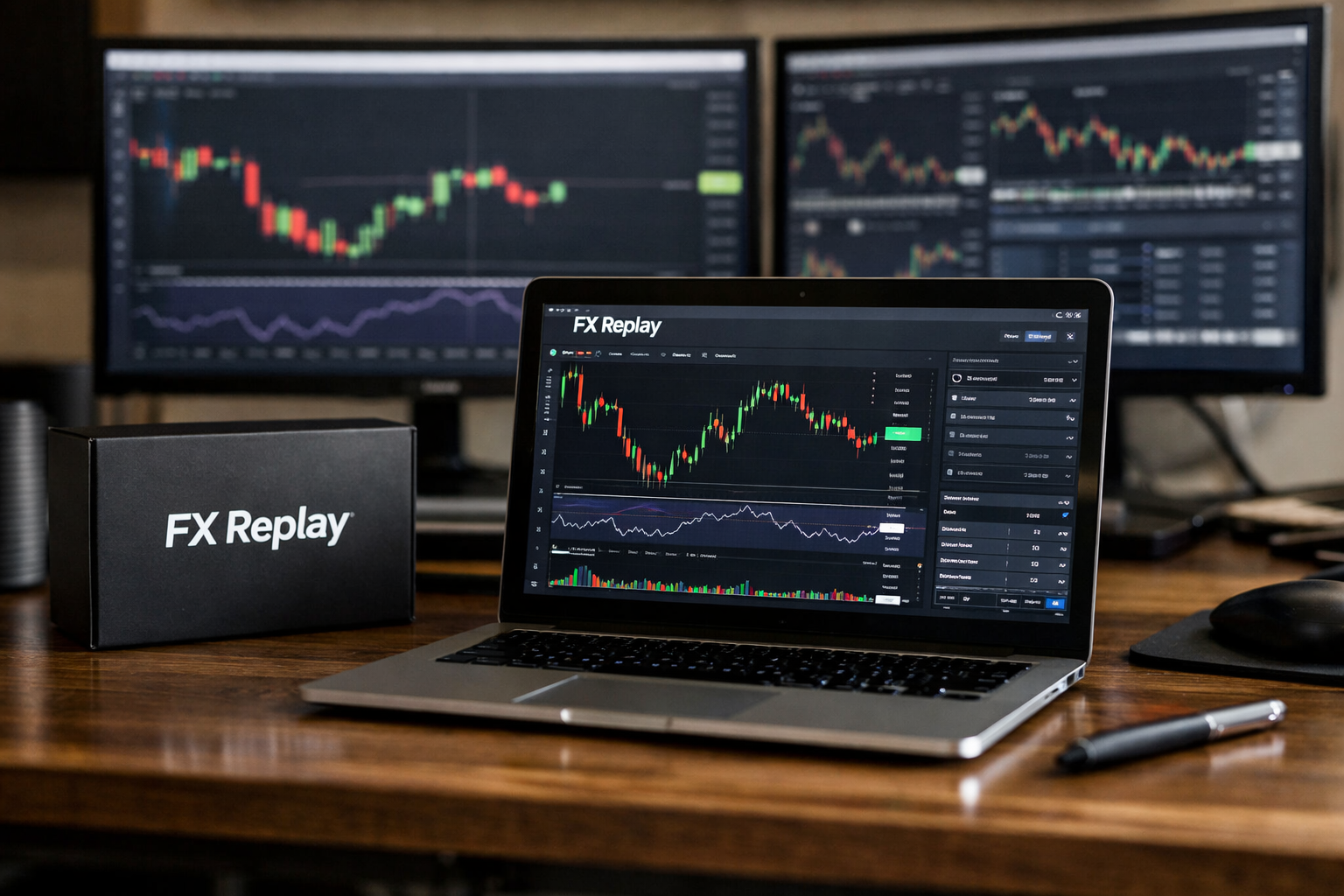
Finding the best trading simulator depends on what you want to practice. Many popular options are designed for casual stock-market education or learning how to place basic paper trades. FX Replay takes a different route: it is a realism-first backtesting platform built for traders who want to replay historical price action, test rules, review execution, and improve decision-making before risking live capital.
This FX Replay review is based on the platform’s verified features and public plan structure. TopTrustReview may earn a commission if you subscribe through our FX Replay partner link, at no extra cost to you. That relationship does not change the practical trade-offs discussed below.
Official website · Latest pricing & offers
FX Replay Review 2026: Quick Verdict
FX Replay is one of the strongest contenders for the best trading simulator if your priority is realistic historical replay rather than a simple stock-market game. Its core appeal is the ability to jump into past market conditions, work through price action as it unfolded, log trades, and evaluate a strategy with more structure than a basic paper trading simulator.
It is especially relevant for day traders, futures-focused traders, and systematic learners who need serious backtesting software. In contrast, many mainstream simulator search results are geared toward beginner stock practice, virtual portfolios, and general investing education.
Who FX Replay is best for
FX Replay is best for traders who already understand basic charting and want deliberate practice. If you trade intraday setups, build rule-based strategies, or need to revisit market sessions without waiting for live conditions, the platform’s replay workflow is compelling.
It can also suit traders evaluating a futures trading simulator with historical depth. The Pro plan includes futures and CME data, seconds data, and custom timeframes, which matters more to active intraday traders than to someone simply learning what a market order is.
Who should skip it
A casual learner looking to practice stock trading with fake money may not need this level of detail. A free stock market simulator game online can be a better first step when the goal is to understand shares, portfolios, and broad investing concepts.
FX Replay is also not a shortcut to profitability. It requires a defined process, honest journaling, and enough time to review results. Traders who do not plan to test or document a strategy may get more value from a simpler trading simulator free option.
Bottom-line rating criteria
For realism, replay-based practice, and strategy analysis, FX Replay ranks highly as a best trading simulator candidate. Its strongest differentiators are historical replay, TradingView-powered charting, economic event context, multichart workflows, and Monte Carlo simulation on eligible plans.
The main caveat is fit. It is not positioned as a lightweight trading simulator game online free; it is a tool for traders who want to study execution and refine a repeatable process.
What Is FX Replay?
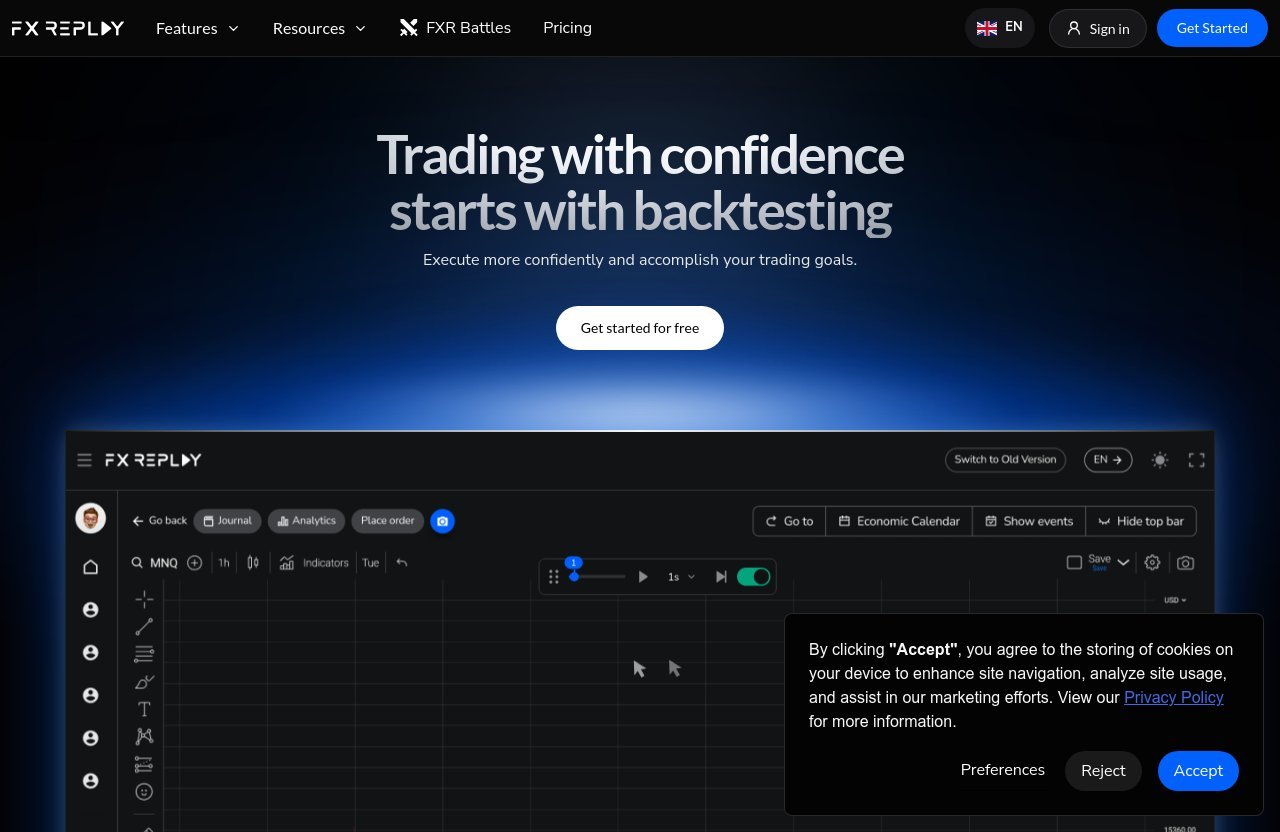
FX Replay describes itself as “The Ultimate Backtesting Software.” It is a platform for testing, reviewing, pressure-testing, and refining trading strategies in one place using real historical data across more than 120 assets and six markets.
Rather than simulating a generic account balance, it emphasizes replaying actual market behavior. That makes it more useful for traders trying to understand whether a setup has a consistent edge across different conditions.
Core purpose of the platform
The core purpose of FX Replay is structured market practice. Users can review historical charts, record trades, use a journal, track strategy performance, and revisit decisions after a simulated session.
This is a different proposition from a beginner-oriented stock simulator. The best trading simulator for someone learning market vocabulary may be a simple virtual portfolio, but strategy-focused traders need a tool that can recreate the uncertainty of an earlier market session.
How replay-based backtesting works
Replay mode lets you jump to a date and experience price action as it unfolded. Instead of viewing the full chart and unintentionally benefiting from hindsight, you progress through the market sequence and make decisions with information available at that point in time.
That process makes trading replay software valuable for testing entry criteria, stop placement, trade management, and patience. You can identify whether a strategy worked because of sound rules or because you were influenced by seeing the outcome in advance.
Why traders use it instead of a generic simulator
A generic paper trading simulator often focuses on virtual orders and account balances. That can be useful, but it does not automatically provide the depth needed to test a specific setup across many past sessions.
FX Replay is designed for deeper study. Traders can combine historical chart review with economic-calendar context, strategy analytics, journaling, and Monte Carlo tools on qualifying plans. For anyone searching for the best trading simulator for pc use, the meaningful question is not just whether charts are available—it is whether the platform supports repeatable practice.
Key Features That Make FX Replay Stand Out
FX Replay’s feature set is built around improving the quality of practice. The platform covers more than 120 assets across six markets with real historical data, while its charting is powered by TradingView.
The strongest value comes from combining market replay with review tools. That combination makes it more than a virtual trading exercise.
Replay mode and historical chart review
Replay mode is the heart of this best trading simulator experience. You select a historical date, work through price movement as it occurred, and test how your rules would have performed without relying on hindsight.
This approach is useful for discretionary traders and rule-based traders alike. A price-action trader can practice reading structure and momentum, while a systematic trader can document whether defined criteria appeared often enough to support a strategy.
Multipar and multichart workflow
FX Replay supports multipar and multichart workflows, with plan access varying by tier. Intermediate includes two charts in multichart, while Pro provides unlimited multichart access.
For traders who use multiple timeframes, this can make backtesting more practical. You may want a higher-timeframe context chart alongside an execution chart, rather than trying to interpret every decision from one view.
Economic calendar integration
Economic events can materially affect intraday volatility. FX Replay includes an economic calendar so traders can align backtesting with real historical data instead of evaluating a setup without knowing that a major release occurred nearby.
The Free plan includes one country and past news without past bubbles. Intermediate expands this to two countries, while Pro provides unlimited economic-calendar access. This is a meaningful detail for traders whose rules include avoiding news periods or specifically trading event-driven volatility.
Monte Carlo simulation
Monte Carlo simulation is a major differentiator for strategy review. FX Replay states that traders can see where a strategy may take them over 100, 200, or 300 trades.
This does not predict future profits, and it cannot prove that a strategy will work live. It can, however, help a trader think more responsibly about possible outcome variation, drawdown sequences, and the importance of risk management. That is the kind of analysis serious users expect from the best trading simulator, not just a virtual portfolio app.
Seconds timeframe precision
Seconds-level detail is available on the Pro plan. This matters for traders whose entries, exits, or trade management depend on fast intraday price movement.
FX Replay’s assets and timeframes information shows examples of CME_MINI futures coverage with timeframes ranging from 1 second to 12 months, with historical data availability varying by market from 2012 or 2019 onward. Not every trader needs that granularity, but active futures and intraday traders may consider it essential.
FX Replay Plans and Pricing Explained
FX Replay pricing is structured around three plans: Free, Intermediate, and Pro. The official information provided confirms the feature differences but did not include exact dollar prices, so any buyer should verify current subscription costs directly on the official checkout page.
The Free plan is genuinely free, requires no credit card, has no trial period, and does not automatically convert into a paid subscription. Intermediate and Pro offer free trials, and FX Replay accepts cryptocurrency payments.
Free plan
The Free plan is a credible way to evaluate the platform before committing. It includes two backtesting sessions, one indicator, a maximum session duration of one month, 50 trades per session, one week of data retention, a journal, one screenshot, one checklist, and a limited analytics dashboard.
It also includes the go-to feature three times per hour and an economic calendar for one country with past news only. However, it does not include multichart, auto break even, rewind price, seconds data, futures/CME data, custom timeframes, strategies, strategy analytics, Monte Carlo simulation, or the RR simulator.
Intermediate plan
The Intermediate plan is designed for traders who have moved beyond basic experimentation. It includes 10 backtesting sessions, three indicators, unlimited session duration, unlimited go-to use, 200 trades per session, six months of data retention, two multicharts, and two economic-calendar countries.
It also adds auto break even, rewind price, three strategies, strategy analytics, Monte Carlo simulation, an RR simulator, two screenshots, and three checklists. Seconds data, futures/CME data, and custom timeframes are not included in this tier.
Pro plan
Pro is the full-featured option for traders who need depth and scale. It includes unlimited backtesting sessions, indicators, session duration, go-to use, trades per session, data retention, multichart access, economic-calendar access, analytics, strategies, screenshots, and checklists.
Pro also includes auto break even, rewind price, seconds data, futures and CME data, custom timeframes, strategy analytics, Monte Carlo simulation, the RR simulator, and the journal. For a trader seeking the best trading simulator for detailed intraday testing, these are the features that most clearly separate Pro from the lower tiers.
Which plan offers the best value
The right value depends on how you plan to use the platform. The Free plan is suitable for testing the interface and practicing a small number of ideas. Intermediate is likely the practical middle ground for traders who want strategy analytics and Monte Carlo testing but do not require futures/CME data or seconds-level granularity.
Pro is the logical choice for intensive testing, advanced journaling, custom timeframes, and futures-oriented workflows. Since FX Replay pricing amounts were not visible in the supplied official page text, compare current prices against the number of sessions and research hours you realistically expect to use.
| Feature Area | Free | Intermediate | Pro |
|---|---|---|---|
| Backtesting sessions | 2 | 10 | Unlimited |
| Indicators | 1 | 3 | Unlimited |
| Trades per session | 50 | 200 | Unlimited |
| Data retention | 1 week | 6 months | Unlimited |
| Multichart | No | 2 charts | Unlimited |
| Strategies and analytics | No | 3 strategies | Unlimited |
| Monte Carlo and RR simulator | No | Included | Included |
| Seconds data and futures/CME data | No | No | Included |
| Custom timeframes | No | No | Included |
Official website · Latest pricing & offers
How FX Replay Compares to Other Trading Simulators
The best trading simulator is not necessarily the most complex platform. It should match the user’s goal, whether that is learning stock-market basics, practicing order entry, or conducting rigorous historical backtesting.
The comparison below focuses on publicly visible positioning and category differences, not unverified competitor specifications or prices.
FX Replay vs Investopedia Stock Market Simulator
Investopedia’s Stock Market Simulator is publicly positioned as a free, practice-focused stock simulator. It can make sense for users who want broad investing education and a low-pressure way to understand virtual market participation.
FX Replay is better aligned with traders who want replay-based historical analysis. If your question is “How do I test my opening-range setup across prior sessions?” FX Replay offers a more specialized backtesting workflow than a general stock-practice environment.
FX Replay vs Trading Game
Trading Game is publicly positioned as a stock simulator app with real market data and lessons. That learning-oriented format can appeal to new traders who want educational structure alongside simulated activity.
For users seeking the best trading simulator for beginners, Trading Game may be more approachable if they are starting from zero. FX Replay becomes more compelling once the learner has a strategy or setup they want to replay, record, and assess across historical conditions.
FX Replay vs Wall Street Survivor
Wall Street Survivor is publicly positioned as a stock market simulator. This type of platform is generally relevant to users exploring stock investing concepts and virtual portfolio decisions.
FX Replay serves a different need: historical execution practice and strategy testing. Traders focused on chart-based intraday decisions are likely to find a dedicated trading replay software environment more relevant than a broad stock-investing simulator.
FX Replay vs thinkorswim paperMoney
thinkorswim paperMoney is publicly described as a stock trading simulator. Paper trading can be useful for practicing platform navigation and placing simulated trades in a market-like environment.
FX Replay is more specifically oriented toward historical replay and backtesting. A paper trading simulator can help a new user rehearse order placement, while FX Replay can help a trader study numerous prior setups rather than waiting for the same conditions to occur live.
FX Replay vs browser-based stock simulators
Browser-based options marketed as a trading simulator game online free or stock market simulator game online often prioritize access, simplicity, and entertainment. They can be useful for understanding the mechanics of virtual trading without a subscription.
The trade-off is depth. A casual simulator may be enough to practice stock trading with fake money, but it may not provide the structured replay, strategy analytics, economic-event context, or advanced testing workflow that committed traders seek.
Best Use Cases for FX Replay
FX Replay is most useful when you have a clear question to answer. “Would I have followed my rules?” is a better starting point than “Can this tool make me a better trader overnight?”
Used consistently, it can turn market review into a more measurable training process.
Day trading practice
Day traders can use FX Replay to practice waiting for their setup, recognizing invalidation, and managing trades as price develops. Replaying a session is more disciplined than simply scrolling through completed charts and assuming every setup was obvious.
This is why it deserves consideration as a best trading simulator for active chart readers. The value is in practicing decisions under incomplete information, not in producing impressive-looking historical results.
Strategy validation before live trading
Before taking a strategy live, traders should test it across enough relevant historical situations to understand its behavior. FX Replay supports that process through backtesting sessions, journals, analytics, strategies on eligible plans, and Monte Carlo simulation on Intermediate and Pro.
No simulator can guarantee that a strategy will succeed with live money. Live spreads, execution, emotions, changing market conditions, and trader discipline can all produce different outcomes.
Risk management drills
A simulator can be valuable even when you are not testing entries. Traders can rehearse stop-loss placement, target management, auto break-even rules where available, and maximum-loss discipline.
The RR simulator and analytics available on Intermediate and Pro can support a more structured review. This is particularly useful for traders who know their setup but struggle to maintain consistent risk behavior.
Session-based market study
FX Replay lets you jump to historical dates, making it useful for focused study sessions. You can review a specific market period, compare how a setup behaved during different conditions, and check the economic calendar for relevant events.
That workflow is more purposeful than treating a stock market simulator game online as entertainment. It encourages traders to build a review routine around evidence rather than memory.
Futures and intraday traders
Futures and highly active intraday traders should look closely at plan access. Futures and CME data, seconds data, and custom timeframes are Pro features, so the lower plans may not fit every futures trading simulator requirement.
For traders who need those tools, Pro’s broader access may justify the upgrade. For everyone else, paying for advanced granularity they will not use may not be the best value.
Pros and Cons of FX Replay
No platform is ideal for every type of trader. This FX Replay review is favorable because the platform has meaningful depth, but the right choice still depends on your markets, experience level, and willingness to review data carefully.
Main advantages
FX Replay’s primary advantage is realism-focused historical practice. The ability to replay past price action, use real historical data, and evaluate decisions without obvious hindsight is a strong foundation for deliberate training.
Other notable strengths include TradingView-powered charting, coverage of 120+ assets across six markets, economic-calendar integration, journaling, strategy analytics on paid tiers, and Monte Carlo simulation on Intermediate and Pro. Pro users also gain access to seconds data, futures/CME data, and custom timeframes.
Main drawbacks
The feature depth can be more than a complete beginner needs. Someone looking only for a best trading simulator free experience may find the Free plan useful, but its limits on sessions, indicators, trades, retention, and advanced tools mean it is primarily an evaluation and entry-level practice tier.
There is also a learning commitment. Backtesting is only useful if the trader defines rules, records results honestly, and avoids changing criteria after seeing the outcome.
When the trade-off is worth it
The trade-off is worth it when better practice can reduce avoidable mistakes. Traders who repeatedly take similar setups, trade around sessions or news events, or want to validate a system before funding a live account can benefit from the structure.
If you only want a casual paper trading simulator for broad stock-market exploration, a free alternative may be more appropriate. If you want repeatable historical execution training, FX Replay is the more specialized option.
Is FX Replay Worth It in 2026?
FX Replay is worth considering in 2026 when you value testing and review over novelty. It is not the best trading simulator for every user, but it is among the better-matched choices for serious replay-based learning.
The practical question is whether you will use its tools consistently enough to improve your process.
Worth it for beginners
For absolute beginners, the Free plan is the sensible starting point. It lets users try the platform without a credit card or automatic conversion, while its journal and limited analytics introduce a more thoughtful approach to practice.
However, the best trading simulator for beginners is sometimes a simpler app or free stock simulator. If you are still learning basic order types, investing terminology, or how portfolios work, Investopedia-style or lesson-based stock simulators may feel less demanding.
Worth it for intermediate traders
Intermediate traders may see the strongest practical value. The Intermediate plan adds longer sessions, more trades, multichart access, strategy analytics, Monte Carlo simulation, and the RR simulator without requiring a full Pro-level workflow.
This tier can fit traders who already have one or more setups and want to examine consistency. It is a meaningful upgrade from a basic trading simulator free environment because it supports review, not just participation.
Worth it for advanced traders
Advanced traders are the most likely group to benefit from Pro. Unlimited sessions, strategies, analytics, and data retention can support an ongoing research routine, while futures/CME data, seconds data, and custom timeframes address needs that many general simulators do not target.
Even then, advanced users should remain realistic. Strong backtest results are not proof of future performance, and they do not account for every live-trading factor.
Final Recommendation
FX Replay is a strong choice for traders who want a realism-first platform for historical replay, backtesting, journaling, and strategy review. It is especially appealing for active traders who have moved beyond casual virtual investing and want evidence-based practice.
Best overall verdict
For serious market study, FX Replay is one of the best trading simulator options to consider in 2026. Its replay mode, real historical data, economic-calendar context, strategy tools, and advanced Pro capabilities create a more complete learning environment than a basic stock-market game.
If your goal is to test, review, and pressure-test a trading process, it is worth checking the current plan options through FX Replay. Remember that disciplined practice can improve preparation, but no platform can guarantee live-trading profits.
Best alternative if you only want free basic practice
If you only want free, broad-based practice, Investopedia’s Stock Market Simulator is a reasonable alternative based on its public free and practice-focused positioning. It is better suited to users who want a straightforward introduction without advanced backtesting expectations.
A simple trading simulator game online free can also be enough for casual experimentation. Just do not confuse virtual portfolio activity with robust strategy validation.
Best alternative if you want stock-only simulation
For stock-only simulation and beginner lessons, Trading Game may be more suitable based on its public positioning as a stock simulator app with real market data and lessons. Wall Street Survivor and thinkorswim paperMoney are also recognizable stock-simulator options depending on the experience you want.
For historical replay, deeper chart-based review, and a more trader-focused backtesting workflow, FX Replay remains the stronger fit.
Official website · Latest pricing & offers
FAQ
Which trading simulator is best?
The best simulator depends on your goal. FX Replay is strongest for realism-focused backtesting, historical replay, and structured practice, while options such as Investopedia’s Stock Market Simulator or Trading Game may be better for broad beginner stock practice.
If you want to build and test a repeatable trading process, FX Replay is likely the better match. If you want to learn basic investing concepts or manage a virtual stock portfolio, a simpler free simulator may be enough.
Can you make $200 per day in day trading?
It is possible for some traders to have days where they make $200, but consistent daily income is never guaranteed. Results depend on capital, strategy quality, risk limits, market conditions, execution, and the trader’s ability to follow a plan.
Treating a daily dollar target as a requirement can encourage overtrading. Simulator practice can help you test process and discipline, but it cannot guarantee live results.
Can you make $1000 a day trading stocks?
Some traders may make $1,000 on certain days, but it is not reliable, typical, or guaranteed. Achieving that amount would generally require sufficient capital, a tested approach, controlled risk, and favorable conditions—and losses are always possible.
A strong backtest does not guarantee real-world earnings. Live trading includes emotional pressure, changing liquidity, execution differences, and other variables that simulators cannot fully replicate.
Is $100 enough to day trade?
For meaningful live day trading, $100 is usually too small after considering position sizing, fees, spreads, and sensible risk management. A small account can make it difficult to absorb normal losses without taking excessive risk.
That said, $100 can still represent a useful learning budget, and a simulator is often the better place to start. You can practice setups, risk rules, and trade journaling without putting real capital under unnecessary pressure.
Related Reading
References
- Investopedia Stock Market Simulator
- Trading Game – Stock Simulator – Apps on Google Play
- Wall Street Survivor
- thinkorswim paperMoney Stock Trading Simulator