FX Replay for Forex: Best Use Cases, Features, and Plans
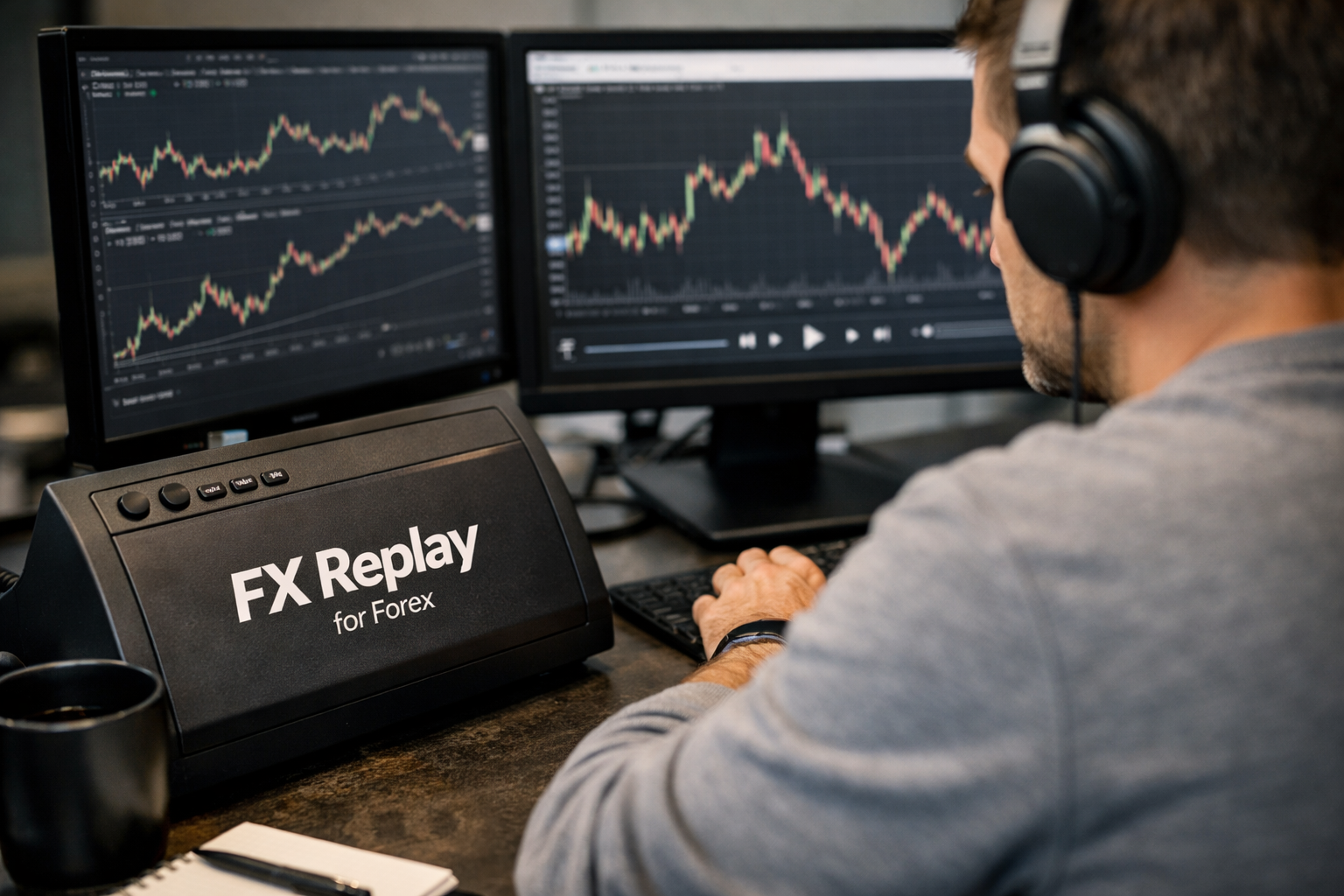
FX Replay for forex is designed for traders who want to practice decisions on historical charts instead of relying on random demo trades or hindsight-heavy screenshots. It is a browser-based platform for backtesting and trading practice, built around real historical data across more than 120 assets and six markets.
This review explains where the platform fits best, who may benefit from it, and where its limits are. If your goal is to improve price action reading, test a structured idea, or build a more consistent review process, FX Replay can provide a practical replay environment without making claims about future trading performance.
Official website · Latest pricing & offers
What FX Replay Is and Who It Is For
FX Replay in one sentence
FX Replay is a browser-based backtesting and trading practice platform that lets traders replay real historical market data, place practice trades, and review results in a structured workflow.
For traders researching fx replay for forex, the important distinction is that this is not a broker or a live execution platform. It is a practice and analysis environment intended to help you test how you would have made decisions in prior market conditions.
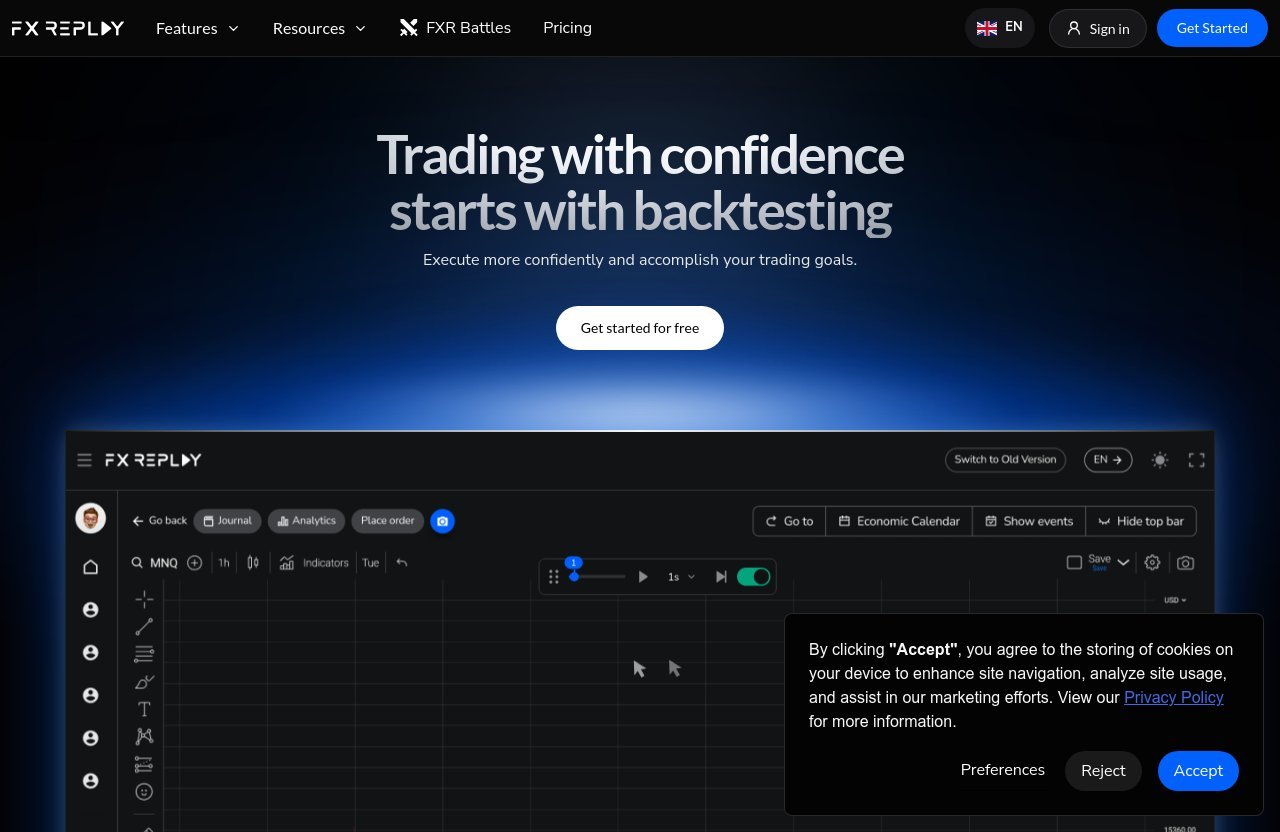
The platform includes Replay mode, TradingView-powered charting, an economic calendar, journaling, analytics, Monte Carlo simulation, and other tools that vary by plan. You can review the platform’s stated capabilities on the official FX Replay homepage.
Why forex traders use replay-based practice
Forex trading creates a practical learning problem: a London or New York session happens once per day, and a specific setup may only appear occasionally. Waiting for live markets to provide enough repetitions can make the learning process slow and inconsistent.
With fx replay for forex, traders can revisit historical periods and observe how their rules perform across different conditions. A breakout trader can replay volatile sessions. A pullback trader can study trend continuation entries. A news-aware trader can compare normal sessions with periods around scheduled economic events.
That makes historical chart replay more useful than scrolling backward through a chart with full knowledge of what happened next. Replay forces a decision before the next candles unfold.
Who benefits most: beginners, discretionary traders, and strategy testers
Beginners can benefit when they need a structured alternative to taking unplanned demo trades. A simple routine—one pair, one setup, defined risk, and a written review—can teach more than constantly switching indicators or timeframes.
Discretionary traders may find fx replay for forex especially useful because their edge often depends on context. Market structure, session timing, momentum, and reaction at key levels are difficult to evaluate with a purely automated backtest.
Strategy testers are another strong fit. If you have written rules but do not yet know whether you can execute them consistently, manual forex backtesting can reveal where your interpretation changes from one trade to the next.
Best Use Cases for FX Replay in Forex Trading
Learning price action with historical replay
Price action practice is one of the clearest uses for FX Replay. Rather than memorizing chart patterns from educational examples, you can watch a market develop candle by candle and decide whether a setup is valid before seeing the outcome.
For example, a trader learning support-and-resistance reactions could replay a selected period on a major forex pair. Before advancing price, they can mark the level, identify the active session, define an entry trigger, and write down where the idea becomes invalid.
This approach turns vague chart reading into a repeatable skill. Over time, you can compare high-quality reactions with low-quality ones and identify the context that mattered.
Testing a forex strategy before risking real capital
A forex strategy should be tested before it is trusted with real capital. That does not mean a replay result guarantees future returns; market behavior, spreads, execution, and trader behavior can differ in live conditions. It does mean you can test whether your rules are clear enough to follow.
For fx replay for forex strategy testing, start with a narrow hypothesis. For instance: trade only trend pullbacks during a defined session, require a specific confirmation candle, and use one fixed exit rule.
Record every qualifying setup—not only the attractive examples. This reduces the temptation to cherry-pick winning charts and provides a more honest sample for review.
Practicing session timing around London and New York
Timing matters in forex, particularly for intraday traders focused on London, New York, or their overlap. A setup that performs acceptably during an active session may be less reliable during quieter periods.
A replay trading tool for forex lets you examine how your approach behaves at the times you normally trade. You might study opening-range behavior, liquidity sweeps, trend continuation after a session open, or reversals following an early impulse.
The practical objective is not to discover a “perfect” session. It is to determine whether your rules depend on conditions you can define and repeat.
Reviewing entries, exits, and trade management
Many trading plans identify an entry but provide little direction once the trade is open. This is where fx replay for forex can be valuable for discretionary trade management practice.
Run the same setup type through multiple historical examples and track how you handle partial exits, break-even decisions, stop placement, and targets. If your results vary wildly, the issue may not be the setup itself; it may be that your management rules are too flexible.
The platform’s journal, screenshots, and checklists can help keep this review organized. Instead of saying “I exited too early,” you can document the reason, chart context, and whether the action followed your plan.
Stress-testing consistency during losing streaks
A strategy can look convincing after a small group of winners. The more useful question is whether you can continue applying it when several valid trades fail in sequence.
Use replay sessions to log a larger sequence of trades under the same rules. If a losing streak causes you to skip valid entries, move stops inconsistently, or take revenge trades, that is meaningful information about the workflow—not a personal failure.
FX Replay includes Monte Carlo simulation on its Intermediate and Pro plans. Used sensibly, this can help traders examine how variations in a recorded set of results may affect expectations. It is an analytical tool, not a prediction engine.
Why Replay Practice Is Better Than Guesswork for Forex Traders
Real historical data instead of random chart screenshots
Screenshots are useful for documenting a trade, but they are weak training material on their own. Most educational screenshots show the finished move, making a setup appear obvious after the fact.
With fx replay for forex, the market unfolds progressively. You must decide what to do with the information available at that moment, which more closely resembles actual trading decisions.
This difference matters for chart reading. It becomes easier to spot whether you are genuinely following a rule or simply recognizing a completed pattern.
Repeatable sessions for pattern recognition
Pattern recognition improves through repetitions, not through occasional observation. Replay allows a trader to study the same type of setup across multiple historical periods without waiting weeks for fresh opportunities.
For example, you could run a focused practice block using only one currency pair and one market session. That constraint helps reveal whether your results come from the strategy’s logic or from constantly changing variables.
Forex replay trading is most useful when the study question is specific. “Can I identify every trend pullback?” is too broad; “Can I apply my pullback checklist during the London session?” is testable.
Bar-by-bar control for disciplined decision-making
The core benefit of a historical replay workflow is control over the pace of practice. Advancing price one bar at a time encourages a decision process: observe, plan, enter or stand aside, manage, and record.
That structure is much more disciplined than jumping around charts looking for examples. It also makes it easier to identify rules that need refinement.
A good manual forex backtesting session includes skipped trades. If every chart produces an entry, your criteria are likely too loose.
The value of removing emotion from practice
Replay cannot fully reproduce the emotional pressure of real money at risk. It can, however, remove some distractions and let you focus on the quality of your decision process.
Practicing without live-market urgency can make it easier to identify impulsive habits. You can notice when you chase candles, enter before confirmation, or abandon an otherwise valid plan after a loss.
That is why FX Replay should be viewed as a skill-building layer, not a substitute for sound risk management or live execution experience.
Key FX Replay Features That Matter for Forex Use Cases
Replay mode and jump-to-date workflow
Replay mode is the central feature for traders considering fx replay for forex. It allows users to work with historical data in a way that supports practice and manual testing rather than passive chart review.
The “go to” function can support a targeted workflow. Instead of browsing randomly, choose a date range, session, or market event period that matches the setup you want to study.
Free users have limited access to the go-to feature, while Intermediate and Pro plans include unlimited usage. That distinction matters for traders who intend to run frequent, targeted studies.
Multichart and multi-market context
Forex setups often need context beyond one chart. A trader may want to compare a higher timeframe with an entry timeframe, or observe related markets alongside a currency pair.
FX Replay’s multichart capability is available with two charts on the Intermediate plan and unlimited multichart on Pro. The Free plan does not include multichart.
For many discretionary workflows, two charts may be enough: one for market structure and one for execution. Traders who routinely monitor several instruments or timeframes may find broader multichart access more relevant.
Economic calendar for event-aware testing
Economic releases can influence volatility, liquidity, and trading conditions. The economic calendar feature can therefore be helpful for economic calendar backtesting, especially if your plan includes rules about avoiding or trading around major events.
The Free plan includes one country and past news without past bubbles. Intermediate includes two countries, while Pro includes unlimited economic calendar access.
This feature should not be treated as a shortcut to predicting news outcomes. Its value is in reviewing whether your strategy behaves differently around scheduled events and whether your trading rules handle that environment clearly.
Seconds timeframe for higher precision
Some short-term traders want more granular historical analysis than standard chart intervals provide. FX Replay offers seconds data on the Pro plan.
Seconds timeframe forex analysis may be relevant for traders whose execution rules rely on very short-term movement. However, greater detail is not automatically better. If your strategy is built around higher-timeframe structure and session context, seconds data can add noise rather than clarity.
Choose the timeframe that matches the decisions you will actually make in practice.
Journaling and analytics for review
Trade journaling software is most valuable when it connects notes to actual decisions. FX Replay includes a journal across all plans, with plan-based differences in screenshots and checklists.
The Free plan includes one screenshot and one checklist. Intermediate includes two screenshots and three checklists. Pro offers unlimited screenshots and unlimited checklists.
Analytics are also plan-dependent: Free includes an analytics dashboard only, Intermediate includes a limited analytics dashboard and strategy analytics, and Pro includes unlimited analytics dashboard access plus strategy analytics. In my experience with trading reviews, the important part is not collecting more metrics; it is reviewing a small number of metrics that influence your next practice session.
Official website · Latest pricing & offers
How to Use FX Replay for a Forex Practice Routine
Set a rule-based setup to test
Before opening a session, define one setup in plain language. Include market context, entry condition, stop placement, target method, invalidation, and the session you intend to trade.
For example:
| Rule Area | Example Practice Rule |
|---|---|
| Market context | Trade only in the direction of the active intraday trend |
| Time window | Focus on a selected London or New York session window |
| Entry trigger | Enter only after a pullback and confirmation candle |
| Risk rule | Use a pre-defined invalidation level |
| Review rule | Screenshot and journal every valid entry and skip |
A narrow plan gives fx replay for forex a clear purpose. Without rules, replay can become entertainment rather than deliberate practice.
Run a session and record every trade
Start the historical chart without looking ahead. Advance price methodically, take only the trades your rules permit, and document skipped opportunities as well as executed ones.
Avoid changing the rules halfway through a session because of a loss or missed move. If you discover a problem, note it for later testing rather than revising the strategy immediately.
This is how a forex trading simulator becomes useful: it gives you a record of your process, not merely a record of wins and losses.
Review screenshots, notes, and outcomes
After the session, review your trades in groups. Ask whether your entry matched the checklist, whether your stop was logically placed, and whether you managed the position according to the original plan.
Screenshots are particularly helpful for separating a poor trade from a valid trade that simply lost. A well-executed loss may support your strategy; a profitable rule-breaking trade does not.
Refine one variable at a time
Do not change the entry rule, trade window, stop approach, and target method all at once. If you do, you will not know which adjustment influenced the outcome.
Instead, keep the core setup constant and test one change over a meaningful group of examples. You may compare one session window against another, or a fixed target against a rules-based exit.
This method makes forex strategy testing more credible and reduces curve-fitting.
Build a weekly improvement loop
A simple weekly routine can look like this:
- Choose one setup and one question to test.
- Complete several replay sessions using the same rules.
- Review journal entries and screenshots.
- Identify one recurring execution issue or one variable worth testing.
- Carry one focused improvement into the next week.
This loop is more sustainable than attempting to master every pair, timeframe, and strategy at once.
FX Replay Pricing: Which Plan Makes Sense for Forex Traders?
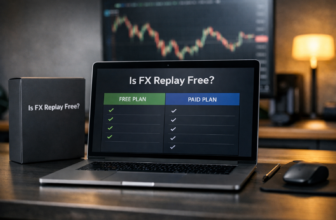
FX Replay lists Free, Intermediate, and Pro plans on its official pricing page. The company’s FAQ states that the Free plan requires no credit card, has no trial period, and does not automatically convert to a paid plan. Paid plans offer a free trial without a credit card requirement.
Free plan for casual practice
The Free plan is a reasonable starting point for someone who wants to see whether fx replay for forex fits their learning process. It includes two backtesting sessions, one indicator, a maximum session duration of one month, 50 trades per session, one week of data retention, a journal, one screenshot, and one checklist.
It does not include multichart, rewind price, seconds data, custom timeframes, strategy analytics, Monte Carlo simulation, or the RR simulator. Its economic calendar access is limited to one country and past news without past bubbles.
This plan is best for casual practice, basic price action study, and evaluating whether you will maintain a journaling habit.
Intermediate plan for regular traders
The Intermediate plan is better suited to traders who practice regularly and need more room for structured testing. It includes 10 backtesting sessions, three indicators, unlimited session duration, unlimited go-to usage, 200 trades per session, six months of data retention, and two-chart multichart.
It also includes auto break even, rewind price, an economic calendar for two countries, three strategies, strategy analytics, Monte Carlo simulation, the RR simulator, a journal, two screenshots, and three checklists.
For many active discretionary traders, this level may offer a balanced set of forex replay trading tools without requiring unlimited capacity. It will be most useful if you consistently test several setups or maintain a documented review process.
Pro plan for intensive backtesting
The Pro plan is aimed at traders who require unrestricted capacity and deeper workflow flexibility. It includes unlimited backtesting sessions, indicators, session duration, go-to use, trades per session, data retention, multichart, economic calendar access, analytics dashboard access, strategies, screenshots, and checklists.
Pro also includes auto break even, rewind price, seconds data, futures and CME data, custom timeframes, strategy analytics, Monte Carlo simulation, the RR simulator, and journaling.
Pro is most appropriate when fx replay for forex is a regular part of your trading development process, particularly if you use multiple charts, require seconds-level data, or want to manage extensive historical records. FX Replay also states that it accepts cryptocurrency payments, and taxes may apply depending on location.
FX Replay Pros and Limitations for Forex Traders
Strengths for manual practice and review
The strongest reason to use FX Replay is its structured approach to discretionary practice. Replay mode, historical data, journaling, checklist support, and analytics can help transform informal chart watching into a repeatable process.
It also supports practical workflows for traders who need to study session behavior, review execution, or conduct manual backtesting. The available plan options make it possible to start small before deciding whether more capacity is necessary.
If you decide the workflow fits your approach, you can explore the platform through this FX Replay access link. As with any affiliate recommendation, this site may earn a commission if you subscribe through that link, at no extra cost to you.
Where the platform may be overkill
Not every trader needs a dedicated replay environment. If you only review a handful of swing-trade charts each month, extensive session limits, multichart tools, or seconds data may not add much value.
It may also be unnecessary for traders who already use a separate process they follow consistently and do not need integrated journaling or strategy analytics. A platform cannot compensate for unclear trading rules or inconsistent recordkeeping.
Most importantly, replay results do not prove that a strategy will work in future live markets. Historical testing has limitations, and real trading includes execution factors and emotional pressure that practice cannot fully replicate.
Considerations before you subscribe
Before choosing a plan, consider these questions:
- How often will you realistically run replay sessions?
- Do you need multichart context for your setup?
- Are you testing a strategy, practicing execution, or both?
- Will you use screenshots, checklists, and journal notes consistently?
- Do you genuinely need seconds data or custom timeframes?
- How much historical retention do you need for ongoing review?
Also check the official site’s promo banner and the checkout coupon field for any current offer information. No specific discount code should be assumed without an offer displayed by FX Replay.
Final Verdict: Is FX Replay Worth It for Forex Trading?
Best fit scenarios
FX Replay is worth considering for traders who want deliberate, historical practice rather than unstructured chart review. It is particularly useful for price action traders, session-focused intraday traders, and anyone building a documented manual testing process.
The best use of fx replay for forex is not chasing a fast answer about profitability. It is using replay to make your strategy rules, execution habits, and trade review process more precise.
Who should skip it
You may want to skip it if you rarely practice, have no interest in journaling, or prefer a very simple chart-review process. Traders looking for automated trade execution, guaranteed signals, or a promise of trading performance should also look elsewhere.
A replay platform is a training environment. It can support better preparation, but it does not remove the need for independent judgment, risk controls, and live-market adaptation.
Bottom-line recommendation
For traders who will actually use historical chart replay consistently, FX Replay offers a practical collection of tools for backtesting, session practice, journaling, and trade review. Start with the Free plan if you want to test the workflow, then compare Intermediate and Pro based on how many sessions, charts, indicators, and records you need.
My practical view is that fx replay for forex makes the most sense when you have one clear setup to practice and a willingness to review every decision. Used that way, it can be a valuable part of a disciplined forex development routine.
Official website · Latest pricing & offers
FAQ
What is FX Replay used for in forex trading?
FX Replay is used for replay-based practice, manual forex backtesting, strategy testing, trade journaling, and reviewing historical execution decisions. Traders can replay real historical data and evaluate whether they followed their rules before seeing what price did next.
Is FX Replay good for beginners?
FX Replay can be good for beginners who want structured practice rather than random demo trading. The key is to start with a simple setup, use a checklist, record each trade, and review mistakes without changing rules constantly.
Can FX Replay help test a forex strategy?
Yes. FX Replay can support forex strategy testing through historical replay sessions, bar-by-bar decision-making, journals, screenshots, checklists, and plan-based analytics features. It can help clarify whether your rules are specific and repeatable, though historical results cannot guarantee future performance.
Does FX Replay support forex-specific practice?
Yes. The platform supports forex assets and offers Replay mode, TradingView-powered charting, multichart options, and economic calendar features that can be useful for session-based forex testing. Its tools can support price action, market-structure, and event-aware practice workflows.
Which FX Replay plan is best for active traders?
The best plan depends on your practice volume and workflow. Free suits occasional practice, while Intermediate offers more sessions, two-chart multichart, strategy analytics, rewind price, and additional journal capacity. Pro is the stronger fit for intensive users who need unlimited sessions, charts, data retention, indicators, strategies, and access to seconds data or custom timeframes.
Related Reading
- review of Mydesigns Photography for better mockup workflows
- practical review of Raycast for productivity workflows
- best data science interview prep tools for structured learning habits
References
- FX Replay | Futures, Forex & Crypto Backtesting Platform
- Pricing | Free, Intermediate & Pro Plans | FX Replay
- A Full Backtesting Workflow Using FX Replay
- FX Replay Reviews | Read Customer Service Reviews of fxreplay.com