Crayo AI vs Pictory: Full Comparison 2026
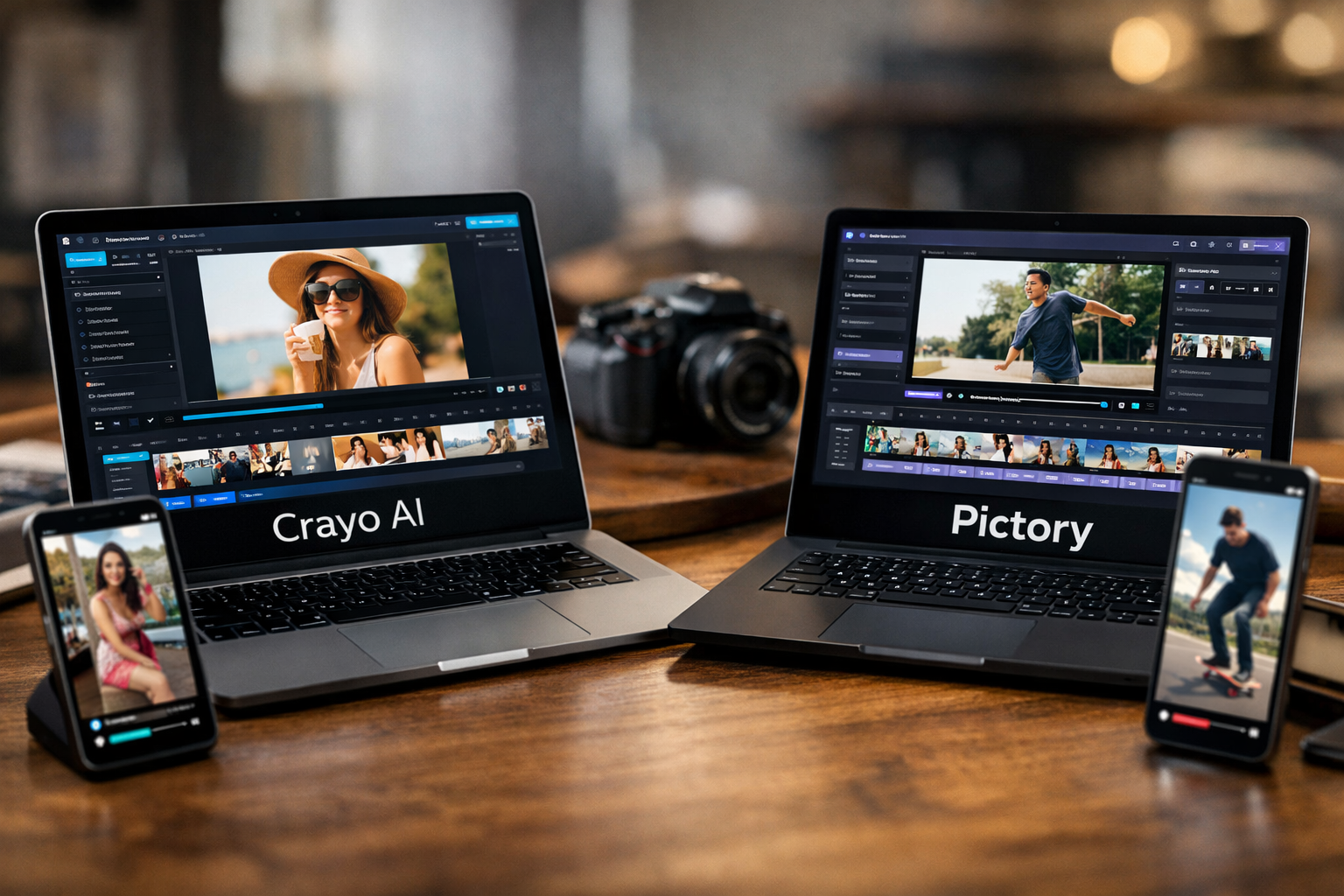
Choosing between crayo ai vs pictory comes down to the type of video you need to make. Crayo is built around turning long videos into polished, attention-ready short clips, while Pictory is generally associated with text-to-video and written-content repurposing workflows.
For creators handling podcasts, interviews, streams, talking-head videos, YouTube Shorts, TikTok, and Instagram Reels, Crayo has the more focused workflow. Its AutoClip system, browser-based multi-track editor, captions, cutaways, and audio tools make it a practical choice for creators who want to move from raw footage to finished short-form content without switching platforms.
Recommendation: For short-form video repurposing, Crayo is the stronger overall pick in this crayo ai vs pictory comparison. It is the official affiliate recommendation on TopTrustReview because its verified toolset is specifically designed for clipping, editing, and publishing-ready short videos. Readers can explore Crayo through our affiliate link if that workflow matches their needs.
Official website · Latest pricing & offers
Crayo AI vs Pictory: Quick Verdict for 2026
Best for fast faceless clipping
Crayo is the better fit for fast clipping from source videos. Its AutoClip workflow uploads a video and uses AI to identify moments, create framing, add captions, and generate titles in a single pass.
That makes it especially useful for faceless channels that repurpose podcasts, commentary, interviews, gaming streams, educational videos, and creator footage. If your content strategy depends on posting multiple short clips every week, Crayo’s purpose-built clipping workflow is more relevant than a general video-generation tool.
Best for text-to-video workflows
Pictory may be the more suitable option when your starting point is primarily written material. In the broader market, it is commonly considered for text-to-video and content-repurposing workflows, such as turning articles, scripts, or written marketing materials into video assets.
However, this distinction matters: a script-to-video workflow is not the same as an AI clipping editor workflow. If you already have long-form video recordings and need strong short clips from them, Crayo is designed more directly for that job.
Which tool is better for creators overall
In the crayo ai vs pictory decision, Crayo wins for creators whose main asset is existing video. Its combination of AI clip finding and a full browser editor means creators can refine clips without exporting into another editing application.
Pictory can still make sense for marketers whose content pipeline begins with blog posts or scripts. But for creators who need a dependable YouTube Shorts AI editor, a podcast clipping tool, or a system for producing vertical social clips at volume, Crayo has the clearer product fit.
What Each Tool Is Built to Do
Crayo AI: AI clipping editor for short-form creators
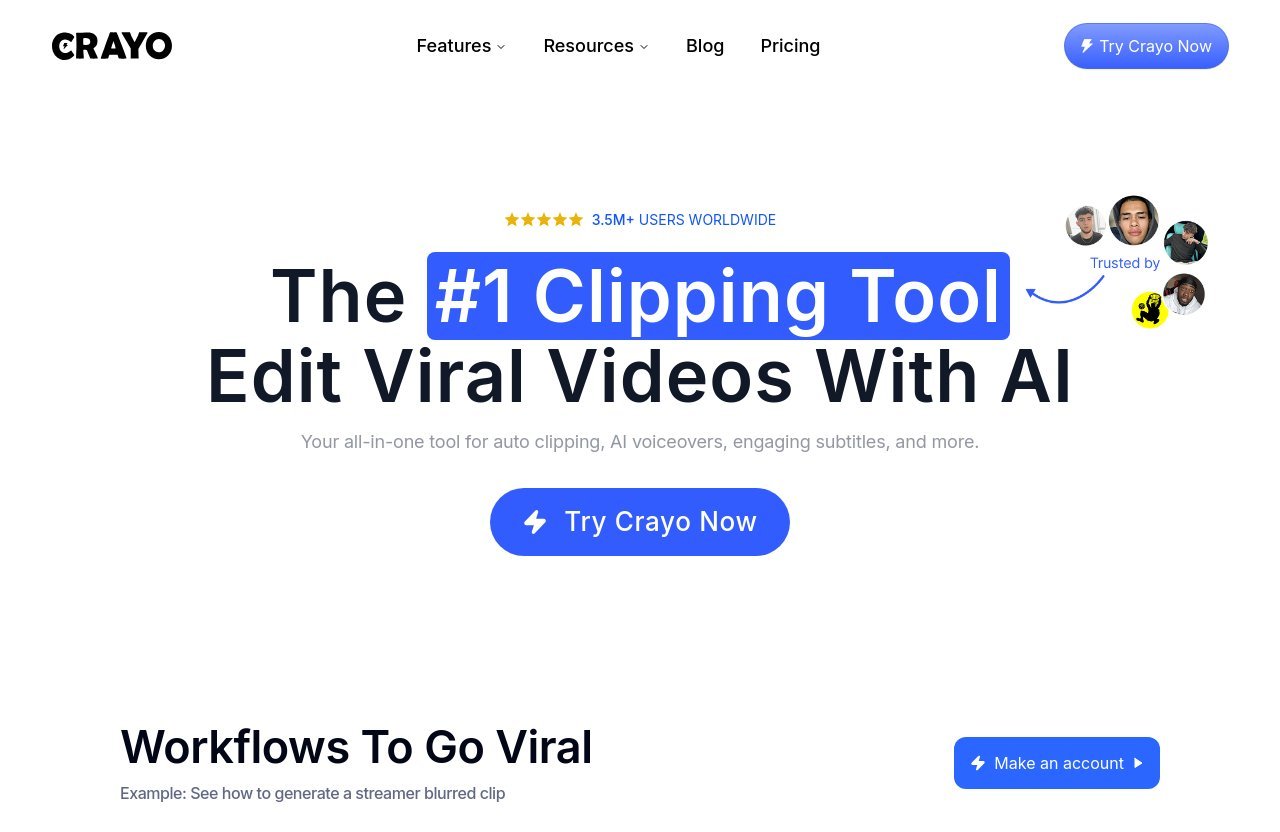
Crayo describes itself as “The #1 Clipping Tool” and is built as an AI clipping editor for viral short-form video production. Its central use case is taking longer videos and converting their most useful or engaging segments into edited clips.
The platform provides four ways to clip: AutoClip, Find Viral Moments with the Video Editor, Find Viral Moments with Edit with AI, and Clip Cutter with Edit with AI. This gives users a useful mix of automation and hands-on control.
Crayo also includes a full browser-based multi-track video editor. Rather than stopping after it identifies a potential clip, it gives creators tools to shape captions, pacing, visuals, cutaways, audio, and framing before export.
Pictory: text-to-video and repurposing platform
Pictory is generally positioned in the text-to-video and content-repurposing category. In practical terms, that means it may appeal to users who want to turn written source material into video rather than extract short-form highlights from a long recording.
This is an important distinction in any crayo vs pictory review. A marketer creating videos from article outlines has a different need from a podcaster with a 90-minute interview that needs ten vertical clips.
Because no official Pictory product or pricing page was supplied for this comparison, I am not assigning unverified Pictory specifications, pricing, export limits, or editing features. Buyers should confirm current details directly on Pictory’s official website before purchasing.
Why the core product philosophy matters
The best tool is not necessarily the one with the longest feature list. It is the tool that removes the largest bottleneck in your existing content process.
Crayo starts with footage and helps turn it into short-form content. Pictory is more relevant where the starting point is text. That core difference should guide your decision before comparing individual features.
Workflow Comparison: From Source Video to Finished Clip
Upload and input options
Crayo’s workflow starts with a source video. From there, users can choose automation-first clipping, AI-assisted moment discovery, manual clip cutting, or a combination of those approaches.
Its AutoClip feature is the fastest route for creators who want to upload one longer video and receive AI-selected moments with framing, captions, and titles. For a busy creator, this can reduce the number of repetitive production steps involved in turning one recording into multiple social assets.
Pictory’s general comparison context is different: it is typically considered when users want to transform text or repurpose written content. That can be valuable, but it is a distinct workflow from finding the strongest moments inside a video conversation.
Automation depth
Crayo’s automation is useful because it is connected to an editing environment rather than treated as the final output. AutoClip can handle the initial selection and packaging process, while Find Viral Moments provides another route for identifying usable segments.
For creators who prefer more control, Crayo also offers Clip Cutter and manual editing. Cutting clips by hand is free under Crayo’s usage model, which is valuable when you already know the exact timestamps you want to use.
In this crayo ai vs pictory comparison, Crayo has the advantage for users who want automation without surrendering editorial judgment. The AI can speed up discovery, but the creator can still review and refine the final hook, pacing, and presentation.
How much manual editing is still needed
No AI tool eliminates the need for human review. An AI-selected moment may be technically interesting but still need a stronger opening line, better subtitle placement, a cutaway, or a visual change to hold attention.
Crayo is well suited to this reality because its multi-track browser editor keeps the refinement step in the same workspace. You can use automated clipping as the first draft, then edit toward the standards of your channel.
That matters more than many first-time buyers expect. The best AI video generator for shorts is not just the fastest tool; it is the one that lets you improve a clip when automation misses the nuance.
Editing Strength: Where Crayo Is Clearly Stronger
Multi-track timeline and in-browser editing
The clearest verified advantage for Crayo is editing depth. The platform includes a full browser-based, multi-track video editor, so users are not limited to selecting a clip and exporting it immediately.
A multi-track timeline is useful for layering visuals, subtitles, background footage, music, voiceover, and other production elements. For creators building a repeatable short-form format, this can be far more efficient than moving projects between an AI clipping tool and separate editing software.
This is where Crayo is strongest in the crayo ai vs pictory debate: it combines discovery, clipping, and post-production in one browser workflow.
Captions, cutaways, effects, and audio tools
Crayo supports AI or manual subtitles, which gives creators flexibility. AI captions can speed up production, while manual subtitle adjustments matter when names, technical terms, humor, or precise timing need correction.
Its verified visual tools include LUTs, zooms, transitions, and reframe effects. Creators can also add cutaways with audio ducking, allowing a secondary visual to appear while the main audio remains clear.
The audio toolkit includes AI voiceovers and Speech Enhancer. Crayo also offers a voice changer, which can be useful for certain faceless video generator workflows, although creators should use synthetic voices responsibly and ensure their content still sounds natural.
Why this matters for creators who hate exporting to another app
Many lightweight clipping tools can identify a possible moment but leave the creator to finish the job elsewhere. That extra export-import cycle creates friction, version confusion, and more opportunities for inconsistent formatting.
Crayo reduces that friction by putting advanced editing next to the clipping process. For a solo creator, this can mean fewer tabs, fewer files, and a more repeatable production system.
Pictory may remain relevant for text-led production, but Crayo has a more clearly verified editing stack for creators whose goal is to produce polished clips from existing recordings.
Content Creator Use Cases: Which Tool Fits Which Channel?
Podcast clips and interviews
Crayo is a strong match for podcasts, interviews, webinars, streams, and recorded conversations. These formats often contain multiple standalone insights, stories, reactions, and teachable moments that can become short-form clips.
For example, a business podcaster can upload one episode, use AutoClip or Find Viral Moments to surface likely highlights, and then refine each result with captions, reframing, cutaways, and audio cleanup. This is exactly the kind of repeatable repurposing workflow an AI clipping editor should support.
For podcast creators deciding between crayo ai vs pictory, Crayo is the more direct fit because the source material is already video or recorded conversation.
Reddit-story and faceless shorts
Crayo can also support faceless short-form formats. Its AI voiceovers, AI images, caption tools, cutaways, and visual effects create useful building blocks for creators producing narrated clips without appearing on camera.
The platform also offers an Icon Generator, Face Swap, Subtitle Remover, AI Brainstorm, and voice changer. These tools broaden what a creator can produce, though they do not replace a good script, a compelling narrative structure, or rights-cleared source material.
If your aim is to create a faceless video generator workflow from a written script alone, Pictory may deserve consideration as a text-to-video-oriented option. If you are repurposing video alongside faceless formats, Crayo provides a more unified editing environment.
Instagram Reels, TikTok, and YouTube Shorts
Short-form platforms reward clarity, pace, visual movement, readable captions, and strong opening seconds. Crayo’s AutoClip, reframing tools, zooms, transitions, caption options, and cutaway support are relevant to these requirements.
For a YouTube Shorts AI editor, the ability to make adjustments after the AI finds a moment is critical. A clip may need a more direct title, shortened pauses, a better crop, or a cutaway at the exact point where viewer attention could drop.
Creators working across TikTok, Reels, and Shorts will likely get more value from Crayo when the goal is volume-based repurposing from existing videos. Its supported-language note of more than 50 spoken languages is also useful for creators serving multilingual audiences.
Marketing teams and repurposing blogs
Pictory may be a sensible option for marketing teams that begin with written assets. If the primary workflow involves adapting blog posts, sales copy, articles, or scripts into video, a text-to-video platform can align well with that process.
Crayo is the stronger option when the team’s content library is full of webinars, product demos, customer interviews, expert discussions, and video podcasts. It is a practical Pictory AI alternative for teams that need to extract more value from footage they have already produced.
Official website · Latest pricing & offers
Pricing and Plan Value
Crayo pricing plans at a glance
Crayo pricing is based on monthly-equivalent plan prices billed every three months. Every plan includes platform features such as the advanced video editor, storage, view tracker credits, and unlimited tracked accounts and posts.
| Plan | Monthly-Equivalent Price | Billing Schedule | Workflow Credits per Month | Export Minutes per Month | Storage |
|---|---|---|---|---|---|
| Hobby | $19/month | $57 every 3 months | 250 | 2 hours | 25GB |
| Clipper | $39/month | $117 every 3 months | 1,000 | 10 hours | 100GB |
| Pro | $79/month | $237 every 3 months | 3,000 | 30 hours | 500GB |
Hobby also includes 30 voiceover minutes, 100 AI images, and 100 View Tracker credits per month. Clipper includes 120 voiceover minutes, 300 AI images, and 500 View Tracker credits monthly.
Pro includes 180 voiceover minutes, 500 AI images, and 2,500 View Tracker credits per month. Crayo marks Clipper as “Most popular” and Pro as “Best value” on its pricing page.
What the plan limits actually mean
Crayo uses one workflow credit per finished video. AutoClip and AI Video Editor use one credit per clip, while Find Viral Moments uses one credit per moment found.
Manual clip cutting is free, which can help creators conserve credits when they know exactly what they need. Export minutes are monthly limits, so high-volume users should estimate their planned output rather than focusing only on the number of clips.
Unused plan credits do not roll over. Credits refill each month on monthly, quarterly, or yearly terms, while one-time top-up credits do not expire.
Pictory pricing is not listed here because no verified official Pictory pricing source was provided. For an accurate pictory review 2026 purchase decision, verify its current subscription terms directly with Pictory.
Which plan is the best value
Hobby is a logical entry point for newer creators testing a consistent clipping schedule. It has enough credits for experimentation, but the two-hour export limit means it is better for modest output.
Clipper is likely the most practical plan for active solo creators, podcast editors, and social media managers. Its 1,000 workflow credits, 10 export hours, 120 voiceover minutes, and 100GB storage create more room for regular production.
Pro is best for agencies, high-output creators, or teams with a large back catalog. The larger export allowance, storage capacity, and View Tracker credits are particularly relevant when short-form video production is a core operational channel.
Feature-by-Feature Comparison Table
Automation and clip finding
Editing and post-production
Voice, images, and workflow assets
Storage and tracking
| Category | Crayo | Pictory |
|---|---|---|
| Primary workflow | AI clipping and editing for short-form video | Generally associated with text-to-video and written-content repurposing |
| Automated clip finding | AutoClip and Find Viral Moments options | Specific automated clip-finding capabilities not verified for this comparison |
| Clip methods | Four workflows: AutoClip, Viral Moments + Video Editor, Viral Moments + Edit with AI, Clip Cutter + Edit with AI | Verify current workflow options on Pictory’s official site |
| Browser-based editor | Full multi-track video editor | Specific editor depth not verified here |
| Captions | AI captions and manual subtitles | Verify current caption features directly |
| Visual editing | LUTs, zooms, transitions, and reframe | Specific tools not verified here |
| Cutaways | Supports cutaways with audio ducking | Not verified for this comparison |
| Audio tools | AI voiceovers, Speech Enhancer, and voice changer | Verify current audio tools directly |
| Additional creator tools | Face Swap, Subtitle Remover, Icon Generator, AI Brainstorm, downloader tools | Not compared due to lack of verified source data |
| Languages | More than 50 spoken languages supported | Not verified here |
| Storage | 25GB, 100GB, or 500GB depending on plan | Not verified here |
| Tracking | View Tracker credits plus unlimited tracked accounts and posts | Not verified here |
The table reinforces the key finding of this crayo ai vs pictory review: Crayo has a clearly documented short-form clipping and editing toolkit. Pictory may fit text-led video creation, but buyers should verify its current capabilities against their own workflow before treating it as a direct replacement for Crayo.
Pros, Cons, and Limitations
Crayo pros and cons
Crayo strengths:
- Built specifically for turning longer videos into short-form clips.
- AutoClip combines moment finding, framing, captions, and titles in one pass.
- Includes four different clipping workflows for varying levels of control.
- Full browser-based multi-track editor reduces the need for another editing tool.
- Supports captions, cutaways, effects, AI voiceovers, and Speech Enhancer.
- Supports more than 50 spoken languages.
- Manual clip cutting is free.
- Includes storage, tracking tools, and additional creator utilities.
Crayo limitations:
- Workflow credits and export minutes are plan-based limits.
- Unused plan credits do not roll over.
- AutoClip, AI Video Editor, and Find Viral Moments all use credits under defined conditions.
- Crayo does not offer refunds.
- You can cancel anytime, but the plan remains active through the current billing period.
Pictory pros and cons
Pictory’s potential advantage is its general fit for users who begin with scripts, articles, and other written content. For blog repurposing or text-first marketing workflows, that starting point may be more relevant than clip extraction.
The limitation in this comparison is verification, not necessarily product quality. Because official Pictory product specifications and pricing were not supplied, I cannot fairly claim it has or lacks specific tools, limits, or editing capabilities.
What neither tool solves perfectly
Neither Crayo nor Pictory can replace content strategy. AI can speed up production, but it cannot reliably decide your audience positioning, validate a topic, or guarantee that a clip will perform.
Creators still need compelling source material, sharp hooks, fact-checking, platform-appropriate formatting, and a testing process. The best results come from using AI to remove repetitive editing work while keeping human judgment over the final message.
How to Choose the Right Tool in 2026
Choose Crayo if…
Choose Crayo if you regularly record podcasts, interviews, livestreams, webinars, tutorials, or talking-head videos and want to turn them into short clips. It is also a strong choice if you need an auto clip editor that still gives you detailed control after the AI makes its first pass.
Crayo is particularly compelling for creators who want captions, multi-track editing, audio tools, cutaways, visual effects, and clip discovery in one browser platform. It is the better choice for most creators seeking a repeatable social video repurposing system.
Choose Pictory if…
Choose Pictory if your workflow starts with writing rather than filming. If you primarily create articles, scripts, internal communications, or text-based marketing assets and want to adapt those materials into video, a text-to-video-oriented platform may be more aligned with your process.
Before committing, confirm Pictory’s current plan details, production limits, and editing tools on its official site. This is especially important if you need a specific capability such as advanced timeline editing, clip discovery, or high-volume short-form exports.
Choose neither if your workflow is different
Choose neither tool as your primary solution if you need highly technical professional post-production, complex motion graphics, feature-film editing, advanced color grading, or hands-on visual effects work. Dedicated professional editing software may be the better fit for those needs.
You may also want another solution if your only requirement is simple screen recording, live streaming, or basic one-off video trimming. The value of Crayo is highest when you consistently repurpose content into short-form clips.
Final Recommendation
Best overall for short-form creators
For creators comparing crayo ai vs pictory, Crayo is the better overall recommendation when short-form clipping is the priority. Its verified AutoClip workflow, multiple clip-finding options, browser-based multi-track editor, captions, effects, cutaways, voice tools, and storage features create a complete system for repurposing video.
It is particularly well suited to podcasters, coaches, interview hosts, agencies, faceless channel operators, and creators publishing frequently to TikTok, Reels, and YouTube Shorts.
Best for article-to-video workflows
Pictory may still be the better directional choice for text-first teams that want to turn written content into video. That does not make it a better tool overall; it makes it a better fit for a different starting point.
If your content library is mainly articles and scripts, compare Pictory’s current official features against your needs. If your library is mainly recordings, Crayo’s workflow is more directly aligned.
Bottom line for buyers
The practical answer is simple: choose Crayo when you need to find, edit, and publish short clips from longer videos without bouncing between multiple tools. Its strengths are clear for high-volume content repurposing and short-form editing.
Choose Pictory when your work begins with text and you need a text-to-video workflow. For most video-first creators, though, Crayo offers the more complete and efficient path from raw footage to finished vertical content.
Official website · Latest pricing & offers
FAQ
Is Crayo AI better than Pictory for YouTube Shorts?
For turning long videos into YouTube Shorts, Crayo is the stronger fit. It is built as an AI clipping editor with AutoClip, AI-assisted moment finding, reframing, captions, and a full browser editor for refining clips before export.
Pictory may be more relevant for text-to-video creation, but Crayo is more directly suited to pulling short-form content from podcasts, interviews, streams, and existing videos.
What is the main difference between Crayo and Pictory?
The main difference is the starting point. Crayo is centered on clipping and editing long-form video into short-form clips, while Pictory is generally associated with text-to-video and written-content repurposing workflows.
This makes Crayo more suitable for video-first creators, while Pictory may be a better fit for text-first marketers.
Does Crayo include a full video editor?
Yes. Crayo includes a full browser-based multi-track video editor. Its verified editing tools include AI and manual subtitles, LUTs, zooms, transitions, reframe tools, cutaways with audio ducking, AI voiceovers, and Speech Enhancer.
This is a major reason Crayo can work as more than a basic clip finder.
How much does Crayo cost per month?
Crayo’s Hobby plan is $19 per month, billed as $57 every three months. Clipper is $39 per month, billed as $117 every three months, and Pro is $79 per month, billed as $237 every three months.
Each plan has different workflow credit, export-minute, voiceover-minute, AI image, storage, and View Tracker credit allowances.
Can I use Crayo for podcast clipping?
Yes. Crayo is well suited to podcast clipping because AutoClip can identify moments from uploaded video, while Find Viral Moments provides another way to surface potential clips.
You can then use the browser editor to improve captions, framing, cutaways, effects, and audio before creating export-ready social clips.
Is there anything better than Pictory?
There is no universal “better” choice because it depends on the workflow. Crayo can be better than Pictory for creators who need to clip long videos into Shorts, Reels, and TikToks with AI-assisted editing.
For article-to-video production, a text-first platform may still be more appropriate. Compare the tools based on your source material, desired output, editing needs, and publishing volume.
How much does Pictory AI cost per month?
Pictory’s current monthly pricing is not verified in the sources used for this article, so it would not be responsible to quote a figure. Pricing can change, and buyers should check Pictory’s official pricing page for current plans, billing terms, and usage limits.
Is Crayo a good Pictory AI alternative?
Crayo is a good Pictory AI alternative for creators who prioritize video clipping and short-form editing rather than text-to-video production. Its AutoClip workflow, multi-track browser editor, captions, effects, audio tools, and creator utilities make it especially relevant for repurposing long recordings.
Related Reading
- best alternatives compared for 2026
- honest 2026 buyer guide
- verified savings and official deals in 2026
References
- Crayo – The AI Clipping Editor
- Crayo Pricing | Plans for every creator
- Crayo AI vs Pictory – Which AI Video Generator Is Better
- We Compared Pictory AI versus 5 Top Options