Local Falcon vs BrightLocal: Which Wins?
Choosing between Local Falcon vs BrightLocal comes down to what you need to prove, report, and improve in local search. For businesses and agencies that prioritize visual Google Maps rankings, detailed local grids, map-pack visibility, and emerging AI visibility tracking, Local Falcon is the stronger specialist choice. BrightLocal may suit teams seeking a broader local SEO platform, but its current pricing and feature specifics should be confirmed directly with BrightLocal.
Official website · Latest pricing & offers
Quick Verdict: Which Tool Wins for Your Use Case?
The short answer: Local Falcon wins for grid-first local SEO work. It is built around visual rank scanning, coverage-area analysis, recurring scans, competitor intelligence, and AI search visibility.
BrightLocal is generally positioned as a broader local SEO toolkit. That can make it worth considering when your process extends beyond rank tracking into wider local marketing operations, but buyers should verify the exact features available in their intended BrightLocal plan.
| Use Case | Better Fit | Why |
|---|---|---|
| Google Maps grid tracking | Local Falcon | Built as a multipoint local rank tracker with visual heat maps |
| Neighborhood-level map-pack analysis | Local Falcon | Variable grid sizes and scan radius .1 intervals are verified features |
| Local SEO reporting | Local Falcon | Campaign, keyword, location, competitor, and trend reports are available |
| AI visibility tracking | Local Falcon | Tracks visibility across AI search experiences and the Local Map Pack |
| Broad local SEO operations | BrightLocal | Generally positioned as a broader local SEO platform |
| Automation and data workflows | Local Falcon | Includes API, MCP Server, Looker Studio, Zapier, and n8n integrations |
Best for Grid Tracking and Map-Pack Visualization
In the Local Falcon vs BrightLocal decision, Local Falcon is the clearer fit when a local rank grid is central to your work. Its official positioning is as the original multipoint local rank tracker for monitoring the coverage-area strength of a Google Business Profile.
That matters because a single ranking position does not explain local performance. A heat map can show where a business appears prominently in the Local Map Pack, where it is slipping, and which nearby zones represent practical optimization opportunities.
Best for Broader Local SEO Operations
BrightLocal is commonly viewed as a broader local SEO toolkit. Teams evaluating it should review its official site carefully to confirm whether its current plans support the specific mix of listing, review, audit, tracking, and reporting needs they have.
The key distinction is workflow emphasis. Local Falcon is highly focused on visual local visibility intelligence, while BrightLocal may appeal to teams looking for a more generalized local SEO environment.
Best for Agencies That Need Reporting and Client Visibility
For agency reporting, Local Falcon offers verified campaign reports, competitor reports, trend reports, keyword reports, and location reports. It also supports scheduled scans, public report URLs, and CSV and PDF exports.
Those capabilities make Local Falcon vs BrightLocal a practical comparison for agencies that need to turn ranking data into a client-facing narrative. The best platform is not just the one that collects data; it is the one your account managers can explain without creating extra manual work.
When to Choose Both Tools
Using both can make sense for larger local SEO for agencies workflows. A team could use Local Falcon as its specialized google maps rank tracker and visibility reporting layer while using a broader platform for other processes.
That said, avoid paying for overlapping features simply because they exist. Start by identifying the report your client wants to see, the actions your strategist needs to take, and the data that supports both.
What Local Falcon and BrightLocal Are Designed to Do
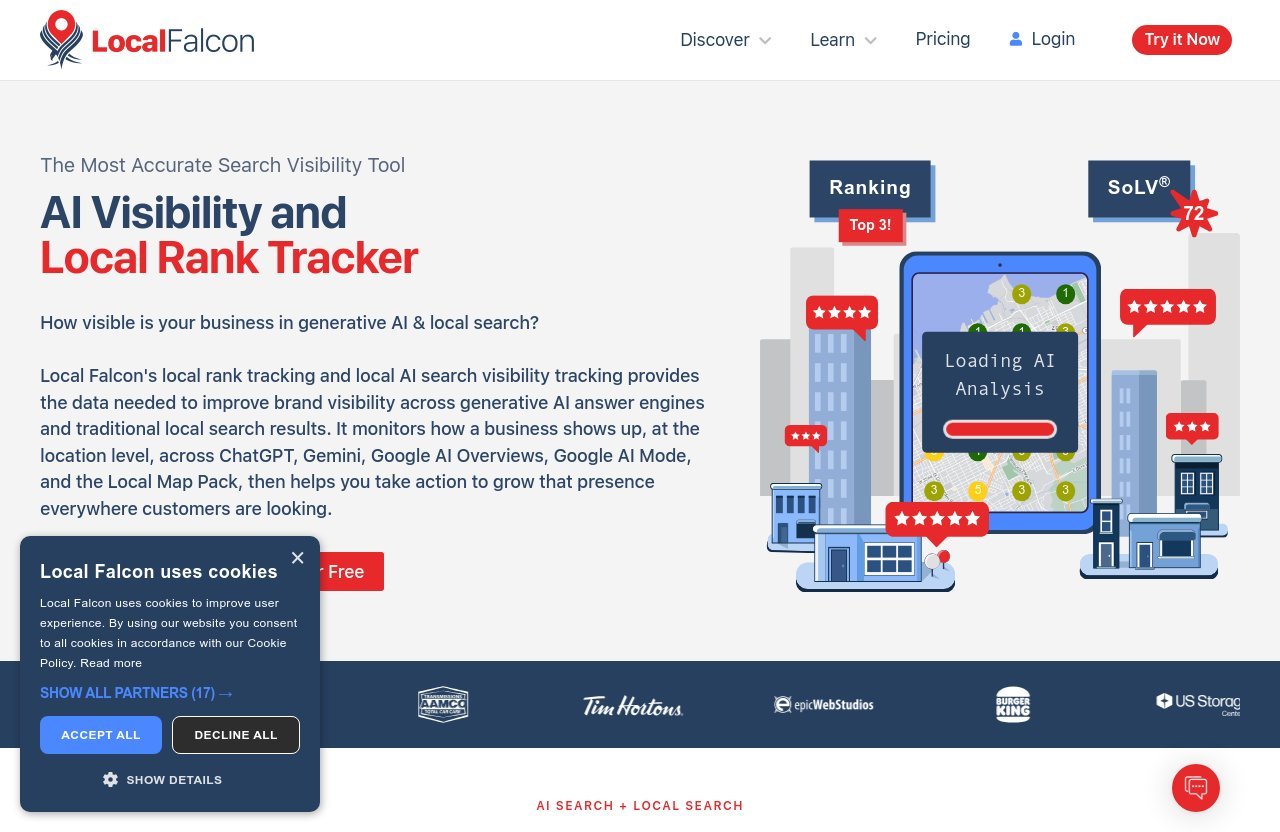
Local Falcon: Grid Scans, Rank Maps, and AI Visibility
Local Falcon is designed for AI Search Visibility and Local SEO Rank Tracking. Its official homepage describes it as the original multipoint local rank tracker, with visual local search rankings, heat maps, recurring scans, trend reporting, and competitor intelligence.
A typical Local Falcon workflow starts with a Google Business Profile and target keywords. You scan a geographic area, review the local search grid, identify patterns in map pack visibility, compare competitors, and monitor whether changes improve coverage over time.
Verified Local Falcon capabilities include:
- Local Keyword Research
- Local Rank Tracking
- AI Visibility Tracking
- Variable Grid Sizes
- Service Area Business Scans
- Scan Radius .1 Intervals
- Scheduled Scans
- Competitor Reports and Trend Reports
- Falcon AI and citation discovery
- Public Report URLs, PDF exports, and CSV exports
BrightLocal: Broader Local SEO Toolkit
BrightLocal is generally used as a wider local SEO platform. Based on its market positioning and the comparison context supplied, it is relevant for teams working across local visibility, reporting, and related local optimization workflows.
However, this article does not have BrightLocal’s official feature documentation or pricing page as a verified source. Therefore, it would not be responsible to claim that a particular BrightLocal plan includes a specific feature, report type, limit, or integration. Check BrightLocal’s current official documentation before buying.
Why These Products Are Often Compared
The brightlocal vs local falcon comparison arises because both tools serve local search professionals who need to measure business visibility. The difference is often one of depth versus breadth.
Local Falcon is especially relevant when rankings vary significantly by location. BrightLocal may be on the shortlist when a buyer wants a broader local SEO toolkit. The practical question is whether grid-based proof of local performance is your primary buying criterion.
Grid Tracking Comparison: Where Each Tool Is Strongest
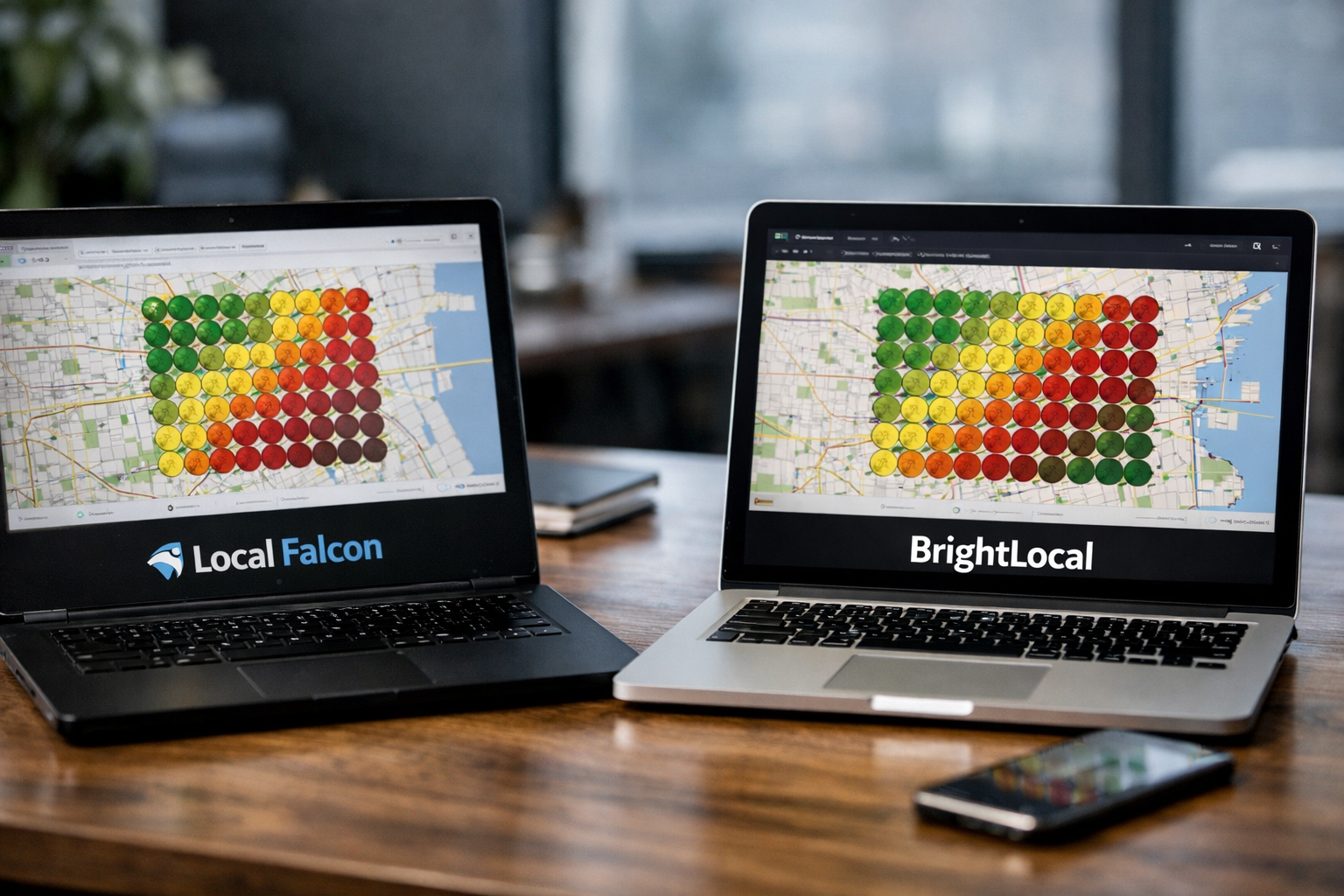
Heatmap-Style Local Rank Visualization in Local Falcon vs BrightLocal
Local Falcon’s strongest documented advantage is local grid visualization. Instead of relying on one rank check from one point, it maps rankings at multiple points around a business location, creating a more useful visual picture of local search performance.
This is important for businesses competing in dense markets. A restaurant may rank well a few blocks away but disappear in adjacent neighborhoods. A geo grid ranking tool reveals that uneven coverage in a way that a standard rank tracker cannot.
Local Falcon’s verified variable grid sizes and scan radius .1 intervals give users flexibility in how they investigate an area. A tight scan can help diagnose street-by-street visibility near a storefront, while a wider grid can help evaluate overall market coverage.
Location-Level Visibility Across Neighborhoods
A local search grid is particularly useful for multi-neighborhood businesses. Local intent is not evenly distributed, and Google Maps results can change based on where the search happens.
In a Local Falcon vs BrightLocal evaluation, ask whether the platform helps you answer these operational questions:
- Where does the business appear in the Local Map Pack?
- Which neighborhoods have weak coverage?
- Is a competitor dominating a specific area?
- Did a profile, website, citation, or review strategy improve visibility over time?
- Are rankings improving only near the business or across the intended service area?
Local Falcon is designed to make those patterns visible. Its heat maps can move the conversation beyond “we rank number three” toward “this is where we are winning and where we are not.”
Competitor Comparison and Opportunity Analysis
Local Falcon includes verified competitor intelligence and competitor reports. This is valuable because local SEO is inherently relative: a business does not need only better rankings; it needs better local visibility than nearby alternatives.
For example, a scan can reveal that a competitor is strongest in one side of town while your client is strongest near its physical location. That insight can influence content, Google Business Profile work, citation research, service pages, and review-generation priorities.
Local Falcon also includes Find Relevant Citations. Used thoughtfully, this can support opportunity analysis by helping a business investigate citation relevance rather than treating local SEO as a generic checklist.
Service-Area and Multi-Location Needs
Service-area businesses face a different challenge from storefronts. Their customers may search across a broad service region, while the business may not have a customer-facing address in every area it wants to serve.
Local Falcon provides verified Service Area Business Scans, which makes it a notable option for this scenario. Variable grid sizes and customizable scan radius intervals also help agencies adapt scans to the realities of plumbers, HVAC providers, mobile services, legal practices, and other area-based businesses.
For multi-location operations, the Local Falcon vs BrightLocal choice should center on repeatability. You need a consistent way to create campaigns, monitor priority keywords, compare locations, and share findings without manually rebuilding reports every month.
Reporting and Client Communication
Scheduled Scans and Recurring Reporting
Local SEO reporting should show change, not just snapshots. Local Falcon supports scheduled scans, letting teams gather recurring data without manually running every report on reporting day.
That consistency is essential when discussing performance with clients. A single scan can be influenced by timing, competition, or short-term fluctuations. Trend reporting provides a more credible basis for showing whether visibility is improving, declining, or simply changing by area.
Public Report URLs and Exports
Local Falcon includes public report URLs, CSV exports, and PDF exports. These are verified features that make it easier to share results with stakeholders who do not need direct platform access.
In practice, public links are useful for client reviews and sales conversations, while exports help teams bring data into presentations, dashboards, or internal analysis. This is where a specialized local rank grid can become a client-retention asset rather than a technical report no one reads.
Trend Reports vs Presentation-Friendly Reporting
Local Falcon offers verified trend reports as well as campaign, keyword, location, and competitor reports. The reporting mix is valuable because different audiences need different levels of detail.
A strategist may need keyword-level data. A client may only need to understand whether map pack visibility expanded in target areas. Good local seo reporting converts technical information into a clear recommendation: what happened, why it matters, and what should happen next.
BrightLocal is associated with reporting and client-facing local SEO workflows in the supplied comparison context. Still, confirm its current dashboard, scheduling, export, and client-access options directly before relying on them for an agency process.
How Agencies Use Reports in Sales Calls and Client Reviews
The best reports make a local SEO service tangible. During a sales call, a local search grid can demonstrate missed geographic opportunity. During a quarterly review, it can show whether that opportunity is shrinking.
For this purpose, Local Falcon’s visual format can be easier to explain than a spreadsheet of rank positions. A prospective client can quickly see where they are absent from the map results, while an existing client can see why ongoing work remains necessary.
Official website · Latest pricing & offers
Agency Value and Workflow Efficiency
Ease of Setup and Daily Usability
A useful platform should reduce analysis time, not create another reporting chore. Local Falcon’s focus on campaigns, scans, grids, and visual results makes it well suited to recurring local visibility reviews.
The right Local Falcon vs BrightLocal choice depends on what your team does every day. If analysts spend most of their time diagnosing Maps performance and explaining geographic variation, a purpose-built grid platform will usually have more immediate value.
Bulk Workflows and Client Management
For agencies, consistency matters more than flashy dashboards. Build a repeatable campaign template, agree on priority keywords, establish scan frequency, and define which report is shared during each client meeting.
Local Falcon provides campaign reports, keyword reports, location reports, and scheduled scans. Those verified tools can support a disciplined client-management system, especially when each location or service area needs its own visibility story.
White-Label or Shareable Reporting Considerations
Shareability is verified through Local Falcon’s public report URLs and export options. However, this article does not verify white-label availability for Local Falcon or BrightLocal, so agencies with strict branding requirements should confirm that requirement with each vendor before purchasing.
Do not assume “client reporting” automatically means fully branded reporting. Clarify whether you need a shareable link, downloadable file, client portal, or a fully customized agency presentation.
Integrations and Automation
Local Falcon includes a Looker Studio Connector, Zapier and n8n integration, Local Falcon API, and MCP Server. For technical teams, these features can reduce repeated manual data handling and allow local ranking data to feed into wider reporting systems.
That is a meaningful consideration for larger operations. You can explore Local Falcon’s current options if integrations, recurring scans, and visual map reporting are central to your workflow.
Local AI Visibility: The 2026 Differentiator
Why AI Search Visibility Matters Now
In 2026, local discovery is no longer limited to classic blue links and standard map results. Users may encounter business information through AI-generated answers, AI-enhanced Google experiences, and conversational search tools before they ever reach a traditional results page.
This changes how local marketers should think about visibility. Ranking in the Local Map Pack remains important, but the broader question is whether a business appears when users ask AI-driven systems for local recommendations or services.
Local Falcon’s AI Visibility Tracking
Local Falcon offers verified AI Visibility Tracking. Its homepage states that it supports AI search visibility across ChatGPT, Gemini, Google AI Overviews, Google AI Mode, and the Local Map Pack.
That makes Local Falcon vs BrightLocal more than a standard rank-tracker comparison. Buyers who want to monitor conventional local rankings and emerging AI surfaces in one workflow should give Local Falcon serious consideration.
Local Falcon also includes Falcon AI, although buyers should review the official product information to understand the exact workflow and current availability before making assumptions about outputs or usage limits.
How This Changes the Buying Decision
AI visibility tracking should not replace local rank tracking. It should complement it. A business can still need accurate Maps visibility data, geographic coverage analysis, and competitor comparisons even as AI-driven discovery grows.
For a forward-looking local SEO team, Local Falcon’s combination of map-based tracking and AI visibility monitoring is a compelling differentiator. BrightLocal buyers should verify whether and how its current offering addresses AI search visibility before treating the products as equivalent.
Pricing and Value for Money
How Local Falcon Pricing Works
Verified Local Falcon pricing-page facts include a free sign-up with +100 free credits and no credit card needed. The platform also states that users can cancel anytime, and enterprise pricing is available on request.
Local Falcon describes itself as “the most cost effective and accurate way to track the rank and local AI visibility of any business listing.” That is the company’s official positioning, not an independently tested price-performance conclusion.
The best way to assess local falcon pricing is to create a real test campaign. Use the free credits to scan your priority keywords, evaluate the report quality, and estimate how often your locations need scans.
Where Local Falcon May Be Cheaper or More Cost-Effective
A tool is cost-effective when it produces decisions and reports that justify its cost. For a grid-focused agency, Local Falcon may be more valuable than a broader suite if it eliminates the need for a separate geo-grid tool and makes client reporting easier.
Value increases when you use the verified capabilities that fit your actual workflow: scheduled scans, public report URLs, service-area scans, trend reporting, AI visibility tracking, and automated data connections. Paying for unused features is not value, regardless of the sticker price.
How to Evaluate Value Beyond the Sticker Price
Compare tools using practical questions:
- Can it show local visibility across the areas that matter?
- Can your team explain the output to clients quickly?
- Does it support recurring reporting without manual effort?
- Can you compare competitors and identify actionable gaps?
- Does it fit your approach to AI visibility tracking?
- Can it connect to your reporting stack or internal systems?
BrightLocal’s exact current pricing is not verified in the supplied information. Check BrightLocal’s official pricing page for current plans, billing terms, and included features. Also review any promotional banner on the official site and the checkout coupon field rather than relying on third-party coupon claims.
Enterprise Considerations
Local Falcon provides an enterprise pricing path, according to its official pricing page. Enterprise buyers should request details based on scan volume, locations, reporting requirements, access controls, integrations, and support needs.
For enterprise comparisons, do not make the decision based on a generic feature checklist. Run a controlled test with representative locations, service areas, and priority keywords. The winner is the platform that fits your reporting process at scale.
Pros and Cons Summary
Local Falcon Pros
- Built specifically for multipoint local rank tracking
- Visual heat maps make geographic performance easy to understand
- Verified variable grid sizes and scan radius .1 intervals
- Supports Service Area Business Scans
- Includes scheduled scans and multiple report types
- Offers public report URLs, PDF exports, and CSV exports
- Includes competitor intelligence and citation discovery
- Supports AI visibility tracking across several major AI and Google surfaces
- Provides API, MCP Server, Looker Studio, Zapier, and n8n options
- Free sign-up includes +100 free credits without a credit card
Local Falcon Cons
- Its grid-first specialization may be more than a simple local SEO user needs
- Credit-based usage means buyers should estimate scanning needs before committing
- Agencies needing specific white-label capabilities should verify those requirements directly
- Teams seeking an all-purpose local marketing suite may still want to compare broader platforms
BrightLocal Pros Based on General Market Positioning
- Generally positioned as a broader local SEO platform
- Relevant for teams assessing local visibility, reporting, and other local SEO workflows
- May appeal to buyers wanting a wider toolkit rather than a specialist grid platform
These are high-level positioning observations, not plan-level feature verification. Confirm current BrightLocal capabilities directly with the vendor.
BrightLocal Cons for Grid-First Users
- Buyers should verify its current grid depth and geographic scan flexibility
- AI visibility tracking equivalence is not established by the supplied information
- Exact report, export, integration, and plan details require official confirmation
- A broader tool can be less efficient if your main need is map-based rank visualization
Decision Guide: Who Should Buy Which Tool?
Choose Local Falcon If…
Choose Local Falcon if your core objective is to understand and improve map pack visibility across a real geographic area. It is the stronger recommendation for local businesses, consultants, and agencies that need detailed grid scans, heat maps, competitor comparisons, recurring trend data, and client-ready reports.
It is also a strong fit if AI search is now part of your local visibility strategy. The verified ability to track AI visibility alongside local rank tracking makes it particularly relevant for modern local search teams.
Choose BrightLocal If…
Choose BrightLocal if you prefer a broader local SEO platform and have confirmed that its current plans cover your precise operational requirements. This may apply to teams that want to evaluate a wider set of local SEO workflows in one environment.
Before choosing it, verify the exact plan features, costs, reporting functions, and any grid tracking requirements. The right decision should be based on your real client or location portfolio, not general platform descriptions.
Choose Both If…
Choose both only when each tool has a clear, non-overlapping job. For example, Local Falcon can be the visual tracking and AI visibility layer, while another platform supports other verified workflows your organization needs.
For most smaller teams, one primary tool is easier to implement well. Start with the platform that solves the most important reporting and optimization problem first.
Official website · Latest pricing & offers
FAQ
What Is BrightLocal Used For?
BrightLocal is generally used as a broader local SEO platform for work related to local visibility, reporting, and local marketing operations. It is commonly associated with workflows involving tracking, listings, reviews, audits, and reporting, but you should verify the current feature set and plan inclusions on BrightLocal’s official site.
Is Local Falcon Free?
Local Falcon offers a free sign-up with +100 free credits, and no credit card is needed, according to its official pricing page. It is not accurate to describe the entire platform as permanently free, since usage beyond the available free credits depends on the current pricing model.
How Much Does BrightLocal Cost?
The exact current BrightLocal price should be checked on BrightLocal’s official website. No verified BrightLocal pricing page was provided for this comparison, so it would be misleading to guess at plan names, prices, or billing terms.
What Are Some Alternatives to BrightLocal?
Alternatives include Local Falcon, Whitespark Local Ranking Grids, and other geo-grid tools referenced in local SEO comparison results. The best option depends on whether you need broader local SEO operations, a dedicated google maps rank tracker, reporting automation, or detailed local grid visualization.
Final Recommendation
The Best Choice for Most Grid-Tracking Buyers
For most buyers focused on local rank grids, Local Falcon is the stronger choice. Its verified multipoint tracking, visual heat maps, configurable scan coverage, service-area scans, competitor intelligence, and reporting features directly address the questions grid tracking is meant to answer.
The Best Choice for Agencies
For agencies, Local Falcon is especially compelling when reporting local visibility is a key part of client retention and upselling. Scheduled scans, shareable public URLs, exports, trends, and integrations provide a practical foundation for repeatable local SEO reporting.
The Best Choice for Broader Local SEO Teams
BrightLocal may still be appropriate for teams that have verified they need its broader local SEO positioning and current capabilities. But in the Local Falcon vs BrightLocal comparison, Local Falcon is the more transparent recommendation for buyers who need deep map-pack visualization, local search grid analysis, and AI visibility tracking in 2026.
Related Reading
- How Much Does a Shockbyte Server Cost?
- Smartlead vs Lemlist: Which Outbound Tool Wins in 2026?
- Best Wpforms Alternatives in 2026
References
- Local Falcon: AI Visibility and Local Rank Tracker
- Local Falcon Pricing – Local Falcon
- The Best Geo Grid Local Ranking Tools Compared
- Local Falcon vs BrightLocal in 2026: Which Tool Wins for GBP & Local SEO?